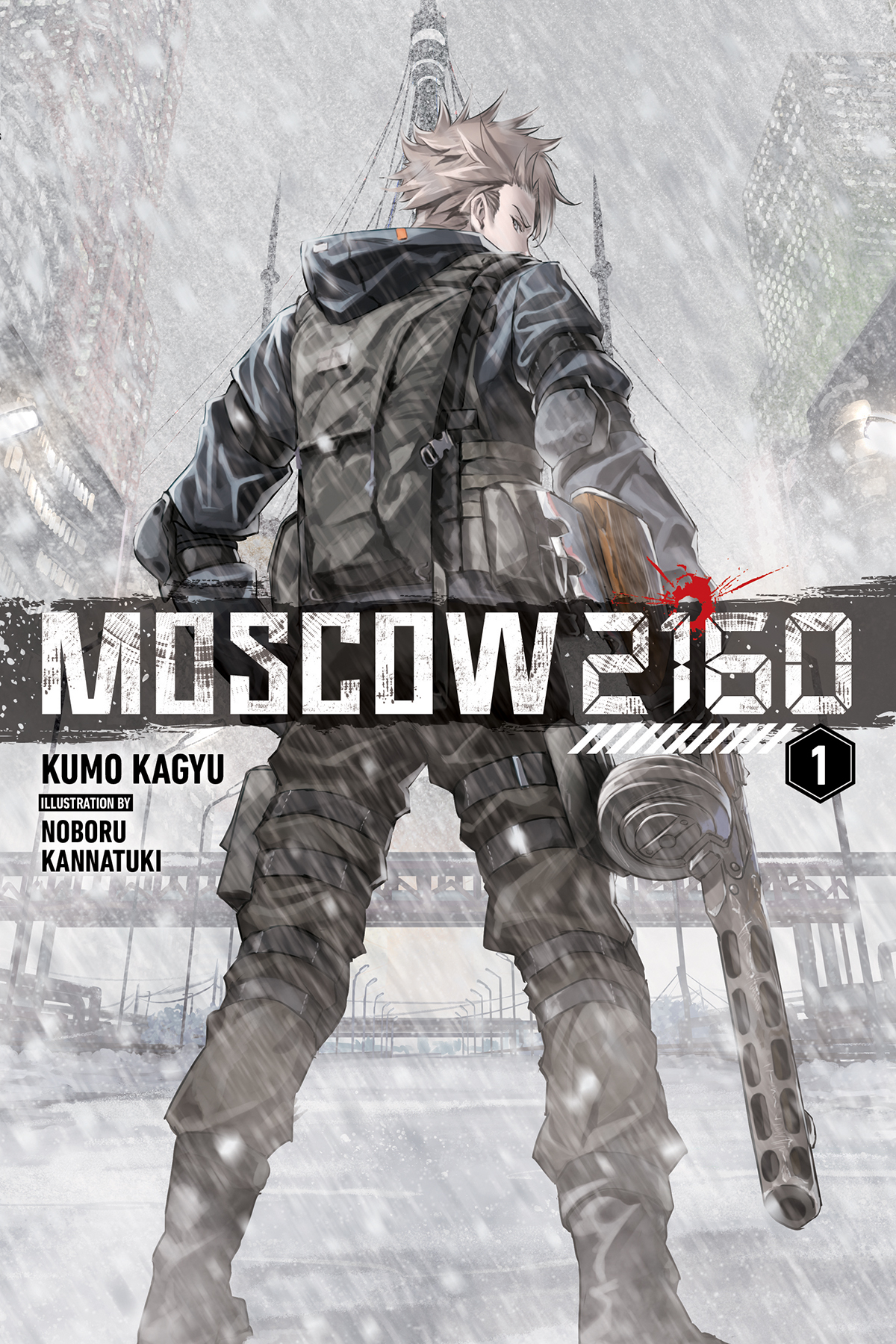
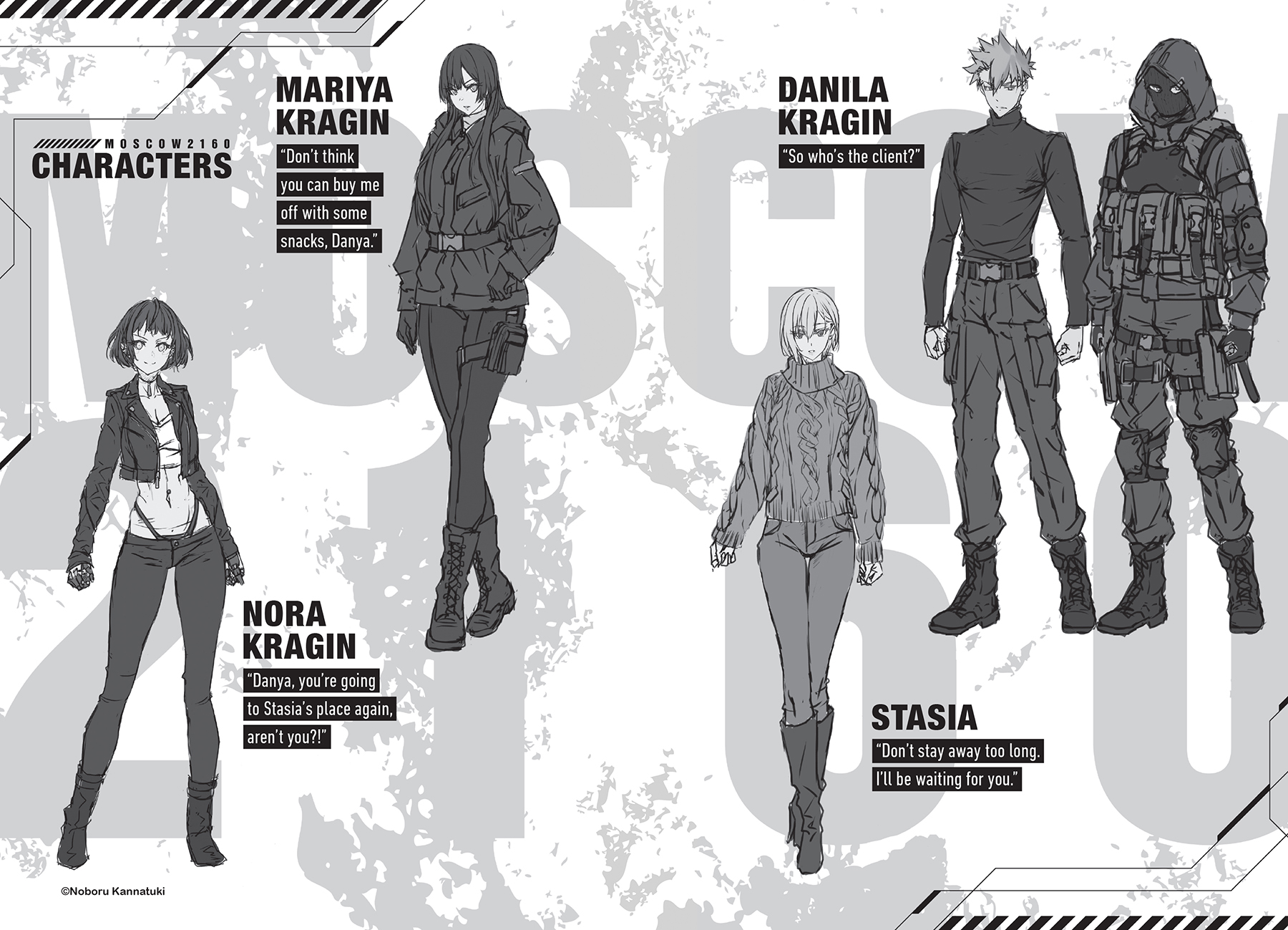
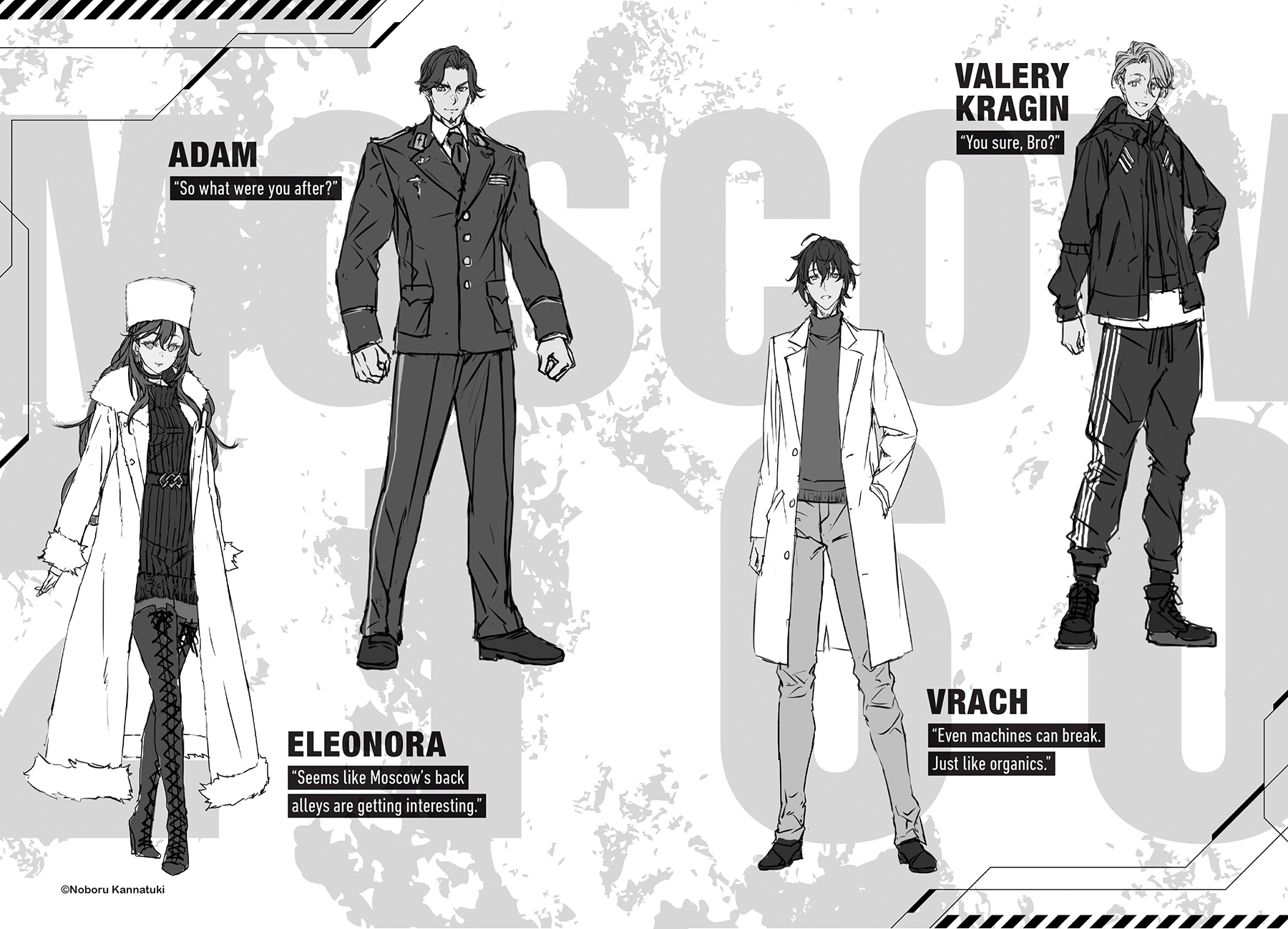
Moscow 2160

—I’m gonna die. Real soon.
In a few minutes at most, probably. Hell, not even that. In one or two. Then I’ll join the farsh<piles of flesh> on the floor.
Hardly any different from a corpse.
Number Eight’s lost a third of his fucking head, after all, and Bones is missing everything south of his shoulder blades. The rest of ’em are in about the same shape. It would be a waste of time to go into detail. I know none of them counted on going out in style, but the oil-slicked floor of a pivnaia<bar>? That’s some tomb.
Tomorrow the Mops will get them, and then konets<that’s it>! Poka-poka<Buh-bye>.
Of course, it’s the bartender who’ll have to do that. Meaning this place isn’t going to get cleaned up for a few days.
As for me, I’m just lying here, basking in the warmth of a pool of spreading blood and steaming viscera.
Shit, for a second there, I thought I was gonna retch. I still might. Corpses don’t vomit—I can tell you that.
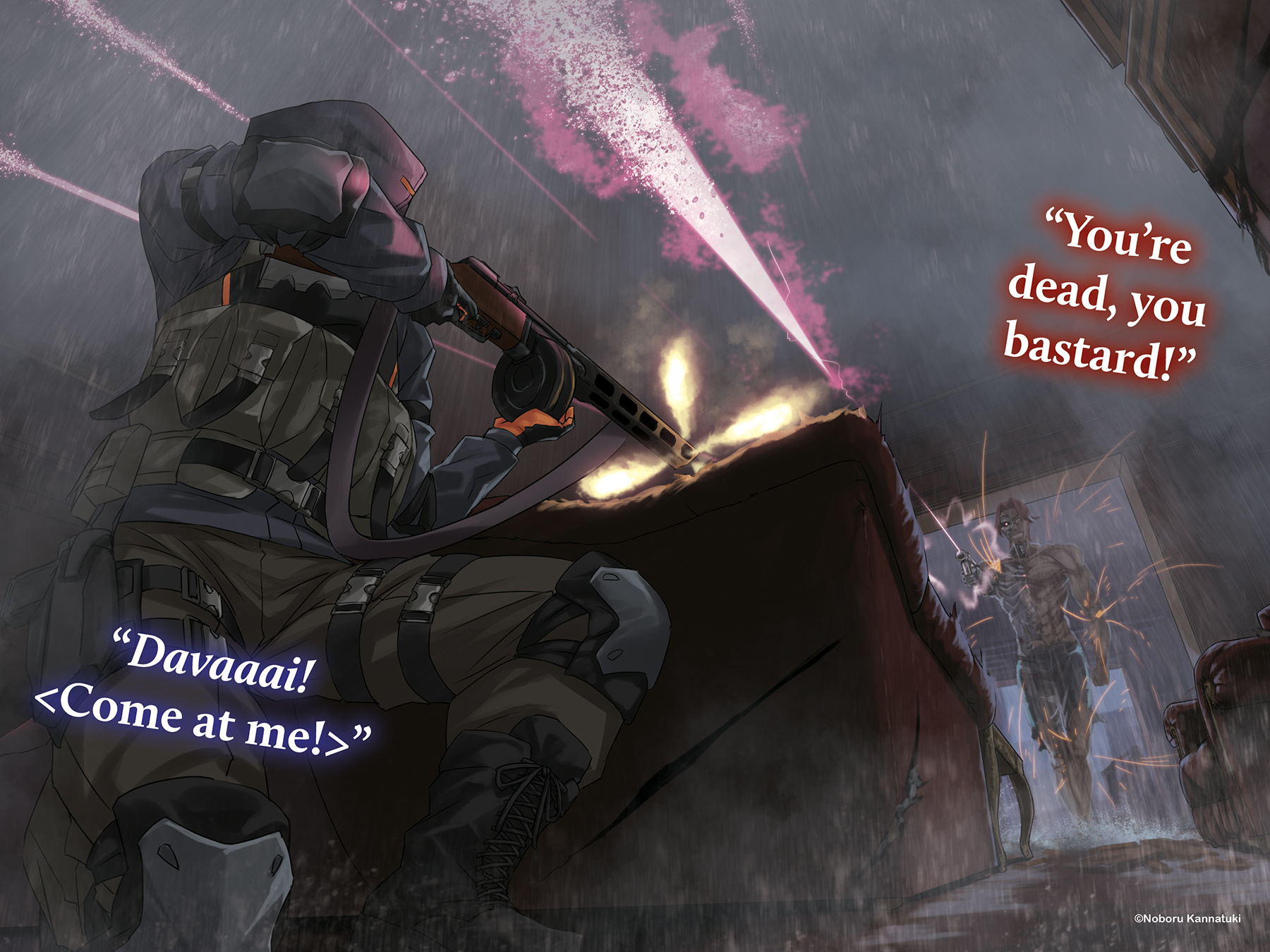
Who did this? A man who now stands on top of the mountain of bodies. Wreathed in smoke, he easily hefts an HCB—a big, heavy machine gun—in one hand. The guy has some serious muscle, unlike me. He reminds me of Captain Ilya Murometz, the bogatyr’<heroic super soldier>, but he’s no Ilya Murometz.
His flesh—well, it’s not as delicate as actual flesh, for one thing. His chrome armor plates are covered in crimson splatters of blood, the Ilyich lamp overhead bathing him in greasy white light. That thing’s supposed to be constant current, but looking at this guy, I wouldn’t be surprised if its shine on him became unsteady.
He has a body of solid metal. Strong as a train, faster than a speeding bullet, able to leap tall buildings in a single bound. He’s one of those veterans—a cyborg. Not like us miaso<meatbags>.
Pretty obvious what would happen to a person who picked a fight with a bastard like him, right? Like, say, if a miaso liquidator—a “Janitor”—tried to take on a cyborg soldier head-on. Well, let me spell it out:
I’m gonna die. Real soon.
In a minute or two at best. I guess I could do some deathbed reflection, but what would be the point, really?
I’d be better off asking myself how the hell I got into this mess. Which takes us back to…oh, about fifteen minutes ago.
“Finally decided to show up, eh, Danila Kragin?”
Those were the first words I heard when I walked in.
It was a shitty little pivnaia, desolate enough that no one would care if some Janitors kicked back there.
I ducked out of the cold and into the establishment, shaking myself like a wet dog to get the snow off.
“Everyone here?” I asked.
“Yeah. They’ve been waiting for you.”
“Huh, that so?” I nodded and looked around at the others.
It really did take all kinds. They were Exhibit A in the catalog of what a client could get for dirt cheap. That included yours truly.
I recognized a few—Number Eight, Bones, Rip, Raspy. As for the rest, I knew their faces, if not their names—or I’d at least heard rumors about them. Same way they’d heard of me, no doubt.
But I wouldn’t call them friends.
Familiar faces…yeah. Satisfied that the term had come so readily to mind, I approached the counter. I took some kopecks, small coins, out of the pocket of my body armor and casually ordered a vodka.
The television in the corner was running the novosti<news> behind its magnifying glass. Another day, another triumphant advance by our Warsaw Treaty Organization (WTO) armies over a border somewhere.
“That shit’s depressing. Change the channel. Put on some goddamn sports or something.”
“Fuck you. This diktor zhenshchina<announcer lady> is hot.”
Turned out no one cared about the news after all.
Yes, another day, another glorious victory for the WTO. The next story would probably be about the Western bloc countries. They were whining about climate problems, but it might as well have been talk about pomidory<tomatoes>. They kept preaching about green, green, green, but their hands just got red, red, red.
Only half watching the television, I sipped my stopka<shot> of vodka, then asked, “So what’s the objective?”
“Some ugolovnik<common criminal>. Igor or Dmitry or some fuckin’ name like that,” Number Eight said, not even bothering to take off his beloved PNV—personal night-vision equipment—as he looked at me. Word was he’d nicked them off some guy he’d assassinated, but I happened to have seen him liberate them from the corpse of another Janitor.
“He’s a returnee from our glorious WTO army. Wouldn’t be good for society to leave him alive.”
“Vot tak<That so>?” I said with disinterest. I didn’t have much confidence whether it would be good for society or not.
That was when somebody noticed the submachine gun hanging over my shoulder. “A PPSh?” they asked like they couldn’t quite believe it. “Think that’ll even work on metallolom<scrap metal>?”
I took another sip of my vodka. “I’m not a good shot when I have to actually aim.”
“Guess that bounty’s all mine, then.” The guy who spoke specialized in the KS-23, a comically bulky gun converted from an antiaircraft cannon. Not a bad choice as weapons go. Just not the sort of thing I preferred to use.
“It can shoot gas bombs and grenades. You’re lookin’ at a universal’noe oruzhie<weapon that can do anything>.”
“Tebe povezlo<Ain’t that nice>.”
“One thing I’ll say for a machine gun. At least you can swing it around real easy.” Bones worked at his teeth with a toothpick—guess he had nothing else to do—and nodded like he knew what the hell he was talking about. “But if you want ease of use, there’s better stuff out there—like what I’ve got.”
He patted his own submachine gun, called Groza<Storm>, which had a grenade launcher fixed under the muzzle. The launcher was built into the weapon, and the magazine behind it gave the whole thing a real twisted look.
“My brother’s with the army of the NKVD,” Bones added, leering. He was talking about the People’s Commissariat of Internal Affairs. As if anyone had asked him. “He made sure one got to me.”
“Sounds like a great guy,” I said.
“Eh, he comes in handy once in a while.”
It wasn’t much of a conversation. All of us were nervous. That’s all there was to it. Yeah, even me.
Janitors who don’t get nervous don’t last long. The ones who do get nervous are the next to go. Everyone just tries to be the last in line to punch their ticket. Yeah, even me.
“Sure, whatever,” said a guy whose name I didn’t know. He was reading a pulp magazine, looking at an announcement for the Moscow Olympics accompanied by gravure pictures of an attractive woman with a cold smile. Apparently, only the Western bloc countries had decadent art. Well, naturally, I guess. Aren’t beautiful women decadent?
She had hair so blond it was almost silver, skin as pale as porcelain—you could tell even with the crappy print quality—and eyes as cold as ice.
“Miss Moscow… There’s a hell of a woman,” the guy said.
“Yeah, a woman you have no chance with,” I answered, deciding to humor him with some conversation. “Stasia’s my lover’s name, too.”
The pivnaia went quiet for a moment. One of two things would happen next. If we didn’t hear a gunshot, there would be an explosion of laughter.
“Some old hag, I’ll bet! Every second lady you meet is named Stasia!” Number Eight said, pounding on my back with a guffaw. “What about her? This Stasia of yours get on you for child support?”
“No,” I said, shaking my head. “I’ve got a younger brother and a couple of younger sisters.”
“Hey, I don’t give a shit!”
Soglasen<That’s fair>. I couldn’t have cared less to hear about other people’s loved ones, either. So I just shrugged and decided to focus on my stopka. I drained the rest of what was in there in one gulp, and the bartender poured me another.
—Now that I’m thinking about it, what was the first alcohol I ever drank?
A kind of bug-repellent cologne or something else containing straight ethanol, I’m sure. Whatever it was, it tasted awful.
Instead of going further down memory lane, while the other guys shot the shit with one another, I glanced down at my wristwatch. It was a Sturmanskie—the same kind that had gone into space with Gagarin. Very precise hands.
“Question—where the hell is Lion?”
“In the john, ain’t he?”
“Ey, ya think diarrhea can kill a cyborg?”
—That was when the door flew open with a bang.
“Privyet <Hey> dumbasses! You’re dead!”
I heard the click of an HCB trigger, and then Rip and Raspy were turned into borscht. Those guys were no slouches on the draw, but they weren’t quick enough to get to the Tokarevs on their hips.
“Koshmar<Shit>!” Number Eight went for his precious PNV, Hawknose screamed, and bullets flew everywhere.
Times like this, the best weapon is one you don’t have to aim carefully. All you want is to hit something—although all you’ll get is to have hit something.
The doorway of the bar was filled by a huge figure, our lead sparking as it bounced off him. Ahhh, vot tak <so that’s how it is>.
One second later, the HCB brrrapped again, and Hawknose disappeared, nose and all.
Number Eight got caught in the spray, and his head, with the goggles still attached, split into three pieces that went splattering across the floor.
Bones at least got his submachine gun up; the guy with a metal body was always going to be faster than the rest of us. The moment Bones’s weapon started raining lead on our attacker, my ears started ringing and the target disappeared.
That was high-speed movement at work—faster than the speed of sound—so there was no way bullets were going to keep up. A shrieking noise pierced the air—the scream of a cyborg. His soul was as blue as the blues.
Or anyway, I think that’s how some capitalist somewhere put it once. Guy’s long dead, anyway.
I had to feel bad for Bones. He flew backward like a truck or a tank had hit him.
The whole time, his beloved comrade Igor—or whatever his name is—was diligently unloading his own HCB. The walls of the bar were riddled with bullets, glasses shattered, alcohol flew everywhere, and a whole pile of cheap Janitors were spread here and there. The bartender didn’t even get to scream, let alone run away. I felt for him.
’Course, I didn’t have time to do those things, either.
I dove for the ground and rolled, tumbling among the flesh, viscera, and blood.
—I’m gonna die. Real soon.
Hardly any different from a corpse.
Well, hey. Sometimes that’s the way it goes.
“Thought at least one of them might have some balls. Oh well,” Igor said as he looked around the bar in satisfaction. The place was totally still; nothing moved.
No life-forms, no heat signatures—but he didn’t need that. The place was bright red. Steam rose from the HCB he’d fired with abandon, from the fresh meat, and from the mechanical body of the guy who’d reacted quickly.
Igor, still wielding the HCB with his cybernetic arm, walked through unidentifiable entrails. The cartridge case bounced into the air.
Moscow was cold.
Freezing. Simply white, ash gray, and pale—even through eyes of chrome.
The battlefields Igor had once strode across were vastly different from the one where he now stood.
“‘Fuck ’em up,’ they said, so I fucked ’em up. And they thought it would be enough to pay this lot to kill us?”
Now Igor seemed to think this might be better than the battlefield. At least in Moscow, he could get paid to kill. Not so in war.
“Ha… Ha-ha!”
It was a metallic laugh. Maybe he was happy, or the laugh was self-deprecating…or he was high on drugs. Or it was all three at once.
“Sobaka<Damn>! Look at this place. What a fuckin’— Ha-ha-ha! Shit! Sobaka…!”
Whatever the reason for the laugh was, Igor strolled through the bar, his prosthetic eyes listlessly sweeping the scene.
Perhaps he couldn’t let go of the habits he’d picked up on the battlefield. If someone slacked off watching for the enemy, they were dead meat.
That was why he noticed it: an old-style submachine gun, a PPSh, the muzzle pointing right at him.
“Hey, you! What the hell do you think you’re doing?!” he roared.
“Far as I’m concerned, I’m just another corpse,” I said, and then I pulled the trigger and unloaded the clip at him. Sparks flew from Igor’s chrome head; he threw his arm in front of his face and stumbled backward.
“Sobaka!”
I wasn’t sure if the curse was directed at his situation or at me. Didn’t really matter either way, I guess.
Keeping his face covered with one hand, Igor swung his free arm, smashing the already useless counter.
“You think that’s enough to kill a man?! Davai<Come at me>! Trus<Coward>!”
Fact is, even if you smash their facial sensors, a cyborg is just as terrifying as they were before. They’re like blenders in human form. If a person got too close, they’d end up either shredded or powdered.
“Steer clear of them.” That’s what Stasia had said. And Stasia was always right.
While Igor was busy turning the lumps of flesh on the ground into gooey red paste, I rolled until I was outside of the bar. My balaclava couldn’t keep the freezing Muscovite wind from stinging my eyes. But I didn’t blink—that’s not something corpses do. And I’d been dead until a moment ago.
I glanced back, and the place didn’t look like a dive bar anymore. It might as well have been a rendering plant or a demolition site.
With all that mayhem, nobody would notice a little hiss of air.
I fiddled with a cheap metal ring I happened to have in my hand. The egg that had dropped from someone’s body—maybe Number Eight’s, maybe Bones’s—would be rolling to Igor’s feet right about then.
The egg had a name: RGD-5. Our motherland’s proudest granata<hand grenade>.
Okay, so one grenade wasn’t likely to get me much, but I was working on the assumption that those guys didn’t carry their grenades one at a time.
“That’s the name of the game,” I said to myself. “You won’t stop a cyborg without at least a few of these babies.”
Boom.
There was no sign of the militsiya<police>. Well, there wouldn’t be—some smashing and explosions were nothing unusual.
I gazed vacantly at the bar, which was in complete shambles. I could see the glint of chrome among the shredded flesh. Rovnaia liniya<Flatline>. Brain function: stopped.
When you got right down to it, there was only one quarry with a price attached, which meant only one person could claim the bounty. I hoped they wouldn’t hold it against me. I was as worthless as the rest of them. We all were.
I glanced at what remained of the bar, which was billowing smoke. God, it was cold. The wind was really howling.
I looked at the great black spire looming overhead—Ostankino Tower. Snow drifted gently down through the spiderweb of electrical cables strung from it.
The town was full of metal pipes transporting hot water that sang with the heat; it was like being in a giant’s intestines.
I shivered, turned my back on the place, took one step, two—then stopped.
“…………Tsk.”
I clicked my tongue, turned on my heel, and set off at a brisk pace. I went around the side of the ruins—or the husk or whatever you wanted to call it—of the bar, around to the back, where the walls and window were still intact.
“’Ey,” I said.
“Wha—? Shit!”
Someone flinched so hard he nearly jumped in the air—a Janitor who had crawled out of the window in the bathroom.
I’d never seen the guy before. Didn’t know his name. But I did know his nickname.
“You’re Lion, right? You in one piece?”
“Y-yeah…,” Lion said weakly. “I’m okay.”
He looked as thin and haggard as a stray cat, but his strangely large eyes gleamed in a way I didn’t like.
A nickname like his wasn’t necessarily a compliment.
I let the PPSh—empty—loll toward him and decided to ask a few questions.
“How much was it?” I asked.
“What?”
“The price on us.”
Lion didn’t tell me. Instead, he howled, “Pomogi, zhe<Please spare me>! I’ve got a family! I don’t wanna die!”
“Konechno<Of course>. I’m sure you do,” I said. No way to deny it. I waved the gun at him and said, “Idti<Get out of here>.”
“Yeah…! Spasibo<Thank you>! Spasibo!”
He repeated his gratitude a few more times—overcome with emotion, I guess—and then he ran like hell. No clue where he was going.
I took two or three steps back. Lion turned. He had a Tokarev in his hand.
His eyes were as wide as saucers. Understandable. I had my own pistol out. I grinned at him.
“I told you. I’ve got a younger brother, a couple of little sisters, and a girlfriend at home.”
No, wait—maybe I hadn’t told him.
In which case, I’d done him wrong.
Man, it felt so out of place it made my head spin, but I wouldn’t survive if I let that sort of thing get to me.
The youngest of the massive “Seven Sisters” was a thirty-four-story skyscraper that stood by the Moscow River. Standing in front of it would be enough to humble anyone, but I didn’t think about my own insignificance. I walked into the building under a ceiling that I could only describe as very pretty and obviously a result of grueling effort, and then got in an elevator.
“…Tsk.”
When I put my hand in my pocket, I realized my body armor had a hole in it. I didn’t know whether to blame Igor What’s-his-name or Lion—but neither was going to be paying me back.
Well, at least I hadn’t dropped my coins. I put a few in the coin slot in the elevator and smacked the button for my floor. The elevator started climbing, saving me the trouble of climbing all the stairs myself. Grateful as I was for that, I hated the wait.
I mean, I also hated how long it took to exit the elevator and go down the hallway.
Even as I stopped in front of a door and pressed the doorbell, I was like an anxious kid.
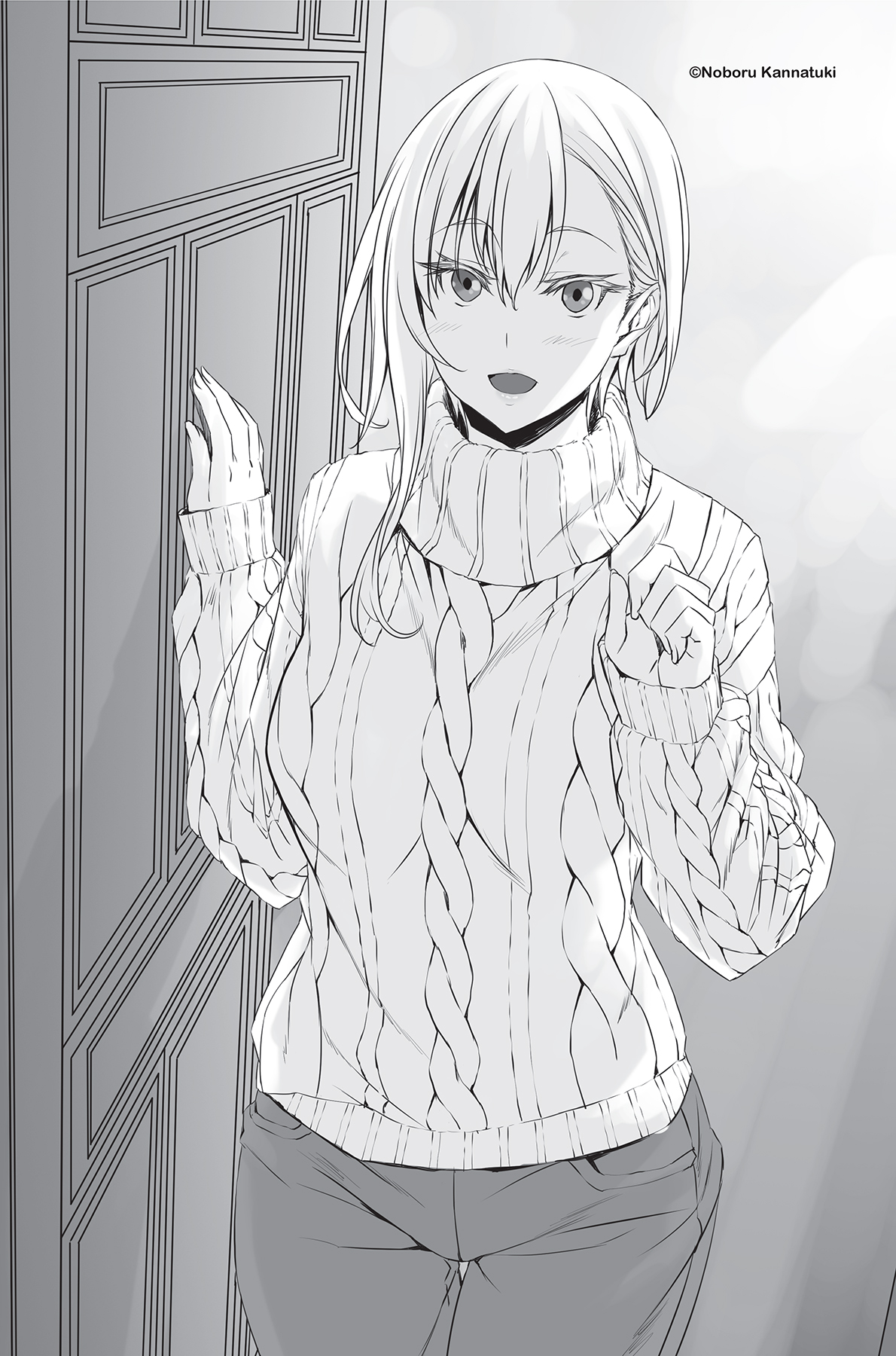
I heard the lock turn. Then the door opened. There was a gust of warm air and a sweet smell.
She had hair so blond it was almost silver. Skin as pale as fine porcelain. Eyes as cold as ice—which melted when she saw me.
“Oh, Danya! You’re finally here, milyi moi<my dear>!”
When I saw her face light up, like the sun when the clouds parted, I felt my shoulders relax a bit. Call the words sweet nothings or put-ons, I didn’t care.
“Mozhno tebia obniat’<Can I give you a hug>?” I asked.
“Konechno.” Stasia giggled, and she was the one who took me in her arms.
She pulled me through the doorway, her face close to mine. Her cheeks flushed a faint rose-pink.
Who else but me would know? Know how Miss Moscow would stretch up just a little on her tiptoes to give me a kiss.
“Mn…”
Our lips touched. Her breath mingled with mine. Our tongues intertwined. Soft, real flesh. The pleasant weight of her body against mine.
Vodka couldn’t hold a candle to this. My freezing body was filled with Stasia’s warmth.
—I’m gonna die. Real soon.
The thought seemed to dog me all the time. I mean, it was probably true.
But so what if it was?
That’s something to think about later.
The Space Race ended in victory for our great motherland. The Zond VIII planted a red flag in the dust of the moon while the US was busy screwing around with its Star Wars program.
Then there were endless international conflicts. Crowds of wounded and mutilated soldiers. Cyborg technology was intended for use in the Space Race, but it was applied to military prosthetics.
So there it was: After two generations, the Cold War between the Eastern and Western blocs showed no sign of thawing.
Gray snow dotted the sky, which was the color of diluted, flickering neon lights. This filthy armpit part of town was infested with mechanized returnee soldiers and scuttling workers trying to avoid the veterans’ eyes.
I worked for a division that kept watch on the thousands of cyber nets that stretched out around the tower. Anyone careless enough to get close went straight to forced detention.
The KGB and GRU were lurking in the background, busy fighting to the death against spies and mafias from the Western bloc. And bribes kept the militsiya off everyone’s back.
The news flashing across the CRT TV showed another glorious victory for our Warsaw Treaty Organization. Rumor had it that the Western bloc nations were harrowed by witch hunts that they claimed were looking for the Reds.
Humanity managed to cling to life here on Earth, while we stared one another down with nuclear weapons.
Freedom, truth, a future, prosperity—all of those had vanished a long time ago.
I’m Danila Kragin, a Janitor. I’m a man any of the powers that be could plausibly disown, and once again today, I’m in the streets of Moscow, doing my part to beautify our city…
Playback

—Who’d ever fall in love with a girl like her?
I remember thinking that as if it was yesterday.
I was standing under a heavy, lead-colored sky, ashen snow drifting down from the clouds.
I was walking streets that were lined with huge metal pipes that looked like a giant’s intestines, which sang with the hot water running through them. It was like being at the bottom of a valley.
She sat at the approach to the kvartira<communal residences>, the numbers on the heels of her shoes on display.
She was maybe fifteen years old—about my age, I guessed.
Of course, I wasn’t one hundred percent certain of my own age.
Just glancing at her, I figured she was older and a bit more mature than the older one of my little sisters, but definitely not older than me.
Her short, unkempt hair was a pale blond, but the snow piling on top of her head soaked it through. What a waste. That same snow had turned her white skin and rose-colored lips a pale purplish color, and she was shivering in the freezing cold.
She was wearing a white one-piece; the shoulders hung loosely, and she had to use a safety pin to hold them up, yet the sleeves were too short. Once in a while—whether from embarrassment or the cold, I didn’t know—she would tug at a sleeve in a vain effort to pull it down. Her arms were as thin as twigs, but the weird thing was that they still looked luxurious and soft.
To be fair, I was no prize pig myself. I was haggard, gaunt, and starving. I hadn’t eaten in days at that point. Not since I’d used the last of our flour to make some pelmeni dumplings, and my little brother and sisters had gobbled them up. There hadn’t been so much as a bite left for me. Instead, I’d guzzled a bunch of water and tried to convince myself it had filled my belly. Then I’d spent all day today running.
The PPSh that dangled from my shoulders was very heavy. The bandolier bit into my skin even through my jacket.
It wasn’t much of a jacket, anyway—it was awfully tight, and the Tokarev pistol I kept near my chest was always whacking my ribs painfully.
Despite all that, she kept staring at me. Frost had collected on her long eyelashes; she blinked rapidly, and I couldn’t help feeling bad when I saw how red her eyes were.
For a moment, I thought maybe she was a rabbit in the snow—not that I’d ever seen a rabbit.
“M-maybe you’d l-like to, um, w-warm yourself before you go?” she asked.
I was cold, I was hungry, and I had only a few kopecks in my pocket.
That’s why I said what I said, how I said it. I made my voice as hard as I could.
“Tsk,” I snapped. “I ain’t got any money.”
“Oh, um, well…”
It didn’t stop the girl from smiling at me.
“The guy was a svin’ia<pig>,” I said, my mouth dry. “I wasn’t scared at all.”
The first time that I, Danila Kragin, ever killed a person, I was ten years old.
The other guy was a veteran back from the wars, and a cyborg to boot. He even had a damn Kalashnikov.
As for me, I just had my Tokarev—which I’d found in the trash.
I had understood one thing, though: If I didn’t do him in, I would die.
He’d shown up in the manhole that we had commandeered for our living space.
Moscow has an extensive underground. The junk dealer talked my ear off about it once—he said it started with some king who had underground tunnels made seven hundred years ago.
Seven hundred years might as well be a million. The number didn’t mean anything to me.
After that, people built other stuff down there—sewage canals, transport canals, subways, air-raid shelters. Everything underground.
Then there were the folks who’d found life up top less than pleasant. They all packed into the Moscow underground.
All that mattered to me was that the underground was dry, there was no snow, and the wind didn’t blow there.
Even better—although there were plenty of little ratholes, the one we’d crawled into had one very important feature: Some of the hot-water heating pipes went directly through it. Of course, there had been some people who died living in the underground, but at least it wasn’t from freezing to death.
We didn’t have a house, but this was someplace we could call our home.
—And then he showed up.
His name… I don’t remember his name. For that matter, I don’t remember telling him my name. He probably didn’t tell us his, either.
He was a heavy guy, and his daily activities consisted of four things: drinking vodka, shouting, hitting us, and sleeping. His favorite thing to say was “You brats are only alive because I fought for you!”
—Khren znaiu<Like I gave a shit>.
It was all I could do to put food on the table by handing over the stuff I pulled out of the trash to the guy who bought people’s junk. With this clown swiping my haul, I couldn’t even do that. Not to mention that after a while, I figured out that he was planning to make bratniye shestorki<mafia runners> of us.
There was no way in hell I was going to risk my life doing mob work just so this asshole could have more drugs to get high on. So when I found a Tokarev in one of my dumpster dives—and when I noticed it was still loaded—I steeled myself.
If he figured out what I was up to, I would be finished. But I wasn’t smart enough to come up with an actual strategy.
That’s why we played along with him that day, like we always did.
I went from trash heap to trash heap, rifling through them until my fingers were red, searching for anything remotely useful.
Our glorious motherland had won a war someplace—or maybe lost, I didn’t know—and the military had tossed out a whole bunch of mechanical stuff.
In that respect, at least, what the asshole said was almost true. The only problem was that me and mine had been thrown out along with the rest of the trash. We’d learned in our very bones that not being wrong didn’t make you right—and the reverse was true, too.
When I had a whole cardboard box full of metal bits I’d collected, I sold it to the junk dealer. He eyeballed the junk and gave us a few kopecks for our trouble.
Yeah, I knew he was lowballing us. But he wasn’t rolling in cash himself, and it was plenty for us to get by on. I wasn’t upset.
I tossed the kopecks into a can that I half hid under my shirt, then crawled back into our hole.
Inside was a sofa we’d dragged in and set next to the heated pipes, and the pig treated it like his throne. He would sit with his oil-streaked arms spread wide, his Kalashnikov and a bottle of vodka for company.
I would humbly offer him the can—he wouldn’t even glance at it, but would take a swig of his alcohol and say, “All right, kids. Clothes off.”
We knew it was coming, of course. We knew that if we tried to object, insist we’d given him everything we’d made, he’d just bellow, “You’re hidin’ some, I know it!” and beat us.
If he was going to beat us anyway, better to take one hit and get it over with.
When it was the girls’ turn to undress, he took his time, patient and slow. And sometimes when he was done, he’d get a grin on that filth-covered face of his and say, “Can’t wait till you grow up.”
So as always, I brought him the money, held it out, took my whack, and went sprawling head over heels onto the floor.
Getting hit with a hunk of metal made mind sort of go blank for a second. Then I’d sway like my whole body was going every which way, and the next thing I knew, the floor and the ceiling had traded places.
He snorted as he watched me crawl on the floor, then grabbed his bottle and brought it to his lips.
I was sure he somehow believed we would go on living even if he never fed us anything.
There was no need to correct that misconception. Today was the end. I couldn’t put up with one more minute of this.
I stole a glance at him, then hunched over and crawled back outside the manhole.
Snow was falling. Snow was always falling. The wind gusted, it was cold, and soon it would be night.
“This ends today,” I said with chattering teeth to two girls, who stood—fully dressed—outside the hole. Both of them had black hair—they looked so similar they could have been twins, but they couldn’t have been more different. One bit her lip but tried to look ready; she just watched me silently. She had long hair. The other child was sobbing, but when I offered her some candy from my pocket, her face lit up. She had short hair.
If we didn’t want that guy leering at us while we changed, we had to go outside the manhole to do it. She cried because it was cold, and froze because she cried. There was frost on her face, and her skin was red even though she hardly seemed to have any circulation.
I couldn’t stand to look at the state she was in—that’s why I gave her the candy.
—I really wanted to save that until the very end.
I’d seen it in some comics in a pulp magazine I’d fished out of the trash. I didn’t know what the story was—that would require knowing how to read—but it didn’t matter. Anyone would know that the hero was the bogatyr’ Captain Ilya Murometz.
He was probably having yet another battle with some villain, maybe a Western bloc spy. Just before sneaking into the enemy base and shooting the place up, he’d set aside a cigarette, which he would smoke after winning.
I’d planned to do sort of the same thing—suck on that candy after today’s business was all over. My special treat.
But she was crying, and if that asshole caught on to me, it would all be down the drain. There was really nothing else I could do.
“Sorry,” I told the long-haired girl as she stared at me. “That’s my last one. If this works out, I’ll buy you one tomorrow.”
“…Mn.” She nodded.
If it works out. If it works out, I might be able to save one ruble. Might be able to buy a chunk of white bread. There might be change—enough for two or even three pieces of candy. If it works out.
“If it doesn’t, though… Then you have to run. As fast as you can.” I directed this toward the other child there, a boy with snot dribbling from his nose. He sniffled in answer; I wasn’t sure if he understood what I meant.
I let out a breath.
They were all about five years old—definitely younger than me in any case.
Me and these three: We were all the kids left in this hole.
There had been others. Kids older than me, stronger than me. But they ran away.
I guess they were afraid of that asshole hitting them. When a cyborg whacks someone, they really feel it.
I showed them the gun I found, but they just said stuff like “That’s dangerous!” or “What if you mess it up?” and squeaked timidly.
Sometime after that, they vanished—well, they didn’t rat me out, so I wasn’t angry about it. I was the oldest of the remaining children, though, so it was decided that I’d be the one to do it.
I went over to a towering pile of trash beside the manhole and pulled out a cardboard box. Inside was a bundle of the Pravda newspaper. I unwrapped it, and a hunk of metal dropped into my hand.
The Tokarev.
I worked the breech, imitating Captain Murometz, and chambered a round.
The gun was black and pretty heavy. It felt like it might just tumble out of my hand. I didn’t even know if I could shoot it. But it was all I had. So it was the best gun in the world.
—They want to know what happens if I mess it up?
“…I’ve just gotta do whatever I can,” I muttered, then slid back into the darkness from which I’d just come.
The guy was a svin’ia. I wasn’t scared at all. Or so I kept telling myself.
—Do real pigs act like him? Just eating and sleeping and snorting?
I sure didn’t know. But it seemed like that was the way to describe him.
I decided not to think about what that made me, the one being pushed around by the pig.
—Whether this works…or not…it ends today.
Thinking that made my steps a little bit lighter as I worked my way through the sewer.
The underground tunnels, which were like a marriage of brick and concrete, were somehow wide and cramped at the same time. It was too dark to really know. I couldn’t even see my breath fogging in front of my face.
The pipe where that bastard was, though, had a light in it. I’d been there and back plenty of times; I wouldn’t get lost.
I made my way along carefully, so that my too-big, ill-fitting shoes wouldn’t make any noise as I approached.
The Tokarev was hefty; my hand felt stiff, like my fingers had ballooned to twice their normal size.
I peered slowly into our space.
There he was. Just like always. Sinking into the sofa that had exposed springs, gazing into the blank air—he might’ve been awake or asleep; who knew?
The Kalashnikov was in his metal hand. In the other was his bottle of vodka. Like I said, same as always. He was kicking back, reclining among the junk furniture we had struggled to acquire.
I took a step closer.
I heard him mumble something to himself.
I took another step.
His head lolled heavily to the side.
Another step.
He still wasn’t looking my way.
Somehow, I managed to raise my arm. I didn’t have the courage to get any closer—but I also didn’t have the courage to back away.
Captain Murometz fired his gun casually, with one hand, but I didn’t think I could manage that. The Tokarev was just so heavy, and my throat was so dry—I hardly felt like I could aim in a straight line.
Nonetheless, I somehow forced myself to raise the gun and stretch my arms out in front of me. They were shaking, but I still tried to aim carefully, fixing my target…
“Oh, huh? It’s you…”
I fired.
There was a high-pitched crash, I flew backward, and the bottle of vodka shattered into a million pieces.
“Oh, you’re dead, you little shit!”
I couldn’t say it had gone well.
Almost immediately, I was tumbling backward through the pile of trash from the guy’s meals.
“Urgh… Ah?!”
I felt a burning pain on my left cheek—it had been sliced open by the broken glass bottle flung with all the strength a cyborg could muster. I didn’t have time to be thankful that I still had my eyeball, though.
It was practically a miracle that I hadn’t dropped my Tokarev. Keeping a tight grip on my gun, I scuttled back into the tunnel.
There was a metallic groaning sound and a gust of wind as something flew over my head. The guy had taken a swing at me again, with all his strength.
I heard the crash of something else breaking, but I didn’t have time to care. I just made sure I held on to my weapon as I got to my feet and tried to point it at my attacker.
“You son of a bitch!” he howled, and I found the muzzle of the Kalashnikov locked on me. The king’s scepter, pointing at me with almost mechanical precision.
“Aahhhh!” My finger pulled the trigger basically on instinct. There was another boom. My arms jerked up, and my eyes burned from the flash. I reset and fired again. Then again. I kept firing.
Only a pain like my thumb was going to come clean off alerted me that the trigger had stopped moving.
“Wh-when…?”
I let the Tokarev clatter from my throbbing hand. I looked down and saw a massive tear at the base of my thumb, blood pouring out of it. When the Tokarev’s breech moved backward, the weird way I was holding the weapon had resulted in it savaging my hand.
“………” I applied pressure to the wound while staring vacantly in the guy’s direction. He was lying back on the sofa, a hole under his right eye. There was red stuff on the walls and on the floor behind him, like beet juice, spreading in a pool. His metal hands clicked eerily as he spasmed, endlessly gripping and opening.
“Is he dead…?”
It looked that way.
If I’m being honest, I couldn’t really process what had happened or why. I collected the Tokarev with my left hand—I wouldn’t be doing any more shooting—and kept a tight grip on it, though it was pointless.
Approaching slowly, careful to avoid the quivering Kalashnikov, I gave the guy a good once-over. He was gazing into the air, just like he had been moments before this all started, but now his tongue dangled limply from a corner of his mouth.
He was dead. There was no question about it. One of the bullets from the Tokarev—I had no idea which shot it had been—had spattered his brains everywhere.
Even after I realized that, I didn’t understand why I was still alive.
I brushed my cheek and clenched my right hand to try to numb the aching pain. Then I slowly turned in the direction he’d been looking in.
“The pipe…,” I murmured.
The hot-water pipe. It was lying sidelong where I’d been standing just moments before.
Of course. How else could a cyborg veteran have failed to kill a ten-year-old?
Just as he’d been taking aim, he’d noticed the pipe—our lifeline—and thanks to his hesitation, I’d gotten in the first shot.
It was because of this asshole that I’d had to do this, and it was because of him that I’d survived it.
—And he was dead.
Me… Apparently, I was so at a loss for what to do that I just stood dazed in front of the guy.
I say “apparently” because I don’t remember doing that, not even for a minute. But that’s what the girls told me I was doing when they and the boy discovered the terrifying scene.
I only snapped back to my senses when the girl with the long black hair tugged on my sleeve. She was biting her lip, and I saw tears beading in the corners of her eyes.
The girl with short black hair was crying helplessly, and the boy was starting to sniffle, too.
So I… Well, I thought I should try to do something appropriate for the moment.
“Tsk…,” I clicked my tongue, and then wrenched the Kalashnikov from the guy’s hands. I could sell it to the junk dealer—it would get us bread for tomorrow, with enough rubles left over to buy some candy.
The asshole was dead, but I was alive and so were the kids, and so we needed food.
That was no different from before.
I’d learned a few things, some important lessons, from that day.
One was that even a cyborg could die—which meant meatbags could die even easier.
And the other was to never point a gun at something I didn’t want to shoot.
After that, everything tumbled along steadily.
We felt like mice partying while the cat was away—for exactly one day.
In less than a week after I killed the guy, bratniye patsaniy<mafia thugs> started lurking around. And I wasn’t stupid enough to imagine I could fight them and survive. At the same time, if I went to a bunch of ugolovniki to take care of us, it would just be the same thing all over again.
Two bad choices. Which meant there was only one thing to do. I reset the Tokarev’s breech, somehow, and stuck the gun in my trousers, then went to have a chat with the patsan.
“That asshole? He went off somewhere,” I said. “So I’m gonna look after this rathole now.”
It wasn’t really a lie. The fact was, I didn’t know what had happened to the guy’s body—but his arms and his Kalashnikov were with the junk dealer, who’d been more than happy to buy them. Plus, thankfully, it looked like the bratniye lived better than that veteran. Or maybe they didn’t have the free time to bother chasing some brats out of a manhole.
Whichever it was, a young mob soldier said, “Yeah?” Then he snorted. “You ever want a job, give me a shout. I’ll find you something.”
Me, I figured I ought to go ahead and just accept what amounted to a show of decency.
The mafia was constantly involved in feuds and fights; they were after someone or another twenty-four seven. They would ask me if I hadn’t seen a person fitting such and such description, and I would search high and low for them, trying to bag the reward.
At first, when I found the target, I would go straight back to report it and happily collect a few rubles. When the junk dealer heard about that, though, he grinned and said, “Dumbass.” That ticked me off, but he added, “Think about it. You found the prey, but you go tell some other hunting dog where it is, wagging your tail the whole time? Stupid.”
When he put it that way, he was right. Instead of a hunting dog’s lackey, it would be better to be a hunting dog—and better a hunter than a dog. It certainly seemed to offer better odds of survival than attacking a cyborg in his personal hideout.
The second time I killed someone, I was nervous, but at least I managed not to do anything as stupid as cutting my hand on the breech.
By about the fourth time, I’d started to pay attention to my aim, so I could economize on bullets. When I got somewhere past ten people, I finally discovered this was what they called being a liquidator—a Janitor.
I would do anything; clean up anything; tomorrow’s working-class hero.
I bought food with the money I earned, then gave it to my little brother and sisters. Among us remaining children, I was the oldest and the only one who knew his last name. I didn’t want to hoard all the good eats to myself, lording it over the place—then I would be just like him.
So they all called me Big Brother, and I gave them the name Kragin.
Mariya Kragin, Nora Kragin, Valery Kragin…just like that.
“Danya? Big Brother?”
Then, before I knew it, I was fifteen, and Mariya, with her long black hair, was shaking me awake.
We’d long ago traded the sofa that I’d splattered with red for something better from the junk heap. It had seemed like the most comfortable thing in the world, but once I got used to it, I realized it was nothing special, and the springs stuck into my back. Thanks to those springs, I couldn’t remember the last time I’d gotten decent sleep.
“…Hmm?” I grunted. My eyes fluttered open, and I sat up, my bones creaking unpleasantly.
“Nora and Valery said they’re hungry,” Mariya said. It was just like her to avoid mentioning that she was hungry, too, but her face—the one that asshole had been “looking forward to”—was hollow and sunken.
“We’ve got bread, don’t we?” I asked.
“We ate it all yesterday…”
I glowered, looking around the living area. Mariya flinched and shrank back. Nora and Valery were crouched in one corner, looking despondent. Doe eyes gazed back at me. Man, I could get sick of those eyes…
“Tsk,” I grunted. “Just hold on a minute.”
Without even glancing at my ten-year-old sister, I went to the kitchen, grumbling loudly all the way. The kitchen is what we called one of the earthen pipes where we had somehow managed to assemble a collection of stuff resembling cooking utensils. I popped a couple of bricks loose and took some frozen pelmeni from our improvised icebox. They were basically just round lumps of flour with nothing in them, but if the shape was right, then it was a dumpling.
I tossed some snow into a stewpot and lit a fire under it to melt the stuff and boil the water, then I dropped in the pelmeni to cook. The Nichrome heating element stayed dark. I glared at it, urging it to hurry up and turn red. While the stewpot heated, I took swigs of water to quiet my growling stomach.
Once the dumplings were ready, I flung them onto a plate and slapped some smetana<sour cream> on them. I didn’t know how many months we had had that stuff. Love it or hate it, one thing you could say for smetana—it never went bad.
“There. Well? Eat!” I said.
“Hooray! Thanks, Danya!” Nora, the one with short black hair, jumped at me like a kitten, her face aglow. As always, her mood could turn on a dime.
I pushed her away and put the plate on the table before I sat down on the sofa.
“Thank you, Big Brother,” Valery said. “I was starving!” He sounded apologetic, but it didn’t stop him from grabbing a spoon and stuffing pelmeni into his mouth.
Mariya was the last to take a seat at the table. She hesitantly brought one of the dumplings to her mouth, but then she stopped and looked at me.
“Um, Danya, don’t you—?”
“I don’t need any. You guys eat up.” I waved my hand dismissively, and after another moment of hesitation, she wolfed down the food.
From then on it was silent, except for the sounds of the kids chowing down so single-mindedly that I was afraid they might eat their plates, too.
I had more important things on my mind, like how I needed to earn some money so I could buy more flour and bread.
—But how?
That was the question.
It might seem obvious to say, but a Janitor couldn’t do his job if there was nothing to clean up. The bratniye went at it pretty relentlessly, but even they stopped for a breath occasionally. Right now, they were ignoring the sort of two-bit thugs that a fifteen-year-old brat with a Tokarev could hope to shoot. And the junk dealer had gotten drunk a while ago, fallen asleep by the roadside, and died. Another stroke of bad luck for me.
It was only after I lost him that I realized how important a trustworthy business partner was. I was just a kid, unable to get a read on the changing times, and this was where it had left me.
I sank back onto the sofa and looked at what occupied the space where the Kalashnikov had once been.
—I’m starting to think maybe it was a mistake to buy this thing.
But a PPSh was a necessity—at least, it had been when I bought it. At the time, I’d been convinced that I was going to have to start thinking about fighting cyborgs.
If I didn’t have this thing, I could probably have kept putting food on the table without doing that. But now that I had it, I had to take on those mechanized soldiers.
Right or wrong, you had to make a purchase when it was available, or you might never have another chance.
—Hell, I might not even have another chance right now.
“Hey, Valery,” I called. His shoulders jerked up as he flinched, but he looked up at me. “You done with your job?”
“Yeah, Bro, I am.” He licked the wound on his thumb that he’d incurred from a spring. “The bullets are all loaded up. Na<Here>!” Valery held up a flat, round hunk of metal for me to see.
I had no idea why it was called a baraban<drum magazine>. No matter how I looked at it, it was obviously more of a konserva<can> or even a discom<disc>.
“Good.” I stood up, went to the junk-covered table, and took the magazine from Valery. It was packed with no fewer than seventy bullets, the same kind that fed my Tokarev. A veritable fortune.
The PPSh had one real drawback, which was that if I slipped up when I was loading it, the spring could easily jump back and hit my finger.
I pulled on my jacket, hitched the magazine to the PPSh, and let it dangle from my shoulder. Then I tucked my Tokarev—a much better one than the gun I’d fished out of the trash that fateful day—into my jacket.
Last, I grabbed my business balaclava and stuffed it in my pocket.
Neither Mariya nor Valery said anything. They just watched me get ready to leave. I didn’t say anything, either.
I clicked my tongue for the umpteenth time and turned toward the exit.
“See you later, Danya! Ni pukha, ni pera<Hope you don’t catch any birds or beasts>! Break a leg!”
Nora’s voice, irritatingly chipper whether she knew it or not, echoed through the sewer behind me.
If one prayed for failure, the evil spirits wouldn’t be drawn to them. That was why I couldn’t reply the way I would have liked.
Instead, I said, “Aw, k cheortu<go to hell>.”
And my mouth and my tongue seemed to move awfully fast.
—Back then, I hardly knew the difference between the Committee for State Security (KGB) and the Main Intelligence Directorate (GRU). I mean, not like it’s much clearer to me now, but at least I know that the KGB is the secret police, and GRU is military intelligence. They do sort of the same thing, though, so they’re always fighting over the same meals. And unfortunately for me, the guy I spotted was GRU—former spetsnaz<special forces>, at that.
Not that I knew any of that at the time. As far as I knew, he was just another cyborg. Another ugolovnik.
Meaning the sort of guy I had killed before.
Dumbass.
Even if he hadn’t been special forces, he wasn’t some drugged-up lush or bratnoi vyshibala<enforcer>.
Maybe I should’ve stopped and asked myself: If everyone knew what he looked like and where he was, why the fuck hadn’t anyone touched him yet?
Back then, though, that only made him more attractive to me. Well, specifically, the price made him attractive.
I was careful, as much as I knew how to be. Did my hunter thing and crept slowly up to his little nest.
Ivan—or, well, maybe it was Igor. Or Alexei? Boris? Something like that—had this girl he was sweet on. I heard he would go to her place for two solid days, no break.
I stared at the window of Ivan’s kvartira from my hiding spot in the shadows cast by a dumpster and contemplated.
If I was going to nail him, it would have to be either when he left or when he came back.
—When he leaves. That’s the plan.
It would be better to do it when he was all excited, in a hurry to meet his girl.
I felt a little bad for Ivan, raining on his parade like that, but when my stomach angrily lent its grumble to the discussion, that decided it.
To be on the safe side, I scrambled around the back alley like a kid looking for somewhere even remotely warm to sleep. When I was happy with the place I’d found, I took out my balaclava and pulled it down over my head, all the way to my chin.
It was only then that I realized how hard the strap of the PPSh was biting into my shoulder, how bad it hurt.
I tossed the gun in the trash can and was greeted by the smell of what seemed to be frozen pirozhki.
Then I folded my arms, leaned my shivering body against the wall—and waited.
I idly glanced upward, and towering over the rooftops, over the whole north end of Moscow, I could see it: Ostankino Tower.
From anywhere in Moscow, I didn’t have to look hard for it. It was somewhere on the list of tallest buildings in the world. It was easy to spot because a web of electrical wires stretched from it like intestines, connecting terminals all over the city.
And watching us.
Probably watching me at that very moment.
I stuck my hands inside my sleeves and crossed my arms. I felt like my teeth were going to start chattering. My stomach growled again.
I didn’t have anything as fancy as a watch, so I didn’t know how long I ought to wait or how long I’d been waiting.
Someone had been begging for one—Nora or Mariya, I couldn’t remember who. Probably Nora. She was always the loudest of the kids. Valery always knew the right thing to say. And Mariya…she would just silently stare at me.
“We’re hungry,” and “I want this.” Or, “We don’t have enough of that,” and “Danya,” and “Big Brother,” or “Bro.” It pissed me off.
“Whose fault do they think—?”
I clenched my teeth. Why did they think I was standing here doing this shit? God, it was cold. God, I was hungry.
I’d never even met Ivan, but I was just itching to kill him.
So when I spotted him in the foyer—a face I’d seen only in a grainy telephotograph—I moved fast.
“Privyet, metallolom<Hey, scrap-metal scumbag>!” I shouted.
Ivan, though, was as fast as lightning. He—I think this is what he did; I only figured it out later, after seeing someone else do something similar—thrust his hand into his shirt collar and pulled out a knife that he kept there.
He was already in motion by the time the word “Hey” was out of my mouth, and I was only then lifting my Tokarev.
To me, it might as well have been magic, the way the knife appeared in his hand. I thought it was some weird switchblade. Which, well, was close to the truth.
I heard a shhnk, and then the knife came flying at me.
I dodged it like it was nothing—because I’d already started rolling, thinking that Ivan was pulling a gun on me. If I’d fired the Tokarev instead, flush with the excitement of having gotten the drop on him, I’d probably be dead now. There were no heating pipes to help me out like when I fought that other Ivan—or Igor or whatever—long ago. That’s why I dodged and was able to save myself.
Instead, the knife buried itself in the concrete behind me, creating a crack, and debris showered down from above me. The trash can toppled over with a clatter, and Ivan locked onto me with his cybernetic eyes.
“Katis, patsan <Get lost, brat>!”
I didn’t want to do it, but he left me no choice: I pulled the trigger of my Tokarev. There was a crack as a bullet buried itself in the wall of the kvartira, and then Ivan was gone.
I heard a screech—the sound of his overdrive, probably.
I dove behind the trash can, although I knew it was pointless. I shoved my hand into the refuse and groped in the soft, rotting trash until I felt something hard.
I grabbed hold of it. Ivan landed in front of me and stood up. I squeezed the trigger.
The bullets went clean through the flimsy tin with an earsplitting noise.
I sprayed the PPSh’s bullets without a thought for whether I would need them later, or how much money I was wasting. I just let them fill the narrow alleyway.
I’d never experienced the flash or the sound of the shock before; it shook my brain and my body so badly I hardly knew what was going on.
I only took a breath when the PPSh clicked uselessly, because I’d blown through seventy bullets.
The place was filled with snow and drifting smoke and the stench of black gunpowder. There were chips gouged out of the kvartira wall, and some cracks in the windows. There was no shouting from the other residents—this sort of thing likely happened every day around here.
I got unsteadily to my feet and squinted, trying to see through the smoke.
Finally, I made out farsh that looked exactly like a shredded piroshki. It was hardly a metaphor: That was just the result of machine mixed with flesh and blood.
It still looked more or less human, though, and I could tell it was Ivan.
—This is why I wanted that PPSh.
I took the gun, now covered in unidentifiable filth, and wiped it with the sleeve of my jacket. I put the strap around my shoulder and let the gun hang—I knew perfectly well it was out of bullets—and brought up my Tokarev instead.
I put a round into the lump of Ivan flesh. There was no reaction.
“Vot tak?” I said.
Of course, he didn’t answer.
I hoped he wouldn’t think I’d been too quick to kill him. If I hadn’t been, I’d have been the dead one.
I finally noticed the state of my jacket and my balaclava; I was soaked. It was hard to breathe. I wanted to fall to my knees and vomit. Not because I’d just killed someone—that was par for the course. But because I’d thought I was going to die. Even though that was par for the course, too.
I crept closer to where Ivan lay on the ground. Yeah. He was definitely dead.
I didn’t know how many of my seventy rounds had hit him or which of them had been the fatal blows.
Maybe he hadn’t thought a kid would have a PPSh—or maybe his cyber body had gotten short on maintenance with him living on the streets. Or maybe he really had been just that excited to see his girl. Could’ve been all of them.
By then I already knew: Even cyborgs could die.
I was more worried about how many rubles I’d have left after I subtracted the cost of seventy bullets.
Then I was thinking about how many of those rubles would be used for my little brother and sisters.
From there I started wondering, How long are we going to go through this cycle?
I peeled off my balaclava and rubbed my cheeks and eyes furiously with my arm. I blinked a few times.
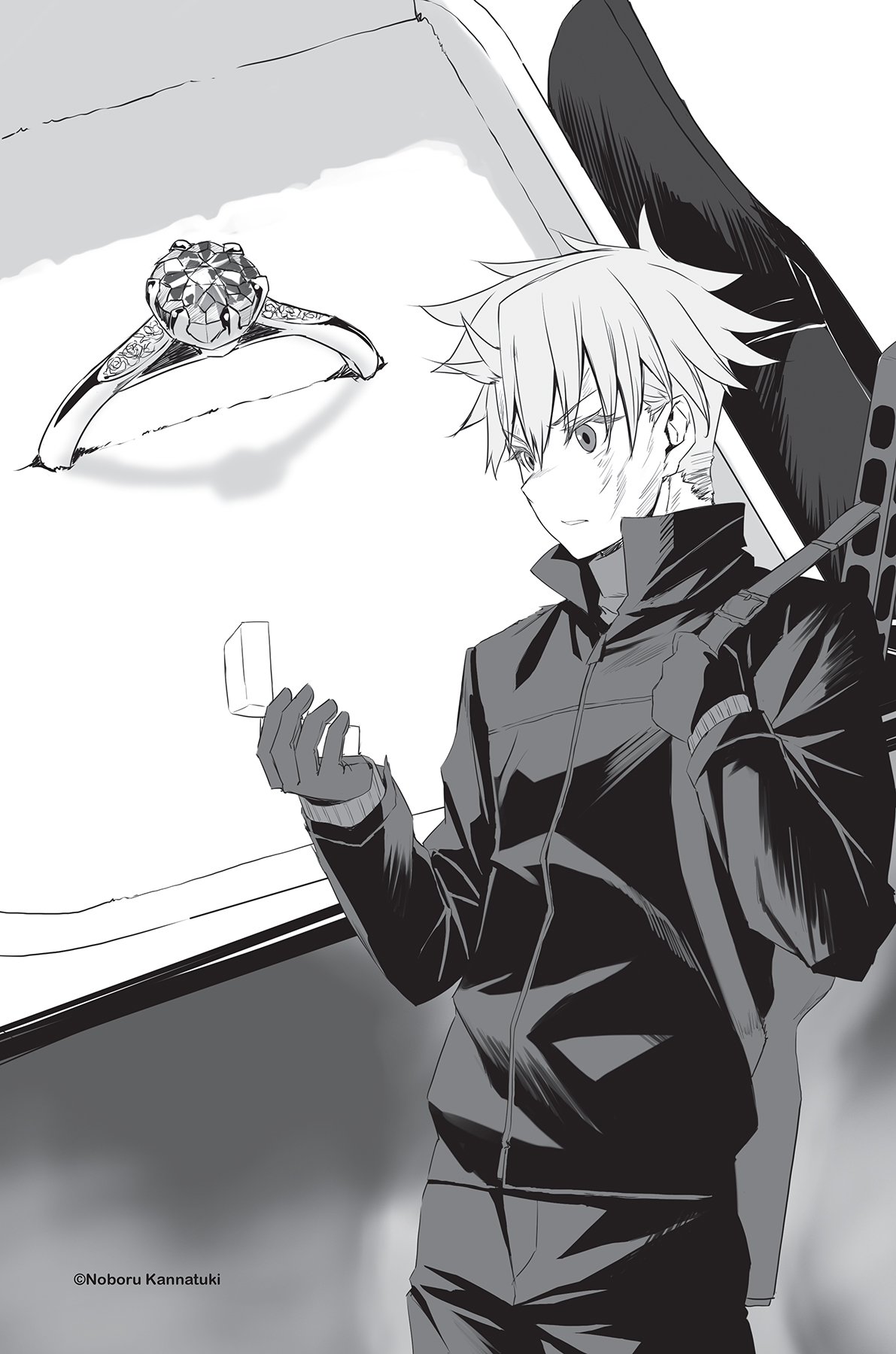
That was when my toe nudged something heavy. I picked it up and found a cloth-wrapped box, in perfect condition other than the bullet holes in it. When I opened it, I found a ring with a diamond smaller than the tip of my pinkie finger.
I thought about it for a second, then I closed the lid and pressed the box back among Ivan’s remains.
Probably because the only thing I was really interested in was the price on his head.
I couldn’t bring myself to steal anything else from him.
After that, I ran as fast as I could. After all, I couldn’t have some other jackass coming around saying, “Yeah, I was the one who did him in.”
I dove for the first public telephone I found. I scrounged in a pocket until I felt the reassuring touch of my small change. Phew.
I put the kopecks in the silver case that stood silently in the middle of the box and worked the center dial. The speaker, located in the upper right, crackled, and I heard the voice of a mafia brigadier.
“Chto s toboi <Yeah, what>?” he asked.
“I killed Ivan,” I said.
“Who?”
“It’s Danya,” I said into the mic in the corner of the box, as loudly as I could. “Danila Kragin!”
“Not you, dumbass,” the voice sneered. “Who’s Ivan?”
“The vyshibala,” I elaborated. “A hundred rubles.” It seemed like enough to buy the whole world.
“Zdorovo <Good work>. Come by tomorrow to collect the money.”
Then the guy unceremoniously hung up. I was sure he would do some legwork, and by the following day, he would know I was the one who had done the job.
All right. I was getting some money tomorrow. Until then, I didn’t have any money.
—“Tsk.”
I clicked my tongue and ran out of the telephone box, the PPSh still hanging from my shoulder. Some dumb kid Janitor who’d just iced a mob enforcer wouldn’t be smart if he stuck around near the scene. I’d be lucky if the worst thing his colleagues did was beat me to death.
I zigged right, I zagged left, racing around the back alleys until I could hardly breathe. Then I pulled off my balaclava—or I tried to. I forgot that it was already in my pocket.
I let out a breath.
Neon flashed among the claustrophobic concrete buildings, and gray snow drifted through the air.
Why did I have to go running around the city out of breath? I didn’t stop to consider the question until about the time I reached Gorky Street. Twilight had already pressed in on the world; it was only thanks to the neon bulbs that it wasn’t fully dark.
“Karmanniy proyektor<Pocket projection devices>, snova televizor<rotating electric telescope>, October 24, 1970—Zond VIII moon landing!”
“Hey, what the hell’s this thing someone dropped?”
“Workers, let us buy cheap bread! Every kind of bread, you can get at the Crop Processing Company Federation!”
“The Ministry of Textile Production sends word to all women! Flawless and hygienic nylon stockings are now available for you!”
“Moonshine will send you to your grave. Drink safe, legally brewed alcohol from only approved distilleries!”
“The latest LSI games! Help Captain Ilya Murometz defeat the wily schemes of the capitalists!”
“The healthiest and most delicious morozhenoe<ice cream>! GOST state standard-approved!”
“Mayonnaise—the perfect condiment for every meal! Bottles can be returned to store where purchased. Courtesy of the Ministry of Food Production.”
Announcements in grating mechanical voices created a cacophony on top of the eye-piercing neon advertisements. Although I registered the messages, the sounds were starting to make me dizzy.
This street could take you all the way to the Kremlin, and it was always packed. There was food, clothing, alcohol, and other entertainments, all right here. So the militsiya kept a close eye on it—supposedly secretly, but everybody knew.
One more step, and I would have been there, on Gorky Street. But instead, I stopped.
I just stared silently at the headache-inducing brightness and overwhelming noise.
Then I turned and rushed into the back alleys.
There was more snow than I ever wanted to see again in my life, and every breath I took pierced my lungs with the cold. But it still seemed better to me than being out there on that riotous street.
The particular back alley I chose to flee down, though, had women in it.
We were just one street removed from all the overstimulation of Gorky Street, yet it was almost unfathomably quiet back here. There were a few kvartiriy, lonely and forgotten but better than the rathole where I lived.
There were women around—some standing, some sitting—doing whatever they wanted, I guess.
Look, I was no idiot. I knew the women were engaged in a trade that, let’s say, didn’t exist on our motherland’s television broadcasts.
They were just like Janitors. Which was to say, just like me. The CRT TV broadcast could try as hard as it wanted to make us disappear, but that didn’t mean we would actually go away. It was enough for them, though, if they just didn’t see us. Real stupid.
These women had been chased off the cyber net, off the CRT, out of the written texts, away from the train stations—and now they were here.
I jammed my hands into my pockets and walked quietly past.
However I chose to spend my time until tomorrow, my last few coins were all mine. We’d blown through the rubles I’d gotten the previous day, but what was left belonged to me.
So I— Well, I hadn’t really intended to stop walking. Hadn’t really intended at all.
“Hey, um…”
—Who’d ever fall in love with a girl like her?
I remember thinking that as if it was yesterday.
I was standing under a heavy, lead-colored sky, ashen snow drifting down from the clouds.
I was walking streets that were lined with huge metal pipes like a giant’s intestines, which sang with the hot water running through them. It was like being at the bottom of a valley.
She sat at the approach to the kvartira, the numbers on the heels of her shoes on display.
She was maybe fifteen years old—about my age, I guessed.
Of course, I wasn’t one hundred percent certain of my own age.
Just glancing at her, I figured she was older and a bit more mature than the older one of my little sisters, but definitely not older than me.
Her short, unkempt hair was a pale blond, but the snow piling on top of her head soaked it through. What a waste. The same snow had turned her white skin and rose-colored lips a pale purplish color, and she was shivering in the freezing cold.
She was wearing a white one-piece; the shoulders hung loosely, and she had to use a safety pin to hold them up, yet the sleeves were too short. Once in a while—whether from embarrassment or the cold, I didn’t know—she would tug at a sleeve in a vain effort to pull it down. Her arms were as thin as twigs, but the weird thing was that they still looked luxurious and soft.
To be fair, I was no prize pig myself. I was haggard, gaunt, and starving. I hadn’t eaten in days at that point. Not since I’d used the last of our flour to make some pelmeni dumplings, and my little brother and sisters had gobbled them up. There hadn’t been so much as a bite left for me. Instead, I’d guzzled a bunch of water and tried to convince myself it had filled my belly. Then I’d spent all day today running.
The PPSh that dangled from my shoulders was very heavy. The bandolier bit into my skin even through my jacket.
It wasn’t much of a jacket, anyway—it was awfully tight, and the Tokarev pistol I kept near my chest was always whacking my ribs painfully.
In spite of all that, she kept staring at me. Frost had collected on her long eyelashes; she blinked rapidly, and I couldn’t help feeling bad when I saw how red her eyes were.
For a moment, I thought maybe she was a rabbit in the snow—not that I’d ever seen a rabbit.
“M-maybe you’d l-like to, um, w-warm yourself before you go?” she asked.
I was cold, I was hungry, and I had only a few kopecks in my pocket.
That’s why I said what I said, how I said it. I made my voice as hard as I could. “Tsk,” I snapped. “I ain’t got any money.”
“Oh, um, well…”
It didn’t stop the girl from smiling at me.
“If we pool your money and mine… I can make borscht with some actual ingredients in it…”
—That’s what she said to me.
I stopped cold. I thought about Ivan.
“Just so you know,” I said, “I don’t have enough on me to turn anyone into a cyborg.”
“……” She didn’t answer.
“If this ends in tears for you, don’t come whining to me.”
“Da<Okay>.” She let out a sigh. I could see it turn to frozen white mist. “Just so long as you don’t beat me, that’s enough…”
“……” This time it was my turn to be quiet. In my pocket, I had my small change. The next day, I would have rubles there.
It was my money. Without question, it belonged to me.
After a long moment, I grunted, “Tsk.”
I accompanied her into the apartment building, which looked like it might collapse at any moment. Now that I thought about it, I’d never been in one of these places except on one of my Janitorial jobs. Let alone with a girl.
Even so, almost immediately I knew exactly what the layout of the place was and where everything was located. Moscow’s communal apartments had only a few kinds of rooms—and just as few types of locks.
It was a cramped space, with nothing but a cot and a kitchen that could hardly have passed for a washroom. Still, it had a small stove in one corner, with a samovar sitting on it.
“It’s not my room,” the girl said with an embarrassed smile. “But I bought this myself.”
I really didn’t care. I shoved the coins at her. She blinked, then took them, a flush coming into her cold cheeks, and nodded.
“Nu, vot<Go ahead>…?”
It was my first kiss. The first time I’d ever made love to a girl. She didn’t really seem to know what to do, but then, neither did I.
We didn’t know how to put on the dried-out “rubber product number two,” and she ended up licking it to help it slide. Somehow, red-faced, we managed to put it on without breaking it.
I’d never felt so awkward in my life, but it was nothing compared to what came after that.
I’d never known that girls were soft, warm, and that they smelled nice. I realized it must be true that they took baths every single day.
Then, for the first time, a girl told me her name while we were in bed.
Stasia.
She whispered it to me as she squirmed beneath me, mewling like a kitten. Her slim arms wrapped around me; I could feel her nails digging into my back. I told her my name, too, while red up to my ears.
I’d never known that telling someone your name could make you feel so warm.
She repeated “Danya, Danya,” in a faint whisper as she spasmed gently beneath me.
I was about to burst, about to pop my cork. Nyet, nyet, a voice said within me, urging me not to. I didn’t lose myself. I gritted my teeth, intent. Because I’d promised her that I would be good to her—not that I knew how to do that.
It was like a dream. It still felt like one, even after I opened my eyes. A dream too good to be true.
It must’ve been, because I could still feel her warmth and her weight in my arms, but she was gone.
—I think I get how Ivan felt.
Still, I knew immediately what I was seeing: light. Morning light, piercing through the window like needles.
It was the first time in my life I’d woken up to sunlight.
Then I realized I was on a cot, and I sat bolt upright.
“Oh, you’re awake, Danya?”
My dream was right there.
Stasia stood in the doorway, clutching a small paper bag. She was wearing a new outfit, not the one-piece she’d had on the day before. Snow had collected on her shoulders, and she was smiling.
“I went to Cherkizovsky Market and did some shopping,” she said. I didn’t even hear her as she added that it had been a long time since she’d ridden the electric tram.
Me—honestly, I don’t remember what I said. I listened stupidly as she told me to hold on for a few minutes, the bedsheets pooled there around me.
As for Stasia, she put on an apron, and in no time at all, she’d started cooking. I caught an aroma that smelled better than anything I’d smelled in my life, and my stomach made itself heard loudly.
“Hee-hee,” she giggled, her voice like the tinkling of a bell.
I just clicked my tongue: “Tsk.”
“Nyet, not quite yet,” she said. “It’ll be ready soon.”
The same word, nyet, but in her mouth, it seemed completely different, like night and day, like a spell.
Then she put bowls of steaming borscht on the table, and it was like magic. “Well? Go ahead.”
“…Sure,” I said slowly.
I think it was the most delicious thing I’ve ever eaten in my entire life.
I clutched my spoon—I mean literally held it in a death grip—and ate that borscht like a hungry dog. I wish I could have shown it a little more respect, but it had beets and chunks of meat floating in it, and it was delicious. So delicious I could have cried.
Stasia just smiled quietly and ate her borscht with her spoon, refined and gentle.
I finished first. I even had time to simply watch her eat, while I sipped some warm water poured from her precious samovar into a broken teacup.
“Um,” she said, blinking shyly. “Don’t stare at me so hard. It’s embarrassing.”
“Sorry.” I was a bit brusque, but I didn’t know what else to say.
I didn’t have it in me to talk about the previous night. I was afraid that if I did, it might all vanish into thin air.
Instead, something else came to mind. I think I was able to say it because I was calm and full of food and warm. That’s why I didn’t hesitate.
“Hey… Have you got any more borscht?” I asked.
“You want seconds?”
“No.” I shook my head even as Stasia lifted her cute, pale behind out of her seat. “I’ve got a little brother and two little sisters.”
“Oh my,” she said, her eyes going wide. “Konechno!”
It was hardly as if everything started going great after that. I made good use of my hundred rubles. Maybe it wasn’t enough to buy the world, but for me, it was big.
I started with some adjustments to make our rathole a bit more livable. Stasia, who for some reason had followed me home to deliver the borscht, narrowed her eyes when she saw where I was living. “Nyet, this won’t do!” she said.
The same word again, but how could the effect be so profoundly different? I was starting to seriously believe she was a witch and that every word that came out of her mouth was a magic spell.
“You have young women living here—you have to consider their needs!”
With that, we cleaned out one of the nearby earthen pipes, chased out the rats, and arranged things to make four improvised rooms. In other words, one for me, one for Valery, and one for each of my little sisters.
That meant the next thing we were going to need was furniture, but that problem was practically solved. When I went to see the mobster about the money, I asked him to introduce me to a good pawnshop—a place that didn’t ask why you were selling what you were selling. There was a middleman’s fee, of course. The junk dealer had taught me about that a long time ago.
“Capitalism is a cliff,” he’d said. “And people who don’t pay their money are right on the edge.”
The mobster chuckled about me being just a kid, but then he smiled and jotted an address on a piece of paper.
The pawnbroker he introduced me to looked sterner than my old junk dealer; he didn’t have much to say to the likes of me, but he knew how to make money. Thanks to that, I was able to resume my junk-collection activities. I had my brother and sisters begin taking on work as well. Between us, we made some money. Our rooms got warmer, more pleasant, more livable. We started to have food on a regular basis.
Funny how much bigger the world looked on a full stomach.
Mariya wanted a watch. My little sister really liked machines, apparently. I hadn’t known.
Valery…he was crazy about cars. I would bring home pulp magazines, and the little bastard would clip out all the car pictures.
As for Nora, she liked cute things, clothes and accessories, and she would go gaga for snacks. Tartlets, say.
Learn to read and write, I’d told them. And then learn some numbers.
I’d find them a textbook the next time I was out. When I said that, they were all shocked, or that’s how I remember it.
“Do you really mean that, Danya?” Mariya asked shyly, concern written across her usually inexpressive features as she tugged on my sleeve. “We don’t really need… I mean, we have enough.”
“Don’t argue,” I said. “Just let your big brother handle it.”
Frankly, I was sort of embarrassed to call myself that.
Mariya was a smart girl, but I couldn’t send her to school. We didn’t have passports—domestic travel certificates—so on paper, we technically didn’t exist. I guess I sort of saw it as my duty to help her study all she wanted just the same.
To my surprise, having a new goal put a spring in my step. I felt like I was moving forward.
A goal.
Stasia.
“Oh! Danya, you’re going to Stasia’s place again, aren’t you?!” Nora said, catching on immediately, after which she teased me mercilessly. Among us siblings, to be found out by Nora was as good as to be found out by everyone. Mariya gave me a cold look, while Valery just stared stupidly, not sure what to do.
I couldn’t let go of Stasia. I started visiting her before and after each job.
Visiting Stasia took money. It was only right that I bring her some cash. Natural, really.
I wanted to keep my brother and sisters full and fed. I wanted them to have clothing. And to buy them all the things they desired.
“I’ll help you, Big Brother,” Valery said with a serious look on his face. “I’m a man, too, you know.”
“Dumbass,” I said, grinning and elbowing him. I was surprised to find his words somehow gave me a rush of happiness. “You’re just a kid.”
I continued to earn money. I’d never dreamed there would come a time when I could earn more money than just what I needed to secure food for the day. The price on Ivan had been bigger than anything I would have dreamed of in my young days.
So I made my way as a Janitor, taking every job anyone would give me. I ran, I shot, I nearly got killed, I killed instead, I got my money, and then the next day came.
The grind was always the same. But although it never changed, it did get better.
It wasn’t that it was never dangerous. I’d come really close to dying plenty of times. But it was sure a lot better than the time I set Nora and Mariya shouting and crying because I came home a bloody mess.
Valery and I had gone to Stasia for help, feeling like a nuclear warhead had fallen on us.
Stasia.
—Who’d ever fall in love with a girl like her?
I remember thinking that as if it was yesterday.
But hey, a person could fall in love with a goat, if the time and place were right.
So let me correct myself.
Who’d ever fall in love with a girl like her? Except me. Except my family.
And so…
It wasn’t like stuff suddenly started to go our way, miraculously or magically or whatever. We made it go our way, by hook or by crook. And I intended to keep making it.
Thanks to that, I was alive. We were alive.
Which tells you what kind of story this is.
Janitorial Work

“Davai, davai, davai, davai,” I muttered, sweltering under my balaclava. I was in a hotel suite, and the source of my discomfort was a heater more luxurious than anything I’d ever seen, belching hot air right beside me.
In the darkened room, I was cooking like bacon.
Power outages were nothing new in Moscow. It was the snow—power lines would give under the weight of it and snap.
Kind of like life sometimes, I thought. Or work.
But this wasn’t that sort of time. This was their job, and mine.
I wanted to reach through the eye holes of my balaclava and scratch my cheeks, but I suppressed the urge.
At the same time, I had the feeling risking it would be wasted effort. But then again, being wasteful was a luxury. And luxury brought peace of mind.
There was someone standing smack in the middle of the room, and someone else crouched by the heater. I didn’t know how the thermal imaging from the PNV could make them out, but it could.
This sure beat doing nothing, though. My life was practically made from an accumulation of useless gestures.
—At least, it has been until now.
All I could do was, well, what I could. As usual, it didn’t really get me anywhere.
“…Tsk.”
I heard seven sets of footsteps. Didn’t like that number. There was bad luck, and then there was bad luck.
Seven was the standard squad size of a group of commandos—any Janitor knew that. A fifteen-year-old shitkicker might not have been aware of it, but twenty-four-year-old Danila Kragin knew.
I heard five sets of heavy footsteps, two others light. Not ideal by any stretch of the imagination, but the situation could have been worse. Nice of them to include a couple of meatbags instead of making the entire squad mechanized. So there was still room for this to go further south.
At length, the footsteps came to a halt directly in front of the door. I sucked in a breath and kept my finger tense on the trigger. I was holding an old submachine gun—a weapon I was very used to. I kept the muzzle aimed directly at the doorway.
The doorknob clacked. Davai. No ambush in here, boys.
The hinges gave slightly. The door opened. There was the tiniest slit. I saw white body armor peek through, and a helmet that looked like a skull.
“Sobaka! I told you it’d be spetsnaz!”
I squeezed the trigger and sprayed bullets like water from a hose.
Kill, PPSh! Kill! Kill! Kill them dead enough that they can’t stick around to resent me for it.
“Ghhk?!”
“Argh!”
Sparks and screams flew through the darkness. I saw lubricating oil erupt from the body armor of someone on our side. And I saw a metal egg roll from his hand with a sharp hiss.
“Janitors!”
“Bliad’ <Fuck>!” I cursed despite not having the time for it, then started running so fast I almost tumbled. Toward the window, of course.
“Idti, idti, idti!”
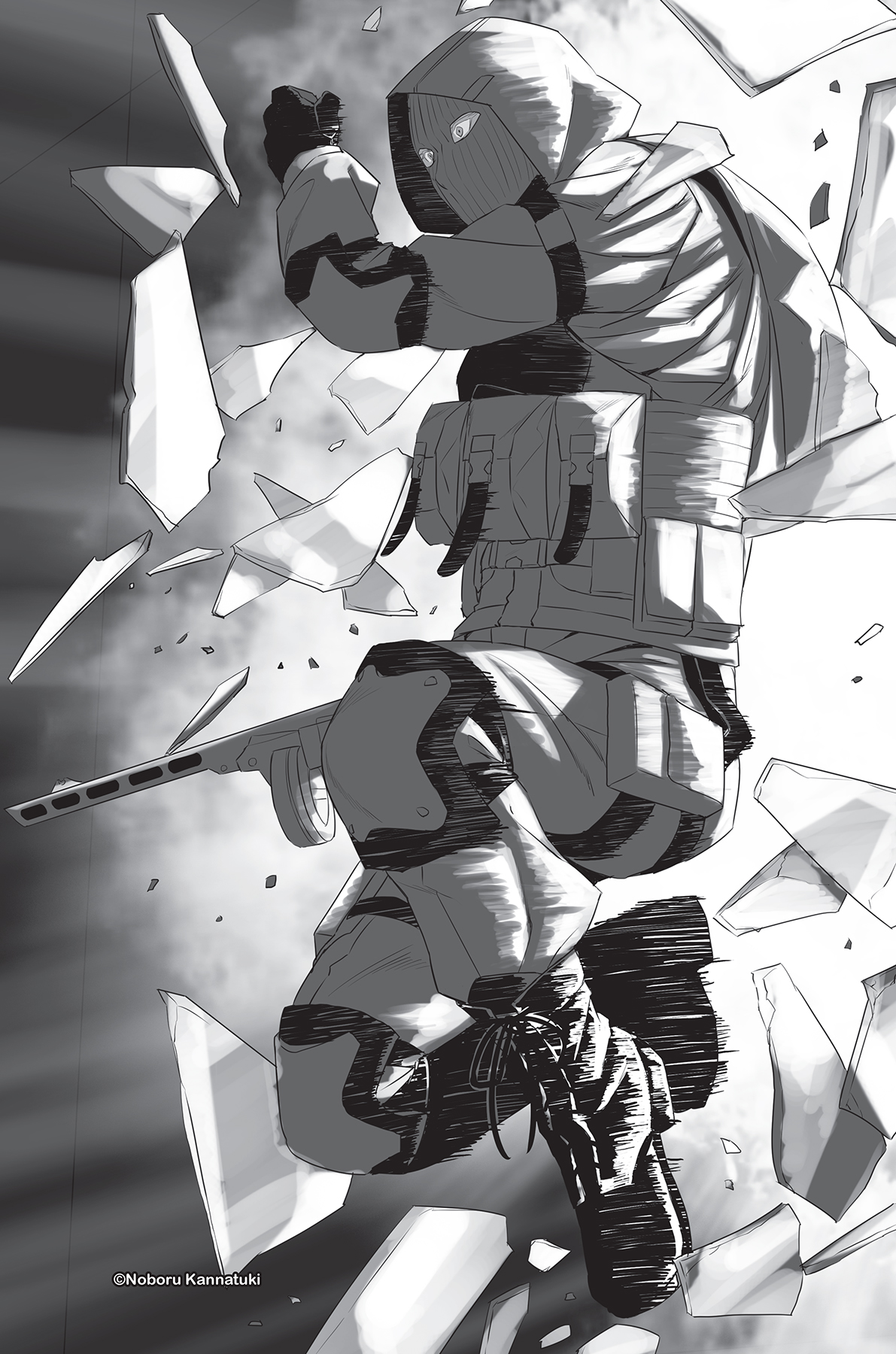
There was a tremendous noise from behind me, accompanied by a gout of flame. The Abakan spat heavy metal like it was going out of style. It was a beast of a gun whose recoil would have torn off the arms of any pure organic who tried to fire it, but cyborgs were a different story.
While the weapon reduced the gorgeous furnishings and lovely heater to splinters, much more the sort of scenery to which I was accustomed, I kicked through the window. It was easy—I hadn’t been stupid enough to lock it.
“See you in hell, comrades!” I shouted, and an instant later, the RGD-5 grenade that had gone rolling along the thick carpet exploded. I leaped into the Moscow night.
The air was sharp and cold enough to cut. It was even worse wearing hole-riddled body armor.
—I’ll have to get this thing fixed.
It would be tough asking Stasia to do that, though. Frankly, an angry Stasia was scarier than any spetsnaz squad.
“Danya… Danya…?”
It was the best way in the world to wake up, so why did it always make me feel like I wanted to sleep a little longer?
I took her delicate wrist as gingerly as if I were picking up a porcelain doll. Being careful not to bend it, I tried to bury myself deeper in the sheets.
“Nyet, Danya. It’s morning!” Stasia giggled and briefly intertwined her fingers with mine. Then, like a cat, she slipped away.
The carpet was soft. The bed was beautiful. Every inch of the space couldn’t have been more different from the kvartira she’d been in before.
Actually, there were three things that hadn’t changed. Me, her, and the little samovar.
“Morning comes every damn day,” I said. “Just like the milk delivery at noon. Nothing unusual or surprising about it.”
“You think? You only get to see the morning sun once each day. Doesn’t that make it special?”
As always, Stasia was right. I couldn’t think of one time she had ever been wrong.
With her pale skin wrapped in equally white sheets, she smiled and opened the curtains. In the sunlight that filtered through the window, past the leaden clouds and the snow, her hair seemed to glow silver.
She was no longer the scrawny little girl she’d once been; she’d kept her features and her grace, but now she was a Venus, a goddess of beauty. Now I could touch her almost anywhere, except maybe her hips, and not feel bones.
When I brushed her abdomen with my rough fingers, she squirmed like a kitten, and even that made me feel a bit apologetic somehow.
Hmm… A goddess of beauty? Even I thought that was a tired expression. Shit. Could I come up with something else?
“There was that… What was it? The thing where a swan turns into a beautiful woman. It’s famous, right? You performed it once…”
“Swan Lake?” Stasia murmured. “You mean back when I was sixteen?”
“Yeah, that’s it.” I nodded. “That was really pretty.”
“Aw, spasibki <thanks>.” Stasia grinned and went over to the samovar with steps that could just as well have been dancing. She looked even lighter on her feet than usual, in a better mood—and if that was because of what I’d said, well, I would like that.
She could perform anything. Ballet, opera, stuff I hardly understood—all of it. It went over my head, but the one thing I knew for sure was that Stasia was the best part.
She picked up a tin of tea leaves, her perfect ass—so small and yet plenty large—swaying as she went.
“Would you like some tea?” she asked.
“Yeah,” I said. Then I paused and said, “Hey, Stasia?”
“Yes?” That perfect ass disappeared as she turned, and her perfect face looked at me inquisitively.
I took my time, gazing at her for several seconds, and then studiously, casually, I said, “Dobroe utro <Good morning>, Stasia.”
“Yes, dobroe utro, Danya!”
Borscht was my favorite, but I didn’t have anything against dark tea.
Glazunya <fried eggs> and toast—that or blini <pancakes> with honey were the ticket.
Really, any breakfast Stasia made was going to be delicious.
She smiled when she noticed me taking my time at the table, savoring every bite.
Then she leaned forward and asked, “You’re not pushing yourself, are you, Danya?”
I licked the jam off my spoon, took a sip of tea, and gave her a look. “If you weren’t satisfied, it must be because I didn’t try hard enough.”
“Durak <Silly>.” She pursed her lips, almost as if she was going to give me a kiss. “This won’t do, Danya. You’re still organic. Don’t waste your money on me—you should spend it on mechanizing. Cyborg parts.”
Hmm. I leaned back in the gorgeous chair there in Stasia’s room, feeling the backrest behind me. It sure didn’t seem like it would hold a cyborg’s weight. Or maybe when she had cyborgs here, she brought out a chair that could handle them.
Chairs were all well and good, but I didn’t like thinking of Stasia trying to support a cyborg on top of her.
“Hey, it’s cool,” I said. “I like being organic.” I picked up my cup and sipped the tea that had spilled into the saucer. “I’m careful which jobs I take, too. You don’t have to worry about me.”
“Talking about work again? I’m aware that what you do is really dangerous, you know.”
“Janitors do dangerous jobs, yeah.”
Stasia didn’t put her fingers through the handle of the cup, so I could see their every movement.
She put the cup soundlessly on the saucer. I smiled. “I’m telling you, I get my jobs from someone I can trust. I’ll be fine.”
“You mean Mariya, right?” Stasia’s expression and tone became about 20 percent softer when she spoke that name.
Mariya, Nora, Valery: She looked and sounded different when she said their names than when she said mine. But then, according to her, so did I.
I don’t know. I wasn’t so sure. What I did know was that at those moments, I loved the way she looked.
“You can’t put them through too much trouble, you hear me?” she said.
“I know, I know.”
Stasia puffed out her cheeks in annoyance. But it was fine. I did know.
I set down my cup with a clink—how’d she do it without making a sound?—and stood up.
I was done with my tea, which meant it was time. I had to go—no matter how much I hated to leave.
I picked up my Tokarev and carefully tucked it into my shirt. As I went to put on my neatly folded body armor, Stasia came over and stroked it—and me. Her fingers passed through the holes, gently brushing my side.
“Don’t stay away too long. I’ll be waiting for you,” she said.
“I won’t.”
“I’ll be very angry if you get yourself hurt.”
I was going to joke about how scary that thought was, but her soft lips prevented me.
“Mph… Mn… Ooh…”
I put my hands on her hips—she’d had to stretch up to reach me—and felt her tremble. I heard the gentle puffing of her breath; it was as adorable as it was eager. She wrapped her arms around my neck.
The smacking sound tickled my ears. The wet tip of her tongue. Sweet saliva. The taste of it—like jam—was almost electric.
Even after I went out into the hallway and closed the door behind me, the last fragrant notes of the tea lingered in my mouth.
I climbed into the birdcage elevator, put in a few coins, and descended to the first floor. Elevators were normally filthy, broken, and covered in graffiti and stickers. But the one in the thirty-four-floor skyscraper where Stasia lived was a sharp contrast. None of the good-for-nothings in the city would dare rough up the youngest of the Seven Sisters on the banks of the Moscow River. When it came to her, even the time the elevator spent descending felt elegant and exciting.
If you ask me, the secret ingredient was those few coins you had to pay to ride. People who paid for their elevators didn’t dirty them. And as for those who couldn’t pay, well, the stairs were free.
Still savoring the taste of the tea, I heard the pleasant ding of the bell as I reached my floor and stepped out.
“Ahhh. Finally got here, did you, Danila Kragin?”
“…Ugh, koshmar.”
As I got out of the elevator, I found my way blocked by a diminutive old lady.
“Oh my. What a ridiculous getup, Danila Kragin.”
We were standing in an elaborate lobby done in stone, with a painted ceiling—I guess it was called a fresco—above us. And this old lady was showing me her fangs.
She had gray hair, pulled back so far and so high that I thought maybe it was making her wrinkles worse. She looked as thin and fragile as a weathered branch, but she glared at me with eyes that glinted like a hawk’s.
“Your hair is everywhere, your vest is covered in dust and dirt, you’re wearing military-issue boots, and to top it all off, you’re dragging around that absurd toy.” As she spoke, she pointed twiglike fingers at my head, my shoulders, and my feet in turn.
“Madam Pisken,” I started, “I—”
“Ne nado <Enough>. I don’t want to hear any excuses,” she interrupted. Then she pursed her lips and snorted.
She was wearing the same black dress she always did, and I couldn’t help thinking she looked like an old witch. All she needed was a pointy hat. She must have been hiding one at home somewhere, I’d bet on it.
I never knew how to handle Madam Pisken. Stasia said she was like a mother, but I wasn’t sure that was true. If it was, though, then every kid in the world was in for a rough time from the day they were born.
“You realize who you come here to see, don’t you?” Madam Pisken said, her voice as loud and shrill as scraping metal. I didn’t understand how she could seem to be looking down on me when she was a head shorter than I was.
Once—quite a long time ago—I’d screwed up my courage and, hoping to make something happen, told her as much. Madam Pisken had only snorted and said, “I was born this way.” Her parents (if she had such a thing!) must have been very stouthearted people.
“She’s not some whore who opens her legs for just anyone,” Madam Pisken went on. “That girl is a first-class actress. Am I wrong?”
“Nyet,” I said.
“You think she’s fit for some random ugolovnik? Well?”
“Nyet.”
“If you know that, you could at least dress decently for her! That’s the pride of the Pisken Theater you’re dealing with.”
“I guess you figure nothing can ever happen to your reputation as long as you’ve got Stasia,” I said.
“I figure that Stasia is sweeter on you than you deserve.”
Cursing my careless tongue, I froze as the old witch glared at me again. I would rather be in the sights of a cyborg’s infrared vision.
“I tell you. That girl! Nothing good has ever come of her being sweet on a man.” Madam Pisken continued to fix me with a piercing glare as she griped on. “Let me tell you something, young man. There’s an endless supply of ‘top-class Janitors’ like you.”
—You know what’ll happen if you try to sponge off her?
Even I understood what she was silently asking. There was only one answer.
“Da.” Obviously.
Satisfied with my prompt reply, the madam spread her palms in an elegant gesture. It was her signal that the lecture was over. I breathed a sigh of relief and fished an envelope out of the pocket of my body armor. Then I counted out some bills—perfectly neat, not a wrinkle on them. Khorosho <Good>.
“Na,” I said.
“Good.” She took my rubles—again, elegant as she did so—and put them carefully away. I’d never seen Madam Pisken do anything so uncouth as counting them. “The fact that you actually have the money on you never, never ceases to amaze me.”
“Is there some fool who thinks he can see Stasia without paying?” I said, raising an eyebrow. “I don’t believe it.”
“Ah yes. You are an unbelievable fool, Danila Kragin.”
“…Tsk,” I grunted. Madam Pisken smirked, and I scowled in return.
She probably would have said she was paying me a compliment—but there wasn’t one person in Moscow who would have smiled and said thank you to get a compliment from this old bag.
—No, wait. Maybe one.
Stasia would have been thrilled to hear a few kind words from the woman who ran the Pisken Theatre.
“Gee, thanks,” I said. I had to admit defeat.
Madam Pisken snorted again and said, “Next time, take a couple of hours to come see one of her performances!”
I went through the entrance, feeling like I was being chased. I pulled up the collar of my body armor against the piercing cold.
—It’s because of the Moscow River.
The wind that came over the blue ribbon flowing past me picked up that bone-deep chill.
A real “top-class Janitor,” I thought, would be someone like Uchitel, “the Teacher.” A woman. Identity unknown. Some said she was an orphan. Absolutely unbeatable in close-quarters combat. She was like Baba Yaga.
I trotted along, my breath freezing as it came out of my mouth, and—as was my custom each time I visited—I looked up. There was a big, bright sign counting down the days until the 2160 Moscow Olympics. Not that I cared much about that. It was just sort of there in my vision.
I was focused on a much bigger sign, which showed the most beautiful girl in Moscow smiling at everyone but me.
“Tupoi <Fool>. Who am I kidding? Most beautiful girl in the world.”
I could have kissed the posters and signs for the Pisken Theatre, which were everywhere in this city.
That was about all a Janitor could do for Miss Moscow.
And maybe bring her some money.
I walked through midmorning Moscow toward Cherkizovsky Market. Then, on a whim, I stopped by a supermarket.
It was an unremarkable building in black, white, and ash gray. The display cases were practically empty, but the place was packed. Probably because it was almost time for the distribution of milk and dairy products. I saw everyone from children to housewives.
I felt some odd looks directed at me as I walked around in my body armor, but I didn’t care; I just got in line at the register.
Finally, it was my turn.
“Next!” The clerk, a dignified working woman in a white uniform, didn’t smile, merely eyeballed me as I approached.
“One box of curd snacks and four hundred grams of doktorskaya,” I said.
“Fifty kopecks.”
“Sure.”
I handed over the coins and took my receipt. Then I went to the selling counter. Everyone stood waiting their turn, clutching their receipts.
“Next!”
“One box of curd snacks and four hundred grams of doktorskaya,” I said again.
“Receipt.”
“Sure.” I handed over my slip of paper, and the worker stuffed my purchases into a paper bag in return. The curd snacks, which were cheese curds wrapped in chocolate, and the doktorskaya, a kind of sausage, were both pretty decent. The fact that you didn’t even have to buy them at the black market only made them better.
The black market—Cherkizovsky Market—had anything and everything, but the watchwords were buyer beware.
Then there was the Vernissage Market, set up on the reclaimed vestiges of a defunct amusement park and some hotels that had once catered to Eastern bloc tourists. It was Moscow’s largest bazaar, and beside it stood a huge arcade of tin and corrugated iron. That was Cherkizovsky Market, and it’s where I went right after I left the supermarket.
“We have Playboy! Stars and Stripes! Blond-haired super solider beauties!”
“We’ve got the latest software from Ono-Sendai! Armies and tetrominoes are yesterday’s news! You want your games from Japan!”
“Cola here! Get yer cola! This isn’t Zhukov’s stuff; this is good, dark cola! Pure! No adulterations!”
“The newest records! Original rock ’n’ roll, limited to just ten copies!”
A sultry voice drifted from the record, which was carved into discarded X-ray tape. The voice wasn’t as nice as Stasia’s, but it carried some emotion. Evidently, the woman was called Jazz. I didn’t know what the song was about, but it felt very imperialist, and it sort of appealed to me.
The shops stood cheek to jowl, with shady characters (not that I wasn’t shady) hawking their stuff and trying to fire people up about their illicit wares.
Around here, you traded money directly for products. No receipt to get in the way. And no reports to the government of what had been sold. There were bootlegs, illicit imports, samoizdaniya <underground publications>, pirated goods. The stuff might be real or it might not, but it was there.
I found myself sucking in the air, a heady mix of the stench of people pressed together along with food and oil and iron.
“Whoops! Sorry, comrade!”
“Hold it right there.”
As some kid tried to reach for the paper bag I was clutching to my side, I didn’t miss a beat—I kicked him in the shin. I was wearing a steel-toed boot, so he definitely yelled and took a tumble, but I didn’t break anything—I was nicer than some people that way.
If he was going to steal, he ought to do a better job of it—and anyone who would lay hands on me was no friend of mine, anyway.
—What’s the big deal? This probably happens to him all the time.
Anyone who would make a big scene over a little thing like that would never have reached his age. Let alone twenty-four.
I worked my way through the crowd until finally I saw my objective.
It was a little coffee stand, suffused with the smell of powdered beans being boiled in a pot to within an inch of their lives.
A girl with long black hair and a wistful expression sipped some of the resulting mud-like liquid.
The fact that she was wearing cast-off military gear might have raised a few eyebrows, but there were girls who looked good in that sort of thing.
For example, girls with white skin, cold eyes, and a piercing stare—girls like a metel, a blizzard.
Her gaze was like a knife that rebuffed any man who thought about catcalling her—and suddenly those eyes were trained on me.
“You took your time, didn’t you, Comrade Danila Kragin? Yes, I daresay you’re late.”
“Sorry about that, comrade. I stopped for a bite.”
“You mean you stopped to get someone to feed you.”
The person before me had indeed grown into a beautiful woman—this nineteen-year-old, my little sister Mariya. She gave a disgusted click of her tongue. “…Tsk. Sobaka.”
When had my sweet little sister learned to do something as uncouth as clicking her tongue like that?
I shrugged, reached into my bag, and took out the curd snacks, which I tossed to her. She caught them against her chest, her eyes as wide as that of a five-year-old who’d just gotten some candy.
She put the box away, then pursed her lips and gave me a look. “Don’t think you can buy me off with some snacks, Danya.”
“It’s a gift. Just say thank you and take it,” I replied, then ordered coffee from the old guy selling it. He might have been awake or asleep; it was hard to tell. I handed him some coins and immediately received a cup full of what really, really looked like mud.
Mariya drank this stomach-turning stuff without so much as milk or sugar. Me, I took a drink of the bitter brew, disappointed to let the sweet taste of tea finally leave my mouth.
“So?” I asked.
“All right, all right.” She wasn’t going to try to pull her punches. “It’s an escort job this time.”
“Guard work, huh?”
“You don’t like it?”
“It’s fine. I was just thinking about what a respectable business that is.”
Sure better than murdering Ivan while he was on his way to his girlfriend.
Mariya stared at me for a moment, then sighed, her eyelashes fluttering.
She opened her bag and took out her trusty portable device, an Elektronika MK-170. It sat neatly in her palm and had a little LCD screen accompanied by a keyboard so small it looked like you would have to press the buttons with the tips of your fingernails. To me, it looked like a pocket calculator with a mess of cables attached to it.
Actually…I guess it basically was. It could run programs, which was the real difference.
Mariya took an acoustic coupler she had ready and plugged it into the receiver of a corded telephone. That was probably why she liked this coffee place so much—the old guy who ran it had a phone.
I checked the guy out: Maybe his real line of business was lending out his phone. The proof was in the coffee.
We heard a dial tone, then the shriek of a connection. Mariya hit the keys with her delicate fingers.
A moment later, the telex terminal started clacking away, then finally spit out some paper. Mariya elegantly tore off a full meter of it with the grace of a world-class typist.
“Here.”
“Thanks.”
I’d tried to give Mariya some education, as best I could with hardly any myself, but she was far beyond me now. The fact was, I didn’t have the foggiest idea what Mariya did these days. She would tell me it was communications and operations. I think the Western-bloc expression was tele-computing.
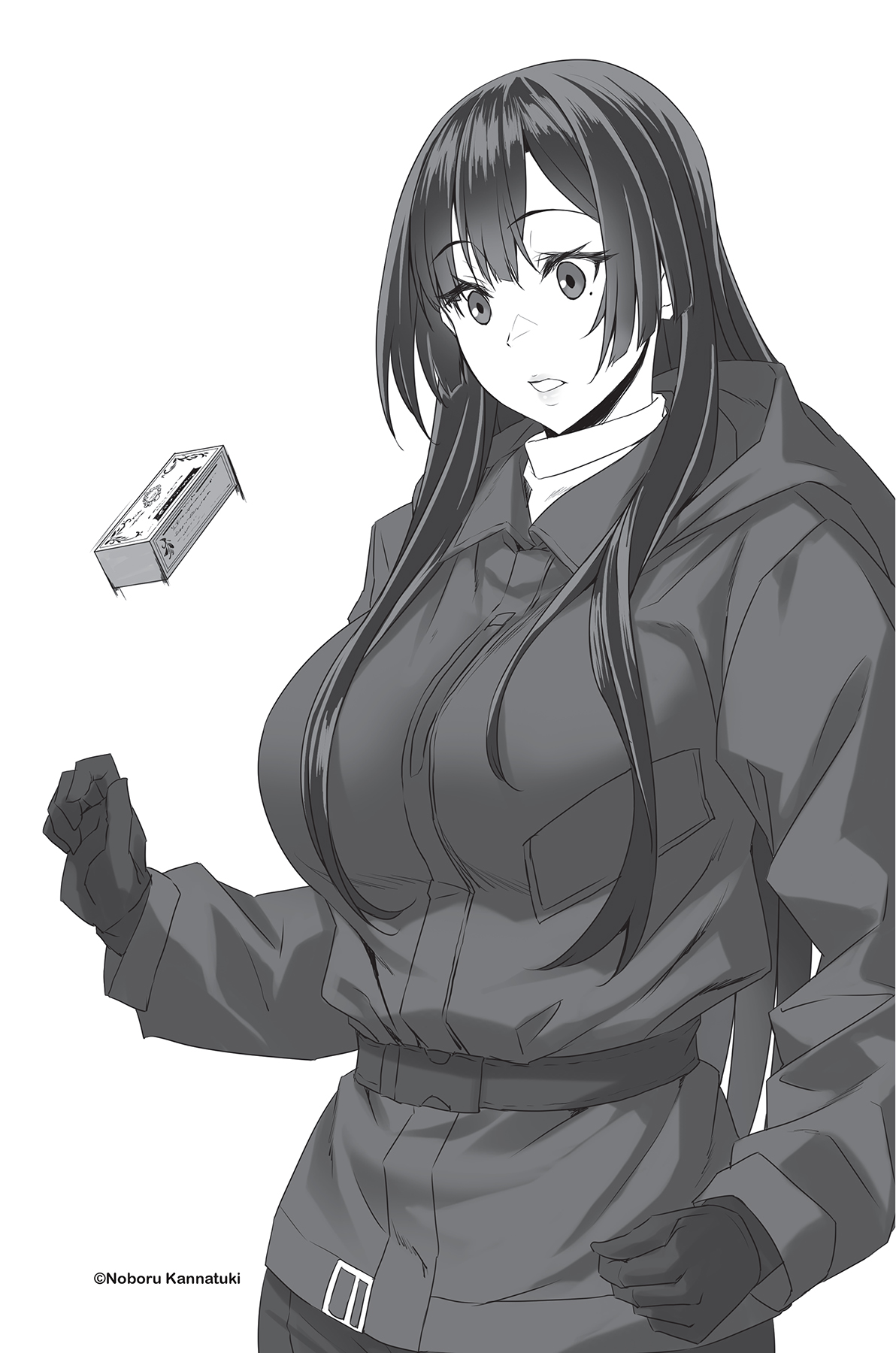
She’d always liked machines, even back when she was little. She’d been so innocently excited whenever I brought one back to our place. At least it meant she had work, which meant she would never have to miss a meal.
It had never occurred to me that the toys my sister was fiddling around with were proper machines. Now her room was full of CRT monitors and devices of all kinds.
She’d become a telegraphist—and without her, my work would have been a hell of a lot harder. So many jobs and offers came in over the wires, including the previous day’s Janitorial job.
If I was honest, I wasn’t entirely thrilled about her work—but part of me thought it was a good thing. At least it was safer than running around with a gun; it was real, proper employment. If I was a top-class replaceable, then Metel was one of a kind.
—It’s my bad for not telling her to clean up.
“So who’s the client?” I asked.
“Someone from Organ.”
The KGB. The guys in black suits. I tried to stop myself from looking as unimpressed as I felt.
“It’s cheaper to put you on the job than to get the men in suits involved.”
The KGB. Organ. The national security forces. In short, the secret police. Fifteen-year-old Danila Kragin might not have known about them, but at twenty-four, he did.
“I’m from the building next to the toy shop” were words used to scare children straight, but they were like Baba Yaga: If you don’t behave, a scary witch will send a terrible monster to kidnap you.
Baba Yaga was made-up. She didn’t exist. Couldn’t.
But Organ—that was real.
The Western and Eastern bloc countries had spent the last two centuries staring each other down. You might think that would leave the KGB on pretty good footing, but you would be wrong. Why? Because our glorious motherland, the USSR, had another information arm.
Namely, the military intelligence bureau, GRU: Aquarium. The military elite who gathered in a glass building and controlled our most potent special forces, the spetsnaz.
They had separate jurisdictions from the KGB, of course. And in the USSR, budgets were tight.
I knew a Janitor once who had described the KGB and GRU as a two-headed dog whose heads fought with each other over a single food dish, always trying to rip each other apart. That Janitor had tried to befriend both heads, and they had promptly torn him in half.
“What’s the payout?” I asked.
Without a word, Mariya raised one finger: one bundle of rubles.
I didn’t know whether that was an appropriate reward for a top-class Janitor. Would Uchitel take the job at that price? I didn’t know; I’d never met her. But for me, it was a boatload of cash. Enough to risk my life over.
I could only speak for myself, not anyone else.
“If Organ is resorting to employing Janitors, the coffers must really be empty,” I said.
Mariya shook her head with a wan smile. “Oh, hardly. They’re overflowing. That’s why they have the luxury of using Janitors.”
“Gotcha.”
Still listening to the sweet voice of the woman named Jazz, I scanned the telex.
The job was to guard a woman. This wasn’t a phototelegraph, so there was no picture, but it said Ilyena Tachibana, twenty-nine years old.
“Tachibana?” I wondered about her surname aloud. “Tachyana?”
“Tachibana,” Mariya said. “I gather she’s of Japanese extraction.”
“Huh.”
Japan—that was farther away than even the last stop on the trans-Siberian railroad. An island country across the sea. I only knew one thing about it, which was that somewhere called Chiba was supposed to be cyborg mecca. And I knew some companies that were supposedly from Japan. Companies like Ono-Sendai in Hosaka, Toyota and Honda, Sony and Renraku, all mishmashes of foreign syllables to my ear.
Oh, and I had heard that the yakuza gangs were cloning ninjas to serve as their secret weapons.
That was all I knew about the place, though. I was more interested in one particular line of the telex.
“‘Member of the People’s Commissariat for Finance’? Nu, da <No way>…”
“Da.” Mariya remained merciless as a blizzard toward her wide-eyed older brother. “She’s not a politician, though, so I don’t think you have to worry too much.”
“Tebe povezlo.”
“Mm-hmm.”
Sarcasm wasn’t working, huh? My sister just smiled and sipped her coffee.
—And she never pulls on my sleeve anymore.
Nichego ne podelayesh’ <It is what it is>. I’ve always been a sucker for that face.
“Okay, I’m in. Labor is glorious.”
Sending one lone Janitor to look out for someone who was doing an observation tour for the budget commission, though?
—It means either the job is safe…or they don’t care if she dies.
I shook my head as I continued reading the telex. It was better not to think about whatever might be going on behind the scenes. Better for my health. Knowing wouldn’t change what I had to do.
“I’ll see what I can do,” I said, folding the sheet neatly and tucking it into my body armor.
Places like this coffee shop were surprisingly good for secret conversations—the marketplace was an unyielding ruckus, as usual; no one would pay any attention to a brother and sister having coffee. How nice of Mariya to grow up so smart.
I drank the rest of the muddy liquid in my tin cup, knowing that in exchange I was going to have a stomachache.
“That reminds me,” Mariya said suddenly. It was a clumsy way of trying to pretend she’d just thought of whatever it was. “You’re still using that old thing? Why not order something from Monashina? The Nun?”
“You know I don’t like Kalashnikovs,” I said with a smile. It was nice, but silly, of her to worry about it. That was my job. “You could do with at least a pistol yourself, Mariya. Don’t come crying to me if some creeper tries to get to you—a beautiful girl all by her lonesome.”
“…Tsk. Keep it to yourself. You’re the one who was late.”
“That’s a bad habit. Stop it.”
“I will not.” She scowled and stuck her tongue out at me. I couldn’t resist smiling. Before she pouted even harder, I remembered the paper bag.
“Oh yeah. Speaking of being reminded of things…”
I thought briefly about Nora, but, well…ahhh, forget it. I still didn’t approve of the way she earned her pocket change.
“Give this to Valery. A little present.”
“All right. Sure.” Mariya took the bag with the sausage in it.
“One other thing,” I said. “Give him a message for me. Tell him to make some time for me.”
“I can do that, too…” She nodded, but she looked hesitant, cocking her head at me inquisitively. “But, Big Brother, couldn’t you tell him yourself when you come home?”
“Don’t be silly,” I said, and laughed. “You think I would act like I was buying off my own siblings?”
There was our house, just like always.
I lifted the iron cover and slipped into the subterranean nest—the manhole with heated pipes running through it. It had been many years, though, and the place had evolved. We’d added a generator and even gotten some furniture. We had lights and heating, just like a house should. I occasionally entertained the thought that, other than the fact that it was underground, this was a pretty fine place we had here.
But I was also always aware that rooms as nice as ours were not at all uncommon—something I felt especially keenly when I was coming back from Stasia’s place.
Janitors who weren’t willing to face facts didn’t last long. Those who were willing were the next to go.
Point is, Danila, if you want to put off your end as long as you can, you need to be careful.
I fumbled in the dark for the switch we’d installed, but even when I managed to turn on the lights, I didn’t hear a peep or a word of greeting.
“Huh! No one else is even home yet.”
I sloughed off my body armor and tossed it on the sofa, then shoved my Tokarev into my trousers and headed for the refrigerator.
That’s right, the refrigerator. A real luxury! Pretty much everything stays fresh if you stash it in there. It was a great feeling to be able to casually buy stuff that had to be refrigerated.
I took out a Tetra Pak of milk with one hand, holding the telex and a map of Moscow in the other. Then I settled myself on the sofa—which didn’t have any springs popping out—and studied the message and the map.
—Guard work, huh?
It was hardly my first time. From first base to oral, missionary to hitting it from the back. Just like I’d done with Stasia. So I understood that the order of things was important. You had to lay the groundwork.
At the very least, I had to make sure I memorized the route that Miss Tachibana would be taking.
As I studied the map, I tried to tear the carton open with my teeth—it was bad manners, and I don’t remember anyone teaching me to do it—when a “claw” came from beside me and poked a hole in the pack.
“Myaaaau ♪!” came a singsong voice.
I clicked my tongue. “Dammit, Nora. I told you, that thing’s not a toy. You’ll take the edge off it.”
“Oh, it’s fine! I’ve got a more important question, Danya: Is that a new job?”
A girl with short black hair climbed up on the sofa and giggled—Nora. She acted like a cat. Her facial features sort of looked like a cat’s. In terms of the growth that old pig bastard had hoped for—well, he wouldn’t have been disappointed.
She wore a black leather jacket and jeans in—yep—black. They were so tight, they seemed suffocating. When I asked her once if she’d accidentally gotten a size too small, she gave me no end of grief for not realizing it was a fashion statement.
Just when it looked like she was going to curl up into a ball beside me, she burst forward instead. “Hey, maybe I’ll help you!” The sparkle in her eyes was mixed with the dull glint of chrome, and claws popped out from her fingertips.
I gave another brief click of my tongue at my sister, who increasingly looked as dangerous as a razor blade. I had only one answer for her.
“No way.”
“Awww, come on!” she wailed, like she had never even imagined I would say that.
I scowled—her voice was as loud as a gunshot—then started drinking the milk through the hole Nora had poked in it.
“You’ve been earning some pocket money for yourself without telling me again, haven’t you?” I said.
—I told you not to do that.
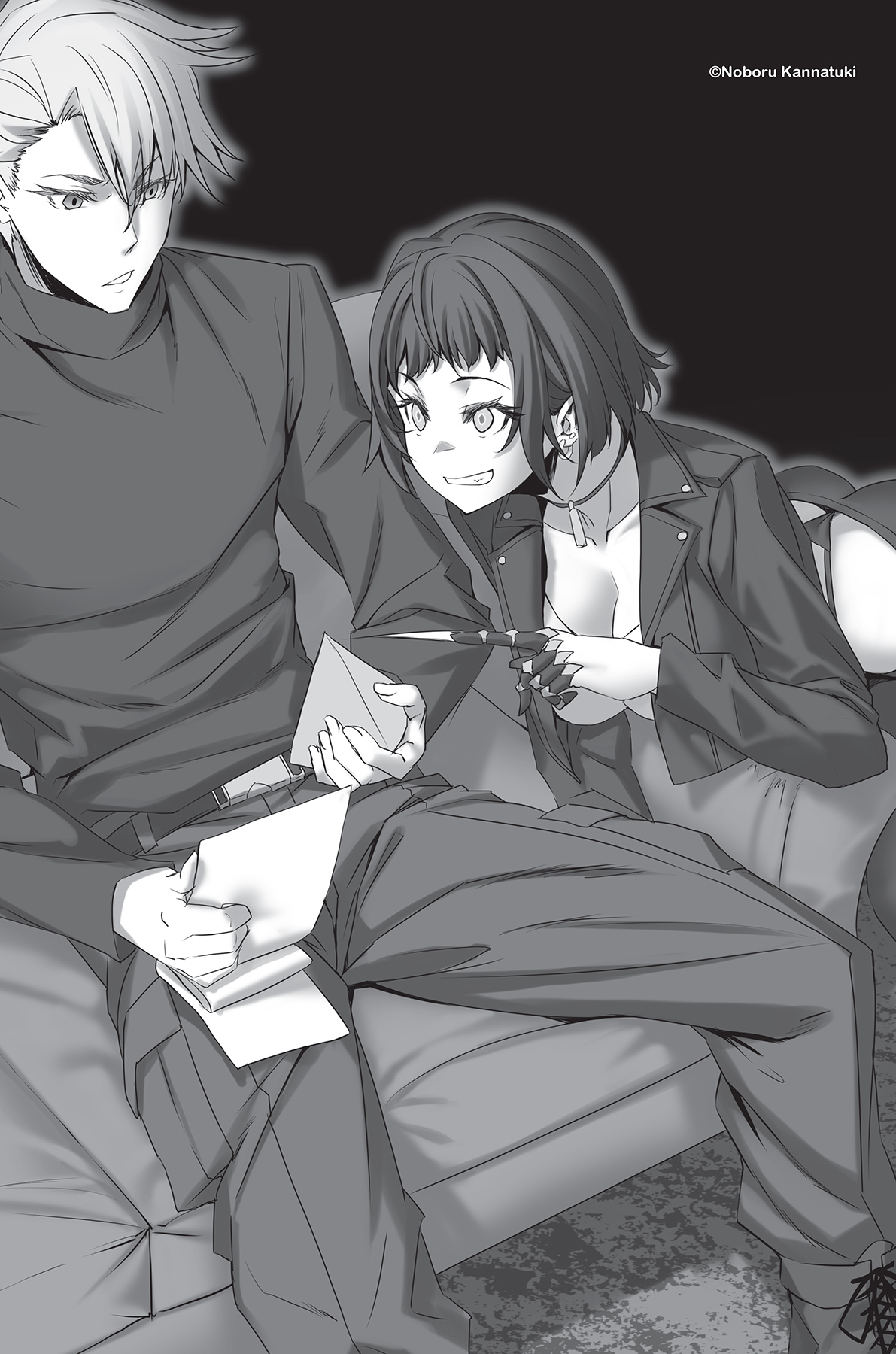
Hell, forget the odd jobs—I still hadn’t accepted her claws or her eyes.
I gave Nora my deadliest look. She gulped—“Urk”—but then her hackles raised, and she went for a counterattack.
“It’s because you’re such a skinflint, Danya!”
“I am not.”
“I’m going to tell Stasia on you, and then she’ll give you a piece of her mind!”
“Aw, go on. You’re going to be the one who ends up getting the lecture.”
“Boo!”
Nora really seemed to get her panties in a bunch when I didn’t even look at her. I just kept studying the map. She was so annoyed, in fact, that she jumped down off the sofa she’d so recently occupied.
“I’m going to the doctor’s—to Vrach’s place!”
“Don’t give him too many headaches.”
“I won’t. He’s not like you, Danya!”
I waved at Nora’s retreating figure.
“Ya poshla <I’ll be back>!” she yelled.
“Great. Ni pukha, ni pera.”
“K chortu, Bro!”
I laughed quietly as I heard the metal scrape of the manhole cover being pushed open, then resumed my focus on the map.
If Nora had really wanted to, her accelerated nerves and electrically heated nails could have reduced me to a pile of quivering flesh in no time flat. But I had never worried she would do that, and never expected to, from the day I was born until the day I died.
“Ahhh, how good of you to come, Comrade Danila Kragin!”
Commissioner Tachibana, who sat smiling in the office, was far more beautiful than I had imagined. Blonds are more my type, but there’s nothing wrong with a brunette, either. Commissioner Tachibana’s hair was a chestnut color.
I studied the office, while also thinking to myself that a woman in a suit didn’t look half bad.
—It’s the perfect picture of an office—stereotypical, I thought.
Of course, I’d only ever seen public officials’ and politicians’ offices on TV.
The decor was subdued. Things like awards and a national flag hung on the walls, and the room was home to a ridiculously large, L-shaped desk. On the desk were several CRT monitors attached to a single terminal. What did a person do with four screens at the same time? It was the same question I had when I saw Mariya’s room.
Each one showed something different, and you could only look at one screen at a time. Maybe two, if you really worked at it.
Next to the monitors, stacks of paperwork—the motherland runs on paperwork—piled up like a range of mountain peaks.
The commissioner’s smile never wavered as she flipped through the paperwork. Laborers got the same pay regardless of whether they worked, but for a commissioner, sabotage was a crime. If they didn’t want to lose their head, they had better be diligent. Work is glorious, comrade.
I watched the dust dance in the sunlight that filtered into the room through a thin lace curtain.
“I guess this is the part where I ask ‘viy po kokomu voprosu <what’s all this about?>’” I said.
“Davaitye po uzhe <Let’s get straight to the point>,” she replied.
I nodded and sauntered toward her desk.
“Is it really all right that I didn’t stash my gun before I came in?”
“But of course.” Miss Tachibana smiled brightly. Was this trust? Couldn’t be. “I know there’s no profit for you to gain from killing me.”
Ah, so she did trust me. I nodded again. That would make everything easier.
“I’m being paid to protect you. If you survive, I get my money,” I said.
“Da, vseo v poryadke <Yes, that solves both our problems>.”
The commissioner and I amiably started in on the details.
The People’s Commissariat for Finance, aka the People’s Logistical Commissariat for Finance, aka Narkomfin—the finance ministry. In short, it was a very important office responsible for cutting the cake that was our motherland’s budget.
And what post did Commissioner Tachibana hold in this all-important ministry?
—Ne imeyet znacheniya <Doesn’t matter>.
As a person without a passport, I didn’t exist as far as our motherland was concerned. Of course, even if I’d had one, it was the members of the Central Committee who so graciously ran the motherland for us. I doubted they cared what Danila Kragin, raised in a manhole, thought about anything.
The most I could do for the likes of them was to play bodyguard for council members on tour.
“Well, comrade. Thank you for being here to work with me today.”
“Certainly, comrade. The pleasure is mine.”
I answered Miss Tachibana’s smile with one of my own, then followed her out of the office.
Outside, a glittering black official vehicle waited for us—a ZiL limousine, which was very roomy and pleasant inside. A ZiL might be old news even among the masses, but their Packard-esque vehicles still saw a lot of service. Comrade Stalin had loved these cars, after all. Hence, so did everyone in our glorious motherland.
Now if only they could pave over the entire nation, everything would be perfect.
I walked once around the car, then peeked underneath, just by way of caution. It wasn’t like I really knew what I was looking for. I just wanted to make sure nothing seemed out of place. I would check if there were any weird parts, any scratches or marks—a less than beautiful car was a car that had been tampered with.
—Then again, the car can be perfectly safe, but if you get run off the road, it hardly matters.
After I spent a few minutes giving myself some peace of mind, I made for the driver’s seat, but Miss Tachibana said, “Oh, don’t worry. I’ll drive.” She held up a finger, from which dangled a key, and spun the key around.
The way she popped open the driver’s-side door and slid her shapely behind into the seat demonstrated she was used to this.
“You don’t have a driver, ma’am?” I asked.
“I happen to like cars. I like controlling them myself.”
“I’ll take the passenger seat, then.”
“Yes, yes. I’m a safe driver—don’t worry.”
I sure hoped so. But I didn’t say that as I got in my seat, just let out a sigh.
The door closed with a clack, and the engine turned over with a low rumble. There was a faint smell of exhaust gas; maybe even council members couldn’t get quality gasoline so easily.
“………”
The car gave us a good shaking as we went along, its suspension unable to cope with the ruts in the asphalt. I held on to my ancient PPSh and looked out the windows—left, right, behind.
What mattered to me were the workplaces Miss Tachibana was going to visit today and the route she would be taking to get to them.
I mentally opened the agenda that she and I had hammered out in her office. It included a long list of factories, offices, bases, official residences, and a slew of other public facilities. Apparently, she was there to make sure that the people were laboring away, as they were supposed to.
I didn’t know how important that was or wasn’t for budget distribution, but I did wonder if there was really any point to all this sightseeing. I doubted anyone could hope for a bigger budget as a reward for showing how serious they were—although a slash in budget as punishment for sabotage was common enough.
—I get it.
I stole a glance at Miss Tachibana’s black eyes—was that the Eastern blood at work? I didn’t know. I thought about how much effort it must’ve taken for her to rise in the ranks of Narkomfin. Her arms were delicate, yet when it came to budgets, she must’ve wielded a scythe with ruthless efficiency.
It had to be the military, I thought. They must chew through money like nothing else. There were lots of places they could find some savings, surely. So naturally she had a target on her back. I pondered the situation. Of course they were after her. Of course she would be attacked. Would she—of course—be killed?
Similarly, I contemplated what it meant that I was the only guard for a woman in such danger. Why use someone official when they could hire an easily replaceable Janitor? Because I was cheap? Because there actually wasn’t any need for security?
Would there be an attack or not? And if there was, who would I be facing? When and where?
What outcome, exactly, was Organ hoping for?
—Not something I want to think about.
I would just do the job I was getting paid for. I didn’t expect to have time to organize my thoughts about all those other things.
After all, Moscow hardly knew what a traffic jam was.
There was no attack.
Miss Tachibana’s inspections went off without a hitch, and she was most pleased with what she found at each stop.
She took a close, careful look at how things were being run, and when a worker pointed out that she’d dropped some rubles, she picked them up.
I figured this sort of scene played out all over our glorious motherland.
As jobs went, it was cushy. All I had to do was silently trail behind Miss Tachibana and look intimidating.
We did this from morning until night. For me, it was just one day, but this was how the people of Organ spent every day, and I had to have some respect for that.
“My goodness, it’s gotten late!” Miss Tachibana said as she slid into the driver’s seat after her final stop. She laughed, but it was nearly midnight. In the motherland, nobody ever thought of doing overtime, so this went beyond diligence and verged on masochism.
“Well, you know what they say—work is glorious.” I shrugged and got into the passenger seat. I was actually starting to get sick of its excessive softness.
I watched Miss Tachibana drive, noting that she seemed very used to it. I thought I could sort of understand how she must feel. I could just about guarantee that she hadn’t set the agenda for this tour. Someone else had told her where to go and what route to take, so I understood that she at least liked to drive herself.
“Oh, reach into the glove compartment, if you would,” she said suddenly, without looking at me, and gestured slightly with her hand that was on the wheel. “You’ll find a small gift there.”
I did as she suggested and discovered a paper bag. I took it out and found it bore the logo of a fast-food chain that had recently been making a name for itself in the Western bloc.
This was luxury stuff—you’d need entire rubles to eat this meal. And it was good enough to last for several hours in the glove compartment.
In the bag were two burgers wrapped in paper. I took one of them out.
“Hee-hee… Our little secret,” Miss Tachibana said.
“Are you sure this is all right?” I asked.
“Oh, hardly. But it is secret.”
“Hmm,” I muttered, and took a bite. It had Asian-inspired flavors, packed with fresh ginger, and it was very welcome to my empty stomach.
“I’ll join you,” Miss Tachibana said, and reached to take the other burger. She drove along, eating as she went—not very ladylike.
She took us to the Hotel Russia, which stood near Red Square—it was the biggest hotel in the Eastern bloc, even bigger than Stasia’s building.
“I find this place convenient when the hour makes it too much trouble to go home.”
Maybe it was because the hotel used to be a public building, or maybe it was because she belonged to the finance ministry—whatever; officials sure could be bold.
I shook my head and followed Miss Tachibana into the building, across some plush carpeting.
We took a birdcage elevator to the fifth floor, then walked down the hall to her assigned room.
She unlocked the door, but I went in first, swinging my submachine gun left and right.
The furnishings were pretty classy—I assumed that applied to the bed, as well. There was one window. A Nixie-tube alarm clock, connected by a cable to an outside power source, ticked away.
All was quiet.
“Come on in,” I said.
“Thank you very much.” Miss Tachibana smiled and entered the room, again looking like this was something she did often.
Me, I probably would have exclaimed, “God, I’m tired!” and collapsed on the bed. Nora definitely would have. Mariya might have sunk to the floor.
Stasia… What would Stasia have done? Giggled and grabbed my arm, maybe, pulling me down with her.
“All right! Fine work today,” Miss Tachibana said. With a start, I realized I had been lost in thought. I guess I was tired. Damn. “That’s all for the inspections. The only thing that’s left is to go back to the office tomorrow.”
“Just leave it to me, comrade.”
“Yes, thank you, I will. I’m glad there were no incidents today.” Miss Tachibana smiled again.
I had been assigned the room across the hall, but it didn’t look like I’d be getting much sleep that night.
There is no word for “safe” in Russian. All we have is a word that means “there is no danger right now.”
I had the distinct feeling that “right now” was about to be over. I stared at the flickering bulb. This was the so-called “eternal bulb,” which promised to give light for a very, very long time. Well, it made good marketing copy, anyway.
The light flickered on and off for a moment, almost as if it were gasping for breath.
I glanced at the Nixie-tube clock. It was 7:52 PM.
“Metel…,” I murmured.
“Ah yes. I think there’s going to be quite the snowstorm tonight…”
Sturmanskie: the first wristwatch in space, the one that had gone to the moon with Zond VIII.
I’d bought it from the old junk dealer for Mariya to practice on, and now it was on my wrist, saying 12:32 AM.
—Seven of them. Five cybers, two meatbags.
“…Tsk,” I clucked. This was going to be tough. My mind working so fast I was almost dizzy, I said what had to be said. “It’s an attack, comrade.”
“Oh, goodness… Do you suppose I cut their budget too thin?” Miss Tachibana frowned, looking almost like a child who’d been caught in a prank. She showed none of the panic of someone who might be about to die. “Is it always like this?”
“Depends on the time and place.” I grinned.
Purges make no exceptions. There’s always someone else.
Turns out politicians are like Janitors in at least one way: We’re both replaceable.
“I’ll buy you some time,” I said as I fixed a drum magazine to my PPSh and chambered my first round in the Tokarev. “You go out the window.”
“How am I supposed to get down?”
“Follow the heating pipes. Hold on to the outside wall and count to ten, then climb down and make for the parking lot.”
“Should I get the car?”
“No, wait until I join you. If it looks like I won’t be coming, get away on your own.”
I couldn’t exactly take responsibility for her from beyond the grave.
Miss Tachibana didn’t argue; she simply said, “All right. Be careful.”
“Careful enough not to die, at least.”
I supported her hips and behind as she climbed out the window. I think many people considered the lower half of a woman in a suit and stockings to be attractive.
—Maybe I’ll ask Stasia to wear some for me next time.
Even as I had the thought, I was lifting my PPSh and crouching beside the heater. I pulled my balaclava down over my nose and mouth to hide my face, then steadied my breathing. It was sweltering.
And then—well, you remember what happened, right?
It involved a grenade.
When she was really angry, Stasia was scarier than the spetsnaz.
Meaning the spetsnaz was about as frightening as Stasia when she was pouting—things were, you know, not ideal, but there was room to work, here.
“You assholes! What do you think you’re doing? They’re organics!” I could hear the squadron leader yelling at the top of his lungs as the muzzle of a gun poked out the window and sprayed fire into the falling snow. The voice was oddly high-pitched, and he was unusually small. He looked like a kid. A kid in body armor.
The spetsnaz with him seemed like folks who were being straitjacketed by professional ethics.
“It’s a 7.62 mm Tokarev round, Ensign Shest Rusalka.”
“‘Ensign’ will do fine, thank you.”
The voice sounded annoyed. This was clearly someone not enamored of their own name.
“A PPSh… That’s an outdated weapon,” the voice went on. “How many shot? How many killed?”
“Four shot. None killed. One immobile.”
“His circulatory system was done in. No danger of brain wave cessation, but he’s in no shape to continue the mission.”
“Damn Organ hired a halfway decent Janitor, I see.”
—Halfway decent but completely replaceable.
The order to follow them immediately went out. Then there were pounding footsteps, and I sighed.
I was clinging to the heating pipes outside the window, trying to listen as closely as I could. At times like this, that lot tended to assume their target had jumped straight down, and thus sprayed the area with bullets. A matter of seconds—a few or a few dozen—could be the difference between life and death. Like now, for example.
My opponents were down to two meatbags and only four cyborgs. Yippee! This was practically easy now.
—Yeah, right! I’m not Captain Ilya Murometz!
Spetsnaz: GRU’s secret weapon, the twin to the KGB’s Alpha unit. Each cell had seven people. I sort of assumed they had thrown the fewest number of personnel into this that they could—either it meant that this squad was strong enough to do the job, or they were letting us off with no worse than this.
Regardless, we were in a fight against time now.
I slid my hands along the pipes, working my way down to the first floor. The place was buzzing on account of the explosion, but there was no sign of the militsiya. Spetsnaz was keeping them away, I suspected. For once, I was grateful to them.
“Comrade Kragin, you’re all right!”
“Oh, hey. You’re alive.”
When I got to the parking lot, still holding my empty PPSh, I found Commissioner Tachibana huddled as small as she could make herself. Well, that was good news, at least. It meant I wouldn’t be working for free tonight.
Relieved, I kept her close to me as I gave the ZiL limousine a once-over.
“……Tsk,” I grunted. It wasn’t that anything was specifically wrong. But still, this was no good. The whole thing just felt dangerous.
When I glanced under the car, something seemed the tiniest bit off. Maybe it was just the snow that had accumulated while we were driving. Maybe it was a bomb. No way to know.
And I wasn’t interested in staking my life on something unverifiable.
“’Scuse me,” I said, and without a second thought, I raised my gun and smashed the window of the nearest car with the butt of it.
“Eek!” Miss Tachibana exclaimed.
“This is when you want a Lada Niva,” I said. They were everywhere, they were as easy to repair as they were to break, and they ran well. They were a treasure.
I reached through the broken window and undid the lock, then opened the door and slid inside. I gave the ignition lock cylinder a taste of my gun, then pulled off the cover and dragged out some cables. If I got these things connected the right way… There. We were up and running.
“Okay. All aboard, Commissioner. If you’d be so kind as to drive?”
“This is highly illegal,” she said, but she got in the driver’s seat.
I slid over into the passenger’s spot and changed the magazine on my PPSh. “That’s why you get someone whose existence you can deny,” I said.
“If and when the time comes, I’m going to say this was all your doing,” Miss Tachibana said, but then she chuckled. Soon the Lada Niva was on its way.
I guess being pulled over by the militsiya was leagues better than being a Janitor going toe-to-toe with the spetsnaz.
Which is to say, it wasn’t bad at all.
“I can’t believe this,” I groaned. You wouldn’t, either, if you looked in the rearview mirror and saw something that looked like a misshapen monster.
“Is something wrong?!” Miss Tachibana said.
“Don’t think about it. Keep driving!”
I looked back again, hoping it had been a trick of the eye.
—Bad freakin’ news.
It was there. I heard an engine that sounded unsettlingly eager, and a bizarre vehicle came rocketing down the road toward us.
It was like an armored monster, or like they’d made a cyborg out of an oversize shrimp or crab. Spetsnaz’s Horseshoe Crab. Supposedly, the KGB had introduced them, but rumor had it that GRU was using them, too—and it looked like the rumors were true.
I could have lived without knowing that.
“I don’t suppose they just happen to be out on separate business…”
You could hope and wish for deus ex machina like that, but it was obvious our backs were to the wall. Nichego ne podelayesh’.
I decided to do something I knew was utterly hopeless: I stuck my arm out the window and opened fire on them with my PPSh.
My Tokarev bullets hit the bulletproof windshield and bounced off like snowballs. Cracks spidered through the dark glass, but it was clear nothing had gone through.
“Vot tak!” I shouted. Almost before the words were out of my mouth, a firing port popped out, and an Abakan returned fire.
A storm of heavy metal came at me. I wanted to know which jackass had officially hired someone or something with two machine guns stuck to it!
“Turn!” I yelled.
“Which way?!”
“I don’t care!”
The Lada Niva was being torn up like a piece of paper.
Miss Tachibana wrenched the steering wheel, lanes and traffic lights be damned. Nuzhda zakona ne znaiet. Necessity was the mother of not giving a shit about the law. Anyway, Moscow’s streets, as I said, had never seen a traffic jam.
With a screech of metal, the car turned down an alleyway. It was too much to hope that the others wouldn’t be able to follow us just because the space was a little tight. Because the glorious motherland had seen fit to design Moscow’s streets in such an organized, logical manner, it was easy to circle around and cut someone off.
There wasn’t much to be said for my PPSh’s smoke screen, either— although it had bought us a few seconds, so it was still worth it.
I couldn’t help noting, though, that they came after us without the slightest hesitation. Maybe it was a matter of fighting spirit?
“Can’t believe they can even see with the windshield all shot up!” I groused.
“They have cameras all over that thing!” Miss Tachibana called back.
“You need to cut Aquarium’s budget a little more!”
Whoever it was ages ago who said big folks were slow folks was a complete moron who didn’t know what the hell they were talking about. You got a massive car? Just put a massive engine in it, and it’ll go plenty fast.
Our Lada Niva was huffing and puffing, and the Horseshoe Crab was catching up.
It was so noisy inside the car that I wished I could put my hands over my ears; I could hardly string two thoughts together. Was that more bullets bouncing off the chassis, or was it the cracked, battered asphalt under the wheels? No way to know.
“Wag the tail and let’s shake these guys!”
“You mean, like, swerve?!”
“Maybe?! Sounds good to me! Just do it!”
We avoided the red fang of one of the heavy metal bullets by a hair’s breadth—and by “avoided,” I mean it didn’t hit either of us. That was a product of the way the rear of the car was swinging back and forth, but of course, doing that cost us speed. And the other guys were awfully fast. This didn’t look good.
There was no point lighting them up with my PPSh. Any minute now, they were going to be on us, and then they were going to skin me and eat me alive.
Wide eyes are fearsome. That’s why you get scared. The ones who get scared and run where they think there’s an escape get chased down and die.
But then again, if you run somewhere there’s no escape, well, you get cornered…and die.
“‘If you call yourself a mushroom, get in the basket,’ huh?”
Once you decide to do something, fucking do it. So fucking do it, Danila Kragin.
I shouted: “Keep going! Straight ahead!”
“What?” cried Miss Tachibana, who was clinging to the wheel for dear life. “What?!”
“Just do it! No one in our glorious motherland works overtime!”
Miss Tachibana was about to say something, but you have to keep your eyes ahead when you drive. Not to mention, there was no time for it.
The Lada Niva, looking like a piece of raw meat, plowed into the supermarket.
“A-are we…alive…?”
“Yeah. If I let you die, I don’t get paid, remember?”
We crawled out of the Lada Niva, which looked unlikely to ever move again, and into the store.
The place was a wreck—well, I couldn’t see at first. It wasn’t like I had PNV. But as my eyes adjusted to the darkness, I could tell. The car had plowed into rows of empty freezers, smashing the glass and scattering the frames everywhere.
Didn’t matter. The store was a big place, with plenty of things to hide in or behind. And lots of entrances and exits, too.
Then there was the fact that the spetsnaz wouldn’t just come racing in. I mean, this was the special forces we were talking about, right? They weren’t some half-cocked Janitor. These guys were elite. They’d be careful. Consider possible traps.
They’d ask themselves: Was it just an accident? Had we been crushed inside the car, or were we merely injured and not hiding? Was it an ambush?
They were well drilled on when and how to use their armored vehicles, and they could bring them to a halt at a moment’s notice.
Plus, there were seven of them—no, six, I guess. And that was assuming there wasn’t anyone else in the vehicle. But anyway, with that number, they wouldn’t be able to surround the building—or cover all the exits.
When it came time to see whether we were even still in the supermarket, Miss Tachibana and I could only hope and pray. Me, I would have long ago given up and just blown up the entire store, but the spetsnaz wouldn’t resort to that, I didn’t think. If they’d wanted us that badly, they would have sent more than one squadron, and I would’ve been dead long before I could be pondering this situation.
Iz pushki po vorob’yam ne streliaiut <Only a fool shoots a sparrow with a cannon>.
Which was another way of saying that those guys had no choice but to check the inside of the supermarket. Even better, they’d have to split up their meager forces to do it, some outside, some inside. They were probably tearing their hair out about it.
Not like I would stick around to play hide-and-seek with them. I was going to kick that table over and run away.
We would have to get out of the car and make our way through the store as fast as we could, in a matter of seconds. We would have a few precious minutes until they figured out for sure that we weren’t in here.
To gain that time, though, I needed Commissioner Tachibana to hurry and get on her feet.
“We’ve got to go. Unless you’d prefer to stay here and die?”
“N-no, let’s go…”
If we went quietly, we could get that much farther.
Even before we heard the screech of the spetsnaz hitting the brakes on their Horseshoe Crab, we were already crouched low and rushing through the store.
Most of our motherland’s buildings have similar layouts. The spetsnaz knew that as well as we did, of course, but in this case, it worked to our advantage. For example, even in a place you hadn’t been before, you never got lost looking for the toilet.
We exited via the service dock, then disappeared into the Moscow night, leaving no trace.
“Where do we go now?” Miss Tachibana asked.
“Somewhere they won’t come looking for us.”
As we ran, I detached my PPSh’s spent clip and traded it for a new one. Just because it wouldn’t scratch them, that was no reason not to keep the gun loaded.
Letting my hands do the work by muscle memory, I scanned the night for the “blizzard.”
I found her in a flashing signal. There was an intersection—the lights straight ahead and to the left were red, but the one to the right shone green.
The number showing how long the light would stay green never changed, just flickered, urging me to hurry.
Man, I had such a great little sister. Without a second thought, I dove down the road to the right.
We went left at the next intersection. Then straight ahead. Right, right. Straight.
Nothing wrong with the guys at TsODD, the transport organization center, helping us out with our work once in a while, right?
And it led us to…
“Yes! Perfect timing! Vibro!”
A GAZ truck pulled up in a sidelong drift, tires screeching, and halted right in front of us. In the driver’s seat, wearing dark sunglasses even in the middle of the night to protect his eyes from snow blindness, was Valery.
“Hey, Big Bro! Your ride’s here!”
“Thanks. Good work.” I reached through the window and mussed his hair, then headed for the covered bed at the back. The rambunctious kid was a certified contrabandist now.
Frankly, I had almost as many objections to that as I did to Mariya’s occupation, but at least he had a job.
It was better than Nora, anyway. I tossed my PPSh in the back and clambered up behind it. “Commissioner, you ride in the passenger’s seat. Valery, be polite to her.” The corners of my lips turned up in a smirk, and I was glad they couldn’t see me. “She’s a gospozha <proper lady>, after all.”
“All right. Thank you for your troubles, comrade.”
Of course, I couldn’t see them, either, so I didn’t know what expression was on the commissioner’s face.
As for Valery, I didn’t have to work to imagine his expression as he chirped, “Just sit back and enjoy the ride, Miss! I’ll get you there safe and sound!”
I bit back a laugh as I settled against the bed and waited for Valery to get going. He was putting on a bit of an act—do you suppose he realized it wasn’t quite working? I was assuming, of course, that it wasn’t “Technical” driving the car.
Technical being the name of the heavy machine gun mounted on the truck.
The vehicle was more advanced than the covered wagons society had three hundred years ago, but then, so was everything else. In other words, that advancement only made so much of a difference. And the people coming after us were wielding the most cutting-edge technology available, so we had absolutely no wiggle room.
“Hey! Here they come!” I shouted, and pounded on the sheet of metal between me and the driver’s seat. I could see the shellfish-like armored vehicle.
“I hear you, Big Bro! Try not to fall out!”
“Real cute!” I shouted back. “That’s Lubyanka behind us—just floor it!”
The GAZ wheezed like the ancient vehicle it was before it shot off into the streets of Moscow. Trying to stay upright despite the relentless shaking of the truck bed, I worked my way over to a gun mount that had been attached in an amateurish weld job.
But the mount was all that I found.
“Hey! Don’t you have any weapons back here?!”
“Oops!” I heard Valery shout. “I pitched ’em when the militsiya came sniffing around!”
“Well, aren’t you just a fucking genius!”
If he’d been five years old again, this would have earned him worse than a spanking.
I grabbed something long and thin lying in one corner of the truck. When I pulled the tattered cloth off it, I found a Degtyaryov heavy machine gun.
“Wh-whoooa…”
While I was busy fixing the thing to the gun mount, though, the spetsnaz’s Abakan opened fire again. Bullets tore through the cover without pity or mercy, and I had to get on the gun while it was still only half attached.
“Ya poshol <Here we go>!”
There was a deafening roar, and spent shell casings clattered everywhere. The flames hurt my eyes, and I could see sparks blossom on the armor.
Like before, I was aiming for the windshield, but there was no evidence that the bullets caused damage to even obscure their vision. If I was lucky, I might take out a camera or two by sheer chance, but I didn’t know where they were mounted.
—I knew spetsnaz were on a different level.
I smiled. Ivan had been “on another level” way back when, too. If I hadn’t used the trick I had, I’d be dead now.
“C-couldn’t you have picked a better car?!” I heard Miss Tachibana shout from up front.
“It’s a budget problem, Miss!” Valery quipped back. He gave the truck’s tail a big swish—which meant I got the same treatment in the back—and hauled it around a corner. I was being shaken around, but not so much that I couldn’t pick up Miss Tachibana’s profound sigh.
“Maybe I cut a bit too deep.”
“Give Organ ten times what they’re getting!” I shouted. Then I could get ten times the reward—yeah, right! At least I might get a few extra rubles. I didn’t think it would be too much to ask for taking on spetsnaz forces trying to nail me from an armored vehicle. Even if I knew my life wasn’t worth all that much.
“Seriously?!”
I could hardly believe my eyes. The pursuing vehicle’s hatch opened, and a small, bullet-resistant, armored figure emerged. They jumped nimbly, leaping through the air.
That had to be the squad leader. Their movements were inhuman, more like those of a wild animal than a cyborg. Like those of a leopard or some other rainforest animal that I’d only seen on TV.
Of course, it wasn’t like I had a luxurious second or two to indulge in those reflections. All I saw was the squad leader kicking off the roof of the armored vehicle and rocketing straight toward me. By the time their hand was reaching for my collar, I could really only react on reflex.
“Hiiiiyahhhh!”
“Hrk?!”
I was inspired to shout really loud as I lifted my right foot up and kicked the Degtyaryov as hard as I could. The bolts popped loose, and the crappy weld gave way. The machine gun tumbled, gun mount and all, out of the truck.
“Wha—?!” shouted the squad leader—anyone would have—as the pile of metal connected. Their voice was a higher pitch than I expected, and now their body was bowled over like a small animal. The switchblade they’d been holding flew out of their hand and disappeared into the street.
—Thanks, Ivan. I’m still alive.
But goddamn. This was no joke.
Only one of the toppled pair got run over and ground into the asphalt by the Horseshoe Crab behind us, sparking as it bounced along the road—and it was the machine gun. The squad leader tumbled along the pavement for a second, but then bounced like a ball back into the air. Then, like a videotape playing in reverse, they lunged backward and landed on top of their vehicle.
“Resistance is futile!” came a shout from the driver’s seat—I couldn’t tell if that monster back there was even human. And I had plenty of reasons to think so.
“…Tsk!” I grunted.
“My Degtyaryov!” Valery cried.
“That stupid gun was throwing the truck’s balance off!” I shouted back, even as I tore around the truck bed, trying to find my next plan. “I’ll give you a bundle of cash to customize this thing—try to think it through next time!”
“Hell yeah!” Valery honked the horn a couple or three times to celebrate his windfall. I wasn’t the only one who thought it was obnoxious.
The squad leader wasted no time in aiming the Abakan atop the Horseshoe Crab right at me. Almost instantaneously, heavy slugs were howling toward me. They shredded the cover over the bed of the truck and riddled the chassis with holes. Valery groaned again, and Miss Tachibana screamed.
Sparks flew everywhere, and I could feel bullets passing inches away from me. All the hair on my body stood on end, and my breath came in ragged pants. I could’ve cried. But I stayed glued to the truck bed. Just like I was clinging to my Tokarev.
I kicked the box of heavy-machine-gun ammunition out of the back of the truck, figuring it wouldn’t be any more use to me otherwise. Brass shells scattered all over the road with a sound like salt coming out of a gigantic shaker. I sort of appreciated the dim golden sheen they had, but the point was that with those things underfoot, even a car would start to slide…
“Or not, I guess!”
The Horseshoe Crab simply drove over the casings like they weren’t there. I know, I know. But I didn’t care. I didn’t have time.
I whipped out my PPSh and unloaded. Seventy bullets was an accounting error by now.
“Wha—?!”
If I’d mechanized my eyes, I’m sure I would have seen the squad leader’s eyes widen behind their gas mask. It looked like we finally understood each other, but it was a little too late. And the folks in the Horseshoe Crab were never going to grok me.
The next second, the ammunition case that had eaten a magazine from my PPSh went up like fireworks. There were explosions, flashes, bombs flying everywhere as the contents lit off one after another. This went way beyond scattering some fireworks—not that that wasn’t obnoxious enough.
Armor-piercing rounds went every which way—including straight at the oncoming Horseshoe Crab.
Of course, that thing could run over a land mine without getting a scratch. I wasn’t going to take it down with this little trick. But it was more than enough to serve as a distraction.
For a moment, the massive vehicle swerved from side to side. Shaking violently atop the Horseshoe Crab, the squad leader didn’t bother to hide their annoyance. “You…sons of…bitches! Don’t you know what you’re doing with that steering wheel?!”
It bought us a few seconds, and Valery, bless my little brother, made good use of them. He stopped zigzagging and put the pedal to the metal, picking up speed as he went around the next turn. That was all. But it was exactly what I wanted him to do. It was what I had fought so hard to buy time for.
I managed to read the letters on the signs as they passed overhead.
Lubyanka Square.
Naturally, we hadn’t flung this truck all over Moscow just for some sightseeing.
But just as naturally, it wasn’t like we were going to the toy store, reputed to be the largest in the Western world, that stood in the square.
I was aiming for the building next to the toy store.
What do you do when the king of the local bullies picks a fight with you? Imagine he’s especially big and scary. You don’t have any hope of beating him in a straight fight. So what’s the plan? Go crying to Mom and Dad.
Sadly for me, I didn’t have any parents.
That left me one place to turn—our nation’s security forces, the KGB. They’d treat me right, wouldn’t they?
“Koshmar!”
Even the GRU spetsnaz wouldn’t go ballistic right in front of the KGB headquarters. That would go beyond a little harassment—that would be politics. And politics meant trouble. Something nobody would eagerly sign up for.
The squad leader cursed and shouted at their men to hit the brakes, and the Horseshoe Crab slid to a halt.
“Hah…haaah!”
I somehow managed to peel off my balaclava as our pursuers swiftly grew smaller in the distance. The night air was cutting cold, and it helped strip my cheeks of the flush and sweat that had built up there.
Guns didn’t work. Machine guns didn’t work. Cars didn’t work. We were dealing with the spetsnaz, and I was just a Janitor. Chance of victory: zero.
Just one thing to say, then, one thing to do.
“Beg for help! Pomogi, zhe!”
Waiting for me—well, really, for Miss Tachibana—was a gleaming black Volga, an official’s car. It shone so brightly that you could see it even in the dark of night. Standing beside it was a man in a black suit who seemed to emerge from the darkness itself.
It wasn’t normal—guys who bothered this little to hide what they did. I was pretty sure the KGB didn’t carry business cards. No more than a Janitor did.
I somehow managed to crawl out of our bullet-riddled truck, a far cry from the sleek black Volga the KGB had. They were both GAZ vehicles but were almost disgustingly different.
That went for us, too. The KGB man wore a suit without a single wrinkle; I stood there in my filthy body armor. In fact, I was starting to feel a little disgusted with myself.
“Good work, Comrade Kragin,” the suit said.
“Please. It was nothing.” I shrugged.
It was true—it was nothing. I just did what I could. This was the result.
If the spetsnaz had been serious, I would be dead already, along with Miss Tachibana and Valery. This was about the level of work that I was cut out for—but I damn well did it.
“Vseo v poryadke, yes?” the man whispered to me.
“Da,” I whispered back.
“Khorosho.”
By that point, Valery was already helping Miss Tachibana out of the passenger’s side of the vehicle. He was probably just imitating what he’d seen in some movie or comic book, but he actually looked pretty good. Except for the Swiss-cheesed truck.
“Here you go, Miss,” he said. “Had a good ride?”
“Y-yes… Yes. It was very…exciting,” the commissioner said, smiling as she took his hand and stepped down. Our motherland might have been collectivized, but a woman like her would always have a secure future, I figured.
Miss Tachibana passed by me elegantly, her heels clicking on the ground. “Spasibo,” she said as she went. “I see we have some excellent Janitors. I hadn’t been aware.”
“Ne za chto <No problem>… Please feel free to call on me the next time you need something.”
“I could say the same. If you’re ever in need, don’t hesitate.”
And then, with the grace of an actress—which is to say, with a grace like Stasia’s—she got in the back of the Volga.
Only then did I let out a deep sigh. I asked Black Suit the one thing I needed to: “What about my reward?”
“You’ll get it from Metel.”
Then Black Suit got in the driver’s seat, without so much as a glance at either the Janitor or the Janitor’s little brother.
From behind the quality bulletproof glass, he said just one thing to me. “Another fine job, Comrade Kragin.”
“Pozhaluista <You’re welcome>,” I answered. I didn’t know if he heard me, or even if he wanted to. By the time the words were out of my mouth, the Volga was already driving away, taking Miss Tachibana with it.
Whatever Organ was after, if they’d wanted her alive, they could breathe a sigh of relief now.
My job was done.
In the end, the fact that I was still breathing was thanks to the territorial tug-of-war between several different organizations, and the fact that they weren’t willing to go all out.
The Politburo, the KGB, GRU: Janitors like me were caught in the middle of the tangled web they wove. I just kept dancing over the ice, without having time to test whether it was thick or thin.
Each time I had to think about that fact, I felt like a dead man walking.
“Big Brother! Valery! Good work.”
“Yipes!”
When Mariya appeared unexpectedly—and soundlessly—out of the darkness, Valery jumped a foot in the air. Nora was beside her, like a black cat. She couldn’t hide the smirk on her face, and she gleefully extended and retracted a claw from her fingertip.
“Myaaau ♪!” she chirped.
“Huh. You’re both here?” I said.
“Hah!” Nora sniffed importantly. “I’m helping my big sister, Mariya. No criticisms there, right?”
“Maybe not.”
I met Mariya’s eyes, and she nodded at me with a pained smile. At least Nora was telling the truth. Fine, then.
Valery, of course, was not about to let the sad state of his beloved truck go unremarked. He clung to its side, slapping his breast theatrically and yelling at his troublemaking sisters: “You gotta stop this! I thought I was going to die, y’know?!”
“Ha-ha-ha! You’re such a chicken, Valery!”
“You can’t twitch and squirm at a job like this. These things happen practically every day in Moscow.”
“I was starting to feel pretty chicken myself by the end there,” I said with a great laugh. Nora guffawed, but Mariya’s look grew sharper. I guess she didn’t feel like lecturing me at the moment, though, because she let it go with one sharp cluck of her tongue. Instead, she pulled out an envelope and handed it to me.
“Na, Brother.”
“Ooh!”
In the envelope, of course, was a bundle of rubles. Crisp, clean bills. I gave them a few flicks, just to feel them under my fingers. I was no Madam Pisken.
I split the bundle of bills in two, snapped a rubber band around one pile and held it out to Valery.
After a second, he said, “You sure, Bro?”
“Aw, just take it. You did a job—a man’s job. You deserve it.” I stuffed the bills in his pocket without another thought for his hesitation. I knew if I didn’t, he would never take them, and if he never took them, he would never be able to fix his stupid truck. “That should cover your trouble and the repair bill. Don’t blow it on anything else.”
“Yeah, yeah, I know.” He nodded grudgingly. Good enough.
I divided the remaining pile into thirds and put rubber bands around two of them, then I handed the two banded piles to Mariya. “Living expenses,” I said. “You need food, you need whatever, pay for it with this.”
“Brother… You don’t…”
I guess Mariya had some objection, but I wasn’t interested.
I didn’t have an education, and I was no mathematician. Mariya was a lot better than me there. But I knew one thing about numbers: It never hurt to have more money.
“Don’t blow it on anything else,” I repeated.
After a very long pause, Mariya finally said, “All right,” and took the bills, holding them tightly, carefully.
I knew where she would probably put them—in a tin can hidden behind a wall in our house. Or maybe she kept her savings somewhere else now. I wasn’t going to go looking for it.
I took the final pile—a pretty thin one by now—and wrapped a rubber band around that, too, and put it in my own pocket.
There. Now we were all done.
We were standing in front of Organ’s building in Lubyanka Square. The place was as good as deserted.
It was deep into the night, and the streets were empty. I could hear a car in the distance. Gunshots.
My breath turned the color of the streetlamps as it left my mouth, drifting in front of me before it dissipated. The heat that had flooded my body ebbed almost immediately, leaving me gripped by a prickling cold.
“Hey, Danya!” Nora exclaimed. “Where’s my share?”
“Your share?” shot back Valery. “You didn’t do anything!”
“Did too! I did my part of the job!”
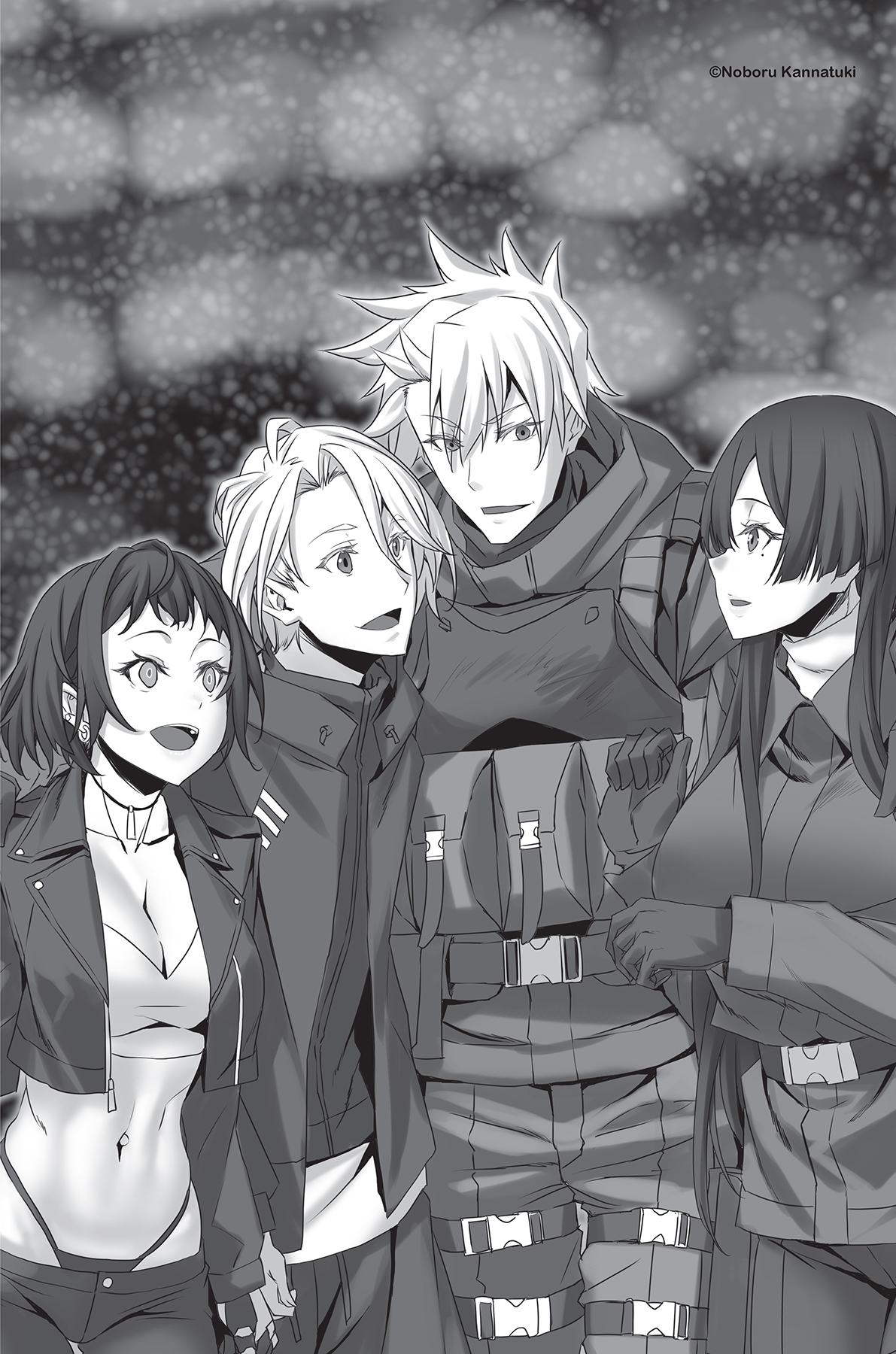
“Which was what?”
“Protecting Mariya!” Nora snorted and puffed out her chest, which was as large as her older sister’s.
Valery snorted back. “Get your big sister to pay your share, then—don’t ask our brother!”
“Booooo! Mariya! Valery’s being mean to me!”
“Both of you, stop fighting. Oh, for… Argh! Brother?”
“Okay,” I said. I patted each of them on the back. “What say we go home and get something to eat?”
“Say, comrade, did you hear?”
“Word is some guy went toe to toe with Aquarium and lived to collect his pay.”
“Huh?! With spetsnaz? Not half bad.”
“Eh, so what? He’ll be dead soon enough…”
It’s true—everyone dies eventually.
The Janitors’ rumors do reach my ears now and again; sometimes I even contribute to them myself.
You hear about particularly capable Janitors every once and a while, but eventually, you stop hearing about them.
Maybe they died, maybe they retired, maybe they changed riverbanks—no way to know. And I wasn’t interested.
I’ve got nothing in common with those back-alley legends, the Baba Yaga fairy tales people tell and have always told in the shadows. I’m not Uchitel, the Teacher, and I’m sure not Captain Ilya Murometz.
That’s what it means to be a top-class, run-of-the-mill, replaceable part.
“Mn… Ah…”
I ran my fingers along the curves of porcelain-white breasts, which rose and fell in time with her breathing. She twisted and moaned, looking like she was drowning in a sea of white sheets.
—Who benefited? That’s the question.
The KGB got to save on its budget and put Narkomfin in its debt.
GRU got to flex its intimidation muscles without losing a single person. Miss Tachibana survived, and she would loosen the purse strings for GRU a bit in the future.
Mariya got to show off what she could do, and since it all wrapped up nice and neat, she’d probably been paid well.
And then there was me.
I survived the affair and got my money, and here I was fondling a pair of pale, beautiful, perfectly formed breasts.
The only piece of clothing I had nearby was battered old body armor full of holes.
“Danya…”
My own name caught me off guard. A pale hand ran through my hair.
In almost the same motion, my nose descended toward the snowy peaks, and I took a lungful of the sweet aroma of soap.
“You were thinking about something else just now, weren’t you?”
I looked up and saw moya lyubimaya <the person I loved most>. Her cheeks were flushed, and her eyes gleamed, damp.
Knowing that I was the one who had made her that way fired my manly pride.
“Nyet. I don’t like when your mind’s not on me,” she said.
“Will you mend my outfit?” I asked.
Her answer was her lips on mine.
“Ngh… Daaa…nya… Danyaaa…!”
Stasia’s breath came harsh. It was like she was gasping for air, and she breathed from my mouth.
Our tongues reached out hesitantly, then entwined. I answered her seeking.
“Oooh… Ahhh… Ahn! Daaanya…! Mmm… Oh! Danya… Danya!”
Once upon a time, I had thought a hundred rubles seemed like enough money to buy the whole world. But what about now? Right now, this one night was everything to me.
So I put everything on her—all the kindness I could muster, focused completely on loving her.
It was about as much as a Janitor could do.
A Cute Girl

“Ooh, you’ve done it now, Janitor!”
“You’re freakin’ dead!”
Well, that was a pretty fair assessment of a guy being chased by two cyborgs, I thought.
And most Janitors who twisted their ankles jumping from the second story of an apartment building subsequently died.
“Tsk! This is why I hate the guys with shock absorbers…!” I grunted, cursing the other guys’ spring legs as I rolled into a back alley piled with gray snow.
I thought I had a pretty good handle on Moscow’s alleyways. Thanks to His Excellency the Man of Steel, they were all the same.
No sooner had I hopped behind some cover, dragging one leg, than the concrete wall was shredded.
“Stand still, sobaka!”
I was all too aware that the griping cyborg was carrying an absurdly large machine pistol. Anyone who would happily carry—let alone use—a VAG-73 was either an idiot, ex-military, or both. The bullets that thing fired were basically rockets, each bigger than Stasia’s lipstick. And unless I was misremembering, it carried forty-eight rounds. Listen, you didn’t have to shoot somebody that many times to kill them. Especially not a meatbag like me.
The guy was currently unloading at the wall on full auto, so yes, I was as good as dead.
I was hoping he would be closer to the idiot end of the scale, but I hadn’t run into this alleyway banking on that.
He was a mafia enforcer. I’d known they were strong since I was fifteen years old.
“Davai!” I shouted, and twisted toward him, then pulled the trigger on my PPSh submachine gun.
A multitude of 7.6 mm Tokarev bullets went flying like water from a hose. They filled the narrow alleyway, sparking off the cyborg in front.
“Hngh?!”
“The hell do you think you’re doing, trus!”
The second cyborg dodged his stumbling companion and squeezed past him, his armor scraping against the wall as he plunged toward me.
—That’s what you get for not doing some exercise, losing a little weight!
If I said that sort of thing to Stasia or Nora, they would have scratched me bloody. I dove around the next corner.
You know, I guess Mariya wouldn’t have been any happier. She spent all her time cooped up in her room. I detached the PPSh’s empty magazine.
I’d have to get Valery to drag Mariya out with us sometime. I flung the spent clip at my pursuer.
There was a distinct metallic crack, and the clip twisted into scrap in midair.
“Your hand grenades won’t work on us again, boy!”
“Whoops!”
If he thought that was a grenade I’d thrown at him, so much the better. I smiled under my balaclava and lunged around another corner.
That was ten shots—Captain Murometz would count the bullets like that, aiming to run them out of rounds.
Sadly, however, I was not Captain Murometz. I wasn’t actually sure if the guy had fired ten rounds or twenty, and besides, think of how much a VAG-73’s clip could hold. And there were two of them. After ninety-six rockets had come my way, I was going to be a pile of quivering flesh.
The only reason I was still alive was because I was hightailing it around these narrow alleyways, and I figured the guys would work out a way to deal with that pretty soon.
Of course, if they were a couple of idiots, it would be a different story. I’d been hoping—but, well, it was probably too much to ask.
One meatbag Janitor taking down two cyborgs head-on? You would need protection from the unscientific being they called God, or it would never happen.
Which meant that today, as always, I was just going to have to do what I could.
“Come on, Danya. Don’t you have to help Mariya today?”
“She hasn’t had enough respect for her big brother in a long time.”
I sank into the soft cushions without a second thought and stared at Stasia’s ass. Her jeans were so fitted they looked legitimately tight, like you could stick a finger in there and immediately bury it in her butt. I actually thought I heard a little squeak every time her perfectly formed legs moved.
I felt like I understood kids who would just stare at the same thing forever and never get tired of it.
“She’s always howling like a blizzard,” I added.
“I think she’s trying to get your attention, Danya.”
“That right?”
“Uh-huh.”
There was another squeak, and the adorable ass turned. Now I saw Stasia smiling.
If she backed up what she said with a smile and a nod, then I was sure it was true. What she said was always right.
A bonus: When she followed up her words and stepped out of the kitchen, there was a steaming soup pot in her hands.
I rubbed together my own hands, which had so recently been gesturing while I complained about my little sister. “Hell yeah,” I murmured.
“Here, the borscht is ready,” Stasia said.
“Great!”
It had been many years since I first ate Stasia’s borscht, and it had a lot more ingredients now than it did back then. I was openly overjoyed about the food and the act of eating it. There wasn’t one bad thing about it.
She put down a classy bowl in front of me, and I dug in ravenously.
There are all kinds of ways to make borscht, but I liked red borscht with beets, topped with smetana. Or anyway, I do now. Like and dislike don’t really apply when you’re just desperate for something to eat.
Me and my siblings’ food preferences mostly came to us by way of Stasia. That included coffee. I savored the taste of the soft pieces of stewed meat as I chewed.
Normally, I would be completely enraptured. There was nothing in life more important than Stasia’s borscht. Except for one thing: Stasia herself, who at the moment was watching me and smiling.
She put her elbows on the table and rested her chin in her hands, just gazing at me quietly. Her eyes crinkled as she smiled. It was great that she was in such a good mood, but I wished she wouldn’t look at me like she was watching a kid.
I started to feel self-conscious about how I was wolfing the food down. Not letting go of my spoon, I said, “You’re not gonna eat?”
“I like to watch you eat, Danya,” she replied.
I clucked my tongue. That only amused Stasia even more. She looked like she might break out humming.
Shit, I really was a kid, wasn’t I? I didn’t like this at all.
I waved my spoon like I was stirring the air, and finally I managed to open my mouth. “Forget about me. Just eat. I’m gonna lose my appetite with you staring at me.”
“Yes, yes, all right.” At last, Stasia started in on her own meal. Her tongue was as delicate as a cat’s. It was built different from mine—I liked the food to be as piping hot as it possibly could be. So while I wolfed it down, Stasia took neat little spoonfuls of borscht, blew hard on them—foo, foo—and finally put the spoon carefully into her mouth.
Then she nodded, satisfied with her own cooking, and swallowed.
The way she did it was really lovely, and I found myself thinking, Oh, so that’s proper etiquette.
It also seemed to me that the air about her hadn’t changed since the first time we ate together. Whatever this was, maybe it was something Stasia inherently possessed…
“……Danya?” she asked after a long moment.
“Huh?”
I was watching her so closely that I noticed immediately when she glared at me. I wondered what it could be. Was it bad manners to leave my spoon stuck in the borscht?
Without a word, Stasia beckoned to me. I leaned forward. So did she.
“…Mn!”
Supporting herself with her hands on the table, she gave me a kiss like a bird’s peck. Her tongue carried the taste of borscht.
Who cared if the food sat for a while? Her borscht was the best in the world, hot or cold.
I spent that day like so many others. Really, nothing unusual about it.
“Finally decided to come back down, eh, Danila Kragin?”
“H’lo…”
Everything was so normal that of course I had to run into the old lady. The moment the elevator door clattered open, there was Madam Pisken with her hawk nose. It was bad for my heart.
Sometimes I got the feeling that the kopecks I tossed into the elevator were specifically to meet her. Maybe I’d try taking the stairs next time—although I suspected she’d be one step ahead of me.
“Well, well. I see you’ve combed your hair today, and even washed off the mud and dust. So you’ve been holding out on us.”
When Madam Pisken stood there, this luxurious hotel and its luxurious lobby became her stage. Now the star of the show reached out importantly with her clawlike fingers, poking me in the shoulder and then in the side. “Can’t say I think much of you showing up in your usual savage’s outfit, with your little toy!”
The pain made me feel like I would have rather been hit with heavy metal bullets. Although for that matter, I was sure the madam’s fingers were made of heavy metal themselves.
“Ivan did say he was always in the most danger when he came here,” I said.
“You’re the one who’s dangerous, not my establishment!”
Bam. She had me there.
Stasia was never wrong—but the same was true of Madam Pisken. She was a spindly, withered little old lady, but she was as precise and as merciless as a cyborg ten times her size. If I saw her show up in some Moscow alley, I would throw down my gun and put up my hands.
Happily, Madam Pisken would never do anything so uncouth.
Unhappily, she was indeed standing in front of me at that moment. There was no escape.
I was a Janitor, though. I wouldn’t just show up here without being ready. Standing tall, I showed her the brand-new seams in my body armor.
“Feast your eyes on this,” I said. “Stasia did all this careful work, just for me.”
“I did that work. So don’t act shocked that it came out so well.”
I deflated by about two sizes.
Madam Pisken snorted and, in a voice that knew neither pity nor mercy, said, “You shouldn’t be bothering an actress with trivial busywork anyway. What if she pricked a finger?”
Slowly I said, “Yes, ma’am.”
“Bring that thing directly to me next time.” She snorted again, and then, with an elegant motion, she held her palm out to me. I obediently took an envelope out of my pocket, counted to make sure all the rubles were there, then gave it to her.
“Here,” I said.
“Good.”
She put the envelope in her dress the way a noblewoman might tuck away a fan.
Only then did I let out a sigh of relief.
“Hmph, don’t worry about your outfit. A black-tie ensemble wouldn’t suit you anyway.”
Trying to dress up would only make me look foolish. The madam might not pull her punches, but in this case, I agreed with her. My little brother and sisters might get away with it, but a Janitor who had to count every bullet? He had no business showing up at the Bolshoi Ballet.
Then again, launching a surprise attack right when you let your guard down is the most basic of basics for a Janitor. Madam Pisken might have once been a top actress—but I was sure she would have made a top Janitor, too.
“But if you ever do show up for one of her performances, at least wear a tie,” she said.
“Urk.” I gulped. Come see a performance. I know, I know.
The madam might be a woman without pity, but it was nothing compared to how she would be if I didn’t respect one of her lectures.
I looked at the painting on the ceiling, hoping it would inspire some halfway decent excuse. I didn’t know who had painted it—the only thing I could think was that it must’ve taken a very tall ladder.
Do you suppose whoever did it had a lifeline to catch them if they fell? Probably not—or maybe they had some smarter way of painting than I could ever think of.
Seeing that I had grown another size smaller, the madam gave me a disgusted look. “You make enough money to pay for your visits. Don’t tell me you can’t afford a ticket.”
“Well, you know. Stasia’s performances sell out three months in advance.”
“Then get your ticket four months in advance.”
Fair enough. I finally had no choice but to surrender, although I didn’t do it in quite those words.
“One of these days,” I said.
“This isn’t something you can put off forever!”
“Da…”
“Huh! You know, the old lady’s right, Big Brother.”
I knew she was. Tomorrow was never guaranteed for a Janitor.
I was in a corner of our cramped but lovely home (by which I mean the sewer), nodding along as my little sister lectured me. What else could I do? Even if that same little sister was the one who was mainly responsible for making this part of the sewer so cramped.
As a practical matter, did we really need all these calculators? (That’s what these electronic calculating machines were, right?)
The section of pipe allotted to Mariya was stuffed with machines and cables and CRT monitors. I thought she was going to give herself neck strain trying to look at that pile of screens. She couldn’t see them all at once, that was for sure, and I refused to believe she used them all to calculate at the same time. Having a bunch of calculators around didn’t actually make it that much faster to calculate things, did it?
When I asked that question once, Mariya had said sulkily, “Sure it does!” She’d basically been a kid begging her brother to get her something. But then again, I’d been a brother ready to indulge his little sister.
How many of these calculating machines had she brought in here on some pretext or other?
“You love to give women gifts, Big Brother. If someone doesn’t hold the reins on you, you’ll collapse dead in a field somewhere.”
And after all that, this was how she talked to me? Look at this room! There was hardly anywhere to walk!
There was nothing to be done at this point, though, so I leaned against the sewer wall and watched Mariya tap away at a terminal keyboard. An Elektronika MK-170 portable device it was not. That tiny little calculator was currently plugged into the case of an Elektronika MK-172.
A mess of other machines was likewise buried in the walls, some that I’d brought in, some that I hadn’t. When I say walls, I mean the ones on both sides and the far end of the room—plus, the floor didn’t look much better. There were cases piled upon cases, spiderwebs of electrical wire, and tape that seemed to run crackling through every free spot.
“I’m starting to worry you want to turn this place into the Electronic Brain Room from the Union’s Academy of Sciences,” I said. I figured the attempt to conquer the Mount El’brus of exponentially multiplying the capability of the Union’s superconducting brains must be something like this.
I looked at the humming calculating machines and CRT monitors and heaved a sigh. “Just remember to clean up one of these days. No man is gonna want…this.”
“Tsk… You’re six minutes late, comrade.”
A cluck of the tongue and a cold reminder—that was all I got. Mariya spun her chair around with a squeak so she could look at me.
“It’s all good. I ate before I came.”
“This is why I can’t stand lotharios…”
My sister probably thought she was doing a good job looking cool and collected, but I could tell at a glance that she was scowling. And probably not because of the bitterness of the coffee she was drinking from her military-issue canteen.
“Give me a sip,” I said.
“It’s dandelion,” she said.
“Sugar?” I asked.
“Substitute.” Although she added with a mild look that she didn’t dislike the stuff.
Sadly, I wasn’t in the habit of drinking substitute coffee with substitute sugar—i.e., salt.
I raised my hands in resignation. “Ladno. Fill me in on the job, comrade.”
“Don’t mind if I do. Work is glorious, comrade.” Mariya typed away at her keyboard again with obvious satisfaction at the opportunity to tweak her big brother. The tape wound along—squeak, squeak, squeak—and the terminal read it, then clacked away. Finally, after much tapping and groaning, it spit out a piece of paper that Mariya tore off in a single smooth motion.
“This request comes in from the mafia.”
“Organized crime. Right in a Janitor’s wheelhouse.”
She handed me the paper, and I looked it over. Unlike the folks from Organ, the mafia offered jobs that were short and simple. There was an address, a date, and a single typed line of text asking me to ransack the place.
“A diversion?” I asked. “They want me to make a show of roughing the place up…”
I had a feeling it was a raid of some kind. No Janitor worth his salt ever wanted the details.
I located the address on my mental map and asked the only question I was really interested in: “What’s the reward?”
Silently, Mariya held up a single finger. One bundle of rubles. Just like last time. The fact that the public administration and the mob paid the same meant that the nation was holding out on me or the mafia was feeling generous.
“You’ve got a reputation—a Janitor who’s cheap, available, and versatile. Lots of people want you, comrade.”
“Work may be glorious, but can’t we get something a little better, comrade?”
“If you don’t like it, we can try for something else.”
You couldn’t fire a gun in Moscow without hitting a top-class, highly replaceable Janitor. We were a kopeck a dozen, so to speak. The only exceptions were the real cream of the crop, like Uchitel.
I had only one thing to say. “Nah. I’ll do it.”
Staying out of danger was an ironclad rule for a Janitor, but then the work itself was dangerous. Nobody would come knocking twice on the door of someone who just stood around and bitched.
Mariya looked like she might be able to swing things for herself even if they never showed up again, but I didn’t intend to make my little sister wipe my ass.
As for the reverse—well, I wasn’t sure. It’d been all well and good when she was a little kid, but somewhere along the line she’d decided it was embarrassing.
“At least tell me about the target,” I said. “I don’t want to go charging in there uninformed.”
Whatever the case, I would have to do what I could. A few pertinent questions wouldn’t hurt.
“I took the liberty of looking into them,” Mariya replied, turning her chair around again so her back was to me and she was looking once more at the monitors. Her pale fingers danced over the keys, and the screen began to flow with green zeros and ones. Looked like something that would ruin your eyes, if you asked me. I had no idea what if anything she was getting out of it.
There was a dial tone, then a whistling screech indicating we had a connection. I knew this was communication calculations—but that was it. All I could do was stand there until Mariya told me what the message from cyberland was.
On a whim, I grabbed an electronic game sitting on a shelf. On the liquid crystal display, Captain Ilya Murometz could be seen in blurry colors, firing a gun at a bad guy. Unlike in the comics, Captain Murometz evidently died if he took two or three hits. I felt a fondness for him well up in me.
“The target is a cheap kommunalka owned by a particular organization.”
Mariya related the info to me in quick bursts in between crackles of electric noise. Her chair squeaked, and she looked at me.
I gave up acting like Captain Murometz, giving his blurry self his, uh, marching orders. There were four electronic explosions. “Residents?” I asked.
“All have the kinds of jobs you don’t see on television.”
I frowned. I knew what sort of place that was and had known since I was fifteen.
“I assume you understand what that means, Mariya,” I said.
“I do, Brother,” she said, annoyed. “The target is an enforcer.”
“Good, then.”
I mean, it wasn’t good at all. The good part was just for me.
“The exact number is speculation, but I think nine people. Of whom the number of cyborgs is, ahem, nine.”
Now, that was not good for me at all.
I repeated it slowly, hoping I had misheard. “They want a lone meatbag to go into a brothel with nine cyborgs and create a diversion?”
Mariya nodded without a word. Evidently, that was what they wanted.
“Are these people complete assholes?!”
“I’d say it’s better than open warfare with Aquarium, comrade.”
“Cheort voz’mi <Goddammit>!”
I didn’t want to say anything in front of my sister that could get me in trouble, but sometimes you just have to let it out. I learned long ago that forcing yourself to hold it in could cause bad things to happen. Lucky me.
“All they want is a diversion. Couldn’t you just get in, make a ruckus, and get out?” she asked. Her almond-shaped eyes had narrowed into a smile; it seemed to amuse her no end to see her big brother scowling so. “They’re not asking you to kill everyone in there. Frankly, they’re not expecting much.”
“I wouldn’t, either, if I were them.”
If they had been hoping for me to do that, it would’ve been as good as ordering me to my death—it would have been a trap. But the reward implied that wasn’t the case.
I guess there was always the chance that some mafia brigadier had been hitting the special sauce a little too hard—but it didn’t seem likely.
In which case, there was no other choice.
“All right,” I said. “I’ll do what I can do.”
“Good. I hope you will.”
My little sister didn’t doubt me. She never had. That was why she always seemed to have me under her thumb.
Mariya started tapping away on her keyboard again. I turned and was about to leave the room when she said, “Oh, that’s right.”
“…?” I stopped with my hand on the door—a door we had somehow managed to make ourselves, of course—and turned my head to catch a glimpse of her.
“That reminds me, where are Valery and Nora?”
“He went to look at a new ride. And wasn’t he pleased as punch?”
“Hah.” Mariya let out a little sigh that seemed to indicate her distress at her younger brother’s waste of money.
I just hoped she wouldn’t give me any grief about it. I was the one who’d told him to buy the damn thing. “A good vehicle is important,” I said. “It’s how he does his job. Better to spend money on it than not.”
“Big Brother, I can’t believe you would say… Never mind.” Mariya shook her head, her black hair appearing a pale bluish-white in the light from the monitors.
I thought about my other little sister, the one with hair that same color—well, I could guess what she was up to. Knocking around somewhere.
Mariya must have had the same thought, because when she turned to me with a squeak of her chair, there was a wry smile on her face. “I guess Nora must be at the doctor’s.”
“If she is, maybe I’ll drop in for a visit while I’m out doing my research.”
“Go easy on her, Big Brother,” Mariya said.
Well, sure I would. I would never be disrespectful to Vrach.
His best customer, the little black cat, was another matter.
Moscow always welcomed me warmly—it had hot-water pipes, after all.
An ashen city, an ashen sky, ashen snow dancing through the air, and my white fogging breath.
The electrical wires stretching up toward Ostankino Tower ran over my head like a spiderweb or a bundle of nerves.
Then there were the dull silver pipes, like a giant’s intestines. If this many of my insides had been outside, it would have been fatal.
We lived our lives flitting among all this. The Kremlin was the brain, and we were the blood. Resources of every kind were brought into Moscow, but getting them where they should go was in the hands of the people.
All we had to do was keep circulating, bustling and busy until the day we died. And when we did finally keel over, there would already be more blood cells to take our place. The glorious motherland was undying.
“You can’t let your child die! Consult a doctor, have fewer gravestones!”
“We’ve got the people’s newest televisor, the KVN 160, in stock now! No assembly required. CRT monitor guaranteed not to explode!”
“If you’re smart enough to want to enjoy the radio and your records at the same time, then you want a fine Minsk Radiola!”
“Start a new tradition today: Brush your teeth with toothpaste!”
“Solidarity is the key to victory! The people’s strength will make the 2160 Moscow Olympics a success!”
“See the Pisken Theatre’s newest performance, starring Miss Moscow…”
As usual, Gorky Street was pulsating with advertisements, so many that they seemed to physically push me forward.
These days, I could walk proudly through even the busiest shopping district in Moscow. At the moment, though, confronted with smiles I never got tired of and never got used to, I picked up my pace. When I thought of where I was going next, honestly, I felt sort of apologetic to Stasia.
Well, hold on. Everything I did and everything I was made me feel that way, so I guess it was a little late.
They say that a man who steals three kopecks is hanged, while one who steals fifty is respected, but that’s a lie. I could save a thousand rubles and I’d still be just a Janitor.
Naturally, then, that wasn’t the reason I didn’t really feel like I was heading for a back street.
I was going to meet some women who were far more upstanding than I was in the world of jobs that didn’t appear on television. If Stasia ever found out, she’d probably pinch me on the butt. Which can really hurt, you know.
I trotted along, saying a respectful, friendly hello to the women who stood along the street. I would have loved to find a partner for the night, but I didn’t have the money to take anyone to the bar; I felt like I was sightseeing.
Which was essentially what I was doing.
All the high-class women—by which I mean educated and trained; all women are beautiful—were at the bar. The even higher-class women didn’t look for partners themselves. Partners came to them. Like me, now.
The people here were women who weren’t like that. Men who weren’t like that. To say nothing of the women whom the mafia had crammed together into a single apartment block. They were treated like disposable objects, I thought, so cheap they hardly bore comparison to the classier women.
Then again, maybe they were there to do the things that the classier women never could.
Or maybe it was both.
“…Tsk.”
When I saw it among the other gray cubes (or is that technically cuboids?), I knew it immediately. Spend enough years trawling the back alleys, and you learn to smell these things—places you don’t want to be associated with. The sort of building that, even if you wanted to sleep there, you knew you’d never come out again.
It was neat and trim but had a patina of filth. That might seem like a contradiction, but this particular apartment block embodied both descriptions. It had been battered by the elements, but there was no graffiti or stickers of any kind. And just outside the front door sat—not a beautiful woman—an ugolovnik in an Adidas tracksuit.
No doubt about it: He was a bratnoi shestorka. Those guys had nothing to enjoy but food, drink, women, drugs, and idle chitchat—and they had no interest in anything else, either.
More to the point, I guess, they didn’t know anything else. I wasn’t so different from them. That was why the people over our heads used us all without a thought.
I doubted he was a patsan. Which meant he was no vyshibala, either.
—Pain in the ass.
A guy like that would drop dead if you put two or three bullets in him. Say hello to Captain Murometz for me. ’Course, so would I.
The only problem was, that was for some other time. Right now, getting involved with him could only mean trouble for me.
There’s a season for every vegetable, and you need a spoon for lunch.
I’d found the building, all right, but I wasn’t there to go charging in with no preparation.
So what was the play? I did what I’d been doing for so long: started wandering around the streets.
I had no intention of going in there as a customer (regardless of whether I actually could). Still, that brat was outside watching me. I had to do a man’s job.
—Still…again…
I took a quick sweep around the front, the back, got a bit of a look—seemed like your garden-variety den of iniquity.
Was I the idiot for bracing myself? Maybe going to Stasia’s place had thrown off my sense for these things. I’d have to work on that.
Getting in would be easy enough. The problem was after that. More precisely, the problem was the guys inside.
I was pondering what to do when I heard a sound I had never expected to hear here: the clack of heels on concrete. One of the women must have been coming out. The errand boy stood up and made a couple of foulmouthed remarks to her before he let her through.
“Hey, suka <bitch>. How’s scrap iron taste, eh? Better than organic?”
Madam Pisken would have slapped the guy to hear him talk like that, but the woman’s voice as she answered was filled with cool laughter. “Otkuda ya znayu <I’m sure I wouldn’t know>.”
The woman was slim and had red hair; the kind of woman who made you want to grab on and never let go. She wore a white coat that fit her to a T, her hips swaying elegantly as she walked, heels clacking against the ground. The coat she was wearing hid most of her, but what I could see showed fine lines. Her long red hair was the color of a burning sea, and her cap looked like a boat floating on top of it.
She looked out of place here—she ought to be somewhere more like the Hotel Ukraina.
I would have preferred a Stasia with red hair, personally, but…well, be that as it may.
—I think this might be it. My udobniy sluchay <chance>.
Convenient? Maybe. But that’s called having good luck.
I followed the woman as she walked leisurely down the street. She was in such obvious good spirits, it looked like she might start humming a tune.
I was always nervous at moments like this. It looked like I had better call out to her, or nothing would happen.
Come on. They say a nosy girl gets her nose cut off in the marketplace, but za vopros ne byut po nosu <no one’s going to mutilate my face just for asking a question>.
“Privyet, krasavitsa <gorgeous>,” I called.
“Da?”
That was the answer of someone who knew she was beautiful. She turned toward me, thrilled, as if she had known I would talk to her. Her eyes shone like a child’s, yet she also looked at me and through me like a rat confronted with a cat.
I took a deep breath but dove in without hesitation. Otherwise, what was the point?
“Let me treat you to a coffee?” I asked. Then I added, “The real stuff, of course. With sugar. What do you say?”
“I’m Nora—Eleonora.”
Red-haired Eleonora adjusted her grip on the warm cup several times, as if it was a precious jewel. Now that I saw her up close, I figured she was probably my age, although strangely, she seemed younger. As I’d learned from my acquaintance with Stasia, women could change the whole impression they gave just by putting on a new outfit. The one distinctly adult thing about her was the delicate chain I could see around her pale neck where it peeked out of her collar.
“That’s my little sister’s name,” I said.
“Oh my, what a coincidence.”
Then again, she’d gotten it from someone she admired and was quite proud of it.
The woman had quietly said she would come with me, and now she was crouched beside me, sipping her coffee.
It was no problem for me to treat her to real coffee—the problem was finding a place that served the stuff. After a lot of searching, we found a moving café, and I ponied up the kopecks to get us each a cup.
So we sipped our coffee by the Moscow roadside. A man and a woman. One sitting, one standing.
Nothing unusual there.
I looked at the gaggle of identical, gray concrete buildings and the crowds of people going by them. Then at the gray sky.
I never knew how to broach the subject at moments like this.
Are there any cute girls there? What’s the place like?
There are girls like me there. It’s a lively place.
That was it, just snippets of idle conversation.
This was all about knowing what you were good at. I was a Janitor who ran around with a submachine gun, not Captain Ilya Murometz, suave chatter-up of women.
“But isn’t it rough there?” I asked.
“How so?”
“I mean with the cyborgs. Can organic girls handle the weight?”
“Oh,” she said, her eyes widening as if she hadn’t expected me to ask that. Then her lips drifted open slightly, and she said, “That’s a fair question. But I don’t service them.” She laughed, smiled, all innocence. “They’re not really to my taste.”
It shouldn’t have been that surprising. Did I think all the women who didn’t exist on the CRT monitors were pitiful and frail? That was just a convenient fantasy men dreamed up for themselves. Women were strong, and proud, and could walk on their own two feet. They didn’t need my help.
“So, well… I guess you could say it’s rough and that I’m not very enthusiastic about it.”
“Huh.”
Eleonora brought her cup to her lips and blew on it. White fog drifted up, and I let my eyes follow it.
“Hmph… They say a rat can be as proud as a lion in his own home,” she said, her lips pursed but still lovely. Even when it was prickly like this, her voice was pleasant on the ears, the chirping of a little bird. “They do have tongues in their heads. They say I’m long on hair but short on brains—they say all kinds of things. I can’t stand it.”
“That’s pretty awful.”
Eleonora blinked, then looked at me. “Were you there for fun?”
“Nah,” I said. I wasn’t. Was I? I thought about it for a second, then the corners of my lips turned up. “Maybe.”
It was just like Madam Pisken said: All I did was put on my balaclava, pick up my toy, and rush in shouting. Could I really call that a job? Especially when I was talking to a woman who had proper employment?
Then again, it was a bit too rambunctious to call it playing around.
“I’d be thrilled if you’d play with me,” Eleonora said.
I shrugged. When a woman sounded that happy, you couldn’t take what she was saying at face value. I knew I wouldn’t be the only one to make her scream uncontrollably in bed.
“But there’s nine of those metallolom in there, right? Scary place to go for some fun.”
“You think? They’re not all that.”
“Really?”
“Most of them have just had an arm replaced or similar. There are only three of them who are really battle ready, plus a couple of ex-military types.”
“Eto kak zhe <Come again>?”
“Most of them have just had an arm replaced or similar. There are only three of them who are really battle ready, plus a couple of ex-military types.”
That seemed awfully important to me, but Eleonora said it with a smile.
To be fair, if I looked at this from an unbiased angle, Mariya and Nora were outliers. Ordinary girls didn’t care how much outlaws had mechanized themselves, as long as they weren’t Janitors themselves. For Eleonora, it was probably the difference between scary, frightening, and absolutely terrifying.
If you weren’t planning a frontal assault, however, it didn’t really matter. Picking a fight with a cyborg was for idiots.
An idiot like me could only groan. “Koshmar…”
Eleonora looked up at me. “If you drop by for some fun, try not to let them notice you, okay?”
I nodded. “Believe me… That’s the plan.”
No choice. I was a Janitor, and a Janitor’s job was to clean up whatever dangerous thing they had been requested to deal with. Anyone who would claim that there was something wrong with whoever gave me this job was under the illusion that being a Janitor was somehow safe.
Above all, I had already accepted the assignment. Now I had to reap what I had sown.
I slugged down the brewed coffee. I felt like the stuff at the Cherkizovsky black market was better.
“Anyway, I’ll be by soon,” I said.
“Hee-hee! I’ll be looking forward to it.”

If I’d never met Stasia, I bet the way she said that would have taken me right in. Instead, I remembered Mariya’s little remark and smiled grimly to myself. I let the last drop of coffee linger on my tongue.
“That thing. Around your neck,” I said.
“What?”
“I like it. It looks good on you.” I crumpled my paper cup as I spoke.
Eleonora blinked, then she giggled, smiling like a young girl. With a nod, she said, “It was a gift. From…a teacher, I guess you could say.”
“Yeah?”
Good. It was good to have someone like that in a person’s life. I nodded and started to head out.
“Sorry to have taken up your time,” I said.
“Not at all.” Eleonora shook her head, sending ripples through her red hair, and fixed me with a smile that could have made a man melt. “Spasibo, vsyo bylo vkusno <Thank you, the coffee was delicious>.”
Even as I shrugged and started walking away, she stayed crouched there, obviously enjoying sipping at her drink.
I thought I could feel her gaze drilling into my back as I went—but I was just being self-conscious.
Yeah, that must be it.
I had no idea how great Mikhail Vasilyevich Lomonosov was. But MSU, Mikhail Vasilyevich Lomonosov Moscow State University, knew. The university, which was one of the Seven Sisters like where Stasia lived, was one of the best not just in the motherland but in the entire Western world. It was said that more than thirty thousand scholars studied there, so it must be a very serious place.
I was on the subway, heading for Moscow State University myself, but of course it wasn’t to study.
Why? I could have just sent Mariya—and anyway, those of us without passports couldn’t get in. Plus, I didn’t have money.
They said science was true, clear perception, a revelation of logic—but I was pretty far removed from clarity or revelation.
There just happened to be an enclave of similarly hapless losers living near the university.
I walked calmly from the banks of the Moscow River to the top of Sparrow Hill. On top of the hill was a great, spreading wasteland, as well as a valley of countless scrap-metal storehouses all packed together.
Garage Valley.
Some people called it the Shanghai slum, but I had trouble believing the city of Shanghai was half as bad as this. This was just a bunch of shacks propped up on the shallowest foundations. It was trouble in more ways than one.
It was a complete contrast to Moscow’s neat, gray skyline. If you wanted to call it a trash heap, well, I wouldn’t argue with you.
In which case, I guess “Shanghai slum” was supposed to mean “a slum like you would find in Shanghai.” I would never know unless I went to Shanghai, something I never expected to have the opportunity to do.
You would have to be a fool to come here with no particular objective in mind—but I had a goal, so maybe I wasn’t a complete fool.
I tried to look confident as I wove among the buildings of the valley, always mindful of the Tokarev at my chest.
I was heading for a barracks flying a flag of two snakes wrapped around a staff. I didn’t think that was much of a symbol for a hospital, but apparently it meant something important.
Well, everything’s important to somebody.
“Yo, Vrach—Doc! You around?”
The moment I opened the door, my nose was hit by the smell of alcohol—and I don’t mean liquor. Unlike the filthy surroundings just outside, Vrach’s hospital was spick-and-span, which made it pleasant. I had to admit, I felt a little bad tromping through in muddy boots.
A voice came from farther inside. “Oh, Danila. Yes, I’m here.” Then I heard some kind of scream. “Sorry, I’m in the middle of something. Just wait there.”
“Yeah, sure.”
I nodded, then sank onto the sofa in what served as the waiting room. It was a far cry from the one I used to have—no springs popping out of it, for one. It was a good sofa.
The hospital might have looked like a shack on the outside, but I knew inside it even contained machines made in Japan.
Vrach was a doctor.
Well, maybe that was obvious. I didn’t know if he was certified. But he was good. At the very least, I’d never heard of him screwing up and killing anyone. Okay, some might scoff and say the dead don’t complain, but if anyone did, I’d punch them.
Speaking as one of his patients, I couldn’t be more grateful for anything as I was for a doctor who would see people who didn’t have passports.
A bit later, a twentysomething man with black hair and delicate features came out of the back, wiping his hands.
“Hey. Sorry to keep you waiting.”
He was my generation, but he was spindly, tall, and had a narrow face. It was just what you would imagine if somebody asked you to picture a young doctor, and certainly—his good luck—he was very different from me.
But inside?
“Anyone dead?” I asked.
“Mechanization procedure,” Vrach said with a laugh. “But they made it through the nerve reconnection.”
“Hmm.”
I figured anyone who could practice doctoring here must be one tough bastard. There certainly weren’t any other physicians around. I knew that I, for one, wouldn’t have the confidence to look so cool right after doing a life-and-death procedure with essentially no equipment.
I waited until Vrach sat on the sofa across from me, then asked him what was on my mind: “How’s Nora?”
“She’s always a help. I can’t handle my cyborg patients alone when they go berserk.”
“I don’t suppose she gets a little violent and breaks them so you have more work to do, does she?”
“No, she’s gentle. She’s upbeat, she’s diligent, and she’s very kind.”
That made me feel better. I shrugged.
This was the guy who worked on Nora’s body, filling it with chrome. Under other circumstances, that might have driven me into a rage, but really, it was Nora’s fault. She’d weaseled her way into the hospital, acting like a poor little girl with no family—which I guess is pretty much what she was.
She’d started helping here and there to earn some small change, begging her way into Vrach’s good graces.
So, knowing perfectly well that she would hear me, I said, “She always knows how to act just like a cat, Doc. She just pretends to be a good kid in front of you.”
“Boo!”
There it was—the surprise attack. I ducked to avoid the electrically heated blade that came down from my blind spot, then eyeballed my attacker. A black cat with chrome eyes and the poorest excuse for a nurse’s hat on her head looked at me, her hackles raised menacingly.
“I don’t cause all that trouble for Vrach!” she snapped.
“Gee, I don’t know.”
“You’re the worst, Danya!”
I calmly parried as she hissed and tried to scratch me with one of her claws. I could see from the color that the power wasn’t on. Nothing to get bent out of shape about.
Even as I evaded Nora, I looked at the doctor, who smiled, a soft look in his eyes. Nora the stray cat might not have noticed, but—well. As long as I knew, I could relax.
“By the way, Doc, I had a little question for you. Got a minute?”
“I’ll be happy to help, if I know the answer.” Vrach nodded—he made it sound like this was just some idle chatter—then he rubbed his hands together as if to say, Now, what did you bring me today?
“Oh, and just for the record, I can’t tell you about my patients. Doctor-patient confidentiality, you know.”
“Zhalko <That’s a shame>. I heard the Krasniy Volk <Red Wolf> was hiding out here.”
My joke earned me another attack from Nora (“Booo!”), but I dodged this one, too.
Vrach smiled faintly—whether at my joke or Nora’s antics, I wasn’t sure. “I didn’t know you went after murderers,” he said.
I nodded. “Maybe one day. In the meantime, I’m counting on the militsiya to do their job.”
I felt something soft but surprisingly heavy land on my knees. Nora, tired of trying to attack me, had flounced back on me instead. I saw her cat eyes looking up at me.
“Danya, is this about work?” she asked.
“Yep. And I’m not going to let you help.”
“Heh-heh! I wasn’t going to. I’ve got my own job to do, so there!” I’m busy!
She was full of pluck and every bit as beautiful as her older sister, but I couldn’t ignore what she had said. “You making some pocket change?”
“Nuh-uh!” Nora pursed her lips. “But I have to respect con…con-fy-dentiality, too!”
“You have to respect what now?” She’d obviously learned the word by rote. What a kid.
I mussed her hair mercilessly; she exclaimed, “Nooo!” and tried to twist away. “Hey, stop that! I finally got it set. You’re messing it up!”
“Copying Uchitel again?”
“It’s not copying—it’s called uvazheniye <respect>!”
“Same thing.”
“No, it’s not! Uchitel is an amazing person!”
“You’ve never even seen her face.”
Oh, shut up! Nora was well and truly pouting now.
Uchitel—the Teacher. A Janitor who rose from the back alleys all on her own, despite being a woman. Once she took up her vibroblade, she dealt death without so much as treading on a shadow—and she was supposed to be full cyborg, from the hair on her head to the tips of her fingers.
And yet, though she stood in a pool of blood, this woman could smile so sweetly she’d steal your heart.
—At least, that’s what they say.
You heard her name, but you never ran into anyone who had actually met this woman—because the ones who had were probably dead. She was a legend of the shadows. Something that didn’t exist, like Baba Yaga.
There were all kinds of rumors: She was a super soldier. She was a rusalka <water sprite>.
I didn’t have time to be screwing around with urban legends, and I’d had my fill of humoring my little sister, too.
“Tell me, Vrach. If you ever met a monster cyborg, what would you do?”
“Run away, no question.”
The obvious answer. I nodded.
“And if I ever ran into one? What should I do?”
“I’d still recommend running away.”
God, he was absolutely right. I nodded again.
“And if that wasn’t an option?”
“Reserve a hospital bed just in case you come back alive.”
Yeah, good advice. I took the envelope out of my pocket and removed several rubles. “I found this on the ground outside the hospital. It’s not your money by any chance, is it, Doc?”
“Oh! Huh, you know, it might be. Thanks. That’s a big help.”
Nora’s ash-colored eyes flitted back and forth like a cat’s as the money changed hands above her. I petted her head again gently, encouraging her to remember how this sort of thing went down.
“I’d appreciate some health advice,” I said. “To help you keep the number of patients down in here. What do you say?”
“Well, since you asked… I still think it’s best to run away.”
Vrach must have been feeling pretty conflicted at that moment, being a doctor and all. There was no real answer other than exercise and eating a healthy diet. I felt bad, but I was asking because I didn’t want to die, either. We had the same goal.
And as they say, yazyk do Kiyeva dovedyet <your tongue will get you all the way to Kyiv>. If you don’t know the way, just ask around, and you’ll find your way there with no trouble. As long as you don’t collapse on the road.
“I should start by saying that I can’t give you any guarantees—it depends on the kachestvo <quality> of the mechanization.”
“If you’re wrong, the next time you see me it’ll be when I’m cursing you from my hospital bed. Maybe you can give me a discount on my treatment.”
It wasn’t like I was asking him to give me the answers to a test. It wouldn’t be a good look to complain just because he was wrong.
Hell, I would be pretty lucky if I was still able to complain.
Vrach sighed, then said slowly, “Even machines can break. Just like organics. And when they do, they stop moving. Even more than organics.”
“You’re suggesting I should bust them up before the trouble starts?”
“Mechanization procedures were created for outer-space development, then appropriated for wounded soldiers.”
That, I knew. Thanks to her. But I didn’t see fit to give her any grief about it.
Vrach paused for a moment, and when he spoke again, he sounded deeply distressed. “And the cheaper the work is, the more they skimp on stuff that was originally designed to cope with cosmic rays.”
“Because we’re earthlings, huh? Zond VIII is a long way off.”
“The plains are our true home.”
I smirked at that and got up, helping myself to some painkillers I spotted on a shelf. “Where’s the coagulant gel?” I asked as I stuffed them in my pocket.
“Fifth shelf,” said Nora, who had been unceremoniously evicted from my knees. I gratefully grabbed a pack of the stuff, letting another ruble drop from my envelope.
“All right, well, if I don’t die, I hope you’ll take care of me.”
“I hope you won’t see fit to increase my workload,” Vrach replied with a grim smile. “I’ve got to change the batteries in Nora’s claws after this.”
I heard Nora cry “Ugh!” She jumped up and landed on the floor like a cat who was about to get a bath. She didn’t actually run away, though—because I was there, or because Vrach was?
Or maybe she just knew she couldn’t escape. She looked at me as if hoping to find an excuse. “Hey, Danya. Do you really not need my help?”
“Of course not. I think you should be more worried about yourself.”
Booo! She pouted at me, but what else was I going to say? It didn’t matter if her batteries were fresh. I was never going to let my little sister in on this.
“I’ll do what I can. And if it’s not enough…” I looked up at the sheet that served as the ceiling, corrugated iron or whatever it was, and shrugged. “Then I guess it’s ‘bozhe moi <God save me>.’ ”
If you’re wondering where to find a temple in Moscow, start by looking underground.
At the bottom of a seemingly endless escalator is a huge temple made of what looks to be marble.
The Moscow subway: the world’s biggest and most luxuriously appointed nuclear shelter. Just show your Troika card at the wicket and toss the militsiya a few rubles, and they won’t even give you a funny look.
You don’t need proof of identity to buy a Troika card, after all.
I can’t speak for anywhere else, but fares on the Moscow underground are determined not by distance, but by how many times you get on and off. The discount you get from a Troika card is better than buying one or two tickets individually.
Although I think it will take another century or so before it gets good enough that you just touch the card to the wicket, like in the government advertisements.
I took the subway along the Moscow riverbank, heading for Varvarka Street, near Red Square.
I was going there to pray, of course.
In this glorious motherland of ours, invisible, unscientific things are considered not to exist. That includes God, naturally. An unscientific being if ever there was one.
But we do still have churches and monks who pray there. I didn’t know if that was because of God’s blessing or something else taking care of them—but if I’d known, I still wouldn’t have had any right to comment on it.
Anyone strives to survive in this world. It’s just nature.
Which was why I was going to the khram <place of worship> to gain that blessing.
—The Church of Saint Barbara.
It was connected to a woman from long, long ago—Barbara, the great martyr of Heliopolis.
Barbara was burned by her father, who rejected her faith. God, however, healed her wounds and miraculously hid her. Then she was stabbed with a sword and died.
People do some real shitty things to each other, you know? Wasn’t there even one person who tried to help her? If something like that ever happened to Stasia— No, no. That was just my dumb imagination at work. Nobody would try to burn Miss Moscow to death. She was in the safest place in the city.
One thing is true, though: Barbara’s a real stand-up girl. Instead of holding a grudge, she gives protection to men. Supposedly she gives safety from fire to soldiers and firefighters. Wonder if she’ll consider doing the same for a Janitor.
It’s not like this stuff is on my mind all the time. It’s just that when I saw the church’s belltower as I trotted along, the thought passed through my head.
I guess this girl who died ages ago might not be thrilled to know she was getting sympathy from a Janitor.
I shrugged and went through the door. The vast stone nave of the church was so quiet that I felt bad about my footsteps. Maybe it was the candles. The air was chilly but didn’t actually feel that cold.
At the far end of the nave was a big screen depicting Jesus, his mother, Mary, and a Russian Orthodox cross. The screen was called an iconostasis: Only clergy were allowed to enter the holy of holies behind it.
“Hey, Monashina,” I said.
“Danila Kragin. Could you perhaps keep your voice down?”
The rich, alluring voice of a woman came from behind the screen. I’d called out because I wasn’t allowed to go back there myself, but I guess she didn’t like that, either.
Then she appeared, a woman so richly endowed that there was hardly a point to her wearing a nun’s habit. Her hair, hidden by her wimple, was tonsured. Of course it was: Why else would she call herself Monashina—the Nun?
If you asked me, though, with a beautiful woman’s outfit only made her face stand out even more sharply. Stasia could shave her head and I’m sure I would still think she was lovely.
“You interrupted the liturgy to summon me,” she said. “I hope you have something important enough to warrant such behavior.” She gave me a pointed look. That habit really suited her.
Thinking how Stasia would look in that outfit, I said, “As it happens, I’m after some ammunition.”
“My, my. What a dreadful thing you ask for.” The woman hugged herself as if to deliberately emphasize her voluptuous breasts and shivered theatrically. “This place is a haven for the human heart. I fear to think what sinful acts you intend to commit using bullets…”
I shrugged and gave her a lopsided grin, then pulled some rubles from the envelope in my pocket. “I’ll make a donation. Will you hear my confession?”
“Yes. Yes, of course I will. That is our duty, after all.” She led me to one of the pews, where I sat down and looked up at the nun standing before me. “O Christ Jesus, Son of God. By your mother’s intercession and that of all the saints, we pray you have mercy upon us.”
She accompanied this invocation with some portentous gestures, then whispered, “Amen,” and ended the liturgy. Then she let out a long breath and smiled brightly at me. “Now, then. Tell me what secrets pain you.”
“I used up a box—no, two boxes of Tokarev ammunition. Bang, bang.”
“Now, that is sinful. To injure or kill another human being is a terrible trespass, Danila Kragin.” Monashina’s face and voice were severe, but her eyes smiled.
—The whole thing with her calling herself a nun was fishy from the start.
As far as I was aware, the Orthodox Church didn’t recognize female clergy—I don’t mean nuns. And yet here she was, running this church.
I thought about it for a moment, then said, “I’m planning to sin some more by smashing up some cyborgs. What do you say to that?”
“If you are asking me to hear such a fearful contrition, then I assume you have commensurate resolution in your heart?”
Of course, Monashina added, without letting her smile slip, that she would be happy to hear what I had to say even without such recompense.
I took several more rubles out of the envelope and offered them to her. She took them with a grin, so fast my eyes could hardly follow, and nodded.
“What level of sin do you propose to commit? Will you be killing…or inflicting rovnaia liniya?”
She went on about “the horror,” as if to drive her point home.
“Who, me?” I said. “I’m not going to commit a sin that bad. No human deaths. Just some breakage.”
“My, my…”
She remained committed to pretending to be frightened.
I heaved a sigh and passed her even more rubles. “I’m begging you. Think of the pious disciples.”
“Yes, yes, of course, God will surely hear you.”
She urged me to wait a moment, then disappeared behind the screen, her hips swaying as she went.
—Monashina is torgovets oruzhiya <an arms dealer>.
After the old junk dealer died, I was introduced to another purveyor of used goods, but then he pulled up stakes for a new location, and that was when I met this woman.
I was frankly impressed that she could do this kind of business out of an Orthodox Church so close to Red Square.
—“Oh, please. That’s why I have to be friendly with the KGB folks.”
That was what I remembered her saying, with a smile, when I asked about it. She was strong and frightening and beautiful.
“Thank you for your patience, Danila Kragin. I assure you, God will watch over you.”
Monashina returned and handed me a bundle wrapped in oil paper. As I checked over how to use the contents, I asked a question that flitted through my mind. “Does this mean I’m forgiven?”
“We cannot grant forgiveness,” Monashina said brusquely. “The forgiveness of sins is the business of our Lord Jesus.”
Meaning humans couldn’t do much about it, I guess. Repent and confess and beg forgiveness, yada, yada.
O God, in your great mercy have compassion on us; by your abounding grace wipe out our iniquities.
Those were the words of the liturgy Monashina spoke over me, and as I listened, I found myself thinking about that long-ago woman, Barbara, again. Even if the unscientific being called God didn’t exist, Barbara and Jesus really had. Really did, still.
Did that mean they would actually turn a blind eye to what I was doing? I wouldn’t be selfish enough to ask for a real blessing.
I had no way to know, of course. And if I had known, I wouldn’t have been able to do anything with that knowledge.
As I went back out the door of the church, I heard Monashina call from behind me: “Amen!”
“Aghh! Hee… Ghh! Ghhk?! Gahh! Ighh…!”
“Come on, umri <die>! Umri! Idti pogibni uzhe <Fuckin’ bite it already>!”
There was a splorching sound, like pounding raw meat with a hammer and putting it through a grinder. The guy making the sound might feel pretty good about it, but those of us who had to listen weren’t necessarily enjoying the experience.
We were in a gray room that was unadorned and all too familiar. The men waiting their turn in a corner of the room looked downright bored.
“Bah! A full cyborg gettin’ riled up!”
“Aw, shaddup! Say what you want, my mods are all set!”
“Ooh, what? You squirmin’? You shakin’? Pathetic.”
“I don’t want to hear it from some creep who uses PNV to get a peek under folks’ clothes!”
The men—the enforcers—were a motley blend of different levels of cyberization. One guy had just a single arm that glinted chrome; another had lenses implanted in both eyes.
But two of the guys in the crowd stood out. Metal monsters with machinery buried from the top of their head to the tips of their fingers. Full cyborgs, no doubt. Military spec.
They were a step down from the absolute newest tech, but that didn’t change the fact that they were walking weapons. I was surprised the army let them take that stuff with them when they were discharged, but at the same time, the brain inside all the chrome wasn’t so different from the other brains around them.
“The boss likes that kind, too. ’Course, the only happy ending I get is to hang around while he does it.”
“Man, I’m sick of these cheap whores, though. I’d like to do it with a girl with a bit more class.”
“Ooh, ya mean like Miss Moscow?”
“Now, there’s a looker. Short hair, right? But a whore’s a whore. Same line of business, if you know what I mean.”
The full cyborg laughed, the sound interspersed with the crackle of static; I could hear him from where I was.
That’s right: me. Me, clinging to a hot-water pipe and climbing up the side of the building. Even if some of them had heat sensors, as long as I was holding on to the pipe, they’d never notice me—probably. I hoped.
—Now, then.
Much as I might not like the prospect, the preparations were all made, which meant there was nothing left but to do it. I glanced at my Sturmanskie, then pulled my sleeve down over the watch and reached for the window.
I happened to know that the glass in this building wasn’t bulletproof. Not that I was smart enough to tell one type of glass from another. Could you even tell just by looking? How different could they possibly be?
What I did know was that even if the glass were bulletproof, there wouldn’t be much point to it if it was filthy and cracked.
Holding on to the pipe with my right hand, I pushed off the wall and thrust my left elbow, covered by my body armor, into the window.
“The hell?!”
“Blin <Crap>!”
The new crack in the glass got the guys’ attention. This would be the deciding moment.
“S dnem rozhdeniya <Happy birthday>!” I shouted. I clenched my fist and used the momentum of my elbow strike to smash through the window with a little friend.
By which I mean…
“A grenade!”
No sooner had I heard the voice shout than there was a plack like someone getting slapped on the butt, and the grenade burst in a pale cloud of electricity.
That’s right: It was an electromagnetic grenade.
Me, I was just a meatbag, so I could use it without thinking twice. Lucky me.
I assumed the woman was organic, too—but, well, even if she wasn’t, it wouldn’t kill her. I needed her to work with me here.
I barely even listened to the screaming of the scrap heaps flailing inside as I let go of the pipe. No need to get involved with them. The client wanted a distraction? They’d just gotten one.
“You pieces of shit! You didn’t even take any defensive measures! Fine. Ya poshol, prikroi menia <I’ll go and you back me up>!”
“Da!”
I made two mistakes here. One was letting myself get distracted by the mechanical form that came hulking out of the window while I should have been focused on jumping down.
The other was picking a fight with two MIL-SPEC, military specification standard, full cyborgs.
“…Tsk!” I grunted as a sharp pain ran to my ankles when I landed—the snow cover on the ground was thinner than I had expected.
Still, I didn’t have time to appreciate this reminder of the blessings of being organic. As I ran, almost tumbling, there was a loud thud behind me.
The reason my pursuers could take that impact so casually was because they were literally built different than I was.
“Ooh, you’ve done it now, Janitor!”
“You’re freakin’ dead!”
Well, that was a pretty fair assessment of a guy being chased by two cyborgs, I thought.
And most Janitors who twisted their ankles jumping from the second story of a kommunalka subsequently died.
“Tsk! This is why I hate the guys with shock absorbers…!” I grunted, cursing the other guys’ spring legs as I rolled into a back alley piled with gray snow.
I thought I had a pretty good handle on Moscow’s alleyways. Thanks to His Excellency the Man of Steel, they were all the same.
No sooner had I hopped behind some cover, dragging one leg, than the concrete wall was shredded.
“Stand still, sobaka!”
I was all too aware that the griping cyborg was carrying an absurdly large machine pistol. Anyone who would happily carry—let alone use—a VAG-73 was either an idiot, ex-military, or both. The bullets that thing fired were basically rockets, each bigger than Stasia’s lipstick. And unless I was misremembering, it carried forty-eight rounds. Listen, you didn’t have to shoot somebody that many times to kill them. Especially not a meatbag like me.
The guy was currently unloading at the wall on full auto, so yes, I was as good as dead.
I was hoping he would be closer to the idiot end of the scale, but I hadn’t run into this alleyway banking on that.
He was a mafia enforcer. I’d known they were strong since I was fifteen years old.
“Davai!” I shouted, and twisted toward him, then pulled the trigger on my PPSh submachine gun.
A multitude of 7.6 mm Tokarev bullets went flying like water from a hose. They filled the narrow alleyway, sparking off the cyborg in front.
“Hngh?!”
“The hell do you think you’re doing, trus?!”
The second cyborg dodged his stumbling companion and squeezed past him, his armor scraping against the wall as he plunged toward me.
—That’s what you get for not doing some exercise, losing a little weight!
If I said that sort of thing to Stasia or Nora, they would have scratched me bloody. I dove around the next corner.
You know, I guess Mariya wouldn’t have been any happier. She spent all her time cooped up in her room. I detached the PPSh’s empty magazine.
I’d have to get Valery to drag Mariya out with us sometime. I flung the spent clip at my pursuer.
There was a distinct metallic crack, and the clip twisted into scrap in midair.
“Your hand grenades won’t work on us again, boy!”
“Whoops!”
If he thought that was a grenade I’d thrown at him, so much the better. I smiled under my balaclava and lunged around another corner.
That was ten shots—Captain Murometz would count the bullets like that, aiming to run them out of rounds.
Sadly, however, I was not Captain Murometz. I wasn’t actually sure if the guy had fired ten rounds or twenty, and besides, think of how much a VAG-73’s clip could hold. And there were two of them. After ninety-six rockets had come my way, I was going to be a pile of quivering flesh.
The only reason I was still alive was because I was hightailing it around these narrow alleyways, and I figured the guys would work out a way to deal with that pretty soon.
Of course, if they were a couple of idiots, it would be a different story. I’d been hoping—but, well, it was probably too much to ask.
One meatbag Janitor taking down two cyborgs head-on? You would need protection from the unscientific being they called God, or it would never happen.
Which meant that today, as always, I was just going to have to do what I could.
“K chortu!”
I poked my PPSh out from behind the wall of the alleyway and opened up without even trying to aim. I had no idea if I hit anything, but I heard bullets striking metal. That could be the wall, for all I knew. I didn’t have the luxury of checking to find out, but then, I didn’t have the motivation, either. I ran, dragging my foot behind me. I had two cyborgs for company.
Dammit—this was luxury, huh? A guy could weep at the clack-clack-clacking footsteps!
“Don’t get so upset!” I called. “It was just a shutka <joke>!”
“If that was a joke, then you’re gonna think what we’re about to do to you is fuckin’ hilarious!”
Yikes. Scary. When I heard the voice mixed with static, I just shrugged and took the next turn, following the wall of the apartment block. Whereupon…
“…Huh?”
Apparently, I’d made a full circuit. I locked eyes with the Adidas-wearing errand boy. My hand moved instinctively.
“Just be glad I’m not the madam!” I said. If I were, he would have ended up with a lot more than just a broken jaw.
It was worth a precious moment of my time. The guy stumbled backward, not even able to scream; I gave him a good kick and lunged for the next corner.
“Davai, davai, davai, davai…!”
The breath I heaved out from under my balaclava got sucked right back into my nostrils. It made me think of that government ad about brushing your teeth, and I chuckled.
I could still laugh—that was good. I might not have any leeway here, but at least I still had it in me to pretend like I did.
Even the fact that I could hear their footsteps was proof of my good fortune. It meant those guys weren’t moving faster than the speed of sound. Maybe they couldn’t. Electromagnetic waves or pure capacity or something.
If they weren’t going to do it, though, it meant they were underestimating me. Or maybe they were hopped up.
The guy firing the Gyrojet pistol was probably the latter.
The earsplitting explosion and the sound of concrete chipping away made me put a little extra spring in my step as I tried to make some more distance.
“Argh… Dammit, my foot hurts…”
Pain or no pain, though, I was alive, so I was grateful for that much. I thanked Ivan from the bottom of my heart. You couldn’t take out a cyborg with a frag grenade—and other ways of trying would have been even worse. So I guess I could count myself lucky that only two cyborgs had come after me.
Even better: They were charging straight ahead, the faster guy in front.
“Idti ko mne <Come and get me>!” I growled. I stepped away from the apartment that we’d been circling and fired my PPSh into the middle of the street.
One thing I’d learned as a Janitor was that bullets didn’t just go bouncing around like idiots. When they grazed a wall or armor, they sort of went rolling along the surface—so the very center was a safe place.
“Ghhgh?! Dammit, back me up here!”
“Jackass! You want backup, then pick up the pace. You’re in the way!”
Meanwhile, my opponents were big, hulking brutes, so in the narrow alleyway, only the guy in front could fire. As long as the guy in back, who’d taken a few bullets and wasn’t moving so fast, didn’t see fit to push past him, he couldn’t shoot me.
Not so much because he was afraid of friendly fire, but because he was afraid of what would happen after he had opened fire and killed me.
Anyway, thanks to that, we were even on the number of guns, if nothing else. I tried not to think about the other factors.
“Grraaahhh!”
The guy in front decided to charge me and let his armor do the talking. I was toast.
Whoever said big guys are idiots didn’t know what the hell they were talking about. I wasn’t fast enough on the draw to hit anything vital. Or maybe I just wasn’t skilled enough. Maybe. I squeezed the trigger on my PPSh.
“Bah! This isn’t funny! How much do you think I spent on this ammunition?!”
The bullets came out of the muzzle like water from a hose, but they bounced off his armor like I was throwing beans at him. Gotta respect MIL-SPEC quality—it let him shrug off even the piercing power of my Tokarev rounds.
I guess that’s just another way of saying you get what you pay for—but apparently the guy behind him hadn’t paid as much.
“Arrgh!” he cried, and I saw him go down in a shower of sparks. One of the bullets must have caught a chink in his armor. He must not have had the protection of the unscientific being—or maybe mne povezlo <I got lucky>.
It didn’t make my situation much better. I was still staring down the barrel of a VAG-73.
“Koshmar!” I shouted, and tumbled. If I was still alive, it was only because I’d chosen an alleyway narrow enough that the guy couldn’t move as fast as he would have liked.
It wasn’t the best place for a full cyborg to take a swing at me. If he connected, I could only wish to end up like that errand boy.
From what I’d heard, the effective range of a Gyrojet pistol was real finicky. Too far, and it wouldn’t work; too close, same problem. Which is why the round that hit me didn’t pierce my armor plating. Or maybe Barbara was counting Janitors among her protectees today. Yeah, that could be it.
Whatever it was, my fall twisted my ankle even worse, and my body armor came off—but that was it.
That was it—but it was also my limit. My body hit the asphalt, hard, and it was as good as over. I could hear heavy, metallic footsteps approaching much too fast for me to change my clip.
“Fine, hvatit <had enough of this anyways>,” I grunted, tossing my PPSh away. My breath was coming hard. I wished I could tear off my balaclava. My vision was getting blurry from lack of oxygen, but I could see my pursuer, literally steel-skinned, coming at me with a smirk, step by step.
“Aw, ne stesnyaisya <don’t hold back>. You’ve hardly scratched me, see?”
He might not be able to punch me, but at this distance, he could just step on me. Which appeared to be exactly what he intended to do. I doubted he weighed quite a ton, but even at several hundred kilos, it would be like getting crushed by a car.
Maybe I should have pulled out my Tokarev, but I was tired of wasting bullets.
I had no hope. I’d known that all along. I was pretty proud of myself for hanging in there for as long as I had, as a lone organic.
I struggled to look up at the lump of steel. My body hurt all over. God, give me a break.
“You got guts, I’ll give you that much,” the cyborg said. “Whose little dog are you? Start yapping, and I can put you down nice and easy.” He peered at me with his chrome eyes.
Reflected in their metallic surface I saw a stupid Janitor, desperate and gasping for breath.
“Want a hot tip?” I managed between gasps.
“Huh?”
“Look behind you.”
The next second, there was a shower of brains and spinal fluid as the guy’s head came clean off his body.
I heard the report of a KS-23, a riot-suppression gun. Personally, I didn’t think riot suppression required repurposed antiaircraft cannons at a full 23 mm. But today I learned it was perfectly suited to turning a cyborg’s brains into scrap metal.
“Sorry I’m late, comrade.”
“You’re right on time, comrade. You saved my neck.”
Past the slag I could see a huge bald man in a white shirt standing calmly, the gun in one hand. Behind him was a whole mess of soldiers wearing Adidas, carrying Kalashnikovs, and obviously raring to go.
I let the mafia brigadier help me up, getting unsteadily to my feet. He looked me up and down, chuckled, “You look like shit,” and picked up my PPSh.
I took it and slung it around my shoulder. I might look like shit, but that’s how you look when you work hard enough to earn your pay.
“Whoops, don’t twitch, friend. I’ll pop your head like a balloon,” the brigadier said—behind us, the cyborg I’d sent sprawling was trying to crawl away.
My rescuer put four rounds into the guy—Brigadier Koropchenko was ruthless.
“Gyaaaagh!” Steel shattered and nerve endings were severed; spinal fluid and lubricating oil went everywhere. Sort of defeated the point of making yourself a cyborg.
There was probably worse waiting for the guy later, I reflected for a moment. Then I said, “How are things on your end? There were still a few over there, weren’t there?”
“We hired a Janitor who can take care of metallolom, at least. You’ve done good work for us.”
“Glad to hear it.”
Yeah: I was a diversion, the bait. That meant there was a main force somewhere. I knew my job.
I wasn’t going to complain, though. I was a deniable asset; that was exactly what made me in demand as a Janitor. I was top-class, but there were any number like me—at the same time, I was the one they were giving the money to.
I pulled the painkillers out of my pocket and popped a few—I didn’t really count. No water; I just swallowed. Would they work on my ankle? How the hell should I know?
“Where’s my reward?” I asked.
“You’ll get it from Metel,” Koropchenko said. “Just like always.”
“There it is,” I said to the enforcer twitching at my feet. To be fair, he wasn’t the one who’d asked. “You wanted to know who hired me, right? I’m going home. My fuckin’ ankle hurts.”
As I walked away, I stripped the magazine out of my PPSh and changed it. Damn, this one was expensive. The electromagnetic hand grenade, the Tokarev bullets. It would have been enough to take Stasia somewhere nice.
“Chyort vozmi <Shithead>…!” the enforcer spat at me from his place on the ground. If there were a cyborg who could kill people with just a look, I’d be dead ten times over.
Happily, that technology wasn’t realistic yet. I just shrugged and walked away.
I spotted a public phone booth by the side of the road and fished in my pocket, quickly coming up with some kopecks. I tossed them into the phone and dialed the number I had memorized. Not a house—a café.
A moment later, there was a clink as the phone accepted the coins, and I heard the hiss of static in the receiver.
“Who’s this?”
“Danya,” I said softly into the mic. “Danila Kragin.”
“Danya! Big Brother!”
There was another clink and a yell. “Valery!” the voice shouted. It sounded like something had been kicked. Then the voice resumed, sounding calmer. “Are you okay? At some point, I wasn’t able to track you from here anymore.”
“Yeah.”
I wondered what kind of face my little sister would make if I told her I’d flung an electromagnetic hand grenade into the situation.
I’d relied on people, done my research, gotten everything ready, prayed, and done what I could—and this was the result.
Not bad, huh?
“Hmm?”
The boss looked up, a knife in his hand. The screams no longer echoed around the bathroom.
The hands of the watch, the face stained with flecks of gore, showed that the appointed time was long past.
It was his bad habit, getting lost in his stress-busting activities.
The boss smiled, looking like he’d been splattered with borscht, then slammed the knife into the lump of meat and wiped his hands. Instead of a towel, he used long golden hair, still youthful and vivacious, luxurious.
“Good Lord. I appreciate your consideration toward me, but if you don’t come when I call, what am I supposed to do?”
After all, there was cleanup to take care of. You always had to tidy things after you’d had your fun.
It wasn’t such a difficult concept. So many other similar folks were out there, after all.
The Aptechnoy Maniac, who only killed people in pharmacies. The Danilov Street serial killer.
The society of murderers called the Blood Magic Gang.
And while it wasn’t quite the same thing, there was the executioner who was something of an urban legend, the so-called White Arrow.
More recently, there were stories of a Red Wolf appearing in the Moscow night.
They were like Baba Yaga, the old witch people told stories of to frighten children—except they were all real.
And although they were real, you wouldn’t see them on television. That’s how the state treated them. Heinous crimes like that were committed in capitalist societies, not in the glorious motherland.
Throw the bodies down a manhole in Bitsa Park, and that would be the end of it. The militsiya liked to take their time doing anything, and anyway, what was it to them if one or two loose women went missing?
As long as you did your cleanup, she’d be considered just one more victim of a serial killer somewhere. Just place your pieces on the chessboard.
But even something as simple as that took time. Playtime was getting too long. This was not good.
He knew it was a bad habit to get too absorbed in what he was doing. He’d have to make an effort to change himself.
“Hey, it’s time to clean up. Help me out over here!” the boss shouted at the bathroom door, but there was no reply.
They weren’t doing drugs out there, were they? The boss tried to be a magnanimous leader, but he needed people to do their damn jobs.
With an annoyed click of his tongue, he exited the bathroom, leaving crimson footprints on the tile. Now he’d have to clean up out here, too. It wasn’t his house, but you couldn’t have blood everywhere.
“Hey?!” he shouted. It was chilly in the room when he was wrapped in nothing but a towel. And still there was no answer.
Of course there wasn’t: There was no one alive in the room.
The boss stepped in a puddle with a plash. It was viscous and sticky, a soup of lubricating oil and spinal fluid.
“What’s this?” He spent a second looking at the stuff—it was almost like jam. What was he thinking in that instant?
“Myaaau ♪!” chirped a voice.
Whatever his thoughts were, the last thing he heard was the mewling of a cat.
He looked up, and at that moment, an electrified claw slashed his throat like a knife through butter. Blood gushed out with a whistle. The black cat danced out of the way, not even a drop getting on her.
Her outfit was a fashion statement, tight all over. Her hair was black and rich. Her eyes were chrome.
Chyornaya koshka, the “black cat”—Eleonora, “Nora of the Black Hair.”
She grinned: The work had been easy, thanks to someone doing an excellent job.
“There! I did what I could. Good stuff!”
Needless to say, Danila Kragin was ignorant of any of this.
“Hey, comrade, did you hear?”
“Yeah. That boss with a, you know, thing for women—he turned up dead.”
“I hear a Janitor laid down the distraction.”
“Sounds like someone’s gonna die again.”
Sometimes I remember a story from long ago. I think it was just after Mariya had started her telegraphy business and begun acting as my go-between. That was back when I was racing pell-mell around back alleys. Hey, I needed money.
I needed way more money than I’d had before, to keep seeing Stasia.
“—I knew it.” That’s what Nora had said. “Danya, you can’t let Stasia and Mariya handle everything.”
“—What should I do when a girl my own age says she wants to go cyborg?” That was Valery’s voice.
They thought I was just lounging on the sofa and that I couldn’t hear them.
Well, that’s not quite true. Back then, I could hear them, but I wasn’t listening.
I would collapse on the sofa in exhaustion, not even sure myself whether I was awake or asleep. Sound could come into my ears, but I didn’t really perceive it as words. Things you’d think I would remember would disappear completely from my mind. But then, weirdly, they would suddenly pop back up later on.
It was like when you moved the furniture a bit and discovered some candy you’d dropped down there years ago. You think to yourself, Sothat’s where it was, but now it’s all covered in dirt—it’s too late for that candy.
“—I mean, you’d definitely get mad, Danya, and Stasia would cry, and Mariya, she’s just a blizzard.”
“—…I’ll tell her not to, since she doesn’t want her big brother to hit her.”
The way Valery said it, though, was quiet and unconvincing; it didn’t sound like he was telling anyone not to do anything.
“—But I’m also going to tell her that I plan to get a used car and help out.”
“—Um… Thanks. Sorry. I know it’s a weird question.”
“—No, hey, it’s cool. Gotta do what you gotta do.”
I wonder what would have happened if I’d jumped up and smacked her at that moment. Guess there’s no point thinking about it.
I guess a little smack wouldn’t have been enough to get either my brother or my sister to change their minds. They were my siblings, after all.
What could I have done? I wonder. I did what I could do, and this is the result.
For the time being, there was— What had Vrach said? Nora’s batteries.
I had to buy Nora new batteries. Top-of-the-line stuff, built in Chiba…
“Argh! Are you even listening to me, Danya?!”
My mind, which had been floating gently in the sky, was dragged back to earth—or rather, to the bed—by Stasia. I guess, with the soft mattress and sheets, I might as well have been in the sky. And with Stasia right there, I could just as well have been dreaming.
Even if she was puffing out her cheeks to demonstrate how annoyed she was with me.
“I told you, you have to be careful! And here you go again…!”
She leaned over and planted her hands on top of me.
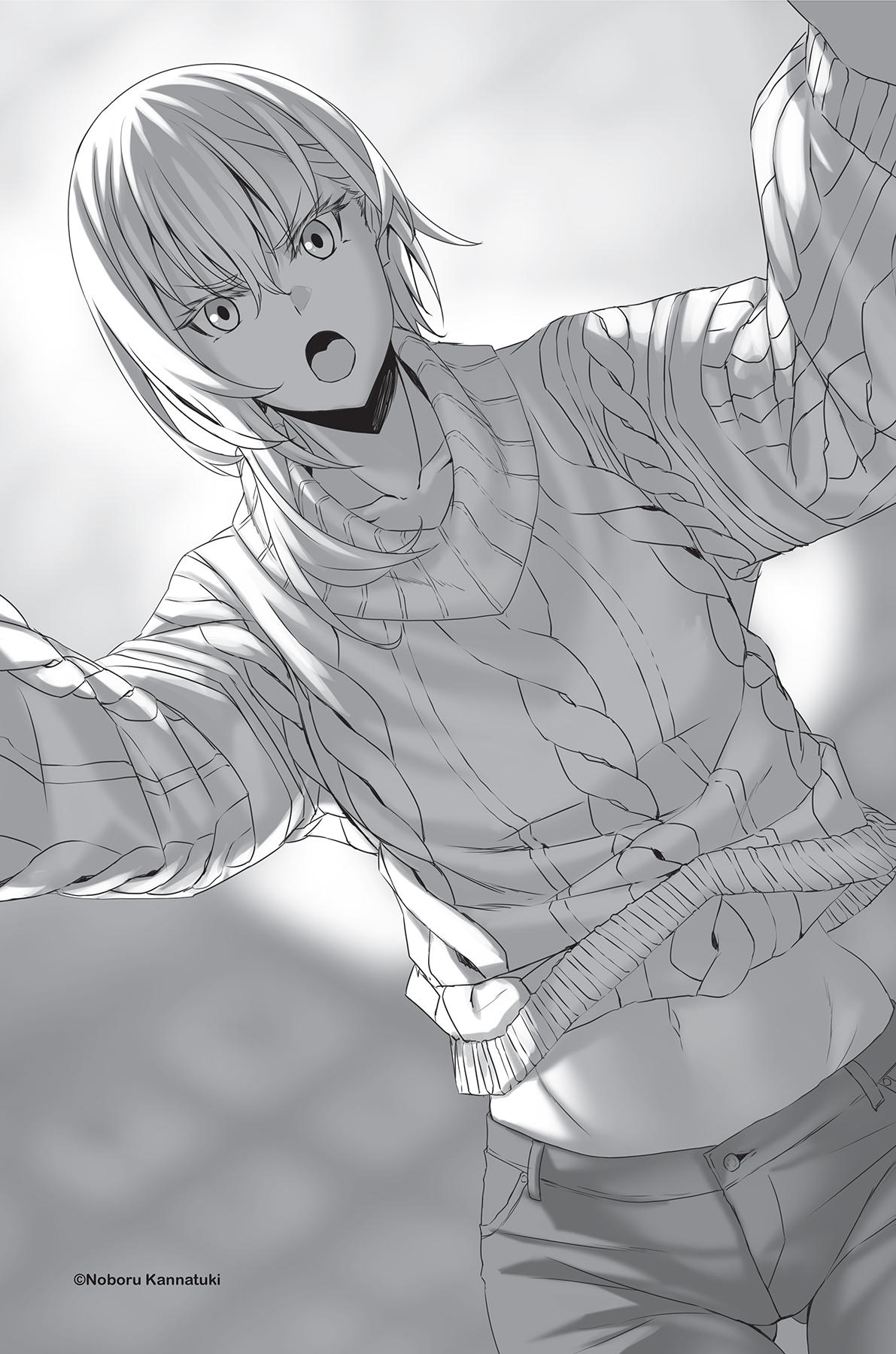
Gazing at the valley before me—which I could see even through her clothes—I replied earnestly, “It’s just a sprain.”
“Maybe so, but an injury is an injury!” Stasia said, and flicked my nose with a finger. If that was meant to be punishment, I would take it. “For today, I want you to lie here! I’ll make your meals. No kisses and no…anything else!”
It would be bad for my foot, she insisted. That was just like her.
I gave her a stricken look. “None at all? Don’t you think that’s going a little far?!”
Her answer gave me no relief. “The doctor said the same thing. You go too easy on those men, he said!” Then she slid back away from me, escaping; she left behind only the drifting aroma of soap and a faint warmth I could still feel above me.
“So I ought to be at least this hard on you, right, Danya?” She looked satisfied with her choice.
“Tsk,” I grunted. I knew once she had made up her mind there would be no persuading her. I could beg and plead, but she wouldn’t listen. So of course I pouted a little.
What would you do, if you’d spent days running all over creation only to be punished at the end of it?
Okay, obviously I knew that it was my own fault. I could never get away with acting like this in front of my brother or sisters. It was just for Stasia. And Stasia knew—she saw right through me.
As she headed for the kitchen, she turned and winked mischievously, her eyes shining like stars. “I’ll make it up to you next time. Okay?”
“…” I focused my thoughts even more intently than I had when faced with GRU and offered my galaxy-brain response: “If you were on top of me, then I wouldn’t have to move, right…?”
“Nyet!”
From Moscow with Love

The Space Conquerors’ Monument towered over Moscow that day, as it always did. It went straight through the web of wires stretching from Ostankino Tower and far beyond, up past the clouds.
The towering monument, more than a hundred meters tall and describing a great arc toward the heavens, was proof that mankind had in fact conquered space. Standing at the base of this monument to our glorious motherland’s triumph were statues of our heroes, the cosmonauts. With them were Tsiolkovsky, the father of rocketry; Gagarin, the first man in space; and Tereshkova, Chaika <seagull>.
And then there was the moon man, Vladimir Komarov.
So many men and women who had pitted themselves against the challenge of the cosmos after those first bold steps taken by the canine Laika.
Sputnik, Zond VIII—even the passage of two hundred years couldn’t dull the shine of these exemplars of human effort. So what if we hadn’t taken a single step beyond those first footprints on the moon? The value of those steps could never be denied.
It simply meant that after that first giant leap for mankind, no one had ever gone up to break the record.
Thus our effort was rewarded
We overcame the infinite blackness and the terror
Forging wings of flame and fire
We bring forth the age of the motherland and of the people!
I couldn’t understand difficult stuff, so I didn’t really get what the poem inscribed on the monument meant.
What I understood was that these folks were outstanding. The men, the women, the dogs: They’d done real work.
Whereas I was crawling along Peace Street that day under their watchful gaze.
It was very rare for our glorious motherland to experience one of those awful capitalist-society phenomena known as a traffic jam—but today was that rare day.
The street was crammed with vehicles, mostly mass-produced cars—Moskvitches, Zhigulis, and Pobedas. Horns honked, and people shouted insults at one another. Then there were the gunshots and explosions.
“Davai!”
“Fuck off, sobaka!”
That was the mafia guys shouting at each other and brandishing their Kalashnikovs. Somebody threw a hand grenade. Was this a brawl, or war? The soldiers were having a firefight, but it wasn’t clear why.
Anyone who got sucked into this was going to pay for it. I saw a bunch of people yelling despite the fact that they didn’t really understand what was going on. Others were running away as fast as they could—they weren’t cowards; they were the smart ones.
“Stoi <Stop>! Stoi! I said stoi tupoi <idiot>!” The militsiya on patrol were adding to the cacophony, but their efforts weren’t doing much. Or maybe it was more accurate to say they didn’t want to do more than shout—they didn’t get paid enough to get involved in this.
Not like I was in for a rich payday, myself.
But the pay was enough to get me to risk my life.
I saw a seamless, near-futuristic limousine, the VAZ-X, belching orange flames and black smoke. No one seemed to have time to care about it. Well, neither did I. Every second counted.
I snorted, pushing my way through the crowd as I ran down the street.
The situation was what it was. I could carry my PPSh in full view, and people would hardly notice.
The rest was up to my enemies. I reviewed the information I had pounded into my brain, my lip curling at the irony.
—Mne povezlo. If it’s just MI6, I might have a chance.
What a thing to think. I might have a chance if it was just MI6?
“I’m not Ilya Murometz!” I groused as I ran. I thought my heart might burst, but so what? I felt a twinge of regret that I hadn’t gone cyborg at all.
Let me die—I’d keep running.
Stasia’s life hung in the balance.
“Mmm… Ooh! Ah… Ahhh! Mmmn… Nnngh…!”
Stasia stretched gently, her eyes damp, her breath coming in pleasant little gasps. I had my arms around her narrow hips, supporting her light body, her breasts pressed against my chest. It was the best job in the world.
“Ooh, ah…! Ah! Daaa…nyaaa…?”
She grabbed my body armor to support herself and looked up at me gently. Maybe she was running out of steam? Her cheeks were flushed, and her eyes were heavy lidded with pleasure. A small silver thread hung from her lips, and anyone in the world would want to kiss her again.
But I couldn’t do that. Time was limitless, but it was always in short supply. My Sturmanskie kept perfect time—it was still the same watch that had ticked down Gagarin’s 108 minutes.
I summoned all my wits and pulled myself off of Stasia as carefully as if she were made of glass. She pressed up against me, sorry to let me go, but I was at my limit, too.
“I think that’s it for today,” I said.
“Yes,” she said with a gentle smile. “Try to control yourself, okay, Danya?”
Don’t go to any other girl’s place. Stasia left off this last part—or maybe it was just a convenient fantasy in my head. Whatever; that was fine, too. It made me feel better just to imagine she thought of me that way.
I ran a heavily gloved hand through her silver hair, and she smiled like a cat.
“I’ll come again,” I said.
“Yes. I’ll be waiting.” She smiled again.
Stasia and I pressed our lips to each other’s cheeks one last time, then I left her room behind.
I glanced back to see Stasia’s hand brushing her hips. “Poka-poka.”
She made it awfully, awfully hard for me to suppress my smile.
As always, I got in the elevator with the slatted door and gave it its kopecks.
Moving silently enough to justify the price, the elevator carried me to the ground floor.
What happened next was, well, also the same as always.
“You’re finally down, Danila Kragin.”
There was Madam Pisken, her brow arched in annoyance, accosting me as aggressively as ever.
I wasn’t going to let her get the better of me, though. I’d faced down GRU and the bratniye, after all.
With studied deliberation, I glanced at the watch on my wrist. “I didn’t think I was up there that long. Wonder if my watch is running slow.”
“I heard how you hurt your foot. Stupid thing to do.”
Sarcasm didn’t work on the madam. She fixed me with a stare like a cat or a hawk eyeing its prey.
I found myself flinching every time she did that. Was that what they call discipline, or was it an instinctive reflex? I wondered, thinking vacantly of someone Mariya had told me about—a guy named Ivan Pavlov and his dogs.
“God loves those who are careful. There is no protection for idiots,” the madam said. So she believed in the unscientific being? She was one of the old guard.
I might have laughed at her. But I couldn’t bring myself to mock people’s beliefs. Not least because the madam would have slapped anyone ill-mannered enough to do so.
“They say the wolf is kept fed by its feet, don’t they?” I offered.
“Then you’d better not hurt those feet,” she snapped, easily smacking away my feeble objection. God, this got old.
This was when you wanted to let your results do the talking. Good work could shut anybody up.
“Don’t worry,” I said. “I’ve saved up the money.”
“Of course you have. Only the people who pay get to hear the music.”
I agreed with her that you shouldn’t be too proud of something so ordinary, but hey, I’d worked awfully hard for this cash.
The madam extended an elegant hand, and somewhat crestfallen, I gave her an envelope.
“…Na,” I said.
“Ladno!”
She tucked the envelope away, making my time and effort disappear like magic.
This is how it always was with me: I felt like a big man when I earned money, then shriveled when it was taken away.
As I stood with my shoulders slightly slumped, the madam gave me one of her piercing glares. Then she jabbed me in the chest with a finger like a weathered branch—or maybe I should say, like an old witch’s staff. “Danila Kragin. I think you should stay away from here for a while.”
“Haaah?” I said.
“You heard me. Don’t come around here. Or don’t you speak Russian?”
“Oh, I do. I just heard nonsense. Eta kak zhe?”
It was only natural I should answer like that. Seeing Stasia took money. But that meant that if I brought money, I could see Stasia. Madam Pisken didn’t have the right to tell me that I could or couldn’t—well, okay, maybe she did.
I doubted the madam was going to tell me that she didn’t want an ugolovnik like me getting close to Stasia.
She looked me over, gave a bit of a sniff, then slowly shook her head. “Don’t get the wrong idea, now. It’s just what’s convenient for us.”
“Meaning what?”
“The next performance! I need the girl to concentrate. That’s all.”
“Hmm…” I pursed my lips, but there wasn’t much I could say.
Stasia’s performances were good, upstanding work; not mine to meddle with.
I was silent for a moment, then expressed my resignation with the click of my tongue. “Tsk. I promised her I’d come again, you know.”
“Then come,” said the madam with a contemptuous glare. And then—shock of shocks!—her lips curled upward. “Just make sure you have the money with you when you do!”
The woman’s singing—Jazz’s, or whatever her name was—was husky as always and undeniably alluring. Good singing was good singing, notwithstanding the scratchy quality of the rib record. Fidelity wasn’t something I’d worried about even once in my life. It was amazing enough just to hear the sound come out.
“Say, there, mister, you look like a discerning listener. How about it? A limited-edition print! Get it before it’s gone!”
“I’m thinking about it.”
I was in Cherkizovsky Market, letting the hawker’s voice roll off my back as I pondered. I wasn’t rich enough to always indulge in this sort of thing—but I wasn’t so poor that I couldn’t ever, either. And if Stasia was busy, I’d have to kill some time at home…
—Music. Someone’s feeling cultured, eh?
Might make me look more refined. Maybe I’d pick up a broken phonograph somewhere and ask Mariya to repair it for me. I’d pay her for the trouble, of course. Then I could listen to Jazz’s ribs.
I could lounge on the sofa in the room in our hole and listen to this husky-voiced foreign woman sing to me.
I’d put a glass of vodka to one side. No Kalashnikov.
As fantasies went, I thought it was pretty classy. I’d still be no Captain Ilya Murometz, but I wouldn’t look half bad.
Looking good was another way of saying that you had cool to spare. And having cool to spare meant you could feed your family decent food, and go see your woman, and listen to music.
“Whoops, prosti <sorry>, comrade!”
“Yeah, zhalko,” I said.
I buried an elbow in the solar plexus of the kid trying to reach into my pocket. I ignored him as he writhed; I just produced my envelope. I plucked out a few rubles and handed them to the shopkeeper. “Give me one,” I said.
“Spasibo, vsevo horoshevo <Thank you for your business, and excellent choice>!”
He took the X-ray tape record and put it in an oil-paper bag, then handed it to me. The tape showed the bones of someone I didn’t know and was engraved with the voice of a woman I didn’t know.
I mean, I knew her name. Jazz. That was enough.
I held the package close to my chest and started off.
I had less money than before, but I had one more record. That was all, but for some reason, it made my steps light.
I was seized by the urge to take the record out and look at it—not that I would do such a thing. If anyone thought I was carrying something valuable, it would only get me in trouble. Like with the kid a minute ago.
Instead, I picked up my pace, hurrying through the din of the black market. The folks here seemed energized somehow—maybe it was the impending 2160 Olympics.
“Step right up—buy your television before the Olympic Games! Chiba-made, clear as crystal even without a magnifying lens!”
“Watch the 1980 Moscow games snova televizor. Use this karmanniy proyektor.”
“We’re taking bets on who wins the medals, starting at one ruble!”
Never in my life had I had any special interest in sporting events. I’d assumed the Olympics would have nothing to do with me until the day I died. But here we were.
—If you think of it like a sort of festival, maybe it’s not so bad.
I wasn’t out to piss on other people just because they enjoyed something I didn’t.
Was that having cool to spare?
If you had money, you could be cool. Cool could be bought with money. And it had a price that matched its value.
—When I put it that way…
Suddenly it didn’t seem so bad, Mariya drinking that bitter mud-water.
My little sister made her own money, spent it on something she wanted, and enjoyed it. Filling her room with monitors and calculating machines was probably something she’d thought she could never dream of.
I plopped myself down next to her without a second thought, the scorched smell of the coffee stand filling my nostrils.
The black-haired girl stayed standing, arms crossed, looking down at me with a glare.
“Dobriy den’ <Good day>, comrade. Right on time today, I see.”
“I’ve learned the value of time, you see. Also, I was chased out.”
“Tsk.”
An annoyed click of the tongue. Mariya bit her lip, another sign of frustration. But she didn’t say anything else.
I looked at her, thinking maybe I would mention the singing woman, Jazz, and the phonograph. Then I set the package with the rib aside and gazed vacantly at the passing bustle. Everyone hurried along, finding what they needed or holding it fast.
“Urgent job?” I asked. Beside me, I noticed Mariya flinch.
“I haven’t said anything about it yet,” she pointed out.
I put my chin in my hands and watched the crowd, moving only my eyes to take in my little sister.
“You’re not drinking your coffee.”
“Dumbass,” she spat, and clicked her tongue again.
I guess she didn’t want to waste any extra time, or maybe she was a bit panicked, or maybe both—because she started talking in a fast mutter. “The client is Organ,” she said.
“Hey, I wasn’t asking for the details—”
“No, listen—please!” she said, almost in a shout. “GRU is nosing around near Stasia!”
For a second, sound seemed to disappear from the world. The bustle of the crowd, the husky singing I could hear in the distance. I sat there stupefied, like a good big brother indulging his little sister’s demand, completely silent.
“A military guy who’s involved with her is planning to seek political asylum—and bring with him the WTO’s most state-of-the-art technology.”
Now, that was a story. It sounded like something an MI6 double-O agent would do.
“And they think Stasia is involved?”
“Fortunately—if you can put it that way—she’s close enough to the KGB…”
Meaning Aquarium couldn’t make any moves right away, and if they did, it would be a political blow to Organ. So for now, they were just circling, keeping an eye on things.
Mariya trailed off. It was just as well—I wouldn’t have understood if she’d tried to explain it to me. I had a mountain of other things to think of besides politics.
“What does the client want?” I asked.
“…” Mariya paused, then said, “The assassination of the man involved. The confiscation of incriminating documents. And for us to get the drop on GRU.”
“Can they guarantee Stasia’s safety?”
“Probably. She’s renowned all over Moscow, so without proof, even GRU couldn’t…”
“And why do they want me for this job?”
“I assume because Organ wants a deniable asset in case you fail.”
“Reward?”
My almost mechanical response pulled the rug out from under Metel.
I looked up at Mariya, but I didn’t see her expression. She was sliding down next to me, like snow falling off a roof.
Her face was whiter than snow as she looked at me. Her eyes stared straight into mine. I realized how beautiful she had become.
“Wait, Big Brother,” she said. “You actually want to do this?”
“Da.”
I answered like it was nothing, just another assignment.
I felt a tug on my sleeve. “……Nyet.”
Of course, only Mariya would do that.
She repeated “nyet” over and over, shaking her head and sending ripples through her black hair. My little sister gripped my sleeve with her pale fingers, like she’d done all those years ago in our rathole.
“You might die,” she said finally.
“Stasia might,” I replied. “And then me… Then all of you, one after another.”
There’s a joke that goes like this: The general secretary is giving a speech when someone sneezes. He demands to know who did it. No one says anything, so he starts purging people, beginning with the guy closest to him and working his way down the line.
Finally, he gets to the last person in the room, who’s quivering and shaking.
The guy admits that it was him who sneezed. And the general secretary responded with:
—Oh, it doesn’t matter, comrade. Feel better soon!
“You brought the assignment to me because you knew I’d say yes, but then you make that face when I accept it. This is how I know you’re not all grown up yet.”
I was such a sucker for the face Mariya was making at that moment—always had been, since she was young.
Mariya bit her lip and looked at the ground. Her black hair cascaded over her face, covering it. She still hadn’t let go of my sleeve.
Then she let out a “Tsk” very deliberately, making sure I heard her. I smiled in spite of myself.
“I keep telling you to drop that habit,” I said.
“I will not,” she replied, then added, “It’s your fault, Danya.” Then she sniffed and rubbed her eyes with her palms. Finally, she looked up again.
I felt like I needed to say something, you know, appropriate. “Aw, c’mon,” I offered. “Don’t worry so much.” I rubbed her head, though somehow it felt wrong to do so with my big, rough fingers. “I’ll just have to do what I can.”
The first thing I could do was pick up the massive tire lying on the floor.
It was a discarded truck tire, and I hauled it up, pushed it over as hard as I could, then heaved it up again. One or two reps were enough to make me sweaty and get me breathing hard, but that was just proof that I was using my body. I gritted my teeth and grabbed the tire again as if it were a fun toy.
This was one of the most important things I could do if I was going to run around carrying a submachine gun and shooting people to death. When I couldn’t run anymore, then I would die. If I got tired from carrying my gun, I would die. That’s what the dead old man had taught me. Now that I thought about it, maybe that old junk dealer had been a veteran himself.
And as a matter of fact, he’d fallen down by the roadside and died when he’d gotten so drunk he couldn’t run anymore. I guess what I’m saying is, at least he practiced what he preached. It was worth heeding his advice myself.
I’m sure if some guy who’d been through the wringer at one of Moscow University’s PE classes saw me, he would have laughed. I was doing it all wrong, he would say. I wasn’t efficient. I was stupid. There were better ways. And on and on.
Like I cared.
He wasn’t the one who would be risking his life—I was. The only guy who could complain about Danila Kragin’s training regimen was Danila Kragin.
If our hypothetical poindexter could go toe to toe with a spetsnaz cyborg and beat the other guy to death, then it might be worth listening to him.
If you were working on a given muscle, what was the difference between doing three sets of ten and just doing it thirty times?
If you got so caught up in those little details that you didn’t focus on your training, then there was no point.
As I worked my body, pouring sweat, I glowered at the heating pipe.
Doma steny pomogayut <At home, even the walls help you>. But right now they weren’t doing me much good.
Airforce Major (VSS) Lieutenant Adam Adrova.
I thought about the phototelegraph in the materials I had wheedled out of Mariya.
That’s right: a telegraph. Not a telex. Wouldn’t do me any good if I didn’t know what he looked like.
What he looked like, it turned out, was handsome, almost like an actor. Even from the photo, I could see his pearly white smile and pale hair—and I could tell that under the military uniform, he was well built.
The ideal soldier, no question. A hero. Cosmonaut candidate. Not to mention a spy in covert communication with the capitalists.
—And he was a friend of Stasia’s.
I didn’t care what face he made when he was getting friendly with Stasia—but what about her? I thought about it for all of one second, then shoved the tire over with renewed vigor. It crashed to the ground, and I grabbed it and hauled it up again.
I heard there had been a similar situation one or two hundred years ago. The officer involved had boarded one of the latest aircraft, flown through the air defense net, and escaped to the Far East, or something like that.
He’d been from Air Defense, I guess, but anyway, apparently there was something about people doing stupid things right before the Olympics.
My job, as I understood it, was to reach Lieutenant Adam and wipe him out before he could escape with the motherland’s secrets.
“But this lieutenant isn’t really the enemy, is he?” The tire lay on the ground where I had slammed it down; I leaned against it to catch my breath, mopping my brow.
Organ was keen to stop Lieutenant Adam from being the idiot he planned to be. And Aquarium was circling around, hoping Organ would screw up so they could take advantage. Well, internecine conflict was nothing new. I might as well get on board.
Unfortunately, thanks to Adam’s extensive network of friendships, this mission was getting out of hand before it even started: MI6 and the CIA were both after his secrets, too.
GRU, of course, wanted to stop them and catch the KGB with its pants down.
And as its own representative, who was the KGB sending into the fray?
“Janitor extraordinaire Danila Kragin…”
Suma sashol <It was insane>. Absolutely nuts. If it had been someone else doing it, I would have pointed and laughed.
—All right, let’s review the situation.
First, the major premise: Organ would never bet everything on me and me alone. Of course not. They weren’t in a position to leave it all to one Janitor and just watch what happened.
That meant I had a sliver of hope that they were going at it with Aquarium behind the scenes.
At least, I would tell myself I did. Because otherwise, this was a trap Organ was laying down to get rid of me.
As for the CIA… Honestly, they didn’t scare me. I mean, it wasn’t like a Janitor could ignore them like some small fry—but that was if they said hello to your face and then came at you. I had bad manners that way. But if the question was whether the CIA had the balls, the answer, frankly, was no. They could have their scope trained on their target and still not be able to shoot thanks to civilian bureaucracy.
They sent sunglass-wearing tough guys after you, sure, but you could find hulks like those anywhere. It wasn’t like Organ and Aquarium and their black suits. Scaring the shit out of us was their job. Not so the CIA’s.
Besides, for all the mischief they did in people’s gardens, they were quaking in their boots at Uncle Sam in his “white house.”
All of which meant…
“Mne povezlo. If it’s only MI6, I might have a chance.” I laughed out loud. Damn… What a thing to say. I might have a chance if it was only MI6?
Who did I think I was, Captain Ilya Murometz?
My thoughts were interrupted by Valery’s easygoing yell. “Heeey, Big Bro! About ready to eat?”
“Sure,” I called back, wiping my face with a piece of cloth I used in lieu of a towel. “You were on cooking duty tonight? What’s for dinner?”
“Sturgeon soup. Nora wouldn’t leave me alone about serving something that was good for a cold.”
“She’s obsessed with her doctor. Figure it out already,” I said, and Valery grinned.
When you mention sturgeon, everyone thinks of its roe, but the meat is pretty tasty, too. Yes, they have anything you want in Moscow.
When Valery walked up beside me as I stood there with the “towel” hanging around my neck, I realized he was almost as tall as I was. He’d always been lanky, but I guess a boy does grow. Well, so do girls like Mariya and Nora.
“What’s Mariya doing?” I asked.
“Sis? She won’t come out of her room, so I sent Nora in to get her.”
“Ah.”
“Big Bro…,” Valery said. “This next job. Is it gonna be a rough one?”
“Just the usual,” I said with a smile. “So hurry up and get me some dinner. I’m starving.”
“You got it! Coming right up!”
Valery went back to the kitchen, and I sat at the table, relaxing in my chair and listening to the household.
A whining voice: “Mariya! Sis!”
An annoyed answer: “Nora!”
Nora must’ve stepped on a cable or something.
I didn’t blame Mariya for not quite wanting to see me—after our conversation, it would have to be awkward. I wondered what kind of look she would give me. Uncomfortable, or upset, or pouty. Or all of those at once.
She herself would no doubt believe she appeared calm and controlled, but I would know immediately. We would know. Valery and Nora and Mariya and Stasia: We knew our family.
A few minutes later, Nora appeared, dragging Mariya by the hand.
We all sat down around the meal Valery had made us and ate, all talking together.
Mariya was prickly, Valery would say something nice and easy, and Nora would stir the pot.
Once the meal was over, I would get down to work. Get my stuff ready and start cleaning.
Then I would go see Stasia.
Nothing would change. I had only one thing to do.
—Better brace yourself, MI6.
“H’lo, comrade. Mind if I drop in?”
“Well, well!” Miss Tachibana looked busy as ever, but she welcomed me with a smile. From the row of monitors and the mountains of paperwork on her desk, I took it she had ascended even higher than she’d been before. Sitting amid it all, though, she looked even more excited than she had been when she was driving, and in an eager voice, she said, “If it isn’t my Janitor. What brings you here today?”
“Just a follow-up appointment. No changes here?”
“Hee-hee, you needn’t worry about me. I’m getting along very well with the people from GRU.”
—So the score was 1–0 in her favor in the matter of budget discussions, I take it?
That was if she was telling the truth, of course. Which I had no way of knowing. That’s how it was with bureaucrats: They would say whatever they needed to for their own benefit.
The capitalists seemed to want to know everything, but what would they do with the knowledge? I sure couldn’t guess. I didn’t have any idea which way I would push the country if I knew all that stuff. I didn’t want that kind of responsibility, anyway. Let the people who could handle it, handle it.
Me, I knew one thing: Financial Commissioner Ilyena Tachibana evidently wanted to stay in my good books. It meant that at the very least, she saw some value in continuing to use me. I was grateful for that.
“That’s perfect, then,” I said. “To tell the truth, I was hoping to get your advice.”
“No problem,” Miss Tachibana said with a smile. “Help and help alike, comrade.”
“Yes, of course.” I took an envelope from the pocket of my body armor, extracted a bundle of rubles, and put the money on the desk. “Someone dropped this in front of the office,” I said. “You wouldn’t happen to know whom it belongs to, would you?”
“Oh, my goodness,” Miss Tachibana said, her long eyelashes fluttering. “Thank you so much. I’ll keep it for now.”
Who knew if the rightful owner might show up? With that, she put the bills in a drawer.
“So,” I said, waiting for her to straighten in her seat again. “About Lieutenant Adam Adrova…”
“Ahhh, he’s quite the controversy right now, isn’t he?”
Her answer was evasive yet striking. She gave a smile—not quite bitter, not quite resentful—and leaned back in her chair, all elegance. She crossed her long legs. That suit, it looked good on her. I should ask Stasia to wear one for me.
“I won’t cause you any trouble, comrade,” I assured her.
“I should hope not, comrade.” She leaned forward, resting her elbows on the desk and steepling her hands. This was a bureaucrat ready to do battle. Her smile now was that of a beast baring its fangs.
Our motherland’s bureaucratic system was really quite an achievement: It could go on functioning no problem, regardless of who disappeared or when.
That meant you had to have some respect for the people who had survived the system.
In any case, this woman, who was neither military nor intelligence, not directly involved in any way, already had the info. That she was playing coy with me about it was either to discourage me or to intimidate me.
Whichever it was, some ugolovnik sewer rat couldn’t hope to resist these folks. All we had was our strength of arms. No education. Maybe a bit of stubbornness. The money we’d saved. That was all. So I picked my words carefully, not trying to be too clever, just saying what I wanted.
You go in the store, you go to the register, you tell them which items you’d like. You get your ticket and you wait.
“I’d be willing to give you that much information,” she said.
—Hell, yes!
I suppressed the eager scratch in my voice and instead offered a measured expression of gratitude. “Thanks. That would be a big help.”
“Certainly. You just look so desperate.”
Dammit, she saw right through me. But to admit that would be more pathetic than admitting I had lost. I shrugged wordlessly, focusing on being ready to pound whatever information Miss Tachibana had for me into my thick skull.
The really crucial stuff was place and time. If you didn’t know those things, you weren’t going anywhere. And once you did know them, you could move on to the next thing.
“Thanks. That’s a big help,” I said again.
“My, leaving already?”
“Like you said. I’m desperate.” I grinned, thanked her once more, and let her know I had to leave.
That didn’t feel like quite enough, though, so I added: “I hope you’ll think of me the next time you need anything.”
“But of course. I hope you’ll be there for me should anything come up.”
Miss Tachibana saw me out of her office with a smile.
I heard the door close behind me, and I was sure she was already throwing herself into her next task.
I could imagine her reaching for the phone on her desk and saying, “All right. It seems we’re going to have a vacancy in the air force officer corps. I wonder who I should try to squeeze in there.”
“Well! If it isn’t Comrade Danila Kragin.”
I was at the Church of Saint Barbara. I paid my respects to the young woman from so long ago, then bowed my head to the woman there at that moment behind the iconostasis.
Monashina looked at me as she emerged gracefully from behind the screen, a thin smile on her face. I wondered what Barbara would think of this voluptuous beauty wearing the habit of her order.
Jesus, at least, didn’t say anything; he just gazed at me and Monashina from the screen.
“What brings you here today? Have you come to make a confession again?”
“Yeah, that’s right,” I said. What else? “I feel a pressing need to tell you exactly which despicable acts I’m about to commit and how I plan to commit them.”
“How awful,” Monashina said theatrically, leaning forward in a way that emphasized her soft and supple curves.
I, however, had neither the time nor the obligation to entertain her. I grabbed the envelope from my pocket, plucked out some rubles, and—resisted the urge to shove them at her.
Instead, I offered them, slowly and respectfully, to the nun. “A donation,” I said. “I certainly wouldn’t want anything I say here getting out.”
“My, my!” Monashina blinked like an innocent girl, as if to say she’d never imagined I would offer her such a vast sum.
Her every gesture, though, was staged, all a performance.
“O Christ Jesus, Son of God. By your mother’s intercession and that of all the saints, we pray you have mercy upon us…”
Still hamming it up—but also looking shockingly genuine—she offered a prayer to the Savior.
“So you’ll hear my confession?” I asked guardedly.
“Yes, of course.” Monashina nodded with the compassion of Mary herself. “This khram is a haven for human hearts, and a place of refuge for all those who handle fire.” Her epitrachelion swayed, emphasizing the curve of her breasts.
“Khorosho.”
Without another moment of hesitation, I unloaded my orders on the nun.
Yeah, this was gonna be sinful, all right. But it was something I was doing for me, because I was thinking about myself. If the Savior and his mother and the murdered Barbara were going to forsake anyone, I hoped they would stick to just me.
There might not be any unscientific being, but those three people, well, I guess they really existed.
“This is somewhat urgent. I’ll need to perform the liturgy and offer the tainstvo <mysteries>.” Once she’d heard me out, Monashina thought for a moment, then muttered, “Amen.” She turned to me and said, “However, I trust God will watch over you.”
“You think he’ll be in time for me to commit my sins?”
“You must not doubt the works of our Lord Jesus, Danila Kragin.”
The works of the son of a carpenter who really existed? Yeah, I could have faith in those. After all, he was a laborer—one of the people.
“Spasibo, comrade,” I said, smirking, to the man on the iconostasis. I slowly got to my feet. Kneeling on the stone floor of the nave was awfully cold. I wasn’t going to stay there any longer than it took to conduct my business. I didn’t have the time, anyway.
—Wait. Am I really done with my business here?
I found myself locking eyes with the man, who stared steadily down at me.
I heaved a sigh and look back at Monashina. “Just a side question,” I said. I wasn’t asking this out of duty. Pity and embarrassment were foremost in my mind. “My…family. Could you pray for their good fortune, too?”
“I’ll have to pray your share as well, then,” Monashina said, answering as quickly and firmly as any actual cleric.
I gave a click of my tongue and a little “pfah.”
Monashina put her hand over her mouth and chuckled. “Yes, indeed. This much you may consider an act of service to a pious disciple. Think nothing of it.”
I didn’t want to talk to her another minute. This time I was really done here.
I turned on my heel and hurried toward the door.
I heard Monashina intone “O blessed Mary,” and then begin reciting a prayer. “Open unto us the gate of mercy, that none who turn to you should perish, but by your intercession may avoid disaster.”
—You are the salvation of the people of Christ.
The last thing I heard before the door slammed shut behind me was Monashina crying “May it be so! Amen!”
I quietly opened the door of the bar. It was a small place, with the lonesome air of a watering hole that’s just opened for the day. The inside was grimy, with only a counter and some tables around which you could stand and drink. The clientele consisted of a redheaded guide, a scholar, and an author.
Chances were, the next thing I did was going to involve trespassing on military property. I shrugged and sat at the counter.
I ordered a vodka, then leaned on the counter and waited for the appointed time. I heard the dull clatter of a tram approaching outside, then going away again. The scholar and the author seemed to be talking idly about something, but everyone was pointedly ignoring everyone else’s conversations. Including the guide, whom they had presumably hired—he wasn’t interested in his customers’ situations.
Neither was I.
That was all the peoples’ work. I didn’t stand to gain anything if they failed, so I wished them success. And if they happened to do very well and maybe shared some of that good fortune with me, well, so much the better.
After a few minutes, the three of them stood up and wove their way out of the bar. I heard a ’58 Land Rover sputter to life and drive away.
I kept waiting a little while longer.
“Thanks for your patience, comrade.”
“Oh, it was nothing, comrade,” I said, raising my shot of vodka to Brigadier Koropchenko when he finally arrived. “Indulge with me?”
“I’ll pass,” he said seriously. “I’m trying to look after my health.”
“That a fact?” I downed the contents of my glass in one gulp and smacked it back down on the counter. The bartender brought me my next drink immediately. You needed some spirits to be in, well, high spirits.
If this mafia guy was looking after his health, that meant he hadn’t fiddled around with any of his internal organs. I felt a twinge of affinity with him. Just a twinge, mind you.
“So, Danya,” Koropchenko said, all familiar. “You said you needed something?”
The mafia was kind to everyone, at least if you ranked higher than an errand boy. If you were a soldier with even a hint of intelligence about you, they could be very nice.
See, if you went around baring your fangs and growling at everyone all the time, your prey would be too scared to get close to you.
So I decided to lay down some breadcrumbs. If I couldn’t get the brigadier on board, I’d be in trouble. “It’ll be no trouble for you. There’s even a reward. And it shouldn’t be dangerous.”
“Hmm.” Koropchenko crossed his arms pointedly and made a show of considering.
All right, don’t panic yet. This was a ripple on the surface of the river that was Koropchenko.
Not that I’d ever been fishing.
“Well, you’ve helped us out more than once. I can at least hear what you have to say,” he said.
In other words, I’d hooked him. Or maybe I was the one on the line. Either way, it didn’t matter.
I took some rubles from the envelope in my pocket and placed them on the counter. “What I’m hoping you’ll help me with is…”
Then I gave him the rundown on the plan I’d come up with—just the parts he needed to know. Some guys tried to play it real sly at moments like this, hide everything they could, but that was stupid. They might be worried that the info would leak out from somewhere, but in their desperation to keep it all close to the vest, they only made themselves look suspicious.
Voron voronu glaz ne viklyuyet <A crow won’t peck out another crow’s eye>, as they say. If you don’t want your eye pecked out, make sure the other guy knows that you’re a crow, just like he is.
“Oh, is that all? I don’t mind a bit, comrade. Consider it done.”
There, see? I raised an eyebrow. “You sure? I know I’m the one who asked, but this is pretty dicey.”
“Oh, sure. I’ve been wanting to get the young soldiers some practice. This will be a perfect opportunity.”
“Sounds good.” I drained my glass and slapped some kopecks on the counter.
“Then again, there’ll probably be another outlandish demand for our favorite Janitor in the future,” Koropchenko said.
“Tsk. I’ll do the job, and you know it,” I said, and we both laughed. Empty laughs, signifying nothing.
“Very well, then, comrade. See you again.”
“Yeah. Till next time, comrade.”
I shook hands with Koropchenko, then showed myself out of the bar.
It wasn’t that I particularly trusted him or had any faith in him. We just happened to be eating from the same feed trough. But that was enough.
If there’s an aroma that doesn’t fit a black-market doctor in Garage Valley, it’s the smell of dark tea.
Yet that was what reached my nostrils, mingled with the odors of blood and alcohol, as soon as I opened the door. I stopped short.
“Teatime?” I inquired.
“Mm-hmm. Just thought I’d stop for a breather,” Vrach answered from where he lounged on the couch, wearing a surgical garment splattered with blood, machine oil, and spinal fluid. Scattered on the floor at his feet were some lumps of what might as well have been scrap metal—prosthetic arms or legs; I couldn’t even tell.
I guess he must have been doing some serious chopwork—er, I mean surgery.
I stepped carefully around the detritus on the floor and sat down across from him.
“Dead?” I asked.
“No, still breathing.”
“Hmm.”
Good news, that. I really thought so. It was always better if people survived instead of making more corpses. Helping people was such a noble profession.
Nothing like being a Janitor.
“But it’s left me beat. I’ll do an exam if you want, but if it’s not an emergency, give me half an hour, would you?”
“It’s sort of an emergency, but not today.”
I grinned, and Vrach gave me a confused “Huh?”
He sat up, although he looked like he really didn’t want to, and peeled off the mask he was still wearing.
“So you want to make a reservation for an emergency,” he said. “That’s something I don’t hear every day.”
“Oh, it’s not a big deal. Just leave one bed open for a day.”
“Even if someone else comes to me dying?”
“In that case, I can just lie on the floor.”
Vrach made a face worse than if he’d drunk that so-called coffee. It wasn’t anger so much as exhaustion and frustration—well, okay, maybe there was some anger there, too. He couldn’t be happy to hear me say that.
Frankly, it was best for Danila Kragin that it still made him upset. But regardless, I had no choice but to rely on Vrach. People without passports didn’t exist at the hospital any more than they did in the rest of the country. There weren’t many places I could get treatment—treatment I could trust, anyway.
After a long moment, Vrach said, “I know what you do for a living, so I won’t lecture you.” He waited another beat, then sighed, rubbed his tired face vigorously, and sighed again. “But you have told Nora, haven’t you?”
This time it was my turn to frown and click my tongue. I pulled out my envelope and took a few more bills from the increasingly slim bundle. “This is my reservation fee, Doc, along with something for your trouble and something to keep you quiet.”
“I don’t need anything to keep me quiet. I have doctor-patient confidentiality to do that.”
“Then consider it payment for labor.” I stood up and tucked the bills into the pocket of Vrach’s surgical gown.
“Huh. You are quite the brother-in-law, Danila Kragin,” Vrach said as I made to leave.
“You mean future brother-in-law,” I said, grinning. Then I closed the door, making sure the sound could be heard from the kitchen.
On the other side, I could hear Vrach talking to somebody.
“My god. This Janitor job…or maybe it’s just Danila Kragin.”
“Whatever! Danya never asks me for help at times like this. Does he think he can do it all on his own?”
“Don’t pout, Nora. You’re the one who hid when you heard him coming.”
“…Whatever.”
—I trotted briskly away from the scene. The conversation had nothing to do with me.
After that I found myself running all over Moscow; by the time I was done, it was night.
The Moscow night was freezing cold. The dull gray sky turned black, and the snow seemed to come down even harder. I stopped by the roadside and watched it, and the leaves of the trees seemed to glow a pale white in the light from the lampposts.
My breath was so cold that it stung the inside of my mouth. On this kind of night, I wanted nothing more than to head home, drink a vodka, and go to bed.
I didn’t have much time left. Even my break time had to be used carefully.
So why was it, then, that my feet seemed to find their way to the banks of the Moscow River? Why did they head toward that white tower?
Propaganda for the Moscow Olympics danced across an electrically lit sign, and there was the most beautiful woman in Moscow, smiling down at me. Would seeing her really inspire courage?
I didn’t know. What I needed just then wasn’t a picture; it was a real smile, in the flesh.
—Don’t be a loser.
I walked through the lobby, a painting by I didn’t know who gazing down at me from the ceiling. I got on the elevator and put in my kopecks, then let the elevator carry me up the floors.
At moments like this, I was really glad we had machines. If I’d had to climb the stairs myself, I think I would have just ground to a halt long before I reached the top. Machines weren’t like that. They just diligently did whatever job you told them to do.
We needed more elevator-like kindness in the world.
Once the elevator had politely deposited me on my desired floor, I proceeded ahead, aware of the mechanical gizmos around me. There was a door and a doorbell. But in the end, a person always had to take the final step themselves.
I stopped, sucked in a breath, let it out again, then finally pressed the doorbell.
Only after I’d rung the bell did I find anxious thoughts running through my mind: Was she asleep? Or awake? Maybe practicing? Was this right before a performance? I would feel bad about that. Or maybe she was in the middle of a performance.
I was a hopeless idiot.
“Hello?” came a sleepy voice. Then, “Oh!”
I had no business seeing Stasia. What must I have looked like to her when she opened the door, as I stood there idle?
“Danya!”
If she hadn’t said my name with a smile, I couldn’t even have mustered a “H’lo.”
“This is special,” she said. “I don’t usually get to see you again so soon. Is your job done already?” Her smile was like a blossoming flower as she graced me with these words.
Fmp. I could feel the strength go out of my shoulders. I leaned against the doorframe. I didn’t try to look inside. I didn’t care who was in there.
“No, uh, this is sabotage. You won’t tell Comrade Mariya, will you?”
“Blin… Ti mne pokoye ne dayosh <You’re no end of trouble>, Danya.”
Any guy would be thrilled to hear Stasia say that. I told her I knew it all too well.
“So what would you like to do?” she asked.
“Huh?”
“I mean, if your foot is better, we could…”
Do you realize what a profound feat of my rational faculties it was to say what I said next?
“I told you. I’m on sabotage.”
I thought it took some real guts to say that faced with Stasia’s limpid eyes. Enough that maybe I could even take on GRU or MI6.
“If I hang around here, Mariya will find out. I’ve seen your face, so now I’m going to go.”
“You could have at least told me you were coming. I could have been ready for you.” She stuck out her lip.
I whispered an apology. If she’d been ready for me, I don’t think I could have held out.
—Sorry, Ivan. I guess I was nothing but a catastrophe for you.
But I’m glad I didn’t try to get you when you were coming home.
“Sorry to bug you,” I said. “I’m going now.” I stroked Stasia’s hair with my gloved hand, then turned while I still had the backbone to do it.
“Danya?”
“Yeah?”
I turned back, caught by the sleeves. An arm slid around my neck, and there were her eyes, so close to mine.
“Mn…”
Her lips were sweet and moist. Our tongues touched almost like they were pecking at each other. Then we pulled apart, a thread hanging between us.
A breath escaped Stasia: “Haah… Ahhh…” A smile came across her rose-colored cheeks. “I hope you’ll come again. I’ll have borscht ready and waiting for you.”
Dammit. What was a guy supposed to do with a girl like that?
Somehow, I managed a nod and said, “Yeah. Make sure it’s nice and hot for me.”
“God… Danila Kragin. He’s a sinner, I tell you.”
Stasia heard the old woman sigh on the other end of the telephone line.
The old lady was the person she trusted most in the whole world, outside her “family.” She could tell this woman things she couldn’t tell her family.
Believing that the old woman’s response would give her absolutely, unquestionably the right answer, Stasia simply stayed quiet and waited.
The old woman—Madam Pisken—seemed to sense that Stasia was waiting for her.
“Listen,” she began softly. “You can go after him, or you can wait. Neither is the right answer, but neither will weigh you down, either.”
Stasia wound the receiver’s cord around her finger. She could tell the old woman was smiling.
“Men are idiots. What you do is, you don’t let them think their idiotic thoughts—you smile and say ‘You’re so silly.’”
“Da.”
They exchanged a few more words—and then Stasia hung up the phone.
She turned and looked around the room. Her eyes settled on the doorway where he had been standing until a few minutes ago.
The room was filled with luxurious furniture. A bed. And one thing that hadn’t changed in all this time—the little samovar.
“Durak…Danya.”
That day, Lieutenant Adam Adrova drummed the seat of the VAZ-X limousine with his fingers and said, “Please, driver. Today’s an important day! I’m supposed to talk to the kids about space.”
“Y-yes, sir…!” His underling sitting in the driver’s seat sounded distinctly anxious.
As well he might. Getting the lieutenant to his appointments on time was his job, and right now they were running late.
Our motherland didn’t have the vile custom of traffic jams—but most unusually, Peace Street happened to be a madhouse today. You could see the Space Conquerors’ Monument, but the Memorial Museum of Cosmonautics at its base seemed impossibly far away. It was going to take forever to get to their destination. What else was there to do but gaze outside?
Lines of cars packed the roadway, horns honking, everyone impatient.
“You don’t often get to see this in Moscow. This is a unique experience, gospozha.”
For all that, Adam wasn’t upset. He had a beautiful woman sitting beside him, and that seemed to be enough for him.
“I’m sorry to disappoint you, but this is par for the course in London.”
The reply came from the young woman in an elegant dress sitting beside him—albeit as far from him as she could manage under the circumstances. Her gorgeous, primarily black dress was, to be frank, not really appropriate for the Soviet Union.
Still, there she was, lovely as a porcelain doll—her skin so white you could almost see the blue veins underneath. It was easy to see why Lieutenant Adam would be in such a good mood, sharing a car with a girl like that.
Which was not, of course, to say that she felt the same way.
“So why are you going out of your way to give a lecture at this particular moment?” she asked.
“Cover,” he replied, his voice forceful but betraying no hint of guilt. “Going about my normal life is actually less suspicious than doing things differently, you know?”
The woman made no effort to hide her annoyance: “I’m not sure there’s much point to a spy trying to avoid suspicion when everyone already suspects him.” Then she asked, “What do you plan to do after?”
“That’s what I’d like to know. Aquarium and Organ are on the move.”
“What if you were to lean on the Yankees?” the woman asked. “You could live in a mansion, like Alexander Mogilny.”
“Now, that’s harsh,” Adam said, but he sounded like he was enjoying himself. He gave a shrug, as if to admit he couldn’t compare with an ice hockey player from 180 years ago. “I guess we have one thing in common—we’re both political refugees. I’m going to cross the Iron Curtain and head for Paris, Dover, and London.”
“I should think your first concern would be whether you get out of Moscow alive.”
“It’s not that much of a concern. I’ve got bulletproof everything.” Adam gently stroked the fine leather seat of the limousine, the same way he might let his hand brush the skin of a woman—the gesture just as delicate and nearly as disgusting.
No doubt this was the same air of importance he assumed when inviting a woman into his bed.
And the lady in black didn’t appear to like it.
“You’ll never get clearance to leave the country,” she said.
“No, I don’t suppose,” he replied.
“You ought to have fled to Switzerland or somewhere before things went this far.”
“Oh, please. If it comes to it, I can use my mechanicals to punch through the border.” The lieutenant laughed out loud. He sounded so calm.
The driver was quaking pitifully, but even that seemed to amuse the lieutenant.
The lady in black could no longer restrain an irritated sigh. “Do you always behave like this?”
“In front of women? Yes.” He passed off her sigh with a wink. “There’s another in the air force. And there’s one woman I dare say I love. A singer at the Hotel Ukraina.”
“Don’t tell me you’re having thoughts of trying to get her out with you.”
“Of course I am.”
The lady in black shut her mouth: She’d lost all words at the sheer absurdity of it. Or maybe she was deeply moved.
Whichever it may have been, Lieutenant Adam interpreted her silence in the most favorable way possible. For he knew that in the end, women always ended up like that.
“Have you seen her perform?” he asked. “She’d look right at home on the West End doing Shakespeare.” He acted cool as ice, but if he kept talking about this subject, there was no question he would melt…
The woman was through listening to Adam wax passionate. “Do I need to include my subjective opinion about the matter of your behavior in my personnel evaluation?”
“Thanks to you, my request to transfer to your section was turned down. I’d welcome any suggestions for how to better myself.”
“I see the evaluation went without a hitch, then.” With a refined movement, the woman opened the door of the limousine and began to step out, the black toes of her shoe touching down on the frozen street.
The cutting Moscow wind caught her hair and carried a sweet aroma into the car.
“Well. So long as you produce results, I won’t complain.”
“Tell me, Miss Double-O-Six…”
The woman froze.
“The rumors that you used to be a Marine commando… Are they true?”
“No comment.”
“Tell me your name, then. Second Lieutenant Mary Goodgate, maybe?”
“My name?” The woman he had called 006 smiled like a shark. “It would have to be Vespa.” She turned her back on Lieutenant Adam. “You can put on airs if you like,” she said, and then her lips moved in a whisper: “But even he didn’t only die twice.”
Then 006 hopped out of the car like any willful young lady might. “Do take care,” she said.
Her black dress should have looked completely out of place, and yet in no time at all she had melted into the Moscow crowd and disappeared.
Adam watched her go as if seeing a ghost, then he muttered with resignation, “Well, it’s all good.”
He was no longer thinking about the woman, who had left not even a hint of warmth in her seat. In his thoughts there was only the woman he assumed was waiting for him on the top floor of the hotel, the most beautiful woman in Moscow—tonight like so many nights.
He would go see the kids, talk himself up, and then he would head for the hotel and whisper his love in her ear. Then he would take her hand and say: “Let’s go to the West.”
What look would she give him, that woman like ice? Just the thought of it fired Lieutenant Adam’s passions.
But to do any of that, first he would have to make his way to the museum and do his job.
“Why are the roads so packed today?” he muttered.
A second later, he heard gunshots.
“Fuck you, sobaka!”
“Hrraaahhh!”
A group of young guys ran shouting into the street. They were all wearing Adidas and wielding Kalashnikovs—they’d been so intent on showing how individual they were that they’d lost all individuality. Now they yelled and let loose with their weapons.
The good citizens of Moscow probably didn’t appreciate it, but I couldn’t have been more grateful.
If you didn’t do something like that, you would hardly see a traffic jam in our motherland.
At least not if I hadn’t asked Mariya to fiddle with the TsODD, the transport bureau.
“Damn, I can’t even tell if this is an act or if there’s a real war going on,” I muttered. The brigadier sure didn’t do anything by halves. I wondered how he was planning to handle the cleanup.
Whatever; didn’t matter to me. I’d paid my money. That was all I had to know.
From my back alley, I eyed the VAZ-X limo, with its sleek, space-age design. The nice thing was that you didn’t have to try too hard to spot such a distinctive vehicle. All I needed to know was the time and place, and the rest would work out. It was child’s play.
I didn’t know what I would have done if Lieutenant Adam had had a taste for plain, inconspicuous cars.
Then there was the moment the limousine’s door opened right in the middle of the traffic jam. That just about gave me a heart attack.
I was relieved in more ways than one when a beautiful woman in a black dress stepped out of the car.
She wasn’t that much older than Mariya or Nora. It did cross my mind to buy them a dress like hers.
The heels of her shoes click-clacked sweetly down the street as she walked away, never so much as glancing in my direction. Was that perfume I smelled wafting from her hair? She looked like a doll. This was dangerous, and I hoped she would keep running.
—I don’t want to get her involved.
What about the driver, then, eh? I’d just have to think of it as his unlucky day.
I’m the one who decides how I feel. From the moment I got into this career, I was never going to be anything but the bottom of the social ladder anyway.
“Davai, davai, davaaaaiiii!”
“You piece of shit!”
I glanced at the Adidas- and Nike-clad ugolovniki yelling and shooting at one another. They seemed to be having fun; that’s what counted. I wondered: Was their life an easy one? Or an awful one?
Considering that it consisted mostly of waving guns around and shouting and shooting at things, it wasn’t that different from what I did for a living.
If they succeeded, would they rise in the mafia ranks? Would their brigadier, their adviser, their boss, praise their work?
—Khren znaiu.
Figuring it was about time, I reached into the tin can beside me. I found what I was searching for amid the frozen garbage—something long and hard—and pulled it out, bracing it against my shoulder.
I took a quick look back. No walls behind me. No people, either. No problem, then.
I looked through the sights, only to see the limo driver, who’d figured out that my prey was in the line of fire, scrambling out of the car. Smart guy. I was holding one of the motherland’s greatest inventions—just one more legacy of the late, great Dr. Tsiolkovsky’s work. It was a hand-held tank-mounted gun called RPG: ruchnoi protivotankoviy granatomet.
“Take a good look, kid!” I shouted, and then I let loose with my RPG.
With an earsplitting roar, the rocket went flying at 150 meters per second, slamming into the limousine almost before you could blink.
I didn’t actually see it, though, because my vision was obscured by the smoke.
The rocket plunged straight through the limousine’s armor and then straight through its engine block, turning the front of the car into a conflagration of orange flames. Unlike in the movies, it didn’t go flying off or spinning through the air. It just hit its target, and boom. All that was left was a big bonfire in the shape of a car.
“What the hell?!”
“Suma sashol! This is no joke!”
“Shit, I don’t wanna get hit by a goddamn rocket!”
I watched crowds of people jump out of their cars and start running at the confusion I had caused. I let out a breath. Then I tossed the launcher back into the trash can—its job was done. It hadn’t been cheap, and I could have reused it, but I wasn’t going to go running around lugging it with me.
“Proshai <Farewell>, Lieutenant Adam.”
I got his schedule, I got an RPG, I got the mafia to make a little ruckus, and I got my traffic jam.
I didn’t even see a shadow of MI6—just goes to show how much money they must have spent—but then again, if I could see their shadow, this would have been over already.
At least I had a chance of winning if it was only MI6…
“I’m no Captain Ilya Murometz!” I grumbled, grabbing the PPSh I’d hidden in the trash can and lunging out into the road. My job wasn’t done yet. I still had to take care of the materials.
I waded in among the panicking crowd, some people running away, some taking advantage of the chaos to do a bit of smashing-and- grabbing.
I thought my heart might burst, but so what? I felt a twinge of regret that I hadn’t gone cyborg at all.
Let me die—I’d still keep running.
Stasia’s life hung in the balance.
Besides, I’d gotten my money. Better do enough work to earn it, Danila Kragin.
As I raced along, a GAZ truck flew past me. Without quite meaning to, I spent one precious instant looking at it.
“Tsk!” I spat.
I recognized the driver, with his dark sunglasses to shield his eyes from snow blindness. And I recognized the girl with short black hair waving at me from the cargo bed.
There wasn’t one person in Moscow who knew whom Arbat was. And yet everybody knew Arbat Street was the oldest and most storied in the city.
It was a patchwork of buildings as old as the torching by Napoleon standing alongside new residences put up by our motherland. And because it had so graciously been reserved for pedestrians, there wasn’t a single car anywhere in sight.
At times like this, I couldn’t be more grateful for exactly that. Long live the Communist Party.
The address I was looking for was burned into my memory—a high-class apartment for military types. Specifically, the penthouse on the top floor.
“Halt! Show me your identification!”
“I’ve got my identification right here!” I said, and whacked the security guard (did military folks need a security guard? Hmm.) with the butt of my PPSh, putting him down.
Sadly, I didn’t have a passport. The PPSh would have to do.
I spotted the elevator. It was coin-operated, nice and clean. I dropped in some kopecks and hit the button.
Or, I should say, the buttons. As in, all of them.
Then I hopped out and headed for the stairs, huffing and puffing my way up.
I pondered whether soldiers took the stairs, or if they were lazy bastards and always used the elevator.
Probably the second one. I based my guess on the fact that I didn’t see anyone else the whole time I was climbing.
I went right past the uppermost floor and arrived at the roof, shoving open the metal door without even taking time to catch my breath.
—It’s empty.
Just the sky, gray and flecked with snow and piercingly cold. It seemed so much closer than it did from the ground.
My breath escaped my mouth and fogged in the air despite my balaclava. My heart continued to threaten to explode, but I kept running.
The penthouse. I looked at the nameplate on the door. Adrova. Okay. At least I wasn’t going to break into the wrong place.
I could sort of see the point of building a house on top of a roof. It probably felt good. In fact, I was sure it did. But no matter where you lived in our motherland, on the roof or in a penthouse, the kind of lock on the door was always the same.
I pulled some keys from my pocket and tried two or three different ones before I hit the jackpot and waltzed inside.
“Damn! Look at this…”
The penthouse didn’t have many rooms, but this didn’t look like a lieutenant’s home. It could have belonged to a general. There was a thick Turkish rug. Ebony furniture. Alcohol and—there—a record collection that spanned every corner of the globe, East and West and everything else. No underground copies or rib bootlegs, either. He’d imported these things or smuggled them in.
He even had records of the woman named Jazz. He must, because they said JAZZ right on them. I sniffed when I saw those on the shelf. Maybe I would take a few home with me.
I wasn’t keen to judge the tastes of a dead man like Lieutenant Adam, but if I had to say one way or the other, I’d say they were questionable. Everything was real high-class and obviously expensive, but that’s all it was.
He was like the polar opposite of Stasia. The guiding principle of this house seemed to be that if it was luxurious and showy, it fit.
Look, not like I’m saying I have such great taste. Maybe I’d decorate the same way if I had the money for it.
“Point is, I don’t see a shadow of MI6 anywhere.”
If I survived, then I could debate the question of my discernment in interior decorating.
I took a quick look around the room, then started with the shoe shelves. I found pairs of black leather shoes, polished so bright that I could see myself in them. I went down the row, smashing the heel of each shoe with the butt of my gun.
Once I’d done that, I went into the living room and smashed the clock, then the radio cassette player. The fact that it was a radio seemed like a bad joke.
Same for the phonograph, which was nicer than anything I could have gotten my hands on. I would have liked to take it home with me, but it was too big.
When I got to the imported-leather sofa, I pulled out my knife and started slashing so I could check what was inside.
Then the bookcase. I took every one of the records out of their paper sleeves and threw them aside, then tossed away the foreign books.
There was something else on the bookshelf, too—a frame with a picture of the most beautiful woman in Moscow smiling gently.
That I took, carefully removed the photo, then flung the frame on the floor, where it shattered and twisted.
You could hide microfilm just about anywhere—that was what made it such a pain in the ass.
“Goddamn these fucking spies!” I muttered, glowering at the Nixie tubes of the clock, still plugged in, that lay on the floor.
I didn’t have time for this. I’d only managed to steal a moment’s initiative—or maybe I was already playing defense.
Maybe the spies had already worked this house over and made off with whatever they wanted. The thought sent a shiver down my spine. I had the sense that every second I spent here, the end was getting nearer.
What was I doing? There was no reason for me to get involved with them directly. I could just run. I should just run. If I wanted to stay alive, that was the master plan. Nothing to worry about. And yet somehow…
“…”
I took a deep breath and let it out. Then I asked myself again: What was I doing there?
The very fact that I was checking his house was the first problem. Where had I hidden my Tokarev? I sure hadn’t brought it right into my damn living room. Did I believe Lieutenant Adam wouldn’t do something that even an orphan with no professional training, living in a manhole, had thought of on his own?
“Hmm…”
I tossed the record I was holding and made a beeline for the front door, the neat little thing I’d just opened a few minutes earlier. The nameplate: Adrova.
Without a second thought, I slammed the butt of my gun into it. There was a hollow crack, and the nameplate broke clean in two. Poor thing.
I scooped the pieces up and nodded in satisfaction: There was black microfilm taped to the back side.
Now it was over. I just had to get this to Organ, and they would take care of the rest.
“Hope everything stays quiet…”
Of course, it was never going to.
The next second, I was literally blown backward, me and the battered door flung into the penthouse by a gale-force wind.
I felt like I’d been hit by a car. But this was a damn rooftop! I hit the ground and bounced.
“Chyort vozmi!”
I hurt like I’d been torn to pieces. But if I didn’t move, I really would be.
I put a hand down on the carpet, the one I’d trampled over so carelessly, and rolled to my feet.
“Stoi.”
“…?!”
A red light burned soundlessly, right through the palm of my hand. I thought I did a pretty good job of not screaming.
I did groan and reflexively jump backward, but the owner of the voice had the decency not to shoot me on the spot.
A man stood there, reeking of scorched gunpowder and metal and gasoline. What had once been a very impressive military uniform was shredded and blackened until it hardly bore looking at.
He fixed me with chrome eyes, a cruel smile playing around the corners of his lips. He looked like an executioner. And gleaming silver in his hand was a ray gun.
I’d seen them in science-adventure magazines lots of times, ever since I was little, but never in real life.
The man must have noticed me looking at his gun, because he said, “It’s a cosmonaut self-defense piece. Uses a combination of zirconium and metallic salt ignited with electricity.” He sounded as proud as a child bragging about his toy.
Certainly a world apart from a PPSh or Tokarev.
“Nice,” I spat. “And how much did that cost?”
“About six million, give or take.”
“Dollars?”
“Pounds sterling.”
With that, the man opened up the weapon and removed the spent cartridge. Then he clicked it back into place and pulled the bolt, loading a new one.
But of course, the ray gun wasn’t the most dangerous thing in the room.
That would be Air Force Lieutenant Adam Adrova. The immortal man, standing there with his artificial skin half melted, exposing the steel body underneath.
I finally understood what secret he was trying to abscond with—and why MI6 wasn’t there.
—The lieutenant himself was the prize.
“Mogu ya kurit’ <Is it okay if I smoke>?”
“Da.”
Lieutenant Adam didn’t really look like he cared whether I minded; he was already pulling a silver cigarette container out of his pocket. He made a show of crushing the Soyuz’s filter tip, then put it to his mouth, lit it from the ray gun’s muzzle, and took a deep, contented breath.
He held one of the little paper-wrapped tubes out as if to ask if I wanted one, but I shook my head. “I’m looking out for my health,” I said.
“Are you, now?”
I steadied my breathing and somehow managed to straighten up, then stared directly at the lieutenant. I’d thought he might shoot me on the spot, but he didn’t seem to be of a mind. He was walking easily around the room, as if observing the chaos caused by a mischievous child.
He raised an eyebrow when he saw the smashed radio cassette player and the detritus of the bookshelf. Sigh—that wasn’t cheap, he seemed to want to say. Then he went over to the wall and glanced at me. “So what were you after?”
Tell your dad why you did all this.
I gave it a moment’s thought, then decided I didn’t feel like being scolded, so I would try honesty.
“To earn living expenses, I guess,” I said.
“A petty reason.”
“That a fact?” I smiled sarcastically and shrugged. “It’s the most I can manage.”
“I assumed they were at least holding your family hostage or something.”
I went quiet. My silence was answer enough, but it would have been gauche to actually say it.
A smile came over Lieutenant Adam’s face, lifting his cheeks—attractive even when they were bare metal—and he took a slow drag on his cigarette. He acted like he was enjoying an after-dinner chat with a guest he’d invited into his home—and he wasn’t that far off.
“I’ve got a pretty good idea of who you are and what you’re here for,” he said.
“Guess I don’t look like official apartment staff.”
“You know, for a Janitor, you make an awful mess,” he replied, openly amused. He sure didn’t act like a screwup spy who’d been exposed and was being hunted. Hell, I had the sense that if he found a bottle of whiskey, he would offer me a glass.
“Having said that, your methods were more overt than I might have expected. Frankly, I’m taken aback.”
“Hey, not so different from you, right?” I replied, careful and alert. I steadied my breathing again. My left hand still throbbed. I was thinking about what to do—like I always was. My options were limited—like they always were. “You must’ve raced down Peace Street at supersonic speeds.”
“Sure I did. I had to catch up with you, didn’t I?”
He would tell me something, Lieutenant Adam said: Espionage was like poker. A spoonful of leaked information could be the key to everything. He spread his arms like he was letting me in on how he’d pulled a prank.
No—it wasn’t like that, I guess—because he meant exactly what he said.
“The doctrine of GRU, the KGB, and the CIA are all as good as broken. That’s what gave MI6 the edge.”
“And you have some reason to tell me this?” I asked.
“Even a stupid—but still useful—spy given to conspicuous displays has the right to enjoy a threat-observation mission,” he said.
Getting through life alive wasn’t like crossing an empty field. Things could change suddenly—like you might find yourself face-to-face with a full cyborg.
I stepped on one of the records on the floor to check my footing and see if I was, in fact, alive. Honestly, it was strange that I hadn’t been reduced to a mound of quivering flesh with the first shot.
But there was a second shot. I was still alive. Even now. Why? It was obvious.
—I’ve got to make this guy talk.
A regular ol’ guy like me wasn’t going to get a word in edgewise with someone who could move faster than the speed of sound—unless he decided to stay still. One second later, I would be dead. So I might as well shoot the breeze with him for a while. If he didn’t think I was in a chatting mood, I was dead.
You know, maybe a guy as arrogant and bold as the lieutenant was the perfect spy.
I decided I’d give Adam something really to be amused by.
“Hey, this your girlfriend?” I asked.
“Hmm?”
I fished in my pocket, moving real slow so he didn’t think I was reaching for a gun. I pulled out the picture of the beautiful woman, her face as chill as the stars in the night sky, and tossed it to him.
“She’s a looker,” I said.
“Ah yes, the most beautiful woman in Moscow…and my lyubimaya.” He almost sounded like he was whispering to the girl in the picture. He put the photo in his pocket.
I carefully judged the distance to the lieutenant, who was leaning against the built-in heater, as I kept talking. “Don’t take this the wrong way,” I said, choosing my words carefully. “But I thought for sure you were a customer, if you know what I mean.”
“You cheeky kid,” Adam said, evidently taking my remark as a pleasant joke.
Not that I’d really meant it that way.
“I’ve never once paid. What we have between us is far more wonderful than that.”
I all but ignored what he was saying as I worked my way toward the torn-up sofa. (Torn-up because of me.) I wondered if it would serve as any kind of obstacle to the ray gun. I could only hope.
I glanced at the clock. The Nixie tubes were flickering.
“You’ve kissed?” I asked.
“Oh, I’ve kissed her many a time.”
“I take that to mean,” I said with a smile, “she’s never kissed you.”
“…………”
There was a long pause, and I saw Lieutenant Adam’s mask drop. He extinguished his cigarette by crushing it against the steel palm of his hand. I appeared to have landed a blow to the pride hidden under that devil-may-care attitude.
It was also, however, a sign of my impending death.
A blow from a cyborg whose movements could be measured in Machs was not something I was ever going to be able to see.
Even less so the beam from a ray gun traveling at the speed of light.
“Metel!” I cried, calling the name of my beloved guardian angel as I dove behind the sofa.
Was the fact that I wasn’t already a mass of smoking goo because the lieutenant was pondering how to kill me? Or had eating my RPG taken just the slightest bit of shine off his mechanical body?
Or, well, maybe it had to do with the ceiling sprinklers, which kicked on noisily.
“You’re dead, you bastard!” shouted Lieutenant Adam, sparking. Trying hyperspeed movement in the middle of this downpour would be like slamming himself into a steel wall.
I waited for the ray beam to slice through the shredded sofa, which took the brunt of the shot, then popped my head out. “Davaaai!”
I let loose with my submachine gun, spraying bullets like water from a hose. Another laser beam sent up steam as it scorched the air.
A broken window let in freezing wind and snow, the spray of water that fell on me was so cold it hurt.
How many shots could a ray gun fire? No point trying to count them. I was no super soldier.
“He’s just a svin’ia,” I muttered, my mouth dry. “I’m not scared of him.”
I could hear Lieutenant Adam cracking the ray gun open. Ejecting the spent cartridge. Reloading.
I didn’t waste a moment, bringing up my PPSh while I grabbed a certain something else in my throbbing left hand.
“Vse zdorovi, comrade!” I shouted, and flung the lump of metal from behind the sofa into the middle of the room. At the same moment, I stuck out my PPSh.
I didn’t know which was faster, my submachine gun or his laser pistol. Probably him. But it didn’t matter; the result was the same.
“Hrgh?!”
Maybe it was the laser shot, diluted by the spray in the air. Maybe it was the last bullet left in my PPSh’s chamber. Either was enough to pierce the ammo drum.
Which promptly went grenade. Boom.
The hail of 7.62 mm Tokarev rounds rendered even a speed-of-sound attack useless. I instantly jumped out from behind the sofa, throwing away my PPSh and drawing the Tokarev at my hip.
“……!!”
I fixed my aim with both hands. The flash of a laser beam seared my eyes. I pulled the trigger.
There was no hot-water pipe behind me—or behind him. Lieutenant Adam looked at me with his chrome eyes.
—I was right all along.
I should’ve killed him before he went to see his girl.
Lieutenant Adam’s head leaned way back. I shot him again. And again. And again. Just kept shooting.
If I were still a brat of fifteen, that might have been all I did. But now I was thinking it through, aiming for the brain and spinal cord.
Cyborgs could be killed. An RPG might not do it, but if you could destroy the brain, they would go down.
And eight bullets in your gun was plenty to spatter brains and spinal fluid everywhere.
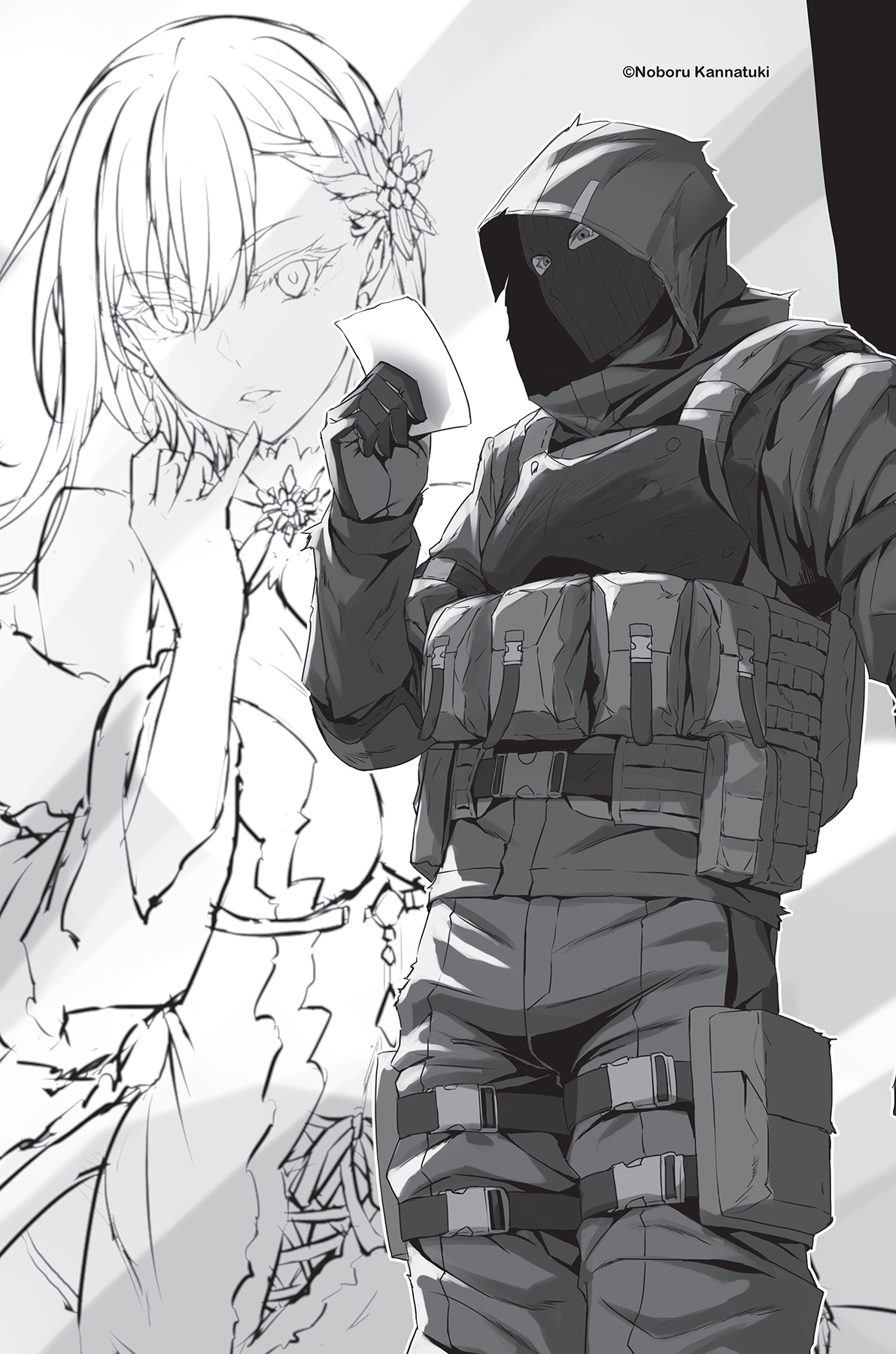
I let out a breath as water showered down on me in big drops. It fogged in the air, misting and blurring my vision.
The gun smoke quickly dispersed, revealing an absolute mess of a room with Lieutenant Adam lying in the middle of it. His hands and arms were spread-eagled, giving sick twitches. He was like a headless scrap-metal puppet, broken.
The obstacles, the gunpowder—all that big talk, and this was how he ended up. I wondered if he was even worth the price on his head.
Slowly, I walked over to him, knelt in the thinning pool of blood, and reached into his chest pocket.
There was a photo of a woman of cold beauty, an expression I had never seen on her face. I took the photo for myself, careful not to get any blood on it.
“If I’ve got even one ruble left, then I win,” I said.
—Take that.
None of which meant I could strut into Lubyanka Square like I owned the place.
Instead, I had to creep up, keeping my eyes peeled in every direction, so that by the time I arrived, I had to admit I was exhausted.
There was the black Volga, as usual, outside the headquarters of the KGB—Organ, next to the toy store. And as usual, standing beside the car was a man in a distinctive yet totally nondescript black suit.
“So you’ve come, comrade,” he said, his voice as sharp as ice and just as cold. “It seems you didn’t get caught in that…traffic jam.”
“Yeah, I managed, comrade.”
He might have been the same man I’d seen last time—I couldn’t tell them apart.
That was how it usually was with KGB operators. They were all the same. So it was fine if I acted like I knew the guy.
“’Course, if you knew it was me, I might have appreciated a little help.”
“We have many enemies of our own, comrade.” The man in the black suit stood beside me, also keeping a certain distance.
The two of us gazed out at the spectacle of Moscow at twilight. The gray sky, the gray city, the gray snow. The evening sun gave all of it a reddish tinge.
I heard the man in the suit let out the slightest breath. “It would have broken us to take on three organizations at once.”
“Gotta be better than going to work knowing a double-O agent might show up.”
“Want to trade places, then?”
“I think I’ll pass.”
We shared a dark laugh. I didn’t actually know how much work this man had done.
But he had certainly done some.
There was no sense that we shared our exhaustion or that we cared about each other—absolutely none.
“More important things,” I started.
“I know,” the man said. “I guarantee Miss Moscow is safe.”
I didn’t like it. So I pressed, “And my little brother and sisters.”
“Don’t worry. At the moment, they have no political value.” Meaning, the man said, his voice softening just a bit, “It’s safe to say that all of you have proven your value many times over.”
I clicked my tongue softly. “Tsk.” I wasn’t stupid enough to miss what he was saying.
I reached in the pocket of my body armor and took out a handful of microfilm. I tossed it to the man in the suit, who took it without blinking and put it in his own pocket.
“Is there anything else, comrade?” he asked.
“No, comrade,” I said, shaking my head. “Glory to the motherland.”
He gave me a single nod, then got in the Volga. I was sure he had somewhere else to go and more work to do.
As I watched the sleek black car roll away, spitting exhaust fumes, I muttered, “I’m not gonna complain.”
Then I turned on my heel and started walking.
I peeled off my balaclava, the cold air immediately stabbing my cheeks.
I knew very well how I had made it safe this far. That wasn’t a situation I could have survived on my own. Even that guy in the black suit probably would have been helpless by himself.
I went around the back of the building, where there was a brand-new GAZ truck waiting. Three kids stood idly in front of it: a boy with a guilty look, a black-haired girl staring at the ground, and another black-haired girl looking perfectly impressed with herself. The two girls could have been twins, except their hair was different lengths.
I let out a breath.
“Yowch!”
“Ow!”
“Myaa!”
Three kids. Three different shouts when I flicked them in the forehead. My little brother and sisters.
They’d probably been running all over Moscow all day—or for even longer than that.
I was about to say something, but I couldn’t find it in me to complain. I just gave a deep, deep sigh.
“Let’s get some grub and then let’s go home,” I said. I looked each of them in the eye as I spoke. They didn’t seem to understand why I’d said that. Maybe they’d assumed I was going to give them a piece of my mind. I wanted to tell them that if that was what they expected, they shouldn’t have done what they did in the first place.
But instead, I said: “I’ll treat you. Whatever you like.”
Nora, not to my surprise, didn’t miss a beat. “Then I want a hamburger!” She flung herself at me like a friendly cat and clung to my arm. “One of the American ones from Pushkin Square!”
“Ugh! Those cost a mint—and you have to wait forever, don’t you?!” Valery burst out. “Try to show a little restraint!”
“Boo on you!” Nora said menacingly.
But I said, “Hey, it’s fine. I’ll even get you a cola. Not one of the Zhukov ones, either—a real one with color in it.” I was happy enough to roll with Nora’s demand. Then I gave Valery a grin and added, “You’re driving, so no drinks for you.”
“Heh! If that’s what Big Bro says, I guess I’ve got to listen.” Valery laughed and scratched his nose with his thumb. He was still wearing those dark sunglasses, trying to look cool. “C’mon, Nora,” he said, “hop aboard—in the back!”
“Oh, come on! I don’t think I like you telling a girl to ride with the cargo—and it’s not the first time you’ve done it!”
“Well, I can hardly make my older brother and sister sit back there, can I?”
“Yeah, I know, but you could at least find a nicer way to say it!”
They continued to enjoy a pleasant argument as they got in the truck.
I turned to my other little sister, who was still looking at the ground, and said as casually as I could, “Hamburger sound good to you, Mariya?”
“Danya…”
It turned out to be my left hand that she was staring at so intently. My glove was scorched, and she could see the bandage and the coagulant gel (both courtesy of Vrach) that I had applied to my hand.
Mariya fidgeted. “Look, I…”
“So it’s settled.”
“Eep!”
I mussed Mariya’s long dark hair with my left hand. It was no longer the oily, filthy hair she’d had as a kid. It was clean and neatly combed—good hair.
“Oh, that’s right. I bought you a record.” I patted her hair neat again as a final gesture, then pulled my hand away.
My sister looked up at me, the corners of her eyes just a bit red.
“I’m gonna dig up a phonograph somewhere next time I’m out, as long as you’ll fix it up for me,” I said.
“…!”
Mariya’s breath caught and she rubbed her eyes, then nodded eagerly. “All right! You can count on me, Danya.”
I told her I would do just that, then headed for the truck’s passenger seat. Mariya and I would have to share it. It would be a little cramped, but we would just have to live with it. Or maybe I should let Mariya in first and have her sit in the middle.
From the back, Nora was fuming for us to get going already, and Valery had already started the engine.
My job was done. We would have hamburgers. We would go home. That was enough.
Maybe we could stop and buy some ponchiki <donuts> on the way. Oh, uh, no…
“Danya?” Mariya grasped my sleeve and looked at me. I shook my head.
“It’s nothing,” I said. I could only smile at the sudden urge I had to toss a piece of candy into my mouth.
“Danya, are you tired?”
“Vseo v poryadke, Stasia.”
What other answer could there be when I was lounging on white bedsheets, listening to Stasia’s voice?
I stretched all four limbs, totally relaxed, and let my head roll to one side so I could see her. She was in high spirits for some reason as she cleaned up the detritus from the dark tea we’d been enjoying.
I watched her curves bend and sway, traced by the tight fit of her pants, as she worked. It was one of the most wonderful things I had ever seen.
I’d seen other wonderful things, too, of course. I wasn’t trying to rank them.
“I mean, yeah, it was a tough job. But it’s done now, so it’s all good.”
“Yeah?” Stasia set down the teacup with a clink and turned toward me. She came over to the bed and sat down—the mattress didn’t even squeak. “You did good work, Danya.”
She sounded so gentle. She reached out with pale fingers and took my left hand, still wrapped in a bandage, brushing it gently as if to comfort me.
The warmth of her from so close—her weight, her softness. How could I put those things into words?
An uneducated slob like me, whatever I said would only sound like I was making fun.
But there was one thing I could say. After a long moment, I offered, “You know, it was definitely worth it.”
I could see her face as she gazed down at me. That much was certain, she was really here.
“It means I’ll be able to listen to that singer, Jazz, right at home.”
“Jazz?” she asked, tilting her head curiously. Then she smiled and said, “Ah. It’s wonderful music, isn’t it? Not that I know that much about it myself.”
“Isn’t it, though?”
Our conversation died out, but that wasn’t such a bad thing. There’s a lot of stuff you need words to communicate, but there are some things you can only share in silence.
Stasia’s fingers brushed my hand, then she took it and tugged at it almost like she was gently massaging it. It felt sort of like she was biting it, a sensation that tickled a little and felt delightful.
“I’d better give you a reward, then,” she said.
“You don’t think you’re too indulgent with me?”
“Last time…” She smiled. “I was being firm.”
“Fantastika!”
“Would you like something to eat? Or…”
“Good question,” I said. Stasia started to get up off the bed, but I took her slim wrist with my hand, delicately. It was so thin and pale that it looked like it might break at any moment, but there was blood in there, and it was warm.
Stasia gazed at me, and—yes—I could see myself in her eyes.
Trying to sound as casual as possible, I said, “I could go for some borscht. Something with actual ingredients in it.”
She blinked, then her eyes lit up with understanding.
That thrilled me—and trying to hide how happy I was, I said, “First—what would you like to eat, young lady?”
“Danya,” she said, and that was the end of our conversation—because she pressed her lips against mine, covering my mouth.
“Mn… Ooh… Danya… Danya!”
She called my name again and again as she rained kisses on me. I embraced her slim, soft, warm, perfect body, holding her as tight as I could, yet careful not to break her.
“Danya… Mm, hhh… Ahhh! Ooh… Danya! Daaanya…!”
It was something I had to do.
I’d done what I could, and this was the result.
I thought it was pretty good, if I did say so myself.
When you get right down to it, I’m just a Janitor who kills people for money. There’s not much that someone like that can do for someone like her. Earn money, pay money, give her kisses. That’s about it.
Well, no…
—I guess I could go see one of her plays, too.
One of these days. One of these days—sometime. Sometime soon. While we were still alive.
With that thought in my head, I closed my eyes, drowning in a soft, porcelain sea.
Payback

“Hey, comrade, did you hear?”
“Oh, you mean the assassination of Lieutenant Adrova?”
“In the background, maybe it was MI6, GRU, the CIA, VVS…”
“No, I heard it was the work of a Janitor.”
“Maybe one was involved, I don’t know. But I can almost promise you he’s dead.”
—Never. They took him too lightly!
Amid the din of the bar, a red-haired woman sat at the counter, tipping back a glass, her eyes crinkling at the throat-scorching alcohol. Ahhh, it was good.
She never would have guessed that there was an amateur/orphan just like her out there, fully organic, and able to do something like that.
At first, it had been a bit of a joke on her part. Call it a break between missions, call it sabotage—whatever it was, admittedly, it wasn’t praiseworthy.
Well, the job had been boring anyway.
She’d decided to tease the boy who’d happened to speak to her, to joke around with him. That was all she’d meant to do.
But then… Well.
—A PPSh… He’s an old soul.
The woman thought of what she’d seen and chuckled, a sound that came from deep in her throat.
There was his prompt retreat after he had thrown the electromagnetic grenade. He’d known how to move, and he’d shown good judgment. There was no indication that he was a cyborg, and she thought he was doing quite well for himself, for an organic.
When he’d twisted his ankle falling and found himself with pursuers hot on his tail, she’d thought, What an idiot, and laughed. But the way he’d bounced back from it—that wasn’t bad.
She’d figured, however, that that was the end for him.
Then the mafia had shown up from behind, and blam. The boy had just been a diversion.
The quarry had been taken by another group, but she was of no mind to worry about the results at this late date. In fact, she had found it quite a meaningful little moment, she thought.
—I see how he works. If the gamble isn’t going his way, he just flips the table over.
It didn’t surprise her to hear that he’d faced down the spetsnaz and MI6.
It wasn’t that those groups were weak—they were terrifying, of course. They just hadn’t been serious. If GRU had been playing for keeps, Baba Yaga would have been involved. And that really would have been the end.
But the boy? When his opponents weren’t serious—when circumstances prevented them from being serious—he immediately saw and exploited that opening.
There were those types, she thought—perceptive, quick thinkers. The top class of a whole pile of their ilk. Right there in the pile of those who were top class.
—How long he’ll survive is a separate matter.
“Seems like Moscow’s back alleys are getting interesting,” she said. She tugged on a chain at her neck, pulling out a small ring that had dropped behind her collar. Then she gave it a gentle kiss. “Don’t you agree, Ivan?”
With that, the red-haired woman—Eleonora—Uchitel, the Teacher herself—gave an alluring smile.
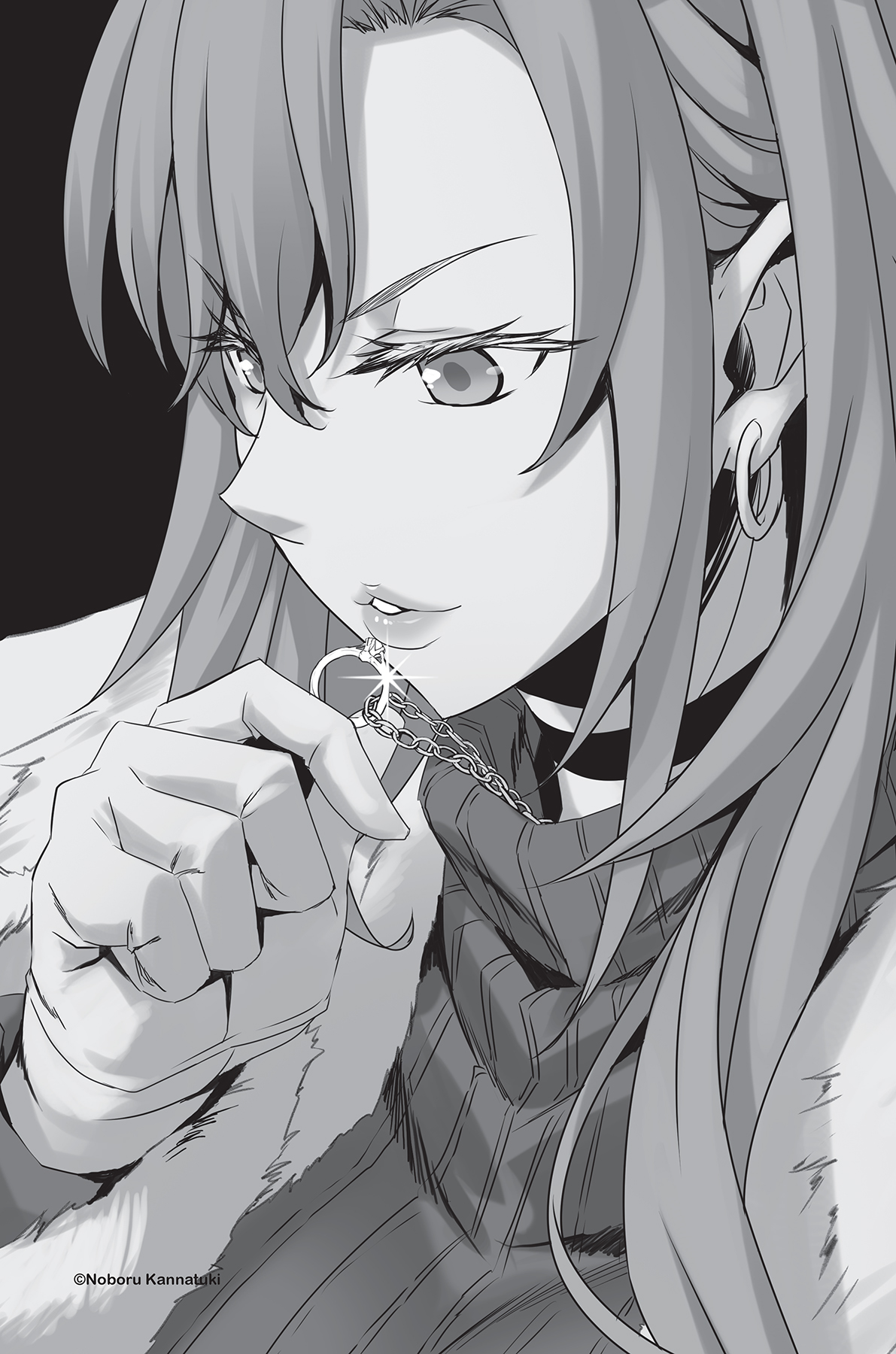
Afterword
Hello, Kumo Kagyu here!
Did you enjoy Moscow 2160?
I poured my all into writing it, so I would be thrilled if you had fun!
I really like Jude Law’s portrayal of Vasily Zaitsev in Enemy at the Gates (Stalingrad in Japan). But it’s not because he’s cool, or because he’s a kick-ass sniper.
I like him because he’s the son of a sheepherder from deep in the Ural Mountains.
He becomes a soldier without really thinking about it, is shaken by being thrown onto the battlefield, then is acclaimed a hero with jubilation all around.
And I like that he’s a youngster who then has a quiet conversation about his dreams for the future with the girl he likes.
“I thought the foreman I saw at the cannery was so cool. I thought to myself, I want to become the foreman of a factory.”
He’s just a simple young guy—that’s why I like Vasily.
This book is a version of something I first posted on the web years and years ago.
I got the setting, the world details, the characters and story, all by rolling dice. So Danila Kragin and his family really were “born” by sheer chance.
I didn’t think much of him—he’s nothing and nobody, so he’ll die one of these days, I figured. But Danila, as it turns out, is stubborn. He has the devil’s own luck, he always fights for his life, and he manages to run through the city.
So I started to fall in love with Danila, his family, and the people of Moscow. To be able to offer them and their story to the world like this makes me very happy.
To all my readers from the web days and to the honorable “May I Compile the Thread About This Ass-Kicker?”—this book couldn’t exist without your encouragement. Thank you so much.
To Noboru Kannatuki, for his superb illustrations, and to Koutarou Sekine, who’s handling the manga version: Thank you both from the bottom of my heart.
Things are getting tough these days. I watch the news and think, That’s not good or I hope somebody does something about this soon.
But this book isn’t really about politics, or about good and evil. If you got any sense that it was, then with sincere apologies, I must tell you that you misunderstood.
For Moscow 2160 is simply the story of people running as fast and as hard as they can.
I would be very pleased if you would take it as such.
Volume 2 is still up in the air, but it might be a story about Baba Yaga.
Those who know, know—but it’s that famous “he” and “she.” I hope I get to tell you the tale sometime.
See you next time!