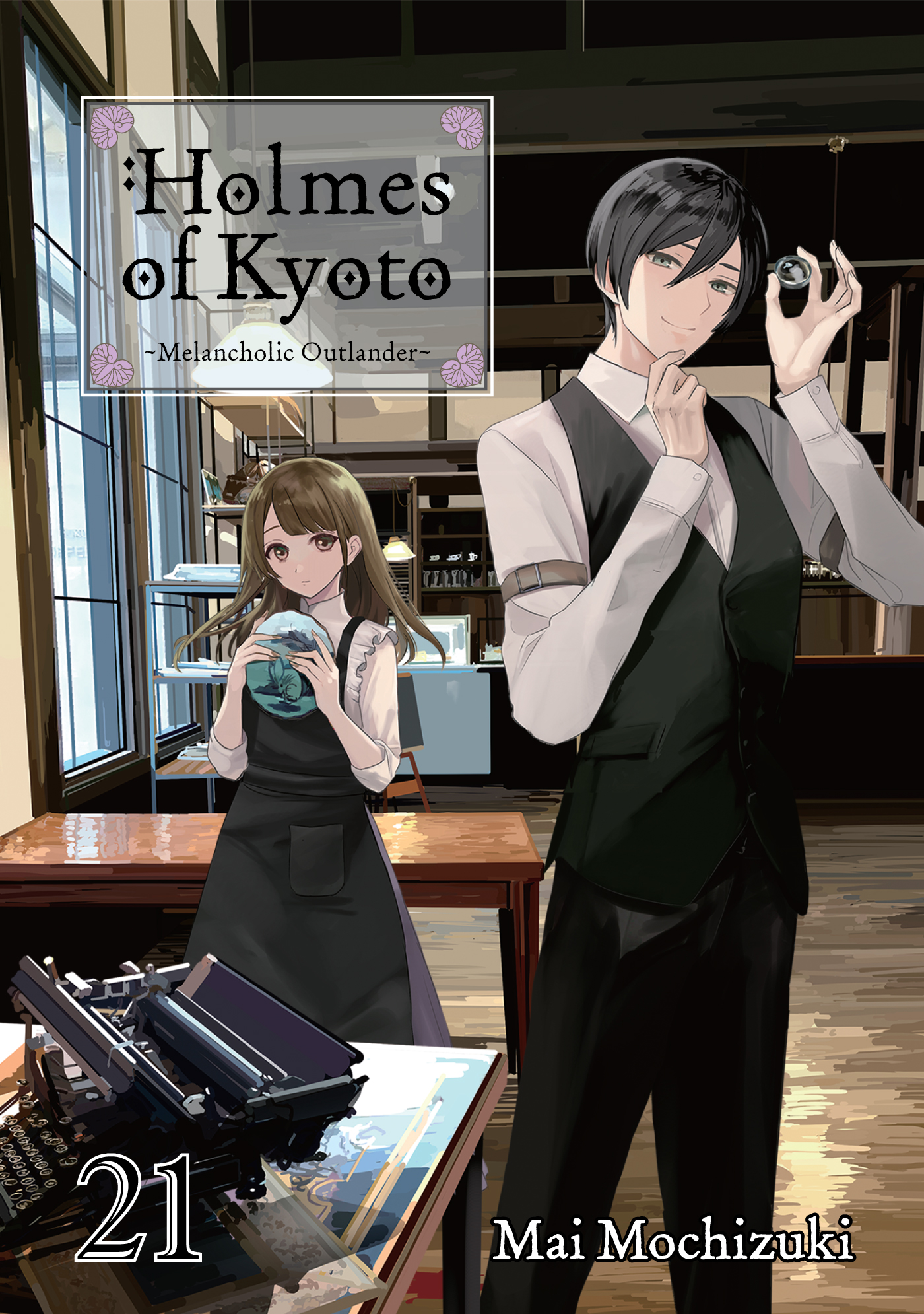
Prologue
Prologue
One September afternoon, I, Aoi Mashiro, was absentmindedly gazing out the window while cleaning the store. There were uniformed middle schoolers outside, presumably on their way home. Today was probably the first day of their new semester. Meanwhile, as a university third-year, I was still on summer break.
“Aoi.”
I flinched in surprise at the sudden voice. Turning around, I saw Kiyotaka “Holmes” Yagashira smiling at me. As usual, he was wearing a black vest over a white shirt, black slacks, and sleeve garters. He was also holding a clipboard since he was in the middle of examining the wares.
“Sorry, I was spacing out,” I said.
“It’s fine. I noticed you were grinning. Did you see something funny outside?”
“Not funny, per se. I was just noticing that the new semester has already started. It’s finally autumn.”
“You’re a fan of autumn, aren’t you?”
“Yes!” I nodded energetically. “I came to love it after moving here. It’s the season when Kyoto truly shines.”
“That’s a good way of phrasing it.” He smiled.
Holmes was in a good mood these days. Well, technically, that was always the case since his outward emotions didn’t fluctuate much. But he seemed particularly happy as of late.
“Autumn would be nice too,” he murmured.
“Huh?”
“I was thinking May would be a good time for the ceremony because it’s your birth month, but autumn with its beautiful leaves is also a lovely option. And then there’s cherry blossom season... Oh, sorry. I got carried away again.”
“It’s okay,” I said shyly.
I’d proposed to him the other day, saying, “After I graduate, will you marry me?” and he’d been like this ever since.
“Apologies; my head’s been in the clouds. Please don’t mind my ramblings,” he said.
Behind the counter was a stack of wedding magazines filled with sticky notes. I was happy that he was looking forward to our special day, but I wished he would keep in mind that I’d said “after I graduate.” It wasn’t that I disliked his enthusiasm, but rather, it made me feel embarrassed, rushed, and overwhelmed. It was probably because I was still in my third year of university, so our wedding seemed a long way off to me.
“Ah, you may think I’m being hasty, but when it comes to marriage, it’s never too early to begin preparing,” he said, reading my mind as usual.
I coughed. What expression am I supposed to make here? I should just change the subject.
“Have you finished checking everything?” I asked.
“Yes,” Holmes said, showing me the clipboard. “I also performed an inventory audit while I was at it. Thankfully, we’ve had zero thefts. Everything matched the stock list.”
“That’s a relief,” I said, placing my hand on my chest.
Since Kura had a bit of an intimidating air to potential visitors, it was never crowded inside. That made it easy to keep an eye on what was going on.
One time, a few students had stepped inside, scanned the interior of the store, and turned to leave with dour looks on their faces. As I’d wondered why they’d left, Holmes had coldly explained, “They must have determined that theft would be impossible.” Those words had left an impression on me.
“Come to think of it, you always say ‘theft’ instead of ‘shoplifting,’” I remarked.
“Yes,” Holmes replied with a firm nod. “I don’t think it’s good to use softer words like ‘shoplifting.’ The same goes for ‘bullying.’ Crimes should be referred to as what they are: theft, assault, defamation, and so on.”
“I see. Phrasing is important, huh?”
“Exactly. Anyway, now I can go to my final apprenticeship with peace of mind.”
Starting next week, Holmes would be working at a tax consulting firm on Shijo Street for a year to obtain his tax accountant license. He already met the requirements to take the exam but wanted to gain more practical experience first. His work schedule was weekdays from 9 a.m. to 5:30 p.m. After finishing there, he’d come to Kura and tend to the store.
“You’ll be working two jobs, right?” I murmured, concerned about his health.
“I’ll be fine. You’re juggling your work and studies too, aren’t you?”
I blinked and gave an awkward smile. “I think that’s a bit different...”
“It’s not. I’m more worried that Komatsu will request my assistance, and then I’ll be working three jobs.”
“You’re still a member of the Komatsu Detective Agency in spirit, huh?”
“It looks like I’ll be stuck with them for quite a while.”
As we were chatting, the door chime rang.
“Welcome,” I said, turning to face the door. “Oh!”
Standing there was a gorgeous woman with long black hair: Yilin Jing. She was the daughter of Zhifei Jing, a Shanghai-born businessman who was one of the richest people in the world. Her attire today was very casual, consisting of a T-shirt and jeans.
“Why, if it isn’t Yilin,” said Holmes. “Good afternoon.”
“Hello,” our guest said with a smile.
“Please have a seat,” I offered.
Yilin gave a cheerful bow and sat down on one of the chairs in front of the counter.
As Holmes served her coffee, she bashfully tucked her hair behind her ear and said, “I came here to let you two know that we’ll be seeing each other more often.”
On the opposite side of the counter, Holmes and I exchanged glances.
“What do you mean by that?” Holmes asked.
“I’ve enrolled in a master’s program at a Kyoto graduate school,” Yilin explained. “It begins in October.”
“Huh?” My eyes widened. “You’re doing a master’s at Kyoto University?!”
“No, not Kyoto University—it’s just a private university in Kyoto. And the program is only a year long...”
The school in question turned out to be quite a famous one.
“Is that so?” Holmes murmured, surprised. “Is it medicine-related?”
Yilin had studied medicine at a university in America.
“No.” She shook her head. “Meeting you two made me realize that I only chose medicine because I wanted my father to praise me. It wasn’t my true dream.” She clasped her hands atop the counter. “I gave it some serious thought and realized that as a member of the Jing family, what I really want is to help my father. So I enrolled in an economics program.”
Holmes hummed and folded his arms. “If you want to study economics, wouldn’t Penn or MIT be better?”
Yilin shrugged. “My father said the exact same thing. While I do want to be of use to him, I’m equally interested in experiencing a fun student life, which is something that can only be done right now. So I’m thinking of joining Aoi at KyoMore...”
KyoMore was short for the Make Kyoto More Beautiful Project, which was led by my university senior, Haruhiko Kajiwara, aka Akihito’s younger brother. We organized events and volunteer activities to brighten up the city of Kyoto, and membership extended beyond our school.
“Ooh, we welcome you with open arms,” I said excitedly. “That said, this part-time job keeps me busy, so I don’t participate very often.”
“Thanks. And, well, don’t worry about it. I have another, more personal, motive for coming to Kyoto...” Her cheeks and ears were slightly flushed.
I nearly gasped. Yilin chose to study in Japan because she wants to get closer to Ensho—real name Shinya Sugawara. It all makes sense now.
I immediately turned to look at Holmes and found him smiling in amusement. From the look of it, he’d already presumed as much when he’d questioned her choice of school. That’s Holmes for you—wicked as ever.
Yilin looked up at him and asked, “Would you be okay with having me here?”
“What do you mean?” Holmes tilted his head. At first glance, he seemed confused, but he undoubtedly knew exactly what she was getting at.
“I’d like to work here for a month until my program begins. I want to learn about art, and most of all, I want to get to know Aoi better. Since I only want to study, you don’t need to pay me.”
“Huh?” I blinked and placed my hand on my chest. “Me? Not Holmes?”
“Yes, I want to know more about you, Aoi.”
The look in her eyes was serious. What exactly was she so curious about?
“Very well.” Holmes nodded. “We happen to be short-staffed right now.”
He explained to her that not only would he be working at a tax consulting firm for the next year, but Rikyu was away in New York as well, leaving me and the manager to pick up the slack.
“So we’d be happy to have you work here until school begins,” he said with a smile.
“Thank you,” said Yilin. “I really appreciate it.”
“We’ll be paying you the standard part-time wage, though. It may be a trivial amount for you, but having someone work for free goes against our principles.”
Yilin stood up and bowed deeply. “I look forward to working with you.”
“Likewise,” I said, bowing back.
“You have a junior now, Aoi,” said Holmes.
“Huh?”
Yilin turned to me and bowed again. “I’m in your care, Miss Aoi.”
“Wait, what?”
Holmes grinned. “You really are her senior, Aoi.”
I’d never been in a mentoring position before. “I guess that’s technically true at Kura.”
“Yes, so please work me hard,” Yilin said with a smile.
My eyes widened. “I could never...”
Autumn was off to a happy start, but I couldn’t help but feel that, once again, something was going to happen.
Chapter 1: A Chic Move
Chapter 1: A Chic Move
1
I decided to study abroad in Kyoto this autumn because I finally steeled my resolve.
Stepping into the antique store Kura, Yilin Jing bowed and said, “Thank you for having me.”
Aoi Mashiro, who’d been diligently removing the cloths draped over the wares, turned around and smiled. “Oh, good morning, Yilin.”
Kiyotaka Yagashira was nowhere to be seen. Today was his first day of work at the accounting firm, so it was only Yilin and Aoi in the store.
Since it was before opening hours, the usual jazz music wasn’t playing. Perhaps the silence was why the air felt so tense. Then again, this was only Yilin’s perception. Spending a significant amount of time alone with someone always made her nervous, no matter who that person was. In a group of three or more, she could get away with just listening to others, but that didn’t work when it was only her and someone else. Many of the people she interacted with were pleasant in group settings but changed their tune when it was just the two of them. She wondered if her current anxiety stemmed from scars left by those bitter experiences.
Come to think of it, I’ve never spent an extended period of time with Aoi before. How will she change when we’re alone?
Aoi excitedly went to the kitchenette and returned clutching something to her chest. “It’s a pleasure to work with you. This apron is for you, Yilin.” She held out a black apron still in its plastic packaging.
“Thank you...”
“Please leave your belongings on the shelf at the back of the kitchenette. There are coat hangers there and small lockers for your bag. You can keep your phone in your apron pocket.”
“I can keep my phone? Um, I mean, am I really permitted to carry my phone with me?”
Aoi chuckled. “You don’t have to force yourself to speak politely.”
“But you’re my senior...”
“You’re older than me, and either way, I’d prefer you to keep talking naturally to me like before.” Aoi took her phone out of her pocket. “You’ll probably need your phone to take pictures of antiques, look up things you don’t know, and take notes. That’s why you’re allowed to keep it with you.”
“So I’m allowed to look things up in the store?”
“Yes, feel free. Just try not to be blatant about it when customers are around. And if you get a phone call while other people are here, please take it outside or in the kitchenette.”
“Got it.” Yilin nodded and entered the kitchenette.
The room was the size of a typical household kitchen. It had a sink, gas stove, and kettle. The shelves were lined with various cups and saucers—Meissen, Copenhagen, and Arabia, among others—as well as mugs engraved with the name Kura.
“These are lovely...”
Even the tins of coffee and tea were stylish. It was like being in a specialty store. There was a curtained-off changing area at the back of the room, which had a full-length mirror and an overhead tension rod with clothes hangers.
Yilin hung up her jacket. Looking down, she saw the lockers that Aoi had mentioned. There were four in total, just large enough to fit a small handbag. She took her phone out of her purse and stored the latter away. She then donned her apron, which was the same black one that Aoi always wore. She looked at her reflection in the mirror. Not bad. Pleased, she slipped her phone and the locker key into her apron pocket and exited the kitchenette.
“Oh!” Aoi’s face lit up. “You look great, Yilin.”
“Do I?” Yilin shyly placed a hand on her chest.
“Yes! The white blouse and black Kura apron really accentuate your trim figure.”
“Trim?” Unsure what the word meant in that context, Yilin took out her phone to look it up. She frowned at the long list of definitions.
“Oh, sorry! I forgot you’re not a native speaker. It doesn’t help that I’ve gotten used to using Kyoto slang.”
“What does it mean?” Yilin looked up from her phone.
“Um...” Aoi looked up at the ceiling. “It means having a slim build, or, like, looking neat and tidy...”
“So, like Kiyotaka?”
Aoi chuckled. “Yeah, exactly. Holmes is the embodiment of ‘trim.’”
In other words, it was a compliment. Yilin felt proud and happy.
“Should I wear armbands too?” she asked.
“I think they’d look good on you.”
After that, Aoi explained the work that had to be done. First, they had to get ready to open the store. This began with removing the cloths draped over the antiques, folding them, and putting them away in the cupboards. Next was cleaning. Aoi liked listening to music while she worked, so she usually played it during this time.
There were four steps to the cleaning process: carefully dust all of the merchandise, sweep the floor while paying extra attention to the corners, collect the dust and trash, and vacuum.
“But it’s impossible to finish dusting everything in the morning, so please work on it whenever you have a free moment,” Aoi said as she brought out the cordless vacuum cleaner.
Yilin looked at her, surprised. “We have to clean all day long?”
“Yes,” Aoi said matter-of-factly. “Most of the items here are very old, so if we let dust build up, the atmosphere will quickly feel gloomy.”
Now that she mentions it, Kura’s storefront may seem intimidating to newcomers, but the interior lacks the somber air that antique shops tend to have. Instead, it feels bright and refreshing.
With a distant look in her eyes, Yilin murmured, “Come to think of it, Juhua said that dust clings to people’s thoughts...”
“I can believe that. When antiques get dusty, it feels like the sentiments they carry are amplified. Who did you hear that from?”
“Oh, Juhua was my nanny.” Yilin blushed since she hadn’t expected her whispered words to be heard.
They continued their work. After sweeping outside the store and wiping down the windows, the next task was to prepare the cash register for the day. Yilin had never taken a close look at Kura’s register before, so she was surprised to see that it was a wooden antique.
“How retro,” she remarked, staring at it. “It must be as old as some of the items for sale.”
“It’s the owner’s—or, well, the Yagashira family’s taste in general. Nowadays, it’s only used for holding cash, though. We do the calculations on this tablet over here.” Aoi grinned and showed Yilin the small device propped up beside the register. “I’ll explain how to use it later.”
Aoi took out a small safe from under the counter, turned the number dials to unlock it, and began transferring the cash within to the register.
“Once this is done, we can put the floor sign outside and hang up the ‘OPEN’ sign. Opening time is generally 10 a.m., but on some days, it’s 11 a.m. We hardly ever get customers in the mornings anyway.”
Proving her point, even after she put up the “OPEN” sign, no one entered the store. The street itself had a lot of pedestrian traffic, but everyone passed right on by.
“Is this store even profitable?” Yilin blurted out without thinking. Realizing her mistake, she closed her mouth.
Aoi giggled. “I wondered the same thing at first. I think the owner only really sees this as a place to store antiques. In reality, all of the revenue comes from visiting clients at their homes or businesses.”
“Oh, I see.”
Yilin had heard that at jewelry stores, the big transactions came from sending sales representatives to celebrity homes rather than in-store sales. It made sense that an antique store would work similarly—but that raised another question.
“If that’s the case, why keep the store open at all?”
“Holmes said that having run this store for so many years is an important indicator of trustworthiness. And most of all, the owner wants to show these antiques to anyone who’s interested enough to come in. But times have changed, and it seems like they can’t afford to take it easy anymore. As the owner’s successor, Holmes has been considering various options.”
These options included a decor subscription service for traditional restaurants, Kyoto-related consulting work, and becoming a certified tax accountant. According to Kiyotaka, it was best to have more than one source of income.
“That I understand,” Yilin said. “Most businesses in Japan used to prohibit side jobs, but it just isn’t possible to get by with one job these days.”
“Yeah.” Aoi lowered her gaze. “Holmes is capable of handling multiple jobs, but that won’t work for me. I’m not the kind of person who can do everything.”
“Oh, is that so?”
“Yes. I already have my hands full with just school and this part-time job. I haven’t been able to participate much in KyoMore’s activities because of it. And during the summer, I couldn’t work at Kura because I was interning at Kyoto National Museum. When I’m absorbed in something, it steals my entire focus.” Aoi sighed.
Yilin was surprised. According to her research, before Aoi Mashiro had come to Kyoto, she had been an ordinary student with no involvement in art whatsoever. However, after she got a part-time job at Kura and became Kiyotaka Yagashira’s apprentice, her talent had rapidly blossomed. In just a few years, she’d become an honor student of renowned curator Sally Barrymore.
Yilin had believed that Aoi was just as exceptional as Kiyotaka but in a different way.
“I thought you were the clever and resourceful type, like Kiyotaka,” Yilin murmured.
Aoi shook her head vehemently. “Not at all.”
“But you gained Sally’s recognition in such a short time, didn’t you? You must have studied a lot to develop that insight. How did you do it?”
Aoi gave an awkward smile. “I got absorbed.”
“Absorbed?”
“Yeah, I was obsessed with antique art. I never thought of it as studying hard—I was just absorbed in learning about something I loved. I’m the kind of person who can only do one thing at a time, which is honestly a bad thing. I wish I could be as versatile as Holmes.” She slumped her shoulders.
Yilin couldn’t help but smile upon hearing that. She turned away and covered her mouth so Aoi wouldn’t notice. Yilin had always been surrounded by people who tried to make themselves sound more impressive than they really were, so Aoi’s openness about her own shortcomings felt refreshingly honest.
“Did you come to love it after being around these antiques every day?” Yilin asked.
“Yes. A big part of it was that Holmes taught me about them whenever he had the chance. Before I knew it, I was hooked.”
“That’s how they get you, huh?” It was the same for me.
In Yilin’s case, it was Ensho’s work that had captured her heart. She turned around to look at the painting of his that was displayed in the store: Suzhou. It was a brilliant piece. The thought of being able to see it every time she came here filled her with joy. Yilin had been awed by the mandala he’d painted, while Yu Garden by Night had taken hold of her heart and refused to let go. She thought back to his latest painting, which had been displayed at the M+ museum in Hong Kong. It was titled Present City and depicted a modern Kyoto townscape.
It was beautiful.
Just remembering it made a passionate sigh escape her lips. She wasn’t the only one captivated by Ensho’s art. Her father was in the same boat—in fact, he seemed more obsessed than she was.
“By the way, was your family opposed to you studying in Japan?” Aoi asked, snapping Yilin out of her thoughts.
“No. Apparently they didn’t think medicine was the right fit for me anyway. And in my father’s case, it worked in his favor.”
“How so?” Aoi tilted her head.
Yilin merely gave an ambiguous smile in response. She had made all of the preparations before telling her father, thinking that if she asked for permission beforehand, she’d be stuck if he disapproved. To her, it was a life-changing decision. She’d been anxious about how he would react. Would he be angry? Happy? Indifferent?
The result had surprised her.
“So you’re going to grad school in Kyoto this fall... That’s good. I was just about to ask you to do something there for me,” he’d said cheerfully, throwing her off.
“What is it?”
“You know that Takamiya guy, right?”
“Of course. He’s the wealthy man who won the bid for Ensho’s painting, isn’t he?”
“That’s right. He’s also an art connoisseur. I don’t care how long it takes—I want you to find a way to get close to Munechika Takamiya and look into something in his collection for me. I hired someone to investigate, but they couldn’t get any information.”
Yilin clenched her fists. She wanted to meet her father’s expectations. That meant she needed to make contact with Takamiya somehow. And in order to get close to him, she would need a common topic of interest—in other words, she needed to know about antiques. That was another reason she’d decided to work at Kura.
“Aoi, I’d like to attend these ‘Kura lectures’ too.”
“You’re more than welcome. Holmes should be back at around 6 p.m.”
Yilin shook her head. “No, I want to learn from you.”
“Huh?” Aoi blinked. “Really?”
“Of course. What do you recommend out of the items in the store right now?”
“Well...” Aoi turned her gaze to the glass display case that held the store’s most expensive wares. “It’d have to be the Shino tea bowl. They’re very famous in the world of antique art, though, so it might be too basic for you...”
“I’ve seen one at the Shanghai Museum before, but I don’t know much about them. I’d love to learn more.”
That was a lie. The Shino tea bowl she mentioned had been on display at an exhibition organized by her father, who had wanted to win over the residents of Shanghai with what he called The World’s Finest Art Exhibition. As the name implied, he’d gathered treasures from all over the world.
The highlight of the Japan section had been the yohen tenmoku tea bowls, of which only three existed in the world. Her father had secured all of them for his exhibition. They hadn’t been the only national treasures on display, though. There had also been a Shino tea bowl called Unohanagaki, so Yilin had already done her research at that time.
Her feigning ignorance wasn’t out of malice—she simply wanted to see what kind of explanation Aoi would give her.
“Well, in that case...”
Aoi took the tea bowl out of the case and placed it on the counter. Kura’s Shino tea bowl was white with a reddish-brown pattern and had a unique warped shape. Aoi looked down at the antique pottery and began her lecture.
“A Shino tea bowl is a tea bowl made in the Shino style. Japan has three major pottery styles: Seto ware, Mino ware, and Arita ware. These three are said to have greatly influenced Japanese pottery culture. Mino is an old province that’s now part of Gifu Prefecture, so Mino ware is the general term for ceramics produced in that region. Seto ware refers to ceramics produced in the area around Seto City in Aichi Prefecture, and Arita ware is mainly produced in Saga Prefecture.”
She grinned and looked at Yilin.
“Quiz time. Which of these three do you think Shino ware falls under?”
“Um...” Yilin retraced her memory. “Mino ware, perhaps?”
Aoi’s face lit up. “Correct. Shino ware is classified as Mino ware. It’s said that Shino ware originated from Soshin Shino, an incense master of the Muromachi period who commissioned Mino potters to make it.”
She explained that there were many types of Shino tea bowls, including patternless Shino, gray Shino, painted Shino, crimson Shino, red Shino, marbled Shino, and Shino-Oribe. Some of these techniques were designated Important Intangible Cultural Properties.
“Personally, I think the most distinctive ones are painted Shino, Nezumi-Shino, and crimson Shino.”
Painted Shino was created by applying Shino glaze (feldspar glaze) over designs painted with “oni ita” pigment, which had high iron content. It was the most orthodox type, and many early Shino tea bowls fell into this category.
Gray Shino involved painting oni ita over the entire piece as a base, carving patterns into it, then applying Shino glaze before firing. The iron content combined with the kiln conditions would produce a gray or reddish-brown finish. If the result was more of an orange color, it became red Shino instead.
Crimson Shino was distinguished from red Shino by technique. It used a yellowish base layer that contained less iron than oni ita, and patterns were drawn on top before Shino glaze was applied. Using the Shino glaze sparingly would result in a bright-red body.
“Now then, which type is Kura’s Shino tea bowl?” Aoi asked.
“Hmm, is it painted Shino?”
“Correct.”
“Your lectures are quiz-style, huh?” Yilin remarked with a smile.
Aoi blushed. “It’s definitely because of Kurishiro, the deputy director of Kyoto National Museum.”
“Oh, you interned there, right?”
“Yes. Kurishiro was a lighthearted person who always taught us things in quiz format. At the time, I thought it was just her cheerful personality, but looking back, those quizzes really stuck with me.”
“Perhaps that’s what it means to have fun while learning.”
Aoi’s lectures were both thorough and enjoyable. Whenever Yilin showed signs of fatigue, Aoi would suggest taking a break and make coffee for her. Before Yilin knew it, the sun had already set.
Kura was part of a roofed shopping street, but since it sat near the intersection of Teramachi Street and Sanjo Street, one could see the sky through the gap where the two roofs ended.
That day, only three customers had entered the store. The first had mistaken it for a café and left immediately. The second had simply looked around, and the third group had arrived just now, while Aoi happened to be outside delivering the neighborhood bulletins.
The door chime rang, and a man in a dark-brown kimono stepped inside. He looked to be in his mid-thirties, with a plain face and hair cut short like a soldier’s.
“Where’s Kiyotaka Yagashira?” he asked, scanning the store.
“He should be here around 6 p.m.,” Yilin replied.
“Oh.” He looked at her. “You must be the one everyone’s been talking about.”
“Huh?” Yilin’s eyes widened. The Jing family was famous. Were rumors spreading about her?
The man scratched his head. “We met backstage a while ago, but you don’t look familiar at all,” he muttered to himself. “I don’t think I would’ve forgotten such a beauty, though... Spending so much time with Kiyotaka must’ve refined you.”
He placed a small box on the counter.
“I don’t have time to wait until six, so pass on a message for me.”
The box contained a wood sculpture of a mouse about the size of a thumb. It had a cute, round form.
“I want Kiyotaka to appraise this for me,” he said.
Yilin nodded in silence. She couldn’t tell what the item was at a glance. As much as she wanted to pull out her phone, take a picture, and perform an image search, doing so in front of a customer would affect the store’s reputation.
She looked down at the mouse sculpture again. It was about five centimeters long, but despite its tiny size, the texture of its fur had been carved out in detail, and its round eyes were simply adorable. It also had a hole in it for threading string through.
“My grandfather passed away the other day,” the man continued, averting his gaze. “He left these to us.”
The sculpture was beautifully made, but as an inheritance, it felt a bit lacking. Yilin glanced up at the man and found a gloomy look on his face. He was probably thinking the same thing—that was why he wanted Kiyotaka to appraise it.
“Grandfather was a man of few words, but there was always meaning behind his actions,” the man said. “This netsuke must represent something he wanted to tell us.”
“Um, who exactly is ‘us’?”
“Me, my brother, and my father.”
“Did you all receive mice?”
“No, my brother got a frog, and my dad got Daikoku.”
“Daikoku?” Yilin didn’t know what that was. She’d have to look it up later.
“Anyway, I’ll come back to pick it up tomorrow evening around 6 p.m.,” he said, turning to leave.
“Thank you for your patronage.” Yilin bowed.
The man stopped in front of the door, nodded in her direction, and left the store. His movements were incredibly graceful. Judging by his kimono, perhaps he was a flower arranger?
“Oh!” Yilin placed a hand over her mouth. “I didn’t ask him for his name or contact information!”
She hurried outside and scanned the area, but the man was nowhere to be seen. She sighed and went back inside.
“What should I do?” she murmured, looking down at the little mouse.
Just then, Aoi returned to the store. “Sorry it took so long. I ended up chatting with Mieko for a while. Oh, Mieko runs a Western clothing store down the street, by the way. She’s in her seventies and has known the owner for a long time.” Noticing the glum look on Yilin’s face, she asked, “What’s wrong?”
“Um, I’m sorry, Aoi.” Yilin bowed deeply.
“Did you break something?”
“No, I made a mistake.”
“A mistake?” Aoi blinked.
After giving Aoi a rundown of the man’s visit, Yilin slumped her shoulders and said, “He left this here and disappeared. He spoke as if we’d met before, so it felt too awkward to ask for his name.”
Aoi hummed and leaned in to peer at the small wooden sculpture. “This is a netsuke.”
“What’s that?” Yilin recalled that the man had mentioned that word too, but she didn’t know what it meant.
“Um...” Aoi pulled out a book on antique art from the shelf and laid it open on the counter. “A netsuke is basically a fastener.”
“It’s used to attach something?”
“Right.” Aoi nodded. “It’s for hooking things like pouches and stamp cases to a kimono sash. From the Edo period to the Meiji period, it was a popular way for commoners to express their fashion sense.”
The book had an illustration of a lion carving affixed to a kimono sash, with a case hanging below it.
“So it’s like a strap you attach to your sash?”
“Yeah, it’s basically a character-themed strap. But netsuke artisans don’t think it’s chic to call it a strap.”
“What does ‘chic’ mean?” Yilin was fluent in Japanese, but some words still escaped her knowledge.
“Um, it’s, like, aesthetic, I guess?” Aoi answered weakly. “Netsuke are called ‘art you appreciate in the palm of your hand.’ They’re typically only three to five centimeters long, but they come in all sorts of designs.”
Themes included Japanese folktales, Chinese history, Edo period customs, animals, plants, and fictional creatures. Animals were especially popular.
The mice, monkeys, and dogs are carved realistically, but they’re also charming, like mascots, Yilin observed, looking at the book.
“What’s important is that they always have a string hole for attaching stamp cases and such,” Aoi explained.
“But in the Japanese period dramas I’ve watched, stamp cases were carried by high-ranking people. Did commoners have them too?”
“Yes.” Aoi smiled. “I used to wonder the same thing, actually. But stamp cases were just containers for holding things like medicine. In those period dramas, it’s not the case itself that everyone bows to—it’s the family crest on it.”
Yilin hummed.
Aoi flipped through the pages of the book as she continued her explanation. “This netsuke is carved from wood, but other materials are used too, like ivory, water buffalo horn, deer antler, porcelain, and metal. Sophisticated ornaments like these are highly regarded overseas as a uniquely Japanese art form.”
Netsuke also had different names depending on their shape:
Katabori-netsuke were themed around people, animals, plants, vessels, and scenery.
Men-netsuke featured the traditional masks used in performing arts like Noh, Kyogen, and Gigaku.
Manju-netsuke were round and flat like manju buns.
Kagamibuta-netsuke were similarly round and flat, but they had a hollow bowl in the center that was covered with a lid, often made of metal.
Ryusa-netsuke got their name from Ryusa Ikejimari, a lathe craftsman employed by the Tokugawa shogunate. These netsuke were created using a lathe and shaped like incense containers.
Sashi-netsuke were long and flat so that they could be inserted between the layers of a kimono sash or hakama cord.
Haizara-netsuke, also known as hihataki-netsuke, acted as ashtrays to be used when smoking with a kiseru pipe.
Hako-netsuke consisted of two parts, a box and a lid. The string holes were located on the underside of the lid and the bottom of the box.
“So the one the customer left here is a katabori-netsuke?” Yilin peered at the mouse carving.
“That’s right.” Aoi nodded. “I’m not an expert on netsuke, so I can’t say who created this, but from looking at it, I can tell that it’s very well-made.”
As they were talking, the door chime rang.
Did the customer come back? Yilin turned around, but instead of the figure she was hoping to see, she was met with a young man with glossy black hair and an attractive face—Kiyotaka.
“Welcome, Holmes,” Aoi greeted him with a smile.
“Good evening, Aoi, Yilin,” said Kiyotaka, placing his briefcase on a chair in front of the counter.
“How was your first day at the accounting firm?” Aoi asked.
“It was mostly training. The staff are all very kind. It’s a nice work environment.”
There must be a lot of female employees, Yilin thought, grinning to herself.
Kiyotaka turned his gaze to her. “How was your first day, Yilin?”
“Aoi is a patient, fun, and thorough teacher.” Yilin smiled.
“I see,” said Kiyotaka, seeming happy. “That’s good to hear.”
“I was enjoying myself so much that it didn’t even feel like work.”
Aoi blushed and changed the subject. “Oh, right, Yilin, I was thinking of having a welcome party for you. Are you free later today?”
Yilin appreciated the sentiment, but unfortunately, she had to decline. “I’m sorry,” she said, pressing her palms together to apologize in true Japanese fashion. “I’m supposed to attend a Rolling Club meeting tonight.”
The Rolling Club was a membership-based international organization dedicated to goodwill and community service. Many of its members were businesspeople or politicians.
“Oh, okay,” said Aoi. “Can I schedule it for another day, then?”
“Of course.”
“We can combine it with Aoi’s feet-washing,” Holmes suggested.
Feet-washing? Yilin frowned, wondering if she’d misheard.
“I don’t think that’s necessary,” Aoi said with a shrug. “Didn’t we already do my feet-washing?”
I heard right after all. And...it’s already been done?
“Um, did you do this for Aoi?” Yilin asked hesitantly.
“Yes,” Kiyotaka said nonchalantly.
“I see.”
Behind Yilin’s calm facade was a flustered and confused heart. Kiyotaka washed Aoi’s feet? She imagined him kneeling on the floor, delicately tending to his partner.
“Aoi, please don’t pull your feet back. I can’t wash them properly like this.”
“But it tickles.”
“Is that really the only issue?”
“You’re so mean.”
“Oh, Aoi. You know Kyoto men are wicked.”
Yilin gasped, her cheeks flushed. The image she’d conjured in her mind was simply too realistic.
Kiyotaka chuckled. “My apologies, Yilin. Feet-washing is a Kyoto-specific term that refers to a celebration or thank-you party. We had one the other day because Aoi finished her internship.”
“Huh?”
Aoi giggled. “I was surprised the first time I heard it too.”
In other words, their conversation had been about dedicating the party to Aoi as well.
“Oh, I see,” said Yilin. “Regional dialects are still hard for me.” She pressed her hands to her burning cheeks, ashamed of her indecent imagination.
Kiyotaka turned his gaze to the item on the counter. “Before I forget, why is there a Masanao Suzuki netsuke over there?” he asked, instantly identifying the thumb-sized sculpture with a mere glance.
“It really is Masanao Suzuki, then,” Aoi said, relieved. Apparently she’d had a hunch too.
“Who is that?” Yilin asked, impressed by their knowledge.
“A netsuke craftsman from Ise who was active from the Bakumatsu period to the early Meiji period,” Kiyotaka replied, picking up the netsuke. “Did Ueda bring this in?”
“He does like this kind of thing.” Aoi laughed. “It wasn’t him, though.”
Ueda was a friend of the manager, Takeshi Yagashira—they’d gone to university together. He was fond of Edo culture, including ukiyo-e art and netsuke.
After Aoi explained what had happened, Kiyotaka hummed and folded his arms. “So the customer was a man in his thirties with rather plain features and a kimono. He claimed to have met Yilin backstage before and seemed confused because he didn’t recognize her face at all. This netsuke was left to him by his late grandfather, and his father and brother each received one as well. Based on this information, I imagine I know who this individual was.”
Aoi gulped. “Who?”
“Kabuki actor Kisuke Ichikata’s older brother, Matsunosuke Ichikata. He must have thought Yilin was Aoi, hence his belief that you’d met before.”
“Oh!” Aoi placed a hand over her mouth.
Even Yilin knew who Kisuke Ichikata was. This past summer, he’d starred in a play called The Tragedy of the Grand Family, and his character had been modeled after Kiyotaka. She wasn’t familiar with his older brother, though.
“It’s true that we met backstage at Minamiza Theater,” said Aoi. “I didn’t really talk to him, so it’s not surprising that he doesn’t remember my face. And I do remember seeing on the news that their grandfather recently passed away. It must have been Matsunosuke, then.” She nodded.
Yilin recalled the visitor’s face and frowned. “He didn’t look anything like Kisuke Ichikata, though. Wouldn’t brothers share a resemblance?”
Aoi shrugged. “In this case, they don’t. The older brother is plain, while the younger brother is the gorgeous type.”
“Indeed,” said Kiyotaka. “For a while, gossipers called them ‘the all-talent older brother and the all-looks younger brother.’ Even the harshest critics acknowledge Matsunosuke’s brilliant acting skills, especially when he plays female roles. If today’s visitor was Matsunosuke, you should have seen the beauty in his mannerisms.”
“Yes, his movements were graceful,” Yilin agreed.
“That confirms it, then. So his grandfather left his descendants a Daikoku, mouse, and frog netsuke,” Kiyotaka murmured to himself.
“Is this netsuke valuable at all?” Yilin asked.
Kiyotaka looked down at the netsuke. “Yes, it’s a fine work of art. This is an authentic piece by the first-generation Masanao Suzuki, and it’s in good condition. If Matsunosuke were willing to sell it to our store, we’d offer three million yen for it.”
“Huh? Three million?” Yilin’s eyes widened.
Aoi giggled. “The price surprises even you, huh?”
“Of course. I mean...” I can’t believe this tiny wood carving can be worth so much, Yilin thought, looking at the netsuke again.
As if reading her mind, Kiyotaka added, “The value of an object is determined by demand—that is, how many people desire it. Avid netsuke collectors have existed since long ago, and Masanao Suzuki is popular among Kyoto connoisseurs.”
He explained that many of Masanao Suzuki’s netsuke were crafted from a type of wood called Asamatsuge. It was known as the “crown jewel of wood” for its hardness, which was leveraged to create intricate carvings.
“His netsuke are charming, fashionable, and have a sense of warmth,” Kiyotaka continued with a smile. “I love them too.”
“Since you say ‘first generation,’ are there second and third generations too?” Yilin asked.
Kiyotaka nodded. “Masanao Suzuki’s style is called the Masanao school, and it has been passed down to the present day. I believe they’re on the fifth generation now.”
Yilin opened the book from earlier and gazed at a photograph that featured various types of netsuke. “There really are so many designs. It’s quite fascinating.”
“Right?” Aoi said. “Oh! Japan’s only museum dedicated to netsuke is right here in Kyoto. It’s called the Kyoto Seishu Netsuke Art Museum.”
As they were chatting, closing time rolled around. They hung the “CLOSED” sign on the door, brought the floor sign inside, and closed the curtains.
“You’re free to go now, Yilin,” said Aoi. “You said you had somewhere to be, right?”
“Thank you for today.” Yilin bowed and left the store.
Having completed her first day of work, she breathed a sigh of relief. Aoi had taught her about many things today, including Shino tea bowls. It had been very educational.
“And even though it was just the two of us, I didn’t feel nervous, and she didn’t do anything unpleasant.” In fact, Aoi had been very considerate the entire time, to the point where Yilin felt a bit bad.
Looking at her watch, it was just past 7 p.m. The meeting started at eight, so she didn’t have to worry about being late. She walked out to Kawaramachi Street and hailed a taxi.
2
Today’s Rolling Club meeting was a regular quarterly gathering rather than a special event. These gatherings were held at the turn of the season, so this one was called the Autumn Meeting.
Yilin belonged to the Shanghai Rolling Club, but the system allowed members to attend meetings in other countries. Still, she never went unless her father asked her to represent him.
Kyoto’s regular meetings were typically held in the hall of a luxury hotel located by the Kamo River. Yilin changed into a black evening dress before arriving at the venue.
Looking around, she saw that it was a small standing reception. The wine selection was extensive, but the food was limited to light snacks. Most of the attendees were elderly, so they probably weren’t interested in having a hearty meal here anyway.
I should’ve eaten beforehand.
Yilin glanced at the food laid out on the long table. There were small sandwiches, crackers topped with dry-cured ham and cheese, Caprese salad, roast beef, small cake slices, strawberries, and Shine Muscat grapes. But eating a little bit now would only make her feel hungrier, and dinner was not the reason she’d come here.
Sipping some white wine to distract her empty stomach, she scanned the room and found her target, an elderly man clad in a haori jacket and hakama pants.
“Good evening,” she said, approaching him with a smile. “It’s a pleasure to see you again.”
The kindly old man smiled back. “Why, if it isn’t Miss Yilin Jing.”
This was Munechika Takamiya, a wealthy connoisseur. He’d been the first to discover Ensho’s talent, as well as that of Ensho’s father, Taisei Ashiya. Yilin recalled her father’s instructions: Get close to Takamiya and obtain information on his collection.
“Are you in Kyoto for a trip?” Takamiya asked.
Yilin shook her head. “I’m actually starting grad school in Kyoto in October.”
Takamiya smiled in amusement. “For what purpose?”
Yilin froze for a second. She’d expected him to ask what her field of study was. Had he realized that she was talking to him at her father’s request?
No, it can’t be. He must be asking why I decided to study abroad in Kyoto.
“Working with Kiyotaka Yagashira and the others got me interested in Japan and especially Kyoto. I want to learn more about the city.”
“I see.” Takamiya narrowed his eyes.
Feeling as if he’d seen right through her, Yilin took a sip of wine to cover up her embarrassment.
“And here I thought you’d come for Ensho.”
“Huh?” Yilin’s eyes widened in surprise. “What? Why would I be here for Ensho?”
As Takamiya said, Yilin was attracted to Ensho. That was another reason she’d started working at Kura. It wasn’t just to gain knowledge about antiques but also to learn more about Ensho’s object of affection, Aoi. But Ensho wasn’t her purpose for coming here. Her real purpose was something else.
“Your father is quite partial to him too,” said Takamiya. “Could it be that you came here to keep an eye on him so that no one takes him away?”
So that’s what he means.
Yilin took a deep breath to regain her composure, then smiled. “Not at all. He doesn’t belong to anyone anyway, right?”
“Of course. But artists cannot develop their talent in isolation. Just as Mozart had his father and Brahms had his teacher, Cossel, artists need someone to support and guide them. Your father and I are likely cut from the same cloth—we share a common desire.”
“A...common desire?”
“We want to discover brilliant creators and support them.”
Indeed, Yilin’s father was actively involved in finding and nurturing talent. The exhibition at Shanghai Museum had been part of that initiative. That said, Yilin didn’t think it was solely out of his love for art. She believed he was also putting on a performance for the world to see.
“Why do you have that desire?” she asked.
“Because we crave what we don’t have.”
She blinked at his instant reply.
“I wanted to become a creator and produce wonderful art myself, but I didn’t have the talent. It’s something that can’t be bought with money.”
Coming from a man as rich as Takamiya, those words were truly convincing. They resonated with Yilin’s heart.
“People seek what they can never possess in others, be it their wives, lovers, or business partners. For example, a man who’s insecure about his looks will want a beautiful woman by his side, while someone with an academic inferiority complex will look for the best and brightest. The physically weak seek the strong. Perhaps we instinctively want to fill the void within us.”
“I see.”
Yilin had witnessed it countless times—men with less than stellar appearances hell-bent on amassing wealth, marrying gorgeous women, and keeping several young mistresses. It could very well have been motivated by their insecurities.
On the contrary, what did a man blessed with both looks and talent, like Kiyotaka, seek in a partner? Yilin pictured him, beautiful and full of confidence, followed by Aoi’s cheerful smile. Was he attracted to her because of her comforting presence?
“So,” Takamiya continued, snapping Yilin out of her thoughts, “our efforts to discover and cultivate artists can also be seen as a search for the creators we wish we could be. When we encounter such a person, we want to support their talent, because by doing so, we might become part of their creations. Arrogant, I know.”
Yilin tilted her head. “You already seem to be supporting Ensho, though.” He even supported Ensho’s father. He must be special to Ensho.
“No, no.” Takamiya shook his head. “If you’re referring to the painting I bought, that’s no different from a mere fan excitedly buying a new release—it’s me supporting him whether he likes it or not. But what I want is to be his only partner. I’m sure your father feels the same way.” He gave a resigned sigh. “It doesn’t seem like Ensho will choose either of us, though. I invited him to tonight’s gathering, but he declined, saying, ‘Thanks, but I ain’t interested in events for rich people.’”
It sounded like something Ensho would say, given his distaste for the upper class.
“But you have a chance,” Takamiya said.
“Huh?” Eyes wide, Yilin pressed a hand to her chest.
Takamiya chuckled. “I assumed your father sent you here to win over Ensho.”
“That’s not true,” Yilin answered with an awkward smile.
Thinking about it, perhaps that was why her father hadn’t objected when she’d told him that she wanted to study in Japan. But in the end, he’d asked her to get close to Takamiya, not Ensho.
Yilin looked at the old man’s face again. He was smiling, but she could tell that he was wary of her. It was inevitable, seeing as he considered her a rival.
“Well then, until next time.” Takamiya bowed.
Yilin wanted to talk to him more—and become friends, if possible—but it seemed the feeling wasn’t mutual. I guess that’s it for today. As she bowed back, she noticed a small puppy netsuke attached to Takamiya’s sash. A stamp case hung below it.
“Ah, it’s a netsuke,” she blurted out without thinking.
“Oh?” Takamiya turned around. “You know about netsuke?”
“Yes.” Yilin nodded awkwardly. Upon closer inspection, the accessory was carved from wood, and its form and eyes were adorable. It’s all or nothing. “Is the artist Masanao Suzuki, by any chance?”
Takamiya’s eyes widened in shock. “Goodness, I can’t believe a foreigner like you is able to identify the creator. Yes, this is second-generation Masanao Suzuki. I collect them as a hobby.”
“I love Masanao Suzuki’s work too. It’s so charming. Netsuke is art you appreciate in the palm of your hand, right?”
Takamiya, oblivious to the fact that she was simply parroting what she’d heard earlier in the day, looked delighted. Other elderly men in kimono began to gather around them.
“I’ve also got a nice netsuke,” one of them said.
“Mine’s cute too,” said another.
All of them were sporting netsuke on their sashes. The materials varied—some were ivory, others were porcelain—but the designs were all stylish.
“Wow, how lovely!” Yilin exclaimed.
Seeing them proudly show off their netsuke as if it were a competition, she now understood why Kiyotaka had been willing to offer three million yen for the wooden mouse. These men would undoubtedly buy it for an even higher price.
“I’ve only recently taken an interest in netsuke, so there’s still a lot I don’t know,” Yilin admitted. “I want to see as many different kinds as I can.”
Takamiya’s face lit up. “How about I hold a netsuke showcase at my place, then? Would you like to come?”
“Oh! Yes, I’d love to!” Yilin bowed deeply.
3
“Tonight was a huge success,” Yilin said, feeling satisfied as she sat down on her bed.
In the end, she hadn’t eaten a proper dinner, so she was starving. She took out the steamed meat buns she’d bought at the convenience store and dug in.
Yilin was currently staying in a three-bedroom apartment along the Kamo River. It was a luxury condo, and its interior resembled a hotel suite.
“If he knew I was living in a place like this, he’d probably say, ‘You really are a rich girl,’” she lamented, imagining his scowl. “But it’s cheaper than renting a new place, isn’t it?”
Her father had already purchased this condo years ago as an investment, so staying here was actually the economical choice.
After finishing her meat buns, she sighed and lay down on the bed. “I’m stuffed.”
Surely this doesn’t fit the image of a rich girl.
She recalled Aoi’s words from earlier: “The price surprises even you, huh?”
Though people were always pointing out the privilege Yilin held as the daughter of a wealthy man, her perception of the value of money was actually no different from the average civilian’s thanks to her childhood nanny’s down-to-earth perspective. Yilin hadn’t been able to live with her parents due to family circumstances. On her birthday, someone would arrange for a cake and dress to be delivered to her, but her family had never celebrated it with her. All of her relatives had shunned her as well. Her nanny, taking pity on her, had showered her with love instead.
Yilin glanced at her phone and saw a new message.
“How are you adjusting to life in Japan?”
It was from her nanny. She smiled and replied, “I’m doing well. Thank you, Juhua.”
Juhua, meaning “chrysanthemum,” was her nanny’s name. The flower symbolized nobility in Japan, but in China, it represented a wish for a long life.
“My name is a prayer for longevity. When I was young, I didn’t quite grasp what that meant, but after passing sixty, I understood. I hope to live as long as possible so I can live with my daughter and grandchildren one day,” her nanny had explained with a wistful look on her face.
For complicated reasons, her nanny rarely got to see her daughter. Because of that, she probably empathized with Yilin’s situation. Worried that Yilin might someday be driven out of the Jing family, Juhua had taught her charge how to live as an average person just in case.
Yilin had resigned herself to her circumstances and was always trying to make amends with her family, though. If she was still driven out despite that, then nothing she’d done would have prevented it. Her relationship with her siblings had improved slightly, but deep down, they were probably still wishing she didn’t exist. Her brother’s interactions with her were awkward, and she remained estranged from her two sisters, who’d married and left home.
“I hope I can be of use to my father...”
4
Yilin didn’t have work the next day, but she was thinking of visiting Kura in the evening to see Matsunosuke Ichikata when he came to pick up his netsuke.
“There’s somewhere I’d like to go before that, though...”
She exited Omiya Station and headed west before turning south at a small road called Bojo Street. After a total of about ten minutes of walking from the station, she came across Mibu-dera Temple on her right, followed by her destination on the left.
The wooden sign in front of the building read “Kyoto Seishu Netsuke Art Museum.” It was the museum she’d heard about yesterday. It didn’t look like one, though—not with its imposing gate reminiscent of a samurai’s abode.
There was an explanatory panel on one side of the gate titled “Former Kanzaki Clan Residence.” The building had been constructed in the late Edo period and was the only surviving samurai residence in Kyoto.
“How amazing... I can’t believe there’s a museum inside.”
Yilin paid the entrance fee, placed her shoes on the rack, and stepped onto the red carpet. There were a wide variety of netsuke on display, ranging from animals and plants to dragons and Heian-period princesses. She marveled at the wonderfully intricate carvings, but at the same time, she couldn’t quite relate to Takamiya and the other men’s obsession with them.
“Mom, can we go to the next room?” a young woman said to a kimono-clad woman who looked to be in her fifties.
“Mm, not yet.” The mother was engrossed in the netsuke.
“You really like these, huh?” the daughter asked in an exasperated tone.
The mother looked up from the display case. “When you start wearing kimono, you’ll understand. It’s so exciting to imagine having these netsuke attached to my sash.”
Their conversation was enlightening. Yilin, too, sometimes browsed shops and fantasized about which accessories would match the dress she was wearing. Perhaps netsuke enthusiasts felt similarly.
If I wore a kimono, what kind of netsuke would I want to wear? she wondered, gazing at the displays with newfound appreciation.
5
After thoroughly enjoying Kyoto Seishu Netsuke Art Museum, Yilin visited Mibu-dera Temple across the street and had a look around. Before she knew it, it was evening, and she had to hurry over to Teramachi-Sanjo.
She arrived at Kura around 5:50 p.m. Upon opening the door, she found Aoi standing behind the counter while Kiyotaka stood in front. Judging by the briefcase in Kiyotaka’s hand, he’d just arrived too.
The two of them looked at Yilin and blinked.
“Oh, good evening, Yilin,” said Aoi.
“Is today not your day off?” Kiyotaka asked.
“I’m curious about yesterday’s customer,” Yilin admitted shyly.
Aoi and Kiyotaka smiled.
“I see,” said Kiyotaka. “I should prepare for his arrival too.” He took off his jacket, revealing his usual vest. His sleeve garters were also already in place.
He’s handsome in a suit, but this look is still the best for him, Yilin secretly thought.
“He should be here soon, so I’ll make coffee,” Kiyotaka said, entering the kitchenette and washing his hands.
“Thank you,” said Aoi. She placed the box containing the netsuke on the counter.
Yilin excitedly went up to Aoi and whispered, “There’s also the question of whether he really was Matsunosuke.”
“True.” Aoi giggled. “I don’t doubt it, though.”
“Me neither, actually,” Yilin said with a mischievous grin. “I’m mostly curious as to why his grandfather chose to leave him that netsuke.”
Aoi blinked.
“Are you not, Aoi?” Yilin asked.
“Well...I think I have an idea.”
“Huh?”
The door chime rang, and the man from yesterday stepped into the store. He was wearing a dark-gray kimono today.
“Welcome,” Yilin and Aoi said in unison.
When the man saw the two women standing behind the counter, his eyes widened. “Wait, are you Kiyotaka Yagashira’s fiancée?” he asked Aoi.
Aoi blushed, perhaps embarrassed by the descriptor he’d used. “Um, yes. I’m Aoi Mashiro. It’s been a while, Matsunosuke.”
So he is the kabuki actor.
“Who’s the other young lady, then?” Matsunosuke asked, glancing at Yilin.
“She’s our new part-timer, a student from China named Yilin Jing,” Aoi replied.
Matsunosuke’s eyes widened further. “Oh, she’s from abroad? Her Japanese is very fluent.”
“Thank you,” Yilin said with a bow.
“I see...” Matsunosuke muttered. “And here I thought I remembered incorrectly.”
“Good evening, Matsunosuke,” said Kiyotaka, returning from the kitchenette with a tray. “Please have a seat.” He set the coffee on the counter, his movements just as graceful as the kabuki actor’s.
The cup and saucer were Arita ware, featuring the traditional pine, bamboo, and plum blossom design along with a Chinese phoenix.
“What a gorgeous cup,” Yilin murmured softly.
Matsunosuke has a plain face, very short hair, and a simple kimono. Wouldn’t such an ornate cup clash with his unassuming aura?
Finding Kiyotaka’s choice surprising, she glanced at Matsunosuke to gauge his reaction. The man looked at the showy cup and smiled in delight as he drank his coffee.
Huh, Yilin thought, giving a small nod. It seemed that Matsunosuke was unexpectedly fond of flashy things. Suddenly, she recalled Takamiya’s words: “We crave what we don’t have.” Perhaps it was precisely people like Matsunosuke who craved extravagance.
He’d probably been excited when he found out his grandfather had left him something, only for it to be a tiny antique netsuke. It was easy to imagine how disappointed he must have felt, especially considering that he’d also said, “Grandfather was a man of few words, but there was always meaning behind his actions.”
After a couple of sips of coffee, Matsunosuke looked at Kiyotaka and asked, “So is the netsuke valuable?”
“Yes, it’s a fine piece.” Kiyotaka repeated his explanation from the day before: The netsuke was an authentic work by the first-generation Masanao Suzuki, it was in great condition, and Kura would be happy to buy it from him.
“I see...” Matsunosuke scratched his head, a conflicted look on his face. “My grandfather was a connoisseur who collected all kinds of things. But after learning that he was ill, he said he was going to prepare for his death and began parting ways with his collection.”
“I’m sorry to hear that.”
“These netsuke were the only things he left to us instead of selling. I wonder what it means.”
“Well...” Kiyotaka looked down at the wooden mouse. “This is purely my own speculation, but would you like to hear my thoughts?”
“Of course.” Matsunosuke nodded with a serious expression.
“Your grandfather relinquished everything except for these netsuke. In other words, these were the only things he couldn’t part with. I suspect he saw kabuki reflected in them.”
“Kabuki?”
“Yes. Kabuki and netsuke have something in common: They were widely loved in the Edo period by samurai and commoners alike. They’re still cherished today, of course, but they aren’t part of everyday culture like they were back then. Also, netsuke were a means of competing in chicness—a refined sense of style that is also mandatory in kabuki.”
“So he was telling us to become chic kabuki actors?” Matsunosuke sounded skeptical.
Instead of answering his question with a yes or no, Kiyotaka merely smiled. “I am told that your father received a Daikoku netsuke, Kisuke received a frog, and you received this mouse. Is that correct?”
“Um, yes.”
“Daikoku—that is, Daikokuten—is the god of economic fortune and matchmaking.”
Oh, so that’s what Daikoku is, Yilin thought, finally understanding the word she’d heard yesterday. The god was known in China as well.
“Did you know that the word ‘daikoku-bashira’—central pillar—originated from Daikokuten?” Kiyotaka continued. “I imagine your grandfather left your father a Daikoku netsuke with the hope that he would become an important pillar of the Ichikata family.”
Matsunosuke listened in silence.
“Next, the frog for Kisuke. Since ancient times, frogs have been said to bring good luck. It was probably a prayer for Kisuke to gain more fans, both in kabuki and the world of entertainment in general, along with the hope that he’ll never give up, just like Ono no Michikaze as depicted in the Hanafuda card ‘Willow and Frog.’”
Matsunosuke nodded in understanding. “Yes, my grandfather often joked that my father was the key to bringing foreign money into the kabuki world. And he wanted Kisuke to try harder too... I see, so that’s why he gave him a frog.”
Kiyotaka smiled. “As for your mouse, let’s go back to Daikoku first. There are various theories, but in Japan, it is firmly believed that Daikoku is the same deity as Okuninushi-no-Mikoto. Regardless of whether that is actually true, it is highly likely that your grandfather considered them the same. In mythology, it is said that Okuninushi-no-Mikoto was aided by a mouse.”
“Not a white rabbit?” Aoi asked.
“This came after the rabbit. Okuninushi-no-Mikoto found himself in yet another predicament, and this time, it was a mouse that saved him. That is why the guardian statues at Otoyo Shrine, which is dedicated to Okuninushi-no-Mikoto, are mice rather than dogs. Now, going back to the netsuke, kabuki was once widely beloved by commoners. It may be impossible to go back to those days, but just as there are people who continue to cherish netsuke, I get the sense that your grandfather wants you to strive to keep kabuki relevant as well.”
Matsunosuke looked down at the wooden mouse and recalled that netsuke symbolized chicness. He trembled as if his grandfather’s message had reached him: “Always remain a chic actor. I entrust the future of kabuki to the Ichikata family.”
“Grandfather wants me to help my father and support the Ichikata family,” he murmured, a faint quiver in his voice. He pressed his hand to his forehead as if to hide his eyes.
Seeing that, Aoi and Yilin began to tear up too. Matsunosuke now understood his grandfather’s wish.
“Thank you so much,” Matsunosuke said with a bright expression—a complete change from when he’d arrived. “I will tell my father and brother too. I’m sure it’ll be eye-opening news for them.”
“Are you sure?” Kiyotaka tilted his head. “I imagine your father understood the intent.”
“No, he was definitely saying, ‘Why’d he leave me a netsuke of all things?’ And Kisuke told me to ask you about it the next time I went to Kyoto for a show.” Matsunosuke shrugged.
Aoi and Yilin gave strained smiles.
“Well, it’s a good thing I did ask you,” he continued. “How much do I owe you?”
Kiyotaka shook his head. “I don’t charge appraisal fees.”
“That wouldn’t sit right with me,” Matsunosuke said with an apologetic look.
“In that case...” Kiyotaka raised his index finger. “If your family ever considers selling any antiques in the future, please give us a call.”
Aoi giggled at the odd intensity of his words.
“Of course,” said Matsunosuke. “We’d be happy to.”
“Wonderful.” Kiyotaka smiled. “I look forward to it.”
Matsunosuke thanked them again, then turned to face Yilin. “Excuse me...”
Not expecting to be addressed, Yilin flinched. “Yes?”
“I’ll be performing at Minamiza Theater until the end of next month. If you’re interested, please come watch. I, um, think it would be a good way to learn about Japanese culture. I don’t have tickets on me right now, but if you contact me, I can send them to you.” He handed Yilin a business card with a QR code on it.
“Thank you,” she said, hesitantly accepting the card.
Matsunosuke breathed a sigh of relief, then noticed Kiyotaka’s and Aoi’s stares. “Oh, you two are welcome too, of course. I’ll arrange good seats for you. Thank you again.” He quickly placed his business card on the counter and scurried out of the store.
Once he was out of sight, Kiyotaka and Aoi chuckled.
“His face was bright red,” said Aoi.
“A serious man asking a lady out on a date is quite a nice sight,” said Kiyotaka.
“Totally.”
“What?” Yilin replied in disbelief. “It’s not a date. He just wants me to experience Japanese culture.”
“But he kept glancing at you, and whenever your eyes were about to meet, he immediately averted his gaze,” said Aoi.
“He must admire glamorous women like you,” said Kiyotaka.
“Huh?” Yilin’s eyes widened. “But even if he feels that way, I...” She clammed up. Saying she was in love with Ensho would only make things awkward. “Anyway, you really are impressive, Kiyotaka. I can’t believe you were able to delve so deeply into his grandfather’s thoughts.”
“Me too,” said Aoi. “I didn’t think it would go beyond ‘stay chic.’”
Kiyotaka gave a knowing smile. “Those were my wishes.”
“Yours?” Yilin and Aoi asked in unison.
“Indeed.” He grinned. “Remember, at the beginning, I said, ‘This is purely my own speculation.’ Thus, my conclusions contained my personal desires. I thought it would be nice if his grandfather had entrusted those netsuke to them with those hopes in mind, and if it would motivate them to strive to expand the kabuki world. After all, I’m not a psychic, so I don’t know what he was actually thinking.”
Yilin gaped in astonishment. However, she couldn’t deny that he had prefaced his explanation with “This is purely my own speculation.”
“That’s our Holmes.” Aoi giggled. “I feel the same way, though. So maybe his grandfather really did intend it that way. I mean...”
“You mean?” Yilin prompted her.
“Holmes truly has a way of reading people’s hearts.”
Yilin felt a chill run down her spine. She realized, though, that Kiyotaka’s words had been filled with compassion. They resonated with one’s heart, inspiring them to do their best. Is this an appraiser’s chic move?
“Oh, right,” Aoi continued, “Holmes, you seemed a bit disappointed when Matsunosuke said his grandfather sold off his collection.”
“Ah, you noticed? Yes, I wish we could have purchased his antiques. It’s truly a shame.”
“Of course I noticed. It looks like his family will contact Kura next time, though, so that’s good.”
Their peaceful conversation soothed Yilin’s heart. Her time at Kura had only just begun. Little did she know her work here would eventually lead to an extremely unexpected revelation: the secret of her birth.
Chapter 2: Under the Mid-Autumn Harvest Moon
Chapter 2: Under the Mid-Autumn Harvest Moon
1
Yilin stood before Mibu-dera Temple once again and gulped. She’d stopped by the other day after visiting the netsuke museum since it was just across the street, and upon entering, she’d discovered it was associated with the Shinsengumi, a police force of the Bakumatsu period.
Seeing the statues of Isami Kondo and Toshizo Hijikata had sparked her interest. Upon returning home, she’d done some research on the Shinsengumi and found an anime series based on them on a streaming service. It was an older show and had already completed its run, but it still seemed to be popular.
She’d casually started watching it, curious to see what it’d be like, and had immediately gotten hooked. Before she knew it, she was already rewatching episodes over and over again. It’s not my fault the characters are all such attractive men, she told herself as an excuse.
Her favorite was Toshizo Hijikata because she saw Ensho in his dignified yet rugged design. Part of it was because Ensho was no longer bald—he’d grown out his hair to the point where it was a little shorter than Kiyotaka’s. His sharp, manly features resembled Toshizo Hijikata’s too. Meanwhile, Kiyotaka had to be the handsome young swordsman whose delicate exterior belied his inner genius. Just like Ensho and Kiyotaka, the two characters didn’t exactly get along. They clashed over the tiniest things.
Yilin had become more and more engrossed in the anime with each historical fact it presented. Seeing the characters strive toward a shared ambition and dedicate their lives to a greater cause had filled her heart with emotion.
“I can’t help but want to buy up all the merchandise I can! And I keep coming to Mibu-dera Temple whenever I have free time.”
It had turned out that the Shinsengumi had once been stationed in Mibu, and this temple had been used as their training base.
This is where those swordsmen honed their skills! she cried in her heart, placing a hand over her mouth.
Mibu-dera was also home to a grave site for the soldiers. The spacious grounds were enveloped in a gentle atmosphere that seemed to welcome visitors while also pacifying the warriors who had once fought with conviction. Perhaps that was why Yilin couldn’t stop coming here.
“Ahh, I feel energized. Time to go to work,” she murmured, setting off for Kura.
Today was her first weekend shift, and it began in the afternoon. Since the accounting firm Kiyotaka worked at was closed on Saturdays and Sundays, he would be at the store today. Yilin was already learning a lot from Aoi, but Kiyotaka was the real reason she’d wanted to work at Kura. His knowledge far surpassed Aoi’s, so he would surely be able to share even more of the charms of antique art.
“Huh? You went to Mibu-dera again?” Aoi asked.
“Yes.” Yilin shrugged as she donned her apron. “I know the anime isn’t the same as reality, but thinking about the Shinsengumi training there just makes me want to go. Also, here’s something to have on your break, if you’d like.” She placed a box of sweets labeled “Tonsho Mochi” on the counter.
“Ooh, this is from Kyoto Tsuruya Kakujuan, right?”
“It was next to Mibu-dera, and it said these sweets were inspired by the Shinsengumi, so I ended up buying them on impulse...”
Kiyotaka looked up from the accounting book. “Shall we take our break now, then?”
“Huh?” Yilin blinked. “But I just got here.”
Aoi giggled. “We’ve been working since morning, so we were already thinking of taking a break.”
“Since it’s Tonsho Mochi, I’ll make tea instead of coffee.” Kiyotaka stood up and went to the kitchenette.
On all-day shifts, they took turns eating lunch. If only one person was on duty, they’d have to sneak a bite in the kitchenette when there were no customers around, but if another staff member was present, they could eat outside if they wanted to. Aoi often ate rice balls and boiled eggs she brought from home.
But although they had to be stealthy with their lunches, drinking coffee and eating sweets at the counter was perfectly fine. When Yilin asked about this discrepancy, Kiyotaka’s explanation had been “We’d rather not be seen eating from our lunch boxes, but if we’re drinking coffee at the counter, sometimes people will mistake the store for a café. It’s a way to bring in customers.”
“Apologies for the wait,” said Kiyotaka, setting tea bowls on the counter in a row. “I decided to use matcha to suit the occasion.” The sweets had been taken out of their little bags and placed on a small plate.
“Wow, you prepared matcha just for us?” Aoi excitedly took a seat in front of the counter.
Yilin sat next to her, looked down at the foamy green tea, and gulped—not because she thought it looked delicious but because she remembered there were rules for drinking matcha. Was she being tested?
Noticing her plight, Kiyotaka smiled and said, “This isn’t a formal tea ceremony, so please drink it however you like.”
“Oh!” Aoi clapped her hands together. “Holmes, why don’t you take this opportunity to teach us how to properly enjoy this tea?”
“I doubt actual tea ceremony practitioners would be happy with my lecture...”
“I’d love to hear it,” Yilin insisted.
“Very well.”
Kiyotaka lowered his gaze to the Tonsho Mochi, which was about the size of a five-hundred-yen coin. The sweet consisted of red bean paste wrapped in white mochi, but what set it apart were the slivers of green kneaded into the mochi. These were called mibuna greens because they were once cultivated in the Mibu region.
“Generally, when having tea, the sweets come first,” Kiyotaka explained. “You finish all of the sweets before drinking the tea.”
It’s a good thing we asked first, thought Yilin. I definitely would have drunk the matcha first.
“We use a special knife to cut them into bite-sized pieces, but you don’t want to cut them too small. For large sweets, you can cut them into thirds, but these Tonsho Mochi aren’t as big, so perhaps halves will do. That said, outside of a formal tea ceremony, these would be eaten whole.” He cut one of the Tonsho Mochi in half and brought a piece to his mouth. “Ah, the firm texture of the mochi is well balanced with the moderately sweet red bean paste. It’s delicious.”
After eating the remaining half, it was time to drink the matcha.
“I believe you’re supposed to turn it, right?” Yilin asked.
Kiyotaka chuckled. “There is a custom of holding it in your right hand and turning it clockwise twice over your left, but generally, the important thing is simply to avoid drinking it from the front.”
“The front?”
“Yes. Please look at your tea bowl.”
Yilin obliged, lowering her gaze. There were red leaves painted on the side facing her.
“I placed it that way because I wanted you to see the design,” Kiyotaka explained. “After appreciating the artwork, you should avoid drinking from that angle. It’s how we show respect for each other.”
Yilin nodded and ate the Tonsho Mochi first. “It’s so springy and delicious...”
“You’re right,” Aoi agreed, eating her piece as well.
As they were sipping their matcha, Kiyotaka gave Yilin an amused look. “I certainly wasn’t expecting you to become a fan of the Shinsengumi.”
Even Yilin herself found it surprising.
“I get it, though,” said Aoi. “The guys in that show are so pretty.”
“Exactly!” Yilin nodded fervently. “They’re beautiful. That’s not all, though. The anime got me interested in the historical events it showed, and reading about the real Shinsengumi made my feelings grow even stronger. Their passion and dedication in those turbulent times really tugs at your heartstrings.”
Kiyotaka chuckled. “It’s great that anime series like that exist. I appreciate it when entertainment serves as a gateway to sparking interest in history and Kyoto.”
The way he spoke as if he were responsible for Kyoto itself had Yilin feeling a bit bewildered, but at the same time, she was overjoyed that her current obsession had been validated.
“When you bought this Tonsho Mochi, did you visit the Yagi residence?” Kiyotaka asked.
Yilin shook her head. “Come to think of it, I did see a sign next door that said that.”
“The Yagi residence once housed members of the Shinsengumi. In the late Edo period—specifically the year Bunkyu 3 (1863)—the head of the Yagi family took in ronin who’d come to Kyoto from Edo. Some of those ronin later went on to become the Shinsengumi. In other words, the Yagi residence can be considered the birthplace of the Shinsengumi.”
“I had no idea. I’ll visit next time. Is it possible to go inside?”
“Yes. It’s currently designated as a Kyoto City Tangible Cultural Property, so they even offer tours. By the way, the Yagi family now runs Kyoto Tsuruya Kakujuan.”
So that’s why the sweets store is right next to it.
“Speaking of the Shinsengumi, Akihito is going to be in a movie about them, right?” said Aoi.
“Yes, I imagine it’s being filmed right now,” replied Kiyotaka.
“Akihito is your actor friend, yes?” asked Yilin.
“Friend?” Kiyotaka looked conflicted. “He’s a loud person who often pays us a visit even though he shouldn’t have that much free time on his hands.”
“Which role is he playing in the Shinsengumi? I hear he’s good-looking, so perhaps Okita? Hijikata wouldn’t fit his image, would he?”
“We were told he’s playing Keisuke Yamanami.”
“Oh, I see.” Honestly, it wasn’t what she’d been imagining, but she was sure he’d put on a good performance nonetheless. “I’m excited to see the Shinsengumi in live action too.”
“You really are into them, Yilin.”
“Yes. It’s actually the first time I’ve ever been so obsessed with something, so I’m bewildered too.”
Truthfully, it wasn’t the first time. She’d also felt this way about Ensho’s artwork. Even with the anime, one character’s resemblance to Ensho was the reason she’d gotten hooked on it in the first place. Perhaps she was simply captivated by him through and through.
As if to hide her real feelings, she continued, “But I mean, it’s such a dramatic story. You have this strict police force protecting Kyoto’s public safety in the Bakumatsu period, and during the Ikedaya incident, they played an important role in preventing the Sonno Joi faction’s coup. But at the end of the Boshin War, their troops were defeated. I wonder how they felt when the capital was relocated to Tokyo...”
“Ah.” Kiyotaka raised his hand. “I hate to interrupt you, but the capital wasn’t relocated—it was reestablished. Kyoto remained as it was, while the seat of power moved eastward. Thus, Kyoto is still a ‘capital’ of Japan to this day.”
“Um...”
“Feel free to ignore him, Yilin,” Aoi whispered.
“Huh? Are you sure I didn’t step on a land mine?”
“Even if you did, don’t worry about it.”
“Wait, so I did?” Yilin’s eyes widened.
“My apologies,” Kiyotaka said, placing a hand on his chest. “This is the Kyoto spirit.”
“Kyoto spirit...” Come to think of it, she’d experienced this before, during the “joraku” incident when she’d asked Kiyotaka to be a tour guide for her father’s acquaintance.
“Holmes can be a bit overdramatic,” Aoi added. “Anyway, that Shinsengumi anime is a time travel story, right?”
Yilin nodded. “Yes, it’s about a modern middle school boy who inadvertently travels back in time to the Bakumatsu period.”
From there, the boy encountered the Shinsengumi, survived the Boshin War, and, alongside Shinpachi Nagakura, devoted himself to honoring his fallen comrades and recording their accomplishments. Then, the spirit of Isami Kondo appeared and brought him back to the present day. The series ended with the boy gazing at Higashiyama’s Daimonji bonfires and sobbing as he mourned his friends.
It was truly a wonderful story. Just remembering it made Yilin feel like she was going to cry again. She wanted to see the bonfires for herself next summer.
“Oh, right,” she said. “Do you two go to see the Daimonji bonfires every year?”
“It’s called Gozan no Okuribi, Yilin,” Kiyotaka said, sounding slightly apologetic but correcting her nonetheless.
I seem to have stepped on yet another land mine. He must dislike me now.
“I’m sorry,” she said, hanging her head.
Aoi patted her on the shoulder. “You don’t have to worry about this either, Yilin.”
“Huh? Really?”
“Really. He said the exact same thing to me at first. Holmes just loves Kyoto so much that he can’t help but point things out. In fact, I think he enjoys these exchanges. It’s his wicked side.”
So this is Kiyotaka’s infamous wicked personality? Yilin gulped.
“I like listening to people talk about their passions, so I’d love to hear more,” Aoi continued with a smile.
Yilin shrugged. “Thanks, but I think I’ll stop for today. It feels like the more I talk, the more land mines I’ll trigger. Besides, we should get back to work.”
“All right.” Aoi stood up.
Kiyotaka took the used dishes to the kitchenette while Yilin began dusting the wares.
“Oh, I almost forgot,” Yilin said, turning around. “Thank you for helping me look presentable for Takamiya’s netsuke showcase.”
Aoi’s face lit up. “You went? What was it like?”
“Ah, I’ve been meaning to ask too,” said Kiyotaka.
Yilin’s father had instructed her to look into something in Takamiya’s collection. She’d managed to establish contact with the man, but he’d been wary of her at first. Luckily, she’d been able to use his netsuke as a conversation topic to get him to open up a bit, and as a result, she’d been invited to a netsuke showcase.
Delighted, she’d planned on attending in a kimono, but that had also been cause for concern. Though she was fluent in Japanese, she lacked experience with Japanese culture. So before the showcase, she’d consulted with Kiyotaka and Aoi about whether it would be appropriate for her to wear a kimono to the event, and if so, what she should be mindful of.
*
“I think you should wear a kimono,” Aoi had suggested. “A simple komon would normally be fine for a casual home visit, but since it’s Takamiya’s residence, I’d choose a semiformal homongi just to be safe. I’m sure you have the means of obtaining any kimono you want, but I happened to receive a bunch of lovely ones from Yoshie recently, so I could lend you one if you’d like.”
Yilin had always thought that all kimono were the same, but apparently there were different ones for different occasions. The most formal kimono was the black montsuki, worn for important events like weddings. Next was the black tomesode, followed by other colors of tomesode, then furisode (generally worn by unmarried women). For semiformal scenarios, one would wear a homongi, tsukesage, solid-color kimono, or kimono woven with a special type of silk called omeshi. For casual settings, there were komon, tsumugi, and yukata.
The time of year was another factor. Not only did the pattern have to match the season but there were different structures as well: lined kimono for spring, autumn, and winter; unlined kimono for early summer and early autumn; and for summer, sheer silks called ro and sha.
“That’s...a lot to take in,” Yilin had said.
“I felt the same way at first,” Aoi had replied with a laugh. “But we choose our modern clothes according to the season too, so the concept is the same.”
Yilin had considered buying a kimono, but borrowing from Aoi was probably the safer choice this time.
“Can I borrow one of yours?” she’d asked.
“Of course!”
“In that case, why not choose a simple sash and attach a netsuke?” Kiyotaka had suggested. “I can lend you one from my grandfather’s collection. It’s by a contemporary artist, so I’d love for more people to see it.”
And so, Yilin had attended the netsuke showcase wearing a semiformal homongi patterned with autumn leaves, a plain dark-red sash, and a playful squirrel netsuke. Takamiya and the other netsuke enthusiasts had praised the accessory, calling it adorable and perfect for autumn. Yilin hadn’t been able to get Takamiya to reveal the information she was seeking, but at the very least, she’d made a good impression.
*
“I appreciate the advice you gave me,” Yilin said, bowing. “Thanks to you, I was able to fit in and enjoy myself at Takamiya’s netsuke showcase.”
“That’s good,” Kiyotaka and Aoi replied with warm smiles.
Their reactions are so similar. It’s like they’re already married.
“By the way, are your feelings for Ensho the reason you’re trying to get close to Takamiya?” Kiyotaka asked bluntly.
Yilin choked. “My feelings?”
His sudden straightforward remarks are where he differs greatly from Aoi.
She hesitated over her response. Takamiya had asked her essentially the same thing, but unlike him, Kiyotaka would not be easily fooled. Plus, it wasn’t as if her father had told her to keep her mission confidential, and it would be extremely reassuring if she could enlist Kiyotaka’s help. Basically, she wanted him on her side.
“That’s not it,” Yilin said timidly. “It was actually a request from my father...” She explained that her father had told her to investigate something in Takamiya’s collection.
Kiyotaka hummed. “Is this the first time he’s asked you to do something like that?”
“Yes. Honestly, he hardly ever asks me to do anything at all. I’m always the one taking the initiative to help him.”
“Now that’s intriguing.”
“Huh? What is?” Aoi asked.
“Yilin has had numerous opportunities to interact with Takamiya thus far, but her father has never requested this until now,” Kiyotaka explained. Turning to Yilin, he asked, “Could you tell me more? I may be able to help.”
“Of course,” Yilin replied. “But what exactly do you want to know?” I barely know anything to begin with.
“All you have to do is answer my questions. Regarding Mr. Jing’s request, what in Takamiya’s collection has caught his attention? Is it a painting?”
“No, it’s a jewel.”
“A jewel?” Kiyotaka murmured, surprised.
“He asked me to find out if there’s a rare jewel in Takamiya’s collection.”
“What kind of jewel might that be?”
Yilin shook her head. “I asked him, but he wouldn’t go into detail.”
Kiyotaka hummed and folded his arms. “Is Mr. Jing fond of jewels as well? I didn’t get that impression from the Shanghai Museum exhibition.”
“Your observation was correct. My father mainly loves art, with antiques coming in second. He isn’t particularly interested in jewels. He’s only really ever bought them to give to women.”
“Now I’m curious,” said Aoi. “If he doesn’t normally show interest in jewels, then it must be an extremely rare one if he’s asking you to investigate it.” She looked up at the ceiling. “Does this mean Takamiya acquired it recently?”
Kiyotaka tilted his head. “It’s possible, but I’m not sure. Shall we check the auctions?”
Yilin glumly shook her head. “I’ve already looked at the listings. Nothing stood out.”
“I see.” Kiyotaka smiled. “Let’s consult with him, then.”
“Him?” Yilin blinked.
2
“It’s finally autumn, huh?” murmured Katsuya Komatsu.
Why “finally”? Because this was the time of year when Kyoto saw a surge in tourist activity—not that it wasn’t already crowded, of course. Komatsu’s detective agency was located in Gion, the heart of the city, so the rise and fall in tourist numbers was easily observed. However, it wasn’t something to be happy about.
Unlike restaurants, a detective agency didn’t profit from greater foot traffic outside its doors. Frankly, it was disruptive to business, since many people would barge in to ask for directions and leave without so much as a thank-you. It was his programming side job that suffered the most from that—whenever he was in the zone, a sudden interruption would break his concentration.
In fact, just a few minutes ago, two such tourists had come in.
“How do we get to the imperial palace?” the young women asked.
It was one of those moments that made him think, Sure is autumn, huh?
“Uh, by that, you mean Marutamachi, right?” Komatsu opened the maps app on his phone and scratched his head.
The imperial palace they spoke of was situated within Kyoto Gyoen National Garden. Komatsu wasn’t sure how to explain how to get there from his Kiyamachi-Shijo office.
“If you’re taking the bus, I recommend boarding the 4, 17, or 205 from the Shijo-Kawaramachi stop and getting off at the Kyoto Prefectural University of Medicine. By train, you can go to Gion-Shijo Station and take the Demachiyanagi-bound Keihan Line to Jingu-Marutamachi Station. It’s only a short walk from there,” someone graciously answered in his stead.
Komatsu turned around and saw a handsome, black-haired, fair-skinned young man—Kiyotaka Yagashira. The appraiser looked even more dashing than usual, perhaps because of his well-tailored suit.
“Thank you!” the women squealed, their voices an octave higher than when they’d addressed Komatsu. They left the office, saying things like “That guy was so cool.”
Komatsu had been suffering from the autumn blues until then, but for some reason, it now felt like spring.
“Guess what, Komatsu? Aoi and I are finally officially engaged.”
Flowers were blooming around Kiyotaka—figuratively, of course. His cheeks were slightly flushed, and his expression radiated happiness.
Komatsu sighed.
“Officially? Weren’t you already engaged?” Ensho asked in a skeptical tone. The artist had once left this agency and found success as a painter, but he’d since returned and was now residing on the second floor again, though it would only be until he found a new place to live.
Komatsu, Kiyotaka, and Ensho were gathered in the office—a familiar sight. Ensho was sitting at his old desk, Kiyotaka was lounging on the guest sofa, and Komatsu was watching them from his own desk. It was as if they’d gone back to the days before Kiyotaka and Ensho had left. The only difference was that Ensho now had hair, styled in an undercut with center-parted bangs.
Why does Ensho having hair make this place feel like a modeling agency? Komatsu wondered.
“I can’t go into detail, but I can tell you that our engagement is now set in stone,” Kiyotaka replied, placing a hand on his chest.
Ensho clicked his tongue. “What’s with this guy? He’s pissing me off.”
Komatsu agreed.
“If you can’t say anything, you shouldn’t have brought it up to begin with,” said Ensho.
“Allow me to tell you the full story, then.”
“No thanks. Don’t wanna hear it.”
“Why are you so irritable? Are you lacking calcium?”
“The hell? I’m like this ’cause of you.”
“Is that so? In that case, let me make it up to you. Open your mouth, and I’ll feed you some dried fish.” Kiyotaka took a small pack of dried fish from the snack bowl on the table and tore it open.
“Are you seriously gonna put fish in my mouth?!”
It really feels just like before, Komatsu thought with a strained look on his face. “Anyway, kiddo, you just got off work, right?”
He’d heard that Kiyotaka had started working at a tax accounting firm at the beginning of the month. It wasn’t a full-time position but rather a temporary apprenticeship for him to gain practical experience. Judging by his suit and the fact that it was 6 p.m., it was fair to assume he’d come straight from work.
“Yes, I’m actually meeting someone here,” said Kiyotaka.
Ensho shrugged. “What, going on a date with Aoi?”
“She is indeed coming, but it’s not just her.”
“Wait, are you gonna introduce me to a client?” Komatsu asked.
“Well...”
“I ain’t interested in your rom-com crap, so I’m gonna take a nap upstairs,” Ensho said, getting up and taking the stairs to the second floor. He seemed to be avoiding Aoi.
Ensho had made a brilliant debut as an artist at a museum in Hong Kong, and he’d been drowning in commission requests, solo exhibition talks, and offers to lecture or speak at events ever since. However, he’d put all of them on hold while deciding on his next steps.
Well, there’s no need to rush.
Ensho’s painting, Present City, had sold for 160 million yen. Even after everyone involved in the sale took their cut, he would’ve ended up with a sizable sum—though Komatsu had heard that after consulting with Kiyotaka, Ensho had decided to have the payments spread out over several years to reduce the tax burden, among other reasons.
At any rate, perhaps Ensho now had what he’d once wished for. But there was one thing he hadn’t obtained: Aoi. Komatsu could imagine this being a source of deep frustration for him.
As the detective began to feel sorry for the artist, the intercom rang.
“Oh, that must be the little miss.”
With a click of his mouse, he brought up the camera feed on his computer screen. Aoi was there with her usual smile, and a long-haired woman was standing next to her.
“Hey there, little miss. And, whoa, Yilin’s here too.”
On the screen, Yilin bowed in response.
“I’m working part-time at Kura now,” said Yilin.
She and Aoi sat next to each other on one of the sofas, while Komatsu and Kiyotaka sat across from them. By the time coffee was served, Yilin had explained that she would be attending graduate school in Kyoto next month and that she had begun working at Kura to learn more about Kyoto and antiques.
Komatsu hummed and watched as she subtly scanned the office, glanced at Ensho’s desk, and lowered her gaze. Knowing she had feelings for the guy, Komatsu wondered if she was disappointed that he wasn’t there. But looking at her again, he noticed she had a relieved expression on her face.
Oh, I get it. Seeing him would’ve been painful since Aoi is here too.
“So you came all this way just to say hi?” Komatsu asked.
Yilin had brought a box of sweets, which now sat on the table between them. Komatsu wasn’t an expert on such things, but it was the kind of department store sweets that his wife and daughter loved.
“Yes, and also for a consultation,” replied Yilin.
“About what?”
“She’s on a mission for her father,” Kiyotaka explained. He relayed the request itself—“I want you to find a way to get close to Takamiya and look into something in his collection for me”—as well as the fact that the item in question was a jewel.
“You mean that Takamiya?” The rich collector who owns a mansion in Okazaki and bought Ensho’s painting for a fortune?
“Yes, that Takamiya. Mr. Jing’s request caught my attention.”
“How come?” Komatsu tilted his head.
“It’s possible that Takamiya recently acquired a rare, valuable gemstone that Mr. Jing had his eye on.”
“Oh, I guess so, yeah.”
“I researched jewels listed in recent auctions but didn’t find anything noteworthy,” said Yilin.
“Yes, I checked too, but couldn’t find anything public,” Kiyotaka added, flashing Komatsu a meaningful look.
If there’s nothing public, that means... “Then it might’ve been at a secret auction?” Komatsu asked.
“Exactly. We’d like you to look into it, Komatsu.”
The wealthy held exclusive auctions among themselves, sometimes on hidden websites that the general population couldn’t access.
“I see.” Komatsu crossed his arms.
Yilin promptly bowed. “I will pay the investigation fee, of course. Please lend me your assistance.”
“Well, you don’t need to pay me for something as simple as this. I can’t imagine that honest old man using underground sites, though.” Komatsu scratched his head.
Kiyotaka, Yilin, and Aoi all shook their heads.
“His good-natured personality has nothing to do with this,” said Kiyotaka. “Those obsessed with art will sometimes go to extreme lengths for it.”
“I’d say he’s quite capable of it,” Yilin added.
“Me too,” Aoi agreed.
“Oh...okay,” Komatsu said, overwhelmed by the three-pronged attack.
He got up, walked over to his desk, and sat down in front of his computer. A few clicks and some typing later, he was on a hidden website that ordinary people couldn’t access easily. Some of the pages alluded to drug dealing, gun smuggling, and even human trafficking, but he ignored the highly questionable content, only checking the art and jewelry auctions.
“Hmm,” he said after going through all of the recent info. “Nothing really stands out. Closest I saw was some guy posting stuff like ‘I want that blue diamond owned by the Japanese woman Atsuko Tadokoro,’ but that’s not auction-related.”
Atsuko Tadokoro was a former client of Komatsu’s. Since she owned a large blue diamond, she was prone to being targeted.
“Diamonds sure are scary,” he murmured.
“Interesting,” said Kiyotaka, standing behind Komatsu. He hummed and stroked his chin. “This post sounds like it was translated into English by AI. It probably wasn’t written by someone from an English-speaking country. Komatsu, could you scroll down?”
“Sure.” Komatsu did as requested, revealing a page filled with information on gemstones.
“Someone says, ‘Ailee Yeung sold the Sun-Drop without announcing it publicly. Buyer unknown. Looking for information,’” Kiyotaka said, translating the English post into Japanese.
Komatsu tilted his head. “What’s the Sun-Drop?”
“A yellow diamond that was discovered in South Africa. It’s cut into a pear shape and weighs 110 carats. It’s the largest diamond of its kind in the world, easily worth one billion yen.”
Komatsu hummed and typed “sun drop” into the search bar. A photo of a dazzling yellow diamond appeared on the screen. Its shape looked more like a teardrop than a pear.
“Huh? You’re kidding, right?” Yilin murmured. “I can’t believe it.”
Ailee was a former actress who now owned a cosmetics company. Yilin’s father, Mr. Jing, used to be a huge fan of hers.
“Is it really that shocking?” Komatsu asked.
Yilin nodded firmly. “Shortly before I was born, Ailee won the Best Actress Award and bought the Sun-Drop as a reward for herself. Ever since then, she’s called the Sun-Drop her personal emblem, and she often features it in her company’s posters.”
“I see,” said Kiyotaka. “If she had to part with such a meaningful treasure, her business might be in a dire situation. That would explain why she didn’t want the public to know.”
“So that’s why she sold it in secret,” said Komatsu. “It’d affect the stock price.”
“Could it be that my father is tracking the Sun-Drop?” Yilin whispered with a frown. “Does he suspect that it went to Takamiya?”
“Do you think your father wants to buy the Sun-Drop and return it to Ailee?” Aoi asked.
“Hmm, he’s always been a fan of hers, and he’s definitely soft on her—or, well, he’s always supportive. But I doubt he’d go that far.”
Well, yeah. No matter how big of a fan he is, this is a billion-yen diamond we’re talking about.
“That said, it would explain why he’s interested,” Yilin continued. “He never cared about jewels before, but Ailee’s Sun-Drop is a different story.”
“The timing matches too,” said Aoi.
“But what’s the point?” Komatsu asked, crossing his arms.
“Well, for example...” Kiyotaka raised his index finger. “Mr. Jing could be thinking of proposing to Ailee.”
Yilin gasped and covered her mouth. “It isn’t completely out of the question. He’s been single for a long time.”
“If I treasured something for years and sadly had to let it go, but then someone retrieved it for me, I’d definitely be moved,” said Aoi.
Kiyotaka’s shoulders twitched. He immediately took his fiancée’s hand and asked, “Aoi, is there anything you cherished for a long time but sadly had to let go of?”
“No,” she replied with a smile.
“Oh, I see...”
Komatsu nearly burst out laughing at Kiyotaka’s visibly deflated expression and hid his grin behind his hand.
Kiyotaka shot Komatsu a glare before regaining his composure. “In my opinion, the quickest solution would be to ask Takamiya directly.”
Komatsu furrowed his brow. “Uh, you mean go to the old man’s house and ask, ‘Do you have the Sun-Drop?’ Isn’t that a bit much?”
Yilin nodded. “I agree. If he did acquire the Sun-Drop and didn’t make it public, it might mean he doesn’t want anyone to take it from him. I feel like I’d make him wary of me by asking that. To make matters worse, he doesn’t seem to have a positive opinion of my father,” she mumbled.
Kiyotaka smiled. “It doesn’t matter if he’s wary. Mr. Jing only asked you to investigate whether there was a rare jewel in Takamiya’s collection, nothing more.”
“Yeah,” said Komatsu. The request was only to confirm that the jewel existed, not to obtain it.
“Regardless of whether Takamiya tells you the truth, if I’m around when you ask, I’ll be able to judge by his response if he has it,” Kiyotaka continued.
“Huh? What do you mean?” Yilin asked.
“I’ll know if he’s lying,” Kiyotaka declared with confidence.
Yilin’s jaw dropped. Next to her, Aoi was nodding.
“Oh, right.” Komatsu clapped his hands together. “Kiddo’s a mind reader.”
“No, I cannot read minds,” Kiyotaka said with an exasperated shrug. “I can only tell if someone is lying.”
As far as Komatsu was concerned, those were the same thing.
Yilin seemed convinced. “If only we’d discussed this before I went to the netsuke showcase,” she lamented. “I could have had you accompany me.”
“There’ll be another one, won’t there?” Komatsu asked.
Yilin shook her head. “Not anytime soon, it seems. At the end of the netsuke showcase, Takamiya said, ‘There won’t be another gathering for a while. Take care, everyone.’”
“How about we pay Takamiya a visit, then?” Kiyotaka suggested.
Yilin shook her head again. “He’s in Tokyo right now. I heard he lost most of his family in an accident, and he only has one grandson left.”
“It’s true.” Aoi gave a solemn nod. “If I remember correctly, his late granddaughter would’ve been around my age if she were still alive.”
That was news to Komatsu. “Huh, really?”
“Yes,” Kiyotaka said quietly. “He told us his story before.”
“You see, I gained an incredible fortune through successful business operations. For a time, I thought I’d obtained everything the world had to offer. I even boasted that there was nothing that money couldn’t buy. Then divine punishment came for me. Since I was busy with work, my wife and my son’s family went on a trip without me. There was a car accident, and just like that, I lost most of my family. My wife who I had spent decades with, my son who I was ever so proud of, and my beloved granddaughter, Satoko...”
Komatsu, who had a habit of researching things, had looked up the accident while listening to Kiyotaka’s retelling. It’d happened twenty-three years ago. Takamiya’s wife, son, daughter-in-law, and granddaughter had gotten into a highway accident on their way to the airport. His granddaughter, Satoko, had been five years old at the time, so if she were still alive, she’d be twenty-eight. That was actually a fair bit older than Aoi, but perhaps to an elderly man like Takamiya, it felt about the same.
“I didn’t know that old man had suffered so much,” Komatsu murmured. “Wait, but his grandson survived, right?”
“Yes,” said Kiyotaka. “His grandson lives in Tokyo and is married with children. Takamiya adores his great-grandchildren and has been visiting them frequently as of late, hence his current absence.”
“I see.” Komatsu folded his hands behind his head. “So that’s why you and Miss Yilin can’t just casually go to his house and ask.”
“Exactly.” Yilin sighed. “It seems he only comes back to Kyoto for meetings and parties.”
“Oh!” Aoi clapped her hands together. “Why don’t we ask him to hold a viewing party for Present City?”
“Huh?” Everyone sounded confused.
“Ensho’s painting should be arriving from Hong Kong soon, right? We could propose a celebratory unveiling party.”
Kiyotaka’s face lit up. “That’s a wonderful idea. Takamiya would surely want to show off his new treasure to his acquaintances.”
“Thank you,” Aoi replied shyly. “Actually, I thought of it because of my personal desire to see it as soon as possible.”
“Your personal desire?” Kiyotaka looked conflicted.
Suddenly, there was a quiet noise from the staircase. Apparently Ensho had been eavesdropping. Kiyotaka noticed and glanced in his direction, but Aoi and Yilin seemed oblivious.
“Oh? You haven’t seen it yet, Aoi?” Yilin asked.
“I was too busy with my internship. I really can’t wait to see it. But we should check with Ensho first, right? Takamiya will probably be more open to the idea if we can tell him that Ensho’s eager to do it too,” Aoi said excitedly.
Kiyotaka finally shifted his gaze away from the stairs. “Good point. I’ll take care of that as well as the proposal to Takamiya.” He smiled. “You two can head back first.”
Aoi and Yilin left the office.
“Now then...” Kiyotaka turned to the stairs again. “You were listening, yes? Do you mind if we suggest an unveiling party to Takamiya?”
No reaction. The room fell silent. Feeling restless, Komatsu nursed an artificial cigarette in his mouth. After a while, there was a creak from the stairs, and Ensho finally showed himself.
“Takamiya bought that painting, so he can do whatever he wants with it,” Ensho said awkwardly.
“If the party is held, I’d like you to attend,” said Kiyotaka.
“What the hell? Your scheme’s got nothing to do with me.”
That was the expected response.
“Indeed, it does not.” Kiyotaka nodded. “However, Takamiya’s fellow art aficionados would surely attend an unveiling party for Present City. Having you there would greatly benefit future activities.”
Ensho snorted. “You want me to suck up to rich people?”
That, too, was the expected response. Komatsu assumed Kiyotaka would proceed to gently persuade the cranky artist, but instead...
“Good grief.” Kiyotaka shrugged. “You sold one painting for a good price, and you’ve already become a tengu about it?”
“What?” Ensho’s eyes widened. “The hell are you talking about? I’ve always been like this.”
It’s true, thought Komatsu.
“I didn’t think you intended to continue the way you’ve always been,” Kiyotaka said coldly. “My apologies. Well, since you gave your permission, I’ll make the suggestion to Takamiya. See you.” He bowed to Komatsu and left the office.
3
Realizing that Kiyotaka had finished speaking, Yilin, who’d been loitering by the office’s front door, looked around, flustered. As she pondered her options, Kiyotaka came to the entrance and saw her.
“Oh?” He smiled. “You haven’t left yet? What about Aoi?”
Yilin shrank back, embarrassed. “I told her to go without me.”
“Do you have something to discuss with Ensho?”
“Yes, but...” She shook her head. “I’ll save it for another time.”
“That might be for the best. I imagine he’s on edge right now.” Kiyotaka chuckled.
The two left the office together. Outside, the sun had fully set, and the sky had grown dark. The lights shining from the traditional wooden townhouses and streetlamps lining the Takase riverbank looked absolutely fantastical.
“If I recall correctly, you’re staying in an apartment along the Kamo River,” said Kiyotaka. “Shall I walk you there?”
Yilin’s place was located between Nijo Street and Sanjo Street, so it was on the way home for Kiyotaka.
“Thank you,” said Yilin.
As they headed north on Kiyamachi Street, Yilin suddenly remembered something.
“Actually, I wanted to ask you something too,” she said.
“Me?” Kiyotaka blinked.
“Can we talk about it while we walk?”
“Of course.” He nodded. “Let’s go down to the riverside. It’s easier to walk there.”
They descended the stairs on the west side of Shijo Bridge. Though the summer heat still lingered during the day, it was a bit cooler at this hour, and there was a pleasant breeze by the water.
Yilin looked up at the row of restaurants along the path, their terraces extending out toward the river.
“The kawadoko are still open, huh?” she murmured.
“Indeed.” Kiyotaka followed her gaze. “The river terraces are generally open from May to September. Tourists call them ‘kawadoko,’ but the ones on the Kamo River are called ‘noryo-yuka.’ The term ‘kawadoko’ refers to the terraces in Kibune and Takao. Also, the locals here tend to just say ‘toko’ instead of ‘noryo-yuka.’”
“Oh, I didn’t know that.” Yilin slumped her shoulders. “I’m sorry.”
“There’s no need to apologize. Not knowing is normal.”
“Sorry,” she repeated, shrinking back in shame.
“You know, Yilin, you’re a bit different from the typical foreigner.”
She tilted her head. “How so?”
“You’re quick to apologize, just like a Japanese person.”
“Yes, I suppose that’s true. Whenever someone corrects me or points something out, I feel like I’m being scolded and can’t help but apologize, even if I know that wasn’t their intent. Studying in America helped a bit, but I fell right back into my old habit.”
This was something her father had noted as well. He’d warned her numerous times, “If you apologize too fast, people will look down on you.”
“I see,” Kiyotaka murmured softly, a distant look in his eyes. “You’ve spent your entire life being considerate of others, haven’t you?”
His words left a deep impression in Yilin’s heart. He couldn’t have known much about her, yet she was struck by the illusion that he understood everything she’d been through. She glanced at his profile and found herself captivated by his beautiful, serene expression.
“By the way, what did you want to ask me?”
His words snapped her out of her daze.
“Oh, right, um... Before that, could I ask what you meant when you said Ensho was a tengu?”
“A tengu is a type of god or yokai that appears in Japanese legends—”
“Wait, I know what a tengu is, and I know it’s an idiom for a conceited person,” Yilin hurriedly interjected, realizing that Kiyotaka had misconstrued the source of her confusion. “I feel like Ensho was right, though. He hates parties, and he’s never liked that kind of socializing.”
“Indeed.” Kiyotaka gave a weary smile. “I am aware of his distaste for parties, and it’s fine if he doesn’t want to attend an event he’ll hate. I wasn’t expecting him to curry favor with the rich in the first place.”
“Then why did you call him conceited?”
“It wasn’t because he didn’t want to attend the party but because his words exuded an arrogance that he didn’t have before.”
“Arrogance...” Considering how talented he is, I feel like his arrogance is justified.
“I’m glad he recognizes his own talent, but I cannot praise overconfidence,” Kiyotaka replied as if reading Yilin’s mind.
“You’re amazing,” she said, hiding her surprise.
“Not at all.”
“No, I really think it’s true. You’re handsome, intelligent, and stylish, and you understand the inner workings of the human heart. In my eyes, you’re the perfect man.”
“Perfect?” Kiyotaka covered his mouth with his hand, looking amused.
“Please don’t take this the wrong way, but I want to know why you chose Aoi.”
“Huh?” He turned to face Yilin.
“I know she’s a wonderful woman,” she hurriedly added. “She’s kind and gentle—I get that.”
But there were plenty of kind and gentle women out there. Yilin didn’t think Aoi possessed a “special something” that would make uniquely talented men like Kiyotaka and Ensho fall in love with her.
“What I find attractive in Aoi is...”
She anxiously awaited his next words.
He looked her firmly in the eye and smiled. “The fact that she doesn’t think I’m a perfect man in the slightest.”
Yilin gave him a puzzled look. “What does she think of you, then?”
“Well...” Kiyotaka grinned. “She probably thinks I’m...far from perfect, lacking in ways, troublesome at times, and worryingly eccentric.”
“Huh?” Yilin’s eyes widened. “So being with her gives you a sense of security because she makes you think it’s okay not to be perfect? I can see that being comforting,” she said, trying to make sense of Kiyotaka’s answer.
“I feel the nuance is a bit different, but I suppose that’s close enough.”
This kind of thing can be hard to put into words.
“By the way, are you asking me this because of Ensho?” he continued.
Yilin gulped. She wanted to dodge the question, but she knew it was futile. “Yes,” she admitted, feeling the flush in her cheeks and ears.
Kiyotaka smiled. “People often ask me for relationship advice because I disguise myself as a nice man.”
Disguise? The word gave her pause, but she nodded, wanting to hear the rest of his story.
“When men seek my help, I give them my honest, unfiltered opinion. But with women, I usually play it safe and give generic advice.”
Yilin hummed.
“If you don’t mind, may I give you the kind of candid advice I would give a man?”
“Huh? Oh, of course. I’d love that.”
“It might come as a bit of a shock, though.”
“A shock?” Yilin chuckled. How could relationship advice be shocking?
“Well, I don’t know if this will work with Ensho, but...”
Yilin gulped. “Go ahead.”
“The best way to capture a man’s heart is to discover his fetishes.”
“Fet...?” She furrowed her brow, wondering if she’d misheard.
“Then acknowledge them and embrace them. Once you do, he’ll never let you go. This only applies if it’s possible, though.”
Yilin was speechless. His advice was much more shocking than she’d expected. After taking a while to sort out the chaos in her head, she said, “So, um, Aoi...discovered your...?”
Was Kiyotaka hiding scandalous interests behind his prim-and-proper facade?
“Oh, I don’t have any odd preferences,” he replied. “Probably.”
“Probably?”
“Yes, I’d consider myself quite average.” He smiled. “Aoi’s feelings toward me are similar to that concept, though.”
“Huh? I’m not sure if I understand... Could you explain it in more detail?”
“Let’s see...” Kiyotaka looked up at the sky. “There’s a part of me that even I have difficulty accepting. I loathe it and feel guilty about it, yet I can never detach it from myself—like a fetish. I thought I’d have to hide it for the rest of my life, but Aoi accepted it as part of me.”
The fetish thing was an extreme example. What he means is that people harbor dirty secrets. I can’t say with certainty that it applies to me too, but I’m sure I have my own insecurities.
“Aoi embraced the part of me that I couldn’t accept,” he continued. “She told me she loved all of me, including my flaws.” His words were charged with emotion, but it wasn’t passion—it was the gratitude of a sinner saved by a sage.
So Kiyotaka loves Aoi because she accepted the “fetish-like” part of him. I get what he’s saying, though truthfully, I have difficulty believing it.
“But maybe she unconsciously accepted that part of Ensho too,” Yilin murmured to herself as she stared at the pitch-black river. Realizing she’d said her thoughts out loud, she gasped and covered her mouth. “I’m sorry. I shouldn’t be asking you things like this.”
“It’s fine.” Kiyotaka shook his head. “I think Ensho is drawn to Aoi for a different reason than I am.”
“Huh?”
He gave Yilin a sidelong glance and grinned mischievously. “So I doubt he’s as obsessed with her as I am.”
“Obsessed?” Yilin giggled.
He’s probably trying to encourage me. Feeling guilty, she averted her eyes. Her apartment had come into view, so she stopped walking and bowed.
“Here is fine,” she said. “Thank you, Kiyotaka.”
Kiyotaka also stopped and bowed. “I’ll be on my way, then. Until next time.”
Yilin climbed the stairs to the road where her apartment was. Although it was advertised as a luxury condo, the building was only three stories high due to Kyoto City’s landscape regulations.
She unlocked the front door and entered the lobby, which was reminiscent of a hotel’s. The east wall was fitted with glass panes, providing a view of the Kamo River. She noticed that Kiyotaka was still by the riverside. He must have been watching her, and after confirming that she’d safely entered the building, he continued north as if nothing had happened.
“He really is a gentleman.”
Every time she observed one of his flawless aspects, she couldn’t help but wonder why he’d chosen Aoi. It wasn’t that she looked down on Aoi. Kiyotaka was just too outstanding. While she understood his explanation, it didn’t sit right with her.
Yilin entered her room at the end of the third floor and said, “Juhua, I’m home. Turn on the TV.”
The TV screen lit up and a voice said, “Welcome back.”
This Juhua wasn’t a servant but an AI assistant. Yilin had named it after her nanny. She’d told it to turn on the TV because she’d heard that tonight’s business program would feature her father, Zhifei Jing. There was still time before it aired, but by leaving the TV on, she wouldn’t have to worry about missing it. Naturally, she was also recording it, but she wanted to watch it live.
She quickly showered and ate her convenience store salad while she had the chance. Afterward, she sat in front of the TV, sipping sparkling water. As she was gazing absentmindedly at the screen, the program began.
Zhifei Jing was introduced as an entrepreneur who conducted business in Asia. The show described him as “a successful man who rode the waves of China’s economic bubble.”
Many people had this impression of him, but Yilin’s perception was a bit different. It was said that China’s bubble had been triggered by the Beijing Olympics, but her father’s success had predated that.
Her father had met a woman named Keqing at Beijing University, fallen in love, and married her. Keqing came from a wealthy family. It was their financial support and Xiaoping Deng’s “A Few Getting Rich First” policy that had allowed Yilin’s father to expand his business. By the time Keqing had given birth to two daughters and a son (Xuan), Yilin’s father had become one of China’s leading entrepreneurs.
“So my family was already rich when I was a child,” Yilin murmured.
The home she’d grown up in had been on the top floor of a high-rise building with a private elevator. She’d constantly been attended to by her nanny, servants, and tutors.
Yilin sighed. “But I couldn’t live with my family.”
Her father had lived in the main house with her half-siblings and grandparents. Yilin had only been allowed to visit them for Chinese New Year. While she had looked forward to the annual gathering, she had also dreaded it.
“I might not get to talk to father much again.”
“My brother might say mean things to me again.”
“My sisters might ignore me again.”
“My grandparents and relatives might glare at me again.”
Her fears had usually come true. In her early years, she’d wondered, Why am I the only one they treat like an outsider? But around age seven, one of her female relatives had told her the truth: “Your mother was horrible.” After that, Yilin had accepted her fate.
Yilin’s mother, Zhilin, had approached Yilin’s father—a married man—for his fortune. Upon learning that her husband had cheated on her and gotten the other woman pregnant, Keqing had spiraled into despair and taken her own life. After that, Zhilin, the plague who had driven an innocent woman to her death, had married Yilin’s father, given birth to Yilin, divorced him, and disappeared after receiving her settlement.
Yilin had told Ensho about her background before. They’d been drinking beer by the Shanghai coast, admiring Pudong’s night skyline.
“Despite that, after my mother gave birth to me, she left my father right away, taking the biggest settlement she could. Because of that, my father’s relatives treat me like a nuisance. My brother hates me enough that he wants to kill me.”
Remembering what she’d said, she smiled bitterly. “Come to think of it, that was the first time I ever told anyone.”
Yilin didn’t know where her mother was or what she was doing. She only knew what she looked like from a few old photographs. As it turned out, mother and daughter bore a striking resemblance. That was probably part of why all of her relatives hated her. They’d always been whispering, “She’ll grow up to deceive men too” and “She’s the daughter of a she-devil.” Even her father clearly saw her as a symbol of his mistakes. That was why he avoided her, unable to look her in the eye.
If Yilin was harboring something within her, it was guilt.
“If only I didn’t exist, Keqing wouldn’t have died...” Her chest ached. “I’m sorry,” she whispered, pressing her closed fist to her forehead.
4
“Yilin, Takamiya agreed to host the unveiling party,” said Aoi, three days after that night.
“Huh?” Yilin froze in the middle of putting on her apron. It was her first shift in three days, and she’d just arrived at Kura. She hadn’t been expecting such a swift answer. “Really?”
“Yes, I heard he was overjoyed. Holmes offered to hold it at the Yagashira residence, but Takamiya insisted on doing it at his own place. So that’s where it’ll be.” Aoi smiled as she continued with the opening preparations.
“That makes sense,” Yilin said, tying her apron. “I wouldn’t want to hold it at another person’s house either.”
“Exactly.” Aoi nodded cheerfully. “Holmes is good at steering things the way he wants.”
Yilin suddenly recalled the conversation she’d had with Kiyotaka at the river. “Kiyotaka sure is perfect, huh?” she asked as if to gauge Aoi’s response.
“Yeah,” Aoi replied nonchalantly as she folded the cloths that had been draped over the antiques.
“You think he’s perfect too?”
Aoi blinked. “Oh, um, yes. I think his public-facing image is as flawless as it gets.”
From the way she spoke, it was clear she didn’t think everything about him was perfect. Perhaps Kiyotaka had been telling the truth.
Aoi tilted her head, wondering why Yilin had fallen silent. “Is something wrong?”
“Every time I see Kiyotaka, I’m surprised by how perfect he is,” Yilin said in a serious tone. “He’s handsome and smart, and he knows how to be considerate. I thought you must’ve fallen in love with him because of that, but the other day, Kiyotaka said you don’t think he’s ‘a perfect man in the slightest.’ Is that true?”
Aoi nodded weakly. “How do I put this? Like I said, I think he’s perfect in some aspects, but there are a lot of areas where he isn’t.”
“He also said you think he’s ‘lacking in ways, troublesome at times, and worryingly eccentric.’ Is that true?”
“Oh...” Aoi gave an awkward smile. “Well, yes.”
“How is he eccentric?” Does he really have scandalous interests? Yilin waited with bated breath.
Aoi looked like she was struggling to find the words to explain, but eventually, she said, “For example, you know how he has an extreme love for Kyoto and antiques? The more time you spend with him, the more you realize it’s to the point of eccentricity.”
“I can see that, yes.”
“And at his core, he’s egotistical and blackhearted.”
“Blackhearted...” I assumed Aoi was simply attracted to Kiyotaka, but that doesn’t seem to be the case.
“But what’s amazing about him is that he achieves three-way satisfaction. He ends up helping other people in order to fulfill his own desires.”
“Three-way satisfaction?”
“It’s a Japanese business principle.”
Aoi proceeded to explain the concept. It had originated with the merchants of Omi, a former province, and stated that when three parties—seller, buyer, and society—all benefit, it leads to great profit. Kiyotaka applied this principle to not only business but his personal life as well.
“Um, what does that mean?” Yilin tilted her head.
“The three parties become ‘yourself, the other person, and society.’ For example, when Holmes shows kindness to someone, that person will be happy, and when someone is happy, the overall mood in the area improves. That helps Holmes’s reputation grow, and good opportunities will come his way through word of mouth. Holmes always says that he’s nice to people for his own benefit.”
“Huh?”
Yilin thought back to the night Kiyotaka had watched to make sure she had entered her apartment. Had that show of kindness been for another purpose? The idea was rather shocking.
“He also brags that he’s only nice to me for his own benefit,” Aoi continued. “He says everything has ulterior motives.”
Yilin’s eyes widened. “Wait, doesn’t it bother you that he says that?”
“I’m sure some people wouldn’t like it, but I’m happy that he’s honest with me.” Aoi blushed.
She seems like a normal girl at first, but maybe she’s eccentric too.
“Oh, so about the party, Holmes says he wants to know your schedule so we can decide on a date and stuff. Can you tell me which days you’re busy this month?” Aoi asked, picking up the tabletop calendar on the counter.
“Um...” Yilin shrugged. “I don’t have any plans at the moment, so anytime is fine.”
“I see.” Aoi put the calendar back and smiled. “I’m looking forward to it.”
“Me too,” Yilin said, smiling back.
She felt a bit nervous as she remembered the mission she’d been assigned.
5
The unveiling party for Ensho’s Present City was scheduled for the day of the Mid-Autumn Festival. Takamiya had named it the “Moon and Painting Appreciation Party” and invited many of his friends and acquaintances.
That day, Yilin headed to the provided address by taxi. The Takamiya residence was in Okazaki, so on the way, she caught sight of Heian Shrine’s towering torii gate, an art museum, and ROHM Theatre Kyoto.
“This area is lovely too,” she murmured softly, looking down at her watch. It was 6:20 p.m. Registration began at 6:30 p.m. In Western countries, arriving at a party ahead of schedule or right on time was sometimes frowned upon, but Japanese people tended to prefer early. Since Yilin didn’t know what Takamiya liked, she decided to play it safe and arrive around the time registration opened.
“Miss, we’re one turn away from your destination,” said the driver. “Takamiya’s house occupies the entire corner. Are you okay with the front entrance?”
“Yes,” Yilin replied.
She took out her hand mirror to check her appearance before arriving. For today’s party, she’d donned an indigo evening gown to match the autumn night setting. A necklace studded with small diamonds hung around her neck. It was a star-themed piece designed by a world-famous Asian jewelry brand called Hua, or Hana in Japanese.
Hana was run by an acquaintance of Yilin’s: Zixuan Zhou, daughter of Hua Ya Corporation representative Haoyu Zhou. In Japan, she went by the name of Azusa. Hana had originally been an apparel brand, but after they launched a jewelry line, their new accessories had caught the eye of a popular Korean actress, igniting their popularity and granting them instant fame. Nowadays, the brand was known more for jewelry than apparel.
Yilin had been a bit cynical at first, thinking it was just a passing fad, but as she’d looked at Hana’s jewelry, she’d felt her heart flutter. The necklace she currently wore was one she’d fallen in love with at first sight. She was normally just a window-shopper, but an unveiling party for Ensho’s newest painting called for something special.
Arriving at the Takamiya residence, she stepped out of the taxi. As rumored, the mansion was so large that it was hard to believe it was located within the city of Kyoto. It had a tall iron fence to discourage intruders, beyond which lay a sprawling lawn. Since there was a party tonight, the gate was open. A crowd had formed in the yard, and guests were lining up to check in at the table in front of the entrance. There were many Westerners in attendance.
“I didn’t think it’d be this large-scale...”
Rather than a physical invitation on paper, Yilin had been sent a QR code via email. She presented it to the staff at the table, who scanned it.
“Welcome, Miss Yilin Jing,” the staff said. “You will find the main event at the end of the hallway to the right. You may keep your gesoku on. Please help yourself to the food and drinks while you view the painting. We will be closing at 9:30 p.m. Oh, and the garden is open to guests as well.”
Yilin had expected the party to begin with an opening speech from Takamiya, but it seemed that visitors were free to drop by, look at the painting, and leave as they pleased.
“I wonder what ‘gesoku’ means?” She looked up the word on her phone and found that it meant “footwear.” In Japan, it was customary to take off one’s shoes when entering someone’s home, hence the need for clarification.
Are Kiyotaka and Aoi already here?
Yilin headed to the party hall with the other guests. It was a large rectangular space. One of the long walls was lined with windows facing the balcony, while the other featured a long table covered in food trays and wine bottles. Circular tables dotted the hall, and sofas had been placed along the walls. An ensemble was playing music at the far end of the room.
Tonight’s star, Present City, was displayed on one of the short walls. It was softly illuminated from all sides, sectioned off by ropes placed such that guests wouldn’t be able to touch it. The painting depicted an overhead view of Gion at sunset. It showed Shijo Bridge spanning the Kamo River, Minamiza Theater, and Yasaka Shrine at the end of the street to the east. The scenery had been painted beautifully and meticulously, and most of all, the pedestrians looked lively and cheerful.
The guests were admiring the painting.
“It’s fascinating, isn’t it?” said one.
“Yes, I feel like I’m being pulled in,” said another.
Yilin’s expression relaxed into a smile.
“Good evening, Yilin,” came Kiyotaka’s voice.
She swung around and saw the young appraiser clad in a charcoal-gray suit and carrying a bouquet of bright-red roses. She’d thought she was used to seeing him by now, but his strikingly beautiful features never failed to awe her.
But what if he was wearing a light-blue haori coat instead of that suit and those flowers in his hands were replaced with a katana? She imagined him in Shinsengumi attire for a second before quickly pulling herself together.
“Good evening, Kiyotaka,” she said. “What are those flowers for?”
“I’m thinking of giving them to Ensho if he shows up.” Kiyotaka grinned mischievously.
He definitely wants to annoy him. “What if he doesn’t?”
“I heard that Takamiya purchased a Sèvres vase for tonight’s party, so I’ll have them placed in that.”
As its name suggested, Sèvres porcelain was produced in the Sèvres commune in France. It had originally been created to rival Germany’s Meissen, but it was now known as “the pride of France” and “elusive porcelain.” What made it elusive? The fact that it was made by a select few artisans who only produced about six thousand pieces per year, making it extremely valuable. France was the country of roses, so Kiyotaka’s bouquet was fitting for a Sèvres vase.
He was only joking about giving it to Ensho, then.
“Where’s Aoi, by the way?” Yilin asked.
“She came across a troublesome young lady at the entrance and got caught up in talking to her, but now she’s admiring the painting.”
Yilin looked back at Present City. As Kiyotaka had said, Aoi was standing transfixed before it. She showed no sign of movement. Even from behind, it was clear that she was overcome with emotion.
If Ensho saw her like this, it’d definitely fill his heart with excitement. A burning sensation made her avert her gaze. How does Kiyotaka feel about this? She examined the man’s expression and found it the same as usual but with a tinge of loneliness.
“Does it frustrate you seeing Aoi absorbed in Ensho’s painting?” she asked.
Kiyotaka shrugged. “It did at first, though I knew it was presumptuous of me, but now...I’m simply envious.” He looked at the painting and squinted as if blinded by its radiance. “I’ve wished many times, ‘If only I had that much talent.’”
Yilin recalled what Takamiya had said about craving what one didn’t have. Kiyotaka must have been in the same boat. And Ensho, who possessed the natural talent these men yearned for, was jealous of him. It really was a case of everyone wanting what they couldn’t have.
“Who was that troublesome young lady, by the way?” Yilin asked, remembering his earlier comment.
Before Kiyotaka could respond, Aoi, who had finally finished viewing the painting, came up to them. “Ensho’s Present City is truly wonderful. I nearly cried,” she said, misty-eyed, with flushed cheeks.
“How did you feel when you saw the painting?” Yilin asked.
During the short period when Present City had been exhibited at a Hong Kong museum, Yilin had gone to view it whenever she’d had the chance. Thus, she’d also seen various people look at it and give their opinions. Intuitively, she felt that half had simply been moved, while the other half had used specialized knowledge to explain exactly what was remarkable about it or to criticize its technical shortcomings. There were also those who had called it “garbage made by a nobody,” but they had been few.
What does Aoi think about it?
Aoi looked back at the painting with a distant look in her eyes. “Ensho’s work is really captivating. When I see it, I’m overcome with the feeling that I’m being pulled inside.”
Yilin had felt this too, and many people had described the same sensation.
“And yet it also feels sharp and unapproachable. It’s like it draws you in but doesn’t let you stay.”
Yilin agreed with that as well.
“But this painting doesn’t have that sharp edge, and I mean that in a good way. It feels like it’s calmly saying, ‘Feel free to step inside this painting.’ It made me happy to think that this is how Ensho sees Kyoto now.”
Beautiful, bright, and cheerful, yet mysterious and gloomy. A place that could be freely entered and freely left.
As if relaying a divine revelation, Aoi spoke without pausing to choose her words, conveying her feelings exactly as they were. To an expert giving a long-winded critique at a museum, it might have sounded like a crude review, but it resonated with Yilin more than any other explanation had. At the same time, she felt mildly frustrated, but she didn’t let it show in her response.
“You’re right,” Yilin said. “Also, that’s a lovely kimono you’re wearing.”
Aoi was dressed in a semiformal homongi. Its undyed beige fabric evoked the image of soft moonlight, and it was adorned with a clover pattern. Her dark sash was decorated with a round moon, and from it hung a ceramic rabbit netsuke. A perfect ensemble for the mid-autumn harvest moon.
“Thank you,” she said shyly.
Thinking about it, a kimono was the most fitting attire for tonight’s party. After all, the highlight was Present City, a painting of Gion.
“I should’ve worn a kimono too,” Yilin lamented, regretting her superficial choice of clothing. “I might’ve impressed Takamiya more that way.” She looked down, wishing she could change out of her dress.
Aoi gently touched Yilin’s arm. “Your indigo dress and diamond necklace are supposed to represent the autumn night and stars, right?”
Yilin nodded hesitantly.
“Your outfit is designed to complement the harvest moon. That’s wonderful,” Aoi continued, her firm tone putting the young lady’s heart at ease.
“Really?” Yilin murmured nervously.
“Yes,” said Kiyotaka. “It suits you and the occasion well. You already showed off a kimono at the netsuke showcase, so I think wearing a dress tonight was the right choice.”
Their praise lifted Yilin’s sinking spirits. “Thank you. And again, you look beautiful in your kimono, Aoi.”
Just as she said that, a woman appeared, saying, “Aoi looks so pretty today!”
“Azusa?!”
It was Zixuan Zhou, who went by the name of Azusa in Japan. She had straight hair trimmed neatly at the jawline. Her face was small and egg-shaped with a straight nose, small nostrils, full lips, and almond-shaped eyes. Westerners called her a peerless beauty, and indeed, her appearance did seem like it would appeal to the West.
Tonight, Azusa was dressed in all red, with a crimson dress and ruby necklace. She didn’t seem to care one bit about the party atmosphere or what Takamiya would think. The way she confidently adhered to the style that best suited her, not trying to flatter anyone, was dazzling in Yilin’s eyes.
“Now this is a surprise,” said Yilin. “Why are you here?”
“Isn’t it obvious?” Azusa stepped forward and peered into her face. “I’ve tried so many times to get you to wear Hana’s accessories, but you always just said ‘How nice’ and moved on. But suddenly you contact me asking for the star necklace because you really want to wear it to a party? Of course I’d be curious about the event!” She gave Kiyotaka a sidelong glance. “I figured Kiyotaka would definitely know about it, so I asked if I could attend too.”
The man in question merely smiled in silence.
Azusa grinned and looped her arm around Aoi’s. “It’s a good thing I came, because I get to see Aoi looking so adorable. Hey, Aoi, can I give you a little kiss? Don’t worry, I’m just celebrating a reunion between friends.”
“Ah, I’m sorry, but could you please distance yourself from my fiancée?” Kiyotaka stepped between them, pushing them apart.
“Ugh, what kind of boyfriend interferes with a reunion between friends? Aoi must be suffocating.”
“I think it’s less suffocating than a kiss from you.”
“Oh? I feel like your kisses would be more suffocating, though.”
“I leave that to your imagination.”
Kiyotaka’s bold grin was met with Azusa puffing out her cheeks.
“Now, now,” Aoi said, spreading her arms. “I’m happy to see you again too, Azusa. But kissing is embarrassing, so let’s hug instead.”
Azusa squealed in joy. “Thank you, Aoi!” She hugged Aoi tightly and stuck her tongue out at Kiyotaka.
“I’m starting to think she’s somehow worse than Ensho.” Kiyotaka grimaced. “It’s rare to get that kind of invitation from Aoi. I’m so jealous.”
Yilin giggled. She could never tell if these two got along or not.
Suddenly, Takamiya made his entrance. “Thank you all for coming today,” he greeted the crowd with a smile.
Yilin straightened her back. Her mission today was to confirm whether Takamiya was in possession of a rare jewel that was suspected to be the Sun-Drop. If she didn’t get the chance to ask, then Kiyotaka would instead.
Takamiya spotted the young appraiser and walked up to him. “Hello, Kiyotaka. Thank you so much for your help.”
Kiyotaka turned to him and shook his head. “I didn’t do anything. Thank you for hosting such a wonderful party tonight. I brought these flowers for your Sèvres vase.” He offered Takamiya the bouquet of roses.
“Why, thank you.” Takamiya accepted the bouquet and shifted his gaze to Yilin. “Thank the rest of you too. You look like a moon goddess, Yilin.”
Feeling a rush of excitement at his words, Yilin bowed and thanked him.
Takamiya then turned to Aoi and smiled. “Oh, is your outfit themed after the harvest moon? It’s lovely. The rabbit netsuke is adorable too. It’s ceramic, yes?”
“Thank you.” Aoi looked down at the netsuke. “Yes, it is. I actually made it myself.”
“Huh?” The surprised voice came not from Takamiya but Kiyotaka.
“Is that so?” Takamiya asked, widening his eyes. “I’m impressed.”
“I recently got into pottery, so I wanted to try making a netsuke,” Aoi explained. “It’s amateur work, but since I made it myself, I feel attached to it.”
“Netsuke are all about the charm, so as long as it has that, you’re golden.”
As they were talking, Kiyotaka knelt down and stared intently at the netsuke. “You made this, Aoi? Its round form and sweet eyes are absolutely adorable. It’s a work of art.”
Aoi shook her head weakly. “I actually wanted it to be jumping, but I couldn’t get it right, so it ended up round like this. Please don’t look so closely or you’ll see how rough it is around the edges.”
“Wait, don’t hide it!”
The women behind Takamiya squealed as they listened to the couple’s conversation.
“Kiyotaka, these ladies have been helping me out,” said Takamiya. “They say they’re your fans.”
Kiyotaka stood up and bowed. “I’m honored.”
“They’d also like to take pictures of you. Would you be all right with that?”
Kiyotaka froze for a second before smiling. “I’m happy to be of service.”
The women’s faces lit up.
“Could you please lie down on that long sofa, then?” asked one.
“Can you place the roses on your lap too?” asked the other. “And rest your chin on your hand?”
So began Kiyotaka’s photo session. The women had quite the aesthetic sense—the sight of Kiyotaka reclining on the sofa and propping his chin on his hand with a bouquet of roses in his lap was so sensual that it sent a shiver down one’s spine.
Azusa bit her lower lip. “I hate to admit it, but good looks are the one thing he has. I’m going to take some pictures too.” She took out her phone and went to stand next to Kiyotaka’s fans.
After the photo session, one of the women said, “I hear you’re engaged, Kiyotaka. Congratulations! How about a celebratory dance?”
“Congratulations,” said the other. “Please dance with me next.”
“Oh, I’d like to dance with you too,” Azusa chimed in.
“Wow,” Yilin murmured. “They phrased it in a way where he can’t use his fiancée as an excuse to decline.”
“Yeah.” Aoi laughed in amusement.
“Doesn’t it bother you, Aoi?”
“It’s just dancing, so I don’t mind. I’d actually like to watch, since I can’t dance myself.”
“Is that right?”
“Do you know how to dance, Yilin?”
“Well enough to get by, I suppose.”
“This might be your chance, then. Why don’t you ask Takamiya to dance with you?”
Yilin’s eyes widened. Dancing would give her an opportunity to talk to him one-on-one. “That’s a brilliant idea.”
“Right?” Aoi walked over to Kiyotaka. “Holmes, go ahead and dance with everyone,” she said with a beaming smile.
“We got the fiancée’s permission!” the women squealed.
Kiyotaka facepalmed but then, as if realizing Aoi’s intent, smiled at the women and said, “Just a little, then.”
The women cheered, and Kiyotaka began to dance with them on the spacious floor. Seeing this, the musical ensemble switched to playing a waltz, prompting other guests to join in. Staff members moved the tables aside to create more space.
“It’s just like a European party,” Takamiya said with a delighted smile.
Yilin gulped and approached him. “Um, Takamiya, may I please have this dance?”
“Oh, I’d love to.”
Suddenly remembering that she needed Kiyotaka to observe Takamiya when she asked the question, she frantically looked in his direction. The appraiser was currently dancing with Azusa. Noticing Yilin’s gaze, he gave her an acknowledging nod and directed his dancing in her direction.
“You’re not plotting something by dancing with me, are you?” Kiyotaka asked.
“No, of course not,” said Azusa.
Yilin couldn’t help but smile at their conversation. She took Takamiya’s hand, and they began to dance. Takamiya moved slowly, but his steps were firm.
“You’re quite skilled at this, Takamiya,” she said.
“Ah, I’m just leveraging past experience. When I was younger, I traveled all over the world. In foreign high society, no one will give you the time of day if you can’t dance.”
“I know.” Yilin laughed. In Asia, one could get away with not being able to dance, but it was essential in European social circles. “Did you travel the world for work?”
“Yes, it was mainly for trade, though I did visit museums along the way. For a long time, work was my hobby.”
“What do you like the most in museums?”
“Hmm, it’d have to be the paintings, since I always wanted to become an artist.”
“I see.” Yilin’s heart was pounding. “What about jewels?”
“I think they’re beautiful, but not to the point of desiring them.”
“So you don’t own any?”
“I have a few, but not that many.”
“Are any of them perhaps particularly rare?”
Yilin had tried to ask that as casually as possible, but Takamiya’s face immediately went expressionless for a second before regaining its usual jovial smile.
“No, I don’t have anything like that,” he said.
“I see...” Even Yilin could tell that Takamiya was hiding the fact that he possessed a rare jewel. She fell silent.
“Why do you ask?”
“Oh, um...I’m interested in rare jewels.”
“Like what?”
Takamiya’s voice sounded deeper than usual. Feeling as if she were being tested, Yilin broke out in a cold sweat.
It’s probably best to be honest here. “For example, the Sun-Drop...”
Takamiya blinked in surprise. “The Sun-Drop? If I’m not mistaken, it’s owned by Ailee Yeung.”
“Yes.” Yilin nodded, then whispered, “I’d appreciate it if this stayed between us, but rumor has it that she’s let it go.”
“I see. That certainly shouldn’t be said too loudly. It could affect her company’s stock price.”
“I think so too.”
“So you thought I had the Sun-Drop?”
“Um, yes.”
“That gem is as beautiful as the shining sun, but I have no desire to own it, and it wouldn’t choose me anyway.”
“Choose?”
“A jewel chooses its owner. If the Sun-Drop truly left Ailee, then it must have sought a new owner. And perhaps a new jewel will come to her—one befitting her current self.”
Takamiya’s words carried weight. Unable to reply, Yilin merely nodded. Their dance came to an end, and as soon as it was over, the threads of tension snapped. Yilin resisted the urge to fall to her knees.
Kiyotaka had just finished his dance with Azusa too. The three of them returned to Aoi, who was waiting by the wall.
“Good work, Yilin,” Aoi said, clapping. “Your dance with Takamiya was lovely.”
“I worked hard too,” said Kiyotaka.
“What did you think of my dancing?” asked Azusa.
“You both did great too,” Aoi replied. “And thank you, Holmes.” She stroked Kiyotaka’s arm as if to placate him.
Kiyotaka gave Azusa a pleased, smug look before turning to Yilin. “I can say without a doubt that he owns a rare jewel. However, it is not the Sun-Drop.”
“I thought so.” Yilin nodded.
Aoi tilted her head. “Could it be that the rare jewel your father is interested in isn’t the Sun-Drop?”
“Um,” Azusa interrupted them awkwardly. “About that Sun-Drop... It actually belongs to me now.”
“What?!” Aoi and Yilin exclaimed.
“Shhh!” Azusa held her index finger to her lips. “Don’t tell anyone. I’ve always wanted the Sun-Drop, so I spent a long time persuading Ailee. She herself said, ‘The Sun-Drop doesn’t fit my image anymore, so I don’t personally mind letting go of it.’ But she couldn’t actually do it because it would cause a huge fuss. But now, my company is planning a collaboration with her cosmetics company. I was going to announce during the official reveal that ‘I begged Ailee to let me have the Sun-Drop, and she agreed.’”
“I had no idea,” said Yilin.
Takamiya had said that a jewel chooses its owner. Perhaps the Sun-Drop had chosen to move from Ailee to Azusa.
“Come to think of it, you do like jewelry,” said Aoi.
Azusa stuck out her chest in pride. “Yes, I love it. You can ask me anything about gems.”
Kiyotaka wasted no time. “In that case, since I’m not too knowledgeable about them, I’d like to ask: What qualifies as a rare jewel in the first place?”
“Well...” Azusa folded her arms. “Generally speaking, the three rarest gemstones in the world are alexandrite, paraiba tourmaline, and padparadscha sapphire.”
Aoi hummed. “I’ve never heard of any of those. What are they like?”
“Alexandrite is a blue-green gem that was discovered in a Russian emerald mine. Apparently it was mistaken for emerald at first. It was presented to the emperor and became highly popular in Russia.”
Azusa then explained that paraiba tourmaline was a recent discovery from Brazil, known for its fluorescent-blue coloring. “It comes in different types of blue, such as Windex blue, neon peacock blue, turquoise blue, and twilight blue. Windex blue is the most popular.”
Last was padparadscha sapphire, which was said to resemble a lotus flower. “It’s a beautiful and charming blend of pink and orange that evokes healing and affection. Personally, it reminds me of Aoi. You should consider it for her engagement ring, Kiyotaka.”
“I’d love to see it,” Kiyotaka replied immediately.
“Wait,” Aoi said, shaking her head. “He already gave me a ring.”
“This is a once-in-a-lifetime occasion, Aoi,” said Azusa. “You shouldn’t be so quick to decline.”
Aoi frowned and said nothing.
Noticing his fiancée’s discomfort, Kiyotaka quickly changed the subject. “Now then, what do you consider a rare jewel?”
Azusa hummed. “Well, there’s the famous Hope Diamond, Saraswati, and Orlov... Oh, let’s go with red diamonds. It’s said that there are only thirty of them in the world.”
As they were talking, there was a commotion in the hall. They looked toward the entrance and saw Ensho standing there. He was wearing a T-shirt and jeans as if offending everyone was his goal.
Nevertheless, Takamiya smiled and walked up to him. “Why, thank you for coming, guest of honor.”
“Guest of honor?” Ensho repeated.
As if on cue, people came from all directions to surround him.
“Present City is incredible,” someone remarked.
“How did you create such a captivating piece?” another person asked.
Even the women who’d been fangirling over Kiyotaka rushed to see Ensho.
“No way! I can’t believe the painter of Present City is so handsome!” one of them squealed.
“Can you take a photo with me?” asked the other.
“Oh my.” Azusa placed a hand over her mouth. “You’ve been upstaged, Kiyotaka. Are you jealous that he’s getting all the attention now?”
“No. I couldn’t be happier,” said Kiyotaka. “The only person I want attention from is Aoi.”
“Oh, is that so?”
Ensho begrudgingly responded to his fans for a bit, but upon spotting Kiyotaka, he pushed through the crowd to get to him.
Yilin’s heart raced as he approached. However, the man’s eyes seemed solely fixed on Kiyotaka. He walked right past Yilin and stopped in front of the appraiser.
“We need to talk,” he said, gesturing with his chin that he wanted to take the conversation outside.
“All right,” replied Kiyotaka.
The two of them went out to the garden via the terrace. Yilin gulped as she watched them leave, the light of the mid-autumn harvest moon casting shadows behind them.
Chapter 3: The Hidden Meaning Behind Words
Chapter 3: The Hidden Meaning Behind Words
1
When the unveiling party for Present City began, Komatsu was working at his office desk as usual. He wasn’t doing detective work, but programming. At this point, his side job was his main source of income, yet he would continue to call it a side job because he prided himself on being a detective.
Taking a break from his intense coding session, he looked up from his screen and saw Ensho sitting at his desk, playing a retro shooting game.
“Is that simple game really so fun?” Komatsu murmured.
“It’s good because it’s simple,” Ensho replied languidly, resting his chin on his hand.
“I guess that can be true sometimes.”
“Come to think of it, have you made any games before?”
“I’m working on game code right now, actually.”
Ensho looked up. “Oh yeah? Why don’t you make one by yourself, then? You can, right?”
Komatsu’s wife and daughter had asked him the same thing.
“I could, but it wouldn’t sell,” said Komatsu. “Making a successful game is about creativity, not programming skill.” He stretched and glanced at his watch. It was 7:35 p.m. “Oh, the party already started,” he remarked, sounding disappointed. He’d been invited too and had even helped Kiyotaka with the preparations.
“What, you wanted to go?”
“Well, yeah. There’ll probably be good food, and it’d be a nice change of pace. But I guess it’s too late now. Are you not going either?”
Ensho merely shrugged in response.
“I get it. Those kinds of gatherings make you feel awkward, right?” Komatsu laughed and brought an artificial cigarette to his mouth.
“You’re quitting smoking, old man?”
“Kind of. Going outside to smoke every time I get the urge is an inefficient use of time.”
“Yeah, that’s true.”
“My wife and daughter keep telling me to quit too, so I’m slowly giving it up. It’s a tough world for smokers these days. What about you, Ensho? Do you smoke?”
“I used to, but I quit without realizing it.”
“Huh?” Komatsu blinked. “Is it possible to quit so easily?”
“I didn’t do it enough to be addicted. Besides, once I start painting, I forget to eat or drink. Smoking’s even lower priority.”
Komatsu hummed in admiration. “It’s like you’re chipping away at your life to paint.”
“It ain’t intentional, though.”
“Did you also paint Present City without eating or drinking?”
“Nah,” Ensho replied with a distant look in his eyes. “For that, I ate and drank normally. I also took breaks. It was a pretty relaxing pace.”
“Oh, so that’s why it feels different.”
“Huh?” Ensho looked up.
“I guess it’s like, your previous works—the mandala and Chang’an—were the sort to be hung up at a temple, while Present City felt like it was meant to be displayed at a museum for all to see. Not saying one’s better than the other—that’s probably up to personal taste—but I like Present City. I’m no expert on paintings, but I think yours are great.”
Ensho awkwardly looked away. Praise always made him uncomfortable.
Maybe that’s why he didn’t go to the party—he can’t stand having his work praised in front of him. Komatsu resisted the urge to grin. “Oh, right, Takamiya’s background was shocking too,” he said, changing the subject. “I had no idea he lost his family in an accident.”
“Really? You’re pretty late to the party.”
“I mean, it’s not like I was interested in him to begin with. But after learning that, I did some research and found out he only had one son.”
“Yeah.”
“I got curious about his son and investigated further. Legally, of course.”
Ensho didn’t seem to care about the clarification. He gave Komatsu a look that seemed to say, Get on with it already.
“His son’s name was Tadaya Takamiya,” Komatsu continued. “He married the daughter of a corporate president, had a daughter with her, and served as a director at Takamiya’s company. Basically, his life was smooth sailing...until he died in a car accident during a family trip at the age of thirty.”
“Maybe he died so young ’cause he was too successful,” Ensho muttered to himself.
“True. But apparently this guy had his dark secrets too.”
“Hm?” Ensho looked at him.
“The reason I was interested in the son was that even though Takamiya only had that one child, he somehow had one surviving grandson. I wanted to figure out what that meant.”
“Now that you mention it, yeah.” Ensho crossed his arms.
“It turns out his grandson is the child of his son’s mistress. She was a hostess at a high-end club.”
Ensho snorted. “So the rich kid had a side chick, huh?”
“Pretty much. Takamiya seems like an upstanding guy, but I had a hunch his son was problematic. So I did some more digging and found out his son, Tadaya, was only a director at his father’s company in name, and he was making extra cash on the side.”
“From what?”
“He bought and sold jewelry. Seems like he was making a killing from gray-zone dealings, including stolen goods which sometimes got him in trouble. Remember how his accident was during a family trip? It happened on the way to the airport. Tadaya was going to Italy for work, and his family was tagging along. But Tadaya had a first-class ticket, while his family was in business class. The fact that he chose to sit separately from them says a lot about their family dynamics, doesn’t it?”
“Yeah.”
“Here’s where it gets dicey. So, you know how the kiddo’s group was talking about a rare jewel? I started thinking it could have something to do with Takamiya’s son, in which case, they might wanna be careful when they ask Takamiya about it.”
“Did you tell them that?”
“Nope.” Komatsu scratched his head. “Work got busy, and I kind of just forgot. Well, knowing the kiddo, there’s no way he’d be rude about it.”
Ensho fell silent for a moment. “Why don’t you just tell him right now?”
“You think I should?”
“If he’s the one questioning the old man, it’s fine. But if it’s Yilin, she’ll probably screw up.”
“Oh, that’s a good point.” Komatsu took out his phone and called Kiyotaka. No response. “He didn’t pick up. Is he in the middle of a dance or something?”
Ensho burst out laughing. “A dance? It ain’t that kind of party.”
“True.” Komatsu chuckled. “Well, I’ll leave him a text message.”
Before the detective could send the message, Ensho stood up. “It’s fine. I’ll go. I gotta ask him something anyway.”
*
It was an unveiling party for his own painting. While Ensho thought it was a waste of time, he also couldn’t help but be curious—not about the party itself, but about the reactions people would have to his work. In the end, maybe he just wanted an excuse to go.
“Even I think I’m being a pain.” He chuckled self-deprecatingly as he walked to Takamiya’s residence.
The doors were wide open, allowing him to hear the waltz being played inside.
“Wait, did they seriously make this a huge affair?”
He suddenly recalled Komatsu’s words: “Is he in the middle of a dance or something?”
It can’t be. Ensho shrugged. Dancing at a painting unveiling? There’s no way. He peered through the doors, and his jaw dropped. Kiyotaka was dancing. “Wait, really?”
It wasn’t just Kiyotaka who was dancing. Ensho caught sight of several other pairs, but Kiyotaka stood out as if there were a spotlight on him. What was more, his partner wasn’t Aoi—it was that bratty rich girl from Hong Kong.
“What the hell is going on here? Has he lost his mind?” Ensho was shocked, but then he saw Yilin invite Takamiya to dance. “Oh, that’s what this is about. It’s still weird, though.” He tilted his head. Don’t they have other ways to talk to Takamiya without dancing?
Still, this meant it was too late to warn them. Yilin was obviously going to ask Takamiya about the jewel.
Ensho watched Yilin and Takamiya from a distance. He could tell that Kiyotaka was also observing Takamiya while dancing.
Takamiya’s cheerful expression suddenly vanished—Yilin must have asked about the jewel. However, he quickly returned to his usual self.
“Bingo, huh?” Ensho muttered. From the look of it, Takamiya really did possess a rare jewel of some sort.
Ensho hadn’t been able to warn them in time, but he still had a question for Kiyotaka. He waited for the dance to end before entering the hall.
Takamiya spotted him right away. “Why, thank you for coming, guest of honor.”
“Guest of honor?”
Before long, he was surrounded by guests. I’m really not cut out for this. Everyone lavished him with praise, but a cynical thought filled his mind: Would they react the same way if Takamiya hadn’t purchased his painting and it hadn’t been displayed at a museum in Hong Kong?
He nearly lashed out at them, but he remembered Kiyotaka asking him if he’d become a tengu. So instead, he politely brushed them off and looked around the hall. Kiyotaka was by the wall, chatting cheerfully with Aoi, Yilin, and Azusa. Had he not even noticed his arrival?
Annoyed, he strode toward Kiyotaka. “We need to talk.” He gestured with his chin to take the conversation outside.
Kiyotaka nodded with a look of exasperation.
2
The full moon hanging in the indigo sky illuminated Takamiya’s garden. Even when wearing shoes, one could tell how soft the well-maintained lawn was.
“Though the lingering summer heat persists during the day, it’s quite cool at this hour. Are you not cold in those short sleeves?” Kiyotaka asked in amusement, his long front bangs swaying in the breeze.
Now that he mentions it, the wind does feel like the autumn kind.
“Not really,” said Ensho. “September’s still summer in my mind.”
“There you go again. Shall I lend you my jacket?” Kiyotaka began to take it off.
“No need,” Ensho declared firmly.
Kiyotaka chuckled. “I didn’t expect you to grace me with your presence.”
“What? You talk like you’re the organizer.”
“Well, I did suggest the idea.”
“Whatever. I wanted to ask why you called me a tengu.”
Kiyotaka blinked. “Oh? Did it bother you that much?”
“’Course it did. I haven’t changed or anything. All I did was sell a painting. How does that make me conceited?” Ensho asked, annoyed.
Kiyotaka smiled in amusement.
“What’s so funny?”
“Nothing. It’s just that you’ve always loathed the wealthy, and you overreacted to the word ‘tengu’ as well. In your mind, braggarts must be in the same position as the upper class.”
“Huh?” Ensho frowned. “They ain’t the same.”
Suddenly, he realized that rich people and arrogant people did fall into the same category for him: insufferable. Kiyotaka was right, and it was a bitter pill to swallow.
“Either way, no one wants to be called stuck-up,” he said, changing his line of attack.
“Is that so? If I painted that piece and someone called me conceited, I would simply scoff at them and ask, ‘Are you jealous?’”
“What? Did you say that out of jealousy, then?”
“I would be lying if I claimed not to feel that way, but what I said was my true impression.”
“But like I said, I haven’t changed.”
“You are correct that there has been no significant difference in your outward attitude, but the problem lies here.” Kiyotaka pressed his index finger against Ensho’s chest. “Your internal attitude. It’s clear you’ve become arrogant.”
“Arrogant?”
“You’re thinking, ‘No matter what I paint, rich people will happily buy it up,’ aren’t you?” Kiyotaka asked, peering into his face.
The painter fell silent.
“Your inner self is projected onto your work more than you think. With the mandala and Chang’an, you had to channel your father, Taisei Ashiya, so you completely emptied your own thoughts. Those extreme circumstances were what gave those pieces their intensity. Meanwhile, the painting you gave me, Suzhou, is brimming with the joy of newfound freedom, and Yu Garden by Night reflects the feeling of yearning.”
Kiyotaka didn’t go into specifics, but the yearning in question had been toward Aoi.
“And Present City depicts the life you experienced in Kyoto. Komatsu cried when he saw it, you know.”
“He...had fun living in Gion, huh?”
After relaying Komatsu’s words, Kiyotaka smiled and said, “Believe it or not, he’s quite sensitive.”
Ensho gave a silent nod. He had felt that about Komatsu too.
Kiyotaka continued, “And Aoi said...”
Ensho twitched at the sound of her name.
“Ensho’s work is really captivating. When I see it, I’m overcome with the feeling that I’m being pulled inside. And yet it also feels sharp and unapproachable. It’s like it draws you in but doesn’t let you stay... But this painting doesn’t have that sharp edge, and I mean that in a good way. It feels like it’s calmly saying, ‘Feel free to step inside this painting.’ It made me happy to think that this is how Ensho sees Kyoto now.”
Kiyotaka looked at Ensho. “It isn’t hard to imagine what would happen if you proceeded to paint a piece while full of arrogance, is it?”
Ensho gritted his teeth. Everything the appraiser said was true, but he still had his doubts. “What does this have to do with the party?”
“There were three things I was trying to convey to you.” Kiyotaka held up three fingers. “First, as I just explained, I sense arrogance in you. Second is the question ‘Are you sure you want to continue the way you’ve always been?’”
“Whaddya mean by that?”
“You sold Present City to the highest bidder—Takamiya—due to a change within yourself. I believe it’s because you found a goal.”
Kiyotaka was right. The friends whom Ensho had committed crimes with were still crawling at the bottom of society. As much as he didn’t want to admit it, Kiyotaka was the one who’d helped him escape that life. It wasn’t easy pulling someone up from the bottom—it required money, and a lot of it.
“You must feel like you’re on cloud nine after selling your painting for so much,” Kiyotaka continued. “You may even think you’ve achieved stability. However, if you plan to start something new, a mere hundred million yen will disappear before you know it.”
“A mere hundred million yen? You really are a rich kid.”
“I wouldn’t say that. For example, Sanjo Bridge was deteriorating, so it was repaired at a cost of about four hundred million yen. Even with all of your wealth, you wouldn’t even be able to repair Sanjo Bridge. For an individual, one hundred million yen is a fortune. But it’s nothing when it comes to making a change in society. If you try to do something with only the money you earned from Present City, it is unlikely to get far.”
Kiyotaka’s argument was strangely persuasive. Ensho was at a loss for words.
“This success is ultimately just a stepping stone. You need to achieve greater heights. Ride this wave and become a true moneymaking artist.”
“A what?” Ensho’s face stiffened.
“Disgusted again? You really do react negatively whenever money is mentioned. Do you hate it that much?”
“As if. I like money.”
“No.” Kiyotaka shook his head. “Much to my regret, there are similarities between you and me. However, there is also a definitive difference: our feelings regarding money. I have no doubt whatsoever that I love money.”
“Huh?” Ensho recoiled slightly.
“You were revulsed just now, weren’t you? That’s because you’re opposed to those words. I’ll say it as many times as I need to: I sincerely love money. I truly believe it is essential for maintaining my own comfort, having good experiences, helping people in need, and protecting my loved ones. Thus, I will never think that poverty is a virtue.”
Ensho felt somewhat intimidated by Kiyotaka’s unwavering conviction.
“So I want to hear your side,” Kiyotaka continued. “Why are you repulsed by money? What is your reason for hating it?”
“Like I said, that ain’t it,” Ensho mumbled. “I like money. It’s rich people I don’t.”
“Why do rich people irritate you so much, then?”
“They’re all despicable.”
“That depends on the person, no? When you were training under Yanagihara, you would have interacted with numerous wealthy people. Were they all despicable? Or is it the general idea of ‘rich people’ that makes you angry?” Noticing a lack of response from Ensho, Kiyotaka continued, “Well then, why does it make you angry? It’s because they have what you don’t, isn’t it?”
“Yeah,” Ensho muttered.
“It’s strange. You feel bitter toward those with money, yet you overreact to the words ‘I love money.’ You desire money but reject it at the same time. I think this is a major problem. At this rate, no matter how much you earn in the future, it won’t stay in your hands. I imagine you’ve always felt restless when receiving money, leading you to squander it.”
Ensho fell silent, unable to argue back.
“First, you need to reform your mindset and learn to like money. Money doesn’t care if someone is good or bad; it only goes to those who openly say that they love it.”
Ensho didn’t want to believe it, but it made sense. Perhaps that was why humble people who worked themselves to the bone for others remained poor, while brazen people became rich.
“Well, what’s the last thing?” Ensho asked. He’d only heard two of the three points that Kiyotaka wanted to convey.
“My third message is, based on everything we just discussed, I would suggest having a little more respect for the people who value your work so highly. Do you understand? All opportunities come through people. That’s why I want you to meet lots of them. Naturally, there’s no need to meet people whom you dislike. However, if you wish to continue to succeed and start something new on top of that, it would be beneficial to at least show your face at gatherings of people who love your work. The world revolves around connections more than you think it does.”
Ensho could tell that Kiyotaka was giving him harsh advice because he genuinely cared. He fell silent for a bit, then laughed self-deprecatingly. “You’re being awfully nice. Are you still trying to become my agent? Is this a scheme to use me to make a killing?”
He immediately regretted his words. How could he say that to the person who’d pulled him out of the dregs of society? Still, he’d never been able to shake the thought that Kiyotaka was only helping him for his own benefit.
Kiyotaka blinked, then chuckled. “Oh, you’re still thinking about that? I’d long assumed I’d been rejected.”
“Rejected?”
“I’m sure someone like you wouldn’t understand how I feel.”
“Whaddya mean, someone like me?”
Kiyotaka turned to look at the hall and squinted as if he were gazing at something dazzling. “A person capable of painting Present City.” He shrugged and looked at Ensho. “But, fine. As you said, I have grand ulterior motives.”
“Which are?”
“I want to become your agent and live comfortably. To that end, I need you to become an artist earning hundreds of millions. That is why I’m doing everything I can to support you.” He looked at Ensho as if to say, Do you feel better now?
Ensho awkwardly averted his gaze.
Kiyotaka chuckled again. “There’s no need to look so apologetic. What I just said was the truth.”
“Huh?” Ensho looked up in surprise.
Kiyotaka took off his jacket and draped it over Ensho’s shoulders. “The T-shirt doesn’t detract from your artist look, but it really is chilly today. It’ll seem more intentional if you wear this on top.”
*
Yilin and Aoi were watching Kiyotaka and Ensho from the shadows. This was because Aoi had said, “They might start grabbing at each other’s collars again, so we have to be ready to step in.”
Yilin had been skeptical that the two men would fight like that, but the atmosphere had indeed been tense and volatile. Even as an onlooker, she’d been nervous.
The moment Kiyotaka took off his jacket and draped it over Ensho, Aoi placed a hand on her chest and murmured, “Thank goodness.”
Yilin, on the other hand, crouched down, unable to contain her excitement. “Those two are so...” she said, a hand over her mouth.
“I know.” Aoi nodded. “It’s moving, isn’t it?”
Despite Aoi’s concurrence, Yilin suspected their feelings weren’t quite the same. In Yilin’s case, it was the same trembling sensation she had when watching anime—a feeling of intense affection toward characters and their interactions. But as Aoi said, it was also moving.
Yilin didn’t know much about Kiyotaka and Ensho’s shared past, but she sensed that they’d been rivals with their fair share of clashes. Now Kiyotaka was giving Ensho harsh yet heartfelt advice, and although Ensho understood that, he couldn’t respond honestly.
The young woman felt like she could understand Ensho’s feelings. He wanted to trust Kiyotaka and open his heart to him, but he couldn’t shake his suspicion that the man might betray him. That was why he’d made those accusations. As for Kiyotaka, he was fully aware of Ensho’s feelings yet chose to openly declare his ulterior motives.
Yilin suddenly remembered something Aoi had said: “I’m happy that he’s honest with me.” She finally understood what that meant. If Kiyotaka had said, “I simply admire you as an artist and want to support you,” Ensho would try to find a hidden meaning in those words. But since Kiyotaka had admitted to having ulterior motives, there was nothing left to probe.
Yilin’s father and Takamiya wanted to support Ensho too, but Kiyotaka was clearly the closest to him at the moment. He also seemed to be the most suited for the job.
“It doesn’t look like we’ll have to worry about them fighting, so let’s go back to the hall,” said Aoi.
Yilin snapped out of her thoughts. “Okay. Also, you sound like their mom when you say that.”
“Those two act like kids when they’re together.”
The two women laughed as they returned from the terrace.
“Good evening, Yilin,” came a familiar voice in English.
Yilin looked up and saw four of her relatives smiling at her. “Ah...”
Her father had two sisters, an older one named Liming and a younger one named Zhulan. They were here with their husbands, named Haoyi and Bowen, respectively.
Yilin tensed at the sight of them. “I wasn’t expecting to see all of you here,” she said, forcing a smile to hide her discomfort.
“Your father told us you’ve been doing good work for him,” said Aunt Liming.
“Yes, he said you probably set up this party for his sake, but he’s too busy with work to attend,” said Uncle Haoyi. “So we came in his stead, though it’s also a vacation for us.”
“Huh?” Yilin’s eyes widened. “My father said that?”
She had been reporting everything to her father in detail, including how she had arranged this party with the help of Kiyotaka and Aoi to facilitate further interaction with Takamiya. Her father’s replies were always curt, as if she should be happy to get any response at all. But apparently he actually recognized her efforts. Her heart surged with emotion, and tears welled up in her eyes.
Suddenly, Aunt Liming snorted. “I see the murderer’s daughter is desperate to ingratiate herself with her father,” she spat out in Chinese.
Yilin’s heart thumped loudly.
“Liming, this girl didn’t do anything wrong,” Aunt Zhulan whispered.
“Oh? Would you still be able to say that when faced with vermin?”
“Vermin? You’re too harsh on her...”
“It’s disgusting how she tries so hard to curry favor with him. She should just behave herself. If anything, you and your husband are too soft on her.”
“You say that, but Yilin is still a member of our family,” said Uncle Bowen.
“She is not family,” Aunt Liming insisted. “I feel so sorry for Keqing.”
Despite the nature of the conversation, everyone was smiling. What was more, they switched to Chinese for their unpleasant gossiping. To an outsider, it probably seemed like friendly chatter. Perhaps Kiyotaka would have noticed what was going on, but he was still talking to Ensho in the garden.
Yilin maintained her smile as she felt her fingertips grow ice-cold. Although this was nothing new, she must have let her guard down after spending so much time enjoying herself away from her relatives. The pain was beyond anything she’d experienced before. Her chest throbbed, her ears rang, and her relatives’ voices sounded distant.
Suddenly, Aoi took her hand. “Who are you talking to, Yilin? Can you introduce me?” she asked cheerfully.
Yilin’s relatives immediately fell silent.
“Oh, of course,” said Yilin, snapping back to attention. “This is my father’s older sister, Liming, and her husband, Haoyi. And this is my father’s younger sister, Zhulan, and her husband, Bowen.”
Aoi nodded and turned to face the relatives. “It’s a pleasure to meet you,” she said in unskilled English. “Yilin has helped me a lot.”
“Ah, that’s lovely to hear,” said Aunt Liming.
“Keep up the good work, Yilin,” said Uncle Haoyi.
“We’ll be in Japan for a while, so let us know if you need anything,” said Uncle Bowen.
“Yes, it’ll be a leisurely trip, so feel free to visit us anytime,” said Aunt Zhulan.
With that, the four left. Aoi was still holding Yilin’s hand.
“Um, Aoi?” Yilin asked.
“Oh, sorry. You looked so pale, I was afraid you might faint. Your hand is so cold too.” Aoi cupped Yilin’s hand in both of hers and rubbed it gently. “Are you okay?”
Yilin nodded, but now that her relatives were gone, her body began to tremble. She hurriedly wiped away the tears welling up in her eyes.
Aoi pulled her into a hug and caressed her back. “There’s no need to worry anymore.” Her warmth spread to Yilin’s freezing body. “Take a deep breath. In, then out.”
Yilin realized she’d become short of breath. She slowly inhaled, then exhaled. Her tense muscles relaxed as Aoi continued to stroke her back.
“Thank you,” said Yilin. “I’m fine now.”
Aoi pulled away, took her handkerchief out of her purse, and gently wiped at Yilin’s tears. Her kindness made Yilin want to cry even more.
Suddenly, Yilin sensed someone’s gaze on her. She looked up and saw Kiyotaka and Ensho standing on the terrace. Azusa was also staring at her in surprise.
Yilin expected Azusa to make a fuss about how it was unfair that she’d been hugged by Aoi. Instead, the young lady glanced at Yilin’s relatives to make sure they were out of earshot before frowning and saying, “Those people were incredibly awful to you.”
“What were they saying?” Kiyotaka asked.
“They called her...the daughter of a murderer.”
“A murderer?” Kiyotaka furrowed his brow.
Aoi covered her mouth in shock. “Why would they say something so horrible?”
Yilin lowered her gaze and shook her head. “It’s not horrible. It’s the truth,” she whispered.
Ensho shrugged. “That ain’t your fault, right? It ain’t worth getting worked up over.” He already knew her circumstances.
Aoi and Kiyotaka were probably curious, but they didn’t say anything out of consideration for Yilin.
On the other hand, Azusa eagerly asked, “What do you mean by that? Tell me so I can help you.”
Hearing everyone’s reactions made Yilin feel a bit more at ease. “Will you listen to my story?”
“Of course,” everyone replied in unison.
3
“I’m what you’d call an illegitimate child,” Yilin said hesitantly, her eyes downcast.
The group had asked Takamiya for permission to use one of his reception rooms. Yilin and Aoi now sat next to each other on a sofa, while Kiyotaka and Azusa sat facing them.
Ensho had elected to stand leaning against the wall. He crossed his arms as he watched the others. Yilin had told him about her circumstances before, on that night when they’d gazed at the Shanghai Tower from the Bund. As she’d just said, she was the child of a mistress, and her father’s wife had committed suicide.
After explaining her background, Yilin sighed. “That’s why my relatives hate me. I’m a murderer’s daughter.”
“Yilin...” Aoi gently stroked the woman’s back, a sorrowful look on her face. The room fell silent.
“What the heck?” Azusa asked, crossing her arms. “That doesn’t mean they should call you that. How ridiculous.”
“I agree.” Aoi nodded. “You did nothing wrong, Yilin. It’s all the fault of others—not just your parents but also your relatives who still say those things about you to this day.”
Aoi seemed like the kind of person who always smiled and went with the flow rather than voicing her own opinion, but that wasn’t actually true. Ensho knew she also spoke up if she felt something was wrong, and this was no exception. But judging by the surprised look on Yilin’s face, this was her first time seeing it.
Kiyotaka, who had remained silent thus far, asked, “I’m hesitant to ask this, but how did Keqing take her life?”
“I heard she threw herself into a lake,” Yilin replied gloomily.
“Did she leave a note?”
“She called my father on the phone and said, ‘I’m going to die now.’ And then she really did it.”
“‘I’m going to die’?” Kiyotaka murmured to himself. “Did Mr. Jing rush over immediately?”
“Of course. But since Keqing was at their Bellagio villa at the time, it took some time for him to get there.”
Aoi tilted her head. “Where’s Bellagio?”
“On the shore of Lake Como in northern Italy,” said Azusa. “It’s a luxury summer retreat for the rich.”
Kiyotaka hummed and folded his arms. “What kind of person was she?”
Yilin shook her head. “My aunts say she was a wonderful woman, but I don’t actually know what she was like, and I’m in no position to ask...”
“Makes sense,” Ensho said with a strained chuckle.
He absentmindedly reflected on Yilin’s story. Keqing had told her husband, Mr. Jing, “I’m going to die now” before drowning herself. At the time, she’d been at their lakeside villa in northern Italy. Mr. Jing had been elsewhere, so he hadn’t been able to arrive at the scene for some time. This had all happened twenty-three years ago, right before Yilin was born.
“Just like Takamiya’s spoiled brat, huh?” he muttered.
Kiyotaka turned around. “What do you mean by that?”
Ensho had only been mumbling to himself—he hadn’t expected to be heard. He awkwardly rubbed the back of his neck and said, “It’s just a coincidence. I noticed this story had something in common with the old man’s son.”
“Hm?” Kiyotaka furrowed his brow. “Can you tell me more?”
Ensho recoiled slightly. “I heard it from Komatsu. He got curious and looked into it.” The painter relayed what he’d heard from the detective.
Kiyotaka appeared to mull over the new information for a bit before saying, “It’d be nice if we could learn more about Mr. Jing and Keqing.”
Azusa clapped her hands together. “Why don’t we ask Ailee, then? She’s known Mr. Jing for ages and brags that she knows everything about him. Apparently she’s never slept with him, though. She’s only attracted to people for their looks.”
Yilin frowned. “But she isn’t in Japan right now, is she?”
“Oh, please. Do you know what year it is? You can talk face-to-face with anyone you want as long as you have an internet connection.”
“Oh, right.”
“I often have remote meetings with Ailee. I normally use my computer for those, but we’ll have to make do with my phone this time.”
As the young lady reached for her phone, Kiyotaka held up a hand and said, “No, let’s do this somewhere else.”
Azusa blinked. “Huh? Where?”
“The Komatsu Detective Agency. We can find the equipment we need there.”
Kiyotaka stood up to leave, and the others, though confused, followed suit.
4
Kiyotaka’s group arrived at the office just as Komatsu was about to finish up work and go home. Since Ensho lived on the second floor, he had a key and didn’t need to ring the intercom. Komatsu’s eyes widened when the sliding door suddenly opened, bringing in a noisy crowd of people, but upon seeing who it was—Kiyotaka, Ensho, Aoi, Yilin, and Azusa—his face relaxed into a smile because he thought they were planning on holding an after-party at the office. However, their grave expressions contradicted his assumption.
“Sorry to bother you at this hour,” said Kiyotaka. “We’re hoping to get your input on something and also borrow the equipment here.”
The young appraiser provided a brief rundown of the events that had led them there.
“So that’s how you all ended up here, huh?” said Komatsu.
After experiencing a brief moment of excitement for what he thought was going to be a lively after-party, he couldn’t deny that he was disappointed. Still, it wouldn’t hurt to help them out.
“You wanna set up a remote call with Ailee, who’s in Hong Kong?” asked Komatsu.
“Yes.” Kiyotaka nodded.
“I’ve already booked an appointment with her,” Azusa said proudly.
“Got it.” Komatsu clicked his mouse, prompting the ceiling-mounted projector screen to descend.
Aoi’s eyes widened in surprise. “Wow, I didn’t know you had such a big screen.”
“About a hundred inches, I’d say?” Azusa remarked. “But why go to the trouble of mounting a roll-up screen to the ceiling? Can’t you just use an LCD monitor?”
Kiyotaka laughed. “Komatsu likes this kind of thing.”
“He said he always dreamed of having a home theater,” Ensho added.
Komatsu grimaced. “Leave me alone, guys.”
Amid everyone’s chatter, Yilin merely wore a listless smile.
“All right, get Ailee on the line and hand me the phone,” said Komatsu.
“Here you go.” Azusa fiddled with her phone a bit, then gave it to the detective.
When Komatsu connected the phone to his computer, Ailee appeared on the big screen. She was lounging in an armchair, wearing a red dress with a low neckline and a pearl necklace. Her neatly curled shoulder-length hair, slightly ajar lips, and mole under her eye radiated allure.
“Good evening, Ailee,” Azusa said in English. “Looks like we accidentally wore the same color dress.”
“This auntie put way too much effort into dolling herself up,” Ensho muttered.
“You shouldn’t call a nubile lady ‘auntie,’” Komatsu quietly admonished him.
Ailee was around the same age as Komatsu’s wife, Masami. While not to the same extent as Ailee, Masami put a lot of effort into her appearance and looked youthful and beautiful. She wouldn’t get angry at someone for calling her “auntie,” but one would certainly see her temple twitch in an exaggerated fashion. Aside from relatives, it was safest to avoid calling women that.
“Komatsu, while I do agree, the word ‘nubile’ typically refers to a young lady who’s just reached marriageable age,” Kiyotaka remarked.
“Huh?” Komatsu’s eyes widened. “I didn’t know that. Man, this is embarrassing.”
“She probably doesn’t understand Japanese anyway,” said Ensho.
“No, she definitely knows,” said Komatsu. “Since I also work remotely with foreigners, I have it set up so speech on this end gets translated and displayed as subtitles.”
Ailee cleared her throat. “Sorry for not being young, Kiyotaka.” Japanese subtitles for her spoken English appeared at the bottom of the screen.
“Oh, no.” Kiyotaka smiled. “I believe women become more attractive as they age.” Since he was speaking in English, his words were also subtitled in Japanese.
“Your fiancée looks quite young to me, though,” Ailee said, glancing at Aoi. Although the two had never met, she seemed to recognize Aoi’s face. Azusa had probably shown her a picture.
“Indeed. That’s why I’m looking forward to seeing her become even more charming in her forties, fifties, and sixties,” Kiyotaka declared passionately, placing a hand on his chest. Beside him, Aoi blushed and stared at the floor.
“Uh-huh.” Ailee shrugged. “Anyway, what did you want to ask me about?”
Azusa turned to look at Yilin, who’d been sitting on a desk chair. Yilin stood up and faced Ailee. “Please tell me what you know about my father and Keqing.”
The older woman seemed slightly surprised, but sensing Yilin’s resolve, she gave a gentle nod. “Keqing called Zhifei to say, ‘I’ll kill myself now,’ then died at Lake Como, yes?” The way she referred to Mr. Jing by his first name showed that she was close with him.
Yilin shrank back. “That’s right... But didn’t she say, ‘I’m going to die now’?”
“No, it was ‘I’ll kill myself now.’ That day, Zhifei was attending a Rolling Club meeting when he got the call. Keqing was screaming so hysterically that the people around him could hear ‘I hate you! I’ll kill myself now!’”
“Judging by the tone, is it safe to assume Keqing wasn’t previously aware that Mr. Jing had a mistress?” Kiyotaka asked.
“No, that’s wrong,” Ailee said flatly. “Keqing had another lover even before Zhifei did. They were overlooking each other’s affairs, and divorce was on the horizon. They were practically already living apart at that point.”
“Huh?” Yilin’s eyes widened. Apparently this was news to her.
“I mean, Keqing’s parents were rich, weren’t they? She never stopped bragging that Zhifei’s success was thanks to her family. They did support him, but I doubt he could’ve achieved so much if not for his own talent. Keqing didn’t think so, though. She stuck to the belief that it was one hundred percent thanks to her and her family. Zhifei was grateful to her at first, but since she always treated him like a servant, his feelings drifted elsewhere.”
“Well, that’s understandable,” said Komatsu. He didn’t know much about Mr. Jing, but he could tell the man had his pride.
“Zhifei met Zhilin—Yilin’s mother—after Keqing started spending more time with her lover. Zhilin was a maid at his mansion, by the way.”
There was a flicker of surprise in Yilin’s eyes.
“Zhifei’s parents and sisters all disliked Keqing because she acted like an empress and looked down on everyone,” Ailee continued, “but that didn’t mean they wanted him to divorce her for real. Anyone could see that Keqing intended to demand a huge settlement, and although she was willing to let go of their two daughters, she was determined to take custody of their son, which would mean Zhifei’s assets would go to her family. Even though all of Zhifei’s relatives hated Keqing, they changed their tune the moment divorce was on the table. In particular, his older sister suddenly became inseparable from Keqing. She even went to that lakeside villa with her.”
Yilin was the youngest of four siblings. China’s one-child policy had been in effect at the time, but it had been possible to have more children by paying a penalty called the social child-raising fee.
“So Mr. Jing’s sisters were with Keqing when she died?” asked Kiyotaka.
“Yes, Liming, Zhulan, and their husbands went to Italy with Keqing, leaving their children in the care of their servants. Keqing was in a good mood when they arrived at the villa and even called me.”
“What did she say?”
Ailee looked up as she thought back to that time. “If I recall correctly, she congratulated me on winning the Best Actress Award and commented on the Sun-Drop I bought to reward myself. She said, ‘I’m jealous because I also wanted that gem, but I’ll get my husband to buy me one that’s just as rare as yours.’ She loved jewels too.”
Kiyotaka hummed and folded his arms. “If she wanted the Sun-Drop, why didn’t she buy it herself?”
“She didn’t know where it was until I bought it. I was only able to acquire it because I happened to be introduced to an excellent buyer. That’s why she was bitter about it.”
“I see. After that, while she was staying at the villa, she learned that Mr. Jing’s mistress was pregnant, flew into a rage and called him, then threw herself into the lake, yes?”
“That’s what people say,” Ailee replied solemnly.
“What did you think when you heard the news?”
“I couldn’t believe my ears. I even said it out loud: ‘That can’t be true.’ But you can’t judge people by their appearances. She might’ve been more distraught than one would’ve thought.”
“Have you met Yilin’s mother before?”
“Yes. It was before she became Zhifei’s mistress—she served me tea as a maid. She looked exactly like Yilin does now. In fact, she was so gorgeous that I even told her, ‘You should become a model instead of a maid.’ But she humbly replied, ‘Someone like me could never,’ and explained that she was an unsophisticated girl who’d just come from the countryside. Her father passed away, so she came to the city to work and send money back to her mother.”
Yilin trembled. It was her first time hearing about her biological mother’s background.
“Where is Yilin’s mother now?” Kiyotaka asked.
Ailee shook her head. “I don’t know. I heard she was so shocked by Keqing’s suicide that she went back to the countryside after giving birth. Zhifei tried to stop her, of course, but she couldn’t bear to stay. It seems like she tried to take Yilin with her, but Zhifei prevented her from doing so.”
“Um,” Yilin finally spoke up. “I was always told that my mother took a huge settlement from my father and abandoned me. Was that...a lie?”
Ailee smiled weakly. “I can’t say it’s a lie. Zhifei should still be paying her, and it’s probably a considerable sum. And even though it was Zhifei who stopped her from taking you, in the end, it’s true that she left you behind.”
From a purely factual standpoint, it was an accurate conclusion.
“Right... I suppose so.” Yilin hung her head.
Aoi drew closer to her and placed a hand on her back. “Words can be so scary. The way something is phrased can drastically change how it’s perceived.”
“Indeed.” Kiyotaka nodded and fixed his gaze on the screen. “But based on this story, I find it hard to believe that Keqing took her own life.”
Everyone else fell silent, their expressions bitter. The lack of surprised reactions was probably because they all felt the same way. Komatsu certainly did. They’d only heard Ailee’s one-sided account, but from what Komatsu had heard so far, Keqing hardly seemed like the type of woman who’d be so heartbroken over Mr. Jing’s infidelity that she’d kill herself. Yet that was what the facts stated. But what if there was a different truth hiding behind them?
“Kiddo, do you think Keqing—”
“However...” Kiyotaka continued, cutting Komatsu off, “we do not have enough information to come to a definitive conclusion. I’d like to hear from others, especially the sisters who were with her at the villa,” he said with an icy glare.
The mid-autumn harvest moon peeked through the office window.
The moon shows its face but keeps its far side hidden. The resemblance to the current situation sent a chill down Komatsu’s spine.
Chapter 4: Banquet of Demons
Chapter 4: Banquet of Demons
1
That night, Yilin had a dream about her childhood.
It was the Chinese New Year, the day when all her relatives gathered. Her father had sent her a dress, a gorgeous piece in red and gold with a flared skirt. It was her first time receiving Western-style clothing from him, and she donned it with joy.
As she was getting into the car, her nanny held out a bag containing a change of clothes and said, “Please bring this with you, just in case you get your dress dirty.”
“Oh, Juhua. I’m in elementary school now, you know. I’m not going to make a mess.” Yilin laughed but took the bag nonetheless, unable to refuse her nanny’s kindness.
Yilin was enrolled in one of Shanghai’s most renowned elementary schools, and she ranked at the top of her class. She’d heard her father was pleased by this. Surely the dress was a reward from him.
Looking back, before she’d reached school age, Yilin had been the type of child who would stare blankly out the window. It wasn’t until she became an elementary schooler and learned about society for the first time that she rapidly developed her sense of self. Despite visiting her father’s residence every Chinese New Year, she never noticed how unwelcome she was until that day—or perhaps this time was different because the dress acted as a catalyst.
The moment she stepped into the mansion, she felt the chilling stares of the people around her and froze in place. However, everyone quickly broke into beaming smiles and fawned over her.
“Yilin, you’ve grown into quite the young lady,” said one relative.
“Oh, I hear you’re doing wonderfully in school,” said another.
“Thank you,” Yilin replied with a proud grin. “I’m having a lot of fun at school.”
Suddenly, Aunt Liming dumped her Shaoxing wine on Yilin’s dress. “Don’t get cocky. You shouldn’t even be allowed to come here.”
Yilin was shocked.
“She’s still a child, Liming,” said Aunt Zhulan. “Come, Yilin, let’s get you changed.” She took Yilin’s hand and whispered, “Forgive Liming, okay? She just hasn’t come to terms with everything yet.”
“What do you mean?” Yilin asked.
Aunt Liming, who must have overheard their conversation, declared, “Here, I’ll tell you: Your mother was horrible.”
Yilin awoke with a start. Her eyes opened to the sight of an apartment ceiling that she was still unaccustomed to.
I haven’t had that dream in a long time. She sat up and pressed her hand to her forehead. Her entire body was drenched in sweat.
She also recalled what had happened next.
After changing into the plain dress her nanny had prepared for her, Yilin went to see her father.
“You aren’t wearing the dress I sent you,” he said coldly.
Before she could defend herself, Aunt Liming said, “Zhifei, girls are picky. You shouldn’t bother giving her clothes.”
Her father never sent her clothes again.
“Juhua, what time is it right now? What’s my schedule for today?”
The AI assistant instantly responded, “It is currently 10:55 a.m. Today, you have a shift at Kura from 1 p.m. to 7 p.m. At 8 p.m., it’s time for your regular report to your father.”
Yilin already had her schedule memorized, but speaking Japanese right after waking up helped her brain switch gears. She tried to use Japanese as much as possible while she was here.
“Thank you,” she said, getting out of bed and heading to the bathroom. It was a terrible start to the day, but the thought of going to work brightened her mood.
I get to see Aoi today, she thought in the shower, grinning as she imagined the girl’s smiling face. “Oh, but it’s a long weekend, so Kiyotaka will probably be there too.”
She suddenly realized she felt disappointed. How strange. Until recently, her heart would’ve raced at the thought of being able to work with Kiyotaka, whom she admired. But now, she was more eager to see Aoi. She even felt like she’d be more comfortable if it was just the two of them.
After finishing her shower, she opened the closet door. “Now then, what to wear?”
She decided to mimic Kiyotaka’s outfit: a white shirt, black pants, and a vest.
“I did buy those armbands, right?”
She took the sleeve garters out of a drawer, cheerfully put them on over her dazzlingly white shirt, and giggled to herself.
“Hello,” Yilin said upon arriving at the antique store at 12:50 p.m.
Aoi, who’d been diligently wiping the bottom of the display window, turned around. “Wow, you look so cool, Yilin! The armbands really do suit you.”
“Thanks,” Yilin said shyly. She scanned the store with her eyes. “Where’s Kiyotaka?”
“He’s at Komatsu’s office. They’re launching a full-scale investigation into your mother’s case.”
Yilin had requested the investigation after hearing Ailee’s shocking testimony, and Kiyotaka had stated his intent to assist.
“They move fast, huh?” Yilin said, feeling a bit guilty.
Aoi patted her on the back. “Believe it or not, Komatsu is really good at his job. Let’s leave it to them and focus on our work here.”
“Okay.” Yilin smiled and nodded. “What were you doing over there, Aoi?” It seemed like she was putting away the items in the display window.
“Since autumn’s finally in full swing, I was clearing out the display to change it up. Can you help me, Yilin?”
“Of course. What kind of display are you making?”
“The theme is National Treasure Tea Bowls and Kura’s Showpieces. We obviously can’t display the real things, so I prepared these photos,” Aoi replied, shifting her gaze to the box at her feet.
The box was filled with framed photographs of medium-large size. The name of the display, National Treasure Tea Bowls and Kura’s Showpieces, had also been printed on thick paper and cut out letter by letter. According to Aoi, the plan was to display the photos on a bamboo lattice screen and hang the words from the ceiling.
“Did you prepare all of this by yourself?” Yilin asked.
“I asked Holmes to help with the photos and Rikyu, who just got back from New York, to design the words.”
“Oh, I see. I assumed you did everything on your own.” Yilin felt somewhat disappointed. She thought it would’ve been incredible if Aoi had prepared the entire display by herself.
“I used to try to do it myself, but it lowered the quality. If you want a project to succeed, it’s important to assign tasks to the people who are best at them. That way, you make good use of both skills and finances, and you end up with the best result. There’s not a lot I can accomplish by myself,” Aoi admitted. “I learned to think this way thanks to Holmes’s influence. The old me would’ve struggled on my own, produced something of average quality, and been satisfied with that.”
This was something Yilin already understood from a logical standpoint. When starting something, rather than trying to do everything alone, delegating tasks to those who excelled in each field allowed them to further hone their skills and resulted in a higher-quality product.
Seeing Yilin fall silent, Aoi hurriedly added, “Oh, but I think it’s fine to be proud of yourself when it comes to hobbies. I’m like that with pottery, after all.”
“I know. I guess this is also ‘three-way satisfaction,’ huh?”
“Yeah.” Aoi smiled.
“Also, what you said reminded me of Carnegie.”
“As in Carnegie Hall?”
“Yes, its namesake, ‘Steel King’ Andrew Carnegie. He was one of the richest people in the world. His grave is inscribed with the words ‘Here lies a man who knew how to enlist in his service better men than himself.’ Carnegie requested it himself, wanting to express that he himself was nothing special—he simply had the skill to gather those who were. He achieved his incredible success by delegating work to the right people. You can’t reach those heights alone.”
Carnegie was said to have excelled at winning over people’s hearts. He valued praising people and recognized even the smallest achievements. His policies included “let people come up with their own ideas” and “remember and say people’s names.” These sounded like things that anyone could do, but Yilin rarely encountered someone who practiced them naturally. Kiyotaka seemed like he might meet the requirements, but he tended to address people as “you” instead of using their names.
Thinking about it, perhaps Yilin only knew one person who fit the bill. She stared at the other girl in the store. “Aoi, you have the makings of Carnegie.”
“What?” Aoi burst out laughing. “I’ve only just learned how to request help from people who are more skilled than me. Anyway, shall we have a study session before we assemble the display?”
“Yes, please.” Yilin nodded cheerfully.
The two moved to the counter. Aoi washed her hands, then took out a reference book and flipped through the pages.
“There are currently eight tea bowls designated as national treasures in Japan, and one of them is a Shino tea bowl,” she explained.
The book featured a photo captioned “Shino tea bowl, named Unohanagaki (Mitsui Memorial Museum).” The pictured item was taller than Kura’s Shino tea bowl and exhibited Shino ware’s characteristic distorted form and smooth texture.
“By the way, these are the other national treasure tea bowls,” Aoi said, pointing to a list on the page.
1.Yohen tenmoku tea bowl, Inaba tenmoku (Seikado Bunko Art Museum)
2.Yohen tenmoku tea bowl (Fujita Art Museum)
3.Yohen tenmoku tea bowl (Ryuko-in Temple)
4.Yuteki tenmoku tea bowl (Museum of Oriental Ceramics)
5.Taihi tenmoku tea bowl (Shokoku-ji Temple Jotenkaku Museum)
6.Ido tea bowl, named Kizaemon (Koho-an Temple)
7.Shino tea bowl, named Unohanagaki (Mitsui Memorial Museum)
8.Raku ware, shirokatamigawari tea bowl, named Fuji-san (Sunritz Hattori Museum of Arts)
Among these, Yilin was most familiar with the yohen tenmoku tea bowls. The three of them had been the highlight of the exhibition at Shanghai Museum. It was easy to see why they were dubbed “the universe in tea bowls”—with their beautiful spotted patterns that resembled blue nebulae, they truly deserved their national treasure designation.
The yuteki tenmoku tea bowl was a golden nebula rather than blue. It was extravagant yet chic, and Yilin found it beautiful as well.
The taihi tenmoku tea bowl was an elegant piece with a striking tortoiseshell pattern. It was slightly smaller than the other tenmoku tea bowls.
The ido tea bowl was a simple yellowish-brown hue. One could say that it possessed profound depth. According to Aoi, this tea bowl was rumored to curse anyone who held it, making their face swell up.
Then there was the Shino tea bowl, which Aoi had already explained to her.
Last but not least, the Raku tea bowl, which had a white upper half and a black lower half. It was made of white clay and used white glaze, which was rare for Raku ware. The lower half’s color had been the result of accidental carbonization within the kiln. As with the yohen tenmoku tea bowls, such accidents could sometimes produce masterpieces.
This Raku tea bowl had been created by Koetsu Hon’ami as a wedding gift for his daughter. It was also known as the “furisode tea bowl” because he’d wrapped it in a furisode kimono when he’d given it to her.
In the book, “Raku” was written with a different character than usual. Curious, Yilin asked Aoi about it, and she explained that its cultural property registration had used this character.
Yilin reviewed the photos of the eight tea bowls. “It’s no wonder they’re national treasures. They have the dignified aura of masterpieces.”
“Yeah. Actually, tenmoku and ido tea bowls were introduced to Japan from China and Korea, so the only purely domestic tea bowls in this list are Shino and Raku. I think it’s safe to say that Japanese people who love antique art and ceramics consider these two special.”
Yilin hummed. “I had the impression that Japanese people are reserved, or rather, they don’t express their patriotism as strongly as people from other countries. But hearing this, I can feel the passion they hold for their country’s art.”
“Yes, I think we take pride in our country’s art and craftsmanship.”
Yilin realized the intent behind the display. She would be staying in Japan for about a year, during which she was bound to interact with connoisseurs like Takamiya. Knowing about Japan’s eight national treasure tea bowls, particularly the two that were special, would undoubtedly prove useful.
“Thank you, Aoi,” she said.
“Oh, no need to thank me. Now then, shall we set up the display? I hope it interests people who pass by.”
After hanging the words “National Treasure Tea Bowls and Kura’s Showpieces” from the ceiling, they began affixing the photographs—eight national treasures plus Kura’s celadon jar and Shino tea bowl—to the bamboo screen. The plan was to decorate the spaces in between with red leaves since it was autumn.
Yilin giggled as she picked up the picture of the idol tea bowl. “I didn’t know tea bowls could be cursed too.”
“Now that you mention it, you don’t hear that often with tea bowls, huh?”
“Yes, it’s usually dolls, chairs, or jewels...”
Suddenly, her father’s request crossed her mind. A rare jewel... In the end, I still don’t know what that was about.
2
Komatsu, Kiyotaka, and Ensho visited the Takamiya residence under the pretext of thanking him for hosting the unveiling party. Naturally, their true objective was to probe into Takamiya’s rare jewel. However, since it involved his deceased son, it was an extremely delicate subject.
Komatsu nervously sipped his tea. He was sitting next to Kiyotaka on a sofa in the reception room. A smiling Takamiya sat opposite them.
“The party was a success,” Takamiya said. “I had a great time too, since I wasn’t expecting to see the guest of honor himself. I felt very fortunate.”
“Like I said, don’t call me that,” said Ensho.
As usual, the painter stood leaning against the wall. Are you the kiddo’s bodyguard or something? Komatsu thought.
Takamiya looked at Ensho with a slight smile, then returned his gaze to Kiyotaka. “By the way, is there another reason for your visit?”
Komatsu choked on his tea. Kiyotaka, on the other hand, placed his cup on its saucer and nodded. “I’d like to inquire about the rare jewel in your possession.”
Takamiya’s lips remained curved in a smile. “I thought so.”
“You were already aware?”
“I was startled that night when Yilin asked me about a rare gemstone. However, it wasn’t because of her. It was you, Kiyotaka. You were staring so intently at my face. So I was caught off guard when she asked about the Sun-Drop’s whereabouts instead.”
“At the time, I only wanted to know if you possessed a rare jewel, but now, the situation has changed. Although, speaking of the Sun-Drop...” Kiyotaka clasped his hands in his lap. “I hear it originally went missing before Ailee purchased it, and it was your son who somehow managed to acquire it and sell it to her.” Komatsu’s investigation following Yilin’s formal request had turned up this information.
Takamiya said nothing and merely waited for Kiyotaka to continue.
“Mr. Jing’s late wife, Keqing, also loved gems and was jealous that Ailee had obtained the Sun-Drop. That made me wonder: Did Keqing also ask your son to procure a rare jewel for her?”
Takamiya heaved a sigh. “Before I respond, let me ask, how much do you know about my son?”
“Well...Tadaya Takamiya served as a director at your company while also dealing in the jewelry trade. He also had an extramarital relationship with a hostess at a high-end club, with whom he had a son.”
Takamiya laughed bitterly. “Hearing that, you must think Tadaya was a terrible prodigal son. But he actually wasn’t. He was a pitiful child who couldn’t do anything he wanted to.”
“What do you mean?” Komatsu furrowed his brow.
“My son loved stones from a young age. Not just gemstones but even raw ores and minerals. Just as I love paintings, he was fascinated by stones and wanted to become a jeweler. However, I opposed him, yelling, ‘You’re supposed to take over the family business!’”
“Did he rebel?” Kiyotaka asked.
Takamiya shook his head. “He was a timid boy, so he quietly obeyed. His marriage was an arranged one for the purpose of expanding the company. His partner was a sophisticated and charming young lady, so I thought he would’ve been grateful to me.” He lowered his gaze. “But that wasn’t the case. My quiet, unassuming son was attracted to a strong-willed, flashy woman. As the saying goes, people want what they don’t have. I do not know how that woman felt about my son, but he seemed to be truly in love with her.”
He paused before continuing.
“When someone spends their days unable to do as they please, they stray from their path. My son began buying jewels in secret. The first time was during a business trip to India, when he found a good bargain. He was the type to devote his passion to finding and researching stones rather than holding on to them long term. He probably found it exhilarating to profit from selling gems he’d thoroughly examined. That was when he found his calling as a jewelry dealer. He found a fellow enthusiast, and the two of them worked together.”
Takamiya gazed at a framed photo sitting atop a chest of drawers, a distant look in his eyes.
“My quiet son became talkative whenever stones were mentioned. He spoke so fervently. ‘Stones possess powerful energy.’ ‘Stones choose their owners.’ He must’ve gotten too absorbed. Eventually, he got involved in backroom deals and even smuggling.”
Kiyotaka gave a solemn nod.
After a period of silence, Takamiya looked at the appraiser and said, “Kiyotaka, there was a minor inaccuracy in what you said earlier.”
“What was it?”
“I believe the request came from Mr. Jing, not Keqing. He asked for an ‘exceptionally rare gem’ for his wife.”
Kiyotaka narrowed his eyes. Komatsu gulped.
“What did your son prepare for him?” Kiyotaka asked.
“The Orlov.”
Komatsu stared blankly, unfamiliar with the name. Kiyotaka’s eyes, on the other hand, widened as he murmured, “It can’t be...”
“What’s that?” Ensho asked.
Kiyotaka sighed. “So that’s what happened.”
“Uh, are you gonna explain?” said Ensho, annoyed.
Kiyotaka ignored the painter as he gathered his thoughts. He folded his arms and fell silent. Then, he looked up. “I’d like to speak with Mr. Jing.”
3
It was now late September. Yilin was visiting Nanzen-ji Temple with Kiyotaka, Aoi, Ensho, and Komatsu. They’d been heading to the rental property where Yilin’s relatives were vacationing, but Kiyotaka had suggested stopping by the temple since they still had time to kill.
Yilin stood in awe before the Sanmon gate, one of Kyoto’s Three Great Gates. Farther on, as they were visiting the main building, they passed the head priest’s quarters. Kiyotaka and Ensho exchanged glances and chuckled, much to Yilin’s confusion.
Komatsu looked around, equally perplexed. “What were you guys laughing at? Did something happen?”
“No.” Kiyotaka shook his head. “I was simply reminded of the time I met a corrupt priest right here.”
“A corrupt priest?” Ensho retorted. “Says the blackhearted rich kid.”
“I won’t deny it.”
From the sound of it, this was where Kiyotaka and Ensho had first met.
“Oh!” Aoi clapped her hands together. “That was when the head priest called Holmes a sheltered boy, right?”
“Wait, really?” Ensho couldn’t help but grin.
Kiyotaka facepalmed, and everyone laughed as they headed to the aqueduct.
Yilin gazed up at the brick bridge. Its beautiful arches were reminiscent of European ruins. “It’s lovely,” she murmured.
Unfortunately, the scene’s splendor was diminished by the fact that it looked like it could rain at any moment. The overcast sky seemed to mirror Yilin’s gloomy mood.
Kiyotaka scheduled a call with my father and arranged to meet with my aunts and uncles. What is he planning to talk about?
“Well then, shall we be on our way?” Kiyotaka asked, interrupting her thoughts.
“Oh, yes,” she replied.
The group left Nanzen-ji Temple.
As they walked through the residential area, Komatsu murmured, “There are a lot of luxury vacation homes near Nanzen-ji, huh?”
“Indeed,” said Kiyotaka, who was leading the way. “Some of them belong to people on the list of wealthiest individuals.”
There were also retreats here for Japan’s top corporations, as well as properties managed by real estate companies that rented mansions to the rich. Yilin’s relatives were such customers.
“Here it is,” Kiyotaka said, stopping in front of a temple-style entrance.
Yilin froze at the thought that her relatives were beyond this gate. Her hand trembled as she reached for the intercom button. She turned around to face Kiyotaka. “Um, they know we’re coming, right?”
“Yes.” Kiyotaka smiled. “I spoke with Mr. Jing and told him I wished to hear his sisters’ sides of the story as well. He said, ‘Please do,’ and arranged an appointment for us.”
Yilin had already heard this. “Right,” she said with a gulp.
“You’re certainly allowed to be present, but since the appointment was made under my name, I’ll ring the intercom.” Kiyotaka pressed the button without hesitation.
The gate opened as if their arrival had been anticipated, and a servant emerged from the house.
“Miss Yilin, Mr. Kiyotaka, we’ve been expecting you,” he said in stilted Japanese. “Please follow me.” He bowed.
As they passed through the gate, it began to rain.
*
It feels like a traditional restaurant here, Komatsu thought as he looked around.
The rental property was a Japanese-style residence, but the rooms had been converted to Western-style, presumably for the comfort of guests from abroad. The room they’d been shown to had European-style sofas and a carpet laid over the tatami mats. But Komatsu spotted a quintessential Japanese garden beyond the outer corridor, complete with vibrant fall foliage and a shishi-odoshi. The clunking sound of bamboo on rock accented the pitter-patter of the falling rain.
Even when it’s raining, Japanese gardens are still atmospheric, huh?
After coffee was served, Liming smiled and said, “Actually, this isn’t my first time meeting you.”
“Indeed.” Kiyotaka smiled back. “We met at the party at the Tiandi hotel in Shanghai. Unfortunately, I had to leave for New York right away, so I didn’t get a chance to properly greet you.”
Oh, the party at the end of our Shanghai trip? Komatsu thought.
He scanned the room. Komatsu, Kiyotaka, Aoi, and Yilin were sitting on two-seater sofas, while Ensho was standing by the wall as usual. Meanwhile, Yilin’s relatives were all sitting in individual armchairs.
Mr. Jing’s older sister, Liming, was a broad-shouldered woman whose sharp gaze conveyed her strong personality. Her husband, Haoyi, was a gentle-looking man with graying hair.
Mr. Jing’s younger sister, Zhulan, had a small frame and seemed good-natured. Her husband, Bowen, was in his forties but looked considerably younger. His baby face gave him a friendly aura.
“It’s a pleasure to have one of Zhifei’s favored artists visiting us,” said Liming. “At Takamiya’s party, I was surprised to see that you’d grown out your hair. You look much better this way.” She flashed Ensho a smile.
Komatsu had his earbuds interpreting for him, but judging from the frown on Ensho’s face, the painter didn’t know English.
“She says you look better with your hair grown out,” Kiyotaka quickly explained.
Ensho shrugged. “Thanks.”
“Why don’t you use earbuds too?”
“Eh, I’m good with you translating for me.”
Kiyotaka smiled at Liming. “He always acts rude like this, but he’s actually very shy.”
Everyone’s expressions relaxed. They were probably thinking, That’s an artist for you.
“By the way, we were told that you have something to ask us,” said Liming.
“Yes,” Kiyotaka replied with utmost seriousness. “Despite appearances, Komatsu here is a skilled detective, and I occasionally act as his assistant.”
Yilin’s relatives glanced at Komatsu, their lack of interest apparent.
“Nice to meet you,” the detective said awkwardly.
“Komatsu received a special request from Mr. Jing,” Kiyotaka explained. “We’re here as part of our investigation.”
At the mention of Mr. Jing’s name, Yilin’s relatives grew tense. They were clearly determined to be of use to him.
“I’ll take notes,” Komatsu muttered to himself, taking his laptop out of his bag and opening it.
After confirming that the detective was ready, Kiyotaka continued, “Mr. Jing appears to be searching for the jewel he once gave to Keqing.”
Everyone’s expressions stiffened.
“Huh?” Yilin furrowed her brow. She was confused but said nothing more.
“He gave Keqing a jewel?” Bowen asked. “I had no idea. Did everyone else know this?”
“Oh...” Liming pressed a hand to her forehead. “Yes, it all started when Keqing saw Ailee’s Sun-Drop and said she wanted a rare gem too.”
“That’s right,” said Zhulan. “So I told Zhifei, ‘Keqing wants a jewel. Why don’t you give her one?’”
“Oh, I remember this.” Haoyi nodded.
“Did he do so?” Kiyotaka asked.
Yilin’s relatives all shook their heads.
“Keqing died before she could receive it,” said Liming. “She was devastated when she learned his mistress was pregnant. Poor Keqing,” she emphasized, glaring at Yilin, who lowered her gaze in shame.
I can’t believe she’d say that stuff right in front of Yilin, Komatsu thought bitterly. He turned to Yilin, worried, and saw Aoi firmly holding her hand.
“That’s strange.” Kiyotaka tilted his head.
“How so?” Liming asked.
“There are three aspects of the testimonies that don’t match up. First, the matter of Zhilin’s existence and her pregnancy. When I spoke with Mr. Jing the other day, he said his wife had been aware that Zhilin was pregnant. He and Keqing had already been discussing divorce. Even so, Keqing had told him, ‘I can’t believe you knocked up another woman while we’re still married. You’re going to compensate me well for that. And don’t forget: Even if she gives birth to a boy, Xuan is still your heir.’”
Yilin’s relatives exchanged confused looks.
“But Zhifei acknowledged that Keqing committed suicide out of shock that Zhilin was pregnant,” Bowen said, bewildered.
“Yes, he did,” Kiyotaka replied. “However, his reasoning was ‘I cannot claim to understand a woman’s feelings or true intentions, so perhaps she truly was shocked.’”
“We were with Keqing that day at the villa,” Liming said. “We watched her furious phone call with Zhifei. She said, ‘I hate you. I’m going to die now.’”
“It’s true,” Bowen added solemnly. “We desperately tried to calm her down.”
“Yes.” Zhulan lowered her gaze. “I called Zhifei right away and told him to come as soon as possible, but he said it was unlikely he could arrive by the end of the day.”
Haoyi grimaced. “After that, Keqing left the house, saying she wanted to be alone, and got on a boat...”
And then she jumped into the lake.
“Let’s backtrack a bit,” said Kiyotaka. “The second contradiction lies in those words she said.”
“Which words?” Yilin’s relatives all frowned.
“Keqing didn’t tell Mr. Jing, ‘I’m going to die now.’ She screamed, ‘I’ll kill myself now!’”
Liming snorted. “Isn’t that the same thing?”
Kiyotaka shook his head. “While the outcome may be the same, the nuance is quite different. The latter carries considerable anger. Also, what she actually said was ‘I can’t believe it. You despised me that much? I hate you too. Just like you want, I’ll kill myself now.’ Mr. Jing said he didn’t understand what she was talking about.”
“Huh?” Yilin’s relatives looked at each other.
“Did she really say ‘just like you want’?” Liming asked, bewildered.
“She did.” Zhulan nodded. “I assumed Zhifei said something like ‘I don’t want to see you anymore.’”
“Me too,” Bowen murmured. “Either way, she was definitely mad at Zhilin. She kept ranting about her afterward.”
“Yeah, why does it matter that the nuance is different?” Haoyi glared at Kiyotaka.
Kiyotaka held up three fingers. “Here is the third oddity. The story goes that Mr. Jing arranged to send his wife a rare jewel, but she died before she could receive it. However...Mr. Jing claims he has no memory of ever doing so.”
“Huh?” Everyone’s eyes widened.
“But Keqing said, ‘Zhifei bought me a jewel. I can’t wait for it to arrive,’” said Zhulan.
“Yeah,” Haoyi agreed. “I remember hearing that too.”
“Thirded,” Liming declared firmly.
Kiyotaka pressed his hands together. “Let’s organize the information we have. Keqing was jealous of Ailee’s Sun-Drop and said she wanted a rare jewel for herself. So Zhulan suggested to Mr. Jing, ‘Why don’t you buy her one?’ After that, Keqing was delighted because Zhifei had bought her a jewel. Is all of that correct?”
Everyone nodded.
“Regarding the jewel...” Kiyotaka took a stack of documents out of his briefcase. “We investigated the dealer who arranged the jewel for Keqing, and it turned out to be the same individual who sold the Sun-Drop to Ailee. This in itself isn’t surprising—if you want a jewel equal in rarity to Ailee’s, the simplest solution is to ask the same dealer.”
No one objected to this.
“However, by a strange twist of fate, that dealer happened to be Takamiya’s son.”
Everyone stared blankly at him.
“Takamiya?” Liming asked. “The one who hosted the party the other day?”
“Yes,” Kiyotaka replied. “His son was a jewelry dealer, but he died twenty-three years ago. It seems he died in a traffic accident while on his way to deliver the jewel to Keqing.”
“Huh?” Everyone gasped. From the look of it, they knew nothing about Takamiya’s son.
“In addition to the ledger for the jewels, he also kept a customer file where he recorded interactions in detail. Allow me to read out what was written regarding this request.”
Kiyotaka looked down at the documents and cleared his throat before reading its contents.
“Request from Zhifei Jing. July 20. Mr. Jing himself called me and said, ‘I want to give my wife a gem rarer than the Sun-Drop.’ He said payment would be made after delivery. I requested advance payment, but he refused, saying he wouldn’t pay without seeing the item. I could have declined, but I accepted because Mr. Jing is a valuable connection to have. During the long phone call, he confessed, ‘Actually, my marriage isn’t going well. To be honest, I don’t want to give her anything.’ I couldn’t help but empathize since I was in a similar boat.”
Kiyotaka paused for a moment, then continued reading.
“Speak of the devil, though. I’d just acquired an extremely rare jewel. I’d already examined it, so I was eager to get rid of it too. I suggested it to him, and he gave his approval. I was glad to find a buyer for it. Since I promised my family I’d take them on a trip, I’ve decided to go to Italy, where Mr. Jing’s wife is staying. My business partner will probably want to come too, but I’ll make him stay behind.”
Here, Kiyotaka added, “The partner he mentions is another jewelry dealer. Takamiya’s son worked as a director at his father’s company, so he teamed up with someone else for his jewelry trade.” He looked up from the documents. “Now, when I asked Mr. Jing about this request, he said he had no recollection of it. It seems he never made that phone call.”
At those words, Zhulan’s eyes darted around, Bowen frowned, Haoyi’s eyes widened, and Liming tilted her head.
“So someone impersonated Zhifei and placed an order with the dealer?” Liming asked.
Kiyotaka nodded. “That’s the gist of it. Someone used Mr. Jing’s name to request a jewel. Since they knew that Mr. Jing’s marriage was rocky, it must have been someone familiar with his private circumstances.”
“But what does that have to do with anything?” Liming asked, annoyed.
Haoyi backed her up. “Yeah, how is this relevant?”
“It is extremely relevant,” Kiyotaka replied. “The crux of the matter is the rare jewel itself.”
“What was it?” Zhulan asked softly.
“The Black Orlov.”
No one seemed to understand the significance of that name. They were all frowning or tilting their heads in confusion. Komatsu sympathized with them because his initial reaction had been the same.
“The Black Orlov once belonged to Russian royalty, but rumor has it that it drove its owners to suicide one after the other,” Kiyotaka explained. “Essentially, it’s a cursed black diamond. The story is famous among jewel enthusiasts.”
Liming snorted. “Isn’t that just superstition?”
“Indeed. But regardless of the truth, what matters is that there are people who believe the rumor. What follows is merely conjecture, but the way I imagine it, Keqing was thrilled about the jewel coming her way, and she impatiently contacted the dealer because she couldn’t wait to find out what it was. Since Takamiya’s son was already heading to the airport with it, the person who picked up the phone was his business partner, who checked the ledger and told her it was the Black Orlov.”
Yilin and Aoi placed their hands over their mouths, their faces pale.
“Keqing couldn’t help but think her husband was trying to give her a cursed jewel even though divorce was already on the horizon. Naturally, she was infuriated. Letting her rage take the reins, she told Mr. Jing, ‘I’ll kill myself.’”
The room fell silent.
“So...” Liming’s sharp gaze wavered. “Keqing didn’t die because she was distraught over Zhilin?”
“I doubt it. Furthermore, I don’t think her threat was genuine either. She likely only said it out of spite.” Kiyotaka looked back at Liming. “By the way, Bowen mentioned that Keqing ranted about Zhilin. I’d like to ask you, Liming: Did you ever witness that firsthand? Did you ever hear her say those words with your own ears?”
Liming furrowed her brow as she rummaged through past memories. “Come to think of it, no, I didn’t.”
“Then why did you think she was complaining about Zhilin?”
“Because...well...Bowen said so.” She clammed up.
“More importantly, who was the one who impersonated Zhifei?” Haoyi asked. “What was their objective? Surely they didn’t really think they could curse someone to death, right?”
Zhulan nodded. “I’m curious too.”
The others gulped in anticipation.
“I came up with a theory based on the information gathered thus far,” said Kiyotaka. “It’s purely speculation, but would you like to hear it?”
Everyone gave their assent.
“Very well. You all detested Keqing for acting like an empress, but divorce was also undesirable because she would obviously demand hefty compensation and child support. So you each tried to steer Mr. Jing and Keqing away from that outcome. For example, Liming tried to prevent the divorce by befriending Keqing. It was for ulterior motives at first, but over time, she genuinely came to adore her. This is shown in her harshness toward Yilin.”
Kiyotaka paused before continuing.
“Zhulan told Mr. Jing to mend his relationship with Keqing by buying her a better jewel than Ailee’s. However, Mr. Jing was not interested. He probably felt uncomfortable giving a rare gemstone to someone he was about to divorce. So Zhulan advised her husband, Bowen, to order a rare jewel on Mr. Jing’s behalf. Bowen called the jewelry dealer Zhulan had researched, pretending to be Mr. Jing. However, he wasn’t enthusiastic about the idea either. He thought, ‘Why must I buy a jewel for that woman?’ and those feelings surfaced in the complaints recorded in the file. Then, the dealer said, ‘I have an extremely rare jewel that fits the bill. It’s the Black Orlov, a cursed diamond that drives its owner to their death.’ He may have also noted that there were no cursed black diamonds other than the Black Orlov, so Keqing wouldn’t know it was being sent out of malice. Thus, Bowen happily agreed and placed the order. That is the sequence of events I came up with.”
Everyone fell silent. Yilin’s eyes widened in shock.
Bowen gave a stiff smile. “What? I’d never do that. Where’s the proof?”
“There is no proof at the moment, but it is a fact that you lied earlier. When I brought up that Mr. Jing had sent Keqing a jewel, you acted shocked as if you’d never heard about it. Yet when I asked if Keqing had received it, you shook your head.”
He’s as observant as ever, Komatsu thought, secretly impressed.
“Did I? Maybe I was just copying everyone else?” Bowen shrugged.
“Perhaps.” Kiyotaka smiled. “But also, you spread the rumor that Keqing was always complaining about Zhilin, no? You even said so in front of me. You were the one who planted the idea in everyone’s heads that Keqing hated Zhilin.”
Bowen laughed awkwardly. “Even if that’s true, so what? Is there a problem with me pretending to be Zhifei to buy Keqing a jewel or telling people that Keqing bad-mouthed Zhilin?”
“Up to this point, it’s spiteful, but not problematic. However, you seem to be capable of manipulating people’s emotions. When Keqing was enraged that her soon-to-be-ex-husband bought her a cursed jewel, was it not you who advised her to tell him that she was going to kill herself? You may have tempted her by saying it’d greatly increase her settlement. After that, perhaps you even got her drunk and suggested taking a boat ride to scare her husband and make him reflect on his actions.”
“Enough with the wild delusions!” Bowen stood up and slammed the table.
A cup fell over, spilling coffee everywhere. A servant rushed to clean up the mess.
“Keqing got mad on her own, drank up a storm, and left the villa,” Bowen insisted. “I had nothing to do with it!”
“Yes, she left by herself,” Liming added.
“My apologies.” Kiyotaka bowed calmly.
Next to Bowen, who was shaking with indignation, Zhulan’s face had gone pale.
“Oh?” Kiyotaka remarked. “Is something wrong, Zhulan?”
The woman flinched.
“Is it possible that Keqing didn’t leave by herself?”
Zhulan lowered her gaze as if to hide from Kiyotaka’s watchful eyes.
“When Yilin encountered you all at the party the other day, it looked like she was surrounded by a banquet of demons. Yet you were the only person who treated her with kindness, Zhulan.”
“I felt bad for her,” she said, not looking up.
“I imagine so. Did you not also feel guilty? You knew Keqing’s death was unrelated to Zhilin’s pregnancy, and above all, you knew that when Keqing left the villa, Bowen was also nowhere to be found.”
“Enough!” Bowen moved forward to grab Kiyotaka by the collar.
“That concludes my report,” Kiyotaka said, picking up Komatsu’s laptop and turning it around for everyone to see.
The screen displayed Mr. Jing and his son, Xuan. Everyone fell silent. Bowen recoiled. Yilin was also speechless—she hadn’t known that her father was on the line.
Mr. Jing heaved a sigh. “Thank you, Kiyotaka. I apologize for my brother-in-law’s rudeness.”
“No, I was rude first.”
“I see you’re the kind of person who will provoke someone to reveal their true nature.”
Kiyotaka shrugged. “Not at all. I don’t do things like this very often.”
Really? Komatsu thought. His eyes met Ensho’s.
Mr. Jing lowered his voice. “As for Bowen... I will have this matter thoroughly investigated.”
“Wait, Zhifei, it’s not true,” Bowen stammered. “Please hear me out...”
“I don’t want to hear anything from you!”
Bowen stepped back and fell to his knees.
Mr. Jing sighed again. “Yilin,” he whispered.
Kiyotaka turned the screen to face her.
“Father...” Yilin squeaked.
“After Keqing died, everyone claimed she killed herself because Zhilin was pregnant. Zhilin told me, ‘I can’t stay with you anymore, so I’m taking our child back to the countryside.’ No matter how I tried to stop her, I couldn’t change her mind. So I insisted on at least keeping the child.”
Yilin nodded in silence.
“Zhilin lost her father at a young age, so her family was impoverished to the point where she was sending money back to her mother. Wanting to do something for them, I hired her mother as your nanny.”
“Huh? Juhua is...my grandmother?”
“That’s right.” Mr. Jing nodded. “But Zhilin told her to never reveal her identity. I’m still supporting Zhilin from behind the scenes, and she’s always shown her love for you through her mother.”
Yilin trembled at the realization.
Her half brother, Xuan, timidly entered the frame, eyes downcast. “I didn’t know any of this... I’m sorry.”
“Xuan...” Yilin placed a hand over her mouth.
“I want to make amends for the pain I caused you over the years. I’ll tell our sisters too. I’m really sorry.”
“It’s okay.” Yilin shook her head.
“From now on, let it be known that anyone who wrongly looks down on Yilin will not be welcome in this family,” Mr. Jing declared.
His sisters and brothers-in-law cowered in fear. Tears welled in Yilin’s eyes, and she let out a sob.
Next to her, Aoi, also moved to tears, gently stroked Yilin’s back.
*
After the discussion with Yilin’s relatives came to an end, Kiyotaka, Aoi, and Yilin headed to Keage Station on foot while Komatsu and Ensho took Ensho’s motorcycle back to Gion. The rain had stopped, and the sun was on its westward descent, dyeing the sky orange.
“Come to think of it, I wonder why my father told me to investigate Takamiya’s jewel,” Yilin murmured, reflecting on her father’s request.
“Ah, well,” said Kiyotaka, “since Takamiya bought Ensho’s painting, Mr. Jing took an interest in him and did some research. He discovered that Takamiya’s son was a gem dealer and passed away twenty-three years ago. Mr. Jing had heard from Ailee that Keqing mentioned having her husband buy a rare jewel, so he sensed a possible connection.”
“So that’s the reason. I feel like I just had a strange dream.”
Yilin had believed that her existence had compelled her father’s wife to take her own life. But not only was that untrue, it was even possible that Keqing had been murdered. And then there was the realization that Yilin’s beloved nanny had actually been her biological grandmother... She sighed and lowered her gaze.
Aoi turned around. “I’m hungry. Shall we go get something to eat?”
“Oh!” Yilin blushed. “I’d love to.”
“We can finally have your welcome party! Or I’d like to, but I just realized your time with Kura is almost over,” Aoi said gloomily.
Yilin had only planned to work at Kura for the month before her graduate program began, and September was nearly at its end.
“I’d like to request a feet-washing, then,” said Yilin.
Aoi laughed. “That’s a great idea.”
Kiyotaka took his phone out of his pocket. “I’ll let the others know. Yilin, what would you like to eat?”
“Normally, I’d let you two decide...but this time, I want motsunabe again.”
“Let’s go with that, then.”
As they talked, they passed through the Nejirimanpo spiral tunnel.
“Oh!” Aoi exclaimed upon reaching the other side.
Wondering what had caught her attention, Yilin looked up and saw a large rainbow spanning the sky.
“It’s so pretty,” Aoi murmured in admiration.
“Yes,” Yilin said with a nod. As she gazed absentmindedly at the rainbow, Aoi took her hand.
“Let’s go.”
The rainbow in the orange sky seemed to be commending Yilin for her past efforts and celebrating her new journey ahead. Moved, she smiled and said, “Yes, let’s.”
Epilogue
Epilogue
“Thank you for the past month,” said Yilin. “It was an incredibly educational experience that changed my outlook on life. I’m truly grateful.”
It was the end of September. As the grandfather clock gonged seven times in the background, Yilin bowed deeply.
“Thank you for all your hard work,” said Kiyotaka.
“Yes, thank you for everything,” said Aoi.
The couple bowed back to her.
“I had an easy time thanks to you,” added the manager, Takeshi Yagashira, scratching his head bashfully. He was an author, and the addition of Yilin to the roster had allowed him to focus on his writing.
“I’m glad I could be of help,” Yilin replied with a smile.
“Oh, right,” said Aoi. “You’re free tonight, yes?”
Yilin nodded. Kura was throwing her a farewell party today. When asked what she wanted to eat, she’d replied that she would rather spend the evening in the store than go to a restaurant. She’d only been expecting a few snacks and a bottle of wine, but after Aoi and Kiyotaka washed their hands, they began laying out tiered bento boxes on the table.
“Huh? What are those?” Yilin asked.
“I prepared them with Aoi,” said Kiyotaka.
“Oh, but I only made the rice balls and rolled omelets,” Aoi added.
The boxes were packed with deep-fried chicken and shrimp, Hamburg steak, rolled omelets, octopus-shaped sausages, steamed vegetables, bite-sized rice balls, and sandwiches.
Yilin gasped. Suddenly, the front door opened, ringing the chime.
Didn’t we finish closing the store? Yilin turned around in surprise and saw Komatsu and Ensho standing there. The detective carried a bottle of champagne, while the painter held a bouquet of bright-red roses. Yilin’s eyes widened further.
“Oh, this is from Holmes and Aoi,” Ensho clarified, sensing her stare. “I just picked it up for them.”
Yilin smiled and nodded.
Komatsu patted Ensho on the back. “Hey, how about handing it to her yourself?”
“Why would I do that? It was Aoi who worked with her, not me.” He curtly passed the flowers to Aoi.
Aoi walked up to Yilin and said, “Once again, thank you for the past month.”
“Thank you,” Yilin replied, feeling her eyes begin to tear up as she accepted the bouquet.
“Oh, right,” said Kiyotaka. “Would we be able to request your help again if we find ourselves short-staffed?”
“Of course.”
“Okay, everyone, please wash your hands before sitting down,” said Aoi. “Let’s have a toast.”
She really is like a mom, Yilin thought, smiling as she went to the kitchenette.
Kiyotaka, Aoi, Yilin, and Ensho sat on the sofas, while Komatsu and the manager sat at the counter. After confirming that everyone was ready, Kiyotaka stood up to uncork the champagne and pour it into their glasses. His smooth movements made Yilin think, He’s like a living work of art.
Once all of the glasses were filled, Kiyotaka shifted his gaze to Aoi, who timidly picked up hers.
“Thank you for your hard work, Yilin,” she said. “We hope you enjoy your university life. Cheers!”
Everyone raised their glasses.
After taking a sip of her champagne, Yilin reached for one of the small rice balls Aoi had made. Surprisingly, Kiyotaka and Ensho had already secured their own. She giggled and took a bite. The seasoned rice ball was filled with various ingredients.
“It’s delicious, Aoi,” she and Kiyotaka both said. Much to her dismay, Kiyotaka had beaten her to it by a split second.
“Oh, kiddo, I’ve been meaning to ask...” said Komatsu.
“What is it?” Kiyotaka replied.
“Where is that cursed jewel now? The Black Orlov, I mean.”
Everyone froze and turned their attention to Kiyotaka.
“Please keep this between us,” Kiyotaka prefaced. “I was curious too, so I asked about it a few days later. Apparently it’s in Takamiya’s possession.”
“Huh?!” everyone exclaimed in unison.
“Is he all right?” Aoi asked, worried.
Kiyotaka chuckled. “He’s had it for twenty-three years now. I assume he’s fine.”
“Does he even know it’s cursed?” Ensho asked with a strained smile.
“He said he was aware of its reputation when he decided to take ownership of it. At the time, he said, ‘I’ve already lost everything. If it wants to take me to the underworld, then so be it.’ It’s said that jewels choose their owners. The Black Orlov must have approved of Takamiya.”
Yilin thought back to her dance with Takamiya. The old man had said the same thing: “A jewel chooses its owner.” Perhaps his words had felt so convincing because he himself had been chosen by one.
“He didn’t publicize it because people would covet it out of curiosity, needlessly creating more victims,” Kiyotaka continued.
“That makes sense,” said Aoi. “Um, did you see it, Holmes?”
“No, he wouldn’t let me.”
“Wait, did you actually ask him to show it to you?”
“Yes.” Kiyotaka nodded nonchalantly. “If you had the opportunity to see such a powerful gem, wouldn’t you want to?”
“Y-You shouldn’t. What if something happens to you?”
“I’m not its owner, so it’s fine.”
Yilin’s expression relaxed as she watched their exchange.
“They flirt every chance they get,” Ensho muttered, annoyed.
Later, when Kiyotaka and Aoi stood up to prepare dessert, Yilin turned to Ensho and bowed. “Um, thank you for coming today.”
“Eh.” Ensho shrugged. “I’m only here to drink.”
Yilin giggled and whispered, “After everything that just happened, I finally understand why I fell in love with you.”
Ensho looked at her in silence.
“I was always lonely, so I was hopelessly drawn to the sense of isolation you carried within you. I thought you might be able to understand me.” She smiled shyly. “But now I realize I was never alone. There were people who truly cared about me.”
After learning the truth from her father, Yilin had called her nanny.
“You were my grandmother all along... Thank you for everything.”
She’d heard crying on the other end of the line.
“Zhilin has always cared about you,” her grandmother had said in a hoarse voice.
Yilin couldn’t stop her tears from falling. She’d promised to meet with them once everything settled down.
“Good for you,” said Ensho.
“Yeah.” Yilin blushed. “One of the reasons I came to Kyoto...was to confront you with my feelings and get properly rejected so that I could move on.”
Indeed, Yilin had come to Japan prepared for rejection. She’d wanted to learn about Aoi and be utterly overwhelmed by her charm. At first, she’d thought Aoi was a nice girl, but she’d been frustrated because she couldn’t understand why Kiyotaka and Ensho loved her. Now, she was fully aware of the appeal: Aoi was incredibly warm and accepting. But even knowing her charm, Yilin didn’t feel crushed. Instead, she felt inspired to become like her. That was one of the wonderful things about Aoi too.
“But things have changed?” Ensho asked.
“Right. I don’t really understand my feelings anymore. I want to take some time to sort them out. So, um, sorry.” She bowed.
Ensho blinked. “Huh? Why does it feel like I’m the one getting rejected?”
“That’s not it. What I mean is, um, I’m sorry for following you around...”
“Eh, it’s whatever.” He put his hands on his hips, exasperated.
“Have you sorted out your own feelings?” Yilin asked.
Ensho shifted his gaze to Kiyotaka and Aoi, who were in the kitchenette. He squinted as though he were looking at something dazzling. “I’m the same as you. The sorting starts now.”
“I see. You know, I found myself wishing I had a mother like Aoi. Have you had that thought too?” Yilin asked jokingly.
Ensho froze, his eyes wide.
The unexpected reaction left Yilin bewildered. “Um, what’s wrong?”
“It’s nothing,” Ensho said, snapping out of his daze.
Kiyotaka and Aoi emerged from the kitchenette, Kiyotaka carrying a large cake while Aoi brought the plates. The cake had lit candles and a chocolate plaque that said “Happy Birthday Yilin.”
“It might have to be a belated birthday, though,” Aoi said with a mischievous laugh.
Yilin stood up, startled. “Huh? How did you know?”
Kiyotaka placed the cake on the table and held up an index finger. “We celebrated your birthday at the Shanghai hotel, remember? That was also at the end of September, so I thought it must be close.”
“Happy birthday, Yilin,” said Aoi.
It had indeed been her birthday just the other day. She’d been able to talk to her nanny on the phone, so it’d already been a happy birthday for her. She’d never expected Aoi and Kiyotaka to celebrate with her as well. Tears welled in her eyes.
“Thank you,” said Yilin. “It kind of feels like you’re my parents.”
Kiyotaka and Aoi looked at each other and chuckled.
“Well then, it’s time to make a wish and blow out the candles,” said Aoi.
Yilin pressed a finger to the corners of her eyes and nodded.
Until now, I always put myself last. My life was withering away. Going forward, I want to value myself more—together with my wonderful friends, she thought as she blew out the candle flames.
As everyone clapped for her, she shyly murmured, “Thank you.”
*
With the arrival of October, the city of Kyoto grew even more hectic. The antique shop Kura, however, remained as relaxed as ever.
Now that Yilin was gone, the store had returned to its previous state. It was mainly staffed by the manager, with me—Aoi Mashiro—and Rikyu taking turns in shifts. On weekends, like right now, Holmes was also present.
I paused my organization of the bookshelves and glanced at the reference books lined up on the counter. They were the ones I’d brought down from the second-floor storage room for Yilin to read.
“I miss having Yilin around,” I lamented.
Holmes smiled. “She was your first mentee, after all.”
“Yeah. She was only here for a month, but I feel a hole in my heart now that she’s gone.” The feeling was probably even stronger because our time together had been so densely packed. “I also really enjoyed seeing how much she absorbed during that time.”
I couldn’t help but want to teach her every little thing.
“Indeed. As for me, I was incredibly concerned by how quickly you charmed everyone.”
“Huh? Are you saying that I charmed Yilin?”
“Yes. I was afraid she’d end up like Azusa.”
“What? But Azusa’s a girl, isn’t she?”
Holmes clenched his fist. “I will be vigilant about gender equality.”
Just then, the door chime rang.
“Hello,” Kaori Miyashita, my best friend since high school, greeted us.
“Oh, Kaori!” I exclaimed, happy to see her.
“Welcome, Kaori,” said Holmes.
She giggled mischievously and pressed her hands together. “I’m going to see a movie with Haruhiko, but I arrived too early. Mind if I rest here?”
“Go ahead,” I replied.
“Shall we take a break too, then?” Holmes suggested, smiling and heading for the kitchenette.
“Oh, I’ll help!” I followed him.
He shook his head. “I can handle this by myself.”
“I was going to ask—are you worried about Kaori too?”
“No, you can be as close with her as you want.”
“Huh? What’s the difference?”
“The difference is...” Holmes pressed his index finger to his chest. “Whether or not they harbor something dark in here.”
“Something dark?”
“Yes, people who harbor such things are drawn to your warmth.”
“Are you saying that Kaori doesn’t? I’m sure she’s had her fair share of painful experiences.”
“The darkness I speak of isn’t necessarily just past experiences; it’s also the person’s inherent nature. Kaori doesn’t seem to be problematic in that sense.”
“I don’t get it.” I frowned.
Suddenly, the door chime rang again. It was strange how this store tended to get multiple visitors at the same time.
“Welcome,” I said, hurriedly leaving the kitchenette.
Our second guest turned out to be Yilin. “Hello. I went to Mibu-dera again and found some delicious sweets. I was hoping we could share them,” she said shyly, taking a box out of a paper bag.
“Thank you,” I said, accepting the box of sweets. “We were just about to take a break. Please have a seat. This is my friend from high school, Kaori Miyashita. And Kaori, this is Yilin Jing, the girl I told you about.”
The two awkwardly bowed to each other.
Before long, coffee, sweets, and wet towels were laid out on the counter. Yilin had brought Kyoto Tsuruya Kakujuan’s Kyo-Chafle. They were soft shortbread cookies made with Uji matcha dough and filled with a layer of matcha chocolate.
“Ooh, this is delicious,” I remarked.
“They’re dangerously addictive,” said Kaori.
“Indeed,” said Holmes.
Yilin nodded happily. “Right? I wanted to buy Tonsho and Ajari Mochi for Juhua—I mean, my grandmother and mother, since I’m visiting them during the next school break. But I heard both of those sweets have a short shelf life, so I asked the store what was popular that could keep for a while. They recommended these, and when I tried a sample, it was so delicious that I just had to share it with you.”
“It really is,” I agreed. “Also, I’m glad you get to meet your mother.”
She blushed and nodded again. “It’s thanks to everyone’s help. I’m so grateful.”
Holmes’s expression relaxed. “You’re still visiting Mibu-dera? You must be deep in the Shinsengumi hole.”
“Yes.” Yilin smiled. “After all that’s happened, I think I understand why I got hooked on the Shinsengumi. I’ve always been restraining myself, so I was fascinated by their intense determination and fiery passion. Even now, that hasn’t changed. I’m hoping I can find fellow enthusiasts at my university.”
“Oh!” Kaori exclaimed. “I love the Shinsengumi!”
“Huh?” Yilin turned to her, startled.
“I’m just a casual fan who got into them from an anime series, though.”
“M-Me too. Who do you like in the anime?”
“It has to be Soji Okita for me.”
“I’m a Hijikata stan.”
“Oh, yeah, Hijikata’s really cool. The Teradaya scene gave me chills.”
“Totally!”
As the two of them chatted excitedly, Holmes and I exchanged looks and chuckled.
“By the way, Yilin, did you see Matsunosuke Ichikata’s performance at Minamiza?” Holmes asked.
“Not yet.” She shook her head. “I’ve been too distracted with other things. The show runs until the end of next month, so I’d like to catch it before it’s gone.” She peeked at me and Kaori. “Um, would you two like to go with me?”
“I’d love to,” I said, beaming.
Kaori blinked. “Huh? I can come too?”
“Yes, of course,” said Yilin. “I received two extra tickets.”
“I already have a ticket too,” I added.
Kaori’s face lit up. “Ooh, I’ll take you up on that, then. I’m excited to see Matsunosuke perform!”
Now it was just Holmes watching the three of us chatter.
“Oh, Holmes has a ticket too,” I said, turning to him. “Would you like to join us?”
He shook his head. “You can enjoy your ladies’ night out. As for me, I think I’ll invite that corrupt priest.”
Corrupt priest? He must be talking about Ensho.
Kaori and Yilin also seemed to know whom he was referring to. We all looked at each other and laughed.
Since I was aware of Holmes and Ensho’s past hostilities, it felt strangely poignant to me. Most of all, I was happy for them.
Relationships could change for better or worse. Two people who once fought like cats and dogs could end up cooperating, just like this. On the other hand, a small misunderstanding could result in broken ties. Holmes was surely aware of that, which was why he placed so much importance on words. It was probably also why he always went to great lengths for me.
I glanced at the stack of wedding magazines behind the counter and smiled happily.
Afterword
Afterword
Thank you as always. I’m Mai Mochizuki.
Holmes of Kyoto has reached volume 21! Some readers thought volume 20 was the end (admittedly, it did feel like a conclusion), but it’s still going.
This volume begins a few days after volume 20 and spans the month of September. Surprisingly, only the prologue and the end of the epilogue are told from the perspective of our protagonist, Aoi. The rest of the story is written from the viewpoints of other characters, like Yilin, Komatsu, and Ensho. This was partly because I wanted it to feel different from usual and partly because I wanted to give readers the experience of working part-time at Kura alongside Yilin.
I also touched on things like the Shino tea bowl and kimono as a sort of series recap. Perhaps because it’s a long-running series, writing Holmes of Kyoto feels comforting, like returning to my childhood home. I’m reminded of how much I love each and every character. Also, this volume contains references to various scenes from previous volumes, namely 2, 13, and 0.
Every time I’m about to start a new volume, I want to cry because I think, “I have no more ideas!” But once I decide on a story and start writing, I remember how much I adore this series. I want to continue it for as long as I can.
This time, I visited Mibu-dera Temple, the Yagi residence, and Kyoto Seishu Netsuke Art Museum for research. I explored the museum as a regular visitor, but for the other two, I was introduced to Mibu-dera’s head priest, Matsuura, as well as the current head of the Yagi household via Taniguchi of Kyoto Daimaru (refer to volume 10) and was able to speak with them directly. Thank you all so much, Taniguchi, Matsuura, and Yagi.
Finally, I’d like to express my gratitude to everyone once more.
Thank you to Shizu Yamauchi for always providing such lovely illustrations. The artwork of Kiyotaka featured in the front pages of this volume was specially drawn to congratulate me on my tenth anniversary. It was so wonderful that I had it included in this book. And it’s thanks to all of my readers’ support that Holmes of Kyoto was able to reach its twenty-first volume. I’m grateful for all of the connections surrounding this series.
Thank you all so much.
Mai Mochizuki
References
References
Nakajima, Seinosuke. Nisemono wa Naze, Hito wo Damasu no ka? (Kadokawa Shoten)
Nakajima, Seinosuke. Nakajima Seinosuke no Yakimono Kantei. (Futabasha)
Miller, Judith. Seiyo Kotto Kantei no Kyokasho. (PIE International)
Degawa, Naoki. Kojiki Shingan Kantei to Kansho. (Kodansha)
Post, Jeffrey Edward (Author) and Kai, Rieko (Translation). The Smithsonian National Gem Collection—Unearthed: Surprising Stories Behind the Jewels. (Published in Japan by Harashobo)
Japan Netsuke Society. Netsuke = Gyoshuku sareta Edo Bunka. (Bijutsu Shuppan-Sha)
Sagemonoya (https://www.netsuke.com/ja/)
Other Sources
Kyoto Seishu Netsuke Museum
Mibu-dera Temple
Yagi Residence
Mai Mochizuki
Born in Hokkaido and currently resides in Kyoto. Debuted in 2013 upon winning the first prize in the second installment of EVERYSTAR’s e-publication awards. Won the Kyoto Book Award in 2016. Other works include Wagaya wa Machi no Ogamiya-san (Kadokawa Bunko), Mangetsu Coffee-ten no Hoshiyomi (Bunshun Bunko), and Kyoto Funaokayama Astrology (Kodansha Bunko). (As of June 2024)
Characters
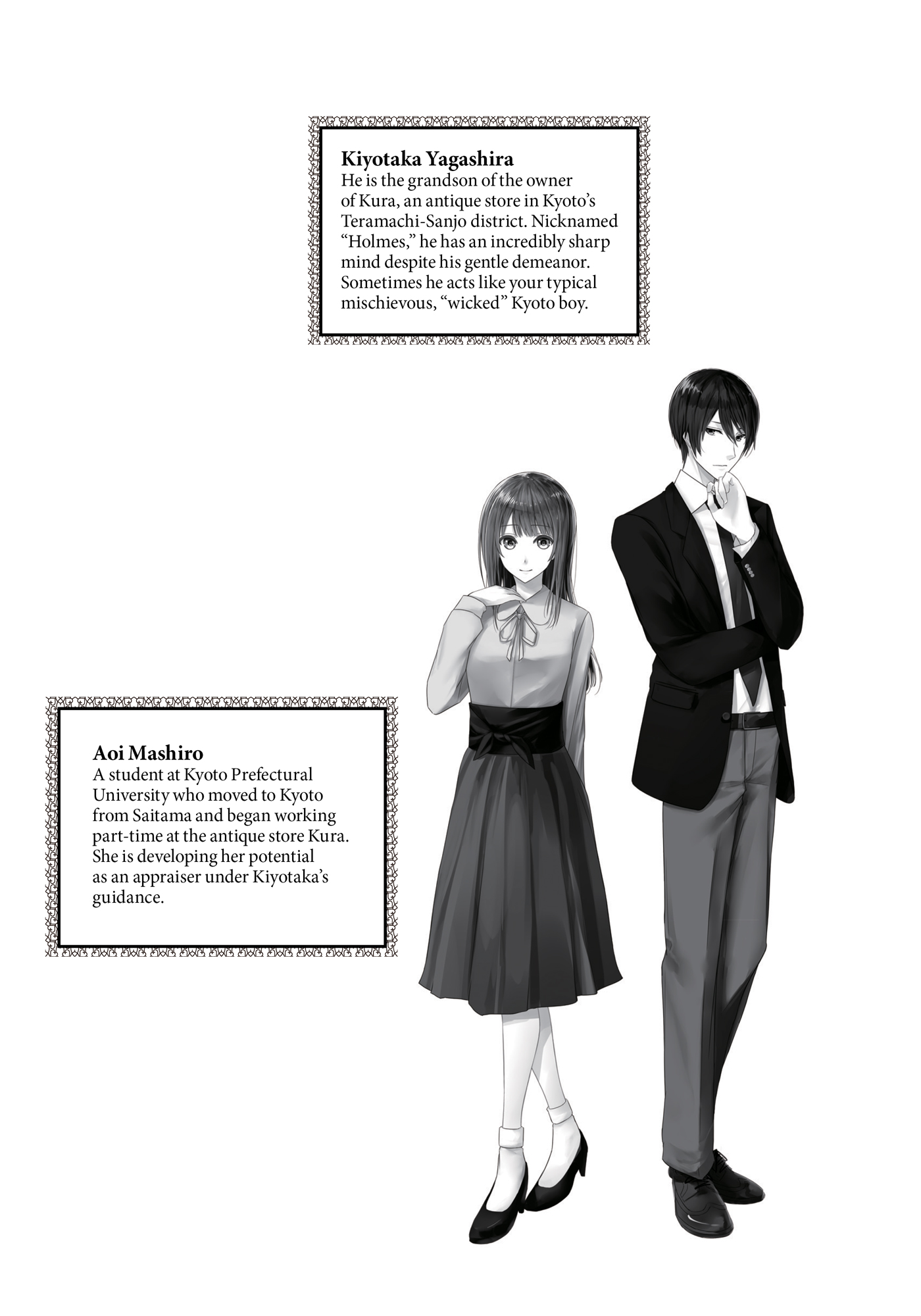
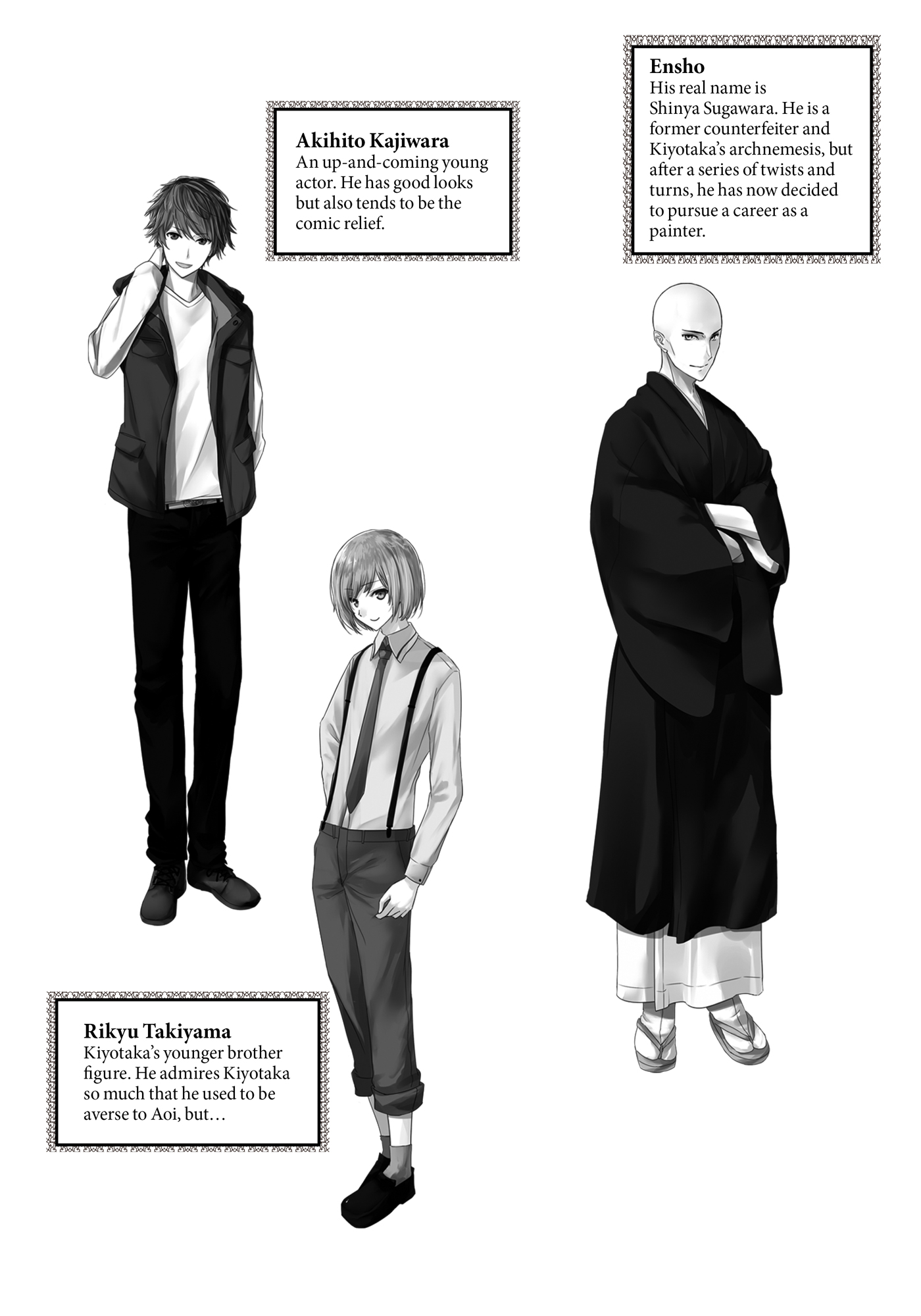
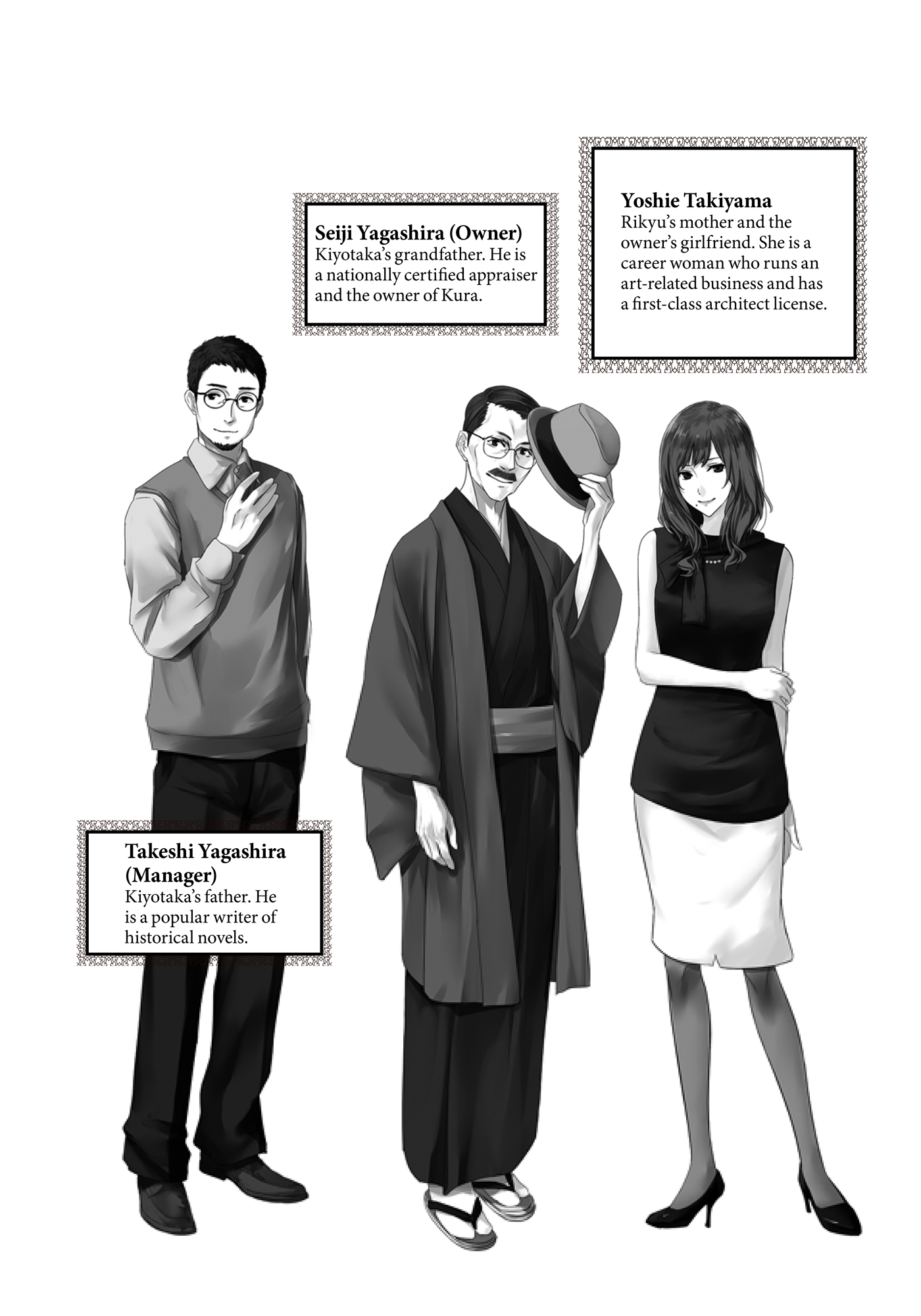
Color Illustrations
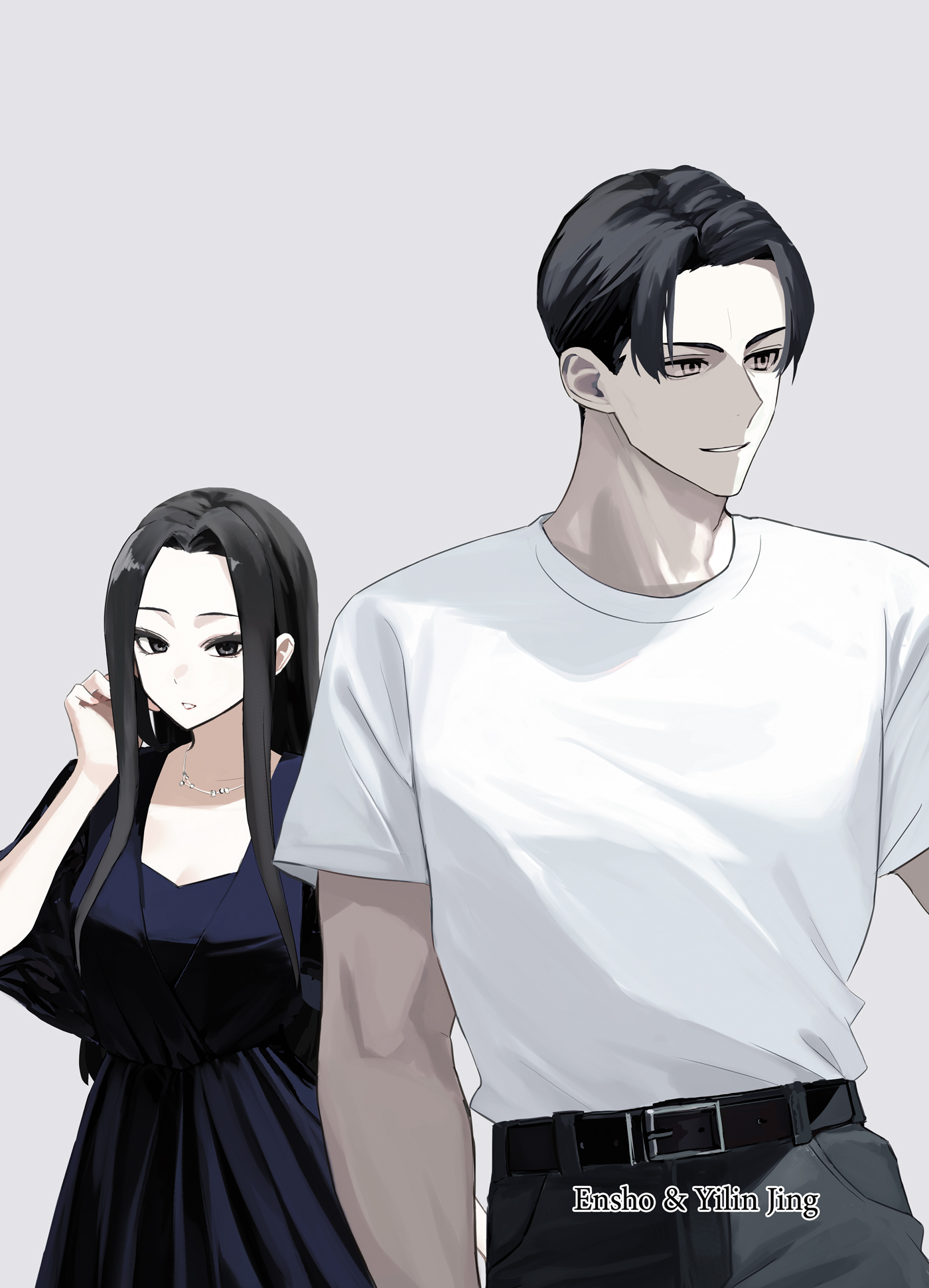
Maps of Kyoto
Map of Central, Eastern, and Southern Kyoto
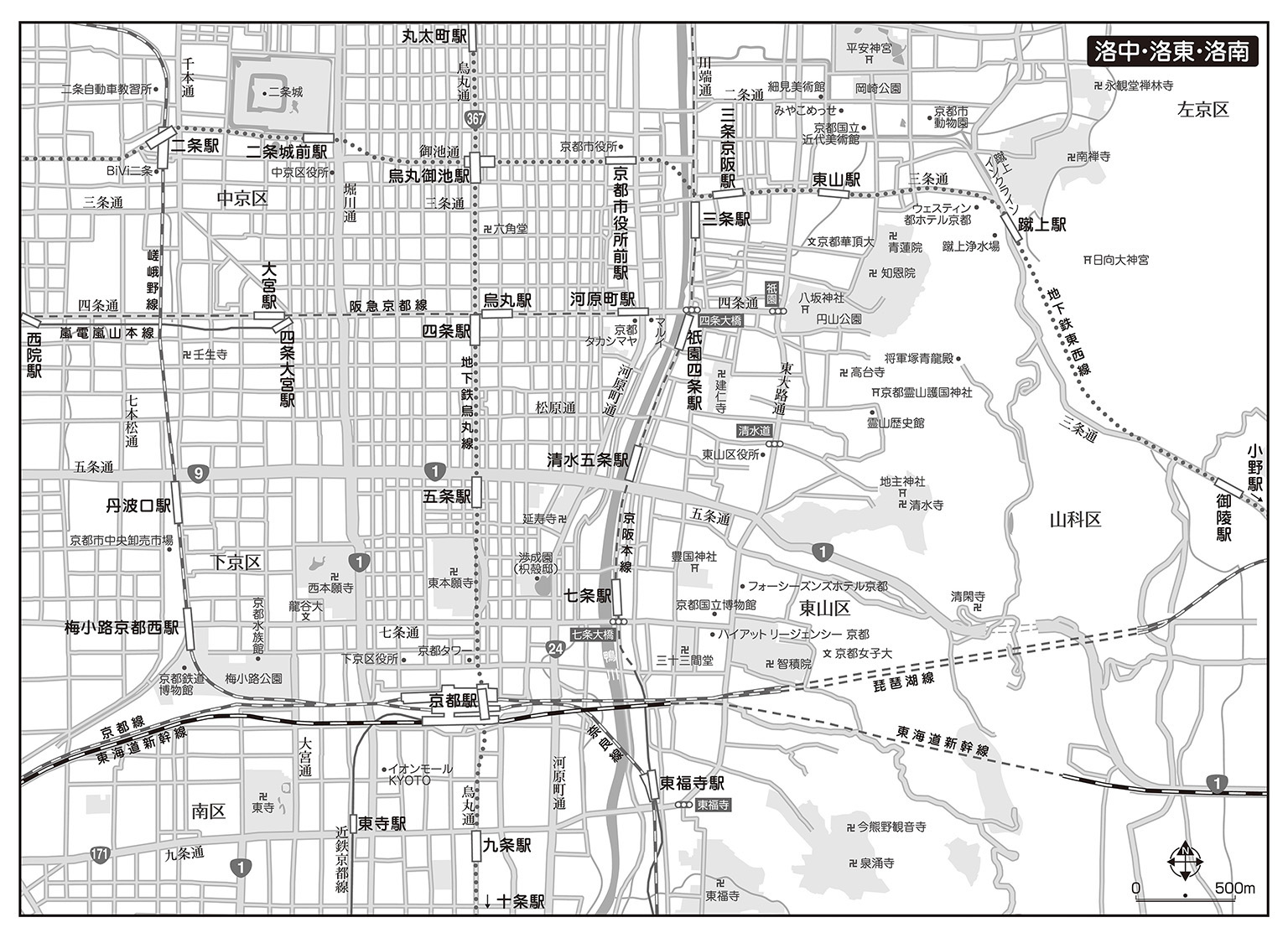
Map of Northern Kyoto
Map of Northern Kyoto
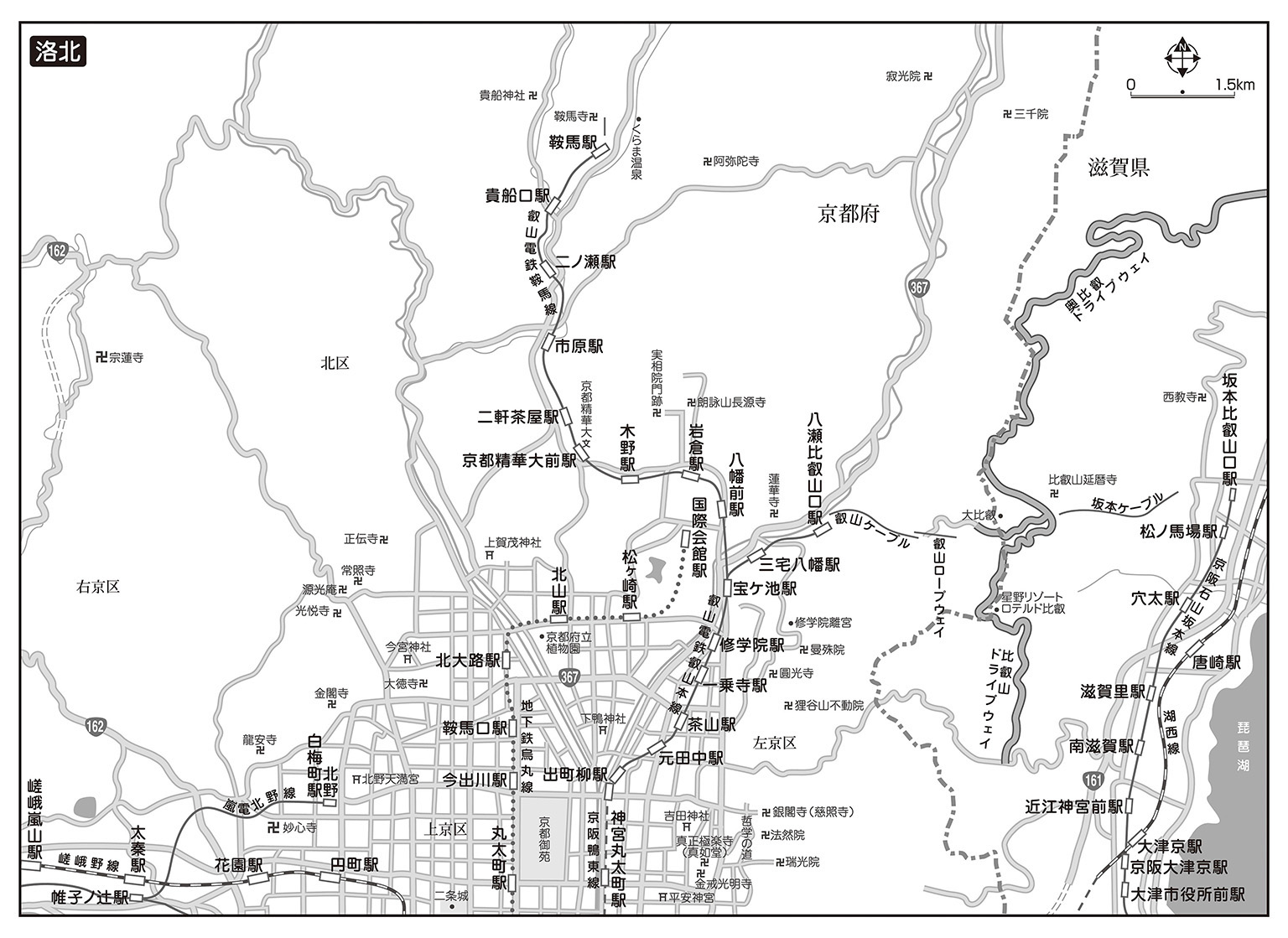
Map of Western Kyoto
Map of Western Kyoto
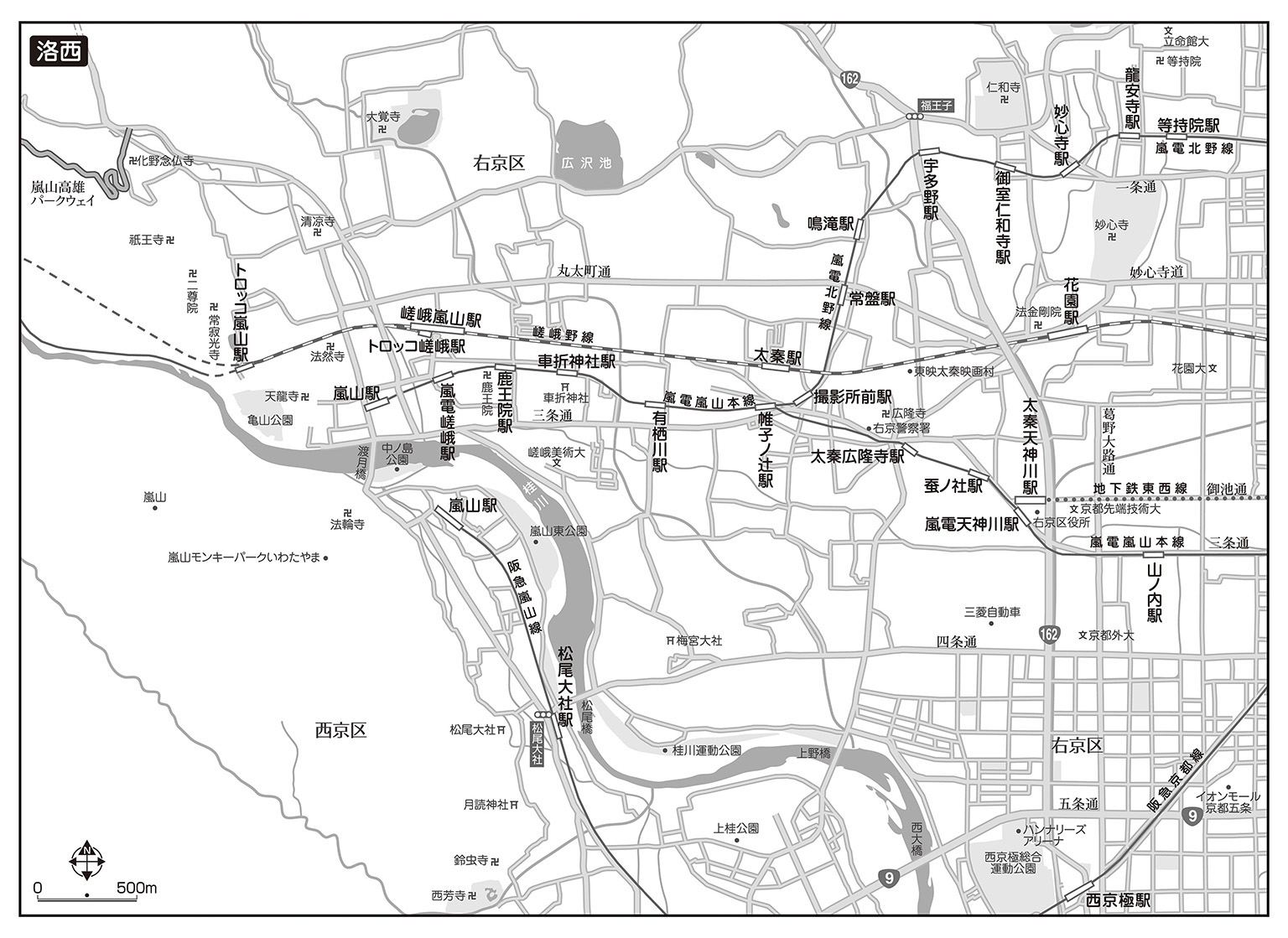
Bonus Translator’s Corner
Translator’s Corner
Thank you for reading Holmes of Kyoto volume 21! It’s time for another round of translation notes.
First off, in chapter 1, it’s explained that Shino ware originated from Soshin Shino, an incense master of the Muromachi period. You may be wondering, What is an incense master? Similar to the traditional Japanese tea ceremony, there’s also a ceremony for appreciating incense, which involves heating fragrant incense wood. An incense master is a practitioner of this ceremony.
Later in the same chapter, Kiyotaka reveals that the frog netsuke left to Kisuke partially symbolizes the Hanafuda card “Willow and Frog.” This card depicts a famous anecdote about Ono no Michikaze, a calligrapher of the Heian period. Michikaze was feeling inadequate about his skills and was on the verge of giving up. One rainy day, he went for a walk and saw a frog trying to jump onto a willow branch. The frog repeatedly tried and failed, and Michikaze thought to himself, The willow is too far; the frog will never be able to jump onto it. Suddenly, a gust of wind bent the branch, allowing the frog to reach it. Michikaze realized he wasn’t putting in as much effort as the frog and returned to his calligraphy with renewed motivation. Thus the netsuke conveys the message “don’t give up.”
In the explanation for the mouse netsuke after that, while Kiyotaka is telling the story of Okuninushi-no-Mikoto and the mouse, Aoi mentions a white rabbit. This is referring to the mythological tale of the Hare of Inaba. The story with all its context is rather lengthy, so I won’t be paraphrasing it here, but there are many English write-ups online if you’re interested!
Lastly, in chapter 4, Yilin talks about Carnegie and says, “His grave is inscribed with the words ‘Here lies a man who knew how to enlist in his service better men than himself.’” This isn’t particularly translation-related, but when I was looking up the original English quote, I found that while it’s true he requested that it be inscribed on his grave, this request was never fulfilled. Now you can be disappointed too, just like me.