SIDE A
SIDE A
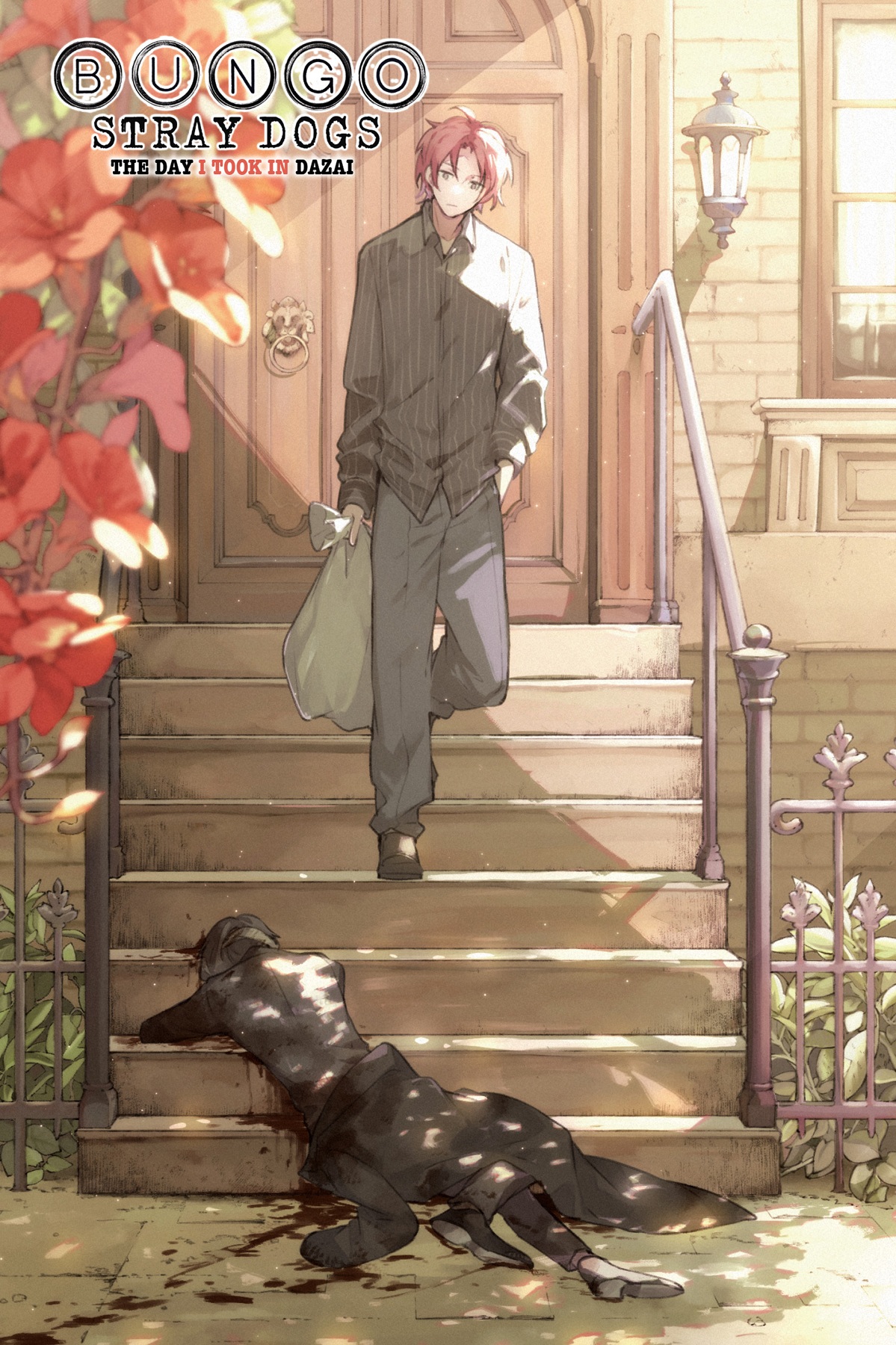
A young man’s bloodied corpse lay sprawled out on my porch.
I gazed down at his lifeless form, then shifted my attention to the road in front of my house.
It was a quiet morning. The apartment building across the street cast a long, black shadow over the pavement. Trumpet vines nestled in the hedges swayed with the gentle wind, whispering secrets unintelligible to human ears. Somewhere far off, the sound of a long-haul truck scraping against the road drifted by.
And there, at the foot of my front steps, lay a body. A corpse.
A dead body would usually stick out like a sore thumb, but not this one. This corpse blended in, becoming one with the peaceful everyday morning scenery. After a moment, I realized why. This corpse’s chest was rising and falling ever so slightly.
It wasn’t a corpse. He was alive.
I observed the young man. He was black from head to foot, from his shaggy hair to his high-collared overcoat, three-piece suit, and tie. The only things that weren’t black were his button-down shirt and the bandages wrapped around his face—those were a mottled pattern of white and red, reminiscent of some sort of eerie Chinese curse.
He had collapsed at the bottom of the cracked concrete steps leading up to the porch, smearing a trail of blood in his wake.
The question was, what was I going to do with this half-dead person on my stoop?
The answer was simple: gently tap him with my toe and roll him straight down the stairs to the sidewalk. That way, he’d be on a public road instead of my property.
The street is government owned, and anyone in distress on public property should, by all rights, be at the mercy of the government’s aid. Meanwhile, an ordinary deliveryman like me should go inside and eat some breakfast.
This wasn’t an act of callousness or cruelty on my part; it was purely self-preservation. The young man’s injuries were unmistakably gunshot wounds, and there were plenty of them. His body probably had even more bullet holes than what I could see, too. And to top it off, a wad of crisp new bills was clutched in his left hand.
What significance did this hold? None whatsoever. Setting aside the obvious—that this guy was major trouble and getting involved would be a one-way ticket to a massive headache—this situation meant nothing.
In other words, he was clearly someone an ordinary citizen shouldn’t get mixed up with. In fact, anyone with a functioning brain would get out of Dodge the moment they saw this young man, like the biblical prophet Jonah would have done had he encountered a second giant fish in the stormy seas.
I looked at the young man, then at the road, then at the sky, and then back at the young man.
That was when I sprang into action. I hoisted him up from under his arms, his heels dragging against the stairs as I hauled him inside before laying him on the fold-down bed. He was a lot lighter than his appearance suggested; I had no trouble carrying him.
Upon closer inspection, his wounds proved severe and plentiful. He’d lost a ton of blood, but he would probably survive with prompt and proper medical treatment.
I took out a medical kit from the back of the closet and gave him some basic first aid. First, I positioned a towel beneath his upper body for elevation; then I cut his clothing away with scissors to check if he still had any bullets lodged in his wounds. To stanch the bleeding, I applied pressure to several points—beneath the armpits, behind the elbows, at the ankles, behind the knees—and bound them tightly with clean cloths. Then I used a sterilized tourniquet to address the bleeding directly at each wound site. Fortunately for him, I could do this kind of first aid with my eyes closed.
Once I finished the initial treatment, I stood over the young man and crossed my arms. His breathing was stable. He didn’t appear to have any broken bones or lung injuries yet consciousness eluded him.
Just throw him out, my inner voice demanded. Providing aid to someone so obviously suspicious defied all reason. I clearly should’ve listened to that warning—any rational person would have. But against my better judgment, I decided to observe the young man further.
I didn’t recognize him, so it seemed he wasn’t an acquaintance of mine. Seemed because the bandages covering half his face made it almost impossible to tell. Even so, he looked far younger than I’d initially thought—young enough, in fact, that he could’ve easily passed for a teenager.
Then I remembered the wad of cash he’d been holding. Sure enough, he was still clutching it. If it was as much as it looked, then it would be a small fortune for someone like me who was barely scraping by on a meager salary. Maybe, just maybe, I could consider it a thank-you for saving his life—a quiet little transfer of funds from his pocket to mine. I picked up the bundle and began flipping through the bills.
And that’s when I finally realized I was the biggest idiot in town as a bitterness filled my mouth.
This was a stack of freshly minted bills. Although there was blood smeared on them in some places, they were still wrapped in a pristine paper band, indicating that they were brand-new. There was no bank name printed on this currency strap, either. In fact, there was nothing written on the band at all. The bills were also neatly arranged by serial number.
It hit me like a punch to the gut.
Two possible explanations came to mind. One was that this wad of bills had been taken from the reserve bank’s vault before circulation. That would mean this young man was either a magician or a demon, since there was no way that an ordinary person could get their hands on something like this.
Usually, bills printed at the mint were first sent to the Ministry of Finance where the serial numbers were scanned to make them usable currency. Then they were transported by armored car to branches of the reserve bank, and from there, they were further divided and distributed to city banks. At that point, the paper band was then replaced with ones from their respective banks.
However, this band had absolutely nothing printed on it. You’d have to have stolen the notes either straight from the reserve or from the armored car during transport.
So was this guy on his way back from robbing an armored truck transporting cash? That’d be a relief; then I’d already be back in the kitchen making coffee. People who robbed armored cars were just violent scrubs, nothing more. Violence alone couldn’t cause a storm.
Another possibility was that this was counterfeit money.
After grabbing a magnifying glass from the back of the room, I scrutinized the wad of bills in my hand. Immediately, my fingertips went numb. I compared the notes side by side with one from my own wallet, but I found no discernible differences whatsoever.
These were supernotes—perfect counterfeits.
I felt dizzy. After all, I was essentially holding a mini–nuclear weapon.
Counterfeit money is a weapon of war as old as the bow and arrow. If you circulate well-made counterfeits in an enemy country, the increased amount of currency in circulation devalues the currency itself, causing prices to rise. A country is, in a sense, its currency. Therefore, if you skillfully incite distrust in the currency, you can bankrupt the economy and even destroy an entire nation.
That was why national defense organizations always kept a close eye on counterfeit money. If forgeries of this caliber circulated publicly, local law enforcement wouldn’t be the ones responding. It would be someone higher up like national security agencies or the military.
I tossed the wad of bills onto the desk, since I didn’t want to leave any more fingerprints on them than I already had, then immediately headed for the telephone. If I reported this information promptly, then I might be able to get some leniency from the authorities. Put simply, the quicker I reported the incident, the better.
But right as I picked up the phone, I heard a hoarse voice—and it wasn’t coming from the receiver.
“Put the phone down.”
I turned in the direction of the voice to find that the young man had finally opened his eyes and was looking right at me. I glanced at the telephone in my hand, then at the young man once more.
“And what if I don’t?” I asked him.
“I’ll kill you.”
He uttered those words with such profound indifference—the same emotional investment one might reserve for describing leftover, day-old potato salad on a convenience store counter. I could see it in his eyes: Threatening to kill someone must have been commonplace for him, no different from saying he was going to trim his fingernails or buy another pack of cigarettes.
“And how are you going to do that?” I asked. I took the receiver off my ear, but I didn’t hang the phone up. “You’re riddled with bullet holes. You can’t even move, since your body’s dying on you. You don’t even have a gun. You would need at least two hundred of you right now to kill me.”
“No, I wouldn’t,” the young man coldly replied. “I’m Port Mafia.”
That was more than enough for me.
“Port Mafia,” I repeated, choosing my words carefully. “Guess I don’t have much of a choice, then.”
I slowly hung the phone up as quietly as possible.
The young man smirked. “Smart,” he said.
If he really was with the Port Mafia, then even the smallest gesture could set him off. I needed to be especially careful. That organization was synonymous with darkness and violence; if they were the ones I was dealing with, then even if I reported this person and got out of the situation unscathed, there was no telling what would happen to me later. Humans have around two hundred bones—I wouldn’t be surprised if the Port Mafia decided to chop me into just as many pieces.
I stared at the young man for about three seconds, then headed to the kitchen. The doorway was completely open, allowing me to keep my eye on him while I began preparing some coffee. I set the kettle on the stove, dampened the filter rod, then put the coffee grounds into the pot before pouring boiling water over them.
“If I’m not allowed to call the police, then how about a doctor?” I suggested, my gaze still fixed on the rising steam. “I gave you some emergency first aid, but that’s about it. You’re going to need to see a real doctor if you want to survive.”
“That’s none of your concern,” the young man replied, his voice stretched thin with emotion. “This is nothing. I’m used to getting a few cuts and scrapes.”
“Really? All right, then.” I stirred the coffee, then set the timer. “Not like there’s anything a humble deliveryman like myself can do against a monster from the Port Mafia.”
“I’m glad you understand. Now, then—”
The young man suddenly began coughing violently and then vomited blood.
I quickly rushed to his side and turned his head to prevent him from aspirating. I examined the inside of his mouth but couldn’t tell where the bleeding was coming from. It could’ve been a cut in his mouth or something internal, for all I knew.
“You need to go to a hospital. You’re seriously going to die like this,” I said.
“Good,” the young man whispered. “Then let me die.”
A chill seemed to pass through the room.
I shifted my attention to the young man. His gaze was fixed on the wall, his face devoid of any emotion and meaning. He was as calm as if he’d simply stated his age.
The sight was nearly incomprehensible. It didn’t even feel like I was looking at a human being. Had this encounter occurred during midnight’s darkest hour rather than daybreak, I might have mistaken him for a ghost or perhaps a hallucination.
Today wasn’t going as I had planned it. At all. It felt like the screws holding my life together were starting to come loose.
“Fine,” I muttered. “If you want to die, then go ahead. It’s your life. I’m not going to stop you. I can’t let you die here, though. The cops would arrest me and say I was the one who did this to you.”
“Would you rather be arrested or killed by the Mafia?”
“That’s a tough question.” I eyed him intently before returning to the kitchen to turn off the stove. “Want some coffee?” I asked while grabbing a can of cream.
He didn’t reply.
“Why were you collapsed outside my house?”
Still no reply.
“Why were you holding all that money?”
No response, unsurprisingly.
I felt like I was having a conversation with a wind fairy—a character from a picture book who had suddenly visited my home one peaceful morning. A suicidal fairy covered in blood.
I poured two cups of coffee, adding a touch of cream to each. As the steam curled upward in lazy spirals, I stirred slowly…and then I noticed it—the silence. The presence in the next room had disappeared: no sounds of breathing, no subtle shifting of weight. Even the lingering scent of death was gone.
Coffee in hand, I peeked through the doorway to find the young man crawling toward the front door. If his legs had been working, he would’ve been long gone, but he clearly didn’t have the strength to walk yet. Instead, he was dragging himself across the floor like a prisoner escaping in an old war movie.
Noticing my gaze, the young man offered a smile that was both resigned and condescending.
“You don’t want me dying inside your house, right? Then I’ll just leave. That way I won’t be your problem anymore. You won’t need to help me or worry about me ever again. All you need to do is sit back and watch.”
“Do you really want to die that badly?” I asked, still holding my coffee.
“Of course. Nothing changed, even after I joined the Port Mafia,” he wheezed as if his soul were leaving his body. “Death is the only thing left that I want.”
Taking a sip of my coffee, I observed him as he resumed his departure. His movements were painfully slow and pathetic. I took another sip of coffee. He continued crawling forward without pause, not even sparing a glance at me. There was exactly one thing on his mind.
“You’re wasting your time,” he told me, still facing forward. He must have sensed that I’d moved. “Nobody can oppose the Port Mafia, and nobody in the Port Mafia can oppose me. In other words, nobody— Bffwaaah?!”
The young man was hoisted into the air, hanging upside down.
I’d wrapped him in a bedsheet, twisted the ends closed like a giant piece of candy, and picked him up.
“Ow, ow, ow! Ouch! I’m gonna start bleeding again! What do you think you’re doing, you big oaf?! Do you want to die?!”
“No, but I don’t want you to die, either, and if you go outside like that, you will die. You can write your own death story once you get better—one that I’m not part of.”
He tried complaining again, so I gave the bedsheet a good shake.
“O-ouch! Ow, ow, ow! Stop! I hate pain!”
“Then will you give up?”
“No!”
As soon as I began to think of a solution, one came to mind: I’ll tie him to the bed.
I lowered the young man onto the bed and unwrapped the sheet. Then I firmly wrapped a large towel around his upper body and bound his arms, which were crossed over his chest. I removed the decorative rope hanging at my front door, used it to bind his legs together, then fastened the ends to the metal frame of the bed. After propping up his head with pillows, I replaced the blanket with a fresh one and opened the transom window to let in some fresh air.
“I’m going to need you to stay still until your wounds heal,” I said, staring down at the young man. “Want anything?”
“My nose itches,” he mumbled, wriggling his restrained arms and glaring resentfully at me.
“That’s unfortunate,” I replied, heading back to the kitchen for my coffee.
His stream of curses echoed behind me, but the houses in this neighborhood were few and far between, so there was no concern about disturbing the neighbors. I savored my morning brew.
And so began the brief yet bizarre chapter of my life where I lived under the same roof as Dazai.
Dazai was an utterly peculiar young man. His eyes, his build, and even his very presence resembled a charred black cat. His voice held the timbre of someone sinking endlessly into the abyss of his own mind, and his dark gaze seemed to harbor a certainty that dawn would never rise again.
He rarely spoke, and when he did, his voice carried the quiet finality of someone who had long since abandoned any hope of being understood. No one had ever grasped the true shape of his soul, and no one ever would. He seemed acutely aware of this as well.
His desire to die seemed genuine. The values that tethered people to life possessed no value in his eyes; they were no different from a lump of rusted metal. I didn’t know why he felt that way, and I likely never would, which was something he seemed to pick up on.
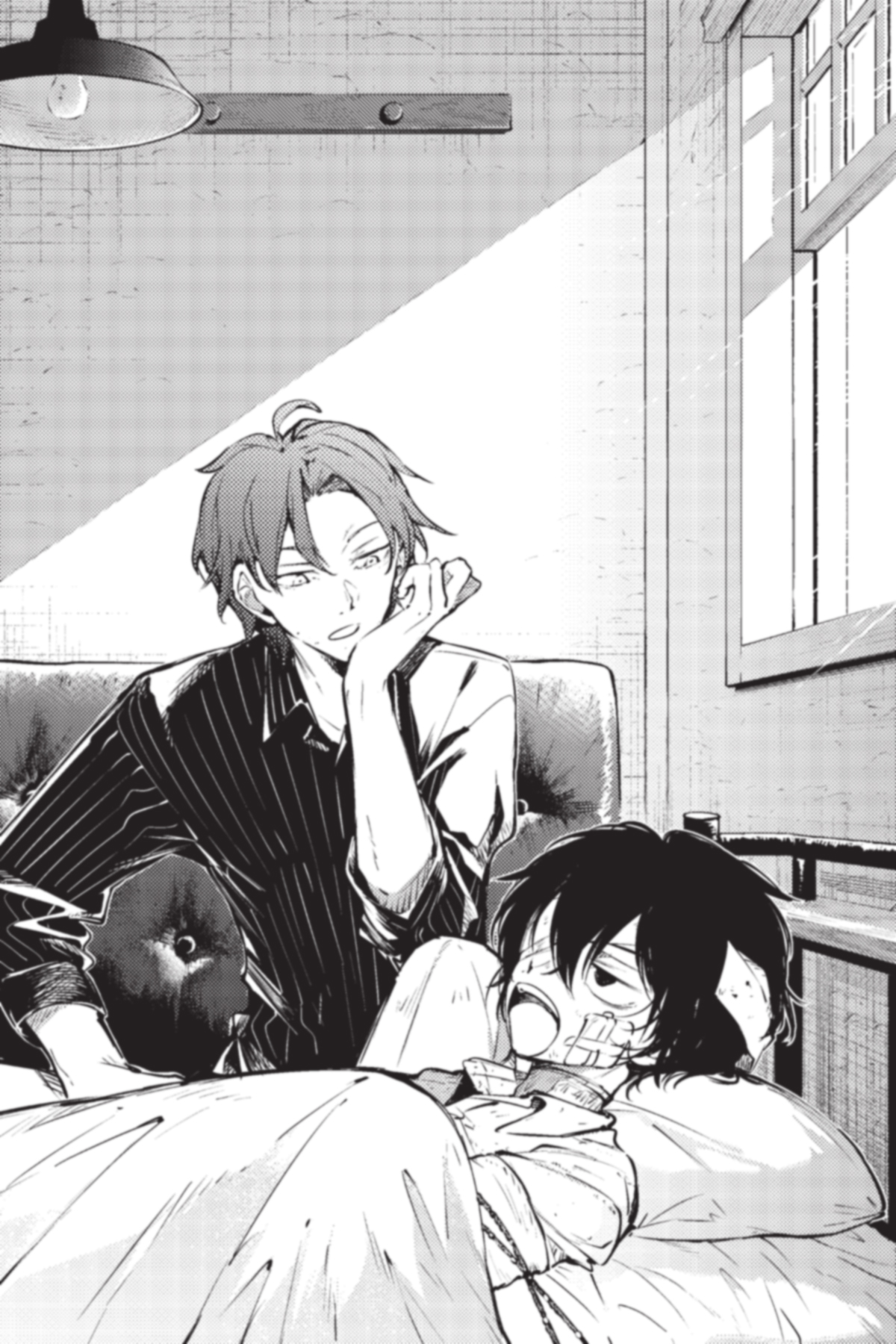
That was probably why he wanted to leave. After all, he had to get out of my house in order to be freed from his pain and reach the eternal slumber he yearned for. But since I was preventing his escape, he found himself separated even from death itself. Therefore, Dazai decided instead to shower me with complaints—and he had quite a bit to complain about.
Meals, sleep, entertainment, even the passage of time—he criticized every aspect of my care with ruthless precision. Absolutely nothing escaped his criticism. He was a tyrant; it got so bad that I had every right to break down and cry like a nine-year-old girl if I wanted to.
To tell the truth, though, I was completely fine…because I knew that his criticisms were merely an act driven by his objective to wear me down.
He wanted to break my spirit, exhaust my patience, and push me to the point that I’d want to toss him out of the house just to be free of him. If I did that, he would win, and that was why I didn’t take a single word he said to heart. In fact, I was positive that he was secretly impressed by how well I was taking care of him.
And yet, his complaints were…
“Hey, you! This porridge is hot! I can’t eat this!”
“Hey, this is really hot! I can’t use my arms when they’re tied up like this, you know! No, wait! Don’t feed—mfff?! Hot! It’th tho hot!”
“I can eat! I can eat on my own! So stop feeding me! W-wait… I can’t move—gaaah! It got in my eye! It burns! It buuurns!”
“Hey, uh… Can we do something about how I only get to go to the bathroom twice a day…? Even the Mafia’s prisoners have a little more freedom than this…”
“Look, I know I said I was bored, but don’t you think I’m a little too old for you to be reading books to me in bed? And you keep reading me the same book! Plus, it’s missing the last few pages, so I have no idea how it ends! Is this torture? Some new type of torture?!”
It was a very convincing performance.
I completely ignored the whole thing as I nursed him back to health, and thanks to my unwavering devotion over the next few days, he eventually gave up.
“This is hopeless… It’s like talking to a brick wall… He’s clueless…,” Dazai muttered that day, his voice hoarse and his eyes dull and lifeless.
I had no idea what he meant by that, but from then on, he started to actually become a little more compliant.
Dazai shifted tactics after that. Instead of complaining about how I was caring for him, he began making specific requests regarding food—especially about particular ingredients. Clearly, his goal was to wear me down, but I was a man of patience and consistency. I also happened to be practical enough to believe that anyone whose arms were bound deserved a bit of entertainment, so I became his kindhearted personal chef.
Dazai’s first request was sashimi made from puffer fish entrails—a rare delicacy. However, when I went to the market to get some, the fish seller called me an idiot, leaving me with no choice but to give up.
Next came grilled destroying angel mushrooms. A beautiful white variety of fungi, apparently. I wandered the mountains in search of them but couldn’t find any. I’d assumed they’d be plentiful, since the locals refused to eat them, but I had no such luck. Instead, I stir-fried some edible wild vegetables I’d found on the way back home, and when I served them to Dazai, he said, “This is delicious,” while shooting me a resentful, murderous glare.
Finally, he asked for a salad made from sprouted potato eyes. Those were easy to come by, but I didn’t have time to wait for enough eyes to sprout, so instead of a salad, I reluctantly served them as a sandwich filling. Dazai ate the sandwich with odd enthusiasm, but later that night, he began vomiting profusely while writhing on the floor, screaming, “It wasn’t enough…!”
To crave something so badly that you’d eat it to the point of illness… It must have been one of his favorite snacks, so that made all my hard work feel worth it.
Then, on another day, I received a new complaint.
“Look, I get that you genuinely want to take care of me only until I get better,” Dazai began, flapping his newly freed arms around. By the way, his legs were still tied to the bed. “But I’m so bored! I’m not allowed to read or use the phone, and there’s no TV or radio, either! All you have are a few music records! I’ve already listened to them so many times that I could probably perform the songs myself… So, like…is there really nothing else here to do? Anything even remotely entertaining?”
“No.”
“Wow… You didn’t even have to think about it. How can you live here without going crazy?” Dazai gazed at me, his eyes quivering with unmistakable terror.
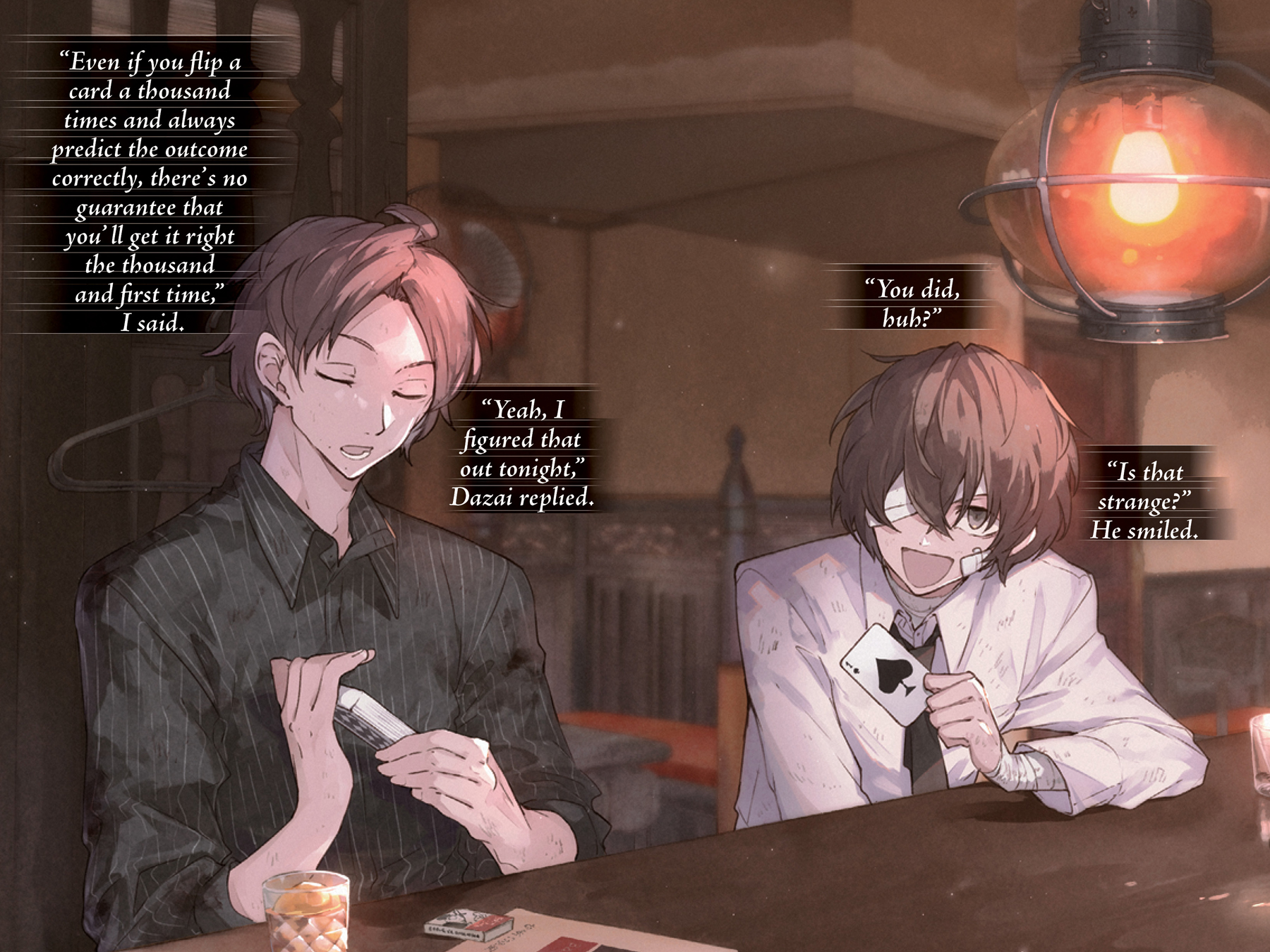
“How about we play a game, then?” I said, sitting myself in a chair. “The last person who lived here left a deck of cards behind.”
“Yeah, I saw that. They’re on the bookshelf over there.” He shot me a skeptical glare. “But I’m not a little ten-year-old. It’s going to take more than that to entertain me.”
“Then why don’t we make a little bet?” I asked, taking the cards out of the box.
Dazai’s eyes flashed for an instant, sharp as a blade. “Oh? Doesn’t seem like you have anything you can bet, though. You don’t strike me as particularly wealthy.”
He was right. I wasn’t drowning in cash, to say the least.
“How about this?” I began.
I took a chessboard from the shelf and arranged the thirty-two white and black pieces in rows facing one another before us.
“These will be our chips. We’ll play poker and bet with them. The rules are Texas Hold’em, and it’s a ring game. The small blind is one chip; the big blind is two chips. No betting limit. If you win all my pieces, then I will allow you to leave this house as a free man.”
“Heh.” His eyes narrowed. “Are you sure? You seem confident. What happens if you win? Would you like for me to offer some of my hidden assets?”
“It’d be pointless to bet something you don’t have on you right now. There’s no way for me to confirm if what you’re saying is true.”
“Then how about this counterfeit—?”
“No. Absolutely not.”
I pushed back the wad of cash Dazai was holding out to me. It looked like I was right; I knew the money was fake.
“Hmm… Let’s do this,” I said. “Every time you lose sixteen pieces, you tell me one of your secrets.”
“One of my secrets, huh?” Dazai faintly smirked. “You really thought this one through.”
It was a suggestion born entirely from my own self-interest.
The problem was simple: Once Dazai recovered and I let him go, there was always the chance he’d come back for revenge, and there was no way I was going to be able to stop him. After all, no wall in this world was high enough to stop the Port Mafia once they decided to retaliate. That meant I needed insurance or, at the very least, something that resembled it.
If I could pry even the smallest sliver of truth from Dazai—his identity, his secrets, the tools he used—it might somewhat serve as a deterrent. Of course, I currently had no way to verify any secrets of his. They’d be merely for my own peace of mind, at best. But if I could get him to divulge a few secrets, that false sense of security might grow just enough to feel real.
“Heh. This is getting interesting. So you think you can squeeze a few secrets out of me, huh?” Dazai wore a twisted grin. “It’s been a while since I met someone who truly believed they could beat me.”
“Sounds like I got your attention,” I said while I dealt the cards. “Are you ready?”
“Ready when you are.”
Heads-up. Pre-flop. I dealt two cards facedown in front of me and two in front of Dazai.
“You strike me as a fair person, so in the spirit of fairness, I’m going to let you in on a little trick I pulled,” Dazai said before even looking at his cards.
“What kind of trick?”
“Although you’re the one who suggested we play cards, I was the one who steered the conversation in this direction so that we’d play.”
He looked at me with eyes that held a profound, unsettling stillness.
“I’d already spotted the deck of cards on your bookshelf, and it didn’t seem like you had much else around for entertainment. Plus, with neither of us having much to bet, it was only a matter of time before you landed on the idea of wagering my freedom. And if you didn’t, well, I figured I could always whine until you gave in. Either way, I nudged things along until you did exactly what I wanted you to do.”
“Interesting,” I replied, studying his face closely. “Then I take it you think you can win.”
“I do,” he said, wearing a faint smile—one that seemed to flicker out from the shadows. “I never lose.”
There was no bravado in his voice, no trace of irony or humor. He genuinely meant what he was saying.
“And that’s why…,” Dazai began while he slid his small blind forward, “…you’re never going to get a single secret out of me.”
Thirty minutes later:
“The passcode to the Port Mafia’s emergency armory is…7280285E…,” Dazai muttered, his expression lifeless. He was bent over with one cheek on the table.
“You have a lot of secrets,” I said, genuinely impressed.
“Of course I do! I’m the leader of the Port Mafia boss’s personal special task force, you know!” he cried. “Gaaah! What’s going on here?! You made me give up almost every single secret I have! How humiliating…!”
The game dragged on for eighteen rounds—and I won every single one of them.
Where he lived, the nature of his subordinates’ unique skills, when he’d joined the Mafia, the total amount of funds at his disposal, his current duties within the organization, his favorite food, the location of a secret vault, the fact that the current boss was a former back-alley doctor named Mori… Each of the eighteen secrets Dazai revealed was more outrageous than the last—more than enough to convince me that he truly was someone important in the Port Mafia.
In fact, he had likely revealed too much. Very few people probably knew the true history of the Port Mafia’s boss—the shadow ruler of Yokohama—and even fewer had learned it and lived.
Now Dazai lay slumped over the table, looking thoroughly deflated. I guess he truly believed there was no way he was going to lose.
“You tricked me…didn’t you?” Dazai said, glaring at me with a gaze thick and sluggish like mud.
I tilted my head, confused. “How?”
“I noticed halfway through that you were predicting what was going to happen. You used a skill. I let my guard down at first, since skills don’t work on me. However, if your skill affects the environment instead of people, then that would explain how you were able to so annoyingly foresee every single one of my moves.”
“Sorry. It wasn’t really something I was trying to keep a secret,” I told him as I shuffled the cards.
My skill allowed me to see events that were about to unfold. The window was longer than five seconds but shorter than six. Therefore, I could see Dazai’s next move, how much he was going to bet, and even the exact cards that were coming.
On rare occasions during tight months when money had run thin, I would take a trip to the casino in the Yokohama Settlement and use my skill to scoop up a bit of easy cash.
“You’re right, though. I wasn’t playing fair,” I admitted. “Like you, I’ve never lost a gamble like this before. Anyway, let’s just say that nobody won. No contest. To be honest, I only wanted to give you something to do, since you were bored.”
“You can’t simply pretend like it didn’t happen.” Dazai shot me a protesting glare. “You couldn’t take back what happened even if you wanted to because unlike money, you can’t give information back. Or are you saying that you can somehow magically make yourself forget everything I told you?”
“I can try if that’s the only way to make things right.”
“What…?” he muttered with a weary expression. “Your jokes aren’t that funny, you know. I mean, they don’t even sound like jokes, since you say everything with a straight face.”
I tilted my head. “I’m not joking, though.”
“Yeah, yeah.” Dazai looked away and pouted. “Man… I can’t believe I leaked all that information. Mori’s gonna be furious with me.”
I pondered for a few moments.
“…Who’s Mori?” I asked.
Dazai seemed stunned with disbelief.
“Did you really forget…?” he said.
Several days went by like this.
Dazai’s injuries were no longer life-threatening and were beginning to heal. Although his wounds must have been inflamed and throbbing with pain, he remained strangely lighthearted for some reason. He didn’t seem interested in struggling or escaping, either, so I undid the restraints around his legs. I still kept the front door locked, though.
It was a pleasant autumn day. The fallen leaves along the streets whispered memories of their time high up in the trees. The fragrance of Osmanthus drifted by, transforming memories into hazy, beautiful recollections.
I sat by the window, lost in thought, contemplating my own past as I waited for the water to boil—time without purpose. It was a luxurious way to spend the day.
“What are you thinking about?” Dazai asked me from the bed.
“I was thinking about when I quit my last job. The Osmanthus were in full bloom that day, too.”
“Your last job?”
I cast a glance at the kettle in the kitchen, confirming it would still be a little while before the water boiled. Looking back, I must have been in an odd state of mind, because in that brief stretch of time before the kettle whistled, I was actually thinking that I might as well indulge Dazai in a little conversation about my past.
“It wasn’t anything special,” I said as I approached him. “It was a dirty job, but I’ve left that world behind.”
“How dirty was it?”
I didn’t reply.
Silence settled over the room for a while after that. I could hear the soft calls of a mockingbird and its young, speaking to one another from somewhere in the garden.
“You don’t want to talk about it? All right,” Dazai said in acquiescence after a few moments. “Once I get better, I’m out of here. I guess that’s the extent of our relationship.”
Again, I didn’t reply. A wisp of steam began to quietly rise from the kettle in the kitchen.
“You’re right,” I told him. “You will leave once you get better, and you’ll be free to end your life however you please, wherever you want. Could I speculate for a moment, though?”
“About what?”
“About why you want to die so badly.”
“Huh?”
“You want to die because you’re an idiot,” I said resolutely.
Startled, Dazai widened his eyes at me in disbelief. And then there was silence.
He shifted slightly, the old floorboards creaking beneath his weight. Somewhere in the distance, a dog on a walk barked at a roadside tree.
“That’s an interesting take.”
When those words eventually escaped Dazai’s throat, his gaze transformed into something no longer human—unlike any living creature’s. His eyes were a pair of exposed wounds on his face where only darkness peered out.
“You certainly talk big for a simple deliveryman. Then again, a lot of people have called me an idiot before, but there’s no way of knowing why they did…since they’re all dead now.”
His expression resembled the end of a canal—a black wall at the point of no return, leading nowhere farther.
“You don’t say,” I remarked. “Still, you would definitely be an idiot if you died before going there even once.”
“Oh? And where’s that?”
“It’s a quiet place. It’s not that far from here, either. And while it’s open to all, not everyone can truly appreciate its inherent worth.”
“What is this? Some kind of riddle?” Dazai laughed hoarsely. “Trying to pique my interest with a little mystery?”
“Not at all. Because I know that wouldn’t work on you.”
“Good point,” he replied, averting his gaze. “I just can’t figure you out.”
He cocked his head to one side, though his gaze remained fixed on me. Then, without a word, he glanced toward the entrance and softly chuckled, not at me but seemingly at the situation itself.
And with that, the heavy air hanging over the room seemed to have gotten somewhat lighter.
“Fine,” he said. “As a thank-you for treating my wounds, I’ll entertain your nonsense for a moment. You told me I’m stupid for wanting to die, right? Here’s a question for you. If it’s so stupid, then why does everyone die in the end?”
I stared at Dazai. He sat in silence, serene and still like an ancient manuscript waiting patiently to be unraveled to reveal its secrets.
“The mortality rate for being alive is one hundred percent,” he said. His voice carried a hoarse echo, like that of a hermit who had been alive for thousands of years. “However, if you look across the entire biological world, there are creatures that do not die. There are creatures that have no internal clocks ticking down until their death. In other words, human death is merely one of the functions included in life—simply a final, obligatory scene written into the script.”
I pondered over what he said for a moment. “So you’re claiming that life isn’t something to be cherished?”
“That’s not what I’m saying. It’s worse than that. Despite this preordained script of death, every single human being is born with a preset desire to not want to die, and that desire will never be fulfilled.”
There was an emptiness to his words, as if he was reading lines from a script he’d recited thousands of times—like well-worn clichés muttered over and over, each one accompanied by the same groans of resignation.
“This implies that the very act of desiring is merely a tool—a convenient hypothesis far removed from the truth—and we are simply followers mimicking this hypothetical thesis of our predecessors. They lived, and therefore, you must live. How do you refute this bleak theorem?”
I looked at him. Several rebuttals came to mind.
For instance, desires were difficult to achieve—that’s precisely what made them desires. But I intuitively understood that Dazai hadn’t revealed even a ten-thousandth of his true intentions. Even if I had voiced a rebuttal, he’d already prepared a counter-rebuttal. This was a discussion that had been fully exhausted in his mind. Plus, he likely had a counter-rebuttal to that counter-rebuttal as well. Like an endless staircase descending into the underworld, there was no bottom to Dazai’s dark reasoning.
I glanced briefly at the kitchen where the kettle had started to steam.
“And that’s why you want to die?” I asked, but Dazai shook his head.
“No. This is nothing but a little play on words. There are things that cannot be expressed through language. Whereof one cannot speak—”
“Thereof one must be silent.” I finished his sentence before continuing. “I get that. You’re the only one who can understand your world, but that still doesn’t change the fact that you’re an idiot. That much I can say with certainty.”
“Yeah, yeah.”
Dazai let out an exaggerated sigh and flopped onto the bed. He reminded me of a teacher fed up with a mischievous child who never ran out of tricks.
“I’m not going to correct you or anything, but are you referring to this place that you were talking about a second ago?” he asked.
“You’ll see when we get there,” I said, glancing out the window at the bright and quiet street.
“How about trying to explain the place to me now just to see how I’ll react?”
“I’ll pass. Sometimes—most of the time—things like this can’t be put into words.”
“Oh? I wasn’t expecting to hear you say that. I thought you loved to read.”
Dazai shifted his gaze to my bookshelf.
“I do, and that’s why this really bothers me” was my honest reply.
Dazai stared at me for a moment and then suddenly laughed—a little more naturally than before.
“Interesting,” he muttered. “You’re modest. I don’t hate that.”
Steam was gradually escaping the kettle in the kitchen.
“I don’t hate staying here, either,” Dazai added. “At least, not as much as I thought I would.”
All of a sudden, there was a knock at the front door. Me and Dazai briefly exchanged glances before a man outside started to speak.
“Excuse me. We’re with the local police. We received a report of an injured man last sighted around here, and we would like to ask if you’ve seen anything.”
A silhouette came into view through the decorative glass panel on the door. It was a patrolman from the city police—the literal power of the state.
Ever since meeting Dazai, my luck had been in free fall, and now it appeared to have finally pierced straight through to the Earth’s core.
“Excuse me. This is the police. Is anyone home?”
The insistent knocking rattled the front door repeatedly.
It should be locked. What’s this about?
Dazai directed his gaze at me, then pressed his index finger to his lips, gesturing for me to be quiet. It seemed he wanted me to pretend that I wasn’t home.
A thought finally began to stir in my sluggish mind. Sure, I could pretend that I wasn’t home, but why would I? The cops weren’t here to arrest me. I hadn’t done anything wrong.
I ran through the possibilities. Let’s say I opened the door and greeted the officers with a casual “hello.” If I only cracked the door open, they probably wouldn’t be able to see Dazai in the back. They would then ask if I had seen a man covered in blood. Then what? Should I tell them about Dazai? Should I keep quiet?
If I kept quiet, they’d leave. That part was easy, but what about after that? If Dazai had committed a crime (and obviously, he almost certainly had), then I’d be guilty of harboring a criminal. I could even be tried for aiding and abetting, depending on how things played out, and that would mean spending the rest of my days in a lovely little government-funded inn, eating three square meals a day.
Now, let’s say that I opened the door and told the police that Dazai was here. He’d almost definitely be arrested.
I mean, just look at him, I thought. He had gunshot wounds and clearly hadn’t gone to a hospital for treatment; that was suspicious enough to spark any police officer’s curiosity. In fact, these officers might even be here specifically because Dazai was already wanted by the police, and if that were the case, then there was a high chance that I was going to be arrested as an accomplice.
Saying that I’d had no idea he was a criminal when I’d patched him up probably wouldn’t fly, either. Even if it did, Dazai and I would have to collaborate on a story in advance for when we were questioned at the station. Of course, we never did any of that, though. There was no time to come up with a story now, and knowing Dazai, there was zero guarantee that he would actually stick to the story, either.
I glanced at him, clinging to a faint glimmer of hope…and found him grinning like a mischievous child plotting a prank, albeit he looked fifty times more sinister. He obviously wasn’t going to be any help.
That look on his face reminded me of another problem. If I handed Dazai over to the police, I could expect a visit from the Port Mafia later. And they wouldn’t just knock on my door—they’d wash over everything like a tsunami, wiping me and this whole house off the map.
Therefore, I had no choice but to pretend like I wasn’t home.
I quietly hid behind the bed right next to Dazai. The police’s knocking was the only sound, like a stray dog’s relentless barking.
With nothing else to do, I found myself counting the rhythm of my own breathing. Ten. Twenty. But when I got to twenty-eight, the knocking stopped.
“Maybe no one’s home,” said a man with a deep voice on the other side of the door.
“Looks that way,” replied a slightly younger-sounding man.
It seemed like they were about to leave as long as we stayed quiet, and then peace might return to the world.
Unfortunately, nothing in life is ever that easy.
Dazai quickly tapped me on the shoulder twice. His expression was stiff as he pointed in the opposite direction of the door. I followed his gaze until I figured out that he was pointing at the kitchen, and I immediately noticed why.
The kettle.
The kettle that I was using to boil water for coffee was steaming vigorously, and the intensity of the steam indicated that it was about to reach a boil.
Why was that bad? Because it was a whistling kettle, and once it reached a certain amount of internal pressure, then steam would shoot through the spout and whistle with all the ferocity of a tuba. Put simply, it was loud enough to reach the other side of the street, alerting the officers that someone was home.
I scanned the room, but there was nothing useful nearby. It was about eight yards to the kitchen, and the wooden floors creaked, which would yet again alert the officers to our presence.
I directed my gaze at Dazai once more. After a brief moment of hesitation, he started to perform a series of gestures.
He pointed at the kitchen, then at me. Next, he held out one hand, palm up, and with the other, he slowly walked his index and middle fingers across his open palm. After that, he pressed his index finger to his lips, then held up his thumb, smiled, and nodded. I nodded back.
“What’s that supposed to mean?” I asked.
“Shhh!” whispered Dazai. “You didn’t get any of that? I’m telling you to sneak into the kitchen and turn off the stove! I’d do it, but I can’t walk like this…”
“All right. The water’s about to boil. I need to hurry.”
“Hey, are you really taking this seriously?” He shot me a skeptical gaze. “Because it’s hard to tell, since your expression never changes…”
I carefully took a step forward. The amber-colored floorboards, which were thin due to the shoddy construction, would creak with even the slightest misstep. I had to pay close attention to where I placed my feet.
Imagining that my toes were like soft cloth falling, I took each step cautiously. Here was another situation where my unique skill would come in handy, allowing me to carefully inspect where to place my toes so that the floorboards wouldn’t creak.
A single second felt like an hour. The kettle hadn’t started whistling yet. On the other side of the door, the police officers were discussing what to do; after about thirty seconds, I had made it halfway to the kitchen. Things were going smoothly.
Incidentally, there’s a phrase called wishful thinking that perfectly describes this situation:
wishful thinking
noun
/‘wish-f
How Sakunosuke Oda was feeling up until just a second ago
I suddenly saw a future where the kettle started whistling a high-pitched, almost merry tune. In other words, I had five seconds left before my own personal death sentence was announced. It was a heart-pounding experience, to say the least.
I wanted nothing more than to leap across the room and grab the kettle, but I held myself back. What I needed now was a new kind of strength—something cautiously savage, you could say.
I placed my fingers carefully on the floor and began to crawl forward, moving low and flat like a water strider gliding silently across the surface of a summer pond. Dazai, however, let out a soft snort of laughter, clearly unable to contain himself at the sight and rightly so. If someone had filmed me doing this and submitted it to the local newspaper, I would have packed up and moved to another city before sundown.
My eyes were locked forward, my face hovering just above the floor, my torso trailing along while my limbs scrambled about like machines with minds of their own.
One second. Two. My shameless crawling was proving to be effective. I was almost at the kettle. In fact, I could probably reach the stove and turn it off from here before a rooster could say cock-a-doodle-doo.
But yet again, I had underestimated the situation.
I’d forgotten about the one foreign element in this house: Dazai, a man more unpredictable than anyone I had ever met. The kind of person who would suddenly start sprinting in the opposite direction for no reason during a three-legged race. The type of guy who would desperately climb up a cliff to survive being mauled, then instantly change his mind and decide he wanted to fall to his death instead. A man so far removed from the logic of this world—our dearly beloved agent of chaos.
Dazai suddenly stood up. “You think the police officers will shoot me if I rush outside with a gun?”
I instinctively looked back with what must have been the most ridiculous expression on my face. Just how much more suffering did I have in store today?
“There aren’t any guns in my house,” I replied.
“Really? Then I guess a kitchen knife will have to do.”
Dazai smoothly slipped right past me…and after all the hard work I’d put into crawling quietly toward the stove, too.
To make matters worse, the officers at the door obviously heard our little exchange.
“Hey! I know you’re in there!” one of them shouted. “Open the door!”
I was so overwhelmed that I couldn’t keep up with everything.
That was when Dazai skipped off toward the kitchen. If he got his hands on a knife, the whole situation would spiral out of control. I had to stop him. I wanted to cry out for help, but unfortunately, I was the only one who could do this.
I sprang forward, sweeping his legs out from under him. Dazai did a little spin in the air, landing cleanly on his back, his eyes and mouth opened wide in surprise. Immediately, I grabbed his neck, slipped behind him, and locked him in a rear naked choke, my forearm pressing against his carotid artery while I wrapped my legs around his torso to hold him in place.
Dazai and I wrestling on the floor.
Police shouting at the front door.
The kettle beginning to obnoxiously whistle.
It was a goddamn party.
Somehow amid Dazai’s gleeful flailing, he happened to land a perfect kick on the kitchen counter, causing everything atop to rattle. Then another kick. Something shifted with a foreboding clink, but I couldn’t see what it was with my back plastered to the floor.
However, the instant I realized that those kicks had been deliberate, I saw the future, and I honestly wished I hadn’t.
I saw a future where the kitchen knife Dazai had been trying to grab was shaken off the edge of the counter, and there was nothing I could do to stop it—at least, not without releasing my chokehold on him.
I promptly used my skill to predict its trajectory and narrowly tilted out of the way. The knife plunged straight down, embedding its razor-sharp blade into the wooden floor with a satisfying thunk.
I’m never sharpening that thing again.
“Stop struggling,” I demanded. “Don’t fight it. It’s okay. This isn’t going to hurt.”
Even I had no idea what I was saying anymore.
“Liar! That’s what Mori says when he gives me a shot!” Dazai yelled as he thrashed about.
It sounded like I wasn’t the only one who had a hard time with Dazai…but who the hell was Mori?
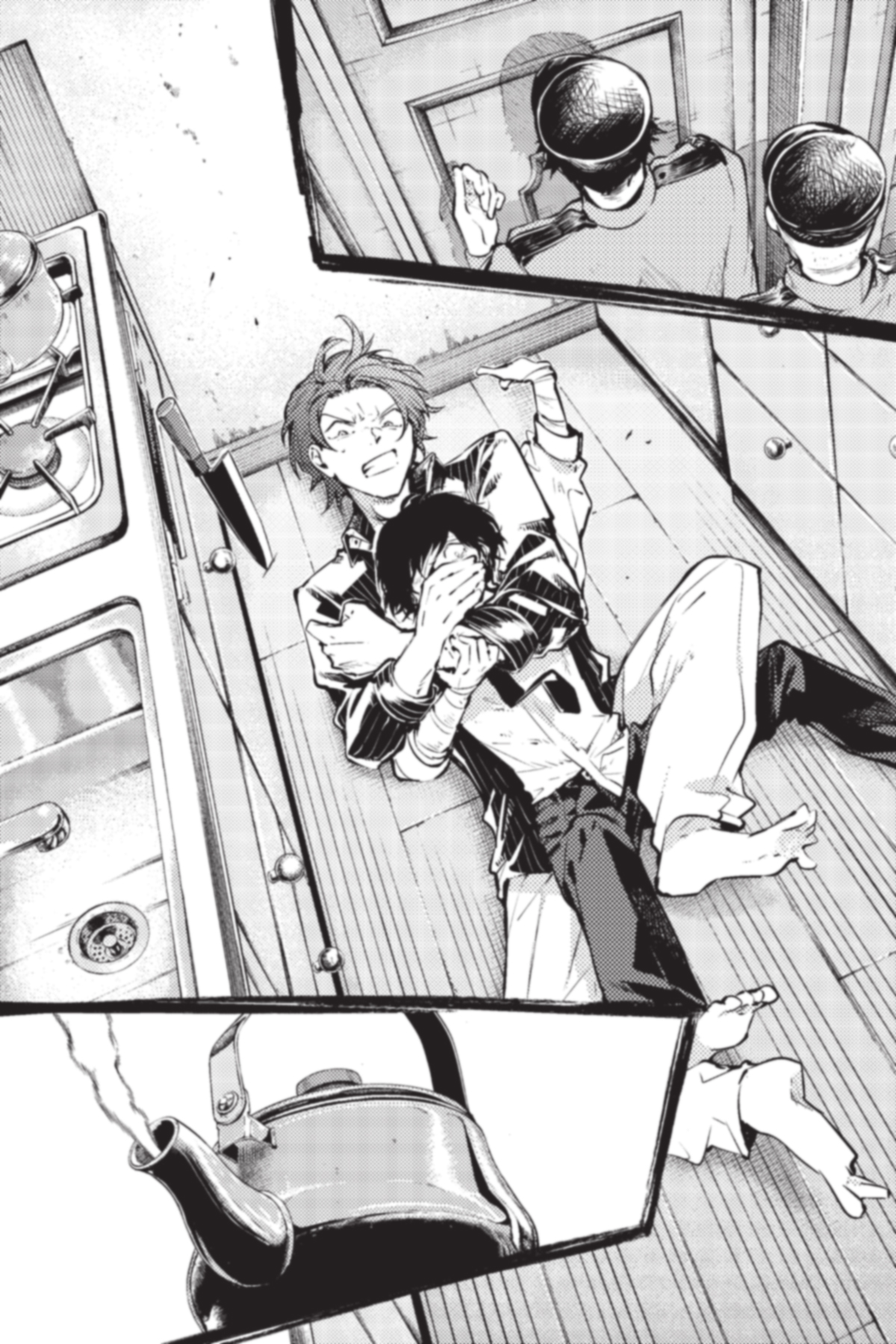
Dazai kicked the counter again, but this time, I heard something even worse—the kettle rocking from side to side.
The universe had really outdone itself. This was unlike anything I had ever experienced: a kettle overhead, a knife by my face, counterfeit bills somewhere in the house, police at the door, and me choking out a man I’d just happened to have met not too long ago.
If the kettle fell, scalding water would spray everywhere. A kitchen knife might give you a little cut, but that kettle was ready to baptize everyone in the room with life-threatening burns.
Meanwhile, the officers were starting to kick the door down; they must have heard us grappling inside.
“Hee-hee-hee, ha-ha-ha!” Dazai giggled before passing out in my arms. The kettle looked like it was going to fall any second.
I grabbed the knife in the floor and threw it upward. It caught the falling kettle in midair right at the handle, and the blade embedded itself into the wooden cabinet. The kettle came to a sudden halt, suspended and swaying wildly until a few drops of boiling water splashed from the spout and landed on the back of my hand. It burned. A lot.
The police officers suddenly barged in, looking just as surprised as I was—their eyes were wide, as if they, too, had never encountered anything like this before. After all, they’d just walked in on someone strangling an injured young man who was blissfully unconscious. It didn’t help that a kitchen knife was lodged into the counter, holding up a kettle as if it was about to pour everyone a cup of tea.
Silence fell.
The officers stared at us, seemingly at a loss for words. Never in my wildest dreams did I think my first time being arrested would go down like this.
“Take off your shoes.”
Maybe that was why such an idiotic remark had just slipped off my tongue.
The officers exchanged glances. One was quite up there in years while the other was relatively young, but both of them wore the same standard uniform and hat.
“Oh, right,” the older man said with a vague nod. “This is shaping up to be a pretty strange day of work.”
“I know how you feel,” I replied.
While a series of bizarre events had unfolded today, the strangest of them all had yet to happen. The real treat was what came next.
Though I said that I knew how the officer felt, I was wrong. Very wrong. I didn’t understand a thing about their job or what was about to happen.
Out of nowhere, the two officers each took out a gas mask, put them on, and dropped something onto the ground.
It was a gas grenade.
Only as the white narcotic gas began to leak out did I finally realize what was going on. Police officers would never use knockout gas to question people. In other words, these guys weren’t the police.
Although I could see the future, it was already too late.
I sprang to my feet and could’ve barreled through the two men to escape, but I didn’t…because I saw one of them draw a gun and point it at Dazai. It was clear that they would shoot without hesitation if I resisted. Even through their gas masks, I could tell that they were serious.
I raised my hands, and in my final fading moments of consciousness, it hit me: I should’ve kicked Dazai down the stairs the instant I saw him climbing up my stoop that morning.
But then again, regret had always been a part of my life. What harm would a little more do?
And just like that, I passed out.

Meaningless images flickered and vanished in my mind.
A café. Cerulean rain painting patterns on the windows. A trilogy with only the first two volumes.
Regret. Bloodstains on the wall.
“There is no forgiveness in this world.”
The voice of my younger self.
He was right. No one would forgive me. I wouldn’t forgive myself, either.
The missing last volume.
“Writing novels is writing people.”
A bearded man, his voice ringing with truth. Or maybe I just needed it to.
I was still walking the long rails toward that answer.
Someday, at a desk in a room with an ocean view…
When I opened my eyes, I had no idea where I was. All I saw in front of me was a wall—bare concrete, dim and damp, stained dark where water had been dripping down it. There was nothing else in sight. Even when I turned my head, all I could see was that wall. I couldn’t move the rest of my body, either, since I was tied to a chair.
“There’s something I need to tell you before we start,” a voice began—a familiar one coming from behind me. “I’m not a fan of violence.”
It was the older officer who had broken into my house.
“I dislike both being subjected to violence and inflicting it myself, so I’d appreciate it if you could view this purely as a business transaction.”
There was a sharp whshh.
A searing pain immediately tore through my back. My skin split open, and my bones creaked. Something hard had struck me—perhaps a baton, the butt of a gun, or even a blackjack—but I still couldn’t see the attacker. All I knew was that the pain was racing up my spine and shooting through my skull.
“Bet you felt that one, huh?” noted the older man. His voice was gentle, almost instructional, like a teacher explaining a lesson to a child. “I held back, though. After all, I’m well acquainted with just how much pain a person can take, and I know when they’ve reached the point of no return. Haven’t been in the business for decades for nothing.”
“And yet, you still haven’t figured it out,” I said, forcing the man to pause for a second.
“…What do you mean?” he asked stiffly.
“You don’t know the first thing about torture. You’re supposed to ask questions first before inflicting pain. What’s the point of hurting someone before they can even give you something? All that does is makes both parties exhausted.”
It sounded like the man faintly snorted. Then he hit me again, this time near the base of my neck. I saw a flash of light as the pain ricocheted through every nerve in my body. This pain was sharper, deeper than before, as if someone had yanked out my entire nervous system through my spine.
“You’re right, lad. This isn’t textbook torture,” he said from behind me. “There are times where you should strictly do things by the book, but there are also times when you need to deviate from the text. I have a good grasp of which tactic to apply here. What you just experienced was merely a warm-up to loosen your lips, so don’t you worry about a thing.”
“I’m relieved,” I replied, staring at the wall. “Let’s get started, then. I don’t know anything about the counterfeit money if that’s what you’re after, though.”
The counterfeit bills Dazai had brought—those were the root of it all. A ticking time bomb smuggled in by the harbinger of disaster himself. With forgeries that convincing, it wouldn’t surprise me if foreign intelligence agencies were starting to get involved as well.
The man’s reaction, however, caught me completely off guard.
“…Counterfeit money?”
His puzzled voice drifted aimlessly with an uncertainty that eventually unraveled into nothingness. My gut was telling me that he had no idea what I was talking about.
“You don’t know about the money?” I asked. “You didn’t kidnap me to ask about the counterfeit bills and Dazai?”
“So Dazai’s your friend’s name? Just who is he?”
I almost brought up that he was a member of Port Mafia before I bit my tongue. If these guys weren’t after the counterfeit money, then it was in my best interest to keep Dazai’s profession a secret.
“We seem to have ourselves a little misunderstanding. Allow me to clarify something,” the man said. “It’s you we’re after.”
“What?”
“Where is the painting?” the man demanded in a sharp, commanding tone.
I paused to quietly contemplate the question for a moment before answering, “What are you talking about?”
“You know what I’m talking about.”
His voice was firm and solemn—the kind of voice a person would use before pushing someone off a cliff.
“You and your people paid a certain man a visit one night at his home and stole the painting, and now we want that painting.”
“I have absolutely no clue what you’re talking about,” I insisted. “Are you sure you’re not mixing me up with someone else?”
I was hit with another blow before I even finished my sentence. This time, it was my shoulder. It felt like a blood vessel had snapped, and a sharp numbness jolted from my neck all the way to my fingertips.
“Yes, I’m sure. We don’t make those kinds of mistakes,” the man patiently explained. He sounded like he was purposely suppressing his emotions. “You used to work for an organization that would kill for money—a ruthless, heartless bunch. Now, I have no idea what exactly you did for this organization, but seeing that you’re a delivery boy now, I’m guessing that you were an accountant or a messenger at best. But that organization itself was powerful. Legendary even. It used to be synonymous with fear in the underground world, up until it was dissolved seven years ago. But although we thoroughly investigated the organization, we somehow only managed to identify you. It was as if the other members had simply vanished, like they never even existed.”
“I don’t want to talk about that organization.”
“But you will, lad. You’ll be telling me everything about them soon, whether you want to or not.” I heard him mindlessly tapping his baton against his palm. “That painting is worth five hundred million, and if we play our cards right, we could make a billion off it. I’m willing to give you a cut if you’re up to it. You don’t have the connections to sell it yourself anyway, right?”
“You’ve got it all wrong,” I quietly replied. “I know the organization you’re talking about, and I did work for them in the past, but I don’t know a thing about this painting.”
“Don’t you think it’s possible that another member in your former organization hid the painting?”
“It’s very possible.”
The man sighed as if he had instantly aged five years. “Honestly, it’s always like this. We’re like starving stray dogs with our noses to the ground, following the scent of our next potential meal. But just when we think we’re finally there, we find out the food was loaded onto a truck and taken somewhere else a long time ago. And so we sniff the air again, following the truck’s scent across the wilderness. It’s a never-ending cycle.”
“I feel for you.”
In truth, I did feel kind of sorry for him. The only reason they ended up kidnapping Dazai was because he happened to be there with me. Unfortunately for them, however, Dazai wasn’t a free bonus with purchase—far from it. He was a member of the Port Mafia and most likely one with a lot of influence, too.
But now that they had kidnapped him, it was too late. Even if they scrubbed him clean, patched up his clothes, and returned him in mint condition, the Port Mafia wouldn’t let this go. These crooks could get on all fours and beg for forgiveness, and the Port Mafia would flatten the back of their heads with an excavator.
In other words, their fates had been sealed. The only question left was whether Dazai and I would meet our ends as well.
Still, I couldn’t threaten them with the Port Mafia, no matter what. I was positive that if they found out Dazai was a member, they would be so terrified that they’d try to hide their stupidity with even more stupidity. They’d probably bury Dazai and me under some concrete, then try to run far away to the other side of the globe before our bodies were discovered. They wouldn’t have any other choice.
That was why I had to pretend that Dazai was my mysterious friend. Nothing more, nothing less.
“At any rate, we have some framework to build off now,” the man said with an icy chill. “All that remains is for you to sing like a bird, and should you need a gentle nudge, I’d be more than glad to help. Sometimes you gotta work your fingers to the bone to get somethin’ done, right?”
He sounded giddy. I heard him repeatedly slap his baton against his palm. It was clear that he was going to literally work my fingers to the bone at this rate.
“And if I don’t talk?” I asked.
“Then you’ll regret it, like a perp wishin’ he started singin’ the moment he got pinched.”
But before I could reply, his radio started crackling.
“What?” he responded.
Although I couldn’t make out what the other person was saying, there was a clear sense of urgency in their tone.
“All right. I’ll be there in a second. Cuff him before I get there.”
After he cut off the radio, I heard his footsteps fade into the distance until he eventually stopped and left me with a few parting words.
“I’m going to give you some time to think. Don’t count on anyone coming to your rescue, either. This is an old wartime bunker. Barely anyone even knows it exists. So you’ve got to make a decision now: become incredibly rich or become rat food. I’m hoping you’ll make the right choice, for everyone’s sake.”
I had carefully observed the shape of my fingernails on both handcuffed hands around fifty times when Dazai eventually appeared.
“Hey, long time no see,” he said with the exact same ambiguous smirk he was wearing before we’d been kidnapped.
“Did they not torture you?” I asked while examining him from head to toe.
“Torture? Oh, that? They were supposed to be torturing me?”
He seemed, if anything, somewhat more radiant than usual.
“I was restrained and surrounded by a couple of guys, but their friends dragged them away before they even started torturing me. After I shared some insightful words, they started hitting each other and crying that they didn’t want to die.”
“Really? What did you say to them?”
“I could tell you…but are you sure you want to know?” Dazai grinned like a monster from the depths of the underworld’s sea.
“On second thought, I think I’m good,” I replied after a moment or two.
We were in a makeshift prison cell used to detain captives. It must have originally been a simple nap room within the bunker designed to protect against air raids. The space was about the size of a modest guesthouse room, with nothing more than the rusted frame of a bed bolted to one corner. The door had been replaced with a raw, crudely welded iron one. A thick mooring chain and an enormous padlock hung from the doorknob.
Several black power cables ran along hooks lining the walls, leading to a murky cage lamp in the back, which was the only source of light. The lack of ventilation left the air thick and stagnant.
“Who do you think these guys are?” I asked.
“A crime syndicate,” Dazai casually replied, jangling his handcuffs. “Except they’re not a massive organization like the Port Mafia. They’re more like a tiny storefront that could get blown away by even the slightest breeze. That said, their background is a little intriguing. Have you ever heard of the Forty-Eight?”
I pondered for a moment before shaking my head. “Doesn’t ring a bell.”
“This is actually the first time I’ve ever encountered them. They’re tougher to find than most other criminal orgs. In fact, it’s practically impossible. Even if there was some sort of great purge and Yokohama became an almost crime-free paradise, the Forty-Eight would still survive and continue to do business as usual here…because they’re all former police officials.”
I narrowed my gaze.
“Local precinct patrolmen, disgraced Special Forces officers, corrupt cops who did time and got out, detectives from public security foreign affairs who’ve been issued burn notices,” Dazai continued. “Countless former police personnel who fell from grace for different reasons built this small but solid labyrinth of an organization where they utilize their skills, contacts, and knowledge for criminal purposes. There are various theories about the origin of their name, the Forty-Eight, but it most likely refers to the forty-eight-hour window police have to refer someone they arrested to a prosecutor.”
“In other words, the fake cops who stopped by my house used to be actual police officers,” I said, thinking back to earlier. “But how did you figure that out?”
“You couldn’t tell? Their mannerisms gave subtle hints and their speech was peppered with old cop jargon.”
I retraced my memories. Now that he mentioned it, the man who’d tortured me had said a few words that got my attention: “You’re gonna regret this, like a perp wishin’ he started singin’ the moment he got pinched.”
Perp—short for perpetrator. Sing—to confess. Pinched—arrested. All old-school police slang. The kind of language that stuck with cops, especially when it had been second nature for decades.
“The Forty-Eight specializes in extortion through their former connections, selling off confiscated goods, leaking information from inside the police force—that sort of thing,” Dazai explained. “Think of them as fallen heroes. Their operation might be small, but they have a lot of members with genuine law enforcement training, so you can’t underestimate them. There are tons of criminal organizations in Yokohama, but the Forty-Eight are probably the only ones hated by both police and other criminals.”
“You sure know a lot about them.”
“I don’t, actually. I have no idea what they’re trying to do,” Dazai replied as he crouched with his back to the wall. “They said they were looking for some sort of painting. Any idea what that’s about?”
“No,” I said, looking at him.
He fixed his gaze on me. His eyes were like a bottomless sea at midnight—dark, still, merciless. Get too close, and they’d pull you under, never letting you go.
Dazai studied my face with unwavering intensity, catching every twitch—every flicker of emotion—like he was dissecting me one layer at a time. It felt as if even the tiniest cells in my body were under his microscope.
There was no telling how long that heavy silence hung between us, but eventually, he broke it, his serious voice edged with gravity.
“You know what they’re looking for, don’t you?”
My gaze drifted into empty space, chasing something that wasn’t there as I peered into the past. I really wanted a smoke for some reason.
“Yeah,” I replied.
“Why didn’t you say anything?”
“Because it’s none of their business,” I said, taking a seat next to him. “They can talk all they want, but they’ll never get their hands on that painting. It’s somewhere they’ll never find it, and as long as I live, that painting isn’t going anywhere.”
“Why?”
“Because that’s what I decided.”
Dazai seemed as if he was going to say something back to me, but he eventually fell silent. His gaze wandered elsewhere, like he was trying to locate an answer hidden somewhere out of reach.
“Okay,” he replied, shifting his eyes forward. “Then let’s not talk about it anymore. Let’s discuss what we’re going to do now.”
I found it strange that Dazai backed off so easily. He could have walked out of here without a scratch if he had just gotten me to tell him where the painting was. And yet, his eyes remained calm, carrying that quiet, tender indifference unique to someone who had already made up their mind. I couldn’t quite grasp the reason behind it, though.
“So… What do you want to do?” Dazai asked me.
“Get out of here. There’s no point in staying any longer.”
“That’s a brilliant idea.” He raised both his hands in front of him. “But how exactly do you propose we do that?”
Both our wrists were bound by handcuffs, and not the toy kind or cheap imitations but the real thing used by actual law enforcement. To make matters worse, the door to our cell was securely locked.
“I know how to break out of here,” I said. “But some things are beyond my control. What I need first…is a reason.”
“A reason?”
“You’re not interested in escaping, are you?”
Dazai gave me a puzzled stare. “Do you plan on saving me, too?”
“I want to, but you don’t have a reason to come with me and get out of here.”
He darted his eyes around. “Good point. I can just kill myself here, so you go on ahead and escape. I’ll—”
“I’m bringing you with me, even if I have to tie a rope around your neck and drag you out of this place.”
He stared at me with his jaw on the floor. “Were you always this aggressive?”
“When I make up my mind to do something, I do it,” I stated, shifting my focus to the sounds beyond the door. I strained my ears, but there didn’t seem to be anyone on the other side. “So if I ask you to come with me, will you?”
“I don’t know. I’m not exactly a good person who’ll do something just because someone asks me to. In fact, people usually have a hard time trying to get me to do anything. What’s in it for me?”
I was honestly surprised to hear him say that.
“Do you really think I have something that you’d want?” I asked.
“No clue,” Dazai replied with a resigned smirk. “I really don’t know. You see, I’ve never met anyone like you. That’s why I’m asking.”
I thought about it for a moment. I had a vague idea of what he might have been after, but it wasn’t anything that I could offer him. However…
“Death is the only thing left that I want.”
“Why does everyone die in the end?”
“Dazai,” I said. “Let’s go to that place I was telling you about once we get out of here. It’s not that far.”
His eyes opened wide. “The place you’d have to be an idiot not to go to at least once before you die?”
“Yep.”
Dazai’s eyes flickered as I held his gaze steadily.
For reasons I couldn’t explain, something in that exchange mysteriously awakened a distant memory, stirring forgotten fragments from my childhood like dust disturbed after years of stillness.
“Dazai, you’re right. There’s no good or evil in wanting to die. The world seems full of important things, but in truth, nothing really matters. Life and death—none of it holds meaning. The place where I’m about to take you probably won’t be anything close to what you’re hoping for, either. You’ll likely find little value in it, just like what you’d find in rocks and scraps of paper.”
He stared at me, dumbfounded, as if he couldn’t quite believe what was unfolding before his eyes. I dropped my gaze to my palm, pressing my fingertips against its surface to make sure my senses remained intact. After that, I continued feeling a few more spots, buying myself a little more time before eventually voicing what had been waiting at the tip of my tongue.
“But what if you find something worthwhile?”
Silence settled between us.
I had never tried to get this close to someone’s heart before, let alone had any experience in succeeding. But strangely, I didn’t really regret it. Even if I hadn’t said those words here and now, I felt certain that somewhere down the line, in some other place and time, I would have ended up saying them to Dazai all the same.
He didn’t respond right away. Instead, he sighed softly, laced his fingers behind his head, and stared off into the distance in thought. The chain between his cuffs rattled faintly.
“I can’t believe I’m about to be convinced by someone who would say something so ridiculous,” he scoffed.
Then, almost as if trying to hide his expression, he turned his head away, only to glance at me out of the corner of his eye.
“A secret place… I mean, I guess I could go with you, since you’re practically begging me.”
I raised an eyebrow. “Oh, don’t be shy.”
“I’m not! I’m not being shy! And I’m not getting my hopes up, either!”
I scratched my head. “Then how about this? If you die here, I’m going to make you a grave, and your tombstone will read: ‘Here lies Dazai, the man who never once beat Sakunosuke Oda at poker.’”
Dazai stared at me, briefly dumbfounded.
“A-absolutely not! All right, fine. I’ll get us out of here!” he exclaimed.
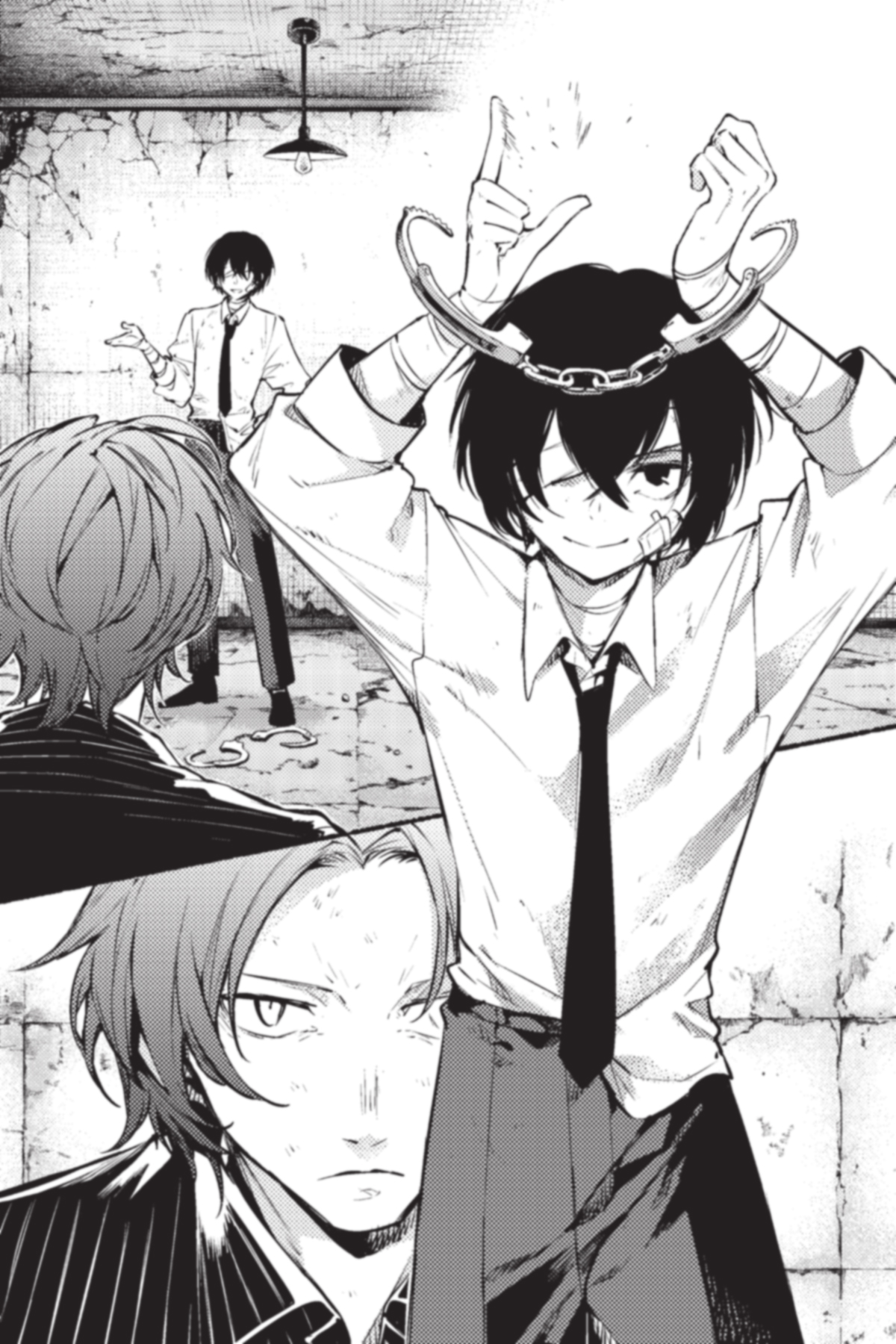
After he stood up, he raised his hands and snapped his fingers. The tightly locked handcuffs smoothly slid off and fell to the floor like a magic trick.
“Those handcuffs have been unlocked this entire time, haven’t they?” I said.
“I found a piece of wire and picked the locks before I got here.”
“Can you do something about the lock on this door, too?”
“Of course,” Dazai replied smugly. Then, as if something had just occurred to him, he glanced over at me. “Hold on. When you said that you knew how to break out of here—was the plan to have me pick the lock on the door?”
I shrugged. “A few days into your recovery, I noticed that the lock on the chain around your legs had been secretly picked and that you were just piling the chains over each other to make it look like they were still locked.”
“Whaaat? You noticed? Lame.” He pouted.
Dazai then seized my handcuffs, inserted a wire into the keyhole with practiced ease, and twisted it deftly for a moment until a sharp metallic click announced the internal mechanism had been disengaged. Immediately, the handcuffs slipped off, dropping to my feet.
“I don’t remember the last time I was excited to go somewhere,” Dazai said with a smile as he rubbed his wrists. “I’m starting to feel like I won’t even mind if there’s nothing there. Anyway, let’s get out of here and get us some fresh air.”
The underground bunker was long and labyrinthine, resembling the inside of some undiscovered subterranean creature’s body.
Guided by only a dim light, Dazai and I moved forward with our hands against the damp walls while black insects occasionally darted away from our approaching fingers.
The sound of dripping water was echoing in the distance, and a faint breeze flowed by. The wind was cold and humid, carrying a gloomy odor like someone’s breath. Yet we continued advancing toward the source of the draft.
“Even if we do get out of here,” Dazai began while he walked behind me, “that doesn’t mean that they’re gonna give up on this painting. You’re going to need to come up with a plan to deal with them…unless you plan on living the rest of your life as a vagabond. Have any thoughts on what you’re going to do?”
“Not really. I don’t plan on moving, either,” I replied, facing forward. “I’ve been attacked my fair share due to my past, and I’ve made it out alive every time. I plan on living until I die this time, too.”
He sighed. “Wiser words have never been spoken.”
I understood what Dazai was trying to say. However, I also had this vague sense of resignation that if the past was going to chase after me, perhaps I should let it do as it wished. What to call this feeling—guilt or perhaps atonement—I didn’t quite know myself.
Nevertheless, I couldn’t simply remain detached and philosophical right now, since this wasn’t just about me anymore. It was probably time to start considering some countermeasures like Dazai had said.
“Wait. Dazai, do you have a plan in mind—?”
I glanced back, only to find that Dazai wasn’t right behind me. He was far off, crouched against the corridor wall with one hand braced against it for support.
“Sorry… Go on ahead without me,” he said. “I’ll catch up with you later.”
He was pale. His fingers were trembling. When I rushed back to his side and placed a hand under his arm to pull him up, his entire body felt as cold as ice.
“What happened?” I asked.
“They probably did something to me…after they kidnapped me…when I was unconscious…”
All of a sudden, I saw the future—a flash of light, a piercing hiss, and then Dazai’s chest tearing open dramatically, ribs bursting out of his body as a massive flower of blood bloomed from his chest.
He died instantly. It was a bullet.
I grabbed Dazai by the collar and yanked him forward onto the ground. A bullet raced through the space where he had been just a moment before, striking the wall with a damp thud. Without wasting another second, I dragged him out of the hallway and ducked behind a concrete pillar.
I had lived through a handful of moments that I might have called the worst in my life and being shot at in an enclosed space like this was definitely one of them. It didn’t help that I was unarmed and carrying someone too weak to move on his own.
“Looks like I underestimated you two.”
A familiar voice sounded from the opposite side of the corridor that we had just come through, beyond the forest of pillars. It was the older white-haired ex-cop. His movements carried the firm, deliberate slowness of someone who was used to making others wait. This was strength that all seasoned officers possessed.
“We rubbed a bit of poison on your bandaged friend while he was unconscious, so his limbs should be pretty numb for a while. Hell, he probably won’t even be able to lift a hand to scratch his own head.”
The older man was holding a double-action revolver, a standard-issue police firearm that held five rounds.
“So either put your hands up and get over here or die trying to protect your friend. Makes no difference to me,” he said, playing with his gun without aiming it at anyone in particular.
I quickly observed my surroundings. I was in a large storage room, likely once a vast space for keeping water and food supplies in case of evacuation. Now, however, it was empty and barren. Columns too thick for one person to wrap their arms around stood at equal intervals like ancient, inanimate soldiers. There were four entrances, one on each wall, and the hallways beyond were submerged in ominous darkness. Put simply, there were neither useful tools nor safe escape routes.
“Are you really that desperate for money?” I asked the man, subtly shifting my position to shield Dazai.
“I understand exactly where you’re coming from. Money, money, money. It’s all the craze. But we don’t believe money is worth more than life itself. I mean, that’s how you and your little friend feel, yes? So just tell us where this painting is. There’s no reason for a mere grunt like you to throw your life away for a place you used to work.”
Men wielding guns began to appear one after another as if those words were their walkout music. Four, eight, twelve—some in suits, others in security uniforms, some in urban camouflage military attire—their appearances varied, but they all wore the same cold, worn-out expression.
While they had automatic pistols, rifles, and shotguns, me and Dazai were unarmed. The odds were stacked too high against us. It didn’t help that Dazai was injured, either. This was most likely why they’d kidnapped him with me. They wanted a hostage.
The older man elegantly yet coldly sneered, backed by the overwhelming disparity in power.
“I’m sure you’ve already heard, but every one of us used to work in law enforcement. If you ask me, our nation’s police force is exceptional, and yet, we are not always compensated appropriately for all the hard work we do. Our meager salary hardly reflects the dangerous nature of our jobs, and the country pretends not to notice this. But we refuse to be like those pigs who only complain to the media and politicians, never taking things into their own hands. We’ve decided to claim what is rightfully ours. In other words, consider this painting of yours to be a modest token of gratitude to those who maintain national order. You must feel honored, huh?”
The former police officer spread his arms as if intoxicated by his own speech—as if he alone were a messenger for the gods on a divine mission.
I couldn’t explain why, but his expression and what he was saying made me hate him. I hadn’t had any particular feelings about him up until then, whether he was beating me, kidnapping me, or torturing me, but this was crossing the line. It was unusual for me to dislike someone, but it wasn’t like my preferences had much impact on the world.
“Good grief.”
I heard an exasperated sigh and turned around to discover that it had come from Dazai.
“I can’t listen to this nobody’s long-winded speech anymore. This is torture. I’m ready to go. I’m thirsty.”
The older man’s eyes glinted with a dangerous light. “You don’t seem to grasp the situation you’re in.”
Every armed man in the room turned the barrels of their guns toward Dazai.
“Sakunosuke Oda, you need to surrender if you don’t want that boy to be killed. We are going to have a long talk after this, though.”
I glanced at the man, then at Dazai. “You’ll let Dazai go if I surrender?”
The man seemed to ponder for a brief moment before eventually nodding. “Of course. The boy has no value to us. That brain and mouth of yours are all we need.”
I slowly observed everyone’s expressions, then scratched the back of my ear—a meaningless gesture.
“All right, I surrender,” I said, raising my hands.
The man’s lips twisted as if he could hardly contain his joy. Another former cop stepped forward and handcuffed me.
“Make sure to tie him up real good this time so he doesn’t run away again,” the man told him.
I glanced at Dazai. He was staring back at me with a vaguely displeased expression, but he didn’t say anything.
“This way, Sakunosuke Oda.” The older man beckoned me. “I’ll prepare the finest booze we’ve got for you. We’re probably gonna be chatting for a while, after all.”
He grabbed the chain to my handcuffs and yanked me closer, then shifted his gaze back toward Dazai.
“Now put this bandaged kid out of his misery,” he told his subordinate with an air of indifference.
“That wasn’t the deal,” I cut in.
“The deal?” He raised an eyebrow somewhat cheerfully. “Yes, I broke our promise, but what about you? We are guardians of the law, you know. Are you saying that you’ve never once broken or disobeyed the law?”
I reflected on my actions up until now.
“Good point,” I admitted.
“What are you doing, agreeing with him?” Dazai droned.
“I know, Dazai,” I replied. “I’m thirsty, too. Let’s get out of here.”
“And how do you plan on doing that?” the man asked. He had a gun to my head. “I find it hard to believe that an unarmed, former low-level grunt is going to be able to do anything up against this many people, especially when we have a hostage.”
“Ha-ha-ha. A ‘former low-level grunt’?” Dazai said.
His laughter was strangely flat and lacking any real depth. I stared at him.
“Is that what you call yourself when you look in the mirror?” he added.
Everyone suddenly glared at Dazai, but he simply continued to casually survey his surroundings, unperturbed by their gazes.
“You want to know why I collapsed on his stoop? Because I’ve heard the rumors,” he told the older ex-cop. “From petty thieves to drug dealers, nobody dares to go near that house—not even the Mafia. No one stirs up trouble around there. Not even the wind dares to blow there. It’s as if they all fear something…or someone.”
“The hell are you rambling—?”
“It doesn’t look like they’re going to let us out of here alive, so you take care of it.”
Immediately, Dazai leaned backward and landed flat on his back with a spectacular thud like a signboard that had given way, causing everyone to instinctively turn to him in utter shock. He was completely supine—the position least likely to catch a stray bullet.
That was the signal.
I seized the wrist of the older man gripping my handcuffs and yanked hard, forcing him to lose his balance.
Then I leaped into the air.
My legs clamped around his neck in a flying scissor choke, but I didn’t stop there. As I flipped upside down, I locked his arm with my grip, dragging him into a free-falling nightmare.
The aging ex-cop never stood a chance. His head slammed full force into the hard concrete floor, knocking him unconscious.
“What the…?!”
The other ex-cops stood frozen, stunned into silence, their minds still scrambling to process what had just unfolded.
However, the world has no patience for disbelief. It keeps moving with or without you.
Right before hitting the ground, I released my legs from the man’s neck and rolled across the floor, breaking my fall. I then sprang to my feet with a stolen pistol in my hand.
“Kill him!” someone shouted.
I dashed forward like a wild beast, firing two bullets each at the enemies in the back of the room. The four bullets immediately struck the men’s arms, and the momentum sent them reeling backward.
Without even checking to see if they fell, I charged toward the nearest enemy—a man wearing a suit and swinging his gun barrel in my direction. I slid within striking distance, keeping my stance low as I fired my gun straight into his arm, causing him to recoil. His automatic pistol flew into the air.
Numbers instantly flashed through my mind. The revolver I was holding had five rounds, and I’d already fired five shots. The automatic pistol, however, had a double-stack magazine with seventeen rounds. I liked that number.
I caught the pistol midair with a reverse grip, but I didn’t have time to adjust. Instead, I hooked my pinkie around the trigger and fired two shots. Then I flipped my wrist and fired two more; what followed were screams from the corner of the room and the sound of the bullets making contact.
I then rolled to the side, came up on one knee, and steadied myself. With a flick of my wrist, I juggled the reverse-gripped pistol and caught it with a proper grip as I readied my stance.
“H-how is he doing this?!” one of the men shrieked in terror. “I thought he was supposed to be some sort of low-level grunt!”
A hail of bullets rained down on me. I leaped sideways, then placed my hand on the floor, half rotating to dodge the bullets until I was behind a pillar.
Immediately, I sensed someone’s presence and quickly turned my head.
From the pillar’s shadow emerged a figure in dark camouflage with short, neatly trimmed hair and muscles that strained against the fabric of his clothes. He charged straight for me, his handgun in front of his chin, his elbows slightly out, securing the handle by pushing with his right hand and pulling with his left—the optimal grip for close-quarters indoor gunfights. I instinctively knew that he was a former Special Forces member—a combat professional.
When he shot his pistol at point-blank range, I jerked my head to the side, just barely dodging in time. I then aimed my pistol at him to counter, but he slapped my hand away.
Our weapons immediately found each other again—his barrel seeking my head as my deflected pistol returned to face him. Like predators in a deadly struggle, our guns circled mere inches apart, hungry for the kill that would end this lethal dance.
From there, it devolved into a savage exchange of gunfire.
A bullet grazed past my ear; I knocked away my foe’s gun barrel with my elbow and swung the grip of my gun at his head. It was a blow that would have shattered his skull had it connected properly, but he tilted his head at the last second, then grinned.
Nevertheless, he was only able to dodge because that was exactly what I wanted him to do. With my arm fully outstretched, I pulled the trigger, the thunderous report detonating inches from his ear. His bestial scream pierced the air as the ejected casing traced a golden arc right into his eye. Metal met skin and muscle with a sickening sizzle, searing his flesh.
I seized the opportunity without hesitation.
Bending my long legs, I delivered three consecutive low kicks to his thigh, knee, and the top of his foot. Right as he slipped off-balance, my right hook crashed into his exposed nape like a sledgehammer, causing his neck muscles to audibly pop.
Then, after slightly jumping back to create distance, I delivered a full-power front kick to his thick chest, launching him against the pillar. His skull rebounded off concrete, and any signs of consciousness instantly vanished from his eyes, leaving him helpless against what came next.
My leg carved through the air like the grim reaper’s scythe as my aerial back roundhouse kick—widely considered the single most devastating kick—connected squarely with the man’s jaw. The Special Forces operative spun violently, crashing headfirst into the floor before falling flat on his back, out cold. Judging by the impact, he was going to be sipping his meals through a straw for at least the next week or so.
“Yoshiba…lost…?”
“Surround him! Surround him and fire! Kill him!”
I had already taken the pistol from the former Special Forces member named Yoshiba. Now there was a mismatched gun in each of my hands.
I knew the battle was over. From here on, it was time to dance.
Bullets rushed toward me, but I stood up, almost closing my eyes, and began firing both guns. Two shots forward. Two shots with both arms spread horizontally. Two shots with my arms raised behind me like wings. Two shots with my arms crossed in front of my chest. Flashes of light illuminated the room, and shadows divided the world.
And finally, I fired two shots forward with both guns aligned.
Several golden shell casings clattered to the floor, ringing out like metallic percussion instruments to compose a crisp outro that signaled the end of the battle. I stood still with my guns raised, waiting for enemy’s next move: for someone to shout, raise a weapon, or burst into the room. But no one came. No one got up. No one fought back.
I was the only person left standing. Everyone else was on the floor, groaning and writhing in pain from being shot in both arms, or legs, or shoulders.
“Unbelievable.”
I turned around at the sound of the fed-up voice and noticed that Dazai was walking toward me.
“Not a single one of them are dead. I mean, they’re seriously injured from being shot in the arms and legs, but they’re all alive. What kind of sorcery is this?”
“I shot them in places that aren’t fatal,” I said in all honesty.
“Uh-huh,” he muttered, dropping his shoulders. “But, like…why? Like— You know what, forget it. We can talk about it later. Ugh… There are so many things I need to ask you. Come on, let’s get out of here.”
“Dazai,” I called as he began to walk away. “Count to two; then take one step to your left.”
Dazai looked back at me, paused for a moment, then swiftly shifted to the left. A bullet raced past where he was just standing.
The shot came from below, from a gun wielded by one of the fallen men. It was the ex-officer who’d tortured me earlier. Come to think of it, I hadn’t shot him; I’d only knocked him out when I threw him to the ground.
I wanted to counter, but my guns had just run out of ammunition.
Before he could fire a second shot, I threw the pistol at my waist. With a sharp flick of my wrist, the weapon spun through the air, flying straight and level, as if pulled by an unseen force, until it hit the gun out of his hand, sending both weapons clattering in opposite directions.
“Dammit…!” The older man grunted, clutching his hand. “Just who are you?! What the hell are you…?!”
There was no reason for me to answer that question. I didn’t owe anyone here an answer. But after thinking about it for a moment…
“There was never a legendary organization of assassins,” I replied.
“What?”
“You said you couldn’t find anyone other than me who used to work in the organization. Of course you couldn’t. Because it wasn’t an organization that carried out all those jobs you know about.”
Bewilderment spread across the man’s face, slowly giving way to a dawning realization, and then shock.
“It was just you…?”
He went limp, and little by little, fear began to cloud his visage.
“The terror—the urban legends surrounding that organization—the legendary group of assassins that even the government feared and wouldn’t touch… Are you saying that was all you? You alone did all that…?”
I picked up the submachine gun that had fallen at the back of the room and stepped in front of the man. The Middle Eastern–made weapon, capable of firing ten rounds per second, was less a tool for punching holes than one for brutally carving out flesh.
“Any last words?” I asked.
When I leveled the muzzle at the man, his expression froze.
I understood exactly how he felt. Whenever someone points a gun at you, the entire world vanishes, leaving only that dark, gleaming barrel to consume your entire field of vision.
“You picked the wrong man to come after,” I said. “And in this business, you have to pay for your mistakes. Same as all the people you’ve killed.”
“W-wait! Don’t shoot!” the man screamed. He wanted to run, but the blow from earlier left his limbs sluggish and unresponsive.
“Why should I wait?”
“I…! I worked as an honest detective for over twenty years!” His strained voice made it sound like he was struggling to breathe. “But…the income I earned in those two decades wasn’t even half of what I’ve made in just six months as a criminal. Why does it have to be that way? Why doesn’t justice pay? I might be a criminal now, but the real evil lies with the leaders of this country who created a system where even doing what’s right doesn’t pay!”
There was sorrow buried in his words—the kind that only someone who truly believed what they were saying could produce—and it resonated with the most profound conviction.
But one person was entirely unmoved by that raw emotion.
“Ah-ha-ha-ha.” Dazai’s laughter was hollow and monotone. “Unbelievable. You’re remarkably unoriginal, aren’t you? Even your last little speech was so predictable.”
Dazai eyed the man with utmost disinterest. He would have shown more curiosity glancing at a pebble on a riverbank.
“Predictable bums like you really annoy me. Anyway, can you just shoot this guy already, Oda—? Uh… Now that I think about it, what should I call you?” Dazai asked, staring at me.
That was when I realized that he had never once called me by my name until now.
“It’s up to you,” I replied. Then I casually fired the submachine gun.
The resulting blast thundered like industrial machinery devouring granite, each 9mm harbinger of death erupting from the barrel rushing toward the man.
The floor exploded violently, concrete shards scattering in every direction. The man let out a voiceless scream, convulsed two or three times, and then went limp.
“Wow, you really aren’t going to kill him,” Dazai said nonchalantly when he saw the man had fainted without a scratch. “You’re a lot more interesting than this guy. But as long as you’re alive, he’s not going to stop coming after you. I think you should kill him.”
“Yeah,” I agreed, dropping the gun to the floor and then walking away as if this were nothing out of the ordinary. “Let’s get out of here.”
There was a slight pause, but I soon heard Dazai’s footsteps behind me.
He was right. I was probably an idiot for doing this—and it wouldn’t be the first time, either.
No king’s reign lasts forever.
Me and Dazai emerged outside during dusk, when the sun, the pinnacle of this world, was setting and losing its radiance. The sky was stained as though violet paint had been carelessly spilled across a canvas, and its warm amber hues were gradually retreating into the distance. Eager stars adorned the heavens with silver twinkles while a crescent moon suspended itself low in the gathering darkness like a celestial scar.
We walked through the city as lukewarm, stale air flowed slowly between the towering buildings. Elegant individuals stole cautious glances back at us. No surprise there, since we were covered in wounds, stained with filth, and to top it all off, we were thoroughly exhausted. It had been a long day, so we had no energy left to concern ourselves with the gazes of passersby.
“I’m beat,” I grumbled.
“Me too,” replied Dazai. “Where are we going, by the way?”
“To the place I said I’d take you.”
I took out a pack of cigarettes from my pocket.
It had been a while since I last smoked, but I’d gone through too much that day not to. However, just as I was about to light up, I suddenly remembered that Dazai was a minor, and that convinced me to put the cigarette back.
“Don’t mind me,” Dazai said. “You can smoke.”
I paused for a few seconds with the cigarette dangling from my lips, my thoughts wavering just like the cigarette. In the end, I decided to take Dazai up on the offer. I inhaled, then exhaled, the smoke rising from the tip of the cigarette before drifting into the twilight.
I turned off the main street and into a narrow alleyway with Dazai right behind me.
There, untouched by the setting sun, night had settled in early. A white light sliced through the darkness. It was a shop’s sign. I stopped in front of it and opened the door.
“Is this the place?” Dazai asked as I silently urged him to step inside.
The establishment was quiet. The narrow, steep staircase descending into the building felt like a secret passage. The first sound I heard was music: a jazz number with a rusted timbre. It was an old tune, full of the sorrow of a family leaving, never to return home. With each step, that melody made it feel as though I were slipping backward through time. Perhaps this place simply lingered in an era a little behind the world above.
Maybe because it had just opened for the night, there were no other customers inside. Bathed in dim light, the place looked as if it had sunk to the bottom of the sea, resting on a yellowish-brown seabed. Behind the counter, the bartender polishing glasses acknowledged me, nodding with his eyes alone.
“Are you serious? This is the place I needed to go to before I died?” Dazai asked with a disappointed note in his voice. “It’s just an ordinary bar. I mean, sure, it looks nice, but…”
“Yep, it’s just an ordinary bar,” I said. “There’s nothing secret or special about the place. I tricked you.”
Dazai stood there, his face blank as if his mind had wandered off somewhere else. Quite some time had passed before he uttered another word.
“…Huh?” he said vacantly.
“Think about it. You seriously believe a nobody like me would know something that even a big name in the Port Mafia didn’t? Besides, you said you were thirsty, right?” I told him. “Hey, I’ll have the usual.”
I sat down on one of the barstools while the bartender quietly placed a spirit in front of me. The liquid in the glass shimmered smoothly, reflecting the light, and the ice suddenly clinked as though giving some sort of signal.
“Why don’t you sit down?” I suggested, looking at Dazai.
He stood there for a beat, visibly disgruntled, but after taking another good look at the seat, the bartender, and me, he slowly sat down. Once settled, Dazai ordered a drink, and a glass was brought to him.
For a while after that, no one spoke.
“So…let me get this straight,” he began while staring at his glass. “Did you lie…in order to stop me from killing myself?”
“No, I’m not that noble.” I took a drink and then placed my glass back down on the counter. “I was just messing with you because you’re young and you were acting like you had it all figured out. Nothing more to it.”
The words I spoke felt somehow both true and deceptive. One’s own heart, no less than another’s, was an enigma.
For a while, Dazai stared intently at me as if trying to see through the layers of my comment, but he eventually gave up and simply shook his head.
“I’m having a hard time believing you, but sure, let’s go with that story for now,” he said.
“Don’t get too hung up on it. There are only two absolute truths in this world.”
I took out a pack of cards from my inner pocket.
“One is that you still haven’t beaten me in poker yet. The other is that the dead forever lose their chance to play poker with the living.”
Dazai glared at me for a bit until his cheeks eventually softened into a smile.
“I’m about to wipe that smug grin right off your face,” he told me.
After that, we clinked our glasses and made small talk while playing poker. We chatted about our current jobs, favorite shops, hobbies, recently published books, the works.
Glasses clinked softly, and bodies leaned in close to share secrets. There was never a moment of silence. For example…
“By the way, how does someone as incredibly skilled as you end up working a safe and boring job like a deliveryman?”
“Because there’s not much else that I can do. I’ve been at this for the past four years. Sure, it’s boring, but most deliverymen tend to quit or die on the job within a month or two, so we’re always short-staffed to the point that I’ll never be able to leave.”
“…What?” Dazai’s eyes opened wide. “People ‘die on the job’?”
“There was an explosion at the distribution center just last week,” I replied, taking a sip of my drink. “A bomb was mixed with the packages, targeting our company, but I managed to throw it outside just before it went off. Another second and all the packages would’ve been blown to bits along with everyone who worked there, too.”
“Wait… What…?” Dazai’s voice was a mixture of surprise and bewilderment. “Do you guys work in a war zone or something?”
“In a way, we kind of do. We’re a postal service that specializes in delivering dangerous cargo to Yokohama’s hazard zones: the Yokohama Settlement, pirate-infested waters, special restricted areas around military research facilities. We deliver packages on time to places where regular postal companies won’t go for various reasons. Sometimes, we’re evading industry spies to get newly developed components to our clients; other times, we’re delivering actual guns to kidnapped tycoons. My boss is incredibly skilled, and the two of us can usually deliver almost anything, but it’s dangerous work with little return. I actually haven’t been paid in four months.”
“Hold up. Why didn’t you tell me these stories when I was injured in bed and bored out of my mind?”
Dazai suddenly looked like a child having a fit.
“Sorry,” I told him.
“I don’t want apologies! Bartender, gimme another one of these!” He slammed his glass onto the counter. “All right, you’re gonna tell me everything right now. I want to hear about every single thing you’ve delivered for work, and I’m not leaving this place until you do! Let’s start with the story about you delivering a gun to that rich guy who got kidnapped!”
“Looks like I don’t have much of a choice.”
I finished my drink, wetting my throat before beginning my tale.
“It all started when…”
That became the signal for the night to begin.
The music flowed, time flowed, and the liquid in our glasses flowed down our throats. Our words quietly emerged and then drifted away, going nowhere in particular.
“Ha-ha-ha! You found two wealthy tycoons who were kidnapped?! Which one was the real one?”
Music had played, and time had gone by. The night deepened as customers appeared and disappeared like whitecaps.
“Dazai, is that true? The man fighting the Port Mafia turned into a monster and tried to destroy Yokohama? And he could shoot beams out of his mouth? I can’t tell how much of that is real and how much is just you pulling my leg.”
We never ran out of things to talk about. Words slipped smoothly from our mouths as if they had long been stored deep in our throats, patiently waiting for their turn to be spoken.
We talked, we listened, we shared. Poker cards were dealt, and several games were played, but neither of us paid much attention to them.
I found myself thinking back to the first time I had met Dazai, collapsed in his own blood, lying in front of my house. That was only a few days ago, yet it already felt so far away, as if it belonged to another lifetime altogether. I wondered: If I had closed the door and left him there that morning, what would’ve become of us?
“All right, I’ve made up my mind: Odasaku,” Dazai announced, leaning forward after he’d finally arrived at some sort of decision. “A short name like Oda just doesn’t feel right for you, and Sakunosuke Oda is way too long. You’re Odasaku. So from now on, whenever someone asks you your name, that’s what you tell them.”
“Odasaku? That’s kind of weird. Makes me sound like a farmer. Do I get a say in this?”
“Nope!”
“Well, then…,” I began, taking a sip of my drink. “I guess that settles it.”
Dazai ordered canned crab. I ordered a gimlet—something I hadn’t had in a long time, but for whatever reason, it suddenly felt right.
We continued to share countless stories after that: opening a package marked HANDLE WITH CARE only to find a baby with a rattle inside; risking one’s life in a rock-paper-scissors match with a Middle Eastern tycoon in order to gain access to a jewel-smuggling network; running away from a five-hundred-strong religious militia just to deliver a single pack of milk; meeting a boy who could manipulate gravity…
Our words gradually lost any connection they had with one another, scattering into fragments that drifted between us. Just as music notes sometimes had their own individual meaning rather than forming a sequence, our chatter behaved as if the vibrations of our throats carried meaning. If I were to put it poetically, we were turning into musical instruments that produced words.
“I haven’t talked this much in forever,” Dazai said at length, clearly exhausted.
“I’m glad,” I replied while dealing the cards. We’d played so many games that I had lost count. “But it looks like we stayed a little too long. The bar’s closing soon. You finally get to go home, huh?”
Dazai’s injuries were no longer life-threatening and would now heal on their own without further treatment. My role here was done, and so was our relationship.
“So when do we get together next?” he casually asked, nodding as he took his share of the cards.
I stopped what I was doing and glanced at him.
Dazai had to have known that wasn’t a regular question. It sounded more special than any line I had ever heard. The word next was like a magic spell, especially when spoken by a man who wished to die. Dazai, however, waited for my reaction with a carefree, innocent smile.
“Good question,” I replied, my gaze wandering as I searched for the right thing to say. “I don’t know. You’re a busy man, after all. But if you really want to meet up again that badly—”
“Ha-ha-ha. You’re hilarious. So that’s what you look like when you’re surprised.” Dazai turned his cards faceup. “Four of a kind, all kings. I win!”
I compared my hand to Dazai’s, and lo and behold, his was better than mine.
“All these games we were playing up until now were so I could figure out your skill,” he revealed with a delighted smirk. “Your skill allows to you read roughly five to six seconds into the future, so if I take seven seconds to reveal my hand after the final bet while simultaneously switching out my cards, you won’t be able to foresee that future.”
Dazai held up the king of clubs from his hand. With a light flick of his wrist, he turned his cards over and back again, revealing the eight of hearts. He then flicked his wrist once more, returning the card to the king of clubs. Even up close, I couldn’t tell where that card had come from.
“Of course, you were keeping your eyes peeled to make sure that I didn’t cheat, so I had to distract you with a little chitchat,” he told me.
“So both the game and the flow of our conversation…were all part of your scheme?”
“Heh. Saying something weighty as camouflage to get your desired outcome—that’s negotiation 101.”
“Which part was the camouflage and which part was your desired outcome?” I asked while organizing the cards.
For a fleeting moment, Dazai’s expression froze as if he’d been caught off guard. But it was only for an instant; he tilted his head and laughed, perhaps to conceal his expression. I almost thought I saw a hint of embarrassment as well, but it could have simply been the bar’s dim lighting.
“You told me that I’d be an idiot if I died before coming here once,” he said, still masking his expression.
“Sometimes, even I end up being right,” I replied, collecting the cards on the table one by one.
The bar was closing, so customers were slowly leaving. It was time for us to go. It was probably deep into the night outside as the world remained still, swallowed in silence.
I observed the deck of cards. I was good at poker, but it wasn’t like I never lost.
Nothing is guaranteed in this world. You can’t control what happens, no matter how hard you try. The only thing you can do is accept it and attempt to fight back by enjoying yourself a little—perhaps in the corner of a bar, somewhere in the past, or within a whirlpool of uncertainty for what’s to come.
“Even if you flip a card a thousand times and always predict the outcome correctly, there’s no guarantee that you’ll get it right the thousand and first time,” I said.
“Yeah, I figured that out tonight,” Dazai replied.
“You did, huh?”
“Is that strange?”
He smiled. This smile seemed a bit older and more mature than the one from before.
I shook my head. What a day.
“Now back to your question,” I said while getting up off my stool. “I’m not sure exactly when we can meet up again, since as you know, you’re a fickle man, and I still have my own issues to sort out.”
He nodded. “The ex-cops, right?”
“They’re not going to give up. Even if they do, I doubt they’ll be the last to come after me, so I need to operate under the assumption that information on the painting has already been leaked. And as you know, even if you run away to the other side of the world, information will eventually catch up with you.”
People in the underworld tended to have connections with one another in some way. I didn’t know through what channels the group known as the Forty-Eight had learned about my past, but they’d probably bought the intel from another criminal organization. And even if they’d obtained it some other way, the Forty-Eight could possibly sell my info to other criminal enterprises. If that happened, I’d have more than just those ex-cops to deal with. A day was going to come when all this would be beyond my capacity.
“Oh, come on. You’re still worried about that?” Dazai crossed his arms. “There’s a real easy way you can fix this.”
“Really?”
“If running to the other side of the world isn’t going to work, then you’re just going to have to go somewhere deeper,” he said lightly with a shrug. “Somewhere so deep that no criminal organization in the world would even dare enter. And this place isn’t that far, either. You can get there from Yokohama.”
He grinned.
“You’d be an idiot if you didn’t go there at least once before you died.”
I pondered for a moment until a certain place came to mind.
If I went there, then no criminal organization could lay a hand on me. This was the darkest place in Yokohama—a sanctuary of the night shrouded in a black storm of violence. Its people were bound by ironclad rules. If an outsider attacked a member, they would become a united row of fangs that tore into any enemy.
“No one can run away from their past forever.” Dazai smiled. “Unless you go there, at least.”
“You’re telling me I should do it?”
“Up to you,” he said, still smiling. “But I promise that if you do, you’ll never be haunted by your past again—because it will no longer be able to reach you.”
“And what exactly is this place?”
Dazai broke into a triumphant grin and spread his arms wide as if in invitation. Then he revealed the name of the place that would greatly change my future and set it in stone.
“What’s it called? Well, we like to call the organization…”
The Day I Took In Dazai Side A – End
SIDE B
SIDE B
A young man’s bloodied corpse lay sprawled out on my porch.
I gazed down at his lifeless form, then shifted my attention to the road in front of my house.
It was a quiet morning. The apartment building across the street cast a long, black shadow over the pavement. Trumpet vines nestled in the hedges swayed with the gentle wind, whispering secrets unintelligible to human ears. Somewhere far off, the sound of a long-haul truck scraping against the road drifted by.
And there, at the foot of my front steps, lay a body. A corpse.
A dead body would usually stick out like a sore thumb, but not this one. This corpse blended in, becoming one with the peaceful everyday morning scenery. After a moment, I realized why. This corpse’s chest was rising and falling ever so slightly.
It wasn’t a corpse. He was alive.
I observed the young man. He was black from head to foot, from his shaggy hair to his high-collared overcoat, three-piece suit, and tie. The only things that weren’t black were his button-down shirt and the bandages wrapped around his face—those were a mottled pattern of white and red, reminiscent of some sort of eerie Chinese curse.
He had collapsed at the bottom of the cracked concrete steps leading up to the porch, smearing a trail of blood in his wake.
The question was, what was I going to do with this half-dead person on my stoop?
The answer was simple: gently tap him with my toe and roll him straight down the stairs to the sidewalk. That way, he’d be on a public road instead of my property.
The street is government owned, and anyone in distress on public property should, by all rights, be at the mercy of the government’s aid. Meanwhile, an ordinary deliveryman like me should go inside and eat some breakfast.
This wasn’t an act of callousness or cruelty on my part; it was purely self-preservation. The young man’s injuries were unmistakably gunshot wounds, and there were plenty of them. His body probably had even more bullet holes than what I could see, too.
I looked at the young man, then at the road, then at the sky, and then back at the young man.
That was when I sprang into action. I hoisted him up from under his arms, his heels dragging against the stairs as I hauled him inside before laying him on the fold-down bed. He was a lot lighter than his appearance suggested, so I was able to carry him all by myself.
Upon closer inspection, his wounds proved severe and plentiful. He’d lost a ton of blood, but he would probably survive with prompt and proper medical treatment.
I took out a medical kit from the back of the closet and gave him some basic first aid. First, I positioned a towel beneath his upper body for elevation; then I cut his clothing away with scissors to check if he still had any bullets lodged in his wounds. To stanch the bleeding, I applied pressure to several points—beneath the armpits, behind the elbows, at the ankles, behind the knees—and bound them tightly with clean cloths. Then I used a sterilized tourniquet to address the bleeding directly at each wound site. Fortunately for him, I could do this kind of first aid with my eyes closed.
Once I finished the initial treatment, I stood over the young man and crossed my arms. His breathing was stable. He didn’t appear to have any broken bones or lung injuries, yet consciousness eluded him.
Just throw him out, an inaudible angelic voice demanded. Providing aid to someone so obviously suspicious defied all reason. I clearly should’ve listened to that warning—any rational person would have. But against my better judgment, I decided to observe the young man further.
I didn’t recognize him, so it seemed he wasn’t an acquaintance of mine. Seemed because the bandages covering half his face made it almost impossible to tell.
A strange premonition stirred within me. There was something wrong with this young man. Of course, it was impossible not to feel something was off when you found a bloodied person on your stoop…but this was a completely different kind of unease.
I circled around to look at his face. The young man’s eyes were closed. His skin was pale and weary. His breathing was so shallow that I had to pay close attention to make sure he was actually alive.
But even so, I sensed a strange fortitude in his posture—a force of will, a certain confidence in his body. It was as if…him lying here was all part of his plan.
The young man opened his eyes and looked at me.
I jumped back, startled, since I hadn’t even noticed him opening his eyes. He existed in motion without moving and perceived everything without appearing to be looking. Such preternatural abilities defined him—a specimen of humanity one might never encounter in the entirety of their existence.
And then those eyes.
I was never an exceptionally observant person, but nonetheless, several things became immediately clear as I gazed into the young man’s eyes. This individual had undoubtedly extinguished lives—not merely a handful or a dozen but hundreds. Anyone who had killed on such a scale transcended the realm of the normal human psyche, drifting far beyond the influence of light and gravity’s pull. You could see it in their eyes and in the corners of their mouth. Their eyes became cosmic voids, the muscles framing their lips merely instruments for articulating the depths of their sins.
Another thing became clear in an instant as well: This young man knew me.
“Who are you?”
The voice that involuntarily escaped my lips was so dry and cracked that it didn’t sound like my own. If I hadn’t braced my feet, my legs would have taken a step back.
“Who are you?” I asked again, but there was no reply.
I couldn’t tell if he was able to hear me, since the light in his eyes showed absolutely no reaction to my question. Even the most frigid souls offered some flicker of a response when you locked eyes and addressed them. And yet, this young man’s gaze offered nothing. He merely oriented his dark eyes toward the space my form occupied.
I couldn’t say anything for certain yet, but there was something about him. It was as if he didn’t have a heart, only a hollow space resembling one.
Suddenly, the young man opened his mouth. It seemed like he was trying to speak.
I focused intently on his lips, straining my ears so as not to miss a single detail…but he said nothing. His mouth formed a shape, but nothing came out. He conveyed no emotion; he only changed the shape of his lips. That was it.
“Do you know me?” I asked. “Why were you collapsed in front of my house? How did you get hurt?”
The young man looked at me, opened his mouth, and inhaled. I thought he was about to say something, but in the end, he didn’t. He gently closed his mouth again as if he regretted ever opening it in the first place.
Could he not speak? Was this aphasia or some type of congenital speech disorder?
Humans tend to lose their voices for various reasons: psychological issues, or brain diseases, or they burned their throat, or they could’ve had their larynx surgically removed. However, none of those seemed to apply to this young man. I got the sense that the words were right there, about to come out of his throat, but he was keeping them down for some reason. He could speak, yet he was choosing not to.
“If you don’t want to talk, that’s fine, but you’re going to die if we don’t treat your wounds. Do you understand what I’m saying?”
The young man didn’t reply. However, his eyes were filled with such a still emptiness that I figured he could indeed hear me. If he was deaf, there would surely be some sign of confusion or an indication that he couldn’t hear.
“I’ll be the one to decide whether I treat your wounds or kick you out. Since you’re not talking, you don’t get to choose. Is that okay with you? If not, speak up.”
The young man stared intently at me. Several seconds went by—perhaps even dozens—until he gently averted his gaze and closed his eyes. He was utterly silent and emotionless.
He could hear and speak. The reason he didn’t engage in dialogue was simply because a door was closed—a thick, enormous iron door that would never open no matter how much force you applied.
“All right. Then I’m going to do what I want.”
My words hung suspended in the stale air before dissolving into nothingness somewhere in the corner of the room.
And so my life together with the young man began.
You probably wouldn’t really consider us roommates, and I wasn’t exactly nursing him back to health, either. It was more like I was fine-tuning a piece of equipment that needed constant observation and maintenance. If I were to frame it in a more twisted way, I’d compare this to taking care of a pet fish.
After all, he simply lay in bed, hardly moving all day, except for when he ate or had to use the bathroom. He didn’t react to anything I said or did. It wasn’t a burden, but it didn’t feel like I was spending time with another human being. I wasn’t expecting to be thanked, and besides, this was much easier than dealing with someone who was violent or complained all the time, although it did leave me constantly on edge. I’d never experienced anything like this before.
Only once, when I tried to change the bandages covering most of his face, did I encounter fierce resistance. The speed with which he reacted completely took me by surprise. He swiftly grabbed my wrist as I attempted to replace the bandages, but no other part of his body moved whatsoever. It was as if his hand alone had become a separate creature, attacking me.
In truth, the bandages needed changing. The wrappings covering most of his face had already turned gray in places, and the bloodstains had darkened into a gloomy hue. From a hygienic standpoint, they weren’t something an injured person like him should be wearing…so I tried to change them, but he put up such a fight that I eventually gave up. I was applying disinfectant thoroughly anyway, so he probably wouldn’t die.
I figured that he was likely afraid of me seeing his bare face. Such stubborn determination shone clearly in the hard, glacial hue of his gaze. If he was this set on not letting me see his face, then there was nothing I could do but back down.
However, no matter how much I pondered over it, I couldn’t recall ever meeting him before. No memory of seeing him in a photo surfaced, either. That’s why his apprehension seemed entirely unfounded. At least, that was how I felt, and I even told him that, but he still didn’t say a word, let alone react.
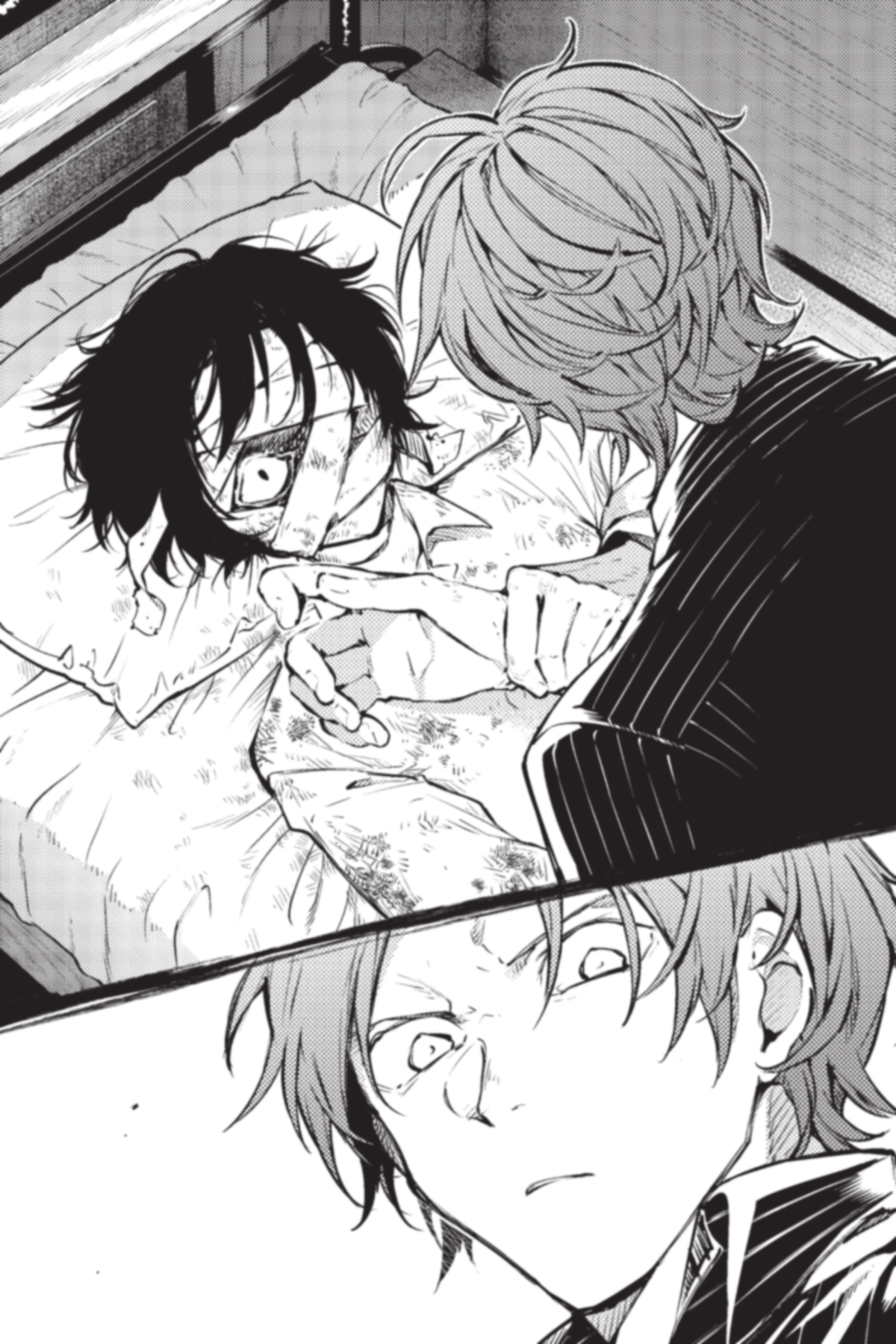
Fine. He could do as he pleased.
Meanwhile, I made his meals, changed his clothes, and replaced the bandages on his body. We didn’t talk. He remained silent, but I wouldn’t exactly call myself a skilled conversationalist, either. Therefore, his taciturn nature was almost convenient. And yet, I couldn’t shake the eerie sense that I was adrift on a boat with no idea where the current was taking me.
It was during a moment like this when the police decided to suddenly show up at my house.
“Excuse me. We’re with the local precinct. We received a report of an injured man last sighted around here, and we would like to ask if you’ve seen anything.”
A silhouette came into view through the decorative glass panel on the door.
I froze in the middle of boiling water in the kitchen to make coffee.
“Excuse me. This is the police. Is anyone home?”
The pounding at the front door persisted, each impact reverberating through the apartment with growing urgency.
I cast a questioning glance at the young man—this nameless occupant of my home—yet he still displayed no signs of human emotion despite the circumstances.
My thoughts spiraled frantically: What would happen if they found him? He was most definitely a criminal; witnessing and committing crimes were probably as natural to his existence as drawing breath. Surely, he dwelled among the shadows of the underworld. Otherwise, he would have gone straight to the hospital after getting shot so many times. The police would probably treat him more like a prize than an injured victim. An easy arrest like this would be enough to pad their books.
Meanwhile, I hadn’t actually broken any laws. All I’d done was tend to a wounded man I’d happened to find. Technically, a responsible citizen would probably alert the authorities upon discovering someone with gunshot wounds, but I could always play dumb. The city police would have no choice but to let it go. I could just say that I mistook the guy’s injuries for stab wounds or something. Gunshot wounds are pretty easy to identify, but there’s nothing illegal about not identifying them.
Basically, I wouldn’t be blamed for turning this young man over to the city police.
I moved toward the front door to answer it, already preparing a passable excuse to get the cops to leave us alone. After all, if I’d ever intended to turn this wounded man in, I wouldn’t have treated his injuries in the first place. But I never got the chance to achieve such feats of foolish self-sacrifice…because something entirely unexpected happened.
The young man suddenly lunged toward the front door like a tightly coiled spring being released. He flung the door open and launched himself at the policemen in a blur of motion that no one could have anticipated. Never in my wildest dreams did I expect him to be this explosive. With speed that belied his injuries, he jumped onto the one wide-eyed policeman before the officer could react and began driving his fingers into the man’s face.
The cop let out a brief, startled cry.
He thrashed wildly, slamming the young man against the wall by the door, but still the young man clung to him like a child riding piggyback. He then drove his fingers deep into the officer’s ears as if he were trying to tear them apart. A feral howl erupted from the young man’s throat, and he yanked out his blood-soaked fingertips—only to plunge them back in an instant later.
The officer immediately grabbed at his attacker’s body with his free arm, staggered forward, and toppled over in the entryway. The floorboards sharply cracked and splintered.
Meanwhile, the younger policeman—the one who hadn’t been attacked—drew his gun as if he’d finally remembered he had it on him. It was a double-action revolver with a swing-out cylinder, and he aimed it at the young man without warning.
A vision of the future flashed through my mind where the officer fired that revolver.
I dashed forward, grabbed the gun, and slid my thumb between the hammer and the firing pin. This way, the hammer couldn’t strike the primer, thus preventing the bullet from firing.
I looked at the policeman. Full of unconstrained wrath, he glared back at me.
That was when I heard a light thud as if something had fallen onto the floor behind me. Something metallic, it seemed.
I wanted to turn around, but I was in an awkward position. My right hand was gripping the gun while my entire left side was pushed against the wall. This was bad.
I caught something white flickering out of the corner of my eye.
I didn’t see exactly when it was thrown, but it was most likely one of the policemen who did it, since I didn’t have anything that dangerous sitting around in my house.
It was a gas grenade.
This single-use obsidian cylinder was designed to release nonlethal incapacitating gas. The discharge lasted twelve seconds, releasing up to 2800 liters of vapor. It was once used as a preoperative anesthetic, and anyone who inhaled it would become disoriented, losing consciousness generally within ten seconds, depending on the concentration. Inhaling a large amount could be fatal.
I covered my mouth and nose, then tried to search for the young man. A gas grenade obviously wasn’t something a city police officer on patrol would have on him.
In other words, these guys weren’t the police.
But before I could find the young man, I noticed something suddenly move out of the corner of my eye. It was the younger officer; he’d let go of his gun and was charging straight at me.
We tumbled onto the floor in a tangle, and the powerful impact to my chest knocked all the air from my lungs. White smoke twisted through my vision, and for a fleeting moment, it felt like I’d been dropped onto the pale ocean floor. But the fog didn’t last.
I coughed, inhaling the gas directly and falling unconscious the next moment.
There was a noise, cold and damp. It was so familiar that it didn’t even register at first. It was the kind of sound that skimmed the edge of consciousness, like the rustling of fallen leaves or the distant rumbling of a passing train.
But it wasn’t just any noise. It was the sound of Sakunosuke Oda being struck.
The deep sound was muffled and hardly sounded dangerous. It could have been a sandbag falling to the ground, but in reality, it was indeed something extremely dangerous.
Dazai knew this. He had lived with that sound pressing against his throat for what felt like an eternity.
“There’s something I need to tell you before we start,” a voice began—an older man. “I’m not a fan of violence.”
He was holding a blackjack. Dazai saw it himself.
He observed the man intently. His piercing black eyes kept watch from beneath the bandages covering his face.
“I dislike both being subjected to violence and inflicting it myself, so I’d appreciate it if you could view this purely as a business transaction,” the older man added.
He swung the blackjack upon the back of Odasaku, who was bound. Dazai watched intently.
Dazai was in the corridor of the bunker, a place of absolute darkness. The space between him and Odasaku stretched over thirty feet, and in that black void, Dazai was completely invisible. Even if someone had passed close enough to brush shoulders, they wouldn’t have known he was there. He had melted into the shadows, indistinguishable from the darkness around him.
Dazai watched—merely watched—as the blows landed.
The blackjack rose and fell. Odasaku groaned.
Despite the violence Dazai was witnessing, his eyes remained fixed and dry, as motionless and unreadable as a corpse’s, untouched by any emotion. And yet, with each strike of the blackjack, his fingers twitched. His joints snapped automatically, his muscles tensing. Each time, the pale, slender veins in his fingers rose to the surface of his skin, and his fingers curled, grasping something unseen as if he himself had been struck.
He was one with the darkness, and thus no one would notice him. Yet the older torturer could still sense the pulsating surge of murderous rage emanating from Dazai’s body.
“What the…?”
The man looked back and peered into the darkness, but the darkness, thick and viscous like mud, offered nothing in return.
He halted the beating and stepped forward, compelled to confirm whether there was indeed a person watching. Suspicion rooted in long experience stirred unease in his gut—the kind of instinct that had kept him alive more than once.
He reached the spot where Dazai had stood—but no one was there, only darkness.
It was as if no one had been there from the beginning. As if the darkness had taken Dazai’s form and then melted back into nothingness.
The man was bewildered, for only the unchanging, eternal darkness of ages lurked there.
The young former police officer had no idea what was going on. He had been abducted while patrolling the underground bunker, but he didn’t realize this until much later—until after he found himself in the darkness and unable to move a muscle.
He was seated. Rather, he’d been forced to sit, like some kind of prisoner, at the foot of a pile of rubble atop a piece of concrete. Having just woken up, he still couldn’t comprehend what was happening, although there was one thing that was clearly discernible: pain.
His body ached. A heavy, sharp pain ran through his entire being like an unpleasant signal; it made his skin prickle with goose bumps. But he couldn’t pinpoint what part of his body hurt yet, since his brain was still more than halfway buried in a muddy stupor.
He was in the depths of the underground bunker, a forgotten second sector left to decay. There had been an accident about ten years earlier where the emergency oxygen tanks being stored there exploded, partially destroying the area. The scars of that moment still marked the bunker: Jagged cracks crawled through the ceiling and walls like living creatures while debris lied scattered in chaotic heaps. The rubble ranged from fist-sized to as large as a car, and steel wires protruded from their cracks like weeds.
Deep in the dimly lit tunnel, in a narrow passage blocked by rubble, the young ex-cop sat—perched upon debris about the height of a tatami floor chair. Or rather, that was where he was constrained, unable to move on his own.
His hands and feet were fixed in place. Both hands were sandwiched between enormous pieces of rubble while his forearms were firmly caught between cracked slabs of concrete shaped like partially closed mouths. The rubble wasn’t heavy enough to crush his arms immediately, but neither was it light enough for him to pull out his arms and free himself.
“What…is…?”
His voice was tinged with despair…because he had seen his feet.
Thick construction stakes, each the size of a thumb, old and covered in rust, were piercing his leather boots, his skin, the flesh of his feet, and the soles of his shoes before sinking deep into the ground. Fresh blood blossomed in dark circles around his pinned feet, a gruesome testament to someone having deliberately, inexplicably, sewn him into place. But for what purpose?
“You’re starting to feel pain.”
A hoarse voice echoed from the darkness, drawing the gaze of the young former officer, his face filled with fear.
“Pain is good. It’s proof that you’re alive. But there’s something even better about pain. Intense pain dominates a person, changes how they think, and at times, it can even erase their entire personality. Do you understand why that’s a good thing, Akihiko Toda?”
The voice was menacing, assertive, and filled with raw danger like a blood-gushing wound. Though high-pitched, almost like a boy’s, it lacked the common humanity a boy would possess.
The young man in the shadows…was Dazai.
“Because it shows us that our personalities—our souls—are nothing more than a convenient, unstable hypothesis built upon primitive instincts like pain and fear.”
A thin smirk made its way to Dazai’s lips. Although most of his face was hidden beneath bandages, his expression revealed itself through his narrowed eyes and the pale crescent twisting of his mouth, curved like the edge of a blade.
“You’re the guy at the house…who was injured…,” the officer named Toda wheezed, now merely half conscious. “How do you…know my name?”
“I know basically everything.”
Dazai approached Toda with a gentle, soothing smile.
“You’re a member of the crime syndicate known as the Forty-Eight. You started as a patrolman in a small town until one day a former, older colleague of yours invited you to join the organization. Your home is under an overhead line near the lower reaches of the Tsurumi River. Your parents and younger sister run a sake brewery in Shinshuu. You don’t go to the bank with the money you earn through illegal means; you hide it in a safe at a scrap metal yard. Smart.”
“What—?”
“Don’t worry. I’m not interested in hurting you. Just tell me everything you know about the painting,” Dazai said, looming over the pale ex-cop, his gaze icy.
“What…? Painting…? Just who are you? How do you know my name—?”
“Wrong answer.”
With utter indifference, Dazai interrupted the man with a casual kick. It was no different from kicking a pebble on the roadside, yet it sent the former officer recoiling in agony. A scream escaped the man’s throat.
“Gaaaaaah?!”
The stake piercing the top of his foot hit his nerves and bones, shooting waves of unbearable agony throughout his entire body.
“To be honest, I wish I didn’t have to waste my time having this conversation with you, either, so let’s skip the pointless chatter. Tell me about the painting. How did you know that Odasaku had it? In fact, how did you know that this painting was valuable in the first place?”
“I…” The man’s face contorted. His was the face of someone with searing pain surging through them. “I don’t…know…”
“Oh?” Dazai raised an eyebrow, but the rest of his expression remained completely flat and composed.
“I’m serious! I’m a nobody! I just joined the organization, so I hardly know anything about what they do! All I know is that Oda guy is hiding a painting worth hundreds of millions!”
“Toda.”
Dazai approached the former officer, then rested an arm on a piece of rubble.
“This is your organization’s secret hideout. There are plenty of people down here who could replace you. Feigning ignorance isn’t going to save you because I won’t feel anything if you die. It wouldn’t inconvenience me in the slightest, either.”
The former officer felt cold sweat gushing from his entire body as he came to a certain realization: This young man wasn’t lying. He could tell by gazing into this stranger’s eyes. To him, the ex-cop was no more significant than a fly that had landed somewhere in the kitchen.
“I watched you all torturing that man, and I was kind of relieved,” Dazai said, his smile as thin as paper. “Because it showed me that even though former police officers are experts of investigation, you’re complete laymen when it comes to torture. That little game you guys were playing wouldn’t even get someone to tell you the time on the clock in front of them…so allow me to show you what real torture looks like.”
Dazai picked up a piece of rubble at his feet. It weighed only a few pounds, so he could lift it without much effort using both hands.
“What do you think I’m going to do with this?” he asked.
Dazai then lifted the jagged fragment of rubble. The former officer tensed involuntarily, knowing that a single downward motion would fracture his skull beyond repair. Escape remained impossible, since his limbs were secured, rendering him utterly defenseless.
For several excruciating moments, Dazai regarded his prisoner with glacial detachment before his lips finally contorted into a cruel, sardonic smirk.
“Nope.” He shook his head. “I’m not going to hit you with it. That’d just tire me out and hurt my hands. A real pro doesn’t use more energy than they have to. This is what I’m going to do with it.”
Dazai placed the piece of rubble on top of the flat, massive piece that already had the former officer’s arm pinned. The heavy weight made the man wince.
“That’s it,” said Dazai. “How do you feel? Pretty anticlimactic, huh? Torture, see, is something you start off gently. That way, you give the person being tortured time to imagine what’s going to happen next. After all, there’s no greater fear than the fear created by our own imagination.”
He lifted another piece of rubble and placed it on top of the same flat slab.
“One or two pieces isn’t a big deal, but what’s going to happen when I stack ten pieces of rubble? What about twenty? Your arms are fixed in place while weight is gradually being added. Right now, you’re probably only feeling a little pressure and some pain, but eventually, you’ll reach your breaking point. Slowly, over time, your bones will shatter, and both of your arms will be crushed. I’ll be increasing the weight gradually as well, so you’ll have plenty of time to imagine this sequence of events.”
The color slowly drained from the former officer’s face. Complex thought vanished from his eyes, leaving nothing but extremely primal and simple emotions.
“That’s what I wanted to see.” Dazai smirked and playfully tapped the man’s forehead. “That’s fear. It’s fear born from your own imagination, and nobody can rob a person of their imagination. Now, shall we continue?”
More rubble was piled on top, pressing down heavily on the former officer’s forearms. Cold sweat trickled down his cheek.
He knew exactly what was coming. His arms were going to be crushed. The bones bearing the brunt of the weight were his radius and ulna, followed by the lunate, scaphoid, and triquetral at the base of his hand, and finally the finger joints. The pressure would break them one by one, starting where the force was greatest.
Compared to the pain of a flesh wound, the pain of a fracture was said to be literally unbearable. Furthermore, with ordinary fractures, bones broke at the single point where the force was the greatest. This situation, however, wasn’t going to be that simple. Here, when one part of the bone would break, stress would then concentrate on a new point until it shattered there as well. The fractures would chain together one after another until the bones were pulverized as if they had been put through a wood chipper. The man’s arms would become nothing but flat mattresses of flesh and blood but reaching that point was going to take an excruciatingly long amount of time.
“Please! Don’t do this!” the former officer screamed.
He tried to stand up and escape, but his struggle was essentially meaningless. He was only able to raise his hips slightly, since both of his hands were pinned under rubble, and both of his feet were skewered into the ground. He couldn’t even properly adjust his position, much less run away.
“Then answer my question,” Dazai said. He leaned his weight against the slab of rubble.
“Gyaaah!”
As he leaned even more, the pressure intensified, eliciting an ominous creak from the man’s trapped limbs.
“Tell me about the painting. That’s the only reason why I’m here. I could have easily crushed your organization, but I need to know about the painting. That’s the first step of my plan.”
“The first step…?” the former officer asked in bewilderment, unable to grasp a single thing his captor was saying. There wasn’t yet anyone in this world who would understand.
“I know everything about you, your organization, and what happens next.” Dazai’s voice cracked as if he was suppressing something from deep within. “All I need now is information on the painting because if I don’t get that, then Odasaku’s going to die. I need to know where that painting is to change the future.”
“What are you saying?! None of this makes any sense! I’m just a low-level grunt! I honestly don’t know a thing!”
“Oh, really?”
Dazai placed more rubble on top. The former officer screamed as he summoned every fragment of his strength to pull his arms free in order to survive.
Both arms stretched taut, his joints turning white and translucent. He held his breath, displaying an unnatural, almost superhuman strength. His arms shifted outward, but that was as far as they went.
“You’re wasting your time,” said Dazai, his tone carrying an unexpected note of tenderness. “If you used every last bit of your strength, you could probably pull your arms out right now, but you won’t. The concrete is rough, and if you pull that hard, then the skin on your arms will tear right off. The more you pull, the less skin will be in contact with the concrete, thus increasing the weight on the remaining skin. In other words, you’d have to pull your arms all the way out while feeling your skin tear and your exposed flesh scrape against the concrete. So? Do you think you have it in you to peel off your own flesh until you’re free?”
A flicker of fear crossed the former officer’s face, and his arms slowly relaxed. He hunched forward, struggling to catch his breath.
“See?” Dazai smiled. “Your will—your soul—is telling you to pull your arms free, but your imagination is creating fear, which prevents you from doing it. I told you, right? Our personalities—that is, our souls—are nothing more than a convenient, unstable hypothesis built upon primitive instincts like pain and fear. Pain is your god right here and now, and that’s why you will talk. Trust me.”
The former officer’s frame convulsed with pure terror—a fear stemming not only from physical agony but also from the darkness of his own imagination. And yet, transcending all this was the dread inspired by the young man before him—this architect of suffering, this sovereign ruler over the merciless kingdom of pain.
“Just who are you? How are you able to do this?” the man demanded.
“I’m a pro when it comes to pain,” Dazai replied, bringing his face closer as if sharing a secret. “All right… If you want an excuse, then I’ll give you one. I’m one of the five executives of the Port Mafia.”
And with that, the former officer jerked violently as if seized by convulsions. A flash of regret flickered in his eyes. His entire body tensed, his muscles locking rigidly, and for a moment, he forgot all about the rubble crushing his arms and the stakes impaling his feet.
“Okay. I’ll talk. I’ll tell you everything you want to know! I had no idea we’d be pissing off the Port Mafia when I took this job!” The man’s hair shook as he screamed. “If it’s money you want, I can get it for you! I’ll even sell out my friends! Just let me go! I beg of you!”
Dazai smiled thinly at how easily this former officer had succumbed.
“Where did you hear about the painting?” Dazai asked.
“From an art dealer.”
The former officer’s eyes were bloodshot as he desperately searched his memory, realizing that every word he uttered could determine his life and dignity.
“He runs a small art gallery by the port, but on the side, he buys and sells forgeries,” the former officer explained. “He’s a gray market businessman for the most part, I guess you could say, but he botched a job last month and got arrested for selling paintings knowing they were fakes.”
“Now we’re getting somewhere.” Dazai grinned and took a seat on the rubble nearby. “Anything else?”
“Well…the local police started to look into his other offenses. Nothing significant turned up until he became the suspect in a really big case: dealing in stolen goods.”
“Oh?” Dazai tilted his head. “Go on.”
The ex-cop began to explain in a halting voice despite the pain he was experiencing.
It had been the art dealer’s biggest job to date. The job was to secretly sell a stolen work of art that had flowed in from Europe. It was an enormous painting, barely transportable by two adults, depicting a farming couple in a medieval European landscape. The piece was painted by a nobleman who had been a great European monarch in the fourteenth century. Put simply, this was considered a masterpiece of that era.
One night, however, it had disappeared from an international art museum in France. Soon after, the thieves—a gang of skill users—fled to Japan seeking to liquidate their prize. They approached the art dealer, and while buying stolen goods was nothing new to him, this particular venture far dwarfed his usual operations, since this painting’s historical significance posed a unique challenge.
With news of the theft circulating throughout the international community, potential buyers had become scarce. Yet ultimately, the art dealer had pulled off the job. The canvas found its way to a domestic tycoon—a man whose wealth flowed from aircraft imports and whose passion for fine art was surpassed only by his love of owning expensive art. The tycoon had displayed the painting in the basement of his home with no intention of showing it to anyone, content to be its sole admirer.
Therefore, when the authorities finally apprehended the dealer, his foremost anxiety centered on the painting, since its location had become the focus of global interest. Furthermore, should investigators uncover its trail, Europol would inevitably get involved. If that happened, the intensity of the investigation and the magnitude of the crime would be incomparable to when the Yokohama police had jurisdiction. It was then that the art dealer had requested the criminal organization the Forty-Eight to erase the evidence of this stolen painting. That had been one of the group’s specialties, after all.
Through their collaborators within the city police, they could steal evidence from the station’s storage or even rewrite criminal records. The price fluctuated according to the severity of the crime being erased, but the Forty-Eight understood the investigation process inside out, which put them in extremely high demand in the industry.
The Forty-Eight’s movements had been swift. They’d erased the travel records of the gang who stole the painting and rewrote surveillance video records around the warehouse used for the transaction. They applied expertise honed during their careers in law enforcement, coupled with a relentless thoroughness that defined their reputation. Even though they had fallen from day to night—from guardians of the law to outlaws—that persistence could not be taken from them by anyone.
But that was as far as it went. Two problems had occurred: First, the tycoon who bought the painting had been killed, and second, the painting had disappeared.
The tycoon had been murdered at his home, along with his family. No evidence revealed the killer’s identity, nor even the method of entry or execution. All investigators could establish was that the tycoon had died instantly from a single bullet to the head at close range. Forensic examination yielded nothing significant, either; the rifling marks on the bullet didn’t match any weapon in the database.
This was clearly a professional hit, and the painting had disappeared as well. That meant only one thing: The killer had known the value of the painting and stole it.
“That’s impossible,” Dazai muttered in bewilderment. “Are you saying Odasaku killed them and stole the painting?”
“It had to be him,” the man replied, fighting through his pain. “The police reports state that the painting was already gone by the time the cops arrived at the scene of the crime. Of course, the tycoon could have gotten rid of the painting right before he was killed, but it’s a difficult painting to sell. And if he were to sell it, he’d likely use the same art dealer he bought it from.”
Dazai stared at nowhere in particular, completely motionless. He leaned his weight against the rubble but didn’t speak a word, lost in contemplation. Though his eyes remained open, they registered nothing of the world before him. It was as though he had even forgotten how to breathe.
“All right,” he said after an interminable silence, his voice completely monotone.
Gone was the mockery from before, along with the cruelty and savage grin. Nothing remained. There was merely emptiness.
In one fluid motion, he pulled out his gun, then leveled the barrel directly at the former officer’s temple.
“W-wait! Why?! I told you everything! I betrayed my men and told you everything you wanted to know! Every last detail!”
“You really don’t listen, do you?”
Dazai’s voice was no longer cold. It was devoid of all emotion. There was no indication of him holding a gun, no indication of him even speaking to another human being.
“I told you already: I won’t feel anything if you die. It wouldn’t inconvenience me in the slightest, either. There’s another thing I forgot to tell you, too.”
Dazai bent his finger.
“I hate the Forty-Eight.”
Bang.
I opened my eyes, unsettled by a vague yet undeniable sense that something was off.
I was in a makeshift prison cell used to detain captives. It must have originally been a simple nap room within the bunker designed to protect against air raids. The space was about the size of a modest guesthouse room, with nothing more than the rusted frame of a bed bolted to one corner. The door had been replaced with a raw, crudely welded iron one. A thick mooring chain and an enormous padlock hung from the doorknob.
Several black power cables ran along hooks lining the walls, leading to a murky cage lamp in the back, which was the only source of light. The lack of ventilation left the air thick and stagnant.
I was restrained near the center of the room, with only the gloomy buzzing of the light fixture breaking the silence. Dreary time passed me by with a dreary expression.
Eventually, I realized something was off: It was too quiet. I hadn’t heard any footsteps or voices for nearly two hours, and I didn’t sense any hostile or conciliatory presences like I did when I first got here.
I stood up and put my ear to the door. No sign of anyone out there.
That’s when I was forced to realize something. I was puzzled, unable to decide on how I should have interpreted this realization.
The door’s padlock was undone.
When I poked the chain, it dropped with a rattle, the padlock falling alongside it. I turned the knob and slowly pushed open the door, which creaked in protest.
I found myself lost in thought for a few moments. Just because the door was open didn’t mean I had to leave. I could still wait here…but what would I be waiting for? Another opportunity to be tortured? Or perhaps a chance to congratulate the people who had kidnapped and restrained me?
In the end, I decided to go outside. Although I was still handcuffed, it didn’t impede my movement.
The underground bunker was long and labyrinthine, resembling the inside of some undiscovered subterranean creature’s body.
Guided by only a dim light, I moved forward with my hand against the damp walls while black insects occasionally darted away from my approaching fingers.
The sound of dripping water was echoing in the distance, and a faint breeze flowed by. The wind was cold and humid, carrying a gloomy odor like someone’s breath.
I thought I might get lost, but that ended up not being the case. I soon discovered a marker: an enormous arrow crudely drawn on the floor where the paths branched. It was written in blood—still wet, indicating that the arrow had been drawn here recently. Looking ahead of the arrow made me instantly grasp what it was pointing to: a person lying on the floor.
I understood that this person was probably no longer alive, but I rushed over regardless. He was on his side, and before I even got close, I could tell that his arms were completely destroyed. His skin had been peeled off, exposing the flesh beneath. His forearms and hands were stripped and torn on both sides as if they’d been crushed between something. But the rest of his arms were hardly damaged at all. What in the world had happened to this man?
Furthermore, his feet had enormous holes penetrating through his shoes, and blood was still slowly trickling out. I was taken aback; corpses hardly bleed…which told me that he was still alive.
I rolled the man onto his back and recognized his face. He was one of the cops who’d broken into my house—the younger one.
“Hey, wake up,” I said. “Who did this to you?”
I slapped his cheek, and the young police officer faintly opened his eyes. Though his face was pale and bloodless, his hazy gaze gradually fixed on me. It took several more seconds for his brain to process what he was looking at, though.
“Stop!” he yelled.
The police officer suddenly shoved me away and rolled backward. Breathing in short, rapid gasps, he desperately tried to flee with his almost useless limbs.
“Hey, wait.”
“Stay back! Please! Don’t—!”
“Wait. Relax. I’m not going to hurt you.”
I approached the man and grabbed his shoulder, pushing his flailing arm away and peering into his eyes.
“Who did this to you? This is your organization’s base, right? What happened to the others?”
The officer seemed to have regained some semblance of reason. His eyes gradually regained focus; he darted them from side to side, trying to get his bearings.
“Where…? Where is he? I thought he was with you,” the man said.
“Who?”
I followed the officer’s gaze and quickly observed my surroundings, but there was nobody there.
I was in a large storage room, likely once a vast space for keeping water and food supplies in case of evacuation. Now, however, it was empty and barren. Columns too thick for one person to wrap their arms around stood at equal intervals like ancient, inanimate soldiers.
“He told me…there was nowhere to run.” The police officer sounded delirious. “He said I need to tell him where the painting is…or everyone here will die.”
“Everyone?” I glanced around but didn’t see another soul. “Where are the others?”
The officer, visibly shaken, shook his head and pointed toward the back of the room. I got to my feet and looked in that direction, but there was only darkness. In one dim corner was the entrance to a corridor that was enveloped in an even deeper void.
I headed in that direction, guided by a vague premonition. Once I stepped farther into the corridor, I struck a match to dispel the darkness. Even before I took a good look at the floor, I already knew what I would find.
A man was collapsed facedown, submerged in a pool of blood as comfortably as if he were lying on a cloud. Farther ahead rested another body, collapsed in an L shape with his arms wrapped around himself. The heavy scent of more blood drifted forth from the void.
A sudden intuition struck me—had everyone in this underground hideout been taken down?
I approached one of the fallen men nearby and checked for a pulse. Apparently, he was still alive, even after losing this much blood. He was breathing faintly, too. When I examined his body, I discovered that he had been slashed with a sharp blade in dozens of spots, yet the cuts ran perpendicular to blood vessels, ensuring that he wouldn’t bleed out. Arteries had been carefully avoided with the precision of a master painter’s brush on a canvas. Whoever did this wanted to keep this man alive and in pain. He hadn’t survived; he’d simply been forced to not die. This was first-class work, the skill of a craftsman in the underground world whose techniques were vastly different from my own.
But these men must have been prepared for violence and raids, so who in the world could have done this to them? Who could have defeated them so easily? How did they manage to torture these people while ensuring that they wouldn’t die? And for what purpose?
The officer from earlier had been threatened that if he didn’t reveal the whereabouts of the painting, everyone here would be killed. In other words, the torturer wanted information on the painting—info that only I knew. That made them my enemy.
Suddenly, I felt like someone who had lost his way on a freezing mountain peak in just his underwear, with nothing for protection and no clear escape route. Beyond the white shroud lurked an unknown monster waiting to tear me apart.
I hurried back to ask the conscious officer for directions so that we could escape together, hoping our departure might convince the torturer to spare the dying victims.
However, before I could even make it there, the entire tunnel violently trembled with a roar. I had to steady myself against the wall while the surrounding concrete rumbled and debris rained down.
“We’re…done for…,” came a voice—the young police officer I had first encountered.
I turned toward him to find him trembling, his eyes swimming as if he were certain the world was about to end. I promptly helped him sit up, but he began rambling frantically, his eyes unfocused like a feverish hospital patient.
“They’re coming. They’re coming. They’re going to kill every last one of us. He uses fear. He uses imagination. Nobody can win against their own imagination. All the exits have been surrounded, and they’re gonna cook each of us alive.”
“Pull yourself together. Who are you talking about? What’s going to happen?” I asked.
The police officer’s gaze met mine, radiating such profound dread from his core that it almost felt contagious.
“He’s with the Port Mafia.”
The Port Mafia… I wasn’t so naive as to not recognize the weight behind those words.
They were like the nighttime wind that blew through this city’s shadows. These relentless hunters pursued their prey in the dark before sinking their fangs into their necks and ripping out their throats. They were messengers of death that no living creature could outrun—and they were here.
There was another thunderous roar. The hall shook like the convulsing entrails of a giant, sending thin cracks across the walls. We apparently had even less time than I had imagined.
“So let me get this straight,” I said. “Right now, this hideout is surrounded, and the Port Mafia plans on killing everyone here, but they’ll spare everyone as long as we tell them where the painting is.”
“I…think so,” replied the officer, his face pale. “It’s not like he wants to take anyone’s life. To him, our lives are worth less than dirt. Come on, please help me. I’ll leave this organization for good. I don’t care about how much money I can make doing this. I just don’t want to live in a world inhabited by that monster for any longer than I have to, so please… I don’t want to die.”
I looked at the young police officer. He was consumed by terror, so deeply afraid to the point that all traces of composure had vanished, leaving only a trembling shell of a human being.
But behind the light flickering in his eyes, I saw it: the man who ruled through fear—the demon of the Port Mafia. It was as if he were pulling invisible strings made of dread to manipulate the officer into speaking on his behalf.
Give me the painting, the demon was commanding me.
“I’m not going to do it,” I replied. “I don’t like that he’s trying to control others, for starters. Secondly, that painting doesn’t belong to me. It belongs to someone else, and I don’t have the authority to trade it for people’s lives. Thirdly, the painting isn’t that valuable anymore. It’s nowhere near worth fifty thousand, let alone five hundred million. Plus, I really doubt they’d let us go even if I did tell them where the painting was.”
“But…! If we don’t give them the painting, then—”
“Fourthly,” I cut in, “they’re not going to kill me, since I’m the only one who knows where the painting is. The Port Mafia might surround this place and kill everyone inside, but they’ll have to keep me alive because they need the information in my head. However, if I tell you where the painting is now, I won’t be the only one who knows the secret anymore, thus diminishing my value. And if that happens, then whether or not they keep me alive is a coin toss.”
“Wh-what are you trying to say?!” The man was basically shrieking at this point. “What about me? What’s going to happen to the rest of us?!”
“You’re criminals,” I calmly replied. “It’s only natural that you’d be devoured by an even eviler criminal organization.”
“You little…!”
Still on the floor, the officer swiftly drew a handgun he’d been hiding and aimed it at me.
I took a step back, observing the weapon—a black 9mm automatic pistol. There was no need to cock the hammer, either, since it was automatic, so he probably wouldn’t have trouble firing, even with his injured arm.
“Were you listening to me?” I said, lifting my hands into the air. “If I die, then no one’s going to find the painting. You’re wasting your time trying to threaten me with a gun.”
“Oh, I understand that. That’s why you’re being smug, acting like you’re better than us.” The young police officer’s eyes shimmered with a frenzied hue. “You think you’re safe and special, and I don’t like that. Me, though? I’m gonna die, regardless of whether you talk to me or not. I might as well shoot you so that I can at least feel a little better before I kick the bucket. So what now? Not so confident anymore, are ya?”
I stared down at the man in silence. Raw desperation was etched into his face as if he were pleading for his life. If I waited long enough, he would shoot me without question, as certain as dawn always followed even the darkest night.
“All right,” I heard myself mutter. “It sounds like you’ve really thought this through, so I guess I have no choice but to talk. I doubt that’s going to change anything, though. Seven years ago, I killed the man who owned the painting. It was the last job I ever took.”
I began to tell a tale of my past.
I explained how I’d killed that wealthy man simply because it was my job. I didn’t know why someone wanted him dead or what kind of person he was. I just aimed my gun at his head and pulled the trigger. That was it.
The painting was apparently the client’s target, but that was something that I had learned much later. My contracted role extended solely to eliminating the wealthy man; other specialists had to handle the extraction and eliminating the evidence. They did their job, and I did mine.
On my way out of the man’s home, however, I happened to notice a novel on a desk, and I decided to take it with me.
It’s always the most trivial things that set everything in motion. This particular book, for example, was what led to a chain of events that made me stop killing.
But around two years later, a spontaneous impulse to return the book arose within me. I was motivated neither by ethical considerations nor remorse but by a belief that by doing so, I might be able to properly face the novel itself. I’d already bought my own copy.
Occupying the tycoon’s estate was his solitary heir—a fifteen-year-old boy. I later discovered that he wasn’t the man’s biological son but rather an orphan who had lost his parents in an underworld conflict. This wealthy man had taken the boy in as his own child.
I must have been out of my mind back then because I wanted to meet that son. I could have easily sneaked into the house, left the book, and vanished without a trace. But instead, I confronted the boy and revealed that I was the one who’d killed his father.
Just how furious the boy was requires no elaboration. His rage was entirely justified as well, since he had twice lost his family to the underworld. He lunged at me, threw whatever was nearby in my direction, and hurled every possible insult he could. While I easily evaded his physical attacks, there was no way to avoid his verbal ones.
Only after his anger whittled him down to exhaustion did I detail the context of his father’s murder. The boy then demanded reimbursement—both for his father’s life and for my unauthorized rental of the novel.
He told me to get the painting back.
There was no reason I had to accept this task. I no longer knew where the painting was, for starters. It could’ve been with some other tycoon in a faraway land. Though I did have some connections I could use to look into the matter, it would’ve been a lengthy, troublesome, and unprofitable venture.
In fact, I probably wouldn’t have accepted this job if it hadn’t been for the book.
Long story short, I was right.
It was indeed a lengthy, troublesome, and unprofitable gig, and extremely dangerous, to boot. Extracting the artwork required infiltrating a private military company guarded by nearly one hundred and fifty armed soldiers, navigating through a storm of gunfire without killing anyone. There was no way I would ever do it again, even if someone begged me. Most of the troubles in my life were ones I brought upon myself.
Once I completed the mission and returned the painting, the tycoon’s son stared silently at it for a long time. Only after around thirty minutes went by did he finally begin to speak—slowly at first—about why he wanted it back.
The painting, he explained, had something to do with a bet he and his father had made. The tycoon had wanted his son to become an even greater businessman than himself, and he’d promised to give him the painting if the boy managed to earn ten million yen by the time he turned eighteen.
“My dad was such an idiot,” the boy had mumbled.
The painting had been acquired through illegal means. It was tainted from the start. Did his father truly believe he would go to such lengths for something like that?
And yet, the tycoon was right. His son had already earned 80 percent of that ten million all by himself.
Nevertheless, he said it wasn’t the painting itself that drove him to try so hard. There was still one year left until he reached eighteen—the promised age. The young man asked me to hold on to the painting until then.
The painting, however, had been tampered with. Secretly written in special ultraviolet-sensitive paint across a quarter of the canvas were the words You are my pride.
Art enthusiasts around the world would likely faint in outrage if they ever found out, especially since that graffiti alone would wipe out the painting’s five-hundred-million value in an instant. Even after death, the tycoon was still causing trouble, but maybe that was the point. Maybe he meant to say the value of the painting didn’t matter, even if it became worthless, because his son was far more valuable. Perhaps that was why he’d gone out of his way to acquire it through illegal channels. Of course, no one would ever truly know, since I’d killed him.
Ever since then, I’d been holding on to the painting just as the son had requested. It was in a storage box, kept in a cool, well-ventilated space under the floorboards beneath my bed.
Its worth as a work of art was long gone, so perhaps there was little sense in preserving it with such care. But for that young man—for the son who lost his father—it still had value. That painting was a memento. It was his father’s final message, and in a way, it was the father himself.
I was still protecting the painting. Not out of guilt or for atonement; I wasn’t that noble. It was simply something I had decided to do after an accumulation of various circumstances.
“And once I make up my mind to do something, I plan on doing it, no matter what anyone says,” I stated while walking toward the officer. “Happy now, Bandages?”
“What?”
Before the police officer could react, I swiftly snatched the handgun from his grasp. The injured officer, unable to stand, no longer had the strength to take it back.
“This isn’t a gun.” I brought the gun-shaped object close to my face. “It’s an eavesdropping device. You’re listening to this, right? You predicted this would happen, so you created a situation where I’d have to say where the painting is while you used this to eavesdrop.”
“That gun…was bugged?” the man asked in astonishment. Apparently, he hadn’t been told a thing.
“The first part I found odd was the fact that it was an automatic pistol,” I began, examining the device. “He was using a city police–issued revolver when he broke into my house, so I’m guessing this automatic pistol is what you probably used to threaten him, huh? Plus, people who make threats usually contact the person they want to threaten. But the only people here are injured officers, which led me to one conclusion. You created a situation where this officer would threaten me so that you could learn where the painting was without having to come here yourself. And to do that, you needed some way to listen in on our conversation.”
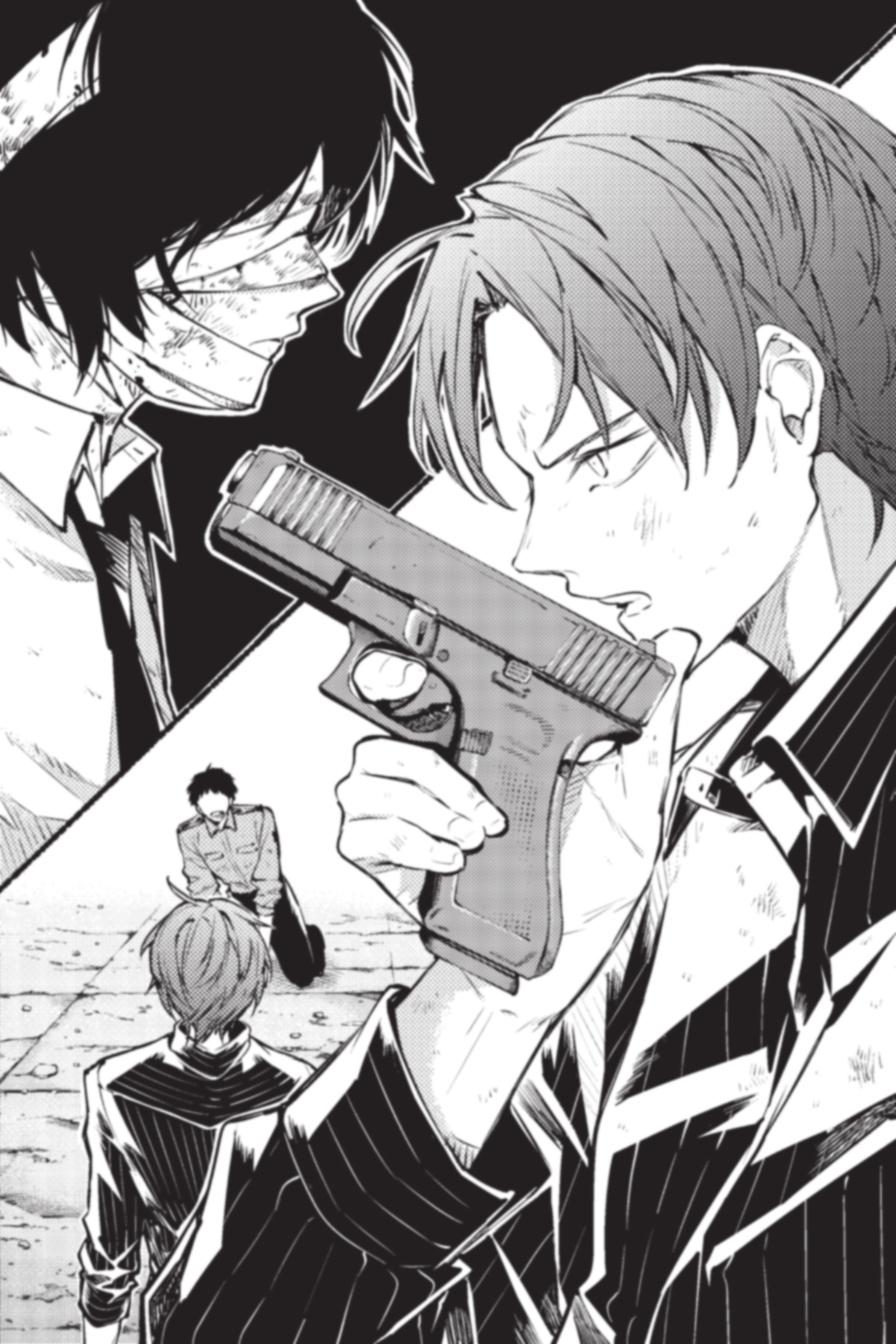
Naturally, the handgun offered no response; this dense, frigid object existed in silence. And yet it projected an unmistakable aura as I continued talking into it.
“The gun is loaded but with blanks, I’m guessing.”
I fired a single shot at the ceiling. The echo of gunfire followed, and a flash of light sliced through the darkness, but that was it. There was no bullet hole in the ceiling.
“That was quite a performance you pulled off. Was all of this planned from the start? Was collapsing in front of my house part of this scheme, too? Because if so, that’s pretty impressive. Anyway, I’ve told you everything about the painting, so it’s time for you to keep your end of the deal. Take your men and get out of here. Then again, you could still come after me, and we could have a good ole fight to the death if you want. Either works for me.”
I carefully inspected the pistol. Although I was no longer in the business, this used to be my tool of the trade. The balance of the gun’s weight was as familiar to me as my own fingers, but the grip was just slightly heavier than I remembered. Therefore, I pressed the release and let the magazine drop into my hand. That’s when I discovered that the polymer material on the side of the magazine near the grip screw had been scraped away in order to embed a small black rectangular device. Put simply, the gun had been bugged.
I raised the wiretapped magazine like a microphone and spoke into it.
“You’re going to sound three explosions within ten seconds and then disappear immediately afterward. If that doesn’t happen, then I’ll consider our negotiations a failure and go get you myself.”
I tossed the listening device aside and started counting to ten in my head. Right as I reached between eight and nine, consecutive impacts shook the underground bunker exactly three times. A moment later, the noise abruptly stopped, and the resulting silence was so profound that it made my ears hurt.
“We’re done here,” I said with a sigh as I began to leave. “I’m calling the police once I get out of this bunker—the real police. Every last one of you is going to be arrested, but they’ll at least patch you up and feed you, unlike the Mafia.”
“W-wait…,” the officer demanded. “Why did you…? You said it yourself. They weren’t going to kill you. You even knew that the gun I threatened you with wasn’t real. Did you do all that for me? For us? But why?”
The answer was simple, although I had no intention of telling him. Because what good would that do? I was empty. I was tired and wounded. I had been betrayed, and I had committed a betrayal.
“I’m thirsty,” I quietly muttered. “I’m going home.”
The officer said something, but I didn’t listen. I simply turned on my heel and walked away.
The soft glow of the gaslights illuminated the faces of the commuters passing through the ticket gates while a handful of city-bound stars flickered faintly in the filmlike veil of night.
Around the station, the night sky and city lights mingled as a backdrop to the silent procession of people making their way home. There were no explosions, no gunfire, no life-or-death negotiations. It was the calm, muted conclusion to a day that began and ended mechanically.
Osamu Dazai and Sakunosuke Oda were at that same station, albeit in different places. Oda, utterly exhausted and rubbing his aching back, was part of the crowd leaving the station while Dazai stood and watched from the shadows beyond the reach of the streetlights. His gaze was fixed on Oda’s figure as it dissolved into the night.
Oda walked along the station platform, exited through the ticket gate, and stepped out into the darkened city.
After escaping the underground bunker, Oda had crossed a mountain to reach a nearby village where he negotiated with a farmer for a ride back to the city in the man’s farming vehicle. From there, switching between buses and trains, he had finally made it back to the station closest to his home, just as night fully settled in.
Oda walked with a weary expression, kneading his shoulder and rolling his neck with an occasional soft crack. His clothes, wrinkled and smeared with mud, drew the occasional glance from passersby—fleeting, detached looks as if he were some strange foreign object—but no one said a thing. This was simply how people were in the city, after all.
As he exited the station and passed beneath the pale glow of the streetlamps, Oda slipped a cigarette between his lips, then patted his coat in search of matches.
“Here,” a voice suddenly called out from behind.
Oda turned around. Someone was in front of him, holding a match that had a small flickering flame.
He blinked, briefly confused, but then he leaned forward, bringing the cigarette in his mouth to the waiting flame. His eyes closed as he inhaled the smoke before slowly exhaling it into the cool night air. Finally, he lifted his gaze to the person before him.
“Hey,” the person said. “You look rough. Are you okay?”
It was Dazai. He stood there, half melted into the shadows of the night, his face marked by a faint, elusive smile.
“…I’m fine,” Oda replied, looking at the man through the smoke. “I tripped. That’s all.”
“These are your matches, right? I saw you drop them when you went through the ticket gate.”
Oda glanced at the matchbox in Dazai’s hand—white-topped with black sides and printed with a bar’s emblem. There was no doubt about it; this was the matchbox that Oda usually had on him.
“Yeah,” Oda murmured, his eyes settling on the matchbox.
He then studied the man before him in silence for a few moments.
“Have we met somewhere before?” Oda asked, his expression blank.
“No, I don’t believe so.”
Dazai offered a vague, unfazed smile. The bandages that had been covering his face were gone. Now a low-brimmed hunting cap concealed his eyes while a black inverness coat obscured both his build and any sign of injury. As for his voice, Oda had never heard Dazai speak before.
“All right,” Oda replied, taking the matchbox before turning his back to Dazai. “Thanks for the matches. Have a good night.”
But right as Oda had walked a few steps, Dazai called out to him from behind.
“You seem to have gotten yourself into quite a bit of trouble.”
Oda stopped and slowly turned around. “What?”
“Oh, it’s just that you seem exhausted, and you’re deathly pale… Plus, even though it’s dark and hard to see, it looks like there’s more than just dirt on your hands and clothes. That’s blood, isn’t it?”
Oda glanced at his own hands, realizing that he did still have blood on his wrists and cuffs from when he’d helped that fallen police officer sit up.
“Yeah, a lot happened today,” he said while sniffing his hands. “It’s not my blood, but yeah, I guess I got myself into a little trouble. Something important was stolen from me—something I’d been protecting for years.”
“In that case,” Dazai began with a weak grin, “then at least you can now stop worrying about it getting stolen.”
Oda stared at Dazai for a few moments as if searching for some kind of answer.
“I suppose,” Oda replied. “I won’t be able to forgive the man who stole it, though.”
Dazai nodded slowly and deeply as if to conceal his expression.
Meanwhile, Oda observed his face for a while, but he eventually turned his back to Dazai once more.
“Thanks for the matches. Take care.”
“If you ever find yourself in trouble…,” Dazai quickly added as Oda retreated, prompting Oda to turn around.
“What?”
“…then go to the Armed Detective Agency in Yokohama. They solve people’s problems and always get the job done. They’ve helped me out in the past, too.”
“Really?” Oda replied after pondering for a moment. “I’ll do that. Thanks for the advice. You’re a good person.”
Dazai’s expression shifted. He opened and closed his mouth as if he were struggling to breathe.
If he told Oda everything now, things would all go back to how they were. The two of them would head to the bar together and raise a toast, just like they had that one night.
“…Odasa—”
But just as Dazai was about to unconsciously utter that name, an express train roared past, slicing through the nighttime silence. Alternating streaks of darkness and light flashed across the street as the clattering of iron shattered the tranquility. Oda narrowed his eyes.
The train was long, its sound drawing out a feeling of sorrow. Dazai lowered his head, hiding his face, which was contorted in sadness. The prolonged roar of the train seemed to foreshadow how cruel the next six long years were going to be.
After the train passed, Oda looked back, intending to ask the young man to repeat what he had just said.
But no one was there.
A flicker of confusion crossed Oda’s eyes. He blinked and surveyed his surroundings. Then, as if to dismiss the thoughts on his mind, he shook his head and walked away, his expression tinged with resignation.
The cold, quiet night wind plunged through the void he had left behind. No words were spoken.
The Port Mafia held on to the painting for a year before returning it to the tycoon’s son. He kept it for several seasons more until he anonymously donated it to a certain museum.
This was how Dazai realized his goal. He’d managed to learn of the painting’s whereabouts from Oda without Oda ever knowing who he was or what he looked like, and by doing so, Dazai ensured that Oda would never again be targeted by any criminal organization.
Dazai’s second goal had been to make Oda despise the Port Mafia so much that he would never join them, thus preventing his eventual death. This objective had also been achieved when Oda ended up getting involved with the Armed Detective Agency instead. Two years later, he became a member.
Another two years would pass before Oda would face Dazai one last time—at the bar’s worn counter, accompanied by the sorrowful melody of a song about farewells.
There, Oda would point a gun at Dazai, and Dazai would utter his final good-bye.
The final good-bye of his life.
The Day I Took In Dazai Side Beast – End
Afterword
AFTERWORD
Long time no see. Kafka Asagiri here. Did you enjoy your time with Bungo Stray Dogs?
The Day I Took In Dazai is a compilation of two bonus stories: Side A, given to audiences during the first week’s release of the film Bungo Stray Dogs: Beast (hereafter, simply referred to as Beast) and Side B, distributed during the second week.
While publishing bonus mini-novels for moviegoers in this format is apparently quite difficult, both the Beans Bunko editions of Beast and Dazai, Chuuya, Age Fifteen were originally released as bonus gifts—just like this one. Therefore, in keeping with that precedent and the creative spirit of the Bungo Stray Dogs series, The Day I Took In Dazai has now been officially brought to print thanks to the efforts of many.
This is the story of how Dazai and Odasaku met—how a suicidal Dazai stumbled into the life of Odasaku, who was neither a Mafia member nor an assassin. Why are there two versions of seemingly the same tale, Side A and Side B, you might ask? That I encourage you to discover for yourself. Just keep in mind that this was a bonus story for the movie Beast, and then it should all make sense to you in the end.
Here’s a little anecdote. It was actually Takuya Igarashi, the director of the Bungo Stray Dogs anime, who proposed writing this story. I found myself a bit worried shortly before the release of the Beast film because I’d actually had to write a bonus story for when Bungo Stray Dogs: Dead Apple came out in theaters, and that bonus story was none other than Beast.
I remember having an extremely tough time… I ended up writing 190 pages, even though they’d only asked for fifty… But I did learn something from this spree of mine and that was to never write simply whatever I wanted to write. I needed to be professional and keep the story trimmed. I needed a professional, suitable tale—just the right one for the occasion.
Hold on, I thought as my pen stopped in place. I paused, looked around, and found myself at a loss. What even is “just the right” story?
The act of writing a novel is quite different from writing for other forms of media like manga, anime screenplays, or video games. They’re almost completely separate things. Novel writing is less about narrating events and more about turning a stream of emotions into concrete sentences. You have to create rhythm, flow, and feelings through a sequence of letters. If anything, this might be closer to composing music than to storytelling.
Therefore, the absolute first thing you must decide is what kind of emotion the novel will carry. There’s no way to start writing without doing that first. That is the one and only absolute rule. So again, what is a suitable story? This question weighed heavily upon me.
Just the right length, just the right kind of content as a bonus for fans, just the right kind of novel—in other words, I needed just the right kind of emotion. I rummaged through the drawers of my mind, searching for just the right emotion waiting to be drawn out, but all that was there was emptiness.
A professional storyteller is someone who has the skill to move the reader emotionally. People are more than willing to pay money when they find a chance to have their emotions stirred. That’s simply the kind of creatures that humans are. Therefore, writers manufacture and sell all sorts of emotions: fear, excitement, love, thought-provoking experiences. That’s the job—or at least, that’s what the job should be.
And yet, I found myself unable to move forward. A good story is one that moves emotions. I understand that. But then what kind of emotion should I utilize to make just the right story? How do I even search for an answer to that? Or rather, how have I been writing novels up until now? I stood there, rooted in place, my legs stiff, my knees unmoving, unable to take a single step forward.
Trying at least to pretend I was making progress, I started listening to music while walking around my neighborhood at night. But the breeze was merely pleasant, and I didn’t get any closer to the story I should write.
What am I going to do if I don’t reach that point? It felt like having something cold jabbed right into my back, but that was when it hit me. A story, or perhaps an emotion, isn’t something you go out searching for yourself. It isn’t something you have to force. It’s something that comes for you. It’s something that you have to patiently wait for. You have no choice but to sit up straight and keep humbly and earnestly waiting for the story to visit. But even once I understood that, the “suitable fifty-page story” didn’t come to me.
Eventually, a week passed, then two weeks. I waited for the story to visit, leaving the door to my heart open while I did other work. It was during that time that I had a remote meeting with the anime staff where I casually asked Director Igarashi, “Is there any kind of story you’d like to see?” He thought for a moment before answering, “I’d like to see the story of how Dazai and Odasaku met.” Bam! That was when it hit me. I could clearly hear the story burst through the door.
Two stories about Odasaku and the two Dazais. A story of how they met and a story of how they never met. A story of something gained and a story of something lost. If I could depict loss and gain like this side by side, then the emotional impact was going to double as it rose before me.
The rest was instantaneous. It wasn’t so much that I pushed forward but rather that I felt like I was being forcefully pulled along, and before I knew it, the story was complete.
I realized something profound during this period. It’s not that the writer finds the story. Instead, the story chooses the writer and comes barging in when it feels like the time is just right. A professional writer is simply someone who has the ability to hear that call.
And this is the most important part—there is no such thing as “just the right” emotion. There are no “suitable” emotions. After all, other people’s emotions are ultimately their own. Therefore, there’s no guarantee that a novel can suitably move the hearts of others. You can, however, move yourself emotionally. You understand exactly what kind of novel touches you and how. Therefore, you should write that. You have no other choice. I believe that is the true meaning of having a professional attitude.
Anyway, while slightly off topic, I was thinking about how “stories come barging in,” and it made me want to talk about Odasaku’s first-person narration.
Odasaku is a unique character. He doesn’t appear in the manga’s main story, and for me, he’s exclusively a character who exists within the novels. The stories where he appears as the narrator are Osamu Dazai and the Dark Era, Beast, and The Day I Took In Dazai, which are all novels. So in my mind, Odasaku doesn’t live in pictures but within the sentences of his first-person narration.
He’s a rather eccentric man, and even if you prepare a place for him to tell his story, he doesn’t start talking that easily. His way of thinking is quite unique. If I try to write his narration after writing other characters’ first-person points of view, I almost always stumble. Odasaku doesn’t speak; he simply sits there silently, and all I can do is say “What’s wrong?” and “Come on, talk” to the blank manuscript in front of me. But he’s a man who doesn’t speak unless it’s necessary. Sometimes, he doesn’t appear for days or even weeks. I can’t help but wonder why a character like him decided to appear before me…
But there’s only one thing I can do when he’s not talking: sit patiently with him and wait. And before long, he eventually begins to speak, one word at a time with a unique rhythm. His words have the power to cut out pieces of the world from a particular angle, creating special cross sections I’ve never seen before, always leaving me surprised.
Whenever he finishes telling his story, he departs to some dark and quiet place, perhaps somewhere like a bar. And there he sits wordlessly, monopolizing his own time, making it difficult to call him back out. I find him quite demanding, but in the end, that’s who Odasaku is, and that’s part of his charm, in my humble opinion.
At any rate, that’s how this story was written. He may return someday, and when that time comes, I will patiently listen to his voice again.
I need to mention that I received the generous support of countless people while writing this story and bringing it to print. So to the Bungo Stray Dogs: Beast Production Committee, the anime staff, the Young Ace editorial department, the Beans Bunko editorial department, and the many people involved in this book, thank you very much. Thanks to you all, I was able to publish yet another tale.
Until the next story, this was Kafka Asagiri.
Special Thanks
The Bungo Stray Dogs: Beast
Production Committee
This novel is the complete version of the bonus story “The Day I Took In Dazai, Side A” given to audiences during the first week of the 2022 live-action movie Bungo Stray Dogs: Beast’s theatrical release along with “The Day I Took In Dazai, Side B,” which was distributed during the second week.