
Table of Contents
Table of Contents Page
Copyrights and Credits
Chapter 1: The Sister Resents the World
Chapter 2: The Villainess Is Determined
Chapter 3: The Sister Has a Revelation
Chapter 4: The Villainess Is Chosen
Chapter 5: The Villainess and Crown Prince Exchange Glances
Chapter 6: The Cardinal Smirks
Chapter 7: The Villainess Receives Congratulations
Chapter 8: The Villainess Dresses in Men’s Clothes and Has a Meeting
Chapter 9: The Sister Solidifies Her Beliefs
Chapter 10: The Villainess Prays
Chapter 11: The Villainess Enjoys Her Stay
Chapter 12: The Sister Becomes the Saint
Chapter 13: The Villainess Bewitches
Chapter 14: The Duke’s Son Shows Appreciation for the Maid
Chapter 16: The Sister Is Canonized
Chapter 17: The Villainess Visits Her Hometown
Chapter 18: The Villainess Attends a Meeting
Chapter 19: The Villainess Visits the People
Chapter 20: The Local Director Receives Encouragement
Chapter 21: The Maid Consults the Duke’s Heir
Chapter 22: The Villainess Takes a Walk Around Town
Chapter 23: The Merchant Scrutinizes the Duke’s Son
Chapter 24: The Refugee Finds Salvation
Chapter 25: The Villainess Confronts a Monumental Problem
Chapter 26: The Villainess Attends the Saint’s Festival
Side Story: The Crown Prince Prays in the Dark
Side Story: The Marquess’s Daughter is Comforted by the Earl’s Daughter
Newsletter
Color Gallery


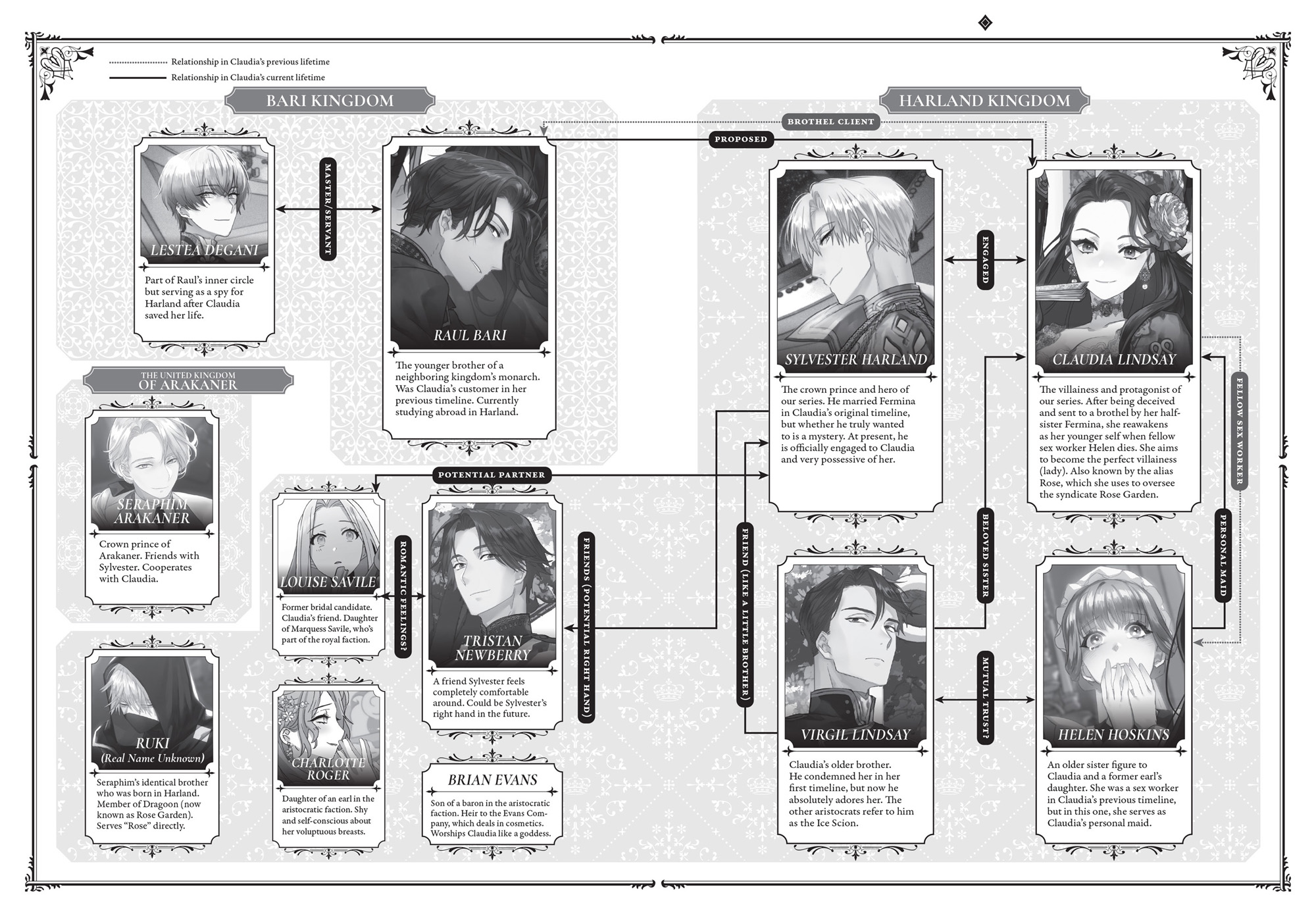
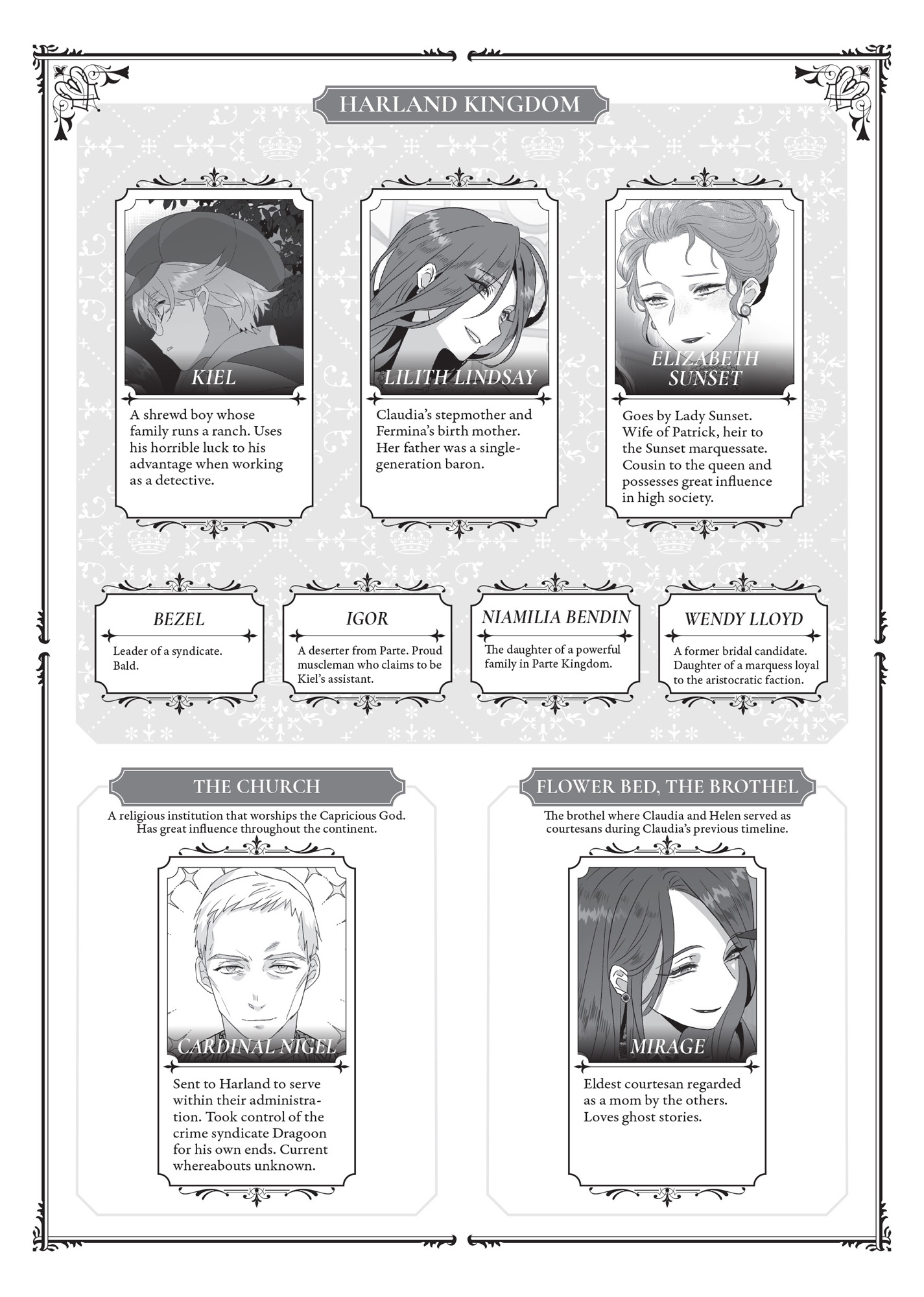
Cast of Characters


Chapter 1: The Sister Resents the World
Chapter 1:
The Sister Resents the World
OUTSIDE, THE RAIN WAS POURING. Humidity hung heavy in the darkness. The girl’s hand pressed against the cool stone walls around her. The onslaught sounded more like fist-sized hail pounding the building than raindrops pitter-pattering against it.
The world, she realized, had been unfair since the moment she was born.
Her fingers were an absolute mess. Where her skin had split, calluses formed. Her nails were chipped and resembled dangerous claws. If she wasn’t careful, she might scratch herself to the point of drawing blood.
She trembled, resentment swelling in her chest. What had she done to deserve this? Why did she have to live in this room akin to a prison cell? There was only one window, barely as wide as her face. It afforded her so little light that her room was bathed in darkness even when the sun was at its zenith. Nighttime was worse. Everything turned black as pitch, especially if she shuttered her window.
Her bed was stuffed full of hay, with a thin sheet drawn over it. She sat there, hugging her knees to her chest. Having a room to herself had sounded wonderful at first, but it was so empty as to be practically unfurnished—save for the bed and a sad, dinky desk and chair. The desk had no drawers, and its only adornment was a book of gospels. There were no writing utensils or stationery. She couldn’t pen a letter even if she so wished.
The worst part of the entire room was shoved away in one corner. She regarded that area with such open hostility, one would be forgiven for thinking it housed a dead body or something equally repulsive. The thing was a chamber pot—provided in case she had to do her business during the night, when she was forbidden from leaving her room. Should she need to empty it, she’d been instructed to toss the contents from her tiny window. She had spare water to rinse the pot out, but that did little to erase the emanating stench if she did, in fact, use it.
This is horrible. Unconscionable.
In this prison cell, her one salvation was that window. Though her room was always dark and dank, that window delivered to her a sliver of light when dawn came and sometimes a pleasant sea breeze. In her otherwise cold and unwelcoming room, the window was her only way of keeping track of the days and seasons.
The reason she’d been told to empty her chamber pot out her window was that the building sat on a cliff, with her room facing a dead drop to the ocean. Tossing her waste out there eliminated the extra cleanup.
If the girl grabbed her chair, dragged it over to the window, and crawled onto it, she could peek outside and see the ocean below. She could hear the wind from this high up, but not the lapping of waves against the shore. If she gazed out at the distant whitecaps, though, it brought her much-needed calm. Sometimes, she could even see boats dotting the horizon. She was on an island, so vessels sailed in and out of the harbor regularly.
During the day, the girl would picture the ocean and its waves to help anchor herself.
Oh, I just remembered. Earlier today, I could hear the seagulls. She closed her eyes and conjured the memory. The deep, bellowing cries of the gulls echoed in her mind. She could imagine them flying free with the rest of their flock.
It was all thanks to the window that she could enjoy such sights and sounds. That was precisely why she hadn’t touched her chamber pot once since her arrival. That was true even now as she clutched at her stomach, praying morning would come quickly. Cold sweat beaded on her skin, chilling her body. If she had to pick anything she was grateful for, maybe it was the fact that the pain came in waves. As long as she endured the peak, it would recede again for a time.
The building’s toilet faced the cliff as well, protruding slightly so its contents would empty into the sea below. It was right beside her room. If only she were allowed to leave, she could access it right away.
It’s crazy that they keep it locked.
No matter how much her superiors justified her confinement by saying it was dangerous at night, it wasn’t like they were camping in the wilderness. To which they would reason that there was no light by which she could see, so there was no need for her to step out of her room—all because they were trying to conserve their candles as much as possible.
Honestly, the more she thought about it, the more this place felt like a prison.
A fresh sheen of slick sweat covered her forehead. The moments of reprieve between waves of pain had grown shorter and shorter. She was near her limit.
Why? Why does it have to be like this?
Tears pricked at the corners of her eyes. This was excruciating. She reached out into the darkness, silently begging for someone to save her. Anybody. Even though she knew no one would. All this because she was born into unfortunate circumstances beyond her control, and nothing had gone right since.
Once again, she had to wonder: Why her?
All she did was pop into existence when her mother gave birth to her. Why did she have to bear such a heavy burden? Especially when there were people out there who were blessed from the moment they were born, never knowing the hardship or struggles of the less fortunate. She resented those people. And that resentment only grew and grew. The senior sister would point out that it was one of the girl’s shortcomings, but she wasn’t sure how else she was supposed to deal with her lot in life.
The girl’s stomach throbbed painfully. She was desperate for relief, but even that wasn’t something she could easily achieve. Why couldn’t even her tiniest, most trivial wish be granted?
Chapter 2: The Villainess Is Determined
Chapter 2:
The Villainess Is Determined
THE BRANCHES OUTSIDE WERE BARE, and thick clouds blotted out the noonday sun. The breath of the presiding gardener came out in a puff of misty white. It was the season when everyone was reluctant to move because of the cold.
By contrast, Claudia’s room was suffused with body heat, its floors covered with thick mats.
Elizabeth—also known as Lady Sunset, since she was still Patrick’s wife—was huffing and puffing on one of these mats. “I always thought,” she blurted out between gulps of air, “that your beauty came from your youth… Turns out this is your secret!”
The noblewoman’s dull gray hair was pinned back and away from her face, though a few strands clung to her sweaty forehead. The exercise had brought a healthy blush to her cheeks, giving her a sultry charm exclusive to a mature woman of her age. Even Claudia found her attention captured by the stray droplet of sweat rolling down Elizabeth’s neck. The woman’s normally narrowed eyes softened, the tense air around her relaxing.
Although Claudia was the one instructing Elizabeth, she still had to act with due consideration, given that the lady was old enough to be her mother. And more to the point, Elizabeth had agreed to support her in high society.
“All this exercise when your body isn’t used to it can be taxing, so be careful not to overexert yourself,” Claudia warned.
Elizabeth huffed bitterly at her. “I’m not that old.”
Overconfidence was the best way to injure oneself, but at the moment, Elizabeth didn’t seem too worn out. She confided that despite being in her mid-forties, she was conscious about her figure and had engaged in some exercise already.
“It’s only natural, given that I’m in a position of influence and have been since I was a child,” Elizabeth said primly. “I’ve always shown exemplary self-restraint, as one should.” Then, as if to make a counterpoint, she added, “So please don’t lump me in with the likes of Lady Thomas.”
The mention of Lady Thomas conjured her silhouette in Claudia’s mind. They had met at an evening party, and she remembered the countess being plump and curvy. There was considerable enmity between House Thomas and House Sunset; Elizabeth held that grudge close to heart as well.
“There was a time when being overweight was a symbol of wealth, but that’s outdated now. What matters most is whether one can make themselves look flattering in the dress they wear.”
Lilith, who was exercising with them, nodded in quick agreement. “You’re so wise, Elder Sister,” she said reverently.
Claudia had imparted her workout techniques—a combination of her own ideas and those shared with her by the courtesans at the brothel—to all those close to her. It was Lilith’s idea to have Elizabeth join them. They were allies now, Lilith reasoned, so if Elizabeth was willing, why not invite her?
It would be a stretch to claim that the Sunsets and Lindsays were close. After Elizabeth’s husband, the former Sunset heir, caused that troubling incident not so long ago, Elizabeth’s position had changed significantly. Her younger brother had been adopted into the main family and was now next in line to inherit the title and lands. Elizabeth had to yield her position as future marchioness to her brother’s wife. She had since moved out of the main house and into a detached villa with her young son.
Yet she’s managed to maintain the same level of power and influence in high society as before. Impressive but not unexpected, knowing Elizabeth.
Elizabeth was determined for her son—who was part of the main house thanks to his father’s line—to inherit the Sunsets’ lands and title after her brother. She left no room for her brother’s wife to usurp her in high society. The main house was intent on keeping its distance from the Lindsays, but since Elizabeth was no longer bound by their decisions, she could do as she liked. It benefited her to maintain an intimately close relationship with Claudia, the future crown princess. She was already close to the current queen. Having the favor of two generations in a row would solidify her position.
Lilith was doing her utmost to fulfill her duties as duchess, but she was struggling to meet the expectations of her peers and elders. This affected the Lindsays’ reputation. While Claudia’s father still held rank in parliament, he was powerless when it came to women’s parties. That was where Elizabeth came in.
I’m glad we’ve established a mutually beneficial relationship. If it had been unbalanced, they would’ve inevitably started scheming against one another. Claudia preferred not to waste unnecessary energy on such maneuvering.
Elizabeth would trust Claudia even more if these exercises helped her maintain or even improve her figure. It was these sorts of small, simple interactions that built upon one another and strengthened a relationship. Trivial though they seemed, they weren’t to be underestimated.
Claudia was lined up beside the other two women on a mat, demonstrating each technique. All this exercise had helped get her blood pumping and warm her up. It was precisely when one felt the least motivated to move that one should do so, she thought.
There was a calm, relaxing atmosphere between the women. Exercising together had given them a sense of unity.
“I have herb-infused water here for everyone,” Helen announced, offering them refreshments at the exact moment they were taking a break from their exertions. She had heated it to the perfect temperature so it wouldn’t chill them unnecessarily.
After taking a long drink, Elizabeth scrutinized Helen thoroughly. Her lips pulled down at the corners. “I shouldn’t be surprised that your mistress, with her lack of endearing qualities, has influenced you as well,” she said curtly.
It was typical of Elizabeth to throw such barbs. Claudia smiled, knowing she didn’t really mean it. “I’m proud to have her as my maid.”
“If you’re so proud, then you should find her a match quickly,” Elizabeth chided her. “Surely she’s old enough.”
Claudia froze. She hadn’t expected that to come up.
Elizabeth shook her head. “I understand your reluctance to part with her, since you favor her so much. But as her mistress, it’s your duty to find her a husband. She deserves that, considering how dedicated she is in serving you.”
Claudia wanted nothing more than for Helen to find happiness. That was a given. On the other hand, she prioritized Helen’s feelings over societal expectations, so she’d avoided broaching the subject. Discreetly, she glanced at her maid and tried to clock her expression, but Helen betrayed no emotion.
“You’re engaged now,” Elizabeth went on. “This is the perfect time to see it done. You two ought to marry at the same time, as it’ll spare you from searching for a wet nurse when the time comes.”
The mention of a wet nurse pulled the distant future over the horizon and into startling view. Knots twisted in Claudia’s stomach, though the rest of the room was unaware of her restlessness. Elizabeth was telling her that Helen should be the wet nurse for her future child. Assuming the two gave birth at around the same time, their children would grow up as close friends. Nothing would make Claudia happier.
“I had such dreams when I first got married, you know,” Elizabeth confided with a frown. “They never came to fruition.”
Elizabeth was the queen’s cousin, and they had long been close. If Claudia were in her position, she would have probably harbored the same wish to serve as her beloved cousin’s wet nurse. Unfortunately, it had taken Elizabeth much longer to get pregnant, so that dream went unfulfilled.
“This must be part of the Capricious God’s plan! You mustn’t give up the dream simply because there’s a slim chance of you two getting pregnant at the same time. With the Lindsays’ backing, Helen has nearly limitless options when it comes to aristocratic husbands.”
Although Helen was a commoner at this point, she could be adopted into an aristocratic family and thus be perfectly eligible to marry any bachelor of rank if she so wished. Typically, when one lost status and was no longer part of high society, it would disadvantage them, but Helen was the daughter of a former earl. She was still in touch with and had ties to many young ladies in high society. She wouldn’t have to fear being ostracized, at least. Few could contest her legitimacy with the Lindsays supporting her. Claudia’s father wasn’t a duke for nothing.
All this to say that Claudia understood where Elizabeth was coming from. Granted, there was nothing saying Helen had to marry an aristocrat if she didn’t want to.
“You’re right,” Claudia acquiesced. “I will consider her options.”
There was no reason to argue the point with Elizabeth and risk upsetting her. Better to smile and nod. What ultimately mattered was whatever made Helen happy.
Elizabeth stared blankly at Claudia’s smiling face as if something had triggered her memory. “Oh yes,” she drawled. “Excuse me for changing the topic so abruptly, but it seems the church plans to name a saint.”
“A saint? Don’t they only do that once every century?” Claudia asked.
The three of them had discussed saints before when they had tea together, she recalled. Elizabeth had declared that if there was to be a saint, it would have to be someone like Lilith.
“You might be summoned, Claudia.”
Lilith latched on to the sentiment. “You think they’ll appoint Claudia as a saint?!”
Elizabeth looked at her disapprovingly. “Calm yourself. It’s unbecoming of a lady to jump to conclusions like that. The church obviously wouldn’t select anyone outside its organization to become saint. You should know that.”
“Oh.” Lilith shrank back ruefully, shoulders slumping. “Yes, you’re absolutely right. My apologies.”
“Nonetheless, they won’t be summoning you without good reason. You ought to prepare yourself,” Elizabeth advised Claudia.
“Of course,” Claudia replied. “I appreciate the advance notice.”
Perhaps she should have anticipated Elizabeth’s impressive information network. The woman had a direct link to the queen, so she knew things well before anyone else. Or perhaps this stemmed from connections she had within the church itself.
Claudia’s only sources of information up to this point had been men, which naturally included Sylvester. What information one had access to was dependent on their rank and place in society. Having Elizabeth join Claudia’s own network was an incredible boon, for which she was most grateful. It helped her see that she was moving forward and making progress.
Until recently, Claudia had only ever really interacted with ladies her own age. Now she had the opportunity to make connections with all kinds of women, including those who were already married and far more mature than herself. Despite her conflicts and trials and tribulations, Claudia’s daily life was blessedly uneventful.
Lilith and Elizabeth soon excused themselves. Claudia’s maids flooded in to stow away the mats they had used. Claudia took the opportunity to pull Helen aside, inviting her to sit so she could address Elizabeth’s recommendation.
“As you know,” Claudia began, “we spoke about you getting married earlier. I want you to know that all I care about is your happiness.” It was her way of telling Helen not to feel pressured, and to get married when she felt ready.
The maid beamed back at her mistress, seeming to interpret the words correctly. “Of course. I already know that’s how you feel, Lady Claudia.” She hesitated. “But I must admit, hearing what Lady Sunset said did spark a new desire within me.”
Helen’s wishes had always been in the context of Claudia—at least until now, which had Claudia eager to hear it.
Helen straightened herself in her chair, her face solemn. Those deep amethyst eyes drew Claudia in, the depth of their color signifying the strength of Helen’s determination. “In the future, when you are blessed with a child, I want to be their wet nurse.”
“Oh, Helen!” Claudia gasped, touched. It warmed her heart to know Helen felt the same.
In both timelines, Helen had been nothing short of affectionate and loving toward Claudia. Their bond was stronger than blood. Claudia was surer of that now than ever before.
She didn’t have to think about her answer. “Naturally, I would love that. Yet there are no guarantees that we’ll be able to make that happen.”
Children were a blessing; they never came as expected. Elizabeth and the queen were prime examples. All they could do was pray for the Capricious God’s grace.
“True,” Helen acknowledged, “and it won’t even be a possibility if I don’t find a partner first.”
The two women smiled at one another, their joy almost palpable. The air between them was warm and welcoming, enveloping Claudia like a loving embrace.
Eventually, a wrinkle settled between Helen’s brows. “I’ve no idea what to do!” she fretted. “I have only ever focused on you, my lady. I don’t even know where to begin.”
Claudia giggled. “Something to look forward to, then.”
Helen cupped her hands to her cheeks with a pout. The way she worried was adorable.
Claudia was sorely tempted to inquire about Helen’s thoughts on Brian from the Evans Company, but she decided to wait until Helen brought it up herself.
“I’ll discuss it with my father,” she declared.
“Thank you, that will be most helpful,” said Helen. “I’ll let my parents know of my intentions as well.”
If Helen was intent on becoming Claudia’s wet nurse, she would need to marry a man of adequate rank. It would take time to find a good match, of course, and there were preparations to be made. Groundwork to be laid.
“No need to worry. You’ll have my full support!” Claudia assured her.
“Goodness, now my heart is racing.”
Helen was finally trying to take a step forward in pursuit of her own desires.
Chapter 3: The Sister Has a Revelation
Chapter 3:
The Sister Has a Revelation
“WHAT KIND OF IRONY IS THIS?” the girl blurted out as she and her peers busied themselves preparing numerous dishes.
Thankfully, she’d made it to dawn the other day without bursting. She’d reached the toilet instead of resorting to the chamber pot. That relief had been momentary, however. As soon as she heard about her schedule at the morning assembly, her face was set in a permanent scowl. And she wouldn’t soon forget it.
The church was going to distribute food to the local poor. It required immense preparation for all the dishes beforehand. They had to trek out to the fields, harvest tons of potatoes, and boil them, all without being able to enjoy any of the dishes themselves. The kitchen had been bustling with activity since sunrise. Her hands were raw from all the washing, and sweat dappled her brow.
“I mean, there’s no way this monastery has much to spare,” she muttered under her breath.
That much was obvious by how sparse the monastery halls were. If not for the sign, people might rightfully mistake the place for a storehouse. This particular monastery didn’t rely on donations, instead receiving regular supplies from the mainland. That was in part due to how difficult life was on the island.
The girl threw her head back, gazing up at the clear blue sky. “But they’re lucky,” she said to herself. “At least they have freedom.”
Unfortunate as the people here were, they could go to the bathroom whenever they wished. If it was cold, they had family to snuggle with. After how long the girl had spent feeling isolated in that cell they called a room, she wasn’t sure why the church had to provide anything to the locals.
She sighed.
“Sister!” called a bright, cheerful voice from behind. This other girl was about the same age, with reddish-brown hair flowing down to her waist. Given enough care, her hair would be beautiful. Alas, it was terribly damaged, which gave it the texture of hay. “The senior sister told us to bring in more water.”
“What?! But we already did that,” complained the girl.
The only faithful at the monastery were women. Rather than use their names, they referred to each other by one simple title: sister. Everyone at the monastery was equal to everyone else, thus there was no need for individual names. That was what the girl had been told, anyway. There were other peculiar teachings here that weren’t part of the scripture.
After the girl expressed her displeasure, the red-haired sister laughed. The girl wasn’t sure what was so funny, but the redhead was always like this. She almost seemed to enjoy her life at the monastery.
“I’ll be doing it with you, so we’ll get it over with quickly,” the redhead said.
“You don’t have to pretend to be such a goody two-shoes.”
“I’m not, I promise.”
It was considerable labor, using the well’s pulley system to lower the bucket, retrieve the water, and hoist it back up again. But the red-haired sister made no open complaints about it.
Though the skies were clear, the breeze was nippy. If the girl had her way, she would’ve preferred not to mess with water at all. If she wasted too much time slouching, however, she knew the senior sister would give her an earful. She plucked together dregs of motivation she didn’t really have and picked her way to the well.
The senior sister was a woman over thirty, with dull blonde hair cut to her shoulders. The girl had grown used to the older woman by this point, but when she first arrived, she could’ve sworn the senior sister had a penchant for tormenting others. And sadly, the girl had frequently found herself a target back then. There were several senior sisters, but this one in particular seemed to be in charge of the girl, for she was almost always within eyesight.
“Why do I have to do this kinda crap?!” cried another girl.
“Quiet! How can you call yourself a sister with that attitude?!”
Frankly, the girl agreed with the first voice and completely understood where that other girl was coming from. She was a new addition to their monastery. Like her, the girl had frequently lashed out at the senior sister in charge of her when she first came. Once she realized she’d receive a harsh reprimand for talking back, she learned to mutter her complaints out of the senior sister’s earshot.
Of the other girls her age, the red-haired sister walking beside her was adept at staying in the senior sisters’ good graces.
“Good thing it’s not raining today,” the redhead said. “I actually like doing meal distribution.”
The girl rolled her eyes. “I told you, no need to try winning brownie points with me by saying stuff like that.”
“I’m serious! It’s our only opportunity to be around regular people. Plus, they’re grateful for the food.”
“It doesn’t do any good to be around them,” the girl insisted glumly.
The locals were victims of poor circumstances themselves. They would have to be to gather around and consume the bland, tasteless meals the church provided free of charge. But they had nothing to offer any of the sisters. Still, the red-haired girl was right. It was a unique opportunity to interact with the outside world, as their monastery didn’t have a chapel or offer church services. There were monasteries like that out there, to be sure, but not this one. There were no opportunities to interact with regular people besides these occasional trips to serve meals to the downtrodden. The redhead very much delighted in this act, it seemed.
“It so does. Last time we went out, one of them gave me a flower crown.”
“Using weeds they found on the side of the road, right?” The girl had seen their dirty hands, as well as the crown. It would have been a wild stretch to call it pretty. Some of the broken stems had been oozing. She wouldn’t have been pleased whatsoever to receive such a thing, and that was putting it nicely. Yet for whatever reason, the red-haired girl had treated it like an expensive treasure.
I don’t understand her.
She and the red-haired girl looked almost the same. They wore the same plain dress as part of their uniform. Their nails were torn and jagged. They had to wipe down their bodies with warm water to clean themselves, having no access to a proper bath. Their hair was thoroughly damaged. They had to do everything themselves. Meal service ran on a turn-based system where everyone would eventually have to cook for their peers. Then there was cleaning, laundry, and field work. By the end of each day, the girl was plumb exhausted.
In spite of these hardships, the red-haired girl wore a great big smile on her face.
Is it awful of me that I can’t relate at all? There was no one to answer that question for her.
As the days passed, her spirit and body frayed. All she knew was that she’d never be able to conduct herself with the level of grace the red-haired girl showed.
***
“Ooh! Thank you, sisters.”
“Please keep moving,” the girl urged. “The next person in line is waiting.”
She was anxious for the old man to move on, but he wouldn’t. She was trying to hand bowls of food out to each person in line. They’d made as much as they could, but they would eventually run out. Those who wanted to partake had been instructed to line up. When the food ran out, service ended. The girl couldn’t wait for this to be over.
“Thank you for always doing this for us.”
The girl sucked in an annoyed breath as the old man grasped her hand. Her face almost wrinkled in dismay. There was no telling where this man’s hands had been. The warmth of his touch was discomforting, and her arms broke out in goosebumps. It took everything in her not to smack his hand away.
And this is why I hate doing meal service.
It was bad enough having to run around, attending to the intense preparations this form of charity required. But she also disliked having to interact with the poor. Worse yet, there was a mountain of cleanup waiting for them when they returned to the monastery.
The girl was already worn thin from participating in these meal services and dealing with these people. It threatened to suck out what little life she had left.
I’m not like that red-haired girl! She couldn’t smile her way through any of this. Nor could she find anything enjoyable about this life. Honestly, she wanted to run away, but she knew the senior sister would never give her a chance to.
Let go already!
The old man clutched her hand, his fingers wandering over her skin as if savoring the feel, reminiscing about his own youth. It was repulsive. The senior sister normally stepped in if anything untoward happened, but apparently, she had deemed this sort of interaction tolerable.
Wonderful. This is the one time she’s willing to let something slide!
At long last, the man released her and the next person in line moved up. The indignation within her refused to abate, however.
It wasn’t until their trip was over and they’d returned to the monastery that she could break away, making a mad run for the well. She shoved the bucket down and reached for the rope, hoisting it back up once it was full. It was terribly heavy, and the rope bit into her skin. She had no choice but to keep going, though. She couldn’t wash her hands without the water. Her fingers had grown numb from the cold, but the girl forced them to keep gripping the rope and heaving the bucket up.
She was desperate to remove the grime of the old man’s hands from her own. She wanted to wash it all away—his touch, the memory of it, everything. The water would be bitterly cold, but she preferred that. She didn’t want to remember the disgusting warmth of that man’s hands on hers.
“Phew…”
At last, the bucket was close enough for her to grab. She was careful not to spill any of the precious water inside. She had plenty of experience under her belt at this point, having failed so many times before. Tamping down her sense of urgency, she safely set the bucket on the ground. Only then did she realize she’d been holding her breath; she exhaled, setting it free. All that was left now was to finally wash her hands.
The water was so clean and clear. Tears began rolling down her cheeks.
She choked back the sobs, her voice leaking past her lips. “Ngh…”
The girl couldn’t count how many tough times she’d faced before the monastery. She never got used to it, no matter how much time passed.
The freezing water seeped into her worn, calloused skin. Her vision blurred. Even if the cold washed away the memory, it couldn’t heal her heart. Still, it was better than nothing. She dipped her hands over and over, scrubbing furiously. It wasn’t until she’d used all the water in the bucket that she finally relaxed.
“I’m so sick of this,” she grumbled under her breath.
Her desperation to run away swelled. She didn’t want to spend one more second in the monastery.
I want to be free.
She drew a map in her mind. There was a stone wall lining the perimeter of the monastery’s grounds. It was twice as tall as any person, which meant it wouldn’t be easy to climb. The only exit was the front gate. Since they’d finished their brief excursion into the town, however, it was now sealed shut and locked. The only way to escape through it would be to snag the key.
But the senior sister always has it on her. It was as if they were trying to keep all the girls under lock and key.
“And seriously, what did I do to deserve that?”
Her mind and body were in tatters. A fresh wave of tears streamed down her cheeks, and she scrubbed them with her sleeve. The girl resolved to find some way to escape, no matter what.
She glanced up at the nearest stretch of wall. There were no footholds, making it nearly impossible to scale. Even assuming she managed, she would have no way of lowering herself once she got up.
I wonder if the wall has any damage I could exploit.
There were only women at their monastery, so they had to attend to any building repairs themselves when the need arose. The senior sisters were used to that, but they were still amateurs. The girl very much doubted they checked the entire wall thoroughly. With the many years of strong rains and winds the wall had been exposed to, there had to be a weak spot somewhere. If she were lucky, she could widen it enough to slip through. She was petite, and since moving to the monastery, she’d grown even thinner than she’d already been. She didn’t need a huge gap.
The girl ran her fingers along the wall, feeling for any spot that might collapse with the right encouragement. When she discovered a depression, she pushed her weight against it. She was disappointed to find that it didn’t budge. Still, it was too early to give up. She told herself that if she looked for a bit longer, she could find a way. She had all the time in the world, so it didn’t matter whether it took a day, a week, or even a month.
The other sisters don’t come over here often, she realized as she dipped into the shadows of the monastery, following the wall.
To her delight, she discovered exactly what she was looking for: a defect in the wall where it was beginning to crumble. The problem was only surface level at this point, but the wall was most definitely weak there. She clung to the spot, trying to grasp the extent of the damage.
I did it! This is it!
It was a hole that must have developed in the wall, which the sisters had filled in with many small stones. Those stones had since fallen free, leaving an opening. Eager to see even a little bit of the outside world, she leaned down and peered through.
I found my way out! No sooner had that thought crossed her mind than, much to her shock and dismay, she found herself gazing straight into another person’s eye.
“Eek!” she cried, reeling back.
Whoever was on the other side seemed equally surprised because they cried out as well. They weren’t alone either. There were several people on the other side, and judging by their voices, they were all men.
“Did you see a sister?”
“Hey, let me get a glimpse too!”
“Was she wearing anything? Or was she naked?”
“Was she young?!”
Their crude commentary made her hair stand on end. The girl scrambled away from the area as fast as her legs would carry her.
Wh-what the hell was that?! Peeping Toms?!
How long had those men been spying on them? How long had they been gossiping about her and the other sisters? It was terrifying. Creepy. Her belly roiled with deep disgust. Bile rose in her throat, and she had to swallow it down, slapping a hand over her mouth.
I need to hurry—back to where other people are!
Desperate to find someone, she ran so fast that she nearly tripped over her own feet. When at last she spotted the senior sister in charge of her, she slammed full force into the woman, clinging to her. She was overcome with fear. She didn’t even care that this was the woman who nagged her ceaselessly; the girl just wanted someone, anyone, to save her.
“What’s the matter with you?” demanded the senior sister.
“O-o-over there,” the girl stammered. “The wall…!” She jabbed a trembling finger in the proper direction. There were tears in her eyes as she explained that she’d accidentally found a hole in the wall through which men had been leering at them.
The senior sister sighed. “Again? I thought we’d gotten rid of all the holes by now. Well, I’ll have this one fixed up by tomorrow.”
“A-again?” the girl echoed in surprise.
“When you gather this many women in one place, these sorts of things can happen, especially because you and many of the other sisters are quite young,” explained the senior sister with an unsettling matter-of-factness. The girl could hardly believe her nonchalance. “If you’ve learned your lesson, don’t go wandering off alone anymore. It’s much safer to keep company with you.”
Speechless, the girl lowered her head.
The senior sister sighed again and hollered for one of the other sisters. “Take her to her room and have her rest.”
“Yes, ma’am.” It was the redhead. She peered into the girl’s face. “Hey, are you okay?” Concerned, she looped an arm around the girl’s back as well as she guided her toward her room. “Did something scary happen? Oh, but if it did, you needn’t worry. We’re safe here.”
“Safe…” the girl murmured, thoughtful.
“Yes. We have these tall walls around us and plenty of food to eat. If we aren’t careful of the birds and bugs, we might lose some of our crops, but we don’t have to worry about any large predators coming for us. Not many places are safer than this.”
The girl glanced up at the red-haired sister, who was smiling like always. The light filtering in through a small window in the corridor poured over her. There was something almost divine about it, as if there was an answer in her smile that hadn’t been there before.
Maybe I’ve had it all wrong, the girl thought.
Upon entering her room, the girl sat on her bed. She almost collapsed, so strong was the relief washing over her. “The people outside can’t get in here.”
The redhead was right. The front gate was securely locked, and they were surrounded by high walls. Sure, those men could peep through that tiny hole, but they couldn’t break in. And the senior sister had assured her that the hole would be sealed tomorrow.
I always thought I was trapped inside a cage. This had been a cell to her, a prison she couldn’t escape from. But what if its purpose wasn’t to keep her in but to protect her from the outside? I thought I knew everything, but maybe I don’t know anything at all.
She’d only focused on her own point of view without reflecting on the matter.
The girl stared at the redhead standing in front of her. They were close in age, but as she thought about it, she realized she knew nothing about the red-haired girl. Everyone at the monastery had a good reason for coming. She was no different, though she wasn’t keen on sharing her story. That was why she hadn’t bothered to ask anyone else’s.
“I don’t even know what your favorite food is,” she blurted out.
The red-haired sister giggled. “Hee hee, what’s gotten into you? But since you seem curious, I like delicious, freshly harvested vegetables!”
“You like veggies and not fruits, huh?”
“Fruits are so expensive, you know? I feel way too guilty eating them, like I’m committing a sin.”
The girl cocked her head. “A sin?” She didn’t see why anyone should feel that level of guilt for eating fruit, of all things.
The red-haired sister seemed to realize how silly it must have sounded. She hurriedly added, “I had a little brother and sister on the outside. They’d never eaten fruit before, so…it feels wrong for me to enjoy it.”
She still had a smile on her face, but it was more strained than the girl had ever noticed before. It struck the girl then that this redhead had referred to her siblings in the past tense. That, coupled with the fact that the red-haired girl had arrived at the monastery all by herself, suggested her siblings had already passed away.
See? I really don’t know anything. Her heart ached as she came to terms with her own ignorance. The girl had spent plenty of time with this red-haired sister, but she’d never heard her story. Instead, she’d focused on how little she could relate to the red-haired sister’s joy when doing meal service for the town. It never dawned on her that maybe she couldn’t relate because she knew nothing about the other girl.
Her mind—which she now realized she’d used so very little of—sparked as it lurched into action. At long, long last, the wheels were spinning.
Chapter 4: The Villainess Is Chosen
Chapter 4:
The Villainess Is Chosen
CLAUDIA FOUND HERSELF in one of the royal castle’s drawing rooms. She hadn’t had much reason to frequent them after being granted her own personal quarters.
The windows offered a glimpse out into the royal gardens, whose verdant greenery was bathed in crisp morning sunlight. The chill crept into the room through small cracks, but it was hardly noticeable with the warmth emanating from the crackling fireplace.
Claudia and Sylvester sat on one sofa, and across the table was another sofa occupied by Cardinal Nigel’s replacement: Cardinal Gique.
Gique’s eyes were small slivers, nearly hidden behind his long white lashes. He slowly opened his mouth and said, “I greatly appreciate your willingness to answer my summons this early in the morning.”
The man kept his head down most of the time, taking a lax and unhurried approach to his duties. Children who met him regarded him affectionately, like a grandfather.
It didn’t bother Gique that he’d been ousted from his rightful position at the castle. He spent his time in Harland like an old man ready for retirement, which was why Claudia didn’t feel the need to keep up her guard around him. Elizabeth’s intel had been right on the money: The church had sent Claudia a direct summons, hence their meeting. As for why it was taking place at the castle, that was because the topic at hand inevitably concerned the whole kingdom.
“As was explained in the correspondence you received, the church is preparing to name a new saint,” said Gique.
The saint was a symbol of the church who lent emotional support to the believers. Her rank was on par with a cardinal, though she wasn’t tied down by the same duties. Her primary role was to go on pilgrimages to countries loyal to the church so that she could unite and uplift the people. Historically, the church chose a saint about once every century, appointing the woman most fit for the position.
Claudia eyed her beautiful, silver-haired fiancé in her periphery. As someone deeply involved in national politics, Sylvester couldn’t ignore the church’s vast influence. That was especially true when the church actively stuck its nose in their business. Sylvester kept a calm smile on his face, but she was sure his mind was hard at work digesting everything as it happened.
There was nothing else for Claudia to do but nod along to the cardinal’s explanation.
Her engagement to Sylvester was official now. In preparation for their marriage, she had been undergoing princess training. This included attending tea parties held only for the married women of high society, where she’d managed to make allies with several women—Elizabeth chief among them. She had only six more months of training left.
Once Claudia became crown princess, she would be more involved in diplomatic affairs. The interests of Harland came before anything else. That included continued peace for her citizens. And to that end, she needed to keep a broad perspective.
She carefully followed each of the words that came from the cardinal’s mouth.
“When we name a saint, we host the Saint’s Festival to celebrate her. We’re planning to hold it in early spring. Her Eminence will make her pilgrimage, praying for peace and prosperity for all. The church would like Harland to be the first nation she visits.”
“An incredible honor, and one we’d be thrilled to announce to our people,” Sylvester said with a smile, no trace of malice on his face.
There were many nations that made the church’s doctrine their official religion, and Harland was no exception. In graciously choosing them to be first in line, the church was obviously expressing how important the kingdom was. Perhaps this was their way of trying to mend the rift that had formed in the wake of Cardinal Nigel’s scandal.
Although it’s equally possible they chose us because we donate the most money, Claudia thought. Politics were always involved when it came to such matters. Where there were people, there were inevitably power struggles.
If the festival was to be held in Harland at the start of spring, that left them only three or four months to prepare.
“With that in mind,” Gique continued, “I’m sure the church will eventually want to consult Harland about crowd control, among other more minor details. Yet this isn’t why I called you here.” There was a pregnant pause as he fixed his gaze on Claudia. “Lady Claudia, we would like you to serve as an A Priori—an assistant to the saint.”
“I humbly accept this most honorable appointment,” Claudia responded with a quick bow of her head.
She wasn’t the least bit surprised. Their request had been written in the letter they’d sent. While she wasn’t entirely confident that she was right for the position, she had no reason to refuse. Her official appointment to the role would take place in a ceremony on the first day of the Saint’s Festival.
“Knowing you, I’m sure you will make a wonderful assistant,” Gique assured her with a hearty laugh.
It was a role of honor with no difficult duties involved. Mostly. The assistant was always a woman from the upcoming generation who also represented her country. Her selection was the church’s official seal of approval. This was nothing short of a great opportunity for Claudia; the church was all but declaring that it recognized her as the future crown princess. Naturally, however, this honor didn’t come without any strings attached.
Gique set a document on the table. “Pursuant to your role as assistant, you will need to begin preparing for the festival starting tomorrow. That means you must remain pure until the festival is over. This document here contains everything you’ll need to know about those preparations, including how to purify yourself.”
“Thank you. All this information is most appreciated.”
From what she could suss out, the document had an extensive list of rules she would be required to follow. The festival itself lasted a week, but the preparations were long and arduous.
I suppose I should count my blessings that they don’t take a full year to prepare. The event itself was incredibly important to the church, so they’d probably been working on this for at least a year.
Once their discussion finished, Gique lifted himself from the sofa. Claudia and Sylvester stood out of respect as he started toward the door.
“The rules shouldn’t be too stifling for you, so no need to worry. You won’t have to change your lifestyle too much,” the cardinal called over his shoulder. Then he paused. “Oh, I nearly forgot. I realize you’re engaged to His Highness now, but one of the stipulations is that you must make no contact with men prior to the festival. Do be careful not to break even a single rule.”
Having dropped that startling revelation, the man left.
Sylvester immediately snatched the document off the table.
Chapter 5: The Villainess and Crown Prince Exchange Glances
Chapter 5:
The Villainess and Crown Prince Exchange Glances
ONCE GIQUE WAS GONE, Claudia and Sylvester returned to their seats. The chill creeping in was beginning to dominate the warmth of the fireplace in certain corners of the room.
Sylvester’s brows pinched as he studied the document. “It politely explains here that even men in your own family are prohibited from touching you,” he said bitterly.
“Interesting. I’ll probably be spending most of that time at my family estate, so I will need to be cautious,” she said. Claudia often embraced her brother, Virgil, in greeting. She leaned over to peer at the list in Sylvester’s hands.
“You won’t be able to see properly that way.” His strong, muscular arms wrapped around her, lifting her like a bride and setting her on his lap.
“Eep!”
In an instant, surprise and embarrassment coursed through Claudia. Her mind went blank. My rear end is on his thighs! And said thighs, she discovered, were harder and more solid than the sofa cushions had been. The longer she sat on him, the more distinct the sensations. His legs were muscular, of course, but they were soft in places too.
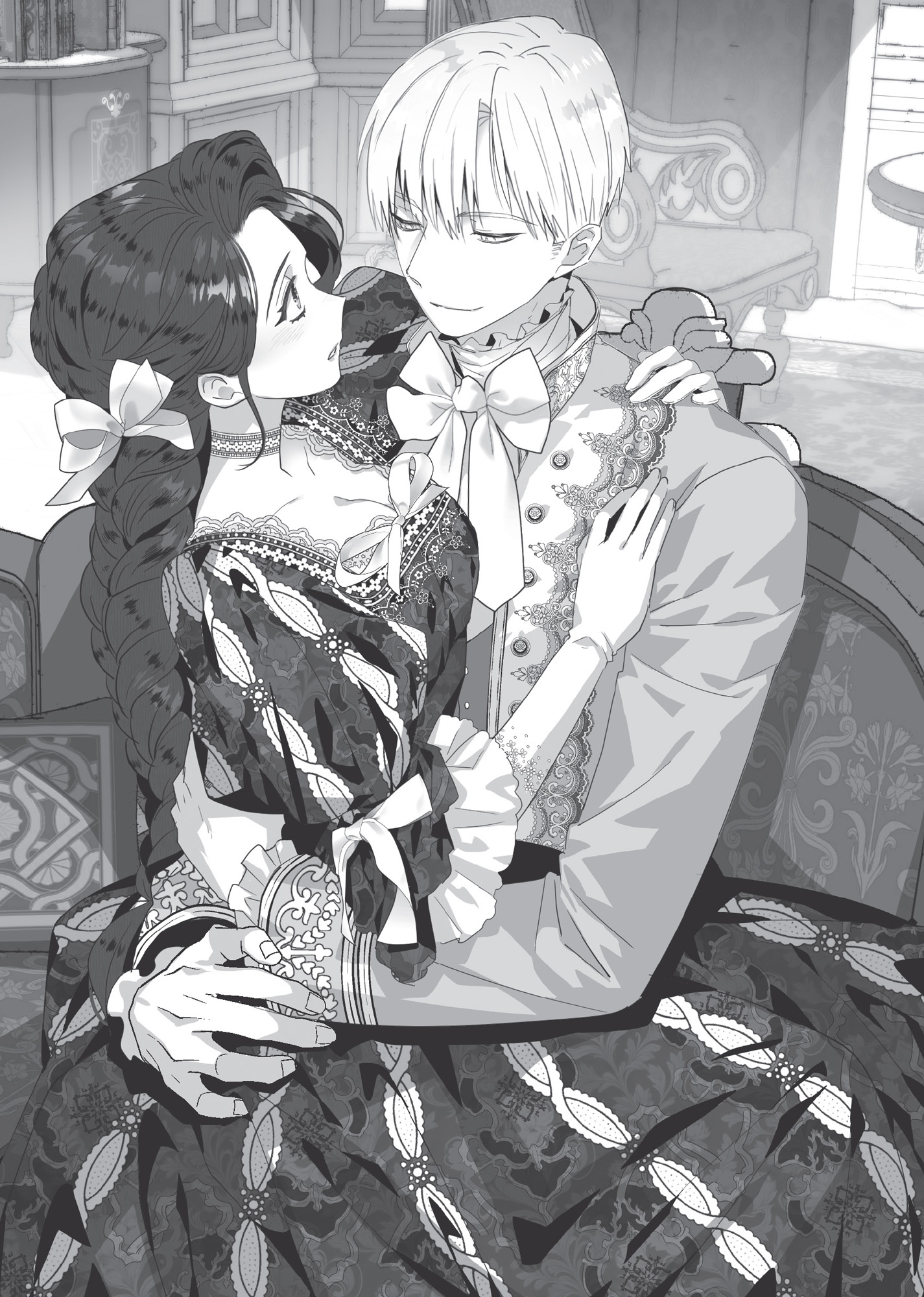
Her world spun. Were you really a courtesan in your past life? She was starting to doubt herself. For whatever reason, when it comes to Syl, I just can’t keep my cool.
Claudia’s arms had instinctively shot around his neck so she could keep her balance, which in turn meant her breasts were pressing up against him.
I’m not too heavy, am I? But there was no point in asking aloud. She knew he wouldn’t give her a straight answer. Cautiously, she peered up at him through her lashes to gauge his reaction. Her eyes met his golden ones, his cheeks slightly flushed.
“May I push you down on this sofa and have my way with you?” he asked in a husky voice.
“Of course you may not.”
“Why is it that you always drive me up a wall?”
It was a rhetorical question, she knew, but she answered anyway. “May I remind you that it’s a problem of your own making?”
This probably wasn’t how he’d pictured it. Sylvester must have intended to gently pull her onto his lap so they could better study the document Gique left behind. That hadn’t been the outcome, though. They were too intimately aware of each other’s bodies and the heat building between them.
Sylvester let out a long, pained sigh, as if trying to banish some of the heat. He adjusted his posture.
Determined, Claudia ignored the suggestiveness of the situation in favor of reading the rest of the document. She figured that as her eyes chased the words on the page, she would grow less conscious of the man holding her.
To purify the body, one is expected to adhere to the following rules:
1. Physical contact with all men, family included, is prohibited.
2. Consumption of meat is prohibited.
3. Periodic consumption of special herbal tea to purify the body is required.
4. Dedicated worship at the cathedral is required.
None of these are too terribly difficult, Claudia thought. She wasn’t overly pleased about the stipulation that she have no contact with the opposite sex, but it wasn’t beyond her capabilities. While she wasn’t allowed to touch Sylvester (or Virgil), she could meet and speak with them. The only issue is that as soon as one is prohibited from a thing, human nature dictates that one will feel even more compelled toward it. People tended not to be too conscious of something until it was pointed out to them (or in this case, prohibited)—making it the only thing one could focus on.
“It would be better not to have a saint at all,” Sylvester declared.
“Syl, that’s inappropriate,” Claudia admonished him with a light tap to his shoulder. She knew that it was only an idle complaint he’d made out of his desire for her, though his expression had darkened considerably.
The cardinal had informed them that the event would be held in early spring, but he’d given no concrete date. The church probably wanted to time its announcement with the sprouting of new growth. If the event was postponed even further, it would be more than four months of adhering to these rules. But that wasn’t the only thing bothering Sylvester.
“Why must they push your princess training back as well?” he grumbled.
Since Claudia was being appointed A Priori and would be preoccupied with preparations to fulfill that role, she was temporarily excused from continuing her princess training. That training, however, was only being put on hold—which had the domino effect of delaying their wedding.
“Lord Thomas and his wife must be celebrating.”
Claudia smiled bitterly at her beloved’s comment. The Thomases were hostile toward the Lindsays, and they took whatever opportunity available to thwart their rivals. It was possible that they would capitalize on this new development to plot against her.
“Perhaps,” she allowed, “but they’ll find it more difficult than ever to stand in my way.”
“True. After how well you performed at their evening party, Lady Thomas has found it more difficult to take measures against you.”
At the evening party in question, which they’d both been invited to, Claudia had successfully pulled one over on Lady Thomas—thanks in no small part to Lady Savile and some other married noblewomen. Lady Thomas would have to be more careful of her conduct at future high-society events. On top of that, Claudia would soon have the church’s official seal of approval, encouraging even more aristocratic ladies to side with her. The political climate was looking none too promising for the countess.
Claudia was doing her best not to shift her weight, lest she draw her awareness back to how she was perched on Sylvester’s thighs.
Sitting in someone’s lap reminds me of my brothel days. Clients often wanted her on their laps while they chatted. Actually, there were even a select few who wanted to get on their hands and knees, declaring they’d be her chair. Everyone had their own tastes (and fetishes). She drove such errant thoughts away; they had no place in what was supposed to be a serious conversation.
“I assume the reason they’re naming a saint now is because of the conflict zone?” Claudia said with a quirk of her brows.
“That’s my thought. Since the issues with Parte, the situation in the conflict zone has only continued to deteriorate.”
War had almost broken out between Harland and Parte after the latter sent Nina to become a bridal candidate. Claudia and Sylvester ultimately learned this was a ploy by Nigel and managed to dodge what would have been a crisis, but the western conflict zone continued to wage war on the other side of Parte.
“The church is trying to suppress the hostilities, but they haven’t made noticeable progress yet,” Sylvester said. “At this rate, it may damage the dignity of the church if they cannot produce results—which is why they probably hope they can score a victory in naming a saint.”
“Depending on how you look at it, this could be their secret weapon for winning over the people,” Claudia said thoughtfully.
Originally, a woman would appear with saintly qualities and thus the church would give her an official title. In more recent years, the practice had taken on political significance, and the sequence had flipped. The fact that there was so much planning going into this signified an ulterior motive.
Claudia had called this the church’s “secret weapon” because naming a saint was such a rare occasion. If they did it too often, it would have less significance; by only having one every century, they gave the position more impact. In truth, if there was a woman who fit the criteria, there was no need to wait a century each time.
But the church could be right. Perhaps it really is that rare for a deserving woman to appear.
It would be easier to know for certain if all candidates for saint had some special power that distinguished them from their peers. Alas, there was no such thing. As long as the woman selected could be a symbol for the church, that was all that mattered. Otherwise, the criteria weren’t specific, which sadly left room for misuse of power.
“I can only wish that the saint will be a ray of hope for the people,” Claudia said.
The ongoing war had given rise to vast numbers of refugees. Whatever the church’s intention in appointing a saint, she wouldn’t complain as long as it helped those affected.
“I feel the same,” Sylvester replied. “Now that it’s looking increasingly likely we’ll be welcoming some of those refugees into our borders, I would like this Saint’s Festival to help soothe people’s hearts.”
The war had lasted so long and been so intense that Harland was beginning to feel the consequences as well.
Chapter 6: The Cardinal Smirks
Chapter 6:
The Cardinal Smirks
NIGEL WAS IN A MEETING with one of his subordinates in his personal quarters at the Holy See.
“Here is the list of saint candidates,” the subordinate said, handing over a document that Nigel quickly accepted.
Silence fell between them. The only noises that permeated the room came from outside the tightly sealed window and from the crinkle of paper in Nigel’s hand. Each little sound lingered in his ears.
“As tedious as I expected,” Nigel said dismissively.
The candidate list represented the ongoing power struggle within the church. Only women directly related to the other cardinals had been nominated. It was obvious that each holy man was vying for the opportunity to become pope in the future.
Nigel had no issue with naming a saint. Admittedly, he’d been feeding information to arms brokers and receiving a cut of their sales in return, but he had no interest in harming the church’s image. He’d engaged in such underhanded business knowing he’d eventually have to pull out when the time came. All the better to do it when the saint began her pilgrimage. That would increase her impact substantially.
And the bigger the impact, the better.
The pieces were coming together in his mind. The plot of this stage play was all too predictable. None of this was surprising.
“Harland will be the one making the announcement for the festival,” Nigel’s subordinate said dispassionately.
“A product of their financial influence, no doubt.”
Not only had Harland driven Nigel from its borders, but it had also constructed what they called a legal affairs agency, over which the cardinal now presided, thereby removing anyone in the position from residing at the royal castle. It was entirely Nigel’s fault, but it was also true that Harland had capitalized on the opportunity to distance themselves from the church—though their financial contributions hadn’t changed. The church subsisted on these donations. They were willing to take a hit to their sphere of influence to maintain relations with a respected ally.
“And Lady Claudia has been chosen as an assistant, I assume?” he said.
“Yes, Your Eminence. I believe Cardinal Gique has already spoken to her about it.”
The name conjured up the image of an unassuming old man with long, snow-white lashes. All Gique desired was for his final days in service to be peaceful and uneventful. He was the perfect candidate to serve in Harland, especially since they had their guard up after Nigel.
A Priori were always selected from the upcoming generation of leadership. It was only natural that the crown prince’s betrothed be chosen, and this was yet another chance for her to distinguish herself. Being an assistant was an honorary position more than anything else, but it wasn’t a meaningless title—not to those of the faith, at least. It would help solidify her position against opposition as well. It wouldn’t be an understatement to say everything was coming up roses for Claudia.
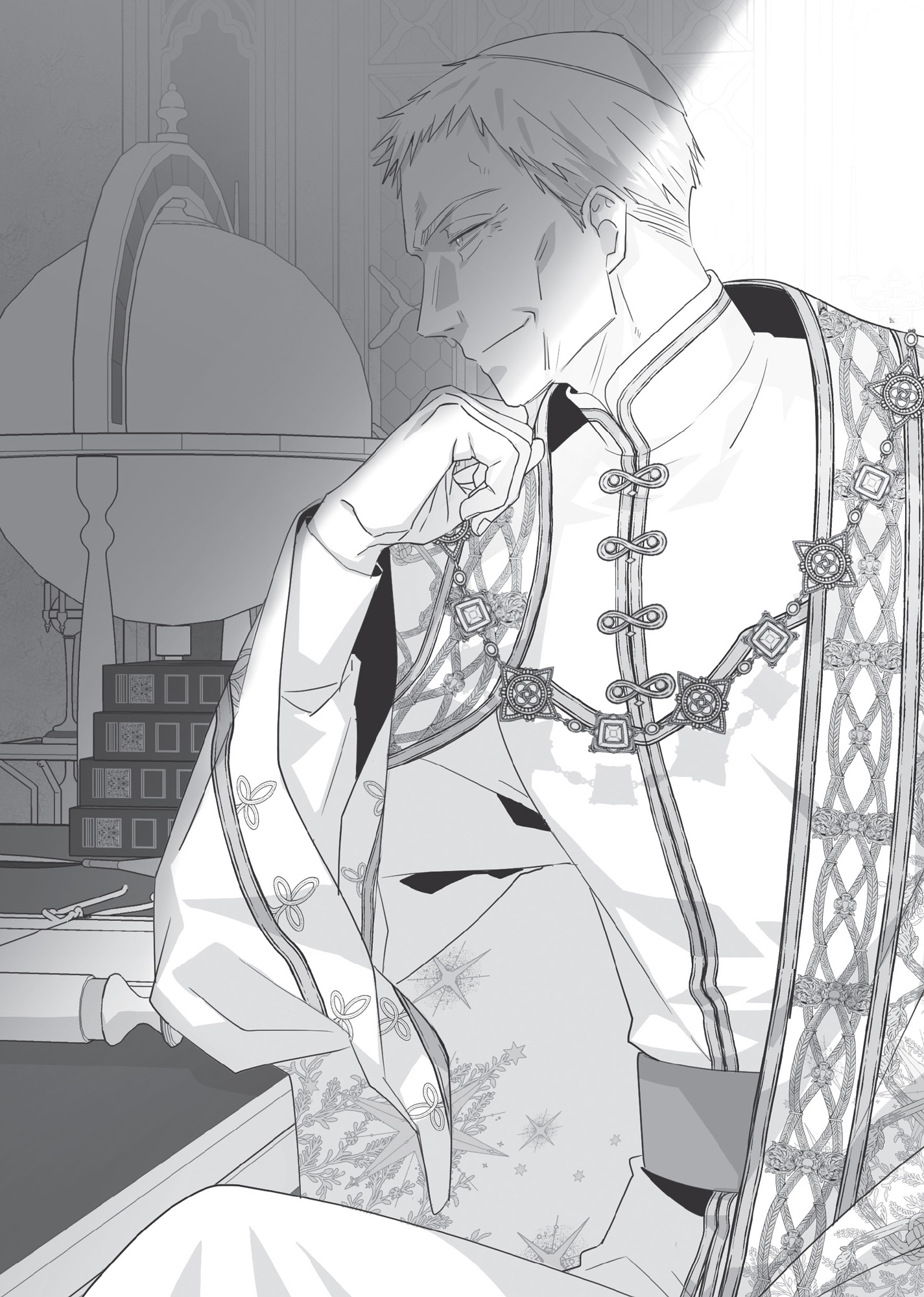
Nigel recalled the young woman’s appearance: the gentle waves in her raven-black hair, the determination that shimmered in her blue eyes. She had a promising future ahead of her, which made her shine even more brilliantly. Lost in thought, Nigel found himself smirking. He owed Claudia. His life had succumbed to boring monotony until she challenged him. She deserved a reward for that.
“What shall we do?” Nigel’s subordinate asked.
“None of the candidates here would be a decent match for her.” Nigel lifted himself out of his seat…then tossed the document into the nearby fireplace.
The subordinate studied the cardinal pensively. “Do you have someone else in mind?”
“Yes. I know someone who would be perfect for the task.” One of the younger sisters popped into his head. This was the time for Nigel to make his move, he was sure. “I’ll see to her myself.”
“I’ll make the arrangements.”
Nigel watched his perceptive subordinate hurry out the door and settled himself at his desk. He needed to scrutinize all the information gathered. There were pieces he needed to fit together to paint the picture he desired—a picture that would thrust Claudia into the depths of despair. And the best way to make sure it had the most impact?
“I need her to climb to the greatest heights she can.”
That would make it more difficult for him to move against her, granted, but that was what made it ever more interesting. Picturing her fall from grace made his heart race with delight.
Go on, then. Enjoy your victories while you can and keep climbing until you stand head and shoulders above everyone else, reaching a peak no one else could. That’s what will make toppling you all the sweeter.
Chapter 7: The Villainess Receives Congratulations
Chapter 7:
The Villainess Receives Congratulations
IT WAS PAST NOON by the time Claudia finished discussing matters with Sylvester and returned to her family’s estate. She ate a light lunch in her personal quarters. Just as she was starting to relax, a maid came to inform her of a visitor.
When Claudia arrived at the front entrance to greet her guest, Lilith had already arrived ahead of her. The woman’s long hair was tied loosely behind her head. Claudia and her stepmother lined up together to welcome Elizabeth, who came dressed in a thick, fluffy cloak. Despite the sun being high in the sky, its light wasn’t enough to drive away the chill in the air.
A maid took the cloak from Elizabeth, who turned to thank Lilith for the invitation. Lilith smiled back, as she always did. Maybe it was Claudia’s imagination, but her stepmother’s expression seemed stiffer than usual.
“I’m always pleased to have your company,” said Lilith.
The main purpose of Elizabeth’s visit was to instruct Lilith on the proper attitude for a duchess, as well as how best to handle troublesome agitators. Elizabeth planned to invite her other friends along the next time she came.
I suspect that’s more of an excuse for tea than anything else.
Aristocrats weren’t constantly walking on eggshells with others. The upheld ideal was for one to constantly stay on their toes, but it simply wasn’t realistic. One needed a true break now and then, especially if they were trying to live up to this standard.
Once Lilith successfully passed Elizabeth’s challenges, Elizabeth turned her gaze to Claudia and smiled. A maid stood beside her, holding a box with a beautiful bow wrapped around it.
“Congratulations, Claudia. Lilith and I,” Elizabeth paused to motion to the other woman beside her, “decided to get you a little gift to celebrate you being appointed A Priori.”
Lilith beamed. “Yes, congratulations, Lady Claudia!”
It wasn’t surprising that Elizabeth already knew; she’d been the one to notify Claudia well ahead of time about the church’s intentions to call upon her. The gift, however, was unexpected.
“Thank you,” Claudia blurted out. The bafflement registered on her face, heat rising to her cheeks.
These two women were like mothers to her. Claudia knew how hard Lilith was trying and how many obstacles Elizabeth had faced in the recent past. They held very different places in society, but they’d come together to select a gift for her. It warmed her heart. This was one of the few times Elizabeth didn’t even attempt to make her usual snide remarks.
In her periphery, Claudia saw the head maid, Martha, bowing her head. Only now did she realize that all the butlers had gathered beside Martha to do the same. Apparently, everyone was in on this little celebration.
A much more noticeable presence entered the room, and Claudia had to crane her neck to peer up at him. Her eyes met two that mirrored hers in color and depth. Strands of straight black hair framed those eyes, which crinkled slightly as her brother smiled.
“Congratulations, Dee,” Virgil said in his deep voice. “This is from me.” He held out a gift of his own.
“Thank you so much!”
Claudia had assumed he was still at the royal castle, attending to his own duties—namely, the matter of the refugees. The crown would be relocating some to their own territories, but the rest would be split among the regional lords to look after. Virgil and her father were busy attending to the ongoing arguments in parliament about how best to support the incoming refugees.
The gift box Virgil presented to Claudia was about the size of her palm. She happily took it from him, but she couldn’t stop herself from asking, “Is it really okay for you to be here, given all the work you have on your plate?”
“I couldn’t miss celebrating my little sister,” Virgil declared before adding in a lower voice, “I left Father to deal with things. The other members will excuse me for ducking out briefly. There were some documents I needed to retrieve here anyway, so it was good timing. But for now, let me focus on you, Dee.”
He held out his arms, ready to welcome her into his embrace. The gesture reminded her that this would be the last time they could do so for the foreseeable future due to the rules she had to follow as A Priori. She stepped closer to him, wrapping her arms around his broad back. His strong arms, in turn, enveloped her.
He’s right, she thought. This is what I need to focus on too. Her mind concentrated on the warmth and the love she felt from him.
***
Claudia saw Virgil off when it was time for him to return to the royal castle. Since Elizabeth was already visiting, they decided to have tea together afterward. Elizabeth had long abandoned instructing Lilith by this point.
“He’ll be returning to your duchy soon, I imagine. Virgil must be utterly spent from everything he has going on,” said Elizabeth. She had grown so accustomed to being around Claudia and her family that she no longer bothered using titles anymore.
Every year, during the off-season, aristocrats typically returned to their home regions until the new season began. However, the ongoing debate in parliament this year had delayed the annual homecoming for all involved.
“The one blessing is that we don’t live in a region of the kingdom that suffers from tremendous snowfall,” said Claudia.
The capital was in central Harland. The Lindsays’ duchy was to the north, along the coastline and adjacent to a mountain range. The mountains protected them from the cold northern winds, so they didn’t experience too much snowfall even in the middle of winter.
“I assume those in the northernmost reaches have either gone home already or given up,” Elizabeth commented.
The administration made a point of keeping most of the main roads shoveled and free of snow as much as they were able, but even so, it was impossible to make the long, arduous journey to the northernmost territories once winter hit. Those who resided in the far north would have to make the trek well before the snow began or resign themselves to staying in the capital.
Their conversation soon turned to Claudia’s new role.
“I understand there are certain restrictions you must observe when appointed A Priori, but it’s still an honor to be chosen. You should be proud,” Elizabeth told Claudia.
“Yes, of course.”
“Tell me, do you know the origin of the term ‘A Priori’?”
Claudia shook her head. “No. As embarrassed as I am to say this, all I know is that it’s the official title for the saint’s assistants.” That was a lie, actually. She had looked up the phrase ahead of time, but since Elizabeth seemed eager to share, Claudia opted to give her the spotlight—in part because she trusted Elizabeth’s knowledge on the matter.
Helen prepared them fresh tea as Elizabeth leaned forward and said, “It refers to an incontrovertible truth. For instance, the way time always moves forward and never backward. One might even call it an absolute fact, for something that is not is thus not A Priori.”
Claudia nodded; this matched what she’d read as well. What followed was new to her.
“You probably think that’s an exaggerated title to bestow upon someone who’s only an assistant to the saint. Originally, A Priori was the title given to the saint. It was meant to represent her foresight and absolute authority as a leader of the people.
“This changed when larger nations formed on the continent. When Harland, Bari, and Arakaner first established themselves, they were mere culminations of a few groups. But as they grew and assimilated with people and territories around them, the church began to appoint assistants to the saint. That was when the word ‘saint’ was first used for the position, and the title of A Priori was relegated to her assistants instead.”
“So the title of A Priori has a longer history than the saint,” Claudia concluded with fascination.
“Precisely,” Elizabeth answered with a nod. “Though most people have forgotten about its prior usage and history. Still, I believe someone who’s been granted the title should be aware of its significance. It’s the highest honor a person outside the church can receive.”
“You’re right. I will most certainly keep that in mind, and I appreciate your explanation.”
Lilith’s eyes glimmered with intense interest. She nodded emphatically. “You’re so wise, Elder Sister! I feel embarrassed about how little I know compared to you. Where did you manage to learn all this, Lady Sunset?”
Claudia was likewise curious. It certainly wasn’t part of the curriculum at the academy.
“There was a time when I was deeply invested in our nation’s history,” Elizabeth said. “Through the Sunsets’ connections, I was granted the rare opportunity to read some of the ancient texts in the church’s possession.”
When the queen was younger, she and her brother often went to the old castle monastery to play. Most aristocrats turned to the church in search of tutors for their children. That was especially true in the Sunsets’ case.
“But I have been looking into A Priori more recently as well,” Elizabeth added. “Claudia, you’re already aware of the legend passed down through my family about our ancestor with the power of precognition, aren’t you?”
Of course Claudia knew; the incident concerning that very legend was all too fresh. Elizabeth’s husband, Patrick, had turned to black magic in his lust for clairvoyance. And he had chosen Elizabeth to be his human sacrifice. Together, Claudia and Sylvester had managed to save her.
Elizabeth continued, “Since she was a woman as well, I wondered if she wasn’t an A Priori herself. The very sort of person the role of saint had been based on in the first place.”
Considering how much influence the woman had wielded in her time, that would make sense.
“The Sunsets suffered a major blow after what Patrick did. That afforded my younger brother a chance he never would’ve had otherwise, granted.”
Elizabeth was probably happy that her own flesh and blood had usurped the main family’s power as opposed to anyone else, but that political shift came with the realization that Patrick—a man she’d adored since she was a child—wasn’t who she’d thought he was. It couldn’t have been easy for her. Doubly so because her son had grown up expecting to be the next heir, in which case she needed the main family to remain in power.
“I was hoping I might retroactively have that ancestor of ours recognized as a saint.”
There were instances when the church had bestowed the title on a deceased woman. The church hadn’t always had broad access to information all over the continent. Now armed with greater resources, they had decided to recognize those who fit the criteria of saint even though they were long gone. If the Sunsets could receive that honor themselves, it would boost their prestige. Not to mention that Elizabeth’s appearance greatly mirrored that of this ancestor. It would provide her extra ammunition against her family—even if her brother had a son and tried to use birthright claim to name him as a successor instead of her own son.
Yes, Claudia could see why Elizabeth was eager to press the issue.
But then Elizabeth’s face clouded. “Shallow of me, isn’t it? The woman was already treated terribly during her life, and here I am trying to use her even after her death.” She spoke with the realization that doing this would make her no better than Patrick, who’d dug up the poor woman’s remains for his own ends. “That’s why I spoke to the marquess and Father Carlo first. Ultimately, I withdrew my request.”
“That was a brave choice to make,” Claudia said approvingly.
“Right, well, I want my son to forget the past and look toward the future.”
He was already the legitimate successor anyway. The last thing Elizabeth wanted was for him to feel any guilt about what she’d done. That would only hold him back.
“Your son has nothing to fear as long as he has you on his side,” Claudia assured her.
“Yes, Father Carlo said the same thing. Since you two are already acquainted, you ought to visit him if you have any interest in learning more about the church or A Priori. He’s a very learned man, and I’m sure he would be happy to teach you.”
The mere mention of him brought his koala-esque face to mind. Carlo had looked after Claudia when she was under his stewardship during her stint at his monastery—all part of her princess training. Carlo had also popped in to visit her family’s estate on one occasion, and he’d chatted animatedly with Lilith.
I should visit him, Claudia thought. It would be good to see him again, and a prime opportunity to further my knowledge.
She had room in her schedule now that her princess training had been postponed.
Once their conversation hit a lull, Helen served them the newly brewed tea.
Elizabeth reached for her cup, then gracefully took a sip. Helen had cooled it to the perfect drinking temperature. “You have a very capable maid.”
“Thank you,” Claudia said on Helen’s behalf, her lips tugging up in a smile. She was glad to have genuine praise from Elizabeth that wasn’t veiled in a barb; the lady seldom gave out compliments.
Elizabeth beamed back at Claudia as she set her cup down. “If the other A Priori is anything like you and your maid, then hopefully there will be no room for criticism of her.”
“Pardon?” Claudia blinked slowly. “Who are you referring to?”
“The one from Bari Kingdom,” Elizabeth said. “Lady Lestea has been chosen for their A Priori.”
Claudia’s mouth fell open. Lestea was the last person she would’ve expected them to choose. Definitely not. I never imagined hearing her name in this context!
Lestea regarded Claudia as the highest being in existence, and she was under Harland’s thumb. Those in high society knew her well, if only for the fact that she was incredibly handsome and wore men’s clothing. Claudia hadn’t anticipated a conservative institution like the church choosing Lestea.
“I suppose it’s a sign of the times,” Elizabeth said, as if she could read Claudia’s mind. “Back in our day, it would’ve been unthinkable. Particularly because A Priori are supposed to be an extension of the saint. They’re to provide support for the people even after the saint has left their borders.”
Lestea’s female peers regarded her with great envy, but the older generation looked down on her. Claudia had heard them gossiping about how no man would want Lestea—not with the way she dressed. They couldn’t believe a woman regularly dressed in men’s clothing. With Elizabeth’s extensive knowledge about the church’s history and fixation on A Priori due to her ancestor, she likely had her own thoughts on the matter.
“You can rest assured that she’s perfectly capable,” Claudia said in Lestea’s defense. Though frankly, she didn’t even believe the words coming out of her own mouth. Lestea had some…personality issues, to say the least. She was a bit fanatical. Claudia didn’t know anyone else quite like her.
At any rate, the three continued to enjoy their tea together as the blue sky gave way to reddish-orange hues.
***
Upon returning to her quarters, Claudia opened the presents she’d received. Elizabeth and Lilith had presented her with winter gloves. They were black and blue with gold accents, and she could tell by the feel of the fabric that they were of the highest quality. Elizabeth and Lilith must have really put their heads together to come up with something that would suit her, since her style was so wildly different from theirs. The thought warmed her heart.
“You’ll be able to use them right away,” Helen said.
“That I will. Would you pick out an outfit to match these gloves so I can wear them on my next outing?”
“Certainly.”
Next, she opened Virgil’s gift.
“Oh my, it’s a bracelet!” Claudia gushed, delighted.
“It’s gorgeous. That’s a sapphire, isn’t it?”
The bracelet was a thin silver chain with a layered cross hanging from it in the shape of a star. The sapphire was set at the center, gleaming beautifully as the light caught it. Though it was only about the size of her pinkie nail, the gem was meticulously cut. It was as if someone had captured the night sky and crystallized it, so vivid was the blue.
Claudia lifted the bracelet, examining it. “This is Lindsay Blue.”
“Real Lindsay Blue?!” Helen cried in disbelief. She, too, was familiar with the shade that had taken on the Lindsay name for its close association with Claudia’s house.
The name originated in Claudia’s home territory, in the mountain range that protected her and her people from the northern winds. Among the mountains was a mine from which sapphires could be mined. Most of these gems were tinged with green, reminiscent of the winter sea. Rare was the sapphire of a pure, solid blue. Those sapphires, depending on the angle they were turned, could look almost black for how deep their color was. Those were House Lindsay’s colors; black hair and blue eyes were characteristics closely associated with their line. Thus, the name Lindsay Blue seemed apt, and it had stuck ever since.
Helen let out a startled breath as she studied the color that so resembled her mistress, her face filled with wonder. “Only Lord Virgil could requisition such a precious jewel. He must have gone to great lengths to get this!”
“It’s a reminder of how important my new position is,” Claudia said, remembering what Elizabeth had told her. A Priori was the title previously used for the saint, and after the saint left, Claudia would still be a source of support for her people.
The rules she had to observe in the meantime weren’t too difficult, but they would limit her daily life until the festival was finally held. She had no complaints about that. These sorts of restrictions were to be expected in such a significant role. If there was any doubt in her heart, it was a lack of confidence. Was she really the right person for this? In her first timeline, Claudia had doubted the existence of the Capricious God. She couldn’t anymore, not after the miracle she’d experienced—but that didn’t erase her past skepticism.
Claudia had become the perfect noble lady, as her mother had always desired. Yet that was by Harland’s standards, and it was merely one aspect of her character. There was no good without evil, and Claudia acknowledged the sins she’d committed. She was most certainly not a saint.
Helen must have noticed that Claudia’s gaze had dropped to the floor because she pressed a hand over her mistress’s. “I don’t believe there’s another lady in this kingdom who could possibly carry out this role to the level I know you will, my lady. In my opinion, you were A Priori long before they chose you.”
Coaxed by Helen’s warm smile, Claudia soon found her lips curling at the edges too. She took another look at her presents. The gifts themselves were incredibly thoughtful, but so was the underlying message of support they carried. She took each in hand and clutched them to her chest. No matter what hardships she might face, she was confident that with all the people backing her, she could overcome anything.
Chapter 8: The Villainess Dresses in Men’s Clothes and Has a Meeting
Chapter 8:
The Villainess Dresses in Men’s Clothes and Has a Meeting
THE FRIGID NIGHT air swept through the streets, sapping the heat of anyone it touched. Claudia descended the brick steps with a lantern to guide her way, and she soon found herself enveloped in an uncomfortable warmth. By the time she arrived at the basement, the chill had largely retreated.
The sizable room before her was bathed in darkness, which was gradually driven back by the orange glow of the lantern as she strode onward. When she reached her destination, she found a fireplace crackling within.
Two men were waiting for her. One was a younger man with a handsome face. Hands outstretched toward the fire, he regarded her with a great big grin. The other was a bald, muscular man who immediately bowed low when she appeared in the doorway. This was the Rose Garden syndicate’s hideout.
Claudia was clad in men’s clothing, her face hidden from sight. As part of her disguise, she used the name Rose to hide her identity. Helen wore a similar outfit.
Ruki, who looked like a carbon copy of Arakaner’s Prince Seraphim, spoke in an unusually cheerful voice. “We heard the news, Boss Lady. The saint’s comin’ to town. And the church chose a certain noble lady as her—what was it again? Assistant or whatever?”
“So it appears,” Claudia answered vaguely. She tried to keep her alter ego separate from her real identity, hence their wordplay. This was probably Ruki’s way of congratulating her.
Though Claudia was the true leader of the syndicate, Bezel acted as her representative, overseeing day-to-day operations. Incongruous with his tough appearance, he gripped a bouquet of flowers and held it out to her. “This is from me and the rest of the boys,” he said, “to thank you for all you do.”
Dangling from the base of the bouquet was a stuffed white cat that reminded Claudia of Candy. Orange beads had been sewn in to represent her eyes.
Helen’s eyes lit up at the sight of the bouquet and the tiny plush toy.
“Bezel made that himself,” Ruki chimed in.
Bezel rounded on his subordinate, face red. “How the hell do you know that?!”
“C’mon. You’re an old dude, and I noticed you were doin’ somethin’ in your free time. Wasn’t hard to figure out. Anyway, ain’t it about time you quit trying to cover up your love of cute stuff? It’s so obvious.”
Bezel’s jaw dropped. “It is?!”
He was an intimidating man with a face and build that would probably make most children cry before he even opened his mouth. He probably realized the uncanniness of his love for adorable stuffed animals, which was why he’d tried to keep it hidden for so many years. What he didn’t know was that it was no secret to Claudia either.

“You didn’t have to say it in front of the boss!” Bezel snapped at Ruki.
“Boss Lady already knows.”
“She does?!”
“You’re very skilled with your hands to have been able to craft this,” Claudia remarked as she took the bouquet from him.
Bezel slapped his meaty hands over his face and crouched on the spot. Blood had rushed to his cheeks, turning his ears tomato red. The room felt several degrees warmer now, both figuratively and literally.
A surprise visitor poked his head in. “You seem to be enjoying yourselves. Mind if I join you?” It was Seraphim, the crown prince who looked every bit like Ruki. His blond hair was tied behind his head. It gleamed a deep, vivid orange in the light. His eyes were a gentle gray that looked entirely out of place in the dank, dreary underground they found themselves in.
Ruki scoffed at his brother. “Outsiders have no place here.”
“Considering I’m here at all, I don’t think I deserve to be labeled an outsider,” Seraphim said primly.
Although the two men were blood relatives, their relationship was all business. Ruki didn’t want Seraphim too involved in his personal life.
“I invited him,” Claudia piped up, stepping between them. “He’s here to exchange information with us.”
Ruki had no choice but to swallow his complaints. “If that’s what you decided, so be it.” He waved a hand. He was willing to accommodate Seraphim if their discussions were about work. “Let’s get talkin’, then.”
Seraphim regarded his half-brother like one might an unfriendly stray cat, disappointment in his eyes.
Everyone took their seats, expressions sobering.
“I’ll begin first,” Seraphim volunteered. “It seems the situation in the conflict zone has hit a critical point. The church is intervening, but its attempts to negotiate peace have been unfruitful. The war isn’t likely to stop anytime soon.”
In his capacity as crown prince, he was directly involved in diplomatic negotiations. He’d visited several countries, big and small, to forge agreements between their nations.
Seraphim’s homeland of Arakaner was north of Harland. During its rough winters, the seawater in the harbor froze over. Considering he hadn’t returned home yet, he probably planned to spend this winter gathering information about the refugee crisis. His lofty position gave him access to highly classified information, and he was savvy enough to travel around and confirm it for himself. Claudia could trust the accuracy of whatever he shared.
Most people hesitated to share unflattering intel about the church because of their affiliation with it. Claudia didn’t have to worry about that with Seraphim; he and his countrymen held a contrary belief system to begin with. Still, she couldn’t let herself forget that Arakaner had its own motives, which likely seeped into the information Seraphim offered. His top priority was to benefit his country, after all.
Reminding herself to take everything he said with a grain of salt, Claudia nodded. “So accepting refugees at this point is an inevitability.”
“The church is taking in anyone with an urgent need for sanctuary, but they’re already over capacity. Harland has no doubt received their official request for aid.”
Considering how busy Claudia’s father and brother seemed in parliament, Claudia had suspected as much. They were still discussing when to begin accepting the refugees and how they would be integrated.
“Unsurprisingly,” Seraphim went on, “the church has not requested our aid at all. But we cannot sit idly by without doing anything.”
“Yeah, you sure like to stick your nose in,” Ruki spat. “No idea why.”
Seraphim smiled thinly. “That’s because the refugee situation cannot be resolved by sacrificing another country. This isn’t a religious issue—we’re all people. Don’t you think we should be helping one another?” It sounded idealistic, but Seraphim was being genuine.
If Harland had a large influx of refugees and couldn’t adequately support them, it might destabilize the entire country. Then Harland’s own citizens might become refugees themselves, fleeing for better lands. The trickle would become a flood, burdening the surrounding nations. Violent gangs would form and spiral beyond anyone’s control. National borders were arbitrary things without solid walls to separate the people on either side. Arakaner was a nation of islands, surrounded by water, but a small barge could easily set out and reach them from Harland’s shores.
This wasn’t a distant problem they could brush off. Seraphim was right; it was better to assist now and prevent any possible problems, thus securing continued stability for their own nation.
Of course, there were never any guarantees.
It’s human nature to seek profit where possible.
At this very moment, the lords in parliament were probably arguing over whom they could foist the responsibility onto. None were eager to shoulder that burden themselves, as terrible as that was to say. The Lindsays could only take on so many losses as well. They would eventually have to find another way to recoup the costs they would incur from taking in refugees.
“Arakaner is prepared to assist Harland financially,” Seraphim said with a smile. His nation was growing fast, with aims of becoming an economic powerhouse. That was its strong point.
I assume he’s doing this to ensure Harland will owe Arakaner in the future.
Not that Seraphim was necessarily lying about the importance of helping one’s fellow man, but Claudia knew better than to think he was offering charity. Nothing was more expensive than when it was given freely. Setting up Harland to owe Arakaner was a good pretext for encouraging those who might otherwise be opposed to support the measure, so it wasn’t all bad. Arakaner had a habit of keeping to themselves because their belief system was so different from most of their neighbors. It was much easier to encourage the administration to get involved in diplomatic affairs if framed in a way that ultimately benefited them.
“Knowing Harland, and your family in particular, I’m sure you’re fully capable of handling this refugee crisis,” said Seraphim.
So he said, but even Sylvester was troubled by the issue. Claudia’s lips twisted. “You make it sound so simple.”
He continued smiling blithely at her. “Those weren’t empty words, you understand. I’m saying that because I have faith in your abilities. I daresay you can apply the same agricultural training policies meant for our people to the refugee issue.”
Arakaner was slow in making agricultural advances due to being an archipelago in a cold climate. To speed up their progress, the Lindsays had personally invited Arakaner’s people to come and learn about agriculture in Harland.
“What surprised me most was how you kept groups together—people from the same villages and settlements. They already shared a sense of camaraderie, so they quickly shared anything they learned with the others.”
Since people knew one another, they had an easy time of working around any issues that cropped up. Granted, grouping up people with established ties did come with a few downsides; they sometimes collectively decided to slack off. However, they were far from their homeland of Arakaner, and having that sense of familiarity considerably reduced their stress.
“I think what we learned from that experience can help you when facing the refugee crisis,” Seraphim concluded.
When the topic first came up, the anxiety must have shown on Claudia’s face. That was probably why he was going to such lengths to reassure her. And Seraphim was right: There was a considerable difference between having family and friends around and being all by oneself. Claudia wasn’t naive enough to think they could use the exact same method with the refugees, but the experience could be useful in some way. That was a comforting thought.
“My country’s biggest concern at the moment is the issue immediately in front of us: the saint,” said Seraphim.
Ruki nodded. “Yeah, definitely means the church’ll be gainin’ ground with the people.”
The Saint’s Festival also involved the saint making a pilgrimage to various nations on the continent. That was as good of an opportunity as any for the church to show off its influence. The festival was sure to be a lavish affair, not least because of all the flowers that would be blooming at the start of spring.
“The saint will give them more power than they had before,” Seraphim said grimly. “All the current candidates are directly related to cardinals, but it won’t matter to the people that their saint was chosen because of nepotism. They’ll clamor at the birth of a new savior regardless.”
Ruki sneered. “They’re pickin’ from their own relatives? That’s nepotism, all right.”
“In the distant past, a woman didn’t even have to be one of the faithful to be given the title.” Seraphim shook his head. If a person fit the criteria to be A Priori (as the saint was formerly known), she was given the title and revered as such. Seraphim’s analysis was that the church initially had no direct connection to the role.
Ruki’s gaze slid to the ceiling, a look of disinterest on his face. “So guys at the top are still only concerned about themselves. That’s nothin’ new.”
“Yes. The bigger an organization, the more those in charge tend to want the same things,” Seraphim agreed.
Intent, whether good or ill, ultimately became irrelevant. Humans were predictable—the way they thought, the way they acted. Everything they did was dictated by accumulated knowledge of the past and their own experiences.
“I should make it clear that my countrymen and I have no desire to rob believers of hope, but I also cannot help hoping that the church doesn’t expand its influence any further than it already has.”
“In that regard, there is nothing we can do but wait and see,” Claudia told Seraphim.
The prince already knew there was nothing he could do in this case. His real objective was probably to put Claudia on her guard, to remind her to stay vigilant.
“Harland wishes to work alongside the church and hold a successful Saint’s Festival.” The statement sounded very diplomatic, Claudia realized, especially when they were supposed to be speaking candidly at these meetings. But she meant every word. She was happy to have a new symbol of hope for the people.
Having confirmed Harland’s stance on the matter, Seraphim had no reason to linger. He promptly excused himself and made his way out. These meetings weren’t always directly beneficial, but it was useful being able to speak honestly to one another. Seraphim knew that, so he would continue to attend.
Ruki watched out of the corner of his eye as his brother left, then stretched in his seat. “Well, that’s that. Time for us to get down to business, eh?”
Rose Garden’s operations extended throughout the capital region, even beyond the city’s borders. The Saint’s Festival meant little to them. If anything, it was an opportunity to explore new ways of divesting witless rich people of their coin. They didn’t care about the refugees much. Provided they didn’t take up residence in the slums, they were no concern of Rose Garden’s. And the slums were exactly what Ruki and Bezel were interested in discussing.
Meeting with Seraphim was only part of why Claudia had come all this way. She was also here to get feedback from Ruki and Bezel about their experimental financial policies. Rose Garden was cooperating with the government in an effort to better support the slums.
Opinions are already split in parliament whether to allot financial aid in the first place.
There were people who insisted those in poverty needed financial assistance to get on their feet, but others argued that handouts would discourage people from helping themselves. To this, Ruki had said, “Try livin’ in the slums yourself and then you can have an opinion.”
Claudia had laughed when he said it, if only because he was absolutely right.
Slums in every region had their own individual circumstances. The policies that worked in one place wouldn’t necessarily work elsewhere. Alas, those in power—the aristocracy—naively believed that there had to be one underlying factor in poverty everywhere, and if they could only solve that, it would be the end of all their problems. That was why Sylvester’s more flexible approach was such a surprise to Claudia.
While she received regular reports on the situation in the slums, she was more interested than ever this time for one reason: She suspected the policies they had enacted to help the slums could be repurposed for the refugee crisis. A few revisions might prove necessary, of course, but the refugees had much in common with the people in the slums. It was worth consideration.
Claudia placed the data she’d received on the table. “So how is our health insurance for low-income earners working out?”
“Very well,” said Bezel.
Ruki smirked. “Pretty interestin’, that insurance system of yours. It’s an awful lot like somethin’ we syndicates already do.”
The health insurance policy was aimed at anyone who could work in the slums, no matter how little they earned. When one pictured the area, they probably first thought of starving children—but that was only a fraction of the large population. Most were people who’d failed to find stable jobs and had nowhere else to go. Without consistent employment, they had to resort to day laborer positions to make ends meet. The health insurance was for those people.
Per the policy, a person was required to pay a minimal fee monthly. If they became unable to work for health-related reasons afterward, they would be granted a regular payout. The administration had tried to implement this policy before, but the official they’d sent met with no success when trying to explain the system to the people of the slums. Those with no money to their names weren’t concerned with what-ifs or could-bes; they lived in the moment and for what they could have now. They would rather gamble away their extra change with friends and enjoy themselves than pay into a system they didn’t know or trust.
“It’s basically like a protection fee, yeah?” said Ruki. “When we told ’em that, it was easy.”
Protection fees were a valuable source of income for the syndicate, typically targeting shop or restaurant owners. It was a contract of sorts; if the owners paid the monthly fees, then an unruly customer beyond the owner’s ability to handle would be dealt with by members of the syndicate. If they didn’t pay, however, those same members would be the ones going there to cause problems. The fee wasn’t optional if someone wanted to run their business peacefully.
Claudia pinned Ruki with a hard look. “Health insurance is entirely different from protection fees.”
He threw his hands up defensively. “I’m tellin’ you, we explained it to them all nice-like! We even sent out our weakest members to do the talkin’. They loved finally gettin’ a chance to contribute.”
Syndicates were mostly about violence and intimidation. Weaker members were primarily relegated to work behind the scenes. It was little wonder that those same people would be delighted to take a more active role in their organization. Thanks to their efforts, their insurance had over 90 percent enrollment without any enrollees defaulting on their payments. There were probably some people in the slums who were under the mistaken belief the syndicate might beat them up if they didn’t pay, but the fee wasn’t substantial enough to burden them. The government wasn’t trying to turn a profit here.
The slums didn’t have the best hygiene. Its residents were at high risk of illness and disease. If having insurance helped encourage them to visit a clinic when they needed to, it was doing its job. Claudia wanted to avoid any of them suffering needlessly from curable sicknesses and treatable wounds. If left as is, they could worsen.
The biggest difficulty is setting up foundations to ensure such health hazards don’t occur.
There was a chance of medical fraud: people falsely claiming to have an illness so they could get their hands on medicines they didn’t need for resale. If the diagnosing physician was corrupt enough to go in on it with their patient, that made it even more difficult to prevent. Thankfully, Rose Garden kept a sharp eye out for any underhanded dealings. Since they engaged in the same sort of tactics, they were professionals at spotting them. Thus, they excelled at preserving the integrity of this new system.
Claudia had also enlisted the faithful who worked in the slums to help coordinate with anyone in need of medical attention. They were in the best place to assure anyone who required help that their insurance would pay for it, so there was no need to abstain out of budgetary concerns. Insurance wouldn’t do the people any good if they didn’t trust it to work for them.
She had received a detailed report about the insurance system and its progress ahead of time, but she wanted to address a few points with Ruki and Bezel to ensure everything was running smoothly. She was relieved to hear there hadn’t been any noticeable trouble.
Ruki raked his hand through his hair. “Hey. I get that the church’s moral teachings are important and all, but are we really gonna hold this Saint’s Festival?”
Having suffered under Nigel’s thumb for as long as he had, Ruki bore no love for the church. He understood their teachings and community could offer salvation for some, but that wasn’t enough to diminish his hostility.
“Yes,” said Claudia. “Just as you and the rest of Rose Garden are professionals in your own field, so too are the church’s faithful. They provide integral support for our communities. There is much Harland can learn from them.”
As part of her purification, she would be staying at the grand cathedral. She probably had a closer association with the church than the average person, and this new role would give her access to more information. She wasn’t going to let that opportunity slip through her fingers.
Many faithful lived in the slums to help the poorest of society. They were luckier than the people they served, since they received funding from the church, but it was those same faithful who provided support for refugees. The church knew how to handle all sorts of people. Claudia was eager to learn from them.
Ruki grunted in response.
“We should use every means at our disposal, shouldn’t we?” Claudia said, knowing this way of phrasing it would be more likely to win him over.
He grinned at her. “Now I get it. You mean to wrap ’em around your finger!”
It’s all about how you frame things, I suppose.
Chapter 9: The Sister Solidifies Her Beliefs
Chapter 9:
The Sister Solidifies Her Beliefs
EVER SINCE THE WHEELS IN HER MIND began spinning, the girl had dedicated much more time to talking to the other sisters. She felt like a starved beast eager for the taste of more knowledge, the importance of which she had forgotten for so long.
Her efforts had rewarded her. Where once she enjoyed only tenuous relationships with the other sisters, she now found them regularly greeting her whenever they spotted her in a corridor.
I used to think it was a bother associating with them.
When they finished their greetings, they’d often offer up a tidbit of information. She was shocked when it first happened, in the form of a quietly passed letter. As she soon discovered, there were many things people couldn’t discuss out in the open. What she found inside this letter was rumor of the senior sister’s past. She’d once been married to an abusive husband who beat her daily until she escaped to the monastery. She wasn’t the only one either. Many sisters had similar experiences.
The women here don’t use their names for good reason, the girl realized. Since there were only women at this monastery, it was sometimes inconvenient to call everyone “sister” without distinction. But there were those who preferred this life, absent of any individuality.
The girl had also discovered that the slow-witted girl constantly facing criticism was actually a former aristocratic lady. It was an unspoken rule not to ask people about their previous circumstances, but rumors abounded. It was hard to hide being part of the upper crust. Once you had etiquette and manners drilled into you, your every action gave you away.
Other girls came out and willingly confided their circumstances, like the red-haired sister who so loved meal services. The more the girl learned about her peers, the more she found that they were trying to face their pasts and grow as people.
The sister with the messy, straw-like red hair was one such example. She’d been unable to feed her much younger brother and sister. Filled with despair after they passed, she drifted until she landed at the church’s door. The reason she loved meal service was that it made her feel like she was helping others. Her smile had always bothered the girl before, but now that she knew of the red-haired sister’s past, that was no longer the case.
I can’t believe I let myself be ignorant for so long.
The girl had shut out anything that didn’t match the beliefs and ideas she already held. It had been so silly of her. What knowledge she had was so pitiably small as to be insignificant.
While talking to the others, one of them had imparted some particularly memorable words of wisdom. “The knowledge you think you have is merely bias that taints your view.”
What you thought was just was only just in your mind. Not everyone would agree with you. And no matter how many did, that didn’t lessen the subjectivity. Honestly, the whole conversation had been so philosophical that she’d felt like a child lost in a maze.
I think those things are still a bit too difficult for me to grasp.
Her mental gears had only recently begun to turn, after all. She was like a baby tottering along. There was no way for her to navigate a full maze and find the exit on her own. Not yet.
But I won’t give up.
Her old self would have dismissed philosophy and the like as too much of a pain to comprehend. Not anymore, though. She now appreciated how important it was to learn. The girl was eager to enlighten herself as much as possible, and in the process, she enjoyed hearing new viewpoints. The world was so much bigger than she’d let herself believe.
“Phew. Seeing everything come together makes it all feel worth it!” An upbeat voice broke through the girl’s reverie, yanking her back to reality—to the musty warehouse she found herself in.
The building didn’t provide much light. Even in the morning, the place was thick with shadows. The girl glanced down at her feet. They had neatly lined up dozens of wine bottles, filling each from a wooden cask.
The monastery grew its own grapes. The sisters then harvested them and extracted the juice, which was stored in these casks and left to ferment. Everything was made from start to finish through their own efforts. They had the scratches on their hands from the intense labor to prove it, and those wounds reminded her of her long days in the fields.
When she’d first arrived, she had been shocked at how much land the monastery used for farming. Aside from their vineyard, they had all sorts of root vegetables and leafy greens as well.
“Come on, keep working! Once we finish filling these bottles, we must start crating them!” The senior sister’s voice cracked like a whip, interrupting the otherwise relaxing time the girl and her fellow sister had spent plodding away at their work. The girl had learned that the sister shouted so fiercely all the time because of how quickly and easily it communicated her meaning. Even if someone couldn’t understand what she was saying, they could still grasp that she was urging them onward.
“Couldn’t she at least let us have a little break?” the girl grumbled under her breath. She’d grown wiser, to be sure, but that hadn’t affected her propensity to complain when exhausted.
Grinning, the redheaded sister knocked her loosely tied hair over her shoulder. The girl maintained a similar hairstyle, since her own hair was so long that it would get in the way if she didn’t.
The sisters created a partition between layers of bottles, with hay for padding and preventing breakage, as they packed them in crates. The crates were then loaded onto a small cart.
“Ready? One, two…”
The crates were heavy, so they had to coordinate and lift them together. This time, the crate landed on top of another with a noisy clatter, which earned them a sharp chiding from the senior sister. “Be more careful!”
In her mind’s eye, the girl stuck her tongue out at the other woman. The bottles were sturdy enough, being made of thick glass. The church had chosen the most durable ones because they consistently reused them.
Once they were finished loading their cargo, they had to check the order form to make sure there were no mistakes before they shipped the wine out. The monastery was also in charge of delivering these goods.
The buyers ought to come here and pick them up instead of making us do it, the girl thought sullenly. It was bad enough that they had to pack them, let alone go through the whole delivery process.
Honestly, those weren’t her only complaints. She could go on and on.
For one thing, the girl didn’t have a very good impression of the townspeople, especially after she’d caught those men spying on her and the other sisters. She would’ve preferred not to go out and mingle with them at all if she could help it.
The red-haired sister was beaming even though they weren’t leaving to do meal service today. Before, the girl would have griped about how she couldn’t understand the sister’s excitement, but she knew better now. Instead, she said, “Doesn’t it bother you? This is a lot of hard work.”
“Yes, but it amounts to something. Selling this wine means more money for the monastery, and it makes me happy to think there are people out there enjoying what we went through so much trouble to make.”
“And if they don’t enjoy it?”
“That would be disappointing.”
“Really? That’s it?”
“Hmm.” The red-haired sister mulled it over. “I guess I hope they’ll give it another try, and maybe next time they’ll like it. Not everything you do is going to make everyone happy.”
“But what if it turns out that this is all just a waste? Wouldn’t that bother you?”
“Oh, don’t misunderstand me,” the girl said, throwing up her hands. “I do think this is tough work! It’s exhausting, and sometimes it’s really tedious.”
Pleased, the girl nodded. “I’m with you there.”
“Exactly! That’s why every time I hear you grumbling under your breath, I can’t help but laugh because I feel the same way.”
“Wait, that’s why you were laughing? Because you agreed?” The girl had noticed how the other sister always laughed and smiled. She’d assumed it was because the redhead was carefree and had no complaints.
“What? Did you really think I enjoyed all this?”
“Well, yeah. I did,” the girl said frankly.
The red-haired sister burst into laughter. “There are times I genuinely do enjoy it, like when we’re doing special events, such as the meal service. But in general, the only reason I’m having fun is because I’m with you!”
“Huh?”
“You’re not like the other girls. If something bugs you, you let it be known. It’s honestly refreshing! It helps knowing that I’m not the only one feeling that way, that there’s someone else out there who is dissatisfied and annoyed too.” Then she added, “And I’m particularly fond of the way you know only to let loose when the senior sister can’t overhear you and scold you for it.”
Never in the girl’s wildest dreams had she imagined this.
The sister went on, “Since entering the monastery, I’ve come to realize there are lots of people here with tragic circumstances. It’s reassuring to know that I’m not any more unfortunate than anyone else. That I’m nothing special.”
There were women who’d suffered from a lack of food, women who’d experienced abuse. Everyone at the monastery was practically born disadvantaged, and for better or worse, it meant they were different from most people. Where the girl had longed for freedom, the red-haired sister had longed for normalcy. For whatever reason, the redhead found the girl and her laundry list of complaints enjoyable. Ironic, since the senior sister would be the first to point out that the girl’s constant bellyaching was her biggest flaw.
“You’re kind of weird,” declared the girl.
“Huh?! I am?!” cried the red-haired sister.
“Don’t worry. Not especially weird, just a little.”
At that, the sister laughed. “Oh, good!”
Before she knew it, the girl was laughing too.
***
To the girl’s great relief, the senior sister didn’t insist they skip lunch to carry out the rest of their work. She felt much better after she had some food in her belly.
“I still feel like we get saddled with all the hard labor,” she groused.
“Ah ha ha, I get what you mean. Technically, we do take turns with the rest of the sisters,” said the redhead.
Duties were doled out in rotations to keep everything fair. In that case, why did the girl always feel like she was stuck with the worst of it? She knew what the senior sister would say if she asked. “You think that way because you have a terrible, nasty personality,” she would snap.
It was true that all the sisters had cracked, patchy red hands. Still, the girl wanted to protest. The work they did wasn’t easy. Maybe her concerns seemed trivial to a woman who’d run from an abusive husband, but to the girl, there was nothing more depressing than the hard labor thrust upon them day in and day out.
I wonder if I think this way because I’m still so ignorant.
She couldn’t put a blithe smile on her face and try to find moments of enjoyment like the red-haired sister did.
The girl noticed the senior sister approaching, and her feet turned to lead. It was time for them to deliver their wine to the restaurant in town. She followed the senior sister, grabbed the handles of the cart, and hauled it forward. The red-haired sister, who’d become the girl’s close partner, pushed it from behind. There was a downhill slope all the way to town, so once they hit it, the sister would have to cling to the back and dig her heels in to slow the cart down and keep it under control.
The girl, who disdained backbreaking work, felt dark clouds swirling in her heart. Ironic that the exact opposite was happening in the skies above. The winds were strong enough to sweep away the cloud cover, leaving an expanse of clear blue. Small bits of dirt got caught up in the gusts, pelting the girl right in the face. Her skin was more sensitive than usual, perhaps because of the chill.
Upon their arrival, the girl endeavored to ignore the gazes of the men in town. It was at times like these that she found herself grateful for the senior sister’s presence. The woman was a nag, to be sure, but she’d protect them from the men.
Stalls lined the streets. Peddlers showed off their wares, their cloth awnings faded from the sun.
A sad sight, thought the girl. Maybe it was the lack of foot traffic that made the stalls look so forlorn to her, or maybe she was too preoccupied with how plain and boring the stalls and goods looked. Whatever the reason, the girl felt no excitement at seeing them. The only saving grace of the town was the rich, warm smell of wheat that hung in the air.
The entrance to the restaurant was thrown wide open. It was so cramped inside that one of the chairs near the front door jutted out awkwardly. It would be a stretch to call this restaurant clean or beautiful, and the paint was peeling in places. But at least now that they’d brought the wine, all they had to do was make the return trip.
No sooner had the red-haired sister and the girl switched places than a sharp cry echoed through the streets.
“Thief!”
Thus ensued the flurried rush of numerous bodies, their feet kicking up sand, effectively blinding the girl.
This really couldn’t get any worse, could it?!
Her stress was already at an all-time high between the arduous labor and the forced visit to a town she would’ve rather steered clear of. All she wanted now was to hurry home and rest. Instead, the fuss had postponed their return. Her blood nearly boiled in fury. All these onlookers who’d rushed out to see what was going on were a nuisance. The streets were already cramped; there was no room for their cart to navigate.
Can’t you people be a little more considerate? Don’t you see us trying to get through? The girl was sorely tempted to scream at them, but the senior sister was nearby. She kept her complaints to herself this time.
“Hey, isn’t that kid they caught awfully young?” said the red-haired sister, shooting a worried glance back at the girl. Judging by her commentary, the thief hadn’t made it far. The authorities already had the culprit pinned to the ground.
The girl moved to join her partner. As long as this many onlookers were gathered, they wouldn’t be able to move their cart.
“You’re right,” she said. “He’s just a boy.”
“He’s skin and bones, so it’s hard to tell, but I think he’s only around six years old.”
The boy’s skin drew taut over his bony arms, which cradled a bread bun. An adult had caught him and pushed him into the dirt. He had no chance of freeing himself. Yet despite his crimes, he yelled out, “I have a younger brother! If he doesn’t eat, he’ll starve to death!”
Obviously, the meal service the church offered once a week—or twice at most—wasn’t enough for the people who truly needed it. The malnourished state of the boy’s body was proof of that.
The onlookers regarded the boy with furrowed brows, their whispers flitting about.
“Where’s his parents?”
“They must be vagrants.”
“This is why the homeless are a blight on our society.”
No one was even trying to help him. Scratch that, there was one person who wished to.
“Sister, can’t we do anything?” the red-haired girl pleaded with the senior sister. “He’s a child, and he only stole to feed his younger sibling.”
Her eyes darted between the senior sister and the boy even as she spoke. She was probably picturing her own siblings in her mind, the ones she hadn’t been able to save from starvation.
The senior sister’s face hardened. She shook her head. “A crime is a crime,” she said. “No matter his circumstances, he must pay the price for what he’s done. For robbery, an adult receives ten lashings. A child receives five.”
“They can’t! He’ll die!” cried the red-haired sister.
The girl had to agree. She very much doubted this scrawny little boy would survive the punishment. She scrutinized him; since he had been caught in the act, the authorities would mete out his punishment here. That was why he was kept pinned down. One of the guards reached for the whip hanging at his side.
No one made to turn away. No one left. The onlookers watched closely, their faces distorted with anxious anticipation, eyes gleaming as if they’d already pictured his suffering in their minds.
What the…?
The girl never would have noticed their expressions before. She’d never had an interest in anything that didn’t directly affect her. But having spoken with all the other sisters, having learned to observe her surroundings more, she had come to an all-new understanding and appreciation for the world. That’s why she was so unsettled.
This is so messed up.
Violating the law had consequences. Carrying out those consequences in front of everyone when the culprit had been caught red-handed was the authorities’ way of making an example out of him. Of warning others not to make the same mistake. That was what they said, anyway. But was it true?
This feels more like an exhibition.
None of the onlookers showed an ounce of sympathy for the boy. They looked down their noses at him, watching him grimace from the pain as he knelt in the dirt. His agony fed them with a sense of superiority.
This was entertainment for them. Something out of the ordinary to watch and enjoy.
This is no different than those peeping Toms.
She recalled when the men had used that hole in the monastery wall to peep at the sisters. A chill ran down her spine, and bile crawled up her throat. The bitterness of it lingered on the back of her tongue.
Is it this town that’s abnormal? This was an island. Perhaps the isolation had done something to them. Or is this considered normal in the world at large?
Tremors ran through the boy’s body, his eyes wide with fear as they latched on to the whip. His voice was muted as it slipped past his trembling lips, making it impossible to hear. But she caught the way the blood drained from his face.
The air became heavy with tension as the crowd waited eagerly for the first crack of the whip.
There’s something wrong with you people. The girl’s hands clenched into fists. She didn’t want to be lumped in with them.
The red-haired girl threw herself at the senior sister, clutching the older woman’s dress desperately. “Please, sister! I beg of you, save him! He can’t survive that whip. He just can’t!”
“There is nothing I can do.”
When she realized her impassioned plea hadn’t moved the senior sister at all, the redhead fell to her knees. The senior sister was as hard and unbending as the law itself. Her expression betrayed no emotion as she stood there, staring blankly at the boy. There wasn’t the same morbid curiosity as seen in the eyes of the onlookers, but she was like an immovable object.
The girl glanced at the senior sister, then at the boy. There was nothing else she could do. Soon enough, the guard holding the whip raised it in the air. Time slowed to a crawl. If she was going to stop this from happening, she had to do it now.
But how?
She wasn’t sure.
Tears welled in the red-haired sister’s eyes. The onlookers watched with vested interest. The shop owner whom the boy had stolen from looked smug.
What can I do to save him? She didn’t know. She just didn’t know.
Someone had peeled the boy’s threadbare shirt up, exposing his back. He was now wailing “I’m sorry!” at the top of his lungs.
I don’t know! What am I supposed to do?!
The girl ached to save him, but there was nothing she could do. Her brain wasn’t working properly. She was so frustrated, she wanted to scream. If only the boy had proper access to food in the first place, he never would have tried to steal it.
The guard swung his whip down.
In an instant, her body made the decision for her. With a garbled cry leaking from her throat, the girl raced forward. She saw in her periphery the way the guard’s eyes widened. Her arms wrapped around the boy as she shielded him with her own body. Searing pain slashed her back.
“L-lash me instead!” the girl choked out.
“Why are you…?!”
She didn’t know. She didn’t know why she’d said that. What had possessed her to use her body to protect him? The girl didn’t know. She didn’t know anything. Except maybe that this really was the only thing she could possibly do.
“This child will die if he receives those lashings!” she shouted. “I’ll take them instead!”
A ripple of agitation spread through the crowd as the guard hesitated, confused by her sudden intervention.
“Stop this!” barked the senior sister.
“This is the only thing I can do to save him! There’s no other way!”
Their meal services hadn’t been enough. The boy had no choice but to steal from a bakery. Yes, what he’d done was wrong. But if he and his brother weren’t starving to begin with, if he had been old enough to work and pay for food, he never would have resorted to this. He wasn’t even doing it to fill his own belly—he was doing it for his little brother!
“Can the church save this boy?!” the girl asked, her voice echoing in the air.
She knew the answer. The church couldn’t save all the starving children in the world. It wasn’t possible. Not even on the mainland, where they had spread their creed far and wide. There were always pockets the hand of salvation could not reach. It was supposed to be a nation’s job—a regional lord’s job—to make sure children didn’t starve. But they were less successful at that than even the church.
The world was unfair.
“If someone must pay for this crime, then as someone more privileged than this boy, I will pay it! I will take his punishment!”
The church kept her fed. She never went hungry. If she got injured, they would tend to her. She had people to look out for her if she needed it—unlike this boy. She had a stone wall to keep her safe.
This is the cost of freedom, she realized. For so long, she had thought the people outside the monastery walls were luckier than her. They had families and could do whatever they wanted whenever they wished. But she’d been wrong.
How ignorant have I been?
Even in this regard, she had been blind to anything but her own perspective. The sharp pain in her back was a reminder of how shallow she’d been. It was her punishment.
Before the senior sister could further admonish her, the red-haired sister rushed over and threw her arms around the boy as well. “I’ll take the punishment with her!”
“That’s quite enough, both of you!” boomed the senior sister’s voice.
The longer this played out, the more confused the authorities were.
Refusing to back down, the girl argued, “Sister, shouldn’t you be over here doing the same as us?! Had we been able to save this child as we should’ve, he would never have been in this predicament!”
The church wasn’t solely to blame. The townsfolk could have spared a little to make sure children like this boy were properly fed. They could have prevented this.
The boy’s trembling arms snaked around her.
“It’s the church’s duty to save the weak, regardless of their status in society. Isn’t that right?!”
There was a brief quiet before the senior sister murmured, “We cannot save everyone.”
“Then that’s all the more reason we should save this boy while we have the chance!”
The girl knew covering for him wouldn’t resolve the core issue. His brother would continue to starve. The senior sister was right; they couldn’t save everyone. But that only filled the girl with more conviction.
“I know there was a victim in this case. I’m not asking for him to be absolved of wrongdoing!”
Calmly, the senior sister told her, “This is selfish. You’re only doing this to feel better about yourself.”
“That’s fine! If that prevents him from dying, I’ll take it! What do you think whipping a starving boy accomplishes anyway?!”
Punishment didn’t save anyone. It went toward making society safer, sure, but she couldn’t help pointing out the absurdity of it all the same. Victims of circumstance, such as this boy, weren’t even considered part of society to begin with.
“I agree that what he did was wrong,” said the girl. “But then who should take the blame for him and his brother starving?!”
He had been born into misfortune. His situation wasn’t of his own making, yet he was being held accountable like a grown criminal? The country couldn’t save him. The church couldn’t save him. And the girl wasn’t the only one who was powerless to do anything.
“So, hey…”
“Yeah, um…”
Murmurs traveled through the crowd, the onlookers exchanging glances. The girl had posed a startling question: Who was to blame? They had slowly begun to understand what she was getting at, and compassion now supplanted their twisted interest in seeing him suffer. It was a parent’s duty to watch over their children, but what about children who had no parents? Moreover, a young sister of the church had offered herself up in his stead, claiming she was more privileged than this boy. If she was more privileged, what about them? Were any of them more blessed? Of course they were.
The bakery owner soon rescinded his claim to victimhood, which left all the guards present looking relieved. “Here,” he said gruffly. “Take this bread with you, kid.”
“You mean it?” Uncertain, the boy accepted it. The girl and the sister had stepped back to give him space, but he was still sitting in the dirt.
“Yeah, I, uh…” The baker rubbed the back of his neck. “Look, I was being shortsighted. Next time you need food, come to me. I’ll give you anything we’ve got that’s expiring or can’t sell—for free.”
“Really?!” The boy’s face lit up, but he quickly cleared his throat. “I’m also very sorry for what I did!”
“As long as you know it was wrong. And you oughta thank those two ladies. One of them took a lash for you.”
An innocent person had felt the sting of the whip on his behalf. Women, even commoners, abhorred unnecessary injury. That was all the truer when one was young and unmarried. Scars could sink a person’s value on the marriage market. Granted, the girl was a nun and thus would never marry, but the point still stood. If she was unlucky, she might carry this scar on her back for the rest of her life.
“Y’know,” said the bakery owner, “if there’s such a thing as a saint, I’d bet that you’re it.”
Other townspeople readily agreed, nodding along.
“Yes, not many people could do what you did.”
“He may be a young boy, but it’s not like you know him, right? And forgive me for saying this, but he’s filthy. A person must be awfully compassionate to put themselves in harm’s way like you did.”
“Yeah, you really made us reconsider.”
“You sisters have such pure hearts.”
While the onlookers showered the nuns with praise, the boy nervously climbed to his feet. “Th-thank you,” he muttered, staring at the ground. His voice was shrill, cracking with nervousness. Color concentrated in his cheeks, all the way up to his ears.
The girl couldn’t help but smile. He had plucked up his courage to thank her. Beside her, the red-haired sister had big, fat tears rolling down her cheeks. She probably saw her late siblings in this boy.
“You are very welcome,” said the girl, “but you mustn’t steal again.”
“I won’t. I’ll talk to the bakery owner and see if he has any scraps when we get hungry.”
Hearing his words, she reflected that this boy had been just as ignorant as she had. He didn’t know any better. He’d thought stealing was the only way to fill his—and by extension, his brother’s—belly. It wasn’t until the baker offered to hand over his scraps that the boy realized there was another way. A way that didn’t have all the consequences that came with stealing. There was no telling what the future might bring for him, but at the very least, the girl was sure his life would be easier than it had been.
“I’m glad things worked out,” she said.
Her red-haired friend sniffled. “Yes. Yes, thank goodness.”
“You’re still crying?” The girl gave her an exasperated look. She was the one who’d tasted the bite of the whip. If anyone should have been crying, it was her.
“How long are you two going to sit in the dirt?!” the senior sister snapped at them. “Get on your feet!” The onlookers regarded her disapprovingly, so she hastened to add, “We need to get you home to treat your wound. As for the cart…I’ll push it this time.”
That had never happened before.
The girl traded looks with the red-haired sister. They both rose to their feet. She nearly doubled over when the pain hit her.
“Are you okay?!” the red-haired sister cried. “Here, hold on to me.”
She offered her shoulder, which the girl gladly took. They shuffled along to avoid aggravating the wound. The path back to the monastery felt farther than it ever had before, but it wasn’t as grueling as usual, perhaps because people continued to commend her as she went.
“What you did was incredible. I could never do something as brave as that,” said the red-haired sister.
“You don’t have to. It hurt,” grumbled the girl.
Frankly, she didn’t even know why she’d done it either.
Had I known how much pain that whip would inflict, I might not have.
Tears still lingered in the corners of the red-haired sister’s eyes. The girl knew the sister had numerous similar scars on her own back. She, too, had resorted to thievery in the past, only to be caught and punished. She’d grown up in a far crueler environment than this. No wonder she thought the monastery was a relaxing paradise.
***
That night, the girl lay in her room with her door locked. Ever since the peeping incident, she thought of it as less of a cell and more of a private retreat. She used to see the strict rules as suffocating and oppressive. Now they were like a protective cradle, shielding her from danger.
She’d kept the shutters closed on her window to protect herself from the cold, but a thin sliver of moonlight crept through. And though the senior sister had treated her wound earlier, it still stung. She wouldn’t be able to lie on her back and sleep. Heat concentrated around the injury, her skin swollen. She was sure it would leave a scar.
But even though the pain was distracting, she was certain of one thing.
I don’t regret what I did.
She had saved the boy—and in doing so, she’d convinced the townsfolk to rethink their amusement at another person’s pain. Her presence had changed people’s minds.
It had finally sunk in.
I’m such an idiot.
She’d been conceited enough to think she was wiser than others. She wasn’t. It wasn’t until today that she could see that.
I thought I was the only one suffering.
Logically, she knew others who had it worse, but she cared more about her own situation than anyone else’s. Her wants and needs were all that had mattered. She had wanted to admit how egotistical she was, always looking for someone or something else to blame. Anything to fit her own narrative.
That’s how I’ve always been.
Whenever she saw anyone else acting like a goody two-shoes, it would rankle her, and she’d disdain them for it despite the fact that she was no different. She so badly wanted to think she was in the right all the time that she convinced herself others were always in the wrong. It was only now that she could face herself head-on.
The girl wrapped her arms around herself tightly. Her brow creased at the intense pain. Still, she couldn’t help smiling when she remembered how she’d defended that poor boy.
I’m surprised at myself.
She hadn’t known she had it in her to do that for someone else. Maybe this was a side effect of the effort she’d put in to broaden her mind. She, who had always blamed others rather than take responsibility, had actually done something for someone else. Even an idiot like her could save other people. That didn’t solve the root of the issue, but others had praised her for it. She had done something others couldn’t.
Not even power and wealth can solve all the problems in the world. There were still many out there who needed help. Children were starving. As a poor nun of the church, the girl had neither wealth nor power—but for a moment, at least, she had protected someone. That boy now had the opportunity to change his behavior and do better for himself. I may be powerless, but there is something I can do for others.
The world was unfair. She was one of many people who had nothing. For a long time, she had been shortsighted, only caring about herself. Today was different. It was neither the king nor the pope who’d stepped in to save that boy. It had been her, no one else.
I did that. Me!
And people had commended her for doing so. This wasn’t all in her head. It was real, and it was still sinking in.
Chapter 10: The Villainess Prays
Chapter 10:
The Villainess Prays
THE STATELY, majestic grand cathedral in Harland’s capital was a popular sightseeing spot. Every minor facet of the cathedral had been crafted by the best artisans, and all of it had been done with respect and reverence for the Capricious God.
A wide cobblestone path wove through the center of its grounds, connecting the many buildings. Elaborate spires jutted toward the sky. An imposing gate sat at the entrance, and a wide staircase led to the cathedral’s seven-meter-tall bronze doors. During the daytime, those doors were thrown open to welcome visitors who came to pray.
The cathedral’s sprawling grounds had other facilities as well, including those specifically for the faithful. The chapel, for example, was open to the public for worship. One had merely to walk in a straight path after entering to find the chapel, past the lines of wooden pews set up in front of a marble altar.
But all other aspects of the cathedral, white as the purest snow and with walls curving and capped off by a dome, paled in comparison to its incredible ceiling and roof. Inside, where the tops of the columns ended, intensely detailed carvings dominated the dome. The entrance was flanked by impressive columns of massive size.
There were twisting tree branches and ivy with drooping fruit—God’s messengers blessing the people with a bountiful harvest. The sculptor had intentionally placed anthropomorphized aspects of nature as well: Someone to represent the wind blowing, someone to represent the waves lapping the shore, and someone to represent a thriving mainland. The sculptures were devoid of color; they were the same pure white as the walls, as if the creator meant to leave further interpretation up to the viewer. The very center of the dome ended in glass connected to an open spire that allowed light to pour in, illuminating every angle of the sculpted ceiling.
Claudia forgot to breathe as she drank in the cathedral’s timeless artistry. This happened every time she visited; she was forever awed by its magnificence.
Letting out a long sigh, she counted down the last few minutes until her appointment. She was supposed to meet her guide. Wearing the plain garments provided for sisters of the church reminded her of her princess training. The present Virgil had gifted her was carefully tucked into her pocket, like a good-luck charm.
There weren’t many visitors today. That was partly because it was noon on a weekday, but Claudia suspected it had more to do with all the knights present. The church had deployed a vast number for her safety. Unlike the royal knights with their heavy armor, these knights wore chain mail beneath their church garb. Instead of swords, they wielded wooden staves as tall as grown men. Perhaps what stood out the most were their acorn-shaped helmets.
Since Claudia had donned a church uniform, she was there as an individual rather than a duke’s daughter or the crown prince’s betrothed. As such, she was to be regarded as an equal by the rest of the clergy—but sometimes, reality wasn’t always so clear-cut. The church realized as much.
Her gaze shifted toward the chapel. The light from the dome reflected off the walls, bathing the area in faint blue light.
I hope I’ll learn something from this experience, Claudia thought. She craved the wisdom to help the poor and the refugees. She wished to soak up any new lessons like a sponge and then apply that knowledge—but one could only absorb what they were able to comprehend. Claudia had two lifetimes’ worth of experience. While that was much more than most, it was no reason to let herself get conceited.
If only life experience counted for ten times the wisdom. But no, sadly. All I have is life experience.
One built up experience over time. Her situation was exceptional, which had given her a broader perspective than most in her position. Even so, a gifted mind would’ve gotten there without needing all those hard-learned lessons.
Well, I mustn’t forget how lucky I am and how much power that affords me.
She was blessed to have been born a duke’s daughter, to have all these opportunities to learn. Most people didn’t have her resources. Thus, it was her duty to figure out how to help others using those resources. And in the process, she couldn’t forget her roots: where her heart lay, what she wanted to accomplish. As long as she earnestly pursued the greater good, it would pay off in the end.
That said, it was her own desire to help people. Expecting others to praise or acknowledge her for it was selfish. There was no room for aggrandizing if she wanted to stay objective.
As Ruki said, too many people lost sight of themselves. That was why he’d challenged other aristocrats to try living in the slums before they talked, to stop lying to themselves and learn firsthand what the people really needed. If she followed his advice and put her best foot forward, then even if she came to the wrong conclusion, he wouldn’t hold it against her. The residents of the slums had only shown such skepticism and resentment toward the government’s decisions because they were made by people far removed from their concerns.
Regardless, I must be careful not to overlook anything.
Claudia was just as susceptible to making armchair analyses as any other aristocrat. Thus, she requested periodic reports and still made time to meet with Bezel and Ruki in person to avoid such mistakes.
“I’m being far too greedy, aren’t I?” she mumbled under her breath, shaking her head.
Claudia decided to put her ruminations to bed. As she lifted her head, she laid eyes on the guide who would assist her through her purification. Her face broke into a smile at the sight of the familiar figure.
“Have I kept you waiting long?”
“No,” she said. “I arrived early to have a look around.”
The man was all round edges, his face reminiscent of a koala’s and his eyes filled with gentle affection. The very air around the elderly clergyman was warm and welcoming. Carlo was the same priest in charge of the monastery where she’d spent part of her princess training, experiencing the life of a nun for a few weeks.
“Have you grown accustomed to your new post, Father?” asked Claudia.
“I have indeed, thank you. Fortunately, I had connections there already, and some members of our monastery were moved there as well. I was already familiar with everyone.”
The church had decided to demolish the dilapidated castle, which had housed the monastery under Carlo’s care for decades, and its services had been shut down in advance. Carlo and the other faithful—all of whom had graciously looked after Claudia and Helen during their short stay—had since been transferred to a different monastery. She was glad to hear they were doing well, especially since the old castle had been plagued with ghost stories.
“I’ll try to find time to visit everyone,” said Claudia.
“Oh, that would be most welcome. They’ll be delighted to see you.”
While her stay had only been two weeks long, she had learned much in that time. Her princess training had taught her the importance of other people’s perspectives.
“Apologies for the last-minute change, but I’ll be serving as your guide today in place of the cardinal,” said Carlo.
“I don’t mind one bit. But I must ask, what do you mean by ‘in place of the cardinal’?”
“Normally, Cardinal Gique would be the one serving as your escort, but he was summoned for an urgent matter and requested that I serve on his behalf.”
Claudia tilted her head. What urgent business could convince a cardinal to abandon the crown prince’s betrothed? Did something unforeseen happen within the church? I’m not offended, of course—this is a welcome opportunity to spend time with Father Carlo. Still, I can’t help wondering.
As Elizabeth had assured her, Carlo was a learned man.
“I’m pleased to have the chance to learn from you again, Father.”
“The pleasure is all mine.”
Once they had finished their pleasantries, Carlo paused to look over his shoulder. Someone, presumably a nun, stood there waiting silently. She had shrunk in on herself. It wasn’t until Carlo’s eyes met hers that she straightened up and strode forward. Claudia was astonished when she recognized the woman’s face.
“Lady Lestea?!”
“It’s been far too long, Lady Claudia. I can’t begin to express how pleased I am to have been selected to serve as your fellow A Priori.”
Unlike most aristocratic ladies, Lestea kept her hair cropped to chin length. Claudia also would’ve recognized those long, slender limbs and that handsome, charming smile anywhere. How had she failed to notice Lestea until now?
Her clothes, Claudia realized. I’ve never seen her in a dress before.
Technically, it was a robe—the same kind Claudia herself was wearing—but it was markedly different from the ones men wore. In particular, the women’s clothes had a cinched waist and loose, flowing sleeves. Lestea had the same silhouette as Claudia for a change.
Lestea always wore men’s attire, even in her homeland of Bari. It was why all the other ladies regarded her as a handsome woman. Claudia hadn’t recognized her at first because she’d never for the life of her pictured Lestea in women’s attire.
Amazing how preconceptions can totally blind you.
She was sure Lestea had purposefully tried to appear unremarkable to surprise Claudia, but still.
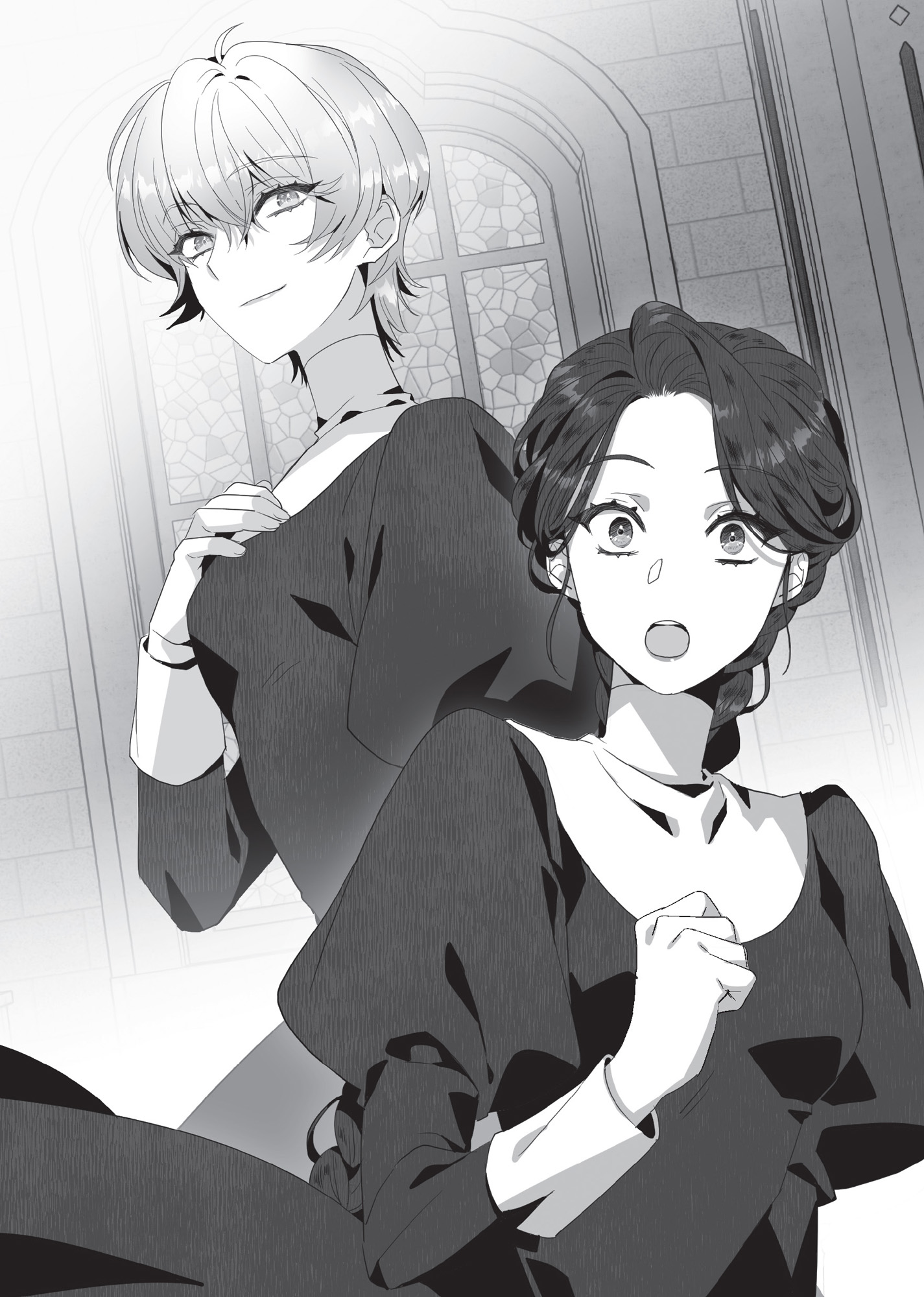
I suppose even Lady Lestea couldn’t completely flout the church’s rules. Seemingly reading her thoughts, Lestea flashed a wry grin of acknowledgment. But if nothing else, Claudia could tell that Lestea was still binding her chest. That’s one point she wasn’t willing to compromise on, no doubt.
“At Bari’s request, I’m here to worship the Capricious God alongside you. Prince Raul is at the royal castle,” said Lestea.
“I hadn’t heard anything about you two coming.”
“Of course not. We made our voyage secretly to surprise you.”
Raul and Lestea loved festivals. They’d said as much back when they were at the academy. Maybe that was a trait all Barians shared.
There will be much they need to discuss, though.
There was the upcoming Saint’s Festival as well as the refugee problem, which was sorely testing Bari’s king. The man was known for his love of efficiency and practicality. Claudia almost suspected he’d refuse to take in any refugees, if not for the nigh inevitable backlash.
I wonder if Syl is as surprised at Prince Raul’s appearance. She couldn’t help smiling as she pictured it.
“Now that you two have reunited, allow me to explain what your purification will involve,” Carlo cut in. At his prompting, Lestea and Claudia took their seats on one of the nearby pews. He was reviewing the process already laid out in the rules document Claudia had been given beforehand. “You’ll be worshipping the Capricious God for two days. That means you’ll be spending tonight here, in one of the grand cathedral’s guest rooms. I will explain the facilities as they become relevant. But first…”
He guided them to the altar, where their worship promptly began.
“You may pray for whatever you wish, as there are no rules about that. Speak directly to the Capricious God himself if you like. Please continue your prayers until I call for you.”
The two women clasped their hands in prayer and closed their eyes. The first thing that popped into Claudia’s head was the refugees, driven from their homes because of the war. She hoped that they would find peace again, and that the war would end as quickly as possible.
Silence rang in Claudia’s ears as she prayed. It was a transparent, colorless thing that pinged off the white walls and echoed around her. And after reflecting off everything around her, it climbed all the way to the dome and escaped through the spire at the top. Even with her eyes closed, she could feel the light pouring over her.
She kept praying until Carlo said, “That’s enough. Come, stand and take a breath. In and out.”
Claudia followed his instructions and breathed in deep before letting it all back out again. She hadn’t realized how much tension she’d been carrying until it eased from her shoulders.
“You’ll be doing the same thing in every area we visit henceforth.”
Carlo led the way with Claudia and Lestea following close behind. They traveled down a corridor lined with towering columns, moving from the cathedral proper to a connecting structure. Surrounded by such colossal constructions, Claudia felt incredibly small.
“Quite simple, isn’t it?” Carlo called back to them.
“Yes,” Lestea and Claudia agreed in unison.
“You don’t need anything to pray but your own will. Status and environment are irrelevant, as are power and wealth.”
Everyone was born with a will, and they would continue to possess it until death. Anyone could pray—no matter when, no matter where. One only needed themselves to do so.
“In fact, you might say it’s the one thing anybody can do, even if they can’t do anything else. It’s proof that we are human.”
Beasts couldn’t pray. Only humans could articulate their thoughts and feelings and send them to the heavens.
“If there’s ever a time when you feel completely powerless, I want you to remember that. Remind yourself that, if nothing else, you can always pray.” Carlo beamed at them. “There’s no need for you to feel helpless. Prayer is incredibly powerful. There are some priests who believe that even prayer is a gift that the Capricious God has given us.”
“Do you hold that opinion, Father Carlo?” Lestea prompted.
Claudia suspected he didn’t, or else he would’ve expressed it more directly.
Carlo scratched his cheek. “I’m a very easygoing person. If prayer helps a believer find the courage to move forward, then I don’t think it matters whether it’s a blessing from the Capricious God or a curse.”
Lestea gawked at Carlo. Those were two wildly extreme sides of the spectrum, but he was obviously telling them the truth.
Carlo went on, “That courage to move forward can be even more powerful if one has a basis for it.” Some people felt it more strongly than others. The motivation was more important to Carlo than the catalyst—but for believers, he would sometimes borrow the words of the other priests.
“I think what’s most effective is your own character, Father,” said Claudia. “You’ve been giving us that courage this entire time by supporting us.”
It was the way he delivered it too. It felt more personal than professional.
Carlo’s face lit up in a smile. “I’m glad to hear it. Those who guide others need to practice self-care more than most.” Someone overloaded with stress wouldn’t have the mental bandwidth to look after others. Only those with the necessary capacity could look beyond themselves and spend time and attention on those around them. “You’re both assertive and self-confident. That’s probably why I was chosen to guide you. And I’m not worried about you being able to look after yourselves.”
Still, everyone was susceptible to exhaustion. No matter how much mental capacity one possessed, attending to the many problems of others would eventually wear them out. That was what made self-care so important, lest one wear themselves too thin. Carlo’s main point was that rest was essential.
“I speak from experience,” he added.
“Your advice is greatly appreciated,” Claudia told him.
Lestea nodded. “Yes, I can tell everything you’ve said is genuine, and it’s been most illuminating.”
While they were lost in conversation, they arrived at the next room where they were due to pray. Claudia and Lestea set about their worship, breaking away after a while to chat with Carlo as he guided them to their next spot. Their time with him was quite productive indeed.
Chapter 11: The Villainess Enjoys Her Stay
Chapter 11:
The Villainess Enjoys Her Stay
A PINK SKY PEEKED through the window. Between stints of prayer, Claudia and Lestea had spent their time chatting with Carlo, then briefly had tea. It wasn’t as tiring as Claudia had expected. If it had been, she would’ve been concerned about her own stamina.
Their day’s worship was at an end, and Carlo was currently giving an explanation about their stay.
“As you’ve already experienced, Lady Claudia, the faithful retire early. This is partly to conserve candles, but you’re welcome to use the lantern in your room however you see fit.” That said, they needed to wrap up their schedule while the sun was still out, which meant they’d need to eat dinner quickly and take their baths. “A sister has been assigned to help you with that, so she can give you further details about bathing. I will excuse myself for the night.”
“Thank you for today,” said Claudia.
“You as well, my lady.” He bowed and left, a warm expression on his face.
As soon as he was gone, the sister took over. She was the same age as Claudia and Lestea. Her hair was parted neatly in the back and tied low, falling over either shoulder.
On their way to the cafeteria, Lestea happily declared, “What a delightfully affable priest!”
“Yes, yet he’s direct and wise with his words,” said Claudia. “I truly admire him.”
A priest oversaw other members of the clergy. Some were strict, some were warm. There was quite a variety of personalities among the priesthood, but the one thing they had in common was a knack for leadership. One specific cardinal stood out as the worst possible incarnation of those skills, but she shooed him from her mind. He was an exception to the rule. An exception among exceptions.
The cafeteria was inside a monastery on the grounds of the grand cathedral. The baths and guest rooms were in the same building. Claudia and Lestea dined with the sister, and once their bellies were sufficiently full, they moved to the baths.
“We prepared a medicinal bath for you today,” said the sister.
“Thank you.”
This was part of their purification process. Incidentally, the church also provided Claudia with the herbs for medicinal baths at home whenever she liked.
The sister joined them for their bath. Generally, a nun was required to attend to everything herself, but Claudia and Lestea were noblewomen. The only reason to have one of the nuns accompany them through their meal and bath was so that she could offer support where necessary.
Claudia was accustomed to doing everything herself, especially because she’d very recently done so for two weeks as part of her princess training. Lestea was similarly used to dressing herself without any aid. She had no problem peeling off her uniform the moment they entered the changing room.
Claudia regularly performed stretches and other light exercises to maintain her shape. Lestea, on the other hand, focused more on building muscle, as evidenced by her well-defined abs.
“Muscular women are beautiful in their own way,” Claudia remarked, impressed.
“Your praise means the world to me,” replied Lestea. “But personally, I think you’re the true definition of beauty, my lady.”
While they complimented each other, the sister glanced between them and muttered, “I didn’t realize noble ladies were concerned enough about their bodies to exercise as well.” She probably thought aristocrats were too pampered to bother. That was true of some people, such as Lady Thomas.
“In my case,” said Claudia, “I’m only trying to pursue my ideal body type.”
“The same for me,” Lestea chimed in. “I’m more muscular than most ladies, save for perhaps those in Parte Kingdom.”
Parte was unique in being a warrior nation where all were expected to train and bulk up regardless of gender or age. However, in more recent times, women from influential families weren’t held to the same standards and could get away without training too much. Lestea’s figure was probably rare even among them.
The sister nodded thoughtfully as she digested their answers. She reached down and pinched her stomach. “That’s incredible. I ought to exercise too.”
“If you’re interested, I’d be happy to teach you my methods. As long as you don’t overdo it, you shouldn’t build too much muscle,” said Lestea.
The woman’s eyes lit up. “You mean it?!” She eagerly took Lestea up on the offer, but they agreed to save it for after their bath. As warm as the changing room was, it was no place to stand naked and chat at length.
As soon as they stepped into the bathroom, Claudia cried, “Oh my!”
What hit her first was a wall of steam, followed by an herbal aroma. Once the steam cleared a little, she was awed by the vastness of the room and the size of the tub. This was a sunken bath. The walls and floor were covered in white tiles, some of which had flowers painted on them.
The capital was densely populated, which made land scarce. There wasn’t a single aristocrat with a bath this large. The Lindsays had several in their mansion, but they were all built to accommodate only a single person at a time.
“At most, we can fit about twenty people in here, which is why it’s so large,” explained the sister. “The three of us will have it all to ourselves today because we rescheduled bath time for the rest of the sisters!”
They clapped in delight. Claudia didn’t normally find bathing that exciting, but she was taken by the sheer size of this one.
“White stones—the kind you find in a riverbed—line the bottom of the tub, so I hope you enjoy the feel of them.”
Claudia’s anticipation grew. She and the other two soaped up their bodies and rinsed before dipping into the bath itself. The stones along the bottom tickled her feet, and an unbidden sigh slipped past her lips. Once she was seated, the water rose to her collarbones. It was the perfect depth.
“This is so relaxing,” she murmured.
Today hadn’t been that exhausting, but fatigue built up over time. The hot medicinal bath made her feel like she was sweating it all out.
“The chill crept in as we were praying earlier,” said Lestea as she settled beside Claudia, her eyelids fluttering shut.
The changing room and cafeteria were kept heated, but the chapel in the grand cathedral had no temperature control, save for a few braziers. That was the only reason they hadn’t completely frozen; Carlo always instructed them to pray close to a brazier.
The three women exchanged comments about how relaxing the bath was.
“This feels less like purification and more like taking a bath at a spa,” said Claudia. There was nothing challenging about this. It made her second-guess whether this activity really satisfied the church’s requirements for purification.
The sister grinned at her. “That’s wonderful to hear! If this helps refresh you, that’s exactly what we want.”
Claudia was reminded of what Carlo had said about the importance of rest and self-care. Apparently, those were the important points she was supposed to focus on during her stay.
“The more serious and dedicated a person is, the worse they tend to be at looking after themselves. Busy people tend to prioritize everything else over their own needs. There’s nothing wrong with taking it easy sometimes.”
It was crucial that the saint’s attendants do just that.
Claudia indulged herself, stretching her arms and legs out. Her breasts came bearing through the water. Feeling the other women’s eyes on her, she glanced at them. Both women hastily averted their gazes.
“What’s the matter?” Claudia asked with a tilt of her head. A lock of hair was glued to her cheek from the moisture.
After a short pause, Lestea blurted out, “It’s too much temptation!”
Claudia thought it was a little late for such comments. They had already seen each other naked in the changing room.
“I thought I was used to seeing other women naked since we so often enter the bath in large groups, but I was wrong,” said the sister. “I didn’t realize another woman’s body could make me feel so nervous.”
Claudia blinked. “What is there for you to feel nervous about?”
Lestea planted her hands on Claudia’s shoulders and spun her around. “Regardless, have some mercy on us. Your wet, nude body is too provocative!”
“Of course I’m nude and wet! I’m taking a bath!” Claudia said with growing confusion.
“How are your maids able to keep their composure?” Lestea wondered aloud.
This conversation wasn’t going anywhere. Claudia could already see they weren’t going to give her any real answers.
“The way a normal person does!” she shot back despite it being a rhetorical question.
Lestea, for her part, was doing her best not to look directly at Claudia. “They must be incredibly brave.”
Are they? Claudia had never thought about it. “You’re exaggerating.”
Lestea’s reactions were so entertaining that Claudia spun around and threw herself at her.
“Whoa!”
Lestea’s body was firm, but it wasn’t all hard planes. She had the softness of a woman’s body too, and she was slender enough to fit comfortably in Claudia’s arms.
“Ah! Y-your breasts are pressing against my back!” Lestea stammered.
“They are, aren’t they?”
“Ngh!”
Mere seconds later, Lestea sank into the water, her whole face bright red.
***
The cool air felt pleasant against Claudia’s flushed skin. She wore a wide grin as they stepped out of the bath, whereas Lestea’s face sagged with exhaustion. On their way to their room, they bumped into a knight with a large, leashed hound. The dog was adorable, with dark-brown fur and a long tail that whipped around excitedly.
The sister stepped in front of them and spoke briefly with the knight before returning to their side to explain the situation. “The dog is here for the evening service on behalf of its master. A servant brought it here, as they apparently reserved accommodations without asking if they were pet-friendly.”
And, as it unfortunately turned out, the inn was very much not pet-friendly. With no other options, the servant had asked if the grand cathedral could look after the hound for one night. It was a friendly dog, rolling on its back to show its belly to the women. With permission, they were able to pet it.
“I’ve seen people attend service with their dogs before, but I’ve never heard of someone sending their dog on their behalf,” said Claudia.
“If they attach a message to the dog’s collar and send it along, it’s allowed to attend in their place on its own,” the sister informed her.
Claudia struggled to absorb this. “On its own?”
“Yes, well, knights will leash it at the entrance and accompany it inside, so it’s not completely alone.”
Claudia wasn’t sure if she should be amazed at how obedient these dogs were or shocked at the audacity of their masters. She couldn’t settle on an opinion; there were so many ways to view this situation.
“Are other animals allowed to do the same?” Lestea asked.
“As long as they can deliver the wishes of their master, yes. There are intelligent cats and birds capable of doing this as well.”
The church generally allowed any animals on its grounds as long as they posed no threat and had no destructive tendencies. Maybe this was an extension of that policy.
“It seems the church is quite welcoming, then,” Lestea said diplomatically. Then she muttered under her breath, “Awfully broad-minded approach for such a conservative institution.”
Only Claudia was close enough to hear it.
Lestea was right about the church being old-fashioned and stuck in its ways, but it was welcoming where faith was concerned. They had saved many people.
Claudia cast one last glance back at the dog as they left. It was funny to think that prayer was supposed to be a blessing from the Capricious God for humans when a canine, of all things, was here doing it on someone else’s behalf.
Lestea leaned in, her breath hot on Claudia’s ear. “You already have a loyal hound right here.”
“Stop speaking nonsense.”
“I was being completely sincere.”
Claudia’s lips thinned. “My apologies, then. I’d rather you speak nonsense.”
Was this Lestea’s way of getting back at Claudia for her behavior in the bath?
Glowering at her, Claudia said, “It would bother me less if you’d said you were joking.”
Chapter 12: The Sister Becomes the Saint
Chapter 12:
The Sister Becomes the Saint
AS THE SEASONS CHANGED, the cold began to creep in. But today was one of those rare, pleasantly warm days with plenty of sunlight. The girl held her hands up toward the sun, staring at the endless blue canvas unmarked by a single cloud.
“It’s the perfect day for meal service,” she declared.
“It really is!” the red-haired sister readily agreed. Her eyes sparkled. “It’s almost like the very weather is celebrating you.”
“Come on, you’re being overdramatic.”
Lately, they’d been spending all their time together. The red-haired sister had become increasingly attached to the girl ever since she saved that homeless boy.
By the time they’d finished their preparations for the meal service, they were covered in sweat. The labor involved in feeding so many people was always intense. When the large gate to the monastery swung open, the sisters were greeted by fanfare.
“Wh-what’s all this about?” the girl asked nervously. She had never experienced this before. From the clamor of the crowd, she picked up one word that the people kept repeating: saint.
The redhead leaned toward her ear and whispered, “They’re all looking at you.”
The intensity of the people’s gazes startled the girl, but it wasn’t altogether unpleasant. She didn’t feel that familiar sense of discomfort at the prospect of visiting the town, largely because they weren’t ogling her with amusement. Unfortunately, there was a larger crowd present than ever before.
“We’re offering a free meal service. Those in need, please line up!” shouted the senior sister.
There were people in expensive finery amid the crowd, which left the girl at a loss. These services were just supposed to be for the poor, for the people who really needed to eat.
“For the moment, focus on handing out the meals,” the senior sister instructed. She must have noticed how rattled the girl was.
“All right.”
The senior sister had given the girl a stern warning once they returned to the monastery in the wake of saving that boy, but otherwise, she had softened considerably.
I assume it’s because she approves of me more now.
The very thought made the girl so happy, she could hardly suppress her smile. She had assumed that her melancholy days would never end, that the monastery would be nothing more than a prison to her. It had taken her a single action to change it all, as evidenced by the smiling faces around her.
I was too much in my own head before.
All it took was breaking out of her own inflexible viewpoint. After that, finding the answer had been surprisingly easy. She had taken a long detour to get where she was meant to be because of her own misguided thinking. She’d been blind to the answer in front of her.
No one was perfect. People were incredibly weak, and thus they formed communities to survive. Overcoming obstacles was important, but one could only make progress by working within their means. The girl had saved that boy without thinking; her body had moved on its own. And as a result, people praised her for it. She’d felt lost in a path of tangled thorns before that moment, but that experience had changed everything. The whole world had unfurled before her. From there, she realized that there was a price for freedom, and that sometimes restrictions could be a form of protection. And no matter how powerless she felt, there was still something she could do. She didn’t have to save the whole world—that was beyond her. She just needed to help the people she could.
“Saint, Your Eminence, thank you for this meal.” The same elderly man from before clasped her hand as he spoke, and she no longer felt as disgusted by it.
It shocked her how much she had changed.
I didn’t realize that a shift in perspective could have such an impact.
She flashed a smile at the man and handed a meal to the next person in line. This elderly man normally took forever thanking her, but this time, he saw how many people were gathered and didn’t dawdle.
“Your Eminence, you’re the light in the dark for us!”
The red-haired sister had been right. Everyone was there to see the girl. It felt strange being called “saint” and “Your Eminence,” but the reality was starting to sink in. Her whole face flushed with embarrassment. This was the kind of reassurance she’d needed to know she was on the right track.
They hailed her as a light in the dark, but she felt the same about their praise. And they continued to commend her until the meal service ended.
***
It had been an exhausting day, but with that came a sense of immense satisfaction.
I guess this is what it means when people say something feels rewarding.
The girl was in a hall typically used for resting after the day’s labors. Groaning, she stretched.
The red-haired sister massaged the girl’s shoulders. “It’s been a long day for you,” she said.
“You don’t have to do that.”
“It’s fine, I want to. It must’ve been hard dealing with so many people.”
“You were helping me deal with them,” the girl reminded her.
“It was nothing. I was only supporting you.”
Many of the people who’d gathered earlier had been there to meet the girl, not to receive a meal. The senior sister had finally obliged them by having them form a line to pay their respects to her. It had been a chaotic mess to organize, since they hadn’t anticipated the crowd. The girl hoped the attendees would forgive her for that. Something of the sort had never happened to either the girl or the monastery before.
“The priest was delighted because we received so many donations,” said the red-haired sister.
“Good to hear.”
The priest wasn’t exactly part of their everyday lives. The girl spent more time with the senior sister than anyone else, so she often forgot he existed. But he was the leader of their monastery. Today’s crowd had been a welcome surprise, if only because their monastery’s budget was extremely tight.
“There’s tension in the air tonight, though,” the girl noted. “And it doesn’t seem to be related to the meal service.”
“That’s probably because everyone’s excited, what with it being that time,” said the red-haired sister, waggling her brows.
She was referring to the regular delivery from the mainland. The ship was late, but it always carried letters from people’s families. Those waiting to hear from their loved ones were on tenterhooks. They were trying not to show it in front of the ever-vigilant senior sisters, but the girl could feel the change in atmosphere.
“I wonder if something happened?” the red-haired sister said. “Gosh, I hope there wasn’t some kind of accident.”
“We’ll just have to pray everything is all right.” The girl clasped her hands as she said that. The sister lifted her own hands from the girl’s shoulders and followed her example.
Their actions had a ripple effect on the rest of the room, and soon the other sisters were praying too.
I never dreamed so many people would put so much importance in my words and actions.
As much as it shocked her, it also warmed her heart. She couldn’t help but giggle.
Soon enough, word reached them of the ship’s arrival. Cries of joy filled the room.
“Quiet!” hissed the senior sister, the same one always keeping a close eye on the girl. She glowered at them, but her sour expression disappeared as soon as the sister who had been waiting down by the harbor returned. She had a flustered look on her face, which was so unusual that everyone took notice. She strode straight up to the senior sister and started whispering.
When the senior sister noticed all eyes on her, she cleared her throat. “Ahem!” Straightening, she turned her gaze to the girl. “You, and you,” she said, motioning to her and the red-haired sister, “and a few others, pair up and come with me.”
What’s this about? The girl shot a questioning glance at the red-haired girl, but she was equally lost. Thus, the girl put her suspicions aside for the moment; if she took too long, the senior sister would give her another scolding. Hurriedly, she and the red-haired sister followed.
***
Once they left the hall, the senior sister led them to the drawing room. One of the other senior sisters came along and rounded up all the other girls to help carry supplies from the harbor—apparently, there were more than usual this time—and the red-haired sister was forced to accompany them. The girl was left on her own, save for the strict senior sister who served as her minder. She found it rather fishy.
Together, they entered the drawing room, where a man in clean, stately attire awaited them. He had cropped black hair and looked to be in his thirties. The girl had never seen him before. Judging by his sunbaked skin, he’d been on the ship from the mainland. His uniform marked him as a member of the clergy. He had to be fairly high up in the hierarchy too, because the senior sister bowed low before him. The girl mimicked her actions.
The man urged them to take a seat on the sofa opposite him. A coffee table was sandwiched in the middle. “Apologies for how abrupt this is. I’m afraid it’s my fault that the regular shipment was so delayed.”
That explained why the letters were so late, then, between this man coming and the extra supplies.
“We’re simply glad you arrived safely,” said the senior sister, her face hardening. She was acting as if the man’s visit was entirely unwelcome.
But isn’t it a good thing that he brought us more supplies? The girl found her senior’s reaction curious. She didn’t have to wonder for long why he’d come, though.
“Hmm. She’s the sister I’ve heard so much about, yes?”
“Yes, she is,” the senior sister answered stiffly.
The man grinned at the girl. “Word of you has reached the mainland. I was anxious to meet you.”
The girl was dumbfounded. How had the mainland heard of her? Then again, the supply ship had visited them several times since she’d saved that boy. It wasn’t odd that the story had reached his ears.
“Not only did you save a boy, but the speech you gave when you did so really struck a chord with me. No wonder the islanders universally praise you.”
“How polite of you to say,” the girl mumbled.
“Oh, but of course. You must be surprised, having a stranger visit you out of nowhere. I’m sure this feels like a bolt from the blue, but I come bearing good news.” He snuck a glance at the senior sister, then launched into an explanation about the upcoming Saint’s Festival. Several candidates had been put forth for the role of saint, and the church’s higher-ups were locked in debate about whom to choose. “I would like to nominate you for the role.”
“Me?”
“Yes. The islanders already call you a saint. Why not take this opportunity to take up the mantle officially, with the church’s approval?”
This was sudden. The girl’s head spun, unable to keep up. She’d never heard of a Saint’s Festival before now.
“I’m not sure I’d be a good fit,” she hedged.
“Aren’t you interested in sharing your way of thinking with more people?”
“Well, yes, but…” The girl hesitated, remembering how she had saved the boy and how it had felt to change the minds of all those onlookers, who’d been so amused at his plight before she interceded. Ever since, she’d received loads of encouragement from the townspeople.
“Personally,” the man went on, “I think poverty is to blame for such crimes, not the people who commit them. I’d like to work with you to spread your message.”
There was a limit to what she could accomplish on an island like this. What if she could speak to the people on the mainland and open their eyes to the plight of the less fortunate? She could picture it now, delivering her message to massive crowds. It would be a lie to say she wasn’t tempted.
The girl drew a deep breath. Sitting up taller, she answered, “I think there’s still much for me to learn here.”
At that, the tension seemed to drain out of the senior sister. She must’ve been nervous about the man coming to take the girl away, preferring to keep the girl under her thumb. There was a reason she was always haunting the girl’s steps. The girl had realized that much after all these years together.
She treats me like I’m some kind of troublemaking misfit.
It was odd, considering the girl hadn’t caused trouble for the senior sister for some time. She had resisted the senior sister’s command when saving that boy, but that had been a unique situation.
The man nodded as if he accepted her decision, but he was more tenacious than his initial response suggested. His lips peeled back in an animated smile. “I’ll be staying here for the night. If you change your mind, let me know.”
“All right. I appreciate your consideration.”
With that, the conversation was over. The senior sister bowed and excused them both, then guided the girl toward the harbor to help the other sisters haul in the supplies.
Chapter 13: The Villainess Bewitches
Chapter 13:
The Villainess Bewitches
THE GUEST ROOMS at this monastery were no less impressive than the sort found in an aristocrat’s mansion. The furnishings weren’t made by first-class craftsmen, but the dressers and table were made of dark mahogany with a beautiful antique design. Upon entry, they were greeted by a drawing room that led into a separate bedroom. Two beds sat side by side to accommodate both Lestea and Claudia.
“The next room over is also a guest room, isn’t it?” Claudia asked pointedly. She already knew there were no other guests staying the night. The hound from earlier was being kept in the knights’ barracks. Lestea could have taken the other room.
“I volunteered to stay with you since, naturally, you’ll need someone to help look after you,” said Lestea.
“Sisters are supposed to handle everything on their own.”
Realizing her flimsy excuse wouldn’t work, Lestea dropped to one knee and hung her head. “Please give me the honor of staying with you!” she begged.
Of course she would act like this the moment they were alone.
“Fine,” Claudia huffed. “Only because I have no other choice.”
“Thank you so much!”
“I’m not doing this for you,” Claudia added quickly, lest Lestea misunderstand her. “If we changed our arrangement now, it would cause trouble for other people.” She couldn’t discount the possibility that the neighboring room would require preparation before it was ready for a guest. Still, she’d made this decision with great reluctance.
Lestea’s eyes sparkled with delight. “You won’t regret this!”
Claudia sank into a sofa in the drawing room. “Please, sit. You’ll only wear me out if you keep this up.” They would have visitors soon. While they waited, she addressed something that had been niggling at her. “Do you know why you were chosen to be A Priori?”
It was obvious why the church had selected Claudia: She was the crown prince’s betrothed. Lestea’s selection was less clear. Even Elizabeth had found it incredibly unexpected.
“They praised me for dressing in men’s clothing and refusing to be bound by stereotypes,” Lestea said flatly.
Ironic, then, that they’d forced Lestea to wear a sister’s uniform for the duration of her stay.
Lestea inhaled deeply and went on, “I’m being used to demonstrate how open the church is to new ideas despite its typical conservatism.”
If the church had been genuine about accepting her, they would’ve allowed her to wear men’s clothing. They had left a nasty taste in her mouth, but she’d softened after seeing how gentle and open Carlo was.
“They made it clear that I won’t be allowed to wear men’s clothing for the Saint’s Festival either.” Lestea shrugged. “I only accepted this duty because it means having the honor of sharing the same title as you.”
“I assume the general populace has no idea you typically dress in men’s clothing, then.”
“That’s correct!”
Bari’s nobles were aware, but the same could not be said for the average citizen. Their world was largely cut off from high society. Word might leak past that social barrier and circulate through the rumor mill, but if they had never seen Lestea wearing men’s attire in public, they wouldn’t make the connection.
“It’s all an act for the church, aimed at the aristocracy. It’s staggering how closed-minded they are,” Lestea grumbled. Her tone shifted as she added, “At least the cardinal was understanding.”
“Really?”
Like Harland, Bari had its own cardinal.
“Ours is a woman,” Lestea explained. “She has a very progressive way of thinking. We got along well. Once I became the saint’s attendant, she informed me about the political situation within the church, so my sacrifice had its benefits.” And because of that, Lestea had deduced the reason for Gique’s sudden absence. “Seems like the church found another possible candidate for saint. When I heard about it, nothing was set in stone yet. Considering how suddenly Gique was called away, though, I’m guessing they’ve made up their minds.”
“That does seem likely.” Claudia had been wondering why Gique left so abruptly. It made sense now.
The other candidates for saint were relatives of sitting cardinals. She wouldn’t have been surprised if the decision revolved around political infighting. What did surprise her was that a new candidate had emerged out of nowhere. She would have to be exceptional to make the church consider her over the other options they already had.
“Whether she becomes the saint remains to be seen and will require some maneuvering to accomplish. Not that who gets chosen really matters to Bari,” said Lestea.
That was quite the statement for one of the saint’s attendants to make. Harland was intent on keeping the church out of its politics, so odds were decent that they would keep the saint at arm’s length.
It would behoove us if she’s reasonable, though.
While Claudia was lost in thought, a booming voice outside their door announced the arrival of their visitors. Lestea hopped to her feet and opened the door, ushering the visitors inside.
When Sylvester and Raul stepped in, Claudia’s jaw dropped. They were wearing long, flowing robes, much like Carlo’s.
Sylvester seemed pleased by her reaction. A smile stretched across his face, his eyes crinkling. “The public cannot know of our visit. We borrowed these uniforms to blend in.”
“To ‘blend in’?” Claudia repeated in disbelief.
That was impossible. The two princes were eye-catching enough on their own, but even more so when they were together. They were too handsome to simply “blend in.” Sylvester’s very existence was like a crown of gold; he had natural gravitas. Raul was more like the sun, with his rich-brown skin and cheerful personality. The lack of any decoration or excessively fancy attire made their inherent beauty stand out even more.
Those robes should hide the lines of their bodies—yet, strangely enough, I can make out every detail.
Gravity pulled the fabric down, tightening it over the swells of muscle and sinew. This was true of even Sylvester, who typically looked slenderer and more unassuming in such clothing. If Claudia wasn’t careful, she’d start ogling.
This is the grand cathedral, she reminded herself. This is the holiest place in the capital. Begone, impure thoughts. Please. Begone!
Her desire to rush into Sylvester’s arms was stronger than ever, perhaps because she was prohibited from touching him. While she struggled with her baser urges, Sylvester slapped a hand over Raul’s eyes.
“What the hell?” Raul demanded.
“I’m doing this for your sake,” Sylvester said plainly.
“I don’t buy that!”
“It might be better to crush both your eyeballs instead.”
Raul flinched. “Why are you threatening me to hurt me all of a sudden?!”
What in God’s good name were these two doing? Claudia stared at her fiancé, unable to figure him out. She hoped he would notice her attention and afford her an answer, but instead, he was looking anywhere but directly at her.
“Aha!” Lestea said from beside Claudia, as if this all made sense to her. “A person is at their most attractive after taking a bath.”
“Goodness!” Claudia cried. “I haven’t done anything but apply my moisturizer to my skin.”
Lestea’s words had reminded her that she wasn’t wearing any makeup. Normally, Helen would take care of that for her. Even when they took trips and stayed somewhere overnight, Helen brought enough cosmetics to give her a natural look, at least. Claudia’s hands flew to her hair, which was still damp from earlier.
I can’t believe how thoughtless I’ve been! Panicked, she blurted out, “I’m so sorry, I didn’t prepare for your visit!”
“Er, no,” Sylvester muttered back hesitantly. It was rare for him to be at such a loss.
Unable to see anything, Raul cocked his head. “What’s going on?”
“My liege, you seem to have missed the most important part of what I was trying to tell you,” Lestea said.
Claudia’s gaze zipped back to Lestea. “Pardon?”
“Right now, you are the most beautiful woman in the world.”
True, she had said something about people looking their most attractive after a bath. The problem was that the woman lavished Claudia with praise so often that she’d taken to completely ignoring everything out of Lestea’s mouth. This was one of those times she wished she had paid attention.
Lestea continued, “Bathing improves one’s blood flow. It’s especially effective in bringing out one’s natural beauty during this season, since people have a propensity for taking longer baths in winter. It’s helped rejuvenate your skin and reduced any swelling. Both men and women tend to look their best after leaving the bath.”
The explanation brought forth a memory of her brothel days. Mirage had once told Claudia that bathing was the most natural kind of makeup. Claudia was a noblewoman, so bathing was just another part of her daily life; she had completely forgotten Mirage’s words until now.
“Your skin is more vibrant than ever, and you have a natural blush to your cheeks. The lack of cosmetics has enhanced your plump, rosy lips. Yes, you’re the very picture of beauty!” Lestea uttered the last few words in a high-pitched, singsong voice.

Raul snatched Sylvester’s arm and pried it away, at last regaining his vision.
“Do you want to die, you bastard?!” Sylvester snapped at him, voice dripping with hostility.
“And who are you suggesting will kill me?” Raul huffed back haughtily. “You? Or Claudia with her beauty? If it’s the latter, I would welcome death’s sweet—”
His eyes finally met Claudia’s, and he froze completely. His mouth hung half open.
Sylvester ripped his arm out of Raul’s grasp, then plunged his fist right into Raul’s stomach.
“Guh!” Raul choked, doubling over. “You asshole, I can’t believe you…”
They had been amicable enough moments earlier, but they had devolved into name-calling. Sylvester was ready to fight if the situation required it—and, having recovered from the unexpected punch, Raul was eager to pay him back.
“If you two are going to resort to blows, take it outside,” Claudia told them, steel in her voice. What had they come all this way for? Sighing, she motioned for the men to take their seats once they displayed a willingness to back down.
Lestea insisted on taking the seat immediately beside Claudia, which earned her a glare from Sylvester. He didn’t fight her over it, though, since he knew he was prohibited from touching Claudia until the Saint’s Festival ended. Claudia also preferred to keep her distance to be on the safe side. Sylvester sat across from her, the coffee table between them. Raul took the seat beside him, opposite Lestea.
How long has it been since we sat across from each other?
Since confirming their feelings for one another—no, during a date before that, actually—Sylvester had insisted on sitting beside her as if it was the most natural thing in the world. He’d refused to concede that spot even when Virgil was present.
Although it was still early in the evening, light in the monastery was limited. Darkness was creeping into the rooms and halls. The oil lamp hanging from the ceiling bathed the room in a soft orange glow; it dyed Sylvester’s silver locks a vivid gold, to the point that they looked like honey. It enhanced his natural allure, and Claudia swore she could smell the sweet scent in the air.
She was reminded of the first time they met, when they had tea together. Sylvester had been so beautiful and aloof that he’d reminded her of a porcelain doll. That impression was long gone. The marshmallowy plumpness to his cheeks had faded. Sylvester had matured into a handsome man, his face all sharp angles.
While she was reflecting on the past, Sylvester quirked a brow at her. “What’s on your mind?”
“I was remembering the first time we had tea and sat across from each other like this.”
“Ah, that.” He nodded. “You were more mature than most ladies your age. Those fearless blue eyes left a lingering impression on me.”
“Did I really seem that impertinent?”
“Not at all. I was the impertinent one,” Sylvester assured her.
She remembered his scrutiny. She’d found him, and the whole royal family, intimidating.
“You didn’t offend me,” Claudia told him, “but you did make me nervous. That feels so long ago now.”
At the time, she had no way of knowing how intimate she would become with the crown prince.
Sylvester smiled at the memories—all the months and years they had spent together since.
Next to him, Raul leaned his cheek against his fist, looking intrigued. “Huh. Claudia’s childhood? Now that’s something I’m interested in.”
“Don’t picture it. You’ll taint it,” Sylvester barked at him.
“Why do you treat me like I’m a plague?”
They were getting distracted again. Claudia needed to bring their attention back to the topic. They didn’t have much time, certainly not enough to waste on these shenanigans. The church had allowed this visit, but the group had been warned to keep it brief.
“My apologies for getting preoccupied by such sentimentality,” said Claudia. “Prince Raul, I assume the reasons you and Lestea are in Harland are the Saint’s Festival and the refugee crisis?”
Raul didn’t seem bothered by the abrupt change of topic. He nodded. “The church has approached Bari about accepting refugees as well. After some negotiation, we have agreed. We’ll be providing as much assistance as possible, but you know what my brother’s like. I came to ask if there’s any other way I can contribute.”
Bari was closer to the conflict zone than Harland was. Understandably, they’d been quicker to agree to the church’s request.
“The refugees will be entering our borders through Parte,” Sylvester said, picking up where Raul left off. “We’ve already decided how many will be sheltered in each region. Your father will probably have more information for you later.”
The negotiations were finally over, then.
“It’s taken a while,” Claudia noted. “I only hope this doesn’t cause chaos for our people.”
“Yes, we’re committed to avoiding any clashes between our citizens and the incoming refugees. We’ll be publicizing the decision ahead of time, but especially at the start, we should keep the refugees separate.”
Harland had the wealth and resources to support the incoming refugees, but it also had impoverished citizens of its own. If the people felt that the crown and its administration were prioritizing the refugees over its own populace and dissatisfaction festered, they could have a rebellion on their hands. It was better to keep the two groups separate and observe the situation to prevent that scenario. However, it was up to each regional lord to make the call on how to handle the refugees allotted to their care. That put quite a bit of pressure on the leadership.
“We’ve implemented a temporary policy to put control in the hands of the regional lords.” Sylvester massaged his brow as he spoke. This policy was probably a result of the prolonged days-long negotiation in parliament.
Bari seemed to have reached their decision without nearly this much pushback. Whether they were able to welcome the refugees without issue remained to be seen, but Claudia already knew that the king would abandon the refugees if he deemed it necessary. This was the same man who had once driven his own brother from the country. His calculating nature was actually useful in this situation, since it provided reassurance that the people would always be his first priority.
“I came to relay the information while I’m able,” said Raul. “But the situation is complex.”
The refugee crisis was similar to the situation with the slums. There was no single answer to everything, no way to stop the war that had created this crisis to begin with. And so, they were left with only one option: Once the refugees arrived, it would be trial and error until they found something that worked.
Raul leaned forward. “It’s important to share intel, right? The refugee crisis is an international matter, after all. It’s not something one country can shoulder on its own. To some degree, we have the same religious creed and speak a common language, but no church is exactly the same.”
A difference in values could be a source of contention. It was a given that no two cultures would be identical, but if there were some commonalities in languages and beliefs, then that could provide some support for what was otherwise an incredibly stressful situation. That would also facilitate open communication, which helped.
“Unfortunately, the financial burden has been hefted onto each country willing to assist with the crisis,” Sylvester said with a bitter expression.
The church was on the front lines, welcoming what refugees they could, but the supplies were bought and paid for with each allied country’s donations. Parte was dispatching mercenaries to guard the refugees as they made their way from their war-torn homelands, but as soon as they crossed the border to their new country of residence, that country was fully responsible for them. It was human nature to help those in need, and it wouldn’t be right to expect anything in return. That said, it was an enormous burden—physically and emotionally. The church was supposed to provide emotional and spiritual support, but it had its limits.
“I can only hope that the Saint’s Festival helps reassure everyone,” said Claudia.
The saint was a symbol of hope, a reminder that everyone would receive salvation regardless of birth status or financial standing. The church had its own political interests in appointing a saint, Claudia knew. Still, she hoped the saint would soothe people’s hearts.
“Regardless, our only option is to support the church. Though I’m not too fond of the notion that they’re gaining power,” said Sylvester.
The church’s actions were benevolent, but Claudia and Sylvester both knew from experience that some would use that power for ill. That, and there were wicked people serving the church. Despite these concerns, they could do nothing but rely on the church’s position as a unifying force. Bari and Harland wanted the Saint’s Festival to be a resounding success. And ideally, their prayers for peace would finally reach the people waging this war.
The king of Bari wasn’t the only one who prioritized his self-interest; all nations were primarily concerned with their own stability. The church was the only neutral organization not associated with any specific country.
This whole situation really makes me think, and not just about the refugee crisis.
Harland was trying to find a way to operate politically without relying on the church. They had only recently liberated themselves from the church’s influence and had intended to continue down that path when this refugee crisis cropped up. Despite their long history, their expansive lands and superpower status hadn’t allowed them to achieve complete independence from the church.
We can only take it a step at a time and achieve what we can.
To borrow Carlo’s words, one was never completely powerless.
“Being appointed A Priori has been a sobering experience,” said Claudia.
Sylvester regarded her with open concern. “Be careful not to overburden yourself.”
She giggled. “If anything, praying has been incredibly refreshing.” Claudia filled him in on the details of her day, and he nodded.
“It’s important to keep your stress to a minimum. Now if only they would allow us to touch.”
“We mustn’t,” Claudia insisted, knowing what he was hinting at. “This is part of the purification.”
He opened his mouth, likely to argue the point, but Lestea cut him off. “You two should be leaving soon. You can entrust care of her ladyship to me.”
“Perhaps they should prohibit physical contact altogether,” Sylvester muttered.
Claudia grinned at her beloved’s pettiness.
“As much as I want to laugh at his pain,” Raul told Claudia, “it upsets me that I can’t at least shake your hand. If Lestea tries anything funny, you have my permission to kick her.”
“Oh, please. Don’t act like I’m a savage brute like you! I would never do anything without her ladyship’s consent!” Lestea spat.
“You know what? Even if she doesn’t try anything, kick her anyway. You’ll have my full support.” Having delivered his seal of approval, Raul snatched Sylvester by his collar. “I know how much you wish to linger, but it’s time to go.”
Sylvester sneered. “I would prefer if you didn’t try to empathize with my feelings.”
“You’re the only person who spurns my goodwill, you know!”
“True,” said Claudia, chuckling at their antics.
As reluctant as she was to part with Sylvester, they would see each other again. Touch was the only thing they were forbidden from doing, so that was encouraging. Watching the two men snipe at one another as they left kept her from feeling too crestfallen about not being able to touch Sylvester. She was initially skeptical about having to share a room with Lestea, but perhaps it was a good thing after all.
“There. Now it’ll be just the two of us until morning.” Lestea flashed a hopeful smile at her.
Claudia leaned her head back and stared up at the ceiling. “Please don’t make me regret my decision to let you stay already.”
Chapter 14: The Duke’s Son Shows Appreciation for the Maid
Chapter 14:
The Duke’s Son Shows Appreciation for the Maid
THE LINDSAY FAMILY CARRIAGE trundled along, pulling out of their driveway as Claudia set off for the grand cathedral. Virgil watched from the front entrance of their estate. His heart throbbed with an indescribable pain. He stared after his younger sister until her carriage disappeared completely, and even then, he hesitated to return to their manor.
This feels like a rehearsal.
It wouldn’t be long before Claudia moved into the royal castle. How much longer did he have with her, here at their family estate? He was feeling more sentimental than usual, perhaps because he hadn’t been able to hug his own sister thanks to the purification prohibition.
A wintry breeze caressed his cheek. He combed back his disheveled bangs, at which point he finally noticed he wasn’t alone. “Helen, you must be freezing.”
“Please don’t worry about me,” she said.
“No, it’s my fault for getting lost in thought. Come, let us go inside.”
Helen wasn’t the only one who had lingered with him; the other servants were still standing there too. Lilith had wanted to attend but unfortunately had fallen ill. It was for the best that she hadn’t come out in this chill.
Once they were all back inside and the door was firmly shut behind them, blocking out the cold, Virgil relaxed.
If I’m going to do it, I should probably do it now.
While the other servants were returning to their posts, he flagged Helen down. They moved to the fireplace closest to the front entrance. He only had a little time until he had to set out for the royal castle to join his father.
“I would like you to have this,” he said, producing something from his pocket. The parcel was wrapped in the same paper used for his gift to Claudia before she left, but the ribbon was a different color.
Knowing Helen, he suspected she would refuse him outright. He preempted her by adding, “It matches the one I gave Dee. I think she would be happy if you wore it too.”
Using Claudia as an excuse was a bit unfair, he realized, but he was being genuine.
“When the gemstone was fully processed, we were left with two perfect stones,” he explained. Normally, he would have picked the better of the two, but it was impossible to choose between them. “I studied them side by side and thought of you and Dee. You two are inseparable, after all. I already gave Dee hers.”
Virgil had heard that Claudia gave Helen gifts regularly to express her appreciation. He hadn’t initially intended to give Helen a present; rather, he’d wanted a matching pair for himself and Claudia. Yet when he laid eyes on the Lindsay Blue stones, he changed his mind.
Previously, Virgil had consulted Kiel about feeling alienated in his own home. It was a bit embarrassing, in retrospect, but Virgil had found it easy to confide in the boy detective. Ironic, since he usually thought of Kiel as needing his protection, what with the boy’s terrible luck. Kiel had advised Virgil to speak with Helen to resolve his concerns. That was partly why, when he saw the two gemstones, he felt compelled to convey his appreciation for her.
Before Helen’s arrival, it was Martha who looked after Claudia. That was a given, as she’d been their governess since before his mother’s passing. She was more of a teacher than a friend to Claudia. What his sister really needed was someone her age with whom she could be herself, and Helen had given her the space to do so. He could never support Claudia the way Helen had, hence his gratitude. Although he’d been a bit suspicious of her when she first came to their estate, he held no such misgivings now.
“Dee won’t be able to wear jewelry while she’s staying at the grand cathedral, but she can keep it with her. Having a matching bracelet should help encourage you in her absence,” said Virgil.
There were times when he felt Claudia was closer to Helen than she was to him. The two women needed each other. If he could support them both, nothing would make him happier.
Helen stared at him, wide-eyed, perhaps caught off guard by how passionately he’d pitched his gift. “I’m awfully undeserving of this, but I will take good care of it.”
“Good,” he grunted. The tension left his face, and his lips tugged up at the corners. He hadn’t realized until then how nervous he’d been. It struck him as strange; why, he was only giving her a gift.
His gaze fell to her flushed cheeks. His hand stretched toward her, fingers brushing her skin. He wasn’t sure why he did that. Maybe it was just because she was within reach.
“I’m sorry. You must have felt so cold outside.”
“N-no!” Helen stammered. “It’s not the cold, I… No, it’s nothing! Excuse me!” She dipped her head and scurried away.
As she turned her back toward him, Virgil’s eyes caught on the stray hairs that fell free from her neatly combed bun. Then his attention moved to her pale, slender neck. There was nothing special about any of it—or at least, there shouldn’t have been—so why did it feel like everything about Helen was more vivid, more captivating? His heart thrummed, and he pressed a hand over it. He’d never felt like this before.
The moment he stopped to reflect on what he’d done, all the blood drained from his face. “Oh, dash it! Did I upset her by touching her without her consent?”
Claudia had impressed upon him the importance of respecting a lady’s personal space. Many women targeted him for his status and unscrupulously sidled up to him, so he was always careful to maintain his distance to discourage such overtures. Helen was always calm and composed. Her being so flustered as she rushed away could only be because of him, right?
Maybe she was more terrified than disgusted.
Virgil was a tall man, with considerable muscle thanks to his morning training with the knights. He also had an intimidating face, with naturally narrow eyes that gave him a perpetual glare. The reason people referred to him as the Ice Scion was his aloof expression. He was aware of how much he scared people.
Next time I see her, I’ll have to apologize.

With the lingering image of Helen rushing away in the back of his mind, Virgil climbed the stairs to prepare for his trip.
***
Once all the preparations were through, Virgil descended the staircase and headed for the front entrance. Spotting the very woman he’d intended to apologize to, he stopped to hail her.
“Hele—”
He cut himself off before he could finish calling her name. Helen was already dealing with a guest. Thankfully, he’d realized and reined himself in to avoid interrupting them.
In moments like this, his late mother would’ve scolded him and insisted he call out to Helen anyway. The master of the house needn’t show such deference for the help, she would tell him. It wasn’t until he saw the way Claudia treated the help that he’d changed his way of thinking. He understood why his mother held such rigid beliefs: On one hand, if a master didn’t conduct himself with the dignity expected of his position, he would only cause more trouble for his servants. On the other, thanks to his younger sister, he had also learned that flexibility was the best way to maintain pleasant relationships with others.
A mother’s lessons were important, to be sure, but one should always improve upon them with their own experience and knowledge. Mothers usually simplified their explanations for their children, so their lessons sometimes lacked context. Virgil’s situation was a bit different. Before he was old enough to think critically, Claudia was already setting a shining example. He struggled at first to understand everything she did, and there were times when he thought she was wrong.
Butshe’s always been cleverer than me, even when we were children.
At any rate, it would’ve been impolite of him to interrupt Helen right now, especially because he wanted to apologize to her personally. It wasn’t official house business.
That’s Brian of the Evans Company, isn’t it?
Though Virgil could only get a glimpse of the man over Helen’s shoulder, he recognized the man. Claudia maintained close business relations with the Evans Company; she had made some good friends while at the academy. Brian himself was only a baron’s son, but he and his family had enough business acumen to garner praise from the other merchants the Lindsays had close ties with. Brian had probably come to deliver a sales report to Claudia.
Virgil suspected his presence would only make Brian unduly nervous. He slipped behind a nearby pillar.
Hold on a moment. Aren’t I being a bit dramatic?
He was the duke’s son. What was he doing, hiding in his own home? Still, there was something about the friendly atmosphere between Helen and Brian that made him hesitate to show himself.
While Virgil struggled to understand his own actions, Brian’s booming voice reached his ears. “There’s a wonderful eatery I’d like to take you to if you’re interested, Miss Helen!”
“Excuse the intrusion, but we don’t accept personal invitations,” Virgil interjected. He’d moved without thinking—and what for? After he’d purposefully hidden himself so as not to disturb them? And now here he was, acting like Helen’s bodyguard, blocking her from Brian’s view.
Both Helen and Brian were startled by his unannounced appearance, but Virgil stood firm. He stared down his nose at Brian. There was a sliver of a moment where Brian’s eyes widened, but he bravely met Virgil’s gaze without backing down.
Oh? He refuses to avert his eyes, does he?
There weren’t many who could do that. Most of high society thought Virgil cold and unfeeling. They found him intimidating, probably in part because of his status as a duke’s heir. The only person around his age who outranked him was Sylvester.
Brian didn’t strike Virgil as fearless. If anything, it seemed he recognized Virgil’s superior status—felt threatened by it, even—but was nevertheless brave enough to stand his ground.
He would have to be brave to approach Helen like this.
It wasn’t all baseless courage, though. Brian’s defiance was calculated. He knew how much Claudia valued him, and no matter how much Virgil outranked him, Brian was convinced the man couldn’t make a move against him so easily. Or maybe it wasn’t Claudia’s favor that Brian counted on to save him. If word got out that Virgil had done something to a lowly baron’s son, it would reflect poorly on him. Aristocrats were all about reputation, especially when it came to households with unmarried daughters.
Whatever it was that empowered Brian, he was no fool. Virgil could tell that much.
Knights learned to predict their opponents’ moves while training. Virgil could read someone during a confrontation, but only when he and the other person were of similar intellect and were on the same wavelength. Achieving this may have sounded simple enough, but people possessed different perspectives and levels of intelligence. The less similar they were, the less likely they would be to identify with each other. Thus, Virgil’s ability to read Brian made him like the other man more.
That said, he wasn’t willing to budge when it came to Helen.
Virgil wasn’t sure how long they glowered at one another. It was probably only a few seconds, though it felt impossibly long.
Helen was the one to break the silence. “Lord Virgil, I apologize for causing you extra trouble.” She turned to Brian. “Lord Brian, as Lord Virgil has already expressed, I don’t accept personal invitations.”
Brian’s shoulders slumped. “All right,” he said after a time. “That’s a shame.” His disappointment didn’t last long, however. He braced himself and stared straight into Virgil’s eyes as he declared, “But I won’t give up!”
He spoke with enough steel that it sounded like a declaration of war. Yet without context, his words would’ve invited misunderstanding. Anyone who walked in at that moment would have assumed that Brian was saying he wasn’t going to give up on Virgil rather than Helen.
Helen must have realized that as well because she let a giggle slip. “You make it sound like Lord Virgil is the one you’re inviting out.”
When it registered that Virgil was of the same mind, Brian gawped at them. “Wha…?! Uh, no! That’s not what I meant!”
“No need to worry,” Virgil assured him. “I understood your intentions.”
“Thank goodness.” Brian let out a sigh of relief. “Uh, well then, if you’ll both excuse me…”
Virgil grunted at him. “Just know that you’ll have no second chances if Helen complains to me about your behavior.”
Brian nodded. “Yes. I know how to be a proper gentleman. I wouldn’t want to upset her anyway.”
“Good.” If Brian was as sincere as he sounded, then Virgil wouldn’t have to worry about him harassing Helen. Besides, he had earned Claudia’s favor, and Helen respected her mistress’s views. Brian wouldn’t have gotten this far without earning Claudia’s explicit approval time and time again.
Helen is too important to Dee for her to allow this behavior if she didn’t think Brian was good enough.
Once Brian left, Virgil turned to face Helen.
“Thank you for stepping in,” she said, bowing her head low.
“I think my intervention was unnecessary.” Considering how assertive she had been in her refusal, she clearly hadn’t needed Virgil’s protection. He was worried she might take his actions the wrong way, so he quickly added, “To be clear, I didn’t do it because I thought you were incapable. I just felt the need to protect you.”
“Of course,” she answered with a nod.
He was relieved she hadn’t misinterpreted him. Now was the perfect moment for him to address what had happened earlier.
“About earlier, I…” He hesitated. “It was thoughtless of me to touch you like that. It was my fault for causing a potential misunderstanding.”
“Misunderstanding…” Helen’s whole body stiffened. “I should be the one apologizing for getting so flustered.”
The way she froze was as good an indication as any that his actions had bothered her.
“I would never do it to anyone else,” Virgil added in a panic. “I reflected on what I did and realized that I don’t have my guard up when I’m with you. That isn’t to say I blame you. It’s through no fault of your own, and the issue lies entirely with me. I think I tend to relax when you’re around, and—”
“Um, Lord Virgil, you don’t want me to misunderstand, right?”
“Correct. A man shouldn’t so casually put his hands on a woman of marriageable age. I realize my mistake.”
Helen nodded slowly. “Yes, I understand that part. You are a gentleman through and through. I know that.”
What a relief. He didn’t want her thinking he went around doing that with every woman he encountered.
“Apologies for taking up your time. I wanted you to know that I don’t act like that with other women.”
“Right.”
“You’re the only woman I’ve given a present to as well,” Virgil went on. “Any other gifts I have sent to others were purely out of politeness.”
“Understood.”
“You’re the only one,” Virgil reiterated. “You’re special to me. I don’t mean to push those feelings on you, I—”
“Um, Lord Virgil, please calm down a little!”
Virgil stared at her. “I am perfectly calm.” He was so relieved to have cleared things up with her that he’d started rambling. Though now that he got a good look at her, her whole face was bright red. “Apologies! I didn’t realize you were ill! Someone, call a doctor!”
“It’s fine!” she squeaked at him. “I’ll be perfectly fine!”
“You shouldn’t push yourself! I would hate for anything to happen to you.”
“I realize how impertinent this is, Lord Virgil, but could you please close your mouth?”
“A-all right,” he stammered, uncertain.
Helen seemed to have difficulty even speaking to him at this point. He was about to march off to summon a doctor himself, but she stopped him.
“I’m really all right,” she insisted. “You’re getting ready to head out to the castle, aren’t you? Then don’t worry about me. There’s no need to delay your departure.”
Her words reminded him that he had a carriage waiting outside, but he couldn’t simply abandon Helen if she was ill. He studied her face. Her eyes were misty, and the color in her cheeks suggested a possible fever. Thank goodness Brian had already left. Virgil didn’t want him to see Helen in this state. No, he didn’t want any man to see her like this.
“I must apologize for this in advance,” said Virgil.
“Huh? Lord Virgil, what are you—”
Virgil realized he was betraying his own earlier apology, but he had to do something. His own concern for her superseded any desire for propriety. He wanted to take her somewhere private where she could rest, so he slipped his arms around her, lifted her like a bride, and carried her to an empty room.
“I’ll call Martha. You will feel more comfortable with her looking after you, I’m sure.”
“Y-yes!”
He gently set her down on a sofa, inquiring about her comfort before he left to summon Martha. While he would have preferred to summon a doctor immediately, Helen wouldn’t let him. Instead, he opted to leave the final decision to Martha. There were health issues a woman could only discuss with other women. As much as it pained him, he knew that as a man, there were some problems he could not solve. Before he left, he commanded Martha to keep him updated.
He was relieved when word later came to the castle that Helen was all right.
Chapter 15: The Maid Blushes
Chapter 15:
The Maid Blushes
AFTER RETURNING TO HER ROOM in the servants’ dormitory, Helen changed into more comfortable clothing and curled up on her bed. Martha had arrived soon after Virgil left. Helen had assured her that everything was Virgil’s misunderstanding, but Martha had refused to listen. She said that Helen had a habit of overworking herself in the first place—and since Claudia was out, it was the perfect opportunity for her to rest.
I’m not sick at all, though, thought Helen. But her whole body relaxed the moment it hit the mattress, and she was out like a light.
When she awoke, the sky outside was painted orange.
“The head maid was right.” Helen had been more fatigued than she’d realized. She’d slept soundly without even realizing she’d nodded off. She reached for the water carafe on her side table. After several gulps, she let out a sigh.
Helen flopped back on her bed. Getting up at this point wouldn’t do any good. Her mind conjured an image of raven-black hair and blue eyes—not her mistress but the man who so resembled her. She thought of his pronounced brow that seemed to communicate his strength of will, and the beautifully sculpted line of his nose. Virgil’s eyes were such a dark shade that, depending on the light, they appeared azure. They were like gemstones, akin to the very sapphires everyone referred to as Lindsay Blue.
I wonder if Lord Virgil realized what he was saying? Helen wasn’t sure he did. At least, not completely.
It was like when an art teacher asked you to draw an egg. Were you supposed to draw it as a circle, as if viewing it from above? Or more like an oval, as if viewing it from the side? It was the same object, but depending on the perspective, it could be drawn differently. Likewise, perhaps Virgil’s words had an entirely different meaning than she thought. That had to be it. Why else would he say she was special to him?
But what if? What if he meant it the exact way she had interpreted it?
There’s simply no way.
She snatched up her pillow and hugged it to her chest. Heat built in her cheeks again, and it was very much not caused by illness. Helen wouldn’t have blushed this easily if she weren’t so shaken.
Urgh, is this what it’s like in high society?
The memory of Virgil’s voice telling her “You’re the only one” echoed in her mind. She slapped her hands over her ears, as if that might help. But it obviously didn’t. His words continued to reverberate in her skull.
Forget what he said, Helen commanded herself. Forget his voice, forget the way he touched your cheek, forget the firmness of his fingers.
Her eyes caught sight of his gift, which she’d set beside the water carafe. Crawling on her stomach, she snatched it up. The ribbon was a beautiful violet color, probably chosen because of her eyes. She unfastened it and peered at the bracelet nestled within. A layered cross in the shape of a star, with a sparkling sapphire set in its center, hung from the thin silver chain. It was indeed identical to the one he had gifted Claudia.
I love it.
It didn’t suit someone like her, of course. As a maid, she shouldn’t have accepted such a gift. Yes, the gemstone was as small as her pinkie nail, but still, it was Lindsay Blue. It would cost her several years’ salary to afford such a thing herself. The sapphires were so rare that few aristocrats possessed something like this.
What delighted her the most wasn’t the value of the piece, however; it was Virgil’s thoughtfulness. She’d nearly dissolved into tears when he talked about hoping that having a matching bracelet with Claudia would encourage her. Helen knew she should have refused the gift despite his words, but she couldn’t. She didn’t want to.
Helen clutched the bracelet to her chest. Lady Claudia…
Claudia was foremost in her thoughts, but Virgil followed close behind. She was endlessly grateful to them both.
She remembered how relieved Virgil had looked, smiling at her when she finally accepted the gift. Those narrowed eyes had softened, the air around him turning gentle and warm. Her cheeks heated again and, ignoring the discomfort of lying on her stomach for this long, she buried her face in her pillow.
It’s cheating, really.
Helen recalled how he’d glared at her when they first met. His attitude toward her gradually softened over time, but unlike his sister, he kept all the servants at arm’s length. Virgil was equally aloof with everyone, which was why his reaction had been so unexpected. She hadn’t been ready for it. She had never even imagined he would smile at her like that. It had pierced straight through her wall of professionalism and hit her square in the heart. If she weren’t more careful, she might have misunderstood his intentions.
When Virgil brushed her cheek, warmth had coursed through her entire body. Her blood had felt hot as lava. It wasn’t until he apologized later that she finally regained her senses—but now she was losing herself to giddiness again.
What did he mean about feeling relaxed around me? Everything he’d uttered suggested she really was special to him. But special in what way? Special because she’d served at Claudia’s side for all these years? That had to be it, right? Yet it felt more personal than that. He’d been so open and vulnerable with her that it was hard to believe it was just a gift to express his gratitude as her employer’s son. Don’t be silly, Helen. You know it’s not that deep.
She blamed his face. The man was incredibly handsome but always so aloof that he felt unapproachable. It was only with Claudia that he showed his softer side, and now he’d shown it to Helen too.
It didn’t matter.
Helen was a maid. Nothing more. She may have once been an earl’s daughter, but her family had since lost that title. She was a commoner now. That’s right, and don’t you forget it. Helen repeated this like a mantra dozens of times.
She sensed a presence approaching and turned to look. “Oh, Candy. You’re home.”
The fluffy cat hopped on the bed, her fur tickling Helen’s cheek.
When Helen first took Candy in, the cat had been tiny enough to fit within Helen’s cupped palms. She’d grown so much. Normally, Candy returned to the room before Helen did, but not today. Candy seemed to find that odd. She was nudging her head against Helen. Helen sat up, put the present box aside, and lifted Candy into her arms. The feline purred happily.
Candy had beautiful snow-white fur and vivid orange eyes. She had become something of a mascot for the dormitory. During the day, she patrolled the grounds, taking naps wherever she deemed appropriate and receiving affection from whomever she encountered along the way. Helen wasn’t quite sure what Candy thought of her, but Candy would always return to Helen’s room by sunset. Helen’s roommate would often bury her face in Candy’s fluffy belly, which earned her a perturbed look from the cat.
While Helen gently massaged Candy’s face, which prompted her to purr even louder, the door swung open and Helen’s roommate plodded in.
“How are you feeling? Wait, what happened to your face?” asked the roommate.
Helen snatched up her hand mirror. She’d been flailing around on her bed, so her hair was a tangled, unkempt mess sticking up in all directions. She used her fingers to comb it down and at least make herself look more presentable. “To answer your first question, I’m fine.”
“You don’t exactly look fine.”
“Don’t I? I slept like a log. I’m worried whether I’ll be able to sleep tonight.”
Her roommate scrutinized her face. “If it’s not physical, I assume it’s mental. If it’ll make you feel better to talk about it, I’m all ears.” The woman approached, leaning her head toward the cat on Helen’s lap. Candy shot her an irritated look.
Maybe it would be better to voice it than to keep wrestling with it on my own.
It would be easier to define her own feelings if she could get someone else’s input. And so, she decided to spill her guts—without mentioning names or specifics, of course.
“Is this about that guy from the merchant family?” the roommate asked.
“No.”
“Aha, then the merchant’s son has a rival now! Whoever it is, I’ll bet they’re head over heels for you.”
Helen shook her head. “I very much doubt that.” She was only “special” to Virgil because of her connection with Claudia. She couldn’t say as much to her roommate, or it would be too obvious who she was talking about. It was frustrating not being able to share all the details.
“Well,” said the roommate, “how do you feel about this new guy?”
“Me?”
“You always refuse men outright, no matter what they say. If you’re waffling this much about it, then you obviously don’t dislike him. Right?”
“He’s a good person,” Helen acknowledged.
“If he asked you out on a date, would you say yes?”
“There’s no way he would ever ask me.”
“Hypothetically, then,” said the roommate. “Picture it. He casually invites you for tea. You prefer something more casual over a big to-do, right? Well, come on, close your eyes and imagine it.”
At her roommate’s prompting, Helen finally shut her eyes and imagined Virgil sitting at his desk, tackling a mountain of paperwork. He’d been so busy lately with the refugee crisis, which was probably why he looked like that in her mind’s eye.
He needs a break more than I do.
Despite everything he had on his plate, he had fussed over her—a mere maid!—and people in high society still had the audacity to call him the Ice Scion. The name didn’t fit him at all. He was so much like his sister. They were both noble souls, always prioritizing other people over themselves even when they were exhausted from their own toils. The more she let her mind wander, the further she strayed from the image her roommate had prompted her to picture.
“Well?” said her roommate.
Helen shook her head. “All that did was convince me now isn’t the time for such silliness.”
“Goodness, you are too work-focused! But I guess it’s not all bad. Life must be pretty good for you to have room to worry about things like romance.”
Upon delivering those wise words, the roommate set about burrowing her face in Candy’s fur.
Many men and women were married off by their families once they came of age. That didn’t only apply to the upper class either. From what Helen had heard, it was common in the provinces for parents to negotiate their children’s matches with family friends. Keeping close connections made everyone’s lives easier.
Helen recalled the lowest point of her life. If it had benefited her family, she would have married anyone. She hadn’t had the luxury of considering otherwise. The stress of their situation had been like a boulder, crushing her. She couldn’t see anything beyond the problems immediately in front of her. Claudia had saved her then, when she could find no other way forward. If not for Claudia, she wouldn’t have been able to consider her possibilities.
I know Lord Virgil didn’t mean anything by what he said. Helen had let his words disillusion her. I’m probably being so sensitive because I’ve started considering marriage.
After Elizabeth’s suggestion, Helen had found herself wanting to be Claudia’s nursemaid if they could make it work. Virgil had refused Brian’s invitation on her behalf, but Helen needed to give it serious consideration. She had to figure out where her heart was.
Unfortunately, she didn’t think she’d find the answer anytime soon.
Chapter 16: The Sister Is Canonized
Chapter 16:
The Sister Is Canonized
“HOW DOES IT FEEL, leaving the island?” asked the priest, who had introduced himself at last as Father Norris.
The girl glanced back at the island. It was barely visible from the mainland, a mere dot amid the crashing waves. “I wish I could say I feel free. Instead, I feel reluctant to leave it behind.”
Although she had initially rejected Norris’s offer, she later changed her mind and decided to depart with him. Prior to taking the leap, she had consulted him about her concerns, and he’d assured her everything would be taken care of. Alas, the red-haired sister wasn’t with her. The girl had left the island all by herself.
“Of course. You’ve parted ways with the people who care for you, so it’s only natural for you to feel lonely without them. But I hope you’ll remember this: You’re special. You’ll be a symbol of hope for many more people soon enough.”
She nodded. He’s right. I have a new goal now. She was like a chick that had finally shed the last of its eggshell, and she was big enough now that she could take to the wide-open skies on her own.
The other sisters are cheering me on too. It broke her heart to say goodbye, but even the red-haired sister had encouraged her to leave. Remembering her and the other sisters brought a smile to her face.
Determination renewed, she turned away from her former home and took a step forward. She didn’t regret her decision. She’d already decided to do whatever she could to help others. The girl hadn’t expected Norris to pick her as a candidate for such an important role, but if she had earned his notice through her actions, then she needed to continue down her chosen path.
Norris nodded approvingly at her.
The two left the harbor and climbed into a carriage bearing the church’s crest. It was nothing like the passenger carriages that the commoners often rode. This was on the level of an aristocrat’s possession.
I suppose that’s to be expected. As a clergyman, he’s bound to ride in a nicer carriage.
She already suspected Norris was high-ranking within the church, what with his crisp uniform and carefully groomed appearance. When she’d learned that he oversaw all the faithful at their monastery, she was shocked. No wonder the senior sister had been so nervous in front of him.
“I thought priests didn’t leave their monasteries,” said the girl.
“That’s normally true. A priest’s duty is to stay at whatever monastery they’re overseeing and look after the people beneath them. My duties as a missionary take up much of my time, however. I’m mostly preoccupied with visiting other monasteries, preaching, and expanding my knowledge.”
As Norris explained it, not all priests served the same function; what they did varied widely per individual. This was especially true for Norris, since he had no one backing him up. He’d climbed to his spot through his own diligent efforts.
“That’s different from my impression,” the girl mused.
The man always had a lively smile on his face. His general demeanor reminded her more of an aristocrat than anything else. If he hadn’t told her that he’d climbed up from nothing, she never would have realized that she had him all wrong.
Norris’s light-blue eyes crinkled as a smile spread across his face. “It sure brings back memories,” he said with a hint of nostalgia in his voice. “But you needn’t struggle the way I did. I hope you use this self-made opportunity to solidify yourself officially as the saint.”
Saints had the same authority as cardinals, though they weren’t eligible for pope because their duties were decidedly different. Still, a saint had significant influence among the people. The cardinals couldn’t ignore her input.
“Can someone as inexperienced as me really become the saint?”
When Norris first approached her about becoming the saint, she thought all she had to do was go with him and she’d be guaranteed the position. Naturally, it wasn’t that easy. There were other candidates.
“You needn’t worry,” Norris assured her gently. “You have the support of the people.”
“Yes, but that support is limited to the island, isn’t it?”
The worst part about her competition was that they were all related to distinguished cardinals. She hated that even within the church, the world was unfair. Her low social standing was a shackle holding her back. Unlike the other girls, she didn’t have anyone substantial backing her.
Norris grinned. “You’ll see what I mean soon enough.”
The carriage trundled along, turning onto a busy thoroughfare. When it finally rolled to a stop at the monastery where they’d be lodging, Norris handed her a white veil.
“This is proof that you’re a saint candidate. Keep it pulled over your head and exit slowly from the carriage,” Norris instructed. He disembarked ahead of her, then held out a hand.
The girl tugged the veil over her face, took his hand, and descended the carriage step. Voices erupted around her.
“It’s the saint!”
“The saint has arrived!”
“Where is she? I wanna see her too!”
Cheers accompanied their cries. The girl’s eyes widened; amid the cacophony of voices were children and adults alike. Her gaze swept the crowd that had circled the monastery. It had fencing instead of stone walls, giving her a good view of the people.
Norris suppressed a laugh at her reaction. “I told you when we first met, didn’t I? Word of you has reached the mainland. Rumors about the sister who was struck by a whip trying to protect a young boy have circulated widely.”
“Yes, you said that, but I never dreamed…” Her voice trailed off. “And how did they know I’d be coming?”
“I sent word ahead of time.”
When had he managed that? The only possible answer was that he’d arranged it the moment they arrived at the harbor. Even so, did information really travel this fast? There was definitely more to Norris than met the eye.
“You’re the people’s hope. Has that sunk in a little more now?”
“Yes!”
“I’m pleased to hear it, though I’m sure there’s still much for you to learn. Once you’ve had a chance to rest, I’ll explain more about your situation and what’s to come.”
They reached the entrance to the monastery, where the girl froze. She would have preferred to say something to the people rather than simply ignore them and leave, but their passionate reception overwhelmed her ability to speak. Moved by their support, she turned toward them and bowed low. That was enough to send another wave of cheers through the crowd.
***
A sister guided the girl to her quarters. Its floors and walls were made of wood, lending warmth to the room. There was also a carpet on the floor. Compared to her cold room of stone at the island’s monastery, the difference was night and day.
The room came with a small parlor at the entrance, furnished with a sofa to accommodate guests. There was a handcrafted desk with a chair in the corner, while the bed sat in the middle of the bedroom’s far wall. She made a beeline for it, her hands reaching to test the mattress. It was soft and plush, unlike the straw-stuffed one she’d been sleeping on. Her body trembled with anticipation. How long had it been since she’d slept in a proper bed?
She was tempted to flop on top of it, but Norris planned to visit her soon. It wouldn’t do to wrinkle her outfit and mess up her hair in the meantime. Remembering the warm reception of the crowd, she stood a little taller. No matter how strong their support, they might turn on her if she appeared too sloppy and unkempt. People’s hearts were fickle, and she couldn’t afford to be conceited.
Soon, a knock came at the door. She invited Norris inside.
“What do you think of your accommodations?” he asked.
“They’re wonderful.”
After being closed in by four stone walls for so long, this was paradise.
They sat on the sofa, and one of the low-ranking faithful slipped in to pour them fresh tea. It was customary for the clergy to do everything for themselves, but Norris and the girl were considered guests.
“All right, let me explain how the saint selection is playing out. As I’ve already told you, the other candidates are related to cardinals.” The church had decided to appoint a saint to establish an easily recognizable symbol of hope. The process had since devolved into a power struggle between the cardinals. “In other words, it’s all politics. Since the church is run by people, cliques naturally form, and clashes are inevitable. This is simply human nature. No matter how much one devotes themselves to the faith or treasures peace, they inevitably must confront an organization’s politics if they are to rise to power within it.”
There were always differences between people. Accordingly, those of the same faith could interpret their religion in different ways. It was nearly impossible for anyone to have the exact same beliefs. Still, the church’s doctrine served to unify disparate parties and bring them together.
“Everything I’ve told you thus far is common knowledge to the aristocrats in allied territories who are familiar with the situation,” continued Norris. “Thus, they’ll think the church is no better than their own governments. And I don’t mean that in a good way.”
The church was supposed to be a neutral and benevolent institution, unlike its self-interested allied countries. They couldn’t allow people to think they were similar. The people held the church to a higher standard, that much was clear; if they didn’t, they would be disappointed. The girl could understand that. As unrealistic as it was, the people expected the church to rise above the rest and lead them. It couldn’t do that if it were no better than the people it served.
“The clergy despises political infighting more than anyone else, knowing the repercussions it could have. That’s only natural. We have many clever people in our ranks, and they know what’s expected of us.” He paused, reaching for his teacup to take a sip. His eyes focused so intently on the girl that she felt like they were boring holes into her. “And that’s where you come in. You have no link to any of the cardinals, and you have the support of the people. You are a true saint. You’re a shoo-in for the position. Don’t you agree?”
The girl had been afraid that the circumstances of her birth would prevent any serious consideration of her becoming saint, but he argued that this was her selling point.
“It goes without saying that the cardinals who put forth their relatives’ names will argue against your appointment. They, too, have some support among the people. Yet these women were born with silver spoons in their mouths. What they possess arises from their blood connections to the cardinals. If the cardinals generate any blowback, it will look like selfish blustering on their part. It will be clear as day to anyone with the church’s best interests at heart who the saint should be.”
A saint was only chosen once a century. Allowing politics to interfere with such a storied ceremony would be unconscionable.
The girl was skeptical. “Will it really play out that smoothly?”
“As I said, there will be resistance. Some will even disparage you to your face. But don’t you worry. I’ll be your shield—and, more importantly, the people are rallying behind you. You saw the massive crowd that came when they heard of your arrival.”
The people, young and old, knew what she had done for the most vulnerable among them.
“It’s not just the islanders. You have changed the minds of everyone who’s heard of your actions. You will overcome this obstacle, and you will be the hope of the church.”
“I will?” she murmured numbly.
“Yes. You are the north star for those of us who don’t want politics in the selection process. You bring with you the winds of change, and you will light our path. I know it must be startling to hear all of this out of nowhere, though.” He spoke with such passion and conviction that the girl got the impression he was the one most disgusted by the nepotism of it all. “They might not express it, but there are many who agree with me—that I can tell you with certainty. As far as I’m concerned, you are our true savior.”
“Savior…”
A savior was exactly what she had hoped for when she was trapped in those stone walls. Back then, she never would’ve believed that she would one day save others. It still hadn’t quite sunk in.
“It’s all right,” Norris told her. “You don’t have to do anything special. I will take care of all trivial matters.”
“I appreciate your assistance,” she said.
“This is nothing. It’s an honor for me to serve our future saint.”
With that, their meeting ended.
Norris’s complete dismissal of all the other candidates was a bit strange, but that just indicated how much he believed in the girl.
I need to focus on what I can do and nothing else.
Even if she wasn’t chosen as the saint in the end, she had nothing to lose. People would see the scar on her back if she removed her uniform. It was proof that she, and no one else, had saved that boy on the island.
With renewed confidence, she curled up in her bed and fell asleep, the realization that even Norris needed saving hanging in the back of her mind.
***
In order to reach the seat of the Holy See, Norris had to take the girl through a mountain range. The church didn’t belong to any one country; its headquarters were located in a basin ringed by mountains.
The city in the basin was teeming with people: faithful who resided there and travelers on pilgrimage to the grand cathedral. At present, the girl and Norris were traveling by carriage along a well-maintained road leading to the cathedral. She glimpsed many buildings through the window, all of them boxy and white. There was so little individuality or color that everything looked covered in snow.
“The church’s knights exist to maintain public safety, much like the city guard in other countries,” explained Norris.
These knights wielded staves instead of swords and wore acorn-shaped helmets on their heads. It made them easy to pick out.
The church didn’t possess its own army, as there was no need for one. The mountains around them provided natural defenses. Anyone who tried to launch an assault would be blocked by the neighboring countries around the Holy See.
No one would ever be insolent enough to try that, though. The only hostile nation that might pull such a move was the United Kingdom of Arakaner, and even that wasn’t realistic with the current state of the world.
“It’s a winding path up the mountain. If you experience any nausea, let me know,” said Norris.
The cathedral was partway up one of the mountains. The journey could be made in a carriage, but the path snaked around, taking wide loops to keep the incline manageable. Many people suffered motion sickness from all the jostling along the way. Thankfully, the girl was perfectly fine.
This was her first time seeing (or visiting) a grand cathedral, though she had caught glimpses of it through the window during their long trip.
She wore her veil, which she had grown accustomed to by this point. Norris alighted first and then held out a hand to help her down.
“You’re nervous, aren’t you?”
Her fingers stiffened around his hand. “Yes,” she admitted. “I still can’t believe this is happening—that I’m going to be the saint.”
Norris had never second-guessed her chances, but the girl hadn’t known enough about the church to share his confidence. It felt surreal from the moment news arrived that she’d been chosen, and it still hadn’t fully sunk in.
She hadn’t done anything special. All she’d done was what she thought was right. Honestly, she thought that Norris’s efforts had a lot to do with the church selecting her; she wasn’t personally privy to the church’s internal affairs. Norris had promoted her and laid the groundwork for her ascension.
He’s incredible. Truly, he is.
She glanced up at the shrewd, black-haired man. Norris was the same as she remembered from their first meeting on the island. Everything she knew about church politics, she’d heard from him—but she could imagine how challenging it must have been to temper the cardinals’ opposition to her appointment. His ability to fulfill all the promises he’d made was astounding.
When the girl climbed out, she found the knights had formed a wall for her. She would be presented to the public during the official ceremony. In the meantime, they wanted to keep her identity under wraps. She hadn’t realized how much security she had until that moment.
She tilted her head back to look at the sky, but her breath was taken away by something else. The grand cathedral was more massive than she had expected; she had to crane her neck to follow the humongous white pillars to the top. They were as thick as about ten men, and there were rows of them along the central corridor.
The cathedral wasn’t gaudy, but it didn’t need to be. The sheer size was overwhelming enough. The entrance itself was like the mouth of a titan. Fear had her rooted to the spot before she could make it inside.
I can’t believe I’m afraid. The emotion was so unfitting for a place as holy as a grand cathedral. She was here to become the saint, yet an immense pressure akin to the hand of a giant was pressed down on her.
Sensing her trepidation, Norris gently patted her shoulder. “Yes, this is how a saint should react. You can already feel the breath of the Capricious God filtering through the cathedral.”
Fear was one of the most basic human emotions, especially when dealing with the unknown. She’d learned about that when she was younger.
“It’s all right,” Norris whispered to soothe her. “The Capricious God welcomes all his children. Now, breathe in deep…and exhale slowly.”
She closed her eyes. The air up here was so much clearer than it had been in the city; it filled her lungs as she followed Norris’s instructions. By the time she opened her eyes, the fear had mostly subsided. She was ready to continue.
When the girl stepped inside, the atmosphere around her changed. The pressure she’d felt while drinking in the full size of the cathedral had fully abated, and her steps felt lighter.
I wonder if this means the Capricious God has accepted me.
Her gaze dropped to the beautifully polished marble beneath her feet. Instead of a shadow, her own reflection stared back at her. It nearly stole her breath away again.
I’m here. I’m actually in the middle of the Holy See’s grand cathedral.
And she was headed to a restricted area, open only to the clergy. How surreal that she was about to venture where ordinary pilgrims could not. She had been granted this special permission the moment she became a sister, but it hadn’t felt special until now.
There wasn’t much difference between a regular person and those at the bottom rung of the clergy. But not even a king could enter the area where she was going. The girl couldn’t even begin to describe how emotional this moment was for her. Sentimentality welled in her chest, and heat built behind her eyes.
They arrived at the entrance to their destination, knights guarding it on either side. It was three times their size.
“This is the boundary between the mundane and the divine,” said Norris. With his signal, the knights opened the massive, heavy doors. It took significant strength to move them; as the opening grew ever wider, the other side slowly came into view.
What first hit her eyes was the light. She was startled by how it fell around the pedestal at the center, as if representing a great power in the room. There should have been nothing particularly noteworthy about it. The light was a natural facet of the space, pouring through a glass window on the ceiling. But it was so concentrated that it gave the illusion of being tangible.
“Go ahead. Touch it,” encouraged Norris.
She stepped forward and inserted her hand into the light. Nothing happened, of course.
“This is a monument meant to represent the Capricious God,” he explained. “Being as fickle as he is, our God doesn’t take any specific form. Rather, he can change his form to accommodate his believers. There are times when he takes the shape of light and others where he takes the shape of darkness. This place looks entirely different at night, which makes it even more interesting.”
Since they would be staying at the grand cathedral for a little while, he suggested she find the time to visit the monument after sunset.
The monument room was like a second entrance to the cathedral. It had other corridors branching off it. If one kept going straight back, they would find themselves in the pope’s office.
“Tomorrow’s Canonization Ceremony will be carried out in the chapel. Attendees are limited to only the faithful, which means the cardinals and any clergy serving at the grand cathedral. Once the ceremony is over, you will move to the front of the cathedral to address the common folk. There is nothing else on your schedule for today, so return to your guest room and rest. You need to regain your energy for tomorrow.”
“Yes, Father,” the girl answered with a nod. She had been reticent since arriving at the grand cathedral. The austere atmosphere had robbed her of the ability to express herself adequately.
“Once the Canonization Ceremony is over, you will be granted permission to take residence in the saint’s room. You will only need to stay in the guest room for tonight.”
Startled, she clarified, “I’ll have my own room?”
“But of course,” he said. “All high-ranking members have their own quarters here, from the pope to the cardinals. That includes those who spend time abroad. And, needless to say, the same goes for the saint.”
Norris escorted her to her room, where they parted ways. He promised he would come to see her tomorrow before the ceremony.
Who knew there would ever be a day in my life when I would find it difficult to relax? the girl thought.
Almost all the rooms at the cathedral had high ceilings and ample space. The furnishings looked smaller than they actually were. There was so much unoccupied, undecorated space in the room that it felt inordinately empty. But it was the fact that she was in the Holy See’s cathedral that so disrupted her composure. When she considered how she would be meeting the pope face-to-face tomorrow, her stomach roiled with anxiety. Until very recently, she had been on the bottom rung of the church’s hierarchy. Meeting the pope was as staggering for her as it would be for a commoner meeting their king. It was an astronomically huge jump.
The girl had learned proper etiquette when she was younger, so it wasn’t terribly hard to adjust—at least in that respect. The bigger question was whether she’d trip up in the moment.
Ugh, I’m not confident at all.
This was going to be a very long night.
***
As the girl had expected, sleep was impossible.
She needed to get out of her own head. And while she was at it, she figured she might as well visit the monument. Norris had advised her to do so, after all.
He said it looks entirely different at night.
Lantern in hand, she headed toward the entrance of the monument room. The corridors were illuminated at night, but the candles could provide only a faint glow in the dark. When she tipped her head back, the girl found the ceiling swathed in shadow. The longer she stared, the more ominous it felt, as if the darkness might drip onto her. She shivered with the absurdity of her imagination, then picked up her pace.
I wonder how the monument looks in all this darkness.
She wasn’t exactly hoping it would be anything special. Most likely, the church had it well lit enough to mimic the way the sunlight poured in during the day. That suited her fine. She was only visiting to take her mind off tomorrow’s ceremony.
The entrance glowed the same as everywhere else, and she smiled faintly. See, I knew it.
But when she stepped inside the room and approached the pedestal, the mirth drained from her face.
“It’s darkness,” she muttered in disbelief. “A beam of darkness.”
It was the exact opposite of what it had been during the day: dark as pitch, a solid stream of shadows pouring in from the window. But how was that possible? She scrunched up her face as she tried to puzzle out the answer, too distracted to notice someone else approaching.
“Why, hello. I see you wasted no time following my advice,” said Norris.
“Father Norris, how is this possible?”
The priest chuckled, pleased she’d reacted the way he’d hoped. “Confused, are you? Of course, this is your first time seeing it. But there is nothing strange about it. It’s simpler than a magician’s trick.”
He went on to explain that it was careful manipulation of light that created this phenomenon. “The light gradually grows brighter from the hall as you approach the pedestal. It’s probably difficult to notice when you’re holding a lantern yourself.”
To test his theory, she stepped away from the monument, put her lantern aside, and approached the pedestal once more. This time, she noticed the gradual change. He was right. Even from afar, she could tell the entrance was brighter than the hallway. She felt silly. She’d noticed the lights, but she hadn’t put two and two together. Why had it caught her so off guard?
As if reading her thoughts, Norris said, “When you approach, you’re too distracted by what you’re seeing to consider how it works. No matter how wise someone is, they are inevitably awed when they first see the monument at night.”
“This monument really makes you think, doesn’t it?”
It was so perplexing that it drove all other thoughts from one’s mind, and it wasn’t immediately obvious until experienced for oneself.
“Is your stomach still bothering you?” Norris asked. He must’ve noticed how much of a nervous wreck she was ahead of the ceremony.
“It’s a little better now,” the girl admitted. “This was a good distraction.”
“That’s good to hear. I was worried it was my fault. I haven’t put too much pressure on you with all my expectations, have I?”
Even before she was chosen, Norris had repeatedly told her that she was a symbol of hope for the people as much as the church. He’d also taught her about the current political situation across the continent, which was how she’d learned about the refugee crisis. A protracted war in the conflict zone had driven a vast number of people from their homes. Honestly, she wasn’t sure whether she would really be able to save them all, but that was no reason to withdraw herself from consideration.
“I want to do everything I can,” the girl told Norris honestly. “If there are people out there in need, I want to help. That’s what drove me when I lived on the island, and that’s what drives me now.”
He smiled warmly, as if he had expected that exact answer from the beginning.
I wonder if I’m that transparent.
Despite how he doted on her, Norris always seemed so relaxed. There was no hesitation in his eyes as she peered at them through the darkness. She was probably nothing more than a child to him; he’d risen this far through his own efforts. Obviously, he was more experienced.
“You really are the only right choice for saint,” Norris said. “Your benevolence will be the salvation for many. I guarantee it.”
Talking to Norris helped her mind settle. She was confident she could finally fall asleep without succumbing to any racing thoughts.
Light and darkness, huh? The monument changed dramatically between night and day. It was a shame that so much thought had gone into its construction and only the faithful could see it. The girl wondered how the red-haired sister would react.
Thinking back, she realized the red-haired sister had long been a guideline for her actions. Though they were apart now, she had spent enough time with the red-haired sister to be able to imagine her reaction. She would probably express her surprise more openly than the girl had, but in the end, she would smile.
The girl plopped down on her bed and heard her friend’s voice in her mind, eventually drifting off to sleep.
***
The Capricious God had no definite form. Many stories depicted him appearing as light. At the Canonization Ceremony, the pope was framed with light streaming in behind him, which reinforced his position as the Capricious God’s messenger. The light was so blinding that the girl didn’t even notice all the attendees.
When the pope called her name, she approached. He draped a stole over her shoulders. They probably exchanged a few words after that, but she couldn’t really remember. Once it was over, Norris assured her that she had conducted herself with dignity—and that was a great relief.
“Now,” he told her, “it’s finally time to present you to the people! Do you remember your speech? If you forget anything, look at your notes.”
He was more excited than she had ever seen him. Maybe that was a given, since he was the one who had nominated her. At long last, his goal to have her named saint had become a reality. Being her backer would give him more influence than he’d had before. His reaction spoke of his expectations for her.
I’m really the saint now, aren’t I?
The weight of the stole on her shoulders was proof of it. A person’s raiment changed depending on their rank within the church. The cardinals wore a white mozzetta with a stole over it. The saint wore similar garments, though her stole was a different pattern than the cardinals’. It was white with blue embroidery, and it was one of a kind. This same stole had been passed down through generations of saints. It was surprisingly pristine, but the fabric was incredibly old.
I feel like I’m dreaming. Her nerves told her that this was very much reality, but she felt like she was walking on clouds as they headed to the front of the cathedral, where she was to address the public.
The first thing that struck her was the sheer number of people. The knights formed a wall in front of the platform, so she couldn’t see her audience until she rose to the stage—but she could hear their voices. Once she climbed the steps to the platform, she saw them…and they saw her.
A blast of wind hit her, ruffling her veil. Cheers boomed all around her. Some people had their hands clasped in prayer, while others were weeping. The swirling gusts were like a manifestation of the people’s emotions.
Are all these people…here to see me? Chills ran down her spine.
The crowd was so massive, it was backed up all the way to the road leading to the city. She couldn’t even begin to estimate how many people there were. What she did know was that she’d never seen so many in her life.
I need to make sure my voice is loud enough to reach them all. They deserved to hear her, having come this far. She was supposed to be a symbol of hope. Would her words eventually reach that island she’d lived on for so long? She pictured the red-haired sister and nodded to herself. This was beyond hoping. She needed to act, to take away the fear and anxiety plaguing these people. She needed to make her plea and give voice to the refugees, to ensure no children among them suffered and starved.
As she was about to open her mouth and begin her speech, Norris appeared in her periphery. He wasn’t supposed to approach her during this time. He was walking slowly and deliberately so as not to alarm the crowd, but there was something unsettling in his demeanor.
Did something happen? She gave him a questioning look as he reached her side, and he leaned in to whisper in her ear.
Her mind went blank. Why would he tell her something so startling now, right as she was about to give her first address to the people?
The girl’s shock must have shown on her face because he added, “I realize this isn’t the ideal time to be telling you this, but I thought you should know as soon as possible. We can discuss further details later. Don’t worry, I believe in you.” When she remained frozen, he reassured her, “It’ll be all right. You can overcome this revelation. In fact, I think you can take advantage of it.” His blue eyes softened, and he quietly retreated.
He must have a reason. In the time she’d spent with Norris, the girl had come to realize that everything he did had a purpose. He even saw right through her. If he said that she needed to hear this now, then she did.
Accept that and think, she ordered herself. Remember what you can do to make a change.
The girl took a small breath, her movements subtle enough that no one would notice. The crisp mountain air flooded her lungs and helped clear her mind.
This means I’ll need to speak about more than just the refugee crisis.
Until this point, the girl had been concerned about two problems: the refugee crisis and the plight of the desperately poor. The priest had revealed to her yet another problem that required her attention—though she suspected that wasn’t why he had rushed to speak to her.
I need to broaden my perspective.
She had to guide the people’s awareness, their focus, to these issues as well. That was within the saint’s power, and it was a power she would need to utilize henceforth.
I can’t believe it. Witches are real.
Norris had just told her as much, though she still was grappling with the idea. And while she hadn’t fully digested his words, she could sense the evil from afar.
Determination renewed, she looked up at the crowd. It was her duty to lead them. They had gathered before her, expecting her to be their light.
This is where my new life begins.
Chapter 17: The Villainess Visits Her Hometown
Chapter 17:
The Villainess Visits Her Hometown
AFTER CLAUDIA’S WORSHIP at the grand cathedral ended, she returned to her family estate. Raul and Lestea were on their way back to Bari.
The latest talk on everybody’s lips was the Canonization Ceremony at the seat of the Holy See. The saint chosen was a woman with absolutely no connection to any of the cardinals. Following the event, there were lively celebrations in the city that served as the church’s seat of power. Word had reached Harland of this saint, who had saved a young boy by putting herself between him and the bite of a whip.
During her first address, the saint had also brought up the refugee crisis, arguing that those with the means should do everything they could to help those in need. This put the issue in the spotlight, and with the momentum from her support, Harland decided on an official day to accept refugees into the kingdom.
As Claudia’s father had informed her, the Lindsays would be accepting the second-largest group of refugees after the royal family due to their stable, developed region. Aristocrats without their own territories were obligated to offer donations and supplies instead.
Claudia and Virgil had left the capital to return to the duchy, where they would eventually receive the refugees. Winter was coming to an end, and the bitter cold was beginning to wane. The temperatures were still low enough that Claudia was wearing her thickest coat as she rode in a carriage along with Helen. Ordinarily, she would have ridden with Virgil, but they had decided against it because of the prohibition for her purification. Better to keep themselves apart to prevent any accidental contact.
They’d departed from their inn early in the morning. If they continued to make good time, they would arrive at their estate around noon.
“We’ll probably be trapped in meetings for a while,” said Claudia.
The regional administration was waiting for the Lindsay siblings’ arrival with bated breath. Virgil had been sending letters advising the administration on the proper handling of the influx of refugees, but they needed to see conditions for themselves to align their strategy to the situation. During their stops at inns along the way, Claudia and Virgil had sat down to hash out their plans for supporting the refugees. The only time they would have for relaxation was on the road.
“This is your last chance to talk if you have something to say,” Claudia told Helen pointedly, hoping it would nudge her along.
Once they arrived at the Lindsays’ ancestral home, Claudia would be too busy to hear her beloved maid out. She could sense Helen waiting for an opportunity to bring something up. It didn’t seem to be urgent, but Claudia wasn’t sure of the next time she’d be able to address the issue.
Her penetrating stare finally did the trick.
“While you were staying at the grand cathedral, something happened,” Helen began.
She had already told Claudia about Virgil’s gift of a bracelet matching Claudia’s. Both wore them today, the Lindsay Blue sapphires gleaming every time they caught the light. However, there was more to the story Helen had yet to divulge.
After going into the details, she tacked on, “I know it didn’t mean anything deeper, but I can’t stop thinking about what he said all the same.”
Claudia folded her arms over her chest. “My brother is absolutely the one in the wrong here.” Virgil had also told her about the present he’d given Helen, and she’d been deeply moved by it. This was probably the best gift he had ever given her. “I can’t believe he would speak so suggestively to you.”
“Oh, I think he was only trying to convey his sincerity,” Helen said in his defense.
Claudia shook her head. “Regardless, there had to be a better way for him to express himself.” She pressed a hand to her cheek and fell into thought.
It was clear that Helen was special to Virgil, if only because she was special to Claudia. For better or worse, my brother loves me a bit too much. The same could arguably be said of Helen as well. That made it difficult to suss out how either of them really felt about one another.
How should I handle this?
If she wasn’t careful, she might unduly influence them. What she wanted was for them to confront their own feelings.
“I will not get involved in this matter,” Claudia announced.
Helen nodded obediently. “All right.” She understood why Claudia had taken this position.
“However, if there’s ever anything you need to talk about—anything at all—I want you to tell me,” Claudia urged her. “And make sure you put your feelings first.”
She wanted Helen to make these decisions for herself and no one else, so she swore to do everything in her power to help her.
The seat of the Lindsay household was located in the southern part of their duchy, full of rolling fields and far from the mines in the northern mountains. Cultivated farmland stretched on for miles, long past the view afforded by the carriage window.
Syl should be visiting his family’s regions as well. He was going to directly oversee preparations for the reception of the refugees.
The scenery changed as they began passing more buildings. They were rolling along a highway, about to enter a town, when the carriage screeched to a halt.
Helen knocked on the window to speak to the driver, demanding to know what was happening. The window opened directly at the driver’s back and was the primary way to communicate with him.
“Citizens have gathered on the road and are blocking our way,” said the driver.
Helen furrowed her brow. “Are they here to welcome us?”
It was typical for the people to gather and welcome the Lindsays whenever they returned. Judging by the clamoring voices outside, however, this didn’t sound like a welcoming party.
The driver continued to inform them about the situation. “It seems they have questions for the lord and lady.”
Virgil’s carriage was ahead of theirs and had stopped first. Both carriages bore the Lindsays’ crest, which made it obvious who was inside. This wasn’t normally the way their people voiced their concerns.
“The knights appear to be on their guard as well,” the driver called back to the two women.
“Excuse me?” Claudia blurted out.
They had knights accompanying them as a security detail. Large crowds like this one could sometimes act irrationally and recklessly. The vigilance of the Lindsays’ security was no surprise, but there was a thread of worry in the driver’s voice. Whatever the reason for this gathering, it was not a friendly one. This had never happened before.
“I must discuss how to proceed with my brother,” Claudia declared.
Helen passed along her intentions to a knight outside. After several rounds of exchanging correspondence through their knights, the siblings resolved to step out and meet the crowd together. The people just wanted answers.
The knights formed a protective barrier between the people and the carriages as Virgil and Claudia alighted, rendezvousing with each other. The previous chaos of overlapping voices lapsed into total silence once Claudia and Virgil appeared. Commoners weren’t normally allowed to speak directly to the regional lord (or their children, for that matter). The fact that Virgil and Claudia came out personally made them recognize their own impertinence.
Good. At least they’re still rational. Losing oneself to rage would make objectivity impossible. It was a relief that they were calm enough to have a genuine dialogue with her and Virgil.
“Here we are!” Virgil’s voice thundered around them. “We shall hear you out!”
The people nervously glanced at one another. Virgil’s natural gravitas had worked against him; his people feared saying anything that might offend him or Claudia. There was no point in coming out to meet them if they weren’t going to speak, though.
At a loss for what to do, Claudia scanned the crowd, spotting a young boy among them. The man standing behind him was probably his father. The boy was scrunching up his face, confused as to why the adults had suddenly turned so meek after their initial vehement disapproval.
When the boy’s gaze met hers, Claudia smiled reassuringly at him. That was enough to encourage him to break the silence when the adults couldn’t find the same courage.
“What’ll happen to us now that there are refugees coming in?”
“Quiet!” the boy’s father snapped.
“It’s all right,” Claudia interceded. “It’s true that we’re accepting refugees, but your lives will not change. Could you tell me precisely what you’re concerned about?”
“Dad and the other grown-ups said that our lives’ll be harder,” said the boy. “We won’t be able to buy the stuff we want anymore.”
Flustered, the father stammered, “Uh, well, I…”
The boy had given her the exact information she wanted. Claudia couldn’t assuage her people’s concern without knowing what they were upset and anxious about.
So the people have already started to worry about the refugee crisis. That was probably because of the saint’s address, which had called more attention to the issue.
The saint had argued that it was natural to help those in need, and her words had helped bring the crisis to the forefront of people’s minds. However, she spoke from the seat of the Holy See. It was always those with the loudest voices who had the least direct interaction with the refugees. As Sylvester had pointed out to Claudia previously, the region, its people, and its leaders were wholly responsible for the refugees. The person preaching ideals was far removed from those dealing with the reality of the crisis. Naturally, there were some exceptions, some who preached and helped—but the saint was not among them.
It’s our fault for not being more proactive.
Word of the massive influx of refugees had spread before Claudia or her family could act, and the people were fussing over the potential sacrifice of their livelihoods for the sake of accommodating them.
Claudia stood straighter, her attention on not just the boy but the entire crowd. “As I already expressed a moment ago, your lives will not be affected. The refugees require immediate support, this is true, but we’re committed to protecting your livelihood first and foremost.”
Virgil picked up where she left off. “It’s only natural for you to feel anxious about the unknown. I promise we’ll provide as much support for all of you as we do the refugees. However, I must inform you that to accomplish this, we will have to increase taxes—which I’m sure is one of your chief concerns.”
Dismay rippled through the crowd at the mention of increased taxes.
Undeterred, Virgil pressed on. “That said, we don’t intend to make your lives impossibly difficult! The saint said those with the means should be the ones helping people in need. That is our objective as well. We want your aid, not your sacrifice. Allow me to assure you that we will not demand more of you than you’re able to give, least of all without transparency about what we’re trying to accomplish.”
His voice and words were reassuring. Since he was the heir, his promises carried substantial weight and soothed the people’s fears. The Lindsays had never increased taxes without properly communicating the reason. It helped that they had fostered a solid foundation of trust with their people.
“Remember, we have welcomed people from abroad into our region before,” Virgil said, referring to when they allowed islanders from Arakaner to come and learn about agriculture in the Lindsays’ territory. That wouldn’t have been possible without the people’s support, as they were the ones doing the teaching. In the process, no one had been forced to sacrifice anything. “The situation is different this time, but what we ask of you is the same. Rumors have a habit of taking on a life of their own and inviting suspicion. But as you can see, I’m here now. My younger sister Claudia is here as well. We will do everything in our power to make sure you have nothing to worry about.”
Their willingness to be transparent was evident by how they had left the safety of their carriages to speak directly to the people, regardless of the knights positioned between them for their security.
“I will repeat this once more for emphasis: What we need from you is not sacrifice but your assistance. Join us once again, and together, let us create a future where those in dire straits can have the help they so desperately need!”
Virgil was appealing for the same thing they had given once before, not something new.
Trepidation about the future disappeared from the people’s faces. Their voices echoed with eager agreement at Virgil’s call to action. Soon enough, they were welcoming the siblings as warmly as they ever had.
As Claudia returned to her carriage, she stroked the bracelet at her wrist and considered her position. On top of being the crown prince’s betrothed, she was also A Priori, assistant to the saint.
What can I do to contribute?
Comforting as it was that the people had backed down and trusted them, this wouldn’t be the last time they were confronted about the refugee crisis. Once they reached their ancestral home, a collection of regional leadership would be waiting to meet them. They would probably share the same worries the people had. Claudia needed to rise to their expectations.
Chapter 18: The Villainess Attends a Meeting
Chapter 18:
The Villainess Attends a Meeting
AN OPPRESSIVE AIR ENVELOPED the meeting room.
After a polite bow and greeting from the leaders, Virgil urged everyone to take their seats. There were ten people in total. Those related to the Lindsays kept quiet, intent on watching how the situation developed, while those who had long served in commerce or agriculture glared at the siblings.
The latter group, though not blood-related to the Lindsays, had worked hard to make the region what it was today. Their voices couldn’t be shut out. This was like parliament on a smaller scale; not even the duke could make decisions without their input. Granted, there were no official votes being counted like at parliament, but making any decision without majority agreement would earn the ire of the Lindsays’ supporters.
As soon as Virgil announced that refugees would be arriving soon, Miguel—a merchant in charge of commercial logistics—raised a hand to request permission to speak. He was an older man who’d originally made a name for himself as a mercenary. There were even stories of him battling a bear.
Miguel had never been in a war, though. He’d served as a bodyguard for traveling merchants. Then, at some point, he established his own mercenary band and used them to deliver goods. He and his men even had a hand in transporting merchandise for Claudia’s trading firm. He’d contributed greatly in recent years to the development of her family’s region. Despite being sixty years old, Miguel was hale and healthy enough to oversee operations directly. The man’s body seemed resistant to age, his muscles as impressive as they ever were. His white hair was wild and long. Altogether, Miguel looked more like a warrior than a merchant.
Virgil nodded, giving Miguel the floor.
“We’re taking in too many refugees!” Miguel argued. “Just transporting relief supplies might overwhelm our logistics.”
The winter temperatures had already impacted their industry. Transport of goods couldn’t wait until spring; their provisions wouldn’t hold out that long. Plus, with spring came the Saint’s Festival. The church had requested that Harland be ready to accept all refugees by then. Those preparations coincided with winter’s end and the busiest time for transporting goods. As Miguel told it, his group wouldn’t have enough manpower to cover their normal yearly work if they had to oversee the logistics for relief supplies too.
“I received your reports,” Virgil said. “We’ll have to hire outside help to cover our bases. There’s no other choice.”
If they limited their regular deliveries to accommodate the flow of relief supplies, it would have untold consequences on the region’s economy. The duke planned to prevent that by allocating whatever resources necessary.
Since Virgil already seemed to be aware of the challenges ahead, Miguel was satisfied.
They’re all just anxious about the situation.
Duke Lindsay had received numerous reports from his regional administration concerning the influx of refugees. The situation wasn’t one they were accustomed to. The duke had already responded to each leader, but it was more reassuring to hear those answers directly. Otherwise, their minds were free to imagine the worst: Had their voices really reached the duke? Did he intend to deal with their complaints? Would they be left to shoulder everything on their own without any guarantee of compensation?
Virgil and Claudia’s personal visit was their way of acknowledging the collective worries of their people and dutifully answering any questions—thereby taking some of the pressure off the prominent community leaders. All these people were incredibly skilled in their respective fields. There wasn’t a problem they couldn’t solve if they put their minds to it.
Virgil was conscious of the role he had to play. He stood firm, showing no hesitation in public. As time passed, the thick gloom in the room abated considerably, though some worries did linger.
“Our family will devote every effort to ensuring each of you can work to your full potential,” said Virgil. He spoke on behalf of his father, and there wasn’t a single person who thought to oppose him.
As the refugees were an unknown element, that likely engendered the lack of optimism. Though similar, this situation wasn’t the same as when the Arakanerians came to learn agriculture. They were always slated to return home eventually; once their training was done, they would be gone. Meanwhile, no one knew how long the refugees would stay. It was possible they might never leave. Did that make them guests? Or were they residents, like everyone else?
“I know this ain’t the politest thing to say,” Miguel said, voice echoing through the room that had shed much of the earlier tension, “but what the saint said has us all more nervous than before.”
The saint was a woman who, until shortly before the Canonization Ceremony, had lived in an isolated monastery on an island. She had stepped in to accept punishment on behalf of a starving young boy, asserting they should address the core issue of child poverty instead of the symptoms, which had in turn gained her recognition from the church. Aside from her statements about how the privileged should help the disadvantaged was her insistence that everyone should welcome the refugees. Word of all this had eventually reached Harland.
No one disagreed with the saint’s message. People should help those in need—of course they should. Beneath the surface, however, the people had to wonder: If their leaders were willing to expend all this effort and money for refugees, what about them? Voices of displeasure were strongest in the poorest regions, but their dissatisfaction was spreading to their neighbors and beyond.
For all their wealth and privilege, the Lindsays could not stop people from talking. Their own citizens had been panicked enough to confront Claudia and Virgil directly on the road—and unlike most populaces, the Lindsays’ people were more accustomed to outsiders because of the islanders’ stint there. It was probably much worse in other regions.
It doesn’t help that we haven’t been given a specific date for the refugees’ arrival. The unknown caused additional stress.
“So, I was thinking…” Miguel went on. “I recommend having Lady Claudia visit the people to offer them comfort. Seeing their A Priori in the flesh would be an immense relief, I’m sure.”
The people had known Claudia since she was an infant. Her presence would probably be far more effective than some distant saint’s.
Claudia was hesitant to accept, if only because she thought this might better serve as an opportunity for Virgil to extend his influence as the duchy’s heir, but her brother nodded approvingly.
“Excellent idea,” he said. “Will you do it, Claudia?” Since this was a formal setting, Virgil called her by her full name rather than nickname.
Claudia nodded. “I would be honored.”
Pleased that they’d reacted positively to his suggestion, Miguel beamed at them. “Good, that’s heartening! Won’t be long before we’re all feeling better about this whole thing!”
How wonderful would it be if visiting the people would solve all their problems? But if things were that simple, the middle-aged administrators gathered at the table wouldn’t be knitting their brows in concern.
This is a critical moment. As future head of their house, Virgil had to determine how to cope with the inevitable turmoil that would result from the incoming refugees.
Chapter 19: The Villainess Visits the People
Chapter 19:
The Villainess Visits the People
MIGUEL HAD SUGGESTED visiting the citizens of the region to quiet their fears, but after some discussion, Claudia agreed to do the same for the refugees as well.
Virgil accompanied her the entire time. Since he governed the region alongside his father and would eventually inherit it, he thought it best to make an appearance—much like when the townspeople confronted them on the road. He attended as heir to the dukedom for their visit, while Claudia did so in multiple capacities: as Virgil’s sister, as the crown prince’s betrothed, and as A Priori. They went to see the central part of their territory, then the north and south, and finally east and west.
The people were unified in their concern about the refugees’ stay, reasoning that their presence could threaten public safety and that supporting them required tax increases. As much as the Lindsays’ people were willing to help others in need, they felt they were getting the short end of the stick. Ultimately, their main issue was the threat posed to their livelihood.
Claudia had borrowed the same sentiment Carlo had conveyed to her before: “As important as it is to help others, please look after yourselves first. You cannot take care of others if you haven’t taken care of yourself. There’s no need to sacrifice yourselves. If something is too difficult to face, then you needn’t face it. Prioritize your own well-being.”
If they wanted to help after ensuring they were in a stable place, she hoped they would answer the call and lend a hand.
Virgil stepped forward after her heartfelt plea to deliver his promise that they would protect their people’s livelihood. They concluded by being completely transparent about what they wanted from their people: assistance in this endeavor, but never sacrifice. They repeated that point multiple times. It was the duke’s duty to ensure no sacrifices were made. Both Claudia and her brother spoke sincerely, and their words had a palpable effect on their people.
***
After the refugees arrived, a series of meetings were held with the local administration and head of financial affairs, during which they were able to discern a few problems in their current strategy. Thankfully, they had carefully reexamined and addressed the support system in place, which had prevented any widespread chaos.
Claudia and Virgil waited until the refugees were sufficiently settled before going to see them. The refugees were staying at the facilities formerly occupied by the Arakanerians. It was perfectly suited to accommodate the refugees, which was why her father and his administration decided to repurpose the place. This also meant pausing the islanders’ training program for the foreseeable future.
Claudia and her entourage left her family’s estate early that morning and arrived at the training facility before noon. Upon climbing out of her carriage, she found that the air was so dry, dust rose up in clouds around them. An overwhelming number of refugees inundated the training facility, and so the officials had built emergency shelters alongside it.
There was still enough of a chill in the air that Claudia was wearing her heavy coat. Virgil soon joined her after disembarking from his own carriage. The local director joined them on their inspection and filled them in.
A makeshift plaza had been set up in front of the facility, and it was overflowing with people. Yet despite how many were present, the place was dour and eerily lifeless. The refugees’ eyes were hollow. They were more like a herd of cattle clustered in the shadows of a pasture to take a rest.
Claudia couldn’t tear her eyes away. I can’t believe this many people were driven from their homes.
The air carried a cloying odor. Some of it was dust and dirt, but beneath that was something fouler than manure.
I recognize this smell.
Ruki had guided her around the slums once, though only the cleanest areas were maintained with the financial support of their government. Not even Rose Garden was entirely sure of what lurked in the darkest parts of the slums, so to avoid health concerns, she wasn’t allowed to visit those places.
Even so, she’d gotten a glimpse beyond the simple, temporary shelters the people had constructed out of lumber. There were heaps of wood waste, tattered clothes, and rotten food, from which emanated a putrid smell. It wouldn’t have mattered whether she had permission or not; her instincts had screamed at her to give those corners a wide berth. She’d doubted her ears when Ruki informed her that there were, in fact, people who lived in those places too.
This odor was the same. It spoke to the cruelty of their voyage, made with only the clothes on their backs. They hadn’t even had the opportunity to wash themselves.
“I notice there are still some hygiene issues,” commented Claudia.
“Yes,” agreed the local director. “As embarrassing as it is to admit this, we distributed a change of clothes for everyone, but the refugees seem hesitant to wear them without washing up first.”
“Wouldn’t most people want to change into clean clothes?”
The director gave her a wan smile, as if struggling with the difficulty of giving a succinct explanation. “We would, certainly. We’re conscious of the importance of hygiene, which is why we prioritize cleanliness. We also know the consequences that can come from people being clustered together in unhygienic conditions. The same cannot be said of the refugees.”
Having the same faith did not guarantee equal development between two nations. What was common sense in Harland wasn’t necessarily common sense in the conflict zone. That went for Bari too. Additionally, leaders such as Claudia or even the local director tended to be more knowledgeable than the average person about hygiene and the like. The church’s doctrine did emphasize the importance of cleanliness, but what constituted cleanliness was left up to interpretation.
“The biggest issue is that the refugees still don’t trust us,” said the director. “Since they aren’t certain they’ll get another set of clothing, they think they need to save what they have.” They probably didn’t want to dirty the clean set they’d been given either. “As much as we’d like to discuss how we can better meet their needs, the deacon who accompanied them is deeply fatigued from the journey. We don’t want to overburden him. It will take some time, but if we regularly provide for the refugees, it’s our hope that we will eventually earn their trust.”
If the refugees were assured they would receive another set of clothes, they would be less worried about the ones they already had. Once they moved into the temporary housing, they would be able to launder their own clothing as well. That would make it even easier for them.
There was another solution. If they were worried about dirtying their clothes, then with a proper wash, that hesitation would go away. Unfortunately, that was also an issue. The facility wasn’t equipped with a bathing area. At best, they could draw hot water and wipe themselves down—but even that would be difficult, considering the manpower required to heat water for this many people. The director and his subordinates were hesitant to employ the refugees for the task, as it was impossible to predict what problems might crop up due to cultural differences. Instead, they prioritized children and the elderly, the most vulnerable groups. This also provided an opportunity to conduct a health exam.
Scanning the plaza, Claudia realized that the children were the only ones moving around. Unlike the adults, they were clad in their new clothes and running about energetically. The fact that they had adapted was as good an indication as any that they were making progress, even if it was slow.
I can understand why our citizens are nervous, though. There were enough refugees to populate an entire town. It was one thing to view a number on paper, and another entirely to see it with one’s own eyes.
Without realizing it, Claudia had reached for her bracelet, fingers running over the Lindsay Blue sapphire. Could she really give these people hope? Was that truly within her capabilities?
To prevent her mood from sinking further, she asked the director, “Why are so many people gathered outside the facility?”
Spring was fast approaching, but it was still cold outside. There were fires to provide heat for the refugees, but staying inside had to be the warmer option.
“It’s a little too cramped for comfort inside, since we’re over capacity.”
Originally, they had planned to assign four people to a room, but they had more than doubled that number. Families were grouped together, so there weren’t many strangers stuck with one another, but the people preferred to be outside.
“However,” the director went on, “we realize it’s cold outside. The elderly are being kept indoors. Soon, we’ll be assigning work to those who are physically able.”
Not being able to provide for oneself could be stressful. The director and his staff had first prioritized the refugees’ basic needs, such as food and sleep. They needed to know it was safe so they could rest at ease. With that taken care of, the people would soon start to wonder about their futures. Those who could would want to work. They might have been refugees now, but in their homeland, they had led normal lives, with normal jobs. Their country of residence might have changed, but they would want to return to the comfort of regular life as soon as possible.
“We will begin by introducing them to our culture to smooth over any clashes,” said the director.
The refugees shared the same doctrine and could communicate, though only about basic, essential things. There were many subjects that required translation. Their deacon doubled as a translator when necessary.
The director had deep circles under his eyes. Claudia offered him words of encouragement for his efforts as they headed into the facility. It was critical to have people like him, who were understanding of cultural differences.
“You are doing quite well,” Virgil acknowledged. “Do you have enough staff?”
“Thank you. And yes, with your help, we’re now able to cover our bases.”
A place like this could never have too much help. Each person there was integral to keeping everything running smoothly.
The director bowed his head to Virgil. “However, I can’t say with confidence that we’ve been able to gather the necessary input from the female refugees.”
That certainly was a problem. The officials approaching the refugees for feedback were generally men, and it was hard to believe that they were sensitive enough to understand what the women really wanted and needed. Brothels were in a similar situation. Men were usually the ones appointed to important positions, and they didn’t prioritize the same things courtesans did. Thankfully, Flower Bed’s Mirage (often referred to as Mom by the other courtesans) had bridged that gap by speaking on behalf of the other women.
“I’ll see what I can find out from the women,” Claudia offered.
Virgil nodded approvingly. “That would be best. There are things women only feel comfortable discussing with one another. We men can only do so much.” He spoke with the wisdom of someone who had experienced this himself.
While Claudia could help today, she wouldn’t be able to act as an earpiece for the women forever. “I think it may be best to select some women among the refugees to represent them in the future,” she said.
Mothers were especially skilled at gathering information to keep their children safe. It might not be readily apparent to the director and his people, but the women probably had formed their own little communities already. And where people gathered, leaders emerged—though not all of them had impeccable character.
“For the moment, I wouldn’t give them any formal authority. Simply have the women present the concerns and requests of their peers. Keeping it unofficial will prevent potential squabbles.”
“Interesting,” said the director. “Yes, I’ll inform my subordinates immediately so we can act on your idea.”
“I’ll feel the women out and see who might be good representatives,” said Claudia.
Of paramount importance was finding women who wouldn’t prioritize their own self-interests over those of the rest of the refugees. By selecting representatives and coming to a consensus on their needs, the women would be able to communicate more effectively—even if the person they were communicating with was a man ignorant of women’s needs. The women would trust the regional administration more if their concerns were answered.
The director promised to have more female officials positioned at the facility as well.
“Good,” Claudia said. “We need to take steps toward earning their trust.”
“Of course. I shall strive to do better.”
“Goodness, I’m sorry!” Claudia quickly added when she realized he’d misunderstood her. “I was actually talking to myself there.”
The director was doing more than enough to accommodate the refugees. Through the inspection, Claudia was reminded of the importance of trust, which was as necessary with the native population in their region as it was with these refugees. Without trust, nothing she said would matter, no matter how eloquent her words.
“Not at all,” said the director. “What you said applies just as much to me, my lady.”
“Indeed,” agreed Virgil. “We all must keep it in mind. Perhaps we should make that our slogan.”
“I will have it written out, framed, and hung on a wall.”
Claudia pulled a face. “Aren’t you being a bit too dramatic, sir? Please don’t tease me!”
The director stared blankly back at her. He was serious.
“I meant what I said,” Virgil threw in as well, which made her even more uncomfortable. They made her feel like she was the one poking fun instead of the other way around.
“Well,” she hedged, “if you think it will be an effective slogan, then I suppose I don’t mind.”
Claudia added that maybe they should take a quote from the deacon instead of her, but the director and Virgil disregarded that suggestion.
The moment they stepped into the facility, Claudia’s heart thudded with unease. The racket of construction from outside echoed in the halls. It was the only sound in the otherwise silent building. Given how many people were staying there, dirt often got tracked in. The staff cleaned the floors regularly, and they did a thorough enough job. So why did Claudia feel so unsteady on her feet?
She spotted a child down one of the long corridors they passed. “Do you have people patrolling the halls?”
“Yes, every night without fail,” answered the director.
She shook her head. “You need to make sure they patrol during the day too. Especially in areas where there are women who can’t leave their rooms.”
“Of course, my lady.”
People could be beasts at times. Thankfully, the director understood her concerns without her being direct and immediately agreed. Age didn’t matter where assault was concerned. It was always the most vulnerable who were targeted.
Claudia added, “Could you also warn the women against walking around on their own?”
Better to prevent them from being isolated and targeted. The refugees had only just escaped to safety and started settling in. Perhaps not everyone felt entirely comfortable, but they were relaxed enough to let their children run around, at least. The director had also mentioned assigning work to some. Others would be more exposed to potential danger when their guardians were off to work.
The quiet stillness in the halls reminded her of the brothel somehow. Perhaps it was all the unoccupied rooms and deserted areas. If someone got dragged into any of those spots, no one would be around to hear their cries. There was nothing to stop it from happening either. On top of that, outsiders were commuting there to help with the construction of temporary housing. They were prohibited from approaching the facility, but that could only be enforced with actual security keeping watch.
Perhaps it’s for the best that most are huddled together outside. She glanced out a window at the refugees assembled in the plaza. At least out there, they didn’t have to worry about being attacked.
“Prohibit all of them from sex work,” Claudia ordered. “And implement punishments for those who pay for such services.”
Those without finances of their own would resort to selling their own bodies first. Without any guarantees about their future, they would be desperate for money. Thankfully, the director had discussed his plans to integrate them into the local culture and then offer career training. Claudia wanted the refugees to know they didn’t have to sell themselves for coin. Her family and the administration had a duty to ensure the need never arose.
“Warn the refugees against anyone who would use their circumstances and vulnerability to take advantage of them,” she said.
“Yes. I will make sure they’re adequately forewarned.”
Many of the refugees were women. It was possible that unsavory businesses would approach them with promises of well-paid work. She and the rest of the leadership couldn’t let their guard down, not even once the refugees were fully settled.
The Lindsays’ region had its fair share of brothels in the city, same as anywhere else. Much like the ones in the capital, they were maintained by the regional administration. Even so, prostitution often came with its fair share of crime. No matter how proud the courtesans were of their work, the average person looked down on the sex industry. It didn’t help that there were still brothels out there being run by syndicates. Regardless of Claudia’s efforts, it wasn’t easy to change the public’s mind about the social position of sex workers.
There was also the fact that they were keeping the refugees separate from the natural citizens. If even one refugee became a sex worker, it would negatively impact the reputation of the entire group. People wouldn’t judge the individual. They would judge all refugees. The resulting animosity toward the group could lead them to dehumanizing the refugees instead of seeing them as the people in need that the saint insisted they were. Claudia wanted to avoid discrimination against them if at all possible.
***
The person Claudia chose to speak with was a woman named Nelly, a mother of boys aged three and five. As someone with young children, she had more needs than most women. Her husband had been conscripted into the army back home, leaving her by herself. She was obviously anxious, having come all the way here on her own, and Claudia hoped their conversation could help her relax.
The director entrusted the care of Nelly’s children to a woman from a neighboring room while Claudia spoke with her privately. Claudia summoned Nelly to the facility’s lounge—but when the woman entered, she made no attempt to sit on the unoccupied sofa and instead fell to her knees before Claudia.
“Please, I beg of you!” she cried, a tremor in her voice. “Have mercy! I don’t know what I have done to offend you, but I will apologize! I’ll do whatever I can to make it right! So please, don’t punish my children! They haven’t done anything wrong!”
Claudia had only wanted to get an idea of how they could better provide for women like Nelly. It made her heart ache to see the woman so overcome with fear at being summoned. She hadn’t fully considered how intimidating an aristocrat could seem to a commoner.
It’s so obvious in hindsight.
Nelly had fled the conflict zone. The ruler she’d supported took her husband away from her, and if she’d been unlucky enough to meet the enemy, her life would have ended in tragedy. She must have really suffered to have such an intense reaction to Claudia’s request for a meeting. In retrospect, Claudia realized she should’ve been more conscientious.
“I’m sorry,” she said.
Nelly must not have expected the apology because her eyes went round. There were noticeable flakes of dandruff in her brown hair, cropped just above her chin. Her face and the rest of her body were covered in a layer of filth, her clothes reduced to tattered rags. She still hadn’t had her turn to wash up.
Claudia lifted herself off the sofa and stooped to press her hands over Nelly’s clenched fists.
Nelly gasped. “Huh?!” She jerked back, shocked by Claudia’s actions, and fell squarely on her bottom.
As Nelly gaped at her in disbelief, Claudia smiled gently. “You must have felt so hopeless. You did well to make it all this way.” She reached behind Nelly and rubbed her back.
Nelly’s eyes darted to and fro as she tried to digest what was happening.
“I didn’t call you here because you did anything wrong,” Claudia told her. She spoke slowly, her voice soft. “I just wanted to talk to you.”
Nelly’s frantic glances finally ceased, indicating she’d calmed down. From Nelly’s right side, Claudia guided her to the sofa. Claudia positioned herself so that their knees bumped and their bodies were fully turned toward one another. She put her hands, palms up, on Nelly’s lap, so that Nelly’s palms touched hers when she clasped them. The reason Claudia was so intent on all these details was because they were techniques for getting the other person to open up—something she’d learned during her brothel days. She had been taught similar tricks when studying diplomacy. The common thread between diplomacy and sex work seemed funny to her.
Although diplomacy doesn’t involve quite as much touching.
A person’s emotions were unconsciously communicated through their expression and body language, which also meant one could use those aspects to demonstrate they weren’t a threat. The reason Claudia sat on Nelly’s right was to make sure her left-side profile was visible, as the right side communicated intelligence while the left communicated empathy—such were the slight differences between them. She had placed her hands palms up to demonstrate she had nothing to hide. She also timed her breathing to match Nelly’s.
“It must be so stressful living in a new place,” said Claudia. “As part of my studies, I lived at a monastery for a little while. It was difficult to adapt to a completely new schedule.”
“A…monastery?” Nelly repeated, surprised.
“Yes. I had to cook and clean for myself. We even did the laundry, which as I’m sure you know can cause cracks in the skin from the prolonged contact with water. I cannot even begin to imagine how hard it’s been for you, having to look after your children on top of it all.”
In truth, Carlo and the other faithful had gone out of their way to ensure Claudia’s chores hadn’t been too difficult, but she supplemented what she had learned with the experiences and knowledge from her previous timeline. What she wanted most was for Nelly to understand that she could relate on some level, that she had some understanding of Nelly’s suffering.
“Isn’t it difficult to do such tasks when you have young children requiring constant supervision?”
“Absolutely. The children have adapted to this move far faster than the rest of us. The second they step outside, they run off.”
Claudia smiled. “It’s a relief they’re so energetic, but I bet you still have a mountain of worries. I plan to increase the security during the day.”
Nelly perked up. “You mean it?! To be honest with you, me and the other mothers have been worried about that. Other than my neighbors from back home, the rest of these people are strangers to me.” Her shoulders sagged with relief.
Pleased to have made progress, Claudia decided to push it further. She held Nelly’s gaze. There was a brief silence between them, though not enough to unnerve the woman. “Hmm, yes. I see.”
“See what?”
“You see, I can tell exactly what kind of person someone is by looking at them. Allow me to show you, and please correct me if I get anything wrong,” Claudia said. “I don’t think you’re the lucky sort. Rather, you strike me as a hard worker with great perseverance who bides her time and snatches up an opportunity when it comes her way. When it comes to important decisions especially, you tend to hesitate and wonder about the correctness of your actions.”
“Oh, that’s absolutely me!” Nelly cried. “How can you tell?”
Claudia giggled. “I can tell by looking at you, as I said. You have a lot weighing on your mind right now, don’t you? Your current situation, your and your children’s futures, and how everything feels like it’s up in the air. Am I right?”
She nodded vigorously. “Yes, completely!”
“Then let’s resolve these concerns one at a time, shall we? Discussing these things in detail can help lessen the toll on your mental health. Plus, under the right conditions, you’re a sociable and optimistic person, aren’t you?”
Everything Claudia had said thus far was vague enough to apply to anyone, but that was what made it so easy for someone to latch on to, thinking it applied specifically to them. This, too, was a technique for getting someone to open up. She felt a little guilty doing this to Nelly—who was opening and closing her mouth like a fish out of water—but it was for the woman’s own good. Claudia hoped it would help reduce some of Nelly’s anxiety.
“My gosh, you really can read me!” said Nelly.
“Now, you needn’t hold anything back. Under the wrong conditions, you probably tend to become more timid and reserved, don’t you?”
“Very much so,” Nelly said with a sharp nod. She then slowly began to reveal her fears as well as the aspects that were lacking in their accommodations. As she spoke, she dissolved into tears. “I-it was so hard…doing this all on my own…”
“Of course it was hard. You’ve been so brave. Anyone would be at their breaking point after traveling all this way with two children,” Claudia reassured her. “But you made it. You are an incredible mother. It’s all right—your children know that too.”
Claudia had experienced firsthand how soothing it could be to have someone recognize her suffering. It was validating to have someone listen to and believe you, to stay beside you until your tears finally dried.
“I’m so sorry for crying!” Nelly sniffled. “Especially when you have been so kind to me!”
“Not at all. But, hmm. If you ever feel like you owe me, can I ask a favor?”
“Certainly, what is it?”
“Would you mind lending a hand if you see someone in need? It can even be someone close to you. Doesn’t need to be a stranger.”
Nelly’s jaw dropped. She stared at Claudia; she’d probably expected a more demanding favor than that. “But that won’t benefit you at all, will it?”
“Strangely enough, it will. Good deeds have a way of paying off. If you help someone else, it will eventually come back to me.” She warned Nelly not to burden herself unnecessarily, however. “I think you already know what’s most important. Trust your heart.”
“Absolutely! I will!” Nelly thumbed away her tears, smiling brightly as she excused herself and left the lounge.
***
Once the visit concluded, Claudia returned to her carriage with Helen.
“There is no end to my worries,” she muttered. No matter how much she did, it didn’t seem to be enough. She couldn’t tackle everything by herself.
Is there anything I’m missing?
Her visit with the female refugees had ended without issue. Seeing how forlorn so many of them were had made her painfully aware of her own inadequacy.
“You’re doing a wonderful job. Now, pardon me…” Helen moved from her seat and slipped onto the cushioned bench where Claudia was, then wrapped an arm around her mistress’s back. “Remember what you told your people before? You must first take care of yourself.”
Claudia let a small, strangled laugh escape. “You’re right.”
With Helen’s consent, she rested her head against the maid’s shoulder. Closing her eyes helped her concentrate on Helen’s warmth.
“You were chosen as A Priori, my lady,” said Helen. “You’re very strong and self-possessed, it’s true, but that doesn’t mean these things have no effect on you.”
Someone as empathetic as Claudia tended to identify too much with others’ pain. It was important to know one’s limits and draw boundaries where necessary. Normally she could do that, but she had underestimated how much she could handle when she embarked on this visit with the female refugees.
“Right now, you’re exhausted,” Helen said. “Please rest.”
“All right.”
There was more Claudia wanted to do. Her mind was racing with other possible strategies for improving the refugees’ lives, but she obeyed Helen’s advice and let those thoughts melt away. If Helen was pointing out how mentally fatigued Claudia was, then she must have been in a sorry state indeed.
“I’ll do an aromatherapy massage for you once we return to the estate,” Helen murmured. “You should eat something delicious too.”
“I worry the refugees would be furious if they heard that.”
“Then their anger would be completely misguided. The people who started and are continuing this war are the ones who should be exercising self-restraint, not you. You have done absolutely nothing wrong!” Helen said with righteous indignation. “When have you ever oppressed those refugees? Never! You’ve worked yourself to the bone for their sakes. You’re allowed to indulge yourself.”
Claudia lifted her head to gaze at Helen’s face. Those amethyst eyes softened, peering gently back at her.
“You’re terrible at letting other people take care of you,” Helen told Claudia. She gently patted Claudia on the head, which left her feeling like she was three again—not that she really remembered what life had been like for herself at that age.
“Is it that different from taking care of myself?”
“Yes, and it’s arguably more important right now. When you are completely worn thin, taking care of yourself might not be enough. But don’t worry, I’ll help you.”
Claudia giggled. “That’s reassuring.”
Helen held both arms open wide. Claudia didn’t hesitate to fall into her beloved maid’s embrace, burying her face in the soft swell of Helen’s chest. If she wasn’t careful, she might not just feel like a three-year-old but actually regress completely.
Thank goodness I wasn’t prohibited from touching women.
If she had been, she might have refused to be A Priori.
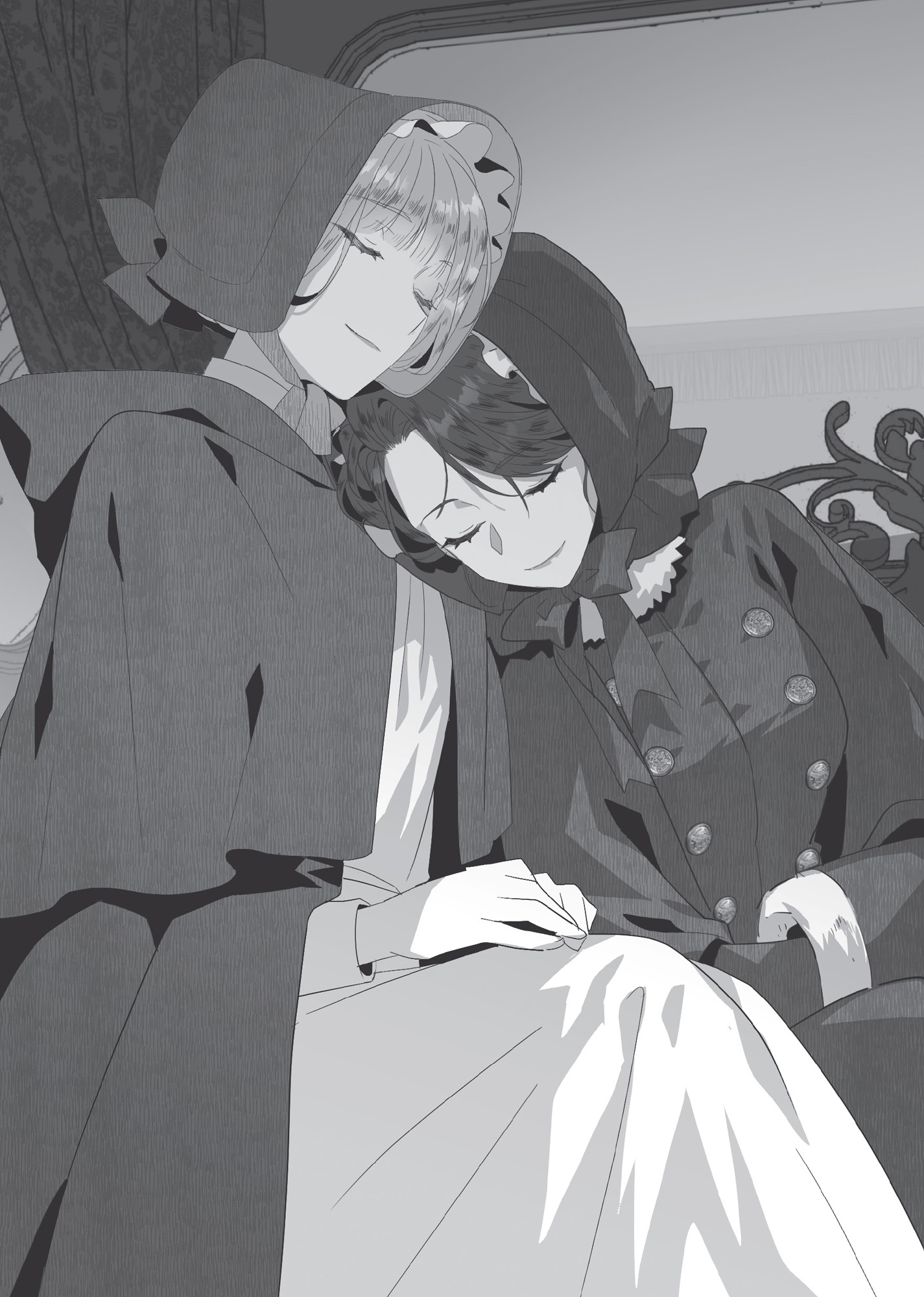
Chapter 20: The Local Director Receives Encouragement
Chapter 20:
The Local Director Receives Encouragement
LONG BEFORE THE REFUGEES ARRIVED, their assigned facility bustled with preparations. The director thought he would faint when he saw the sheer number of supplies they had to store away. Everything had to be organized and distributed appropriately. No number of extra hands would be enough.
As bad as the director felt for the refugees, having to trek here through the worst season and all, he was glad that it was winter, when farmwork hit a lull. It made it easy to find and hire people with nothing better to do.
Thank goodness this is happening before most of them set off for the mines.
The farmers had their hands free in winter. Most headed to the mines in the north to bring in extra income for their families. The job had its risks, but miners were paid for each piece mined. If one got especially lucky, they could hit the jackpot.
The more immediate problem was that once spring closed in, the fields would need tending in preparation for crop season. All the extra hands the director had secured would disappear. He broadcast their need for more helpers throughout the entire region, but since most were farmers, few would answer the call when crop season approached.
He finished writing his thoughts before putting his pen down and massaging his brow. It was the dead of night. The hours had passed faster than he’d realized once he entered his study. The only light was from the lantern on his desk, along with a bit of warmth.
Earlier in the day, he had visited the agricultural training facility to check on the temporary residences under construction—simple and plain, but durable enough to last a long time—and give his subordinates various instructions. He had to organize their security team and manage the day laborers he’d hired. When he finally made it home, it was a relief to see his wife and children. Seeing how rowdy and rambunctious his kids were brought a tear to his eye; it was a reminder of the peace and security in his life. Saving these refugees would help maintain that.
When the director was first appointed to his position, Virgil had written to him personally. It was the first time he had ever received correspondence from someone so highly ranked. His hand had trembled as he opened the envelope. His superior was the one who’d recognized the handwriting and revealed the sender’s identity when he handed over the letter. Said superior was a relative of the Lindsays and a viscount himself, and he had attended meetings with other core leaders of the local administration—hence his familiarity with Virgil’s penmanship.
The director knew that even though Virgil had addressed the letter himself, it didn’t mean he’d personally written it. Not that he minded; he was a commoner, and a duke’s heir had deigned to send him a letter! Its value was comparable to a medal of honor.
In the letter, Virgil apologized for the delay in his return and acknowledged the director’s work. The director resolved right then and there to tuck the letter in a box and keep it as an heirloom for his children.
Virgil went on to discuss the refugees’ situation. He said that although they were born in a different country, they’d lived just like the natural citizens of Harland. It struck a chord with the director when Virgil described how the refugees’ prosperity would positively impact their community.
As he read, the director thought, Ah, this is what makes a real politician.
There were a certain number of people who expressed disdain for the poorest members of society. Some would even suggest abandoning those same people to their fates. They were incapable of showing even a smidgeon of empathy or putting themselves in the shoes of those they disparaged. They’d never understand the terror of being at such a low point that they had nothing left to lose.
Those at the top talked about the poor as if they were a monolith, but there were different levels of poverty. For example, people who weren’t sure whether they could put food on the table each day versus those who managed to scrape by.
What would happen if the government abandoned those at the lowest level? Then there would be no hope for those at the level barely above them. It would also send a message that the moment they hit rock bottom, that was it. Their life was over.
And that wouldn’t be the only consequence. Righteous, upright people would resort to crime in hopes of bettering their situation. Abandoning the slums and its denizens would push them to the brink, and the public would be in immediate danger. It didn’t matter which level of poverty you abandoned; the result was the same. The repercussions would have a vast ripple effect.
In the course of his work, the director had learned the importance of governmental support. Having Arakanerians come to the Lindsays’ region for agricultural training had been a timely reminder. Most of the islanders lived in much poorer conditions than residents of the Lindsays’ region. Yet despite their living conditions, they had taken the long journey to this territory, eyes shining with hope. Seeing the way the people here lived made the islanders realize how much better their lives could be—which motivated them.
People need hope. If they can envision a future for themselves, it helps pave the way forward.
Few were born criminals. Most were made that way by their environment. Nothing was more heartening than having leaders who understood this.
And Lord Virgil is one of them.
Virgil had not only acknowledged the difficulties the director was facing, but he had also recognized his hard work. The director had no objections to his new appointment.
He glanced at the framed letter hanging on his wall. His wife slipped in and poured him a cup of piping hot tea.
“You must be exhausted.” She followed his gaze. “Looking at it again?”
“Yeah. That letter always encourages me. And the ability to sit here and drink your tea reminds me of how happy my life is.”
What could be more precious than this peaceful moment, with his children sleeping quietly nearby?
He wrapped his arms around his wife’s waist. “You have it rough, taking care of everything around the house. I doubt I’ll be able to come home for a while once the refugees arrive.”
A small laugh escaped her lips. “You don’t need to worry about that. Do you think it’d be all right for me to come see you and bring you some lunch?”
“Absolutely, though I might not be able to spend much time with you.”
“I just want to deliver you a meal. I worry about you not eating enough.” His wife knew too well how he got carried away with his work, to the detriment of his stomach.
The director slipped out of his office chair and planted a grateful kiss on his wife’s lips. Having written out all the matters on his mind regarding the training facility, he’d confirmed for himself that nothing needed urgent attention. He could call it a day and get some rest.
“Once work calms down, why don’t we go on a trip?” he offered.
“Oh? I’d love that. The children would too.”
The director was guaranteed a decently long vacation and compensation for his work with the refugees. Everyone needs to be able to envision a good future for themselves.
The clearer that vision, the more discipline and motivation they would have. It was important for people to have something they could accomplish themselves, no matter how small.
When the director made to leave his study, he paused for one last glance at the picture frame, which was painted black and blue. His wife had found it at the general store and brought it home, insisting that if he was going to frame the letter, it should be with the Lindsays’ colors. She was always doing sweet things like that for him.
***
As the director had predicted, his work intensified the moment the refugees arrived. It probably went without saying that it never let up.
With all the people milling about and the lack of humidity, there was a constant cloud of dust hanging in the air.
When the armed escort from Parte Kingdom arrived with the refugees, the director was shocked. Their commander was a woman. He knew that Parte trained all their people to be warriors regardless of age or gender, but this was his first time meeting one of them.
Parte was southwest of Harland. The Lindsays’ region was in northern Harland, which meant few Parteans could travel all this way.
The director greatly appreciated the commander’s work. Some of his own subordinates were women, but he hadn’t selected them for his team at the training facility because of the difficult nature of the work. Part of it was the need for stamina and physical strength, which made men the more optimal choice. But seeing this commander being assertive and giving orders to her crew, he realized he’d made a mistake. At the very least, he should have asked his female subordinates whether they wanted to work on his team at the facility.
Then again, they grew up in a very different environment than this woman. Women in Parte began military training in childhood. He didn’t think the women raised in Harland were quite the same. In this kingdom, physical labor was for men.
Still, we’re civil officials, not laborers. There might not be as much of a difference in stamina and strength between the men and women in this line of work as I thought there was.
He shook his head.
Something to consider later.
The commander stated that she and her crew would be returning to the conflict zone now that they had delivered their charges; there were still more civilians to save. The director couldn’t let her go without expressing his respect for what she and her subordinates were doing. When he thanked her for her hard work on the front lines, she stared blankly at him.
“So Harlanders think that’s where things are hardest, huh? Everyone has their role to play. For us soldiers on the front lines, it’s those in the periphery who are essential to our survival. It helps morale if we know we have plenty of supplies.”
She smacked him hard on the back, enough to knock the wind out of him. Hunched over as he was, the director managed a nod.
“What matters most to us is that these refugees are given a place to live in peace and safety. That’s what all our toils were for. And this place seems good. They were shocked and delighted when they saw all those buildings you’ve got over there—temporary housing, I think you said? Anyway, that’s all the reward we need.”
Then the commander tacked on her own advertisement, bidding him to hire her and her crew if they ever needed some mercenaries. She’d seen his security team, and she could tell they wouldn’t be nearly enough to cover a group of this size. She was a pro. He trusted she knew what she was talking about and decided he’d scale up security just to be safe. The director had contacted Miguel in advance to request additional mercenaries to shore up their numbers, but the commander’s reaction suggested he’d need more still.
“If we have room in our budget, I’d love to request you,” he told her.
“One of Parte’s mercenaries is worth a hundred regular men,” said the commander. “All the other mercs know that. Appoint one to a high position, and you’ll have an easier time maintaining order.”
Mercenaries came in a broad spectrum. The worst of them were no better than brutes. Putting someone from Parte in the lead would have even the roughest members of the bunch listening and taking orders.
“Might’s got a time and place, and we know exactly when and how to use it!” With a grunt, the commander flexed her arm, showing off her muscles. Hers were impressive enough; she could probably knock him out with a single punch.
“That would definitely put my mind at ease. I’ll consider it.”
“Rumor has it that Director General Darton visited Harland. If he strikes a deal with your superiors, then you can use his name to strike fear into any unruly mercenaries. Even my blood runs cold when someone brings him up.”
The director hummed in thought. “I’ll keep that in mind.”
Darton had to be fearsome indeed if he could intimidate a woman as brawny as this commander. While the director wasn’t sure how far his opinion on hiring a mercenary from Parte would get, he made a note to try all the same. While he’d been lucky enough to get a letter from the duke’s heir himself, he was just a lowly civil official working for a viscount.
With a cheerful smile, the commander excused herself and left. The director’s next meeting was with a deacon named Smit, who had fled the conflict zone with the rest of the refugees and was assigned as a coordinator. The other clergy he’d worked with in the conflict zone had split up to accompany the other refugees.
Smit was in his forties—so about the same age as the director—though his brown hair was peppered with gray. He had sunbrowned skin and chiseled muscles, which made him look more like a day laborer than a man of faith.
He looks the exact opposite of me.
Smit had been in fit enough form that he’d looked after the ill and the injured the whole way, traveling with them in a carriage. He still looked quite energetic despite the journey, but noticeable dark circles under his eyes betrayed his exhaustion. The director couldn’t begin to thank him enough for everything he’d done for these people.
“Deacon Smit, you have suffered greatly on this trip,” said the director.
“My suffering is inconsequential. We have the saint to thank for our safe evacuation from the conflict zone.”
“If there’s anything you require, please let me know. We’ll do our best to accommodate you,” the director responded smoothly, grinning. Something about what Smit said bothered him, but he couldn’t quite put his finger on it, so he pushed it to the back of his mind.
“These people have overcome incredible hardship. They’re strong souls, but I’m afraid they may not be very friendly because of how dearly they miss their homeland,” said Smit.
The director nodded. “Of course. I can only imagine how mentally fatigued they must be.”
How much it must weigh on someone to leave their homeland, not knowing when—if ever—they would be able to return.
“I realize this is deeply personal, and as a holy man I hate to admit it, but I can’t help feeling like I’ve completely cut ties with my homeland.” Smit’s own smile was faint. “I had no other real choice, you understand. Yet it still weighs on me.”
Despite being plagued by chaos and unrest, it was still the home where Smit was born and raised. It had its problems, but he would have loved it, no doubt. Had the flames of war never encroached, Smit wouldn’t have needed to run.
The director could think of no delicate words to offer him.
“Apologies. I didn’t intend to put you in an awkward position,” said Smit. “I want to follow Her Eminence’s example. It’s my goal to offer you and the others here as much support as I can.”
Their meeting ended without the director finding the appropriate consoling words for the deacon. He was disappointed in himself, but he also didn’t want to take up more of Smit’s time than was necessary.
He’s just as tired as the others. He needs to rest immediately.
Smit had been leading the refugees all on his own. There was no telling what kind of toll that had taken on him.
When the director saw the snaking length of the refugee line, his motivation very nearly fled him. Instead, he steeled himself, the memory of Smit’s commitment and unwavering spirit burned into his mind.
Since living quarters were to be separated by family, the director and his team needed to interview all the refugees. There still wasn’t enough temporary housing to go around. They would probably need different households to room together for the time being. If there was any overflow, those people would have to sleep in carriages for now.
It was chaos.
At the very least, the director wanted to make sure everyone had a place to stretch out and sleep for the night. This involved him scrambling around all day. He didn’t make it back to his office until the sky was pitch-black. His subordinates complimented his efforts as he nodded off for a little while.
I forgot to eat lunch. His subordinates had eaten with the refugees, but he hadn’t found the free time to swing by and grab his portion. The director had known that they would be incredibly busy, which was why he’d told his wife not to come for the first few days.
He missed home. The refugees probably missed their homes even more.
The director couldn’t let sentimentality get the best of him. He needed to become a lifeless doll and focus solely on dealing with the issues at hand. That was what his job required of him right now.
A few days later, once he was able to summon his wife to the facility, he did just that. The director immediately threw his arms around her upon her arrival.
“I made sandwiches—that way you can keep at least one hand free for work,” she told him.
“That’s a huge help.”
His wife updated him on what his children had been up to, and once he’d relaxed a bit, the topic switched to the saint. He recalled what Smit had said about her before.
“You’re so busy with work that you haven’t heard, have you? The Canonization Ceremony was held the other day.”
“I know that much,” he replied. “It was big news.”
“Okay, but do you know what she said in her speech?”
The director shook his head. “No, why?”
“She said those with the ability to do so should help the refugees.”
“Hmm. Isn’t that only natural?”
“Well, yes. None of us can turn our backs on those who need help.” But then, with a conspiratorial note in her voice, she added, “There are some who are worried and asking, ‘What about the rest of us?’ Our neighbors have even popped by to ask. It’s that bad.”
The director rubbed his chin. Were there really that many people interpreting the saint’s words in the worst possible way? As soon as that thought crossed his mind, he froze. “Oh…”
Maybe he had no room to talk. The reason Smit’s words had bothered him so much was because it felt as if the credit for his efforts—and those of so many others, like the commander—had been stolen away by the saint. He wished he’d protested then, reminded the deacon that it was the people directly involved with the refugees who were doing all the hard work.
How blasphemous of me. Maybe it was because he’d spent days working himself to the bone.
His wife eyed him suspiciously, waiting for him to say something.
The director shook his head. “We’re lucky to have a duke who cares so much for his people. We wouldn’t have this peace and stability if not for his leadership. He isn’t one to be so influenced by the saint that he would turn his back on his own people for the refugees.”
“I agree—but the refugees aren’t the same as the Arakanerians, now are they? They come from lands riddled with war and death. Some of them are probably uncivilized.”
“Ah, I see what you mean. The people already had their doubts in the first place.”
What Virgil had written in his letter was communicated only to those within the administration, the director included. The director had no way of getting anyone outside his profession to understand they had nothing to fear. Likewise, he had no way of knowing what they were feeling. It was only because his wife was filling him in on the town gossip that he finally realized how widespread unease was among the public.
“There’s no need to worry about that,” said the director. “These people’s lives weren’t very different from ours before they became refugees. They even have a deacon with them. If you’re still concerned, you can consult him when he’s free.”
“That’s true,” his wife agreed. “I forgot about their deacon.” That alone was enough to reassure her. She hastened to add, “There’s no need for me to bother the deacon personally.”
Their conversation helped the director see the great importance of a shared religious creed. It was reassuring to know the other side carried the same moral values.
“Then try to calm the neighbors,” the director advised.
“I will, don’t worry.” His wife shook her head, more at herself than at her husband. “I was being silly. Really, I can’t believe myself. I should learn from your example and be more levelheaded.”
“You’re doing plenty. I can’t visit all our neighbors and reassure them—but you can.”
His sphere of communication was limited to his coworkers. His wife might have better sway, given her connections. She laughed, agreeing with him.
But even she has her limits.
She was only one person. As someone working directly with the refugees, the director could only pray that people’s fear didn’t balloon into a rebellion before anyone could stop it.
After that, his wife informed him that Claudia and Virgil would be visiting various towns to reassure the people. They were also planning to visit the refugees soon as well.
I knew it. They know how to be good leaders.
Virgil and his sister must have heard how uneasy their people were, hence the visits. He was immensely grateful to them for their timely response. Moreover, he appreciated their patience while the situation at the facility settled before they visited. It would have created additional chaos had they come any sooner.
The saint’s words had had a positive impact on the refugees. There were still petty squabbles between some, but nothing major. They understood Harland’s graciousness in taking them in.
I figured they would be different from the Arakanerians, but I didn’t realize how much.
Where the Arakanerians’ eyes had been full of hope, the refugees’ were devoid of it. This was what people were reduced to when they couldn’t see a future for themselves. The director’s heart ached for them. The way the refugees clung to each other, covered in filth, made them look like an inky mass. If not for the children’s voices breaking the silence, he might not have recognized them as human beings.
***
It was finally the day of Virgil and Claudia’s visit to the training facility.
According to the director’s wife, their visits across the region were a resounding success. He was deeply grateful to her for always keeping him up-to-date. What the Partean commander said echoed in his mind: “Everyone has their role to play.”
He jotted a note to himself to see about visiting headquarters to check if any female civil officials were available for transfer. Gathering information from the refugees wasn’t going as smoothly as he would’ve liked. All his crew were men, as was the deacon. He couldn’t shake the feeling he’d made a major oversight there.
Also, while it often slipped his mind, the deacon was a refugee himself. The director didn’t want to overburden him. Faithful had arrived from the local monastery to help, but the refugees didn’t trust them the way they did Smit. Thus, the director wasn’t confident that they were adequately addressing the female refugees’ needs.
When Claudia’s carriage arrived, the director stood a little taller, his attention devoted to her visit with Virgil. He wished that they could restore a little hope to the refugees, as they had done for their citizens.
Blood roared in his ears. He was all nerves, reminding himself that he needed to avoid offending the lord or his lady sister. When the Lindsay siblings emerged from the carriages—easily identifiable by their trademark black hair—he nearly fainted. Their skin was so polished that it sparkled, and he half wondered if they were human.
I guess this is what people mean when they say we live in different worlds.
The director was not unaccustomed to the aristocracy; his direct superior was a viscount. But this was on a different level. His preconceptions were washed away. If someone told him the Lindsay siblings were fae who lived among the clouds, he would’ve believed it. He bowed his head instinctively, not brave enough to meet their gazes.
I can’t believe this is the man who wrote me directly. He swore to himself that he’d polish that picture frame as soon as he could go home.
When Virgil complimented him on his hard work, the director felt like he was dreaming. But he soon jolted back to reality when Virgil and Claudia began making inquiries about the refugee situation. It was gracious of them to take the time and effort to come and understand the goings-on at the facility. This was no time for him to indulge in Virgil’s praise.
One of their biggest problems was the lack of an adequate bathing area. But even if they had one, they had to be careful of their water usage and any resulting sewage. Most of the Lindsays’ region was farmland, and the area around this facility was no exception. They couldn’t risk water shortages or contamination being blamed on the refugees, not even if it affected only a select part of the countryside. That was why they had to forgo using more water than necessary or establishing a bathing facility that required kindling. Fortunately, Claudia and Virgil already seemed aware of these circumstances and didn’t press him further.
They were having a productive dialogue until the director inadvertently admitted his shortcomings when it came to the female refugees.
“I’ll see what I can find out from the women,” Claudia said.
“That would be best,” Virgil agreed. “There are things women only feel comfortable discussing with one another. We men can only do so much.”
With that, the decision was made.
This unexpected turn made things a bit hectic for the staff, but it was positive chaos this time. With Claudia’s slogan motivating him, the director reflected on his own mistakes. He should have recruited female officials from the start.
Claudia and Virgil’s visit had a visible effect. All the women Claudia pulled aside for one-on-one interviews seemed to perk up after they finished. Their bright moods had a sweeping effect on the rest of their fellow refugees.
I can’t believe her meetings had such an impact!
Maybe it was because the women finally felt like Harland was willing to accept them long-term instead of offering them temporary refuge. No matter how much the director had attempted to reassure them, he was but a lowly official. He could offer no guarantees. It wasn’t until the high-ranking rulers made those promises directly that the refugees could rest easy.
“All that’s left, then, is to strengthen security.” The director hadn’t recognized the need for daytime patrols until Claudia had pointed out the atmosphere inside the place. He’d been negligent. He put his trust in his crew and anyone else working around the facility, assuming they were good people—and that bias was dangerous.
The director had heard before that every person had two wolves inside them, one good and one bad. They fought constantly, and whichever one you fed would win out. He needed to ensure no one’s bad wolf ate their fill.
There were more women than men among the refugees, as most men in the conflict zone had been conscripted. Knowing this, the director had prioritized male officials among his staff—but he should have been more conscientious about the risks that could pose.
Fortunately, Claudia was already acquainted with Darton. She had granted him leave to recruit mercenaries from Parte and to use the Lindsay name if necessary.
The director was impressed by Claudia’s shrewdness. She’d had no trouble convincing Nelly to speak up. “We need to take steps toward earning their trust,” she had said to him. Those words were now their slogan, which he kept in mind and let guide him.
“And we need to prohibit them from sex work,” he reminded himself out loud, recalling her orders.
They had prohibited such activities when the Arakanerians visited as well. It was always possible that a few who’d come for agricultural training might run away and become illegal immigrants. With no official identification, they would have little choice but to sell their bodies to make ends meet. Fortunately, they were surrounded by farmland, and everyone out in the boonies knew one another. Anyone who had ever tried to make a run for it had been captured. There were strict policies in place, allowing them to forcibly apprehend anyone who misbehaved.
Children’s voices echoed in the distance, along with the women’s laughter. Those were the very things the director wanted to protect. The refugees were here for very different reasons than the Arakanerians. He wanted to believe they wouldn’t resort to prostitution or make a run for it, but he had to earn their trust before he announced these prohibitions. Otherwise, they would have no meaning. The words Claudia had muttered unthinkingly to herself, which had since become their slogan, were perfectly apt for their situation. It would take baby steps, but they would prove themselves trustworthy.
And I will be a role model for the rest of my crew, the director swore to himself.
Chapter 21: The Maid Consults the Duke’s Heir
Chapter 21:
The Maid Consults the Duke’s Heir
THAT NIGHT, after bidding Claudia good night, Helen ran into Virgil in the hallway.
“I realize you must be exhausted as well, but could you spare me a moment?” he asked.
“Yes, certainly,” Helen answered.
It was perfect timing, since she’d been wanting to speak with him anyway. She told Virgil as much, and they moved to an empty drawing room where they could sit and talk. Virgil’s office was always bustling with officials shuffling in and out at all hours, so he’d chosen this room for its privacy. It was obvious what they both wanted to discuss.
“Please, go ahead,” Virgil said.
“All right. It’s about Lady Claudia, actually… The plight of the refugees has deeply affected her, most likely because she witnessed their living conditions personally during her visit.”
Virgil nodded. “That was weighing on me too. Dee tends to take on more than she should. She probably thinks the refugees’ situation is her responsibility to solve.” He smiled sardonically. “It’s really my responsibility, though.”
“May I say as much to her?” asked Helen.
“Be my guest. I’m not trying to scold her for her involvement, but I don’t want her taking it all to heart.”
If Helen admonished Claudia for taking Virgil’s work from him, she would back down. She was always keenly aware of the boundaries of their social positions.
“It might be better for her to focus on her duties as the saint’s attendant,” Helen suggested.
“Indeed. Her presence alone is enough to give people hope. I can’t even begin to articulate how much it meant to them, having her visit and listen to their concerns the way she did.”
Miguel, who had recommended these visits in the first place, was greatly pleased with the result. Even the merchants’ guild acknowledged the positive influence they’d had. There was far less unrest among their people now than there had been before. It had probably helped that the refugees’ arrival hadn’t caused widespread chaos.
“We need to maintain this tranquility.” Virgil pressed between his brows, massaging his forehead with more force than necessary.
He’s been grinding himself to dust, working every day. Before she even realized what she was saying, Helen burst out, “Would you mind if I massaged your shoulders?”
“Hmm? Oh, go ahead.”
Virgil had his own maid, but Helen very much doubted the woman gave him massages in his office.
“Lady Claudia is terrible at letting other people take care of her, but so are you,” Helen chided as she massaged him. “You have some real knots in your shoulders. You ought to take rest periodically too, my lord.” She shifted her weight to press deeper. “It doesn’t hurt, does it?”
“It hurts,” was all he said.
“That’s proof that you’re getting proper blood circulation, then,” she replied smoothly. “I’ll be a little gentler.”
“No, it feels nice, actually. Please continue as you were.”
He didn’t seem to be lying, so she continued working her fingers into his muscles, squeezing from his shoulders to the base of his neck.
“So, I’m not good at letting other people look after me, hmm?”
“Did you not realize that?” Helen asked.
“The concept never even crossed my mind.”
Unsurprising. Like sister, like brother—though Virgil was far worse than his younger sister.
“Then please be more cognizant in the future,” Helen advised him. “The best way of performing self-care is to kick back and treat yourself to your favorite food and drink.”
“Hmm. Does taking care of myself really count? No one is looking after me, then.” Virgil tilted his head back, his eyes meeting hers. The light in the room was reflected in his blue eyes, and she nearly lost herself in their depths. “Helen?”
“Oh. Right.” She shook her head. “I think I’m done with your massage.”
She yanked her hands back and stepped away. The overlapping star hanging from her bracelet swayed with the sudden movement.
“Thank you. My shoulders feel so much lighter.”
“Glad to be of service.” Helen tried to excuse herself as if they hadn’t shared a moment, wanting to deny the noisy thrumming of her heart. But that low, husky voice of his stopped her in her tracks.
“May I ask you to do it again?”
Her mouth felt dry. “Another maid can do it for you.”
“I want you to do it.” He rolled his shoulders and smiled softly at her as he spoke, which made her blood pulse in her ears.
There’s no deeper meaning to it, Helen told herself. He just liked the massage. That’s all.
Maybe she was secretly relieved that he didn’t have any ulterior motives. If someone asked her to choose between Claudia and Virgil, she would loudly and confidently choose Claudia. That was the only reason she and Virgil could be alone in a room together: She valued Claudia above all else.
“Very well,” Helen relented. “If we should have a free moment in our schedules at the same time, feel free to call for me.”
There was a brief silence as he let her words sink in. “Ah. Of course. This is a privilege, not a right.”
She wasn’t sure she followed.
“I forgot that your time belongs to Dee. Your words reminded me how rare it is to be able to share these moments. I appreciate you giving me your time.”
“You’re being far too generous. I am only a maid.” Helen was the one who had noticed his exhaustion and offered.
She bowed her head and made her escape at last. She wasn’t sure whether all hardworking aristocrats inspired doting from their servants or if it was specific to the Lindsay siblings.
Either way, they’re both serious flirts without even realizing it.
Chapter 22: The Villainess Takes a Walk Around Town
Chapter 22:
The Villainess Takes a Walk Around Town
AT HELEN’S SUGGESTION that she renew her spirits, Claudia went out into town. She could sense Helen’s mood taking a nosedive, which was unusual.
Her carriage drew attention for bearing the Lindsay colors and crest, but the people on the street quickly made way. It was past noon by the time they visited the shopping district, which was utterly peaceful.
And this is exactly what we need to protect. This tranquility was what her people feared losing.
“I wonder if the people’s attitudes toward the refugees will change once they start mingling,” Claudia wondered aloud.
“Good question. The unknown creates so much fear,” said Helen.
Accepting refugees was such a unique event that people were picturing the worst to prepare themselves. That sometimes led to baseless speculation, which further stoked the fear of the unknown. If there were already problems present, that was more fuel for the fire. Virgil had dealt with the logistical issues the extra supplies presented, but it would take time for their transportation to fully catch up.
When Claudia emerged from her carriage, a cold wind nipped at her cheeks. People who recognized her on the street squealed in delight. She flashed them a smile. Ahead of her, Helen opened the door to a ladies’ clothing boutique. A bell echoed to announce their entrance as they stepped inside, and the fuss from outside grew faint as soon as the door was shut behind them.
“Welcome, welcome!” said the proprietress, a graceful woman with deep wrinkles around her mouth. Usually Claudia summoned her to the Lindsay estate, but she soon caught on to the reason for Claudia’s visit. Shortly thereafter, she was introducing them to the most colorful pieces in her collection.
The boutique primarily supplied ordinary dresses for everyday wear. The majority were rather simple in design. Upon seeing the new spring collection lined up, however, Claudia recognized its vibrance and variety.
“Is the fabric for your dresses arriving on time?” she asked.
“I was warned to order them well in advance, so our shop hasn’t suffered from delays,” answered the proprietress.
Rumors had abounded about Harland’s acceptance of refugees well before the decision was made, and the people had known the Lindsays’ region would be among the first to meet the tide. They had expansive lands and ample wealth, so it was a given. Their people knew how well-off their region was over others.
Many farmers were continuing generations of the same work. Even if a natural disaster hit and damaged their crops, they still had the mines up north to provide for them and keep them from starvation. The people trusted Duke Lindsay and his family’s reign.
No one is feeling optimistic about the influx of refugees, though.
Otherwise, they wouldn’t have surrounded her and her brother’s carriages when they first arrived, nor would the subsequent meeting with the leadership have been so tense. The skies ahead looked dense with gray clouds, the exact opposite of the pristine aqua dress in front of her. It was good for the leadership to be vigilant, but their misgivings could spread among the people, which concerned her.
The saint has great influence. Or rather, the church did. The saint’s plea for the refugees had a ripple effect, which thrust them into their current situation. And now, not only do we need to calm the refugees, but we need to reassure our citizens as well.
At least until the two groups could safely mingle and respect one another.
Helen’s face popped into view, jerking Claudia out of her thoughts. “Are you going to try this on, my lady?” The maid hadn’t said as much, but she was trying to distract Claudia from thinking about work.
Claudia forced a smile and nodded. The dress in question was a soft, creamy yellow. The shade reminded her of custard cream, in fact, which brought on a sweet tooth. “Why don’t we pick up dessert before we head back?”
“I think that’s a splendid idea!” Helen was eager to indulge Claudia, especially after their talk yesterday.
Once Claudia had the new dress on, she twirled in place. The skirt danced through the air. “This is adorable!”
“It suits you perfectly. I think it would go well with a wide-brimmed hat.”
Fortunately, the shop next door was a millinery.
The proprietress chimed in, “Oh, you should definitely stop by! The owner will be delighted. Anyone who gets to see you in person, my lady, will have a new lease on life!”
“You exaggerate,” Claudia told her.
“Nonsense!” the older woman insisted. “You were our goddess long before the Evans Company began worshipping you!” She sniffed irritably, as if annoyed that the Evans Company had some nerve to claim Claudia when she belonged to the territory first.
Claudia itched to smack herself on the forehead upon hearing that Brian’s reverent words had reached all the way to the Lindsays’ region.
“Come to think of it, the Evans Company set up a branch store here, didn’t they?”
“I think it’s a bit odd to be running a shop featuring fan merchandise with the Lindsays’ colors,” Helen said disapprovingly. Lowering her voice, she added, “Though I did purchase a few things.”
Claudia gave her a look. “You did, did you?”
“Naturally. Those colors represent both you and Lord Virgil. Everyone’s been buying goods in pairs from that shop.”
Claudia blinked. “Everyone, you say?”
“One is not a Lindsay citizen if they don’t have something in the Lindsay colors,” Helen argued with her nose in the air.
From the way Helen spoke, the Evans Company was making a good profit.
The proprietress offered a toothy grin. “We’re lucky, really we are! We get to see you face-to-face after all, Lady Claudia.” Only citizens were granted that opportunity. “Your visit the other day washed away all our fears. As long as you and Lord Virgil are hale and healthy, our region will be peaceful.”
“Precisely!” Helen said with a sharp nod. “Yet Lady Claudia feels so sorry for the refugees that she doesn’t think she deserves any luxuries.”
“Oh goodness, no! That won’t do!” cried the proprietress. “Lady Claudia, if your hair were to lose its luster or your skin its suppleness, why, that would be a loss for all your people. A devastating one. Please, you must look after yourself!” Before Claudia could say anything, the proprietress added, “The refugees, too, I think would prefer the support of someone proud and wealthy over someone poor and unfortunate.”
The former offered a more substantial and reliable form of support as well, one recognizable at a glance.
“And the people will be able to tell how wealthy our region is simply by visiting the town. You’d be doing me a favor by indulging yourself and making purchases from my shop. Think of it as a contribution to our town’s economy!”
When Claudia looked down, she noticed the proprietress already had another dress in her hands. She couldn’t help but smile at the old woman’s tenacity. Ultimately, she bought three dresses, two hats, and some dessert before they finally set off for home.
Claudia sank into the cushioned backrest in the carriage. “Phew,” she breathed out, “that was fulfilling.”
Helen smiled proudly. “I’m glad to hear it.”
Every shop Claudia visited was eager for her to pamper herself. Not surprising, since they all wanted to make a sale, but their duke’s daughter purchasing luxuries was a given.
“The Evans Company made an incredible business decision with that general store,” Helen remarked.
“Yes. You were quite right about everyone buying from their store.”
When Claudia inquired with the other store owners if they’d bought their goods from the Evans Company’s store, they insisted—much like Helen—that everyone did. A nearby customer overheard her inquiry at one point and showed off a charm from that store. Wherever she went, the people referred to her as the region’s goddess, not the Evans Company’s. Their stubborn claim over her warmed her heart.
Claudia spent more time in the capital than she did in her region. Her visit had been delayed and would therefore be shorter than she’d planned. Despite her absence, the people insisted that this was her and Virgil’s home. She could feel their love.
“Once the refugees begin mingling with the citizens, I hope they take an interest in the Evans Company’s store. Though I doubt they need anyone’s encouragement. People might offer some of those goods to them as gifts, even,” Helen mused aloud.
That was possible. If they were going to stay in the Lindsays’ region, they might as well own the Lindsays’ colors—that was how the people would rationalize it. From what Claudia had heard, even the Arakanerians had purchased some of those goods before departing for their island.
“It’s good to have a sense of unity, in my opinion,” the maid tacked on.
“I agree.”
The carriage rattled around them. The roads were well maintained, which made for a smooth ride. Great care and attention went into infrastructure in the Lindsays’ territory. If there were any issues with the roads, traveling merchants and transporters would alert the proper authorities. If the condition of the roads was too poor, then craftsmen would be dispatched for repairs without delay.
This might be a good opportunity, actually. Helen would be annoyed with her for thinking about work again, but Claudia was plenty refreshed; she wouldn’t have been able to come up with new ideas if she weren’t. A tired brain was a nonfunctional brain, after all.
At present, the citizens and refugees were being kept apart, with temporary relief measures in place for the latter. But the increased flow of goods and dispersal of supplies was temporary, as often happened during emergencies. All the leadership could do at this point was watch how things played out.
Claudia had already discussed more long-term support for the refugees with her brother. Every option had its pros and cons, but Claudia wanted something more promising.
Something we could offer our people as well as the refugees. Something that was less a means of support and more a policy paving the way to a better future. Something that could only be done here, in the Lindsays’ region.
The measures they had been testing in the capital’s slums with Rose Garden had been a good indicator of how to accomplish this. There was a timeless source of concern for anyone, regardless of their country of residence or their financial situation. It was something she had experienced personally in her brothel days.
Claudia turned her gaze to Helen. Their eyes met, and as always, Helen smiled.
She used to pull funny faces at me sometimes when she was a courtesan. Claudia never wanted to see Helen waste away, her body mere skin and bones. Never again.
As soon as she got home, she went to Virgil with her proposal. Virgil agreed it would be a change for the better, and soon enough, they implemented her idea.
Chapter 23: The Merchant Scrutinizes the Duke’s Son
Chapter 23:
The Merchant Scrutinizes the Duke’s Son
MIGUEL WAS IN THE MEETING ROOM at the Lindsays’ estate, decorated with a stately table of dark walnut with leather armchairs lined up around it. The wallpaper was moss green, hand-embroidered with an enormous pine tree. Unlike the drawing room, where the Lindsays invited most guests, only a select few were ever received in the meeting room.
This was where the heir’s true trial was taking place. Twenty people were gathered to decide whether Virgil was fit to be the next duke.
Yeah, perfect timing for a refugee crisis, Miguel thought glumly. It was tragic for the people driven out of their homeland, and he wasn’t too optimistic about his company’s ability to make timely deliveries with the added burden. Still, he wasn’t entirely pessimistic either. The Lindsays were a rich family. He was more worried about the other regions. We don’t want to deal with any spillover from elsewhere.
Miguel stroked his carefully groomed mustache.
The church had proclaimed its intentions with the saint as its mouthpiece, and her words had stirred unrest among the populace. It was no wonder the poorest in society were upset; it was only natural to expect the regional administration to focus on their needs over those of others.
Harland avoided sending refugees to regions with the lowest revenue. They were trying to keep the refugees separate from their own impoverished population—but regardless of their intentions or reasons, they couldn’t stop people from speculating the worst. One could isolate people, but one could not so easily block and compartmentalize information. Such was the case with the saint’s words, which spread and created a wave of apprehension.
Goods distribution was as pivotal to a region as blood flow to the human body. Blockages could have a devastating impact. It was up to each regional lord to manage such an issue with their own resources, but not all aristocrats were skilled at administration. Duke Lindsay was much more flexible than his peers, and that made him a rarity.
How does his son measure up?
Virgil was talented, to be sure, but Claudia stood out far more. Her accomplishments were unending, from her recent appointment as A Priori to supporting Arakaner through her trading firm.
Miguel’s group had undertaken the task of transporting her goods from their region to Claudia’s firm. He’d accompanied them personally for the first trip.
Never thought I’d be riding a boat.
The two countries could see each other’s harbors in the distance because there was relatively little sea between them. Short as the trip was, it still counted as a sea voyage, and Miguel had never dreamed he’d live long enough to see his grandchildren’s faces—let alone sail. Life was full of surprises. And he’d never let his grandkids know how it unnerved him, looking into the endless depths of those waters.
Virgil was involved in the daily administrative work for the region, but his accomplishments didn’t quite stack up to Claudia’s. As someone who served the ducal house, Miguel hoped Virgil would earn himself more prestige.
Why’s he only motivated when it concerns his sister? Everyone knew Virgil doted on Claudia. Miguel wished the man would show a little more restraint in the public eye. A man’s supposed to be the one standing out and soaking up the spotlight.
Miguel had no qualms about Virgil being wrapped around Claudia’s finger, to be clear, but there was a time and a place. There were other times a man needed to fight—to be a sword or a shield, whichever the situation called for. But instead of giving off an unyielding martial aura, Virgil gave off the impression of a graceful and dignified lordling.
The Lindsay siblings entered the meeting room together. Claudia kept her lips sealed during the talks, perhaps because her studies revolved around being an assistant. But she was still captivating in her silence. There was something about her that stole Miguel’s breath away. She huddled in her seat, eyes downcast on her lap in a way that made her look vulnerable—which in turn made him want to protect her.
This is no time to be staring, Miguel scolded himself.
Today’s meeting was about long-term support not just for the refugees but for their people as well. He’d received word ahead of time.
From beneath a chiseled brow, Virgil’s blue eyes regarded those assembled. His azure depths spoke to his strong determination, his expression stern and focused after long workdays in his office. Yet there was a luster to his skin and hair, betraying none of the exhaustion he surely felt.
Visiting their subjects had been a resounding success. There was no reason for Virgil to announce the tax increases—which netted him a few negative points, but perhaps that was a strategy on his part to prevent any surprises when the increases happened.
Looks like weakness to me, though.
A general was supposed to be strong and imposing. Virgil showed no signs of regretting his decision to be transparent. He was no less confident and assertive than his father.
He controls himself well.
Miguel had heard that Claudia empathized greatly with the refugees. Anyone’s heart would ache at seeing the refugees’ condition, having barely escaped with their lives. Nonetheless, there were times when a leader needed to prioritize themselves, even if others might call them callous for it. Miguel had learned that lesson during his mercenary days, when he’d been on death’s door more times than he cared to count. Falling while trying to save another was the pinnacle of noble idiocy. One only achieved an accomplishment fit for the history books if they survived.
Worried though Miguel was for Claudia, she showed no shadows of doubt or unease on her face. He nodded in approval to himself.
Virgil laid out their planned policy. It was met by a slew of shocked whispers.
“Did you say ‘regional healthcare’?” Miguel demanded, voice rising above the rest.
“Correct. And as a special exemption, we’ll allow the refugees to enroll as well,” said Virgil. What he’d proposed was a healthcare initiative that would cover all their region’s people.
The others questioned whether this was any different from a tax increase.
“It’s different because the revenue from this program will be used solely to cover people’s medical expenses,” Virgil reasoned. “But I won’t deny that it’ll feel like any other tax increase. We can label it a healthcare tax, but as I said, it will not be pooled with the rest of their taxes but rather set aside as a separate fund.”
“Separating our tax money, hmm?”
With the right documentation, one could receive tax deductions from the government. If they were trying to get a deduction on medical costs, they would be almost guaranteed to receive it—which allowed a lot of room for abuse.
“By requiring everyone to have insurance, we can remove the loophole used to cheat our administration out of money. Those in good health might see it as a waste, but I think they’ll come to realize that having it will give their lives more stability, in case of the unforeseen.”
The people were commoners and thus didn’t have the same education afforded to aristocrats, but they were still able to think for themselves. They shared the same doctrine and moral values. They would help their neighbors and save money where they could, but these things weren’t enforced. It was up to each individual to make their own choices, which could be a problem in and of itself. Most did not plan for their futures. Many had poor impulse control and would make spur-of-the-moment decisions—some of those financial—even though they knew better. Such was human nature.
It was safer for all to be legally required to participate in the healthcare program for their own sake, rather than leaving it up to individual choice. Then there was no need to wrestle with impulse control, and they could aim their frustrations at the local administration instead.
So this is why he warned them about tax increases.
They had plenty of resources to support the refugees with the national government’s financial backing. Their region still needed people on the ground to organize and attend to miscellaneous jobs, but the government’s aid funded all of that too—even the day laborers. Why frame this tax increase around the refugees, which would only leave a worse impression on the people? That was what initially bothered Miguel.
Nevertheless, he was reevaluating his opinion of the young lordling, seeing more potential in Virgil as future duke than before. Taking in refugees was an irregularity to begin with. Miguel was beginning to understand why Virgil was taking this approach to the refugees and the citizenry. Explaining his intentions well in advance of pushing forward the policy into law would reduce confusion too.
Now this has gotten interesting. Miguel was fortunate not to have experienced any serious wounds or illness, but in his line of work, many of his comrades had been forced to retire for those very reasons. He’d also seen people so desperate to save their money that they’d put off medical treatment and lost their lives.
Can they save people like that with this?
Then Virgil stated his intention for medical attention to be given equally, regardless of social station—which meant aristocrats would receive the same treatment as anyone else. This caused quite the stir in the room.
Yeah, that’s what I’m talking about!
Heat built behind Miguel’s eyes, his heart shuddering in his chest. He clenched his hands into fists. An extraordinary surge of energy zipped through his body, powerful enough to make him want to jump up and shout. This was a historic moment, that was for certain. The documents in front of him were proof that Virgil’s proposal wasn’t mere reckless idealism; it was a carefully thought-out plan.
“We’ll probably implement this in three or four years at the earliest,” Virgil continued. “I want to spread word of our intentions and make preparations in the meantime. We’ll use our income from the mines for an initial investment into the healthcare fund.” He was referring to their earnings from sapphires mined in the northern part of the region.
Virgil’s aristocratic relatives frowned in disapproval, concerned about the reduction in their profits.
For their benefit, Virgil called on Claudia to address them. She lifted her wrist, showing off a bracelet. The sapphire sparkled as it caught the light. It was the rarest shade, the extremely valuable Lindsay Blue.
“I’ll be wearing this when I attend the Saint’s Festival,” said Claudia.
Clergy didn’t typically wear accessories, but Claudia was only an attendant. She’d be forgiven for wearing one so long as it wasn’t gaudy. She was acting as a representative for their country, and she was allowed to differentiate herself from the others.
Clever move!
The Lindsays’ relatives treated their Lindsay Blue sapphires as family heirlooms. Claudia wearing one to such a monumental event would massively increase their value, and not one of their relatives could be upset about that, especially because it would boost sapphire prices overall. When people realized they couldn’t snag a Lindsay Blue sapphire for themselves, they would settle for the next best thing.
“I would also like to educate more doctors in anticipation of our policy being put in place,” said Virgil.
“You want to set up a medical school too?!” Miguel blurted out.
“We already lack adequate doctors as things stand, and we’ll need proper education for our officials if we’re going to maintain strict oversight for our healthcare system.”
Insurance systems were often exploited. They would need people with sufficient medical knowledge to perform inspections to prevent that. That also meant some civil officials would need to be educated in the field. Virgil also indicated his desire for increased cultivation of medicinal herbs. The more he explained, the more radical his plan seemed.
Everyone exchanged glances, but none expressed disapproval. This policy had promise. They felt it in their bones.
Not one person in this room could’ve predicted this. Before walking in, they had assumed financial aid would be all they could offer as long-term support. None of them imagined Virgil would offer a plan to everyone’s benefit.
Commoners will be able to go to clinics in the future as they need? If I didn’t know better, I’d think he was pulling my leg!
“Yowch!” cried the old man beside him. Miguel hadn’t realized it, but in his excitement he’d started smacking the back of the elderly fellow, who happened to be the leader of the Farmers’ Guild.
“My bad,” Miguel said, unable to wipe the grin off his face.
With things looking this promising, I can’t kick the bucket anytime soon!
He was anxious to see what the future of this region held, preferably up close. It was a shame he didn’t have a granddaughter around Virgil’s age.
I do have a grandson, though. Maybe the young lord swings that way?
Sometime after that, Virgil discovered that he had one new marriage proposal amid his regular correspondence.
Chapter 24: The Refugee Finds Salvation
Chapter 24:
The Refugee Finds Salvation
NELLY WAS UTTERLY EXHAUSTED. Her husband had been conscripted, and she had no way of knowing if he was still alive. To say she was lost in despair was an understatement—but with children to care for, she couldn’t let the tears flow free. She would be a ship lost at sea without them to anchor her.
Her sons were three and five. Their little trio huddled together every night on their voyage, Nelly thinking only of her homeland. Why did she have to run from the place she was born and raised? And with our home empty, who will be there to welcome my husband when he returns—if he returns?
But there was no substitute for safety. A neighboring village was attacked, their food stolen. It was a tragedy, with most of the casualties being women and children. A few escaped by the skin of their teeth, covered in blood. And those escapees? Many died of their injuries. The horrors of war had encroached dangerously close.
When Nelly realized that she and her children could be next, she was terrified. Her entire village fled together, along with two or three neighboring villages. Those whose settlements hadn’t been ravaged were forced to travel the farthest for refuge. It was the start of a long journey.
Any deserters were left behind. The days pressed on and chipped away at the moral part of her, the part that wanted to help and support others. She grew more selfish, more annoyed at her children and their grumblings—and she hated herself for all of it.
Even after they left their homeland behind, they couldn’t rest easy. Bandits appeared along the way, eager to relieve them of what few possessions they had left. The Parteans had proved as strong and capable as the rumors suggested, but there were still casualties. She couldn’t let her guard down. All along, she wondered, Will we reach our destination safely?
Paranoia took hold of her. Maybe this was their intention all along. To shave down our numbers slowly but surely.
No one wanted to shoulder an unnecessary burden, and that was what they were. All she had was the clothes on her back. She doubted she would be of much use to anyone, no matter where she ended up. Yet she was too afraid of death to give in.
She was greatly relieved when the deacon, whom she’d known before their flight, told her of the saint’s plea. It was reassuring that some other country would take her in without question. This voyage wouldn’t be for naught. At the same time, it shook her when she realized what she was: a refugee.
I haven’t done anything wrong, though. All she did was live a normal life in a place racked by a war she never asked for, one that had ripped her husband from her and eventually turned her into a refugee. And that was what she was now: a refugee, not the ordinary person she had been.
***
When at long last, Nelly arrived at her destination, what awaited her far surpassed her imagination. She had never seen buildings so tall. According to the deacon, people from other nations considered their homeland to be dangerous and impoverished. By contrast, the Lindsays’ region was peaceful and wealthy.
The staff told her and the other refugees that their lives would be cramped and difficult in the short term, but eventually, each family would get their own house. She could hardly believe her ears.
I thought they would work us to the bone and then sell us off somewhere.
The saint had spoken in their defense, yes, but Nelly hadn’t necessarily believed it would have any effect.
When she heard the Partean mercenaries were leaving, her anxiety threatened to swallow her whole. What guarantee was there that bandits wouldn’t attack? The local director had promised her they were safe, but she only trusted the deacon. Most kept their silence when the local staff made inquiries about what they needed. There was no telling what demands these people would make of them in return.
Yet for all her doubts, she was starting to relax more and more as the days went on. Her children were eager to go outside and play. She couldn’t let them go without supervision, so despite the cold, she set out with them. Soon enough, she found herself naturally forming relationships with the other mothers.
“What will happen to us now?”
That was all their conversations swirled around, though they also complained and vented about their daily stressors. Some of the women voiced their discomfort about the men who leered at them as they came and went from the housing construction site. Even the male refugees who had managed to dodge the draft back home made the women uneasy.
“If anything happened to my children, I couldn’t keep going!”
“Let’s look after each other.”
As long as they stayed together, the men couldn’t do anything. They warned their children to be vigilant too.
Then one day came the announcement that some high-ranking nobles were coming to inspect the area and see how the refugees were doing.
Nelly was scared.
According to the saint, these higher-ups had a duty to support and provide for the refugees without compensation. But Nelly knew better. There was no such thing as unconditional goodwill. She hugged her children close, knowing that soon the day would come when something would be demanded of them.
While she and the other mothers were bracing themselves, Deacon Smit reached out to her. His hair was peppered with gray, his skin sun-kissed, and his body thick and muscled. Smit was a comforting presence, and he had been a pillar of strength for everyone along the way.
“If you’re afraid, you should pray. These people won’t do anything to you if you pray,” he told her.
Nelly believed him. And so, on the day the higher-ups came, she prayed. She did her best to avoid their eyes and waited for the storm to pass.
Alas, her prayers went unanswered. One of the higher-ups was the duke’s daughter, and she summoned Nelly, of all people.
The deacon lied to me! She cursed him in her heart as she prostrated herself on the floor. Nelly protested that she hadn’t meant to offend the duke’s daughter, and her children were blameless. They deserved to be spared.
When the duke’s daughter responded, Nelly was blown away. The lady had apologized to her. Her clear, graceful tone coaxed Nelly to lift her head. Before she knew it, the duke’s daughter—an absolutely gorgeous woman—was right beside her. The woman’s hands were so warm as they covered Nelly’s grimy ones. All the tension left Nelly’s body as the noblewoman’s kindness enveloped her.
“You must have felt so hopeless,” said the woman.
In the conversation that followed, the beautiful woman accurately assessed Nelly’s personality and guessed all the anxieties that had been weighing on her. Nelly was left gaping, flapping her mouth like a fish.
Maybe this woman isn’t actually human, she thought. It would make sense if she wasn’t. This woman’s skin was too soft, her eyes were like gemstones, and her hair resembled the finest black silk. Nelly struggled to believe she could be of this world, especially since she’d read her so easily.
Oh goodness, she may have heard me cursing the deacon in my head. Nelly suddenly felt guilty.
Not even one of the faithful could have predicted what this beautiful creature would do. The woman was so out of the ordinary, so supernatural that it triggered a strong defiance in Nelly. If she couldn’t hide anything from this woman anyway, then she might as well unload her every thought.
At the same time, the warmth of the woman’s hands on hers provided a sense of relief. The way she sat, knees turned and pressed against Nelly’s, made Nelly feel like the duke’s daughter was opening up to her, not the other way around. Thus, Nelly began answering all the questions she’d been asked. No matter how childlike her responses were, the woman never pulled a face or wrinkled her nose. She listened with empathy. When Nelly finished confiding everything, her heart was so much lighter that she burst into tears.
Her scalp was covered in dandruff, her skin dark with grime. And though Nelly was desensitized to it, she knew she gave off a pungent odor. No ordinary person would give her a second glance, of that she was certain. But this woman had.
“Of course it was hard,” the duke’s daughter had told her. “You’ve been so brave. Anyone would be at their breaking point after traveling all this way with two children. But you made it. You are an incredible mother. It’s all right—your children know that too.” She met Nelly’s eyes without a hint of hesitation or disgust, as if she saw her. Truly saw her and understood.
Ah. She actually wants to know…how much I suffered, how difficult it was. She’s treating me like a normal person.
When the woman wrapped Nelly in her arms and tucked her against her chest, Nelly wept. Only after Nelly’s tears subsided did the woman dampen a cloth and dab her puffy eyes. Nelly felt like she could breathe again, truly breathe. Still, ashamed she’d been so pitiful in front of the duke’s daughter, she apologized and lowered her head.
“Not at all. But, hmm. If you ever feel like you owe me, can I ask a favor?”
“Certainly, what is it?”
“Would you mind lending a hand if you see someone in need? It can even be someone close to you. Doesn’t need to be a stranger.”
Nelly’s jaw hung open, and for a moment, she just stared. “But that won’t benefit you at all, will it?”
“Strangely enough, it will. Good deeds have a way of paying off. If you help someone else, it will eventually come back to me.”
Nelly nodded, convinced. This woman saw the world from a very different perspective—and if she said this is how the world worked, who was Nelly to gainsay her?
As soon as Nelly’s meeting with the beautiful woman ended, one of the other female refugees was summoned. When the noblewoman’s facility visit was over, Nelly watched her leave. Smit was standing nearby, and she couldn’t help but ask him whether today’s events had been a mass hallucination.
“No, this is reality,” he assured her. “And she didn’t do anything to you, did she?”
It was then that Nelly realized he hadn’t lied to her at all. If he was telling the truth now as well, then the lingering warmth she felt on her hands was real. Her heart swelled. As her breath spilled out in a visible puff, she realized something. Studying the deacon’s bronze face in profile, she noticed his exhaustion. But of course, he had suffered right along with them on this long voyage. Perhaps he was worse off, considering he’d stayed with the sick and injured for their entire trip. He had more gray hairs now. Why hadn’t she seen it sooner?
“Um, Deacon Smit, aren’t you worn-out?”
“Oh? Have you recovered enough to start worrying about others? I’m fine.” He smiled at her, but the dark circles beneath his eyes caught her attention. Smit seemed to realize he hadn’t quieted her concerns at all because he added, “I’ve been a bit too excited to get enough sleep, that’s all. Nothing is more reassuring than seeing the others recover their spirits like you have, though.”
Nelly nodded. That made sense. She had been numb to others and their troubles because she’d been too stressed out about her own. She respected Smit even more because he had been compassionate despite being in the same situation. Never had she been so sure that the clergy, Smit included, were different from ordinary people like herself.
“You’re incredible,” she told him. “We haven’t been a burden to you, have we?”
“You wound me. I’m glad to be the one all of you can depend on most. It brings me joy to serve you. So please, don’t hesitate to look to me for comfort if you need it.”
“Thank you for everything you do for us.” As grateful as she was, his obvious fatigue made her pray that restful sleep would come to him as soon as possible.
***
After a little while, the refugees were encouraged into a cultural exchange with the people of the region. There were many words Nelly had never heard before and customs she was unfamiliar with, but through the exchange, both groups began to understand one another better. As for Nelly, what she felt most strongly was how much less intelligent she was.
It all started with her going to the river to do laundry with some of the local women. By this time, her turn to bathe had finally arrived, and she was able to fully clean herself. Nelly hated having to rely on the facility staff for everything, however, so she brought her dirty dishes with her, intending to wash those too—until the other women stopped her.
“Oh, Nelly, you can’t wash greasy plates here!”
She blinked. “But don’t we wash our clothes here?”
“Clothes aren’t covered in grease!”
It was the first time she’d ever heard of there being restrictions regarding washing in the river.
“If you wash that in the river, the filth will spread downstream and create issues for the people living there.”
It wasn’t good for the fish, apparently. That was why they had a separate sewer system. The facility was connected to it too, they told her. In large cities, laundry wasn’t allowed to be washed in nearby rivers; it was only permitted here because they were surrounded by farmland, and the population was less dense.
“There are places we can take the dirty water to purify and reuse it. We try to separate the dirty water from the clean water for that reason.”
Nelly struggled to digest this. “Purify and reuse water? I’ve never heard of such a thing.”
She’d always thought herself a clever, capable housewife, but the citizens of the Lindsays’ region had such a different way of thinking. They had a broader perspective, and it made her realize how narrow hers had been her entire life. When they realized how dejected she was, the women comforted her by saying it was understandable; she was in a different environment now. They told her that she wasn’t stupid. She just had more to learn.
When she learned she would be given work that suited her and receive compensation in return, Nelly was over the moon. Money was essential. People often bartered back home, but one couldn’t buy clothes without coin. Fortunately, it was the start of crop season, and the farms needed all the help they could get.
The topic everyone felt most passionate about was children. Mothers shared the same concerns about their children, regardless of country or culture.
“My kids just have to be on the move all the time. I keep telling them it’s dangerous to visit construction sites, but they won’t listen,” someone said.
Nelly clapped her hands together. She was having the exact same problem! “Mine too! I don’t know if it’s because they’re boys, but they insist on going to watch the construction. There’s so much of it going on around the facility that I always have to keep an eye on them!”
“I know what you mean! The area around the facility is probably the most dangerous. You know, I’m half tempted to give up and leash them like dogs at this point.”
It was one thing if the children watched from afar, but if the adults weren’t vigilant, the little daredevils would wander closer and closer to the danger zone. They were neither quiet nor obedient. Nelly was less anxious now, thanks to the increase in security, but she was still beside herself worrying that the children might follow a stranger if given the chance.
The local director’s wife—who always brought his lunch—wandered over, perhaps noticing the animated chatter. She looked relieved to see the locals and refugees mingling without issue.
Nelly’s eyes were drawn to a decoration on the wife’s bag. When she noticed Nelly looking, the woman pulled her bag up, making it easier for Nelly to ogle the miniature tapestry of black and blue woven together. Something about it captivated Nelly.
“This is fan merch, meant to represent Lady Claudia and Lord Virgil,” supplied the wife.
“‘Fan merch’…?”
She knew immediately that this Claudia must be the beautiful woman who interviewed her, and that Virgil was Claudia’s older brother, the duke’s representative and heir. Nelly had never heard of “fan merch” before, but she understood the concept right away because of how closely the colors matched the siblings’ hair and eyes.
“Do you think I could get one too?” Nelly asked.
“Oh, hmm… Maybe I should suggest that to my husband.” She barely finished her sentence before scurrying off to flag him down.
Days later, the adult refugees were handed trinkets in the Lindsays’ colors, and soon everyone knew about a certain shop selling fan merch. They became bona fide charms when the refugees realized how much more welcoming the locals were after seeing their trinkets.
Once construction of the temporary housing wrapped, the day laborers disappeared, and the women were able to leave their children in other people’s care and take up work themselves. They all understood that the support they’d been given wouldn’t last forever. They needed to become independent before it cut off completely. Some were lucky enough to find aristocrats to sponsor them, but those opportunities were few and far between.
That’s one difficulty overcome, and now another one to face.
Nelly wanted to sigh when she tallied their funds. The staff provided them with supplies as well as a stipend to cover their meals every month. Once the free meal services ended, they would have to take care of food themselves. Thankfully, there were groceries among the regular government handouts—which meant her cash was mostly for emergency purchases, like salves and ointments for the children if they got hurt. But those handouts wouldn’t last forever, and she was discouraged thinking about how they would manage then. Still, their lives were much happier now, considering they didn’t have to worry about losing them.
The director had assured them that they would be given advance notice of their aid being cut.
That’s assuming no war breaks out here, Nelly had thought. The director’s wife had laughed off Nelly’s worry when she voiced it, saying that simply wouldn’t happen.
It’s strange. She’d traveled through two—no, three—countries to reach this place, and everything was peaceful. From as far back as she could remember, her homeland had always been unstable. What makes this place so different?
Nelly didn’t feel she was smart enough to answer that question, but she understood how precious it was for her children to be able to run around carefree.
Sometimes, she thought about her husband. If the war ever died down back home—and she knew that was a big if—would she be able to see him again? She couldn’t forget her home, though she wasn’t confident she could return and live there again. Her children would be happier growing up here. Their little hovel that they’d carved out in the dirt had been so cramped; they didn’t deserve to be cooped up there forever.
I know I’m only dreaming. She would have to go back eventually. No matter how kind the locals were, Nelly was a refugee. She didn’t belong here. They were only nice to her because she was a guest they knew would leave eventually. It’s only natural for them to tell me to go home once the danger’s over.
As the saint had requested, the refugees were being cared for, but what happened once they weren’t refugees anymore? They’d have to go back home to their uncomfortable lives, wouldn’t they?
Honestly, Nelly was envious of the people who’d gained aristocrats as sponsors. They could live here forever.
Her husband’s face popped into her mind. She still missed him even now, but…
Nelly sighed inwardly. I need to focus on what’s in front of me.
She had to find a job. She wanted to buy her children some of that fan merch too.
***
Once their cultural exchange ended, the refugees were given career training. Nelly chose to learn agriculture, the primary industry in town and the region as a whole. It had also been recommended by one of the local women, who’d become a close friend of Nelly’s, which played a big part in her decision. Soon enough, she and her friend were working together to earn a living. That was about the time she caught wind of a regional healthcare system.
On one of her days off, while hanging her laundry up to dry, she spotted the local director near the temporary housing lot. She instructed her children to stay in her line of sight and sped toward him, calling his name. Nelly had become better acquainted with the man through his wife. She’d made all sorts of connections through the cultural exchange.
Claudia had been on the money when she guessed that Nelly would be a sociable, optimistic person in the right conditions. Thanks to the opportunities afforded to her, she’d become acquainted with a vast number of locals.
The director had stayed at the training facility with the refugees for a while, but lately, he only came to check on them. His own home and workplace were in the city, so he needed a carriage to travel to the housing project. It was a stroke of luck that she’d managed to catch him.
Meanwhile, I see Deacon Smit all the time.
Smit was living in the temporary housing as well. She saw him often, even without looking for him. She was a little worried about him, though, since she’d caught him zoning out quite frequently. The dark circles beneath his eyes hadn’t lessened whatsoever. When she tried to inquire about his well-being, he insisted he was fine. There wasn’t much an ordinary person like her could do for a man of the faith.
Nelly shook those errant thoughts from her head and focused on the director. The whole regional healthcare stuff was a bit difficult for her to grasp, but now that she’d learned refugees like her were eligible for it, she had to seek confirmation. She knew that proactively seeking information would net her an advantage.
“Ah, the regional healthcare system? We’re working out the details of its future implementation,” said the director. “You remember how we had all those day laborers here, building your housing? As we speak, half of them are busy building a school.”
“A school?” Nelly tilted her head at him. She didn’t understand what a school had to do with healthcare.
The director apologized, realizing she was right to be confused. He oversaw so many projects that he tended to link them together even when they weren’t the main topic. “My wife’s always telling me it’s a bad habit of mine,” he said. “Anyway, the healthcare part, right? The refugees will be covered by insurance as a special exception. We’re still setting up the system, but once it’s ready, you’ll all be able to see a doctor for an affordable price.”
His longer explanation about how this system functioned reminded her of the way the village women would pool money to pay for everyone’s tea. The tea fee was always the same, and whatever was left over would be placed in a rainy day fund in case any of them needed it. When she was younger, she thought it would be better to save all that money for other things, but she knew now how important community was. It gave them a sense of solidarity, and she always appreciated the wisdom shared by her elders during these gatherings. Nowadays, she still had teatime with her friends if their days off matched up.
“Will this cost us a lot?” Nelly asked.
“It should only be about 10 or 20 percent of your income, I think. Low-income earners will get a break, though. That’s part of the aid we’ll be giving to those who can’t afford it.”
“Oh, all right.”
That was quite the stiff fee, but she would be grateful to have it when the children got sick or hurt. Nelly knew from experience how effective medicine could be. She could still remember how shocked she was the first time she took a pain reliever. Her homeland taught them little incantations, but none of those had an immediate effect; she was appalled when the locals claimed they had no effect at all. The deacon assured her that they most certainly did, but that they might not work here.
“But this means even we’ll be able to see doctors, right?” Nelly clarified.
“Of course! When I say everyone can, I mean everyone. Amazing, isn’t it? A shame that words don’t do it justice.” The director went on to tell her that the idea came from Virgil and Claudia.
“Then it must be remarkable,” Nelly said, convinced.
The director’s gaze lowered to her neck, where she was using the trinket they’d given her as a necklace. His eyes softened. The trinket had an incredible effect on him. “So, you’re a fan of Lady Claudia, are you? The veteran higher-ups are restless because of this new policy. I can’t wait to see what the future holds for our region!”
Nelly nodded vigorously. “Lady Claudia is an incredible woman.”
Virgil was the heir and future duke of the region, and Claudia was going to marry into the royal family and eventually be the mother of the whole kingdom. Incredible was an understatement, especially since Claudia had already been named A Priori. Nelly was convinced that if they thought this healthcare system was necessary, then it must be. She would simply have to cut costs where she could.
“And when will it start?” Nelly asked.
“Three or four years from now, at the earliest.”
“Huh?” That was a long way away. Her mind struggled to keep up.
“It’s a huge policy change, which requires substantial preparation,” the director explained.
Nelly’s face pinched. “Um, but…the refugees are included in this, right?”
“Yes, of course.”
“But won’t we no longer be refugees by that point?”
A laugh burst out of him. “Ah ha ha, you might be right! Some of you will probably be full-fledged citizens by then. Hopefully, those who want to return home at that point are able to do so.”
She was struggling to digest the concept of becoming citizens. It sounded too good to be true. The director was essentially telling her that if she didn’t want to go home, she didn’t have to. That couldn’t be possible, though, could it?
Nelly eyed the man. He was waiting for her to ask. He’d already sussed out her confusion and the root of it. When she asked him how he’d read her, he pointed to her forehead.
“Anyone can figure out what’s going through your mind when your face is scrunched up and you’ve got a wrinkle in your brow.”
“Oh. I didn’t realize I was making such a face.” She scrubbed at her forehead, smoothing the crease in question. “Um, I hope you’ll keep this chat between us. I’m not speaking on anyone else’s behalf here, just my own.”
He nodded. “Don’t worry. I’m good at keeping secrets.”
“Does this mean that even once things calm down back home, there’ll be a way for some of us to stay? Um, legally, of course.”
Now it was his turn to contemplate. He put a hand to his chin and lapsed into thought. Had she looked the same a moment ago?
Since he’s not answering immediately, I guess that means it’s impossible. Maybe he thought she was greedy and ungrateful. I shouldn’t have said anything.
But Nelly had said something because if anyone knew how to stay, he would—and she couldn’t suppress her desire to do so. The director probably hoped she and the other refugees would leave as quickly as possible. I am such an idiot.
She wanted to clutch her head in her hands; why couldn’t she think more before she opened her mouth? Maybe he would still forgive her if she hurried up and apologized.
“Um,” she squeaked out, “I’m so sorry!”
“Hmm? Oh, no need. There are ways,” he told her. “I was thinking about why we don’t seem to be on the same page. Figured it’s probably my fault again.”
She perked up. “There are?!”
“Yes. You simply need to say you want to stay.” The director went on to explain that when the time came for the refugees to return home, she simply needed to fill out paperwork expressing her intent to stay. Those who wanted to remain would be allowed to do so. It sounded too good to be true.
“I think the ‘refugee’ label is probably what creates misunderstandings,” said the director. “The term works to an extent, since you literally are taking refuge here after fleeing from your homelands, but we locals think of you more as immigrants.”
“Immigrants,” Nelly muttered, testing the word on her tongue.
“Someone who moves from one country to another. To tell you the truth, some citizens were worried about us accepting refugees because they assumed you would be here for the long-term, not temporarily. They wondered whether there would be language and cultural barriers, but all their fears disappeared after interacting with you.”
“So what you’re saying is that from the very beginning…” Nelly’s voice trailed off.
It was dawning on her that they’d been welcome to stay from the start. As long as they didn’t commit any crimes, none of them would be forced to leave. When that sank in, tears of relief sprang to her eyes.
“It seems we’re still lacking in how we communicate things to you and the others,” said the director. “I’m glad I understand how you feel now. Let’s call a meeting soon.”
During said meeting, he could give a more in-depth explanation about the regional healthcare system.
Nelly was worried at first when she heard it wouldn’t be implemented for another three or four years at the earliest, since that was so far away. But it was also an administrative declaration that the refugees were welcome to stay long-term.
Lady Claudia truly is incredible.
It was just as the director had said: The Lindsays’ region had a promising future again. Their policies aimed to make life better not only for their residents but for the refugees as well. It was a necessary nudge forward for Nelly, a reassurance that she had a place there today—and she would tomorrow and the day after too.
“I don’t know how to begin repaying you all for what you’ve done,” said Nelly.
The director answered, “Be kind to others.”
His words reminded her of Claudia’s; if she ever felt like she owed Claudia, she should help someone in need.
“It’s more difficult than you think,” he went on. “You must be in a good place mentally yourself before you can do that. And it’s something you do without expecting any gratitude in return.”
“But that’s exactly what you’ve done for us!” Nelly protested.
“Not at all. We’ve expected a lot of you. We want you to be grateful, and besides, making sure you can live here safely will help the development of our region. That’s why we’re giving you financial support and encouraging you to gain independence. As a merchant might say, this was an investment.”
He was probably trying to make her understand that they had ulterior motives in helping them, but as far as Nelly could tell, she and the other refugees only stood to benefit from it.
“I’ll do my best to help anyone who needs it!” Nelly declared.
“Just don’t push yourself beyond your own means. You don’t have to help everybody, just those who ask. If you think it’s too much for you, then come to us. It’s our job to deal with the big problems.”
“All right.” Nelly returned to her temporary housing feeling triumphant.
The size of each house correlated with the size of the occupying family, but the overall layout was the same for each. After the entryway, the first room was the cooking area with an earthen floor, then there was a step leading up into the living area and bedrooms. Where the entrance was square-shaped, the rear of the house was rectangular. There was solid distance between one’s house and their neighbor’s if they were living in family housing, but the single-person residences were all connected to one another. She learned they were called townhouses.
The area that sat beside the training facility and the plaza had transformed into a real residential district. All the buildings looked identical, however, which could make it hard to tell her house apart from the others at a glance.
Children were out playing in front of their homes. It seemed there were more children about now than there had been before.
As Nelly returned to her laundry, realization struck her. “He basically told me I should continue living the way I have been.”
All the director wanted from her was the same thing she’d been aspiring to back in her homeland—to lead a peaceful, regular life.
Her tears threatened to spill again. She didn’t have to do anything special. The country she lived in had changed, but she didn’t have to. All she had to do was live the way she always had with her children. That was it.
Her shoulders felt so much lighter. This was salvation; she could feel it. Her heart swelled with gratitude.
Since there was nothing else she could do, she clasped her hands together and prayed, hoping this time, too, it would be answered. If there was nothing else she could offer, she could at least offer this.
Chapter 25: The Villainess Confronts a Monumental Problem
Chapter 25:
The Villainess Confronts a Monumental Problem
CLAUDIA DECIDED TO VISIT the training facility once more before she returned to the capital. This time, it was less of a sympathy call than an inspection. According to the reports, many of the refugees had been transferred to temporary housing. She wanted to see with her own eyes how their lives had changed.
Claudia was taking breaks, but the concerns in the back of her mind lingered. She couldn’t shake the feeling that she had overlooked something important, so she’d partly set out to alleviate her unease. Virgil didn’t accompany her this time. It was just her and Helen, with the local director acting as their guide.
As she stepped out of the carriage, the first thing she noticed was the drastic change in atmosphere. With the construction work nearby on hold, there was no longer a constant cloud of dust and dirt hanging in the air. The construction wasn’t completely over; there were still houses to be added in the future. They had prioritized families with children first. Those who hadn’t been appointed a home yet were still living in the facility.
“People aren’t clumped together in the plaza anymore, I see,” said Claudia.
The last time she was there, the refugees were still covered in filth as they huddled together in the plaza. It was comparatively deserted now, save for a few children engaged in some sort of game.
The director surveyed the plaza and nodded. “Having their own space has helped immensely. Those who’ve already moved into the residences are livelier. The cultural exchange had a real impact too.”
There were more women than men among the refugees in the Lindsays’ region. Those physically fit enough had been conscripted, and those left behind had fled their war-torn homeland. There were many single-mother households like Nelly’s. The local citizens had been eager to help when they learned about the refugees’ circumstances, especially in securing jobs for most of them.
“We provide a daycare system at the facility for all the mothers who must leave to work. Watching the children is a great way for the younger refugees to make a little extra coin, and we make sure there are adults present just in case,” supplied the director.
This system mirrored how orphanages were run. The director and his team had learned how education and playtime were structured there and done the same for the refugee children at the daycare.
“By the way,” said Claudia, “I heard the deacon was moved into the temporary housing already.”
“Yes. He’s living by himself.”
Smit was supposed to join the local monastery, but he’d chosen to live in temporary housing, lest he create too much distance between himself and the other refugees. He said he would move to the monastery once they were more accustomed to their new way of life.
“I’d like to speak with him. As I understand it, he’s closer to the refugees than anyone else,” said Claudia.
The director nodded. “That’s true enough. He should be resting at home today. Let’s stop by his place while I’m showing you around the residences.”
“Would it be all right to drop by without notice?”
“The man may be exhausted, but I’m sure he’d welcome the chance to see you, my lady. In fact, I think he’d be vexed if he missed it.”
It was a rare opportunity to be able to speak to a community leader. The only real time it was possible was when Claudia paid a sympathy call or came for an inspection. Other than that, one would have to submit paperwork if there was something they desired of her, and the contents of their request would be reviewed and possibly rejected. For the deacon, who was trying to support all the refugees in the community, her visit was probably more than welcome. The director assured her as much—and he would know, given that he’d been communicating with the deacon whenever time permitted.
With that settled, they headed for the temporary housing district.
“We’re the same age, but he has so much energy,” said the director. “He’s been shouldering most of the responsibility of looking after the refugees.”
“Isn’t that too much for him?”
“I’m always telling him to rest, but the man is determined and can’t seem to sit still. He should have more alone time now that he’s moved into the residential district, though.”
The residential district was spread out before her. She’d glimpsed it briefly during her carriage ride.
“All the houses are identical, which can make it hard to find your way. But we have signboards up in each section that designate the house numbers,” said the director.
The street in front of the houses was wide enough for horse-drawn carts. The alleys behind each house were comparatively cramped, perhaps three paces from house to house. All the buildings were positioned so that their backs faced one another. Looking closely, she realized that covered ditches dotted the alleys behind them.
“Those are for the sewer,” the director explained when he noticed the direction of Claudia’s gaze. “Toilets are positioned at the back of each house, and we have the river flushing water through the ditches to make sure no stench lingers.”
They had constructed the sewers on the alley side rather than out front—where there was frequent foot traffic—to reduce any unpleasant smells. They were calling this a temporary housing district, but depending on what happened from here on out, it might not be so temporary after all. Virgil was already considering developing the area into a proper town.
“I heard this may end up being the design for future housing as well,” said Claudia.
“Yes, provided there are no issues, we may start building other residential districts the same way. I’m hoping everything continues to go smoothly.”
The temporary housing district itself was an experiment. The region’s population soared year by year, so the administration had to plan for expansion. They were going to run out of housing otherwise, and they needed as many samples as possible for reference when the time came to build more.
“For single-person houses, we’ve opted for long townhouses instead of detached homes,” continued the director. These were sometimes also known as rowhouses. As the name implied, the houses took up long rows of land and were separated only by a single shared wall. From the front, the houses looked like a single building with doors placed at regular intervals.
The director knocked on the deacon’s door. When that didn’t seem to be enough, he rang the bell beside it. There was no response.
“Could he be out?” Claudia suggested.
“That’s strange. He usually tells me if he’s going somewhere.”
The deacon had no plans for the day, but it was possible he’d left for a walk.
While they were debating whether to return later, one of the deacon’s neighbors poked their head out. “Oh, that wasn’t our bell?” Evidently, they’d misheard.
The director took the opportunity to inquire about the deacon. The wall that separated their homes was relatively thin, so one could hear whether there was someone on the other side. “Do you know when the deacon left?”
“He hasn’t,” said the neighbor. “He should be home. I heard some noise in there a little while ago. Maybe he’s having trouble getting to the door because he stubbed his pinkie toe or something.”
That would be an amusing reason if true, but Claudia had a sinking feeling in her stomach. She pressed her ear to the door. There was no sound on the other side. The deacon was supposedly home, but she didn’t sense anyone. Her pulse quickened.
Panicked, she turned to her knights and ordered, “Break this door down!”
The director and neighbor were both taken aback by her command, but the knights busted in the door. As soon as they got a glimpse inside, the knights stormed into the deacon’s home.
Claudia had seen it too: the deacon with a noose around his neck, hanging from the ceiling of his living room.
The knights cut him down and began giving him chest compressions.
Claudia was frozen at the front door. There was nothing she could do to help, and she couldn’t scrub the image of his body swaying from the ceiling from her mind.
Something had been niggling at her all this time, a sense that she’d missed something. It was a vague anxiety that had sat in the pit of her stomach, with no forthcoming explanation as to its cause.
If only I had figured it out sooner. The crushing weight of regret pressed down on her heart.
The deacon began sputtering, regaining his breath. They had found him just in time. The director sprinted away to call for a doctor.
As soon as the danger had passed, Claudia’s legs gave out.
“Lady Claudia!” Helen cried, flying to her side.
Carlo had no idea how right he’d been. Even a deacon needed someone to support and comfort him.
How many people have I managed to comfort? The only person she had touched and closely interacted with since the beginning of her visits was Nelly. Given her elevated position, there was a limit to how many people she could engage with on that level. When they first came and the people barred their way, she’d had to speak with them through a wall of knights. And now she knew that there were people who needed more help than she’d thought.
The deacon was one of those people. The clergy were humans too. I knew that and still overlooked this man.
Carlo’s words haunted her: “Those who guide others need to practice self-care more than most.” He’d also said that she and Lestea were self-possessed, which was why they had been chosen.
There’s a reason I’m as strong as I am, though. Helen ushered Claudia into the deacon’s living room, guiding her to a seat. Claudia’s eyes lingered on her beloved maid. It’s because I’ve always had so many people supporting me.
Helen and the other veteran courtesans had been there for her when her life went belly-up. They taught her how to live anew, gave her the motivation to keep going, to keep learning. She’d only made it this far in her second timeline because countless people had her back. Before she met Helen in her last timeline, she’d probably needed a companion more than anyone else. She understood better than most what it was like to feel all alone, with no one to rely on.
When did I become so dense? In retrospect, there had been numerous signs. She’d wondered if she was truly worthy when Gique approached her about becoming A Priori. Her heart had been warning her that she was overlooking something.
Claudia was spending more time with high-ranking aristocrats daily, Elizabeth chief among them. In her initiatives with Rose Garden, she considered everything from the perspective of a policymaker. She wasn’t putting herself in the shoes of the people in the slums. There were misgivings lurking in the corner of her heart about how dramatically her life had changed since her brothel days.
The deacon had accompanied the refugees with a strong desire to help all the people he could, but the overwhelming nature of the situation had still chipped away at him until he could find no other answer but this. What about the others?
Claudia had included the refugees in her policies because she wanted to create a future with them. She’d assumed she could save people by offering them provisions and stipends. But was that enough? Claudia had never left her homeland. In her brothel days, she’d been confined to the capital.
Nina said it was like being skinned alive. That was how she had described being torn away from her home and family. The only thing she could do to put up with the fear was pray.
Why hadn’t Claudia realized all this until now? She should have paid more attention to the refugees’ mental states.
I can’t blame the saint for this. The saint was a symbol of hope for the refugees. Many had been saved because of her pleas for their protection. Claudia and so many others had mistakenly believed that would be enough. The saint and the clergy were supposed to provide the mental support, and so Claudia and the local administration hadn’t.
There was so much for her to reflect on, but she resisted the temptation to cradle her head in her hands. I can’t waste my time on regrets. Now that she’d realized her error, the next step was to find a solution. She had Helen and so many others to help her. People she could consult for advice.
While she was rallying her spirits, the doctor arrived. After a quick exam, he announced that the deacon was all right, but that it was important to keep an eye on him.
“It’s lucky you were able to find him so quickly,” said the doctor. “He’s unconscious now, so we’ll have to wait until he wakes to be absolutely sure.”
Claudia excused herself. There was nothing more she could do for the deacon. The rest was up to the director. “Please let me know when you learn more about his condition,” she said.
“I will. Had you not noticed something was amiss, I fear we would’ve been too late to save him. I know it must have been traumatizing. I hope you won’t let it haunt you too much, my lady.”
“That’s kind of you to say. This incident has made me realize how many people I have supporting me.”
Claudia returned to her carriage to head back to her family’s estate, the issue weighing on her mind.
Helen sat beside her, anxious. “Lady Claudia, are you all right?”
“Yes. I feel much calmer now,” Claudia assured her. “This must have shaken you too.”
“I didn’t see what was happening until the knights had already cut the deacon down. Thankfully, they had him breathing soon enough, so it wasn’t too traumatizing for me.”
“That’s good.” Claudia paused. “Would you mind helping me collect my thoughts?”
“I certainly don’t mind—but aren’t you pushing yourself?”
Claudia smiled thinly. “I have you to look out for me. I’m quite all right. I don’t look too pale, do I?”
Helen studied Claudia’s face closely before nodding. She seemed satisfied enough to let Claudia continue.
“What bothers me was the timing of the deacon’s suicide attempt.”
The deacon wouldn’t have been able to take his own life in that manner while living in the facility, surrounded by people. It was only possible once he was alone, and there was no one to keep an eye on him. She said as much to Helen.
“That’s a good observation,” said Helen. “I agree, he wouldn’t have resorted to it if he hadn’t been living by himself.”
“And that makes me wonder: Could the same not apply to others?”
When she last visited the refugees, they were huddled in the plaza, and there had been few opportunities for total privacy. Someone was always watching. What if moving into the residential district and being all alone had negative consequences?
“It may be best for us to keep tabs on those living alone,” Claudia concluded.
“Hard to believe that offering people housing could lead to something so tragic.”
The director had said the refugees were in better spirits now. That much was probably true for those who had made connections, but not everyone could adjust as easily. Not even the deacon could withstand the mental toll. What about other refugees?
“The older men and women probably have a stronger connection to their homeland than the younger generation,” said Claudia.
Statistically speaking, there were more refugees with family than without. Most of those who had come alone were elderly, their children conscripted back home. Moving to a foreign land had more of an impact on them than the younger ones. Many were physically and mentally fatigued from the voyage.
The refugees mostly had separate living quarters now, which meant they weren’t keeping watch on one another as they had once been. Maybe there were quite a few struggling to seek the help they needed as they adjusted to their new lives. Claudia needed to pay more attention to their mental health.
She continued discussing the topic with Helen, puzzling out a strategy for handling this new challenge until the carriage rolled to a stop.
Chapter 26: The Villainess Attends the Saint’s Festival
Chapter 26:
The Villainess Attends the Saint’s Festival
A REPORT ARRIVED, detailing that the deacon had regained consciousness safely and suffered no residual effects from his suicide attempt. Smit’s own position was what had driven him to such desperation; he shouldered too much, and it had drained him completely. He’d overextended himself.
Not only that, but Smit had been isolated from all his fellow faithful, leaving him without anyone he could rely on. The refugees who accompanied him and the locals in the Lindsays’ region knew him only as a deacon, not necessarily as an individual. That had piled on the pressure.
Leaving one’s homeland was akin to shedding the shell they had built over many years and being thrust into a new world completely naked. Smit had the same anxieties as the rest of the refugees.
According to Smit himself, he’d realized in retrospect how much his mental health had spiraled. One sign had been insomnia. He’d assumed it was because he wasn’t trying hard enough and pushed through it. It wasn’t until he was living alone that the temptation crept in and he found himself wanting to end it all.
Smit had since moved to the local monastery and was recovering there, as originally planned. The administration was looking to reconnect the clergy who had traveled from the conflict zone by establishing communication between them. As such, Smit was surrounded by other clergymen who emphasized his mental well-being. They were careful to treat him as an individual rather than a mere servant of the church.
A different deacon replaced Smit to serve the refugee community in the Lindsays’ region, and they had local clergy dispatched alongside them. The director and his staff were paying more attention to the people living alone. They wanted to make sure they hadn’t missed signs of deteriorating mental health in anyone else.
Ultimately, the faithful were in the best position to offer mental health support. Nothing served as a safe harbor quite like religion.
How much can I feasibly learn from them and apply on my own? Could Claudia support those people on an individual basis, like the clergy? Not really, not with her social position.
Then she remembered something: When she was immature and foolish in her previous lifetime, she had felt the most isolated from others. It was through overcoming various challenges with the people in her life that she had made it this far. She couldn’t forget that. When Gique asked her about being A Priori, she had second-guessed her own worthiness. She and everyone else in the region had assumed the church and people’s shared faith would be enough to support them mentally, and they’d fallen behind in their hubris.
Despite the mistakes and the costs, she was certain there was something she could contribute as the saint’s attendant. Even if she couldn’t be the brightest symbol of hope like the saint, she could be the second brightest. Sometimes, blinding light could create deep shadows. There were places where faith alone couldn’t save people, where people needed help from their fellow human beings. She understood that now. With renewed determination, she was ready to face the future.
Claudia stared at her reflection in the full-length mirror. She was wearing a nun’s habit for the festival, since she was attending as A Priori. The Lindsay Blue sapphire bracelet dangled from her left wrist, sparkling in the light. She was on standby in a waiting room at the grand cathedral. Through a nearby window, she glimpsed a clear blue sky, the sun shining brilliantly as if blessing this auspicious day.
A knock sounded at the door, and Claudia moved to invite her visitor in.
The silver strands of Sylvester’s hair danced around his head as he slipped inside. As soon as his golden eyes fell on her, he hissed, “Just a little longer.”
It was obvious what he meant. Claudia would continue to be prohibited from contact with the opposite sex until the Saint’s Festival was fully over. The festival would last a week in Harland. The saint would only stay for two days before leaving for Port Brenach and setting sail for Bari.
Sylvester sat on the sofa and stared at Claudia. He had a freshly bloomed iris in his hand, which he twirled to keep himself preoccupied.
Claudia wore a matching pained expression as she nodded in agreement. “I want to feast on meat once this is over.” She hadn’t eaten much meat before this whole ordeal began, so she’d assumed it wouldn’t be difficult to do without. Little did she know that as the months passed, she would begin to long for it—to the point that a medium-rare steak, tender and juicy, was no less tempting than a well-seared one.
“You’re more concerned about what you’re going to eat than being able to touch me?” Sylvester asked incredulously.
“Could you do without meat?”
“Don’t be silly.” Sylvester needed the protein, especially with all his physical training.
“Is it just me, or have my breasts shrunk?” Claudia said absently.
“I’ll order the chef to prepare beef, pork, and chicken the moment this is over!”
He responded so quickly that she burst into a fit of giggles. Claudia felt rather pitiful that she hadn’t been able to maintain her figure, but it was a relief to know she’d have the meat she desired soon enough.
“We shouldn’t be discussing this first thing in the morning,” she said.
“Whyever not? This is a serious problem that we need to resolve immediately!”
“Please don’t stare at my chest as you say that!” she scolded. “And not my rear either, thank you!”
Claudia understood and even appreciated his interest in her body. She could spend a whole night discussing the beauty of the human body, in fact. But she would soon be attending her own Canonization Ceremony, where she would be officially appointed A Priori. Technically, her position was already established within the church. The ceremony was for the wider public.
Regardless, she needed to keep a clean mind.
“Not to change the subject, but I hear the saint’s Canonization Ceremony was a huge affair since they selected someone outside the group of original candidates,” said Claudia.
She hadn’t paid the saint selection much attention since she’d been busy preparing for the refugees. All she’d caught was hearsay. Claudia didn’t even know what the woman looked like. The saint wouldn’t remove her veil until the Saint’s Festival, which was partially what drummed up excitement.
Sylvester’s expression soured. “I wish she’d be more careful with her words when making proclamations.” He wasn’t too pleased about her first address.
The saint hadn’t been wrong, though. Her heart was in the right place when she made her statements. The problem was that it sounded like idealism to the people of the world, who were struggling to make ends meet already. It didn’t help that the church had tossed the problem on its allies’ doorsteps without offering much support. Every country, Harland included, had to scramble to accommodate the sudden flood of refugees.
“What policies did the royal family implement in their regions?” Claudia asked.
“We’re going to offer loans to the lowest-income earners.”
“Oh dear. You’ll be competing with Rose Garden, then.”
He shrugged. “They agreed to the arrangement when we said we’d leave debt collection up to them.”
For those who had no one else they could turn to, crime syndicates typically offered loans with exorbitant interest rates. The loans Sylvester spoke of would be much more affordable and have lower interest. Port Brenach and the other areas under the royal family’s direct control were full of merchants. Offering loans to help refugees set up their own businesses would lead to greater tax revenue in the future. It was a clever policy that fit the unique characteristics of their lands.
“I hear your region is setting up a regional healthcare policy. We received paperwork requesting permission to set up a fund,” said Sylvester.
It had passed without issue, and Duke Lindsay and Virgil were now busy putting it together.
“The difficult part will be getting it up and running, same as your policy.” Claudia was resolved to do whatever she could to help.
When she lifted her gaze, her eyes met his golden ones. They crinkled with his smile, and she found immense comfort in them. She couldn’t look away. Sylvester brought the flower to his lips, as if it were Claudia herself. He kissed the petals, and their trembling mirrored the thudding of her heart. Claudia was torn between the temptation of him and her desire to keep her mind pure.
A voice carried on the spring wind, calling for her. It was time.
With that, they left the waiting room. Sylvester took off first since he was a guest of honor, his feet ferrying him to the entrance of the grand cathedral.
Claudia would be meeting the saint before the public did. Both women would take to the stage together, and the saint would guide her to the cardinal, who would then declare her official appointment.
I wonder what kind of person she is. The rumors said the saint was an incredible person. Claudia pressed her hand to her racing heart and steeled herself as she strode forward, ready to face the future.
***
After leaving the waiting room, Claudia headed for the rear entrance to the chapel. A carriage would be waiting there, where the saint was on standby. Church knights had accompanied her during her voyage.
It came into view as Claudia rounded the corner, tucked out of sight of the grand cathedral’s main entrance. The whole carriage was white, with gold and silver embellishments. The church’s crest was emblazoned along the sides.
The saint is just inside this carriage, Claudia thought.
The saint must have sensed her arrival because the door to the carriage swung open. A black-haired priest stepped out first, offering his hand to the woman within. The saint was swathed in white, her habit entirely different from most nuns’. The ivory fabric had embroidery of the same shade. Her entire ensemble seemed to symbolize the bright ray of hope she had become.
Claudia approached, paying her respects to the saint. The woman responded with a nod and slowly peeled back her veil. The seconds stretched on. First Claudia saw her hair, and then the rest of her face.
Her heart stopped.
It can’t be.
Claudia knew that face well. It was a little more mature than she remembered, since it had been a few years, but there could be no mistake. The woman standing before her was Lilith’s daughter and her own half-sister.
The saint was Fermina.
“Hello again, Elder Sister.”

Claudia knew she should say something, but she was stunned speechless. How had Fermina escaped the monastery? No, wait, that was obvious. She had become the saint. Claudia’s mind was scrambling to keep up.
Her eyes darted around as her thoughts raced—and for the first time, she turned her attention to the man beside Fermina.
“Whatever’s the matter?” Fermina asked Claudia. “Are you not feeling well?”
Claudia’s attention was forcefully dragged back to her half-sister. “No, I’m all right,” she managed this time. “It has been so long that I doubted my eyes at first.”
“I learned much during my stay at the monastery. If I look more mature in your eyes for all those experiences, nothing could make me happier.”
Claudia had realized it was Fermina at once, but that was mostly because of her own intuition. Closer inspection revealed that Fermina held herself very differently than before. She was perfectly composed, clad in her white habit, and had the air of dignity one would expect of a saint. She had lost a bit of weight, likely during her stay at the monastery. That life had not been easy for her, it seemed.
Fermina had committed several crimes in the pursuit of ruining Claudia’s reputation. Their father, the duke, had disowned her and sent her off to a monastery. She was supposed to live quietly, away from the rest of the world. Sylvester knew how incorrigible the girl was, so he hadn’t gone easy on her. Claudia wasn’t aware of the full details, but what she did know was that Sylvester had arranged for Fermina to stay in an incredibly strict environment.
Has she changed for the better? If Fermina was telling the truth—that she really had learned her lesson at the monastery—Claudia couldn’t be happier for her, especially if she was reformed enough to earn the honor of being called saint.
“I heard you protected a young boy from the whip. Has your injury healed?” asked Claudia.
“Yes. Fortunately, it has healed completely, though it left a raised scar on my skin.” Fermina smiled brightly as she spoke about it, as if all that mattered to her was saving the boy and the lingering scar was inconsequential. This was a stark difference from her former self, a girl who’d been loath to sully her own hands with work and preferred to be waited on. It was a huge step forward, putting herself in harm’s way for another person.
Perhaps she really has matured. Claudia hoped so, yet she had the distinct feeling that something was very wrong, like invisible hands were circling her neck without her knowing.
Fermina’s calloused fingers brushed across Claudia’s skin. She pulled Claudia close, wrapping her up in a hug. There was no warmth in it, though Claudia wanted to believe that was because Fermina was nervous too.
“I have long regretted what I did to you, Elder Sister,” said Fermina. “I cannot believe how utterly foolish I was. If only I’d followed the faith better and lived an honest life sooner. Instead, I went out of my way to interpret everything you did in the most uncharitable ways possible and worked against you. I am so ashamed of myself!”
“Fermina…” Claudia murmured, moved.
Claudia, too, had been forced to face herself head-on and confront her own immaturity. That was something they had in common. And at the very least, Fermina looked entirely sincere. Having had the same experience, Claudia readily accepted Fermina’s apology.
A shadow fell over Fermina’s face. “If I had realized my mistakes…” She was probably thinking that if she had, she’d never have been sent to the monastery. Determination burning bright in her eyes, she leaned closer to Claudia’s ear and whispered, “Maybe I would have realized the truth about you sooner.”
Those words brought the past Claudia had long forgotten rushing back. But Fermina’s face wasn’t warped with smug triumph, as it had been when she manipulated those around her to condemn Claudia. Her gaze was steady, earnest.
“The truth?” Claudia echoed, confused.
“Oh, please don’t try to hide it. I already know everything.” The words hung heavy in Claudia’s ears, her mind struggling to catch up to what Fermina was saying. “You changed the moment your mother passed away. You hear rumors about people changing after seeing the error of their ways, but that wasn’t you. You were like a completely different person.”
Claudia’s entire body stiffened.
This isn’t possible. She couldn’t actually… But what if…?
No, Fermina couldn’t know Claudia had reawakened as her past self. Even if Claudia said as much, people would laugh it off.
“You used to be so ill-tempered, but suddenly, you became so composed. The perfect aristocratic lady. And you twisted our elder brother and our father around your little finger.” Fermina shook her head. “It’s obvious to me now. I didn’t believe it at first when I heard the truth, but then I remembered something. Something you did to me that made it all click.”
Before Fermina even revealed what she was talking about, Claudia knew. The skin on her back prickled, turning to gooseflesh, a chill coming over her.
“You remember the proposal you made for the school festival when we were in the academy, don’t you? That was my idea.”
Fermina was right; it had been her idea originally. Claudia only knew of it because Fermina had proposed it in her past life. She didn’t know all the details of the proposal, which was why she’d compensated by adding ideas of her own this time around. Fermina had protested at the time that Claudia had stolen it from her. She must have wondered this whole time how Claudia had done that—and now, she claimed, she knew.
“You’re a witch.”
“What?” Claudia blurted in disbelief.
“Did you really think no one would notice? Please. Have some respect for the church’s ability to gather information.”
Where did this word “witch” even come from? And what was it supposed to mean? Claudia was utterly lost.
Fermina took advantage of Claudia’s silence to press on. “I understand you used black magic to harness power beyond your ken. Please don’t turn your eyes away from your own sins.” She glanced at the church knights, sending them a silent signal.
Claudia tried to yank herself away, but Fermina had a strong grasp on her hand and refused to release her. The knights didn’t doubt their saint for a moment. Soon enough, Claudia was surrounded. Before she knew it, they had her hands tied behind her back.
“I haven’t done anything!” Claudia cried. Protesting her innocence was all she could do now.
“When I said the same in the past, you didn’t listen to me, did you?”
That was because there had been evidence of Fermina’s guilt. What proof did Fermina have?
Fermina’s large, chocolate-brown eyes gleamed with conviction. There was none of the doe-eyed innocence she had tried to play up in the past. She was the saint now, and with the power the church had vested in her, she declared, “Claudia Lindsay, you malevolent witch! I hereby pass judgment upon you. For the sin of betraying the church and resorting to the terrifying power of black magic, you shall repent!”
Chapter 27: The Saint Smiles
Chapter 27:
The Saint Smiles
OH, HOW SHE HAD WAITED for this day.
Once Fermina’s carriage had reached the grand cathedral, she sat and reflected on everything that had brought her to this point. She would never forget the moment the pope called her name and bestowed her with her ivory stole. It had been such an honor; it meant so much to become the saint.
While anyone could become a cardinal, this position was more exclusive. More special. Not even a king or queen could use their power and influence to obtain the title of saint. Only someone acknowledged by the public could earn this right.
The whole process had passed in a blur, and suddenly she was the saint. Thinking about it now, she almost wanted to laugh. It had all gone so smoothly, as if scripted. Fermina was grateful to the Capricious God for affording her this opportunity.
I never thought it would be so simple.
Her thoughts returned to the island. After she started socializing more proactively with the other sisters, someone had snuck her a letter. It had read thus: If you save the boy being threatened with a whipping, I will get you out of this monastery.
She didn’t know who’d sent it, and they didn’t give her any details about where or when this was supposed to take place. Fermina had thought it a prank until she went to the town that day and saw it happening before her very eyes. Out of desperation and still skeptical about the letter, she threw herself in front of the boy.
All she ever had to do was perform a good deed. It had been that simple. By putting herself in front of that boy, she’d earned endless praise. She hadn’t known until she left the monastery, but that one small action of hers had struck a chord everywhere. It had sent a chill of pleasure down her spine when people remarked on how special it was, what she’d done. Nothing could replace the sweet taste of widespread acknowledgment.
Funny how none of them knew that the red-haired sister had been the first to react when the boy was in trouble. If they were going to praise Fermina, then she should’ve been included as well. Fermina had only followed her example.
Though I suppose it’s natural for me to get the credit, since I was the one who shielded him from the whip directly. Encouraged by that success, Fermina had continued to use the red-haired sister as a blueprint for her actions thereafter. She hated the free meal services with every fiber of her being, but she had never forgotten to smile while she attended them. That had helped her gain the attention not only of the townsfolk but of the clergy as well.
When she and the other sisters were waiting for the ship to bring them their mail, Fermina had experienced a delicious sense of superiority over how the other sisters had copied her and started praying.
Ah ha ha! They’re so simple. It boggled her mind that they could be considered delinquents. That was what they were, by the way: Most of the sisters at the monastery where Fermina had stayed were criminals. Granted, they’d either had extenuating circumstances or shown an earnest desire to reform their ways.
The red-haired sister who loved participating in the free meal services was one such example—but there were other sisters who, like Fermina, were noble ladies who’d committed egregious enough wrongs to land them in the monastery. The only exceptions were the senior sisters. They were victims. The younger sisters were perpetrators, and the senior sisters were victims meant to oversee their reformation.
That one senior sister was charged with keeping watch specifically over Fermina. That was something she’d realized during her stay, though she’d only confirmed it once and for all when she initially refused Norris’s invitation. It had been a pain to deceive the older woman and make her escape from the island. It wouldn’t have been possible without the red-haired sister’s assistance, which allowed her to meet Norris again and secure his help.
Norris was the one who’d sent her that letter. The baker and the little boy were in cahoots and had worked together to deceive the crowd—and they’d fallen for it hook, line, and sinker.
Still, didn’t they resent me a little too much, putting me under such strict watch?
Admittedly, Fermina was the one who had landed herself in that situation to begin with, but an aristocratic family normally sent their daughter to whatever monastery and washed their hands of her thereafter. Instead, her family had gone out of their way to send her to the worst place possible.
Fermina’s hands were still calloused and cracked even though she consistently applied cream to her skin. Her fingernails were only now presentable after dedicated filing.
Maybe this is for the best, though. Calloused hands will win me more sympathy than smooth ones. Now that she was the saint, people had the most charitable interpretations of her. People would praise her as the new light of hope when all she did was spew idealism. Life was all too easy. It almost made her nervous, wondering whether this was really all right.
But the best part is that my name will be in the history books. Even if Harland eventually dissolved, the church was the purveyor of history. Living on that island had taught her that there were people and places even royalty couldn’t reach. No matter how much power or money they had, there were people they couldn’t save.
That moment back in town, Fermina was the one who saved that boy. Not Sylvester, not Claudia, but her—the woman people had likened to a saint well before she was officially given the title. Even now, Sylvester couldn’t touch her. It was thrilling.
Hee hee. You’ll regret not picking me when you had the chance.
Fermina had gone about things all wrong in the past. She shouldn’t have tried to oppose Claudia directly. If she’d only done good deeds, she could have had a leg to stand on. There would have been no need to send her to that isolated island.
Then again, I wouldn’t be where I am now without my experiences there.
It had been miserable; she wasn’t even allowed a name, referred to only as “sister,” but it was a small price to pay for being able to stand proudly and present herself as the saint.
No one can hurt me now. Fermina had knights serving her. The faithful regarded her with reverence, heaping flattery upon her. This newfound power made her grin. But the true fun would lie in condemning Claudia.
Fermina conjured Claudia’s image in her mind—that black hair, those blue eyes. She was probably dedicating herself to her final preparations for the festival, ignorant of the hell she would soon be cast into.
***
Norris, who’d ridden in the carriage with her, was the first to move. “Come, Your Eminence, it’s time to pass judgment on the witch.” He climbed out of the carriage and offered his hand to help her out.
Claudia’s face was just as Fermina remembered. From her supple cheeks to her glistening hair, every aspect of her appearance spoke to the wealth of her family.
She was born with a silver spoon in her mouth. Claudia had everything Fermina didn’t simply because she was born to a proper duchess.
She seems to have bewitched Father too. Fermina was deeply disappointed in her parents and their inability to love her the way she thought they should’ve. No matter. I’m sure they’ll change their minds after they hear the saint has condemned her.
Honestly speaking, Fermina would have preferred to save this for Claudia’s Canonization Ceremony, where she could have made a bigger splash in front of the public, but that presented the risk of outside interference. That was why she’d agreed to act against Claudia in a place where only other church officials were present.
Claudia performed a reverent curtsy before her, and it gave Fermina such pleasure to see someone as proud as her half-sister showing her respect. Oh, how I wish I could enjoy this moment forever.
Alas, her time was limited.
Fermina slowly pulled back her veil. Showing her face to Claudia would be the final nail in her coffin.
“Hello again, Elder Sister.”
Blood drained from Claudia’s face as the shock registered.
Fermina flashed a smile at her. This brought her an unmatched thrill. Her muscles clenched, straining to maintain the facade. It would be a waste to let this moment zip by too quickly. Fermina had waited too long.
Norris had advised her to deceive Claudia at first, to lure her into a false sense of security so she didn’t try to escape. Fermina was careful with her words; she didn’t want to miss this chance. She gripped Claudia’s hand and spelled out the truth for her.
“You’re a witch.”
“What?”
“Did you really think no one would notice? Please. Have some respect for the church’s ability to gather information.”
Norris was the one who told Fermina. Her blood had run cold upon learning that her half-sister was a witch. But Norris was convinced that, as the saint, Fermina could overcome this.
Before Harland moved its capital to its current location, the land had belonged to the Sunsets, and black magic had been performed there. That was how Claudia had gotten her paws on it. Honestly, it explained so much about Claudia that had been unnatural, such as how her personality changed so drastically upon her mother’s death.
When I met her, I was confused because she was so different from Father’s description. Claudia must have already started using black magic by that point. That’s why she was able to conduct herself so perfectly during the tea party the royal family hosted, and again at the academy.
It was as if she knew everything Fermina was going to do before it happened. But what convinced Fermina the most was the incident with the school festival. That idea was mine!
Claudia had used her black magic to steal it. Then she had found the instrument Fermina hid afterward.
The more Fermina recalled their shared past, the more certain she was about the witch accusation. Claudia seemed intent on maintaining her innocence, but as a victim of her wicked ways, Fermina would not be deceived. Claudia could try to make excuses and play the fool, but she wasn’t going to talk her way out of this.
“I understand you used black magic to harness power beyond your ken. Please don’t turn your eyes away from your own sins.” Her eyes moved to the knights, who immediately launched into action. Everyone here obeyed her blindly.
After she was apprehended by the knights, Claudia finally lost her calm.
Delicious, Fermina thought gleefully.
“I haven’t done anything!” Claudia cried.
“When I said the same in the past, you didn’t listen to me, did you?” Fermina could still remember how dispassionately her half-sister had been as she handed her over to the knights. It had to be so vexing to be on the opposite side now. She could not escape the consequences of her actions. Fermina was going to judge her, here and now, as the saint. “Claudia Lindsay, you malevolent witch! I hereby pass judgment upon you. For the sin of betraying the church and resorting to the terrifying power of black magic, you shall repent!”
Fermina had noticed the way Claudia’s gaze faltered as she listed examples of Claudia’s misdeeds, as if acknowledging Fermina was on the right track.
I was right, then. She is a witch.
The knights escorted Claudia to a simple, unadorned carriage they’d prepared for this. It would be nice if the church could appeal to Harland directly and convince them to give them custody of her, but Fermina very much doubted that would happen. This would affect the dignity of their kingdom. Sylvester’s lust for Claudia might blind him and lead him to defend her. It was imperative that they drag Claudia out of the country to pass judgment on her.
“It must be so difficult for you to condemn your own family, Your Eminence. Yet you performed your part splendidly,” said Norris.
She waved a dismissive hand. “I only performed my duty as saint. Any faithful should be able to do the same.”
Norris would take care of the rest; Fermina had a glorious stage to attend to. The public was waiting anxiously at the front of the grand cathedral, wondering when they would finally be able to see their saint and savior.
Side Story: The Crown Prince Prays in the Dark
Side Story:
The Crown Prince Prays in the Dark
NO SOONER HAD SYLVESTER plopped Claudia onto his lap than he found himself fighting his own lust for her.
“May I push you down on this sofa and have my way with you?” he asked in a husky voice.
“Of course you may not.”
His arms were around his beloved before he knew it, pulling her close. It wasn’t really his fault for wanting to put his hands on her more than usual, he reasoned.
The church had approached Claudia through Gique. She was the obvious choice to serve as A Priori during the Saint’s Festival. If the church wanted someone dignified and cultured to serve as a female leader for the upcoming generation, no one fit the bill better than Claudia. Her reputation had grown substantially after their engagement ceremony. The Evans Company, whose business ventures spread well beyond their own home region, had done well to support her growing popularity. Not even the kingdom’s own information network could match the power of merchants.
Claudia’s appointment as A Priori was as much a boon for her family as it was for the royals. Everything was going smoothly.
Though I fail to understand why purification completely prohibits touch with the opposite sex. Sylvester would welcome the prohibition if he were the only man allowed to touch her. That was how he preferred things, anyway.
Alas, the rules stipulated that not even the men in Claudia’s family could touch her, so there was no room to negotiate an exception for himself. And worse, she would have to start observing that prohibition starting tomorrow.
This was all so sudden.
It wasn’t as though they wouldn’t be able to see each other anymore, but it certainly felt like it. Sylvester knew it was temporary, only until the Saint’s Festival, but that meant two or three more months of being unable to feel the warmth of her body in his arms. That was one of the few things that pacified the vicious beast lurking deep within him.
His body was toned and taut, but hers was soft and supple. The night of their engagement, he remembered how comforting it had been to feel her warmth through the thin fabric of her clothes. He regretted how pitiful he had been, but the memory still soothed him. If he let down his guard, his carnal desires might overwhelm him. That wasn’t the only reason he liked touching her, though.
I thought I would be able to maintain reason. Now, I’m not so certain.
Once they were done with their discussion, silence fell between them. He sensed tension in Claudia. Normally, nothing could fluster her, but when they were alone together, she became more conscious of him. He couldn’t get enough of that.
Heat bloomed in his chest, an intense affection for her overtaking him. Her pale nape peeked from beneath her hair, seducing him. He pressed his cheek against it. He longed to plant a kiss there, but he feared he wouldn’t be able to restrain himself. His lips would start to wander, and he’d want to taste all of her.
“I love you, Dia,” he told her, the emotion too strong not to express.
Sylvester loved everything about her. Every wavy lock of her hair. Everything that made her her. His immense affection for her was like an inferno in his core. It was almost painful, creating a heat that built behind his eyes. It was a familiar sensation, one he knew well because of her: love.
“You have my whole heart,” he said.
“And you have mine,” she responded in that soft voice of hers.
He longed to see her face. What expression was she making? He pulled his cheek away and peeled back the dark curtain of her hair so he could better examine her profile. A sweet aroma flooded his nose, making him dizzy. His head started to careen to the side before he caught himself.
It was Claudia’s favorite rose perfume, and it blended perfectly with her natural pheromones. His body reacted instinctively. There was no way to stop himself. Reason could not override this; his male impulses were taking over.
Claudia seemed to detect danger and recoiled, but it had the opposite effect.
“My apologies, but don’t move right now,” he pleaded.
“All right.”
Each time his desire bested him, he felt pathetic. Why was it so difficult to control himself? He wanted to be more composed with her, to be someone she could always rely on. But no, whenever he was with Claudia, his carefully constructed facade crumbled to dust.
Sylvester sucked in a long breath. He didn’t want to bring any more shame upon himself before her than he already had. When he exhaled, her hair tickled his cheek.
Her lips were like soft flower petals moistened by morning dew as she, too, breathed out. At long last, she was craning her head so that he could see her. Her cheeks were flushed, indicating her body was feeling it too.
This is far too dangerous. His reason was holding on by a thread that had grown so taut, it was fraying. Sweat broke out across his skin, making it damp. Despite knowing how precarious the situation was, how close he was to losing total control, it was hard to tear himself away. Dia must feel the same.
Claudia could hop off his lap and put distance between them if she wanted to, but she remained obediently seated. She hadn’t said anything, but he could interpret her thoughts and feelings through the rough sound of her breathing.
I need to calm down. No matter how hot his blood ran, he had to cool himself. You must stay conscious of your actions.
If he let his mind go blank, let his body act on instinct, that would be the end of it. And what good would it do him if Claudia hated him for it? If he made her afraid of him in the process? That was a future he hoped never to experience.
The resolution was obvious. He needed to cut himself off and stop indulging in her. After another deep breath, he released his hold on her, moving her to the seat beside him. He could sense her relief in the air immediately, and he knew he’d done the right thing. There was something lonely about not being able to touch her, but the inferno in him was slowly subsiding.
What had he hoped to accomplish by having her so close, anyway? All he’d done was show her once again how poor his self-control was. Sylvester reproached himself for his actions. I wonder if she’s disgusted with me.
He had made it perfectly clear how much he desired her. It probably made him less of a gentleman, but it was better than trying poorly to conceal it—which he feared might lead to a bigger tragedy. Claudia was always accepting of his immaturity when it came to this. There were times she lost her patience with him, but he was grateful she’d never been turned off by it. He was the one disgusted with himself because this seemed to happen every single time they met.
Now Claudia had to undergo purification for this holy ceremony in the spring. He should apologize if he offended her. There really was no other way around it. As Sylvester resolved himself, Claudia beat him to the punch by leaning against his shoulder.
“Do you mind if I stay like this for a little bit?” she asked.
“A little bit? You can stay like this forever,” he said. There was no need for Claudia to even ask for permission. The moment he felt her weight against him, his heart leapt into his throat.
“How I wish I could,” Claudia said sadly.
Their time was limited, especially because of their respective positions in society. Those at the top of the social hierarchy had the fewest moments to themselves. And when they did, that time could be cut short once a problem cropped up. That was what made him so loath to pull away from her.
No, he corrected himself, that’s just an excuse. Their positions didn’t matter. Even if they had more time together, it wouldn’t be enough to satisfy him.
Their hands linked, fingers weaving together.
“I’m always taking advantage of your kindness,” Sylvester muttered. He would make selfish demands, and she would indulge him. He couldn’t take that for granted.
When his mother complained about his father, all her dissatisfaction was a result of his father’s pride. She had impressed upon Sylvester the importance of never taking anything for granted in a relationship—for if one did, it could damage the trust between them. The experience hadn’t been his own, but the exhaustion on his mother’s face had left a lasting impression. For as loving and amicable as his parents’ relationship was, there were still issues.
Claudia glanced up at him. “I’m the one taking advantage of yours,” she insisted.
“For instance?”
“Right now. I’m taking up all your time.”
“And I’m taking up all of yours,” he reminded her.
Surprise registered in those beautiful blue eyes. There was more she seemed to want to say, but she hesitated. Claudia finally tore her gaze away, squeezing his hand instead. “I, um… I’m always relying on you to resist temptation,” she muttered, voice strained with embarrassment.
His throat suddenly felt dry.
“I know it’s better for us not to have too much close contact, but I can’t pull myself away. I don’t have enough willpower,” Claudia said.
Sylvester had been the first to put distance between them, but she had gone out of her way to push up against him. Honestly, Sylvester loved that.
“It’s dangerous, true,” he admitted. “Ashamed as I am to say this, I’m walking on a tightrope here.” That tightrope was his reason, and it was in danger of snapping any second—whereupon he’d lose himself to his baser urges.
Claudia smiled, letting out a little giggle. “But you still respect my choice, don’t you?”
She was far too defenseless, especially since she assumed there was no further danger as long as they were bantering. He knew it was because of the trust they had built over all this time together. It was rewarding in its own way, but it left him feeling conflicted. Mostly because he wasn’t sure whether he could continue to resist temptation, particularly when she stared up at him with those dewy eyes. Her features softened, long lashes casting shadows over her cheekbones.
I cannot allow myself to betray her trust, though, can I? Least of all after she’d verbally reaffirmed her faith in him. Sylvester savored the warmth of her hand in his, using his free hand to pinch and twist the skin of his thigh. He had to restrain himself just a little longer. Whether he liked it or not, someone would soon come to usher him along to the next appointment on his schedule. Holding her in his gaze was enough to help him overcome most anything.
***
That evening, when most others were already asleep, Sylvester summoned two guests to one of the castle’s guest rooms: his redheaded childhood friend and a male dancer. The latter he had requested as a tutor. While Claudia was purifying herself and observing all those prohibitions, he itched to change himself in the meantime. After much contemplation, he decided self-improvement was the answer.
The next time they could touch each other again, Sylvester wanted to captivate her the way she did him. His motivations were the exact opposite of the purity she was trying to achieve, but self-improvement was an expansive enough category that this still fit. To achieve more sex appeal, however, one needed another perspective—which was why he’d enlisted a dancer.
Sylvester had attended a party where he learned that male dancers had special techniques for drawing people’s attention. Hiring a male courtesan was another option, but to start, Sylvester had opted for the dancer, whose techniques had wider applications. He’d called Tristan to join him since Tristan hadn’t been making much progress lately with Louise.
The tutor was in his late twenties, with a similar height and build to Sylvester and Tristan. He understood he was here not to perform but to teach, so he’d come dressed in casual wear rather than his dancing attire.
“First you must draw people’s attention, for without that, techniques are useless. This is true even when you’re alone with someone. You need to be able to control their gazes.” Loose-hanging, colorful clothing was eye-catching, but wearing such attire would be out of place on anyone other than a dancer or other performer. “The most natural way to accomplish this is by using your hands. Though slightly less effective, you can also use your eyes.”
The tutor demonstrated examples while sitting and standing. Some of his techniques were particularly suggestive.
Dropping his voice, Tristan whispered, “Hey, Syl, you sure this is necessary?”
“You’re the one who told me you wanted to learn too,” Sylvester responded curtly.
Tristan had been eager when Sylvester first brought it up, but now that it was time for him to try the moves, he was losing his nerve. His discomfort must have been obvious to the tutor because the man gently said, “You don’t need to use all these techniques. All I’m doing is teaching you ways to express yourself. What matters most is your individuality. You shouldn’t try anything that feels too unnatural for you.”
“Oh, okay.” Tristan nodded stiffly.
“If your emotions aren’t in it, it won’t matter how much you try, it won’t have the desired effect. Also, it doesn’t matter how much you try to appeal to the other party—if they aren’t interested, there’s no point.”
Tristan stared down at his feet. “Right…”
Unable to remain silent, Sylvester chimed in, “Perhaps you should build more self-confidence first.”
Perhaps it was too early to learn this together. Still, there was probably something Tristan could learn tonight, if Louise’s reactions to him were anything to go by.
The tutor, too, noticed Tristan’s uncertainty. “If you lack confidence, why don’t you focus on trying to entertain your conversation partner instead? You can try a few different things to gauge their interests.”
Sylvester nodded thoughtfully. The tutor’s advice was starting to come together. He’d spoken a moment ago about trying to appeal to one’s audience, which was exactly what royalty had to do with their subjects.
Now that I think about it, public addresses are also about pleasing the crowd. As a leader, he had to maintain his expected public image. Was this not essentially the same?
Tristan perked up. “Entertain them?”
“Precisely,” said the tutor. “Simply put, if you’re enjoying yourself, the other person will as well. Wouldn’t you like that?”
“Yes.”
“And don’t you think it would be good to have as many tools in your arsenal as possible to achieve that?”
Different people had different interests. There was no way to know for certain what worked. As the tutor said, it was ideal to have as many options as possible.
This time, Tristan’s head bobbed eagerly. “Yes!”
“Good answer. It’s best to try these techniques out in front of others to see how they work. But if you’re too embarrassed, you can do them in front of a mirror instead.”
Their little lesson ended safely, and Sylvester decided he’d request another when time permitted.
“Why don’t we invite Virgil along next time?” Tristan suggested.
Sylvester scoffed. “I very much doubt he’d want to participate.”
“You don’t know if you don’t ask.”
Sylvester pictured his future brother-in-law, and he didn’t feel the least bit compelled to reach out. But what if Virgil did have someone he wanted to entertain and appeal to? Maybe it wouldn’t be so bad to ask. Mainly because helping Virgil out might help soften him up so he didn’t constantly butt heads with Sylvester.
Sylvester left the guest room where Tristan would be staying for the night and started toward his own quarters. He passed the room that had been repurposed for Claudia’s use, remembering how he’d snuck inside on the night of their engagement ceremony. He’d been able to maintain his hold on reason at the time, even though his emotions were on the verge of spinning out of control. Claudia had been the one to soothe his soul. That was something she could do that even the saint never could. No one in the world could ever replace her.
Moments with her flitted through his mind: her smiling adorably, her blushing in his arms. There were even moments when she was so sensual, it was nearly impossible to resist her. She occupied his thoughts entirely as he slipped into his quarters, the crackling fireplace providing a comfortable warmth.
Sylvester stood in front of his mirror, remembering the techniques the tutor had imparted to them. He slid his hands down his body. I wonder what Dia likes about me.
There were times when he felt her gaze on him, seemingly ogling his muscles. The easiest ones to make out through his clothes were his pecs and arm muscles. His abs and calves were only noticeable when he wore something thinner and more formfitting.
The tutor said it’d be best to show them directly when possible. Specifically, by rolling up his sleeves or leaving his shirt slightly unbuttoned. He’d noted that this was especially effective for Sylvester, who always wore sleek, modest uniforms. It would be more stimulating when he showed skin.
I hope it works on her. All he could do was try to gauge her reaction.
After testing some of the techniques in the mirror for a bit, Sylvester blew out all the candles in the room, save for the lamp at his bedside table, then cracked the window to let in some air. The heat that had built in his body cooled instantly when the chill hit him.
The sun had long since set, leaving the sky pitch-black. Sylvester stared out at the empty abyss as he lost himself to his thoughts. When he considered how desperately he was trying to capture Claudia’s interest, he chided himself. Anyone else would think he was ridiculous, surely.
“I should practice what I preached to Tristan.” Sylvester didn’t have much self-confidence either.
Maybe it was because he’d made so many foolish mistakes before Claudia finally accepted his proposal, and some part of him worried if he was making them still. Being petty and small-minded certainly didn’t help. He knew that.
But there was this worry that wouldn’t go away, one that popped up out of nowhere when he least expected it: What if Claudia disappeared? The incident with the terribly unlucky boy detective hadn’t caused this sudden anxiety in him. It had existed long before that, sheltering in the depths of his heart.
Sylvester had no idea why.
Maybe everyone who fell in love felt this way. People had reassured him the fretting didn’t last forever. It was possible that all his more minor worries had snowballed into this big one. He didn’t know for sure either way. Nor was he confident that he could overcome it in the future. It wasn’t something that he was content to leave be, which was why he was doing everything in his power to combat that fear.
He muttered his beloved’s name. “Dia.”
There was no response, of course. She wasn’t here.
But still…
“Dia…” He called her name, a desperate wish in his voice.
As his eyes slid shut, a final wish ran through his mind. He hoped that nothing would prevent him from seeing her again, and that they could share more sweet moments together.
Side Story: The Marquess’s Daughter is Comforted by the Earl’s Daughter
Side Story:
The Marquess’s Daughter is Comforted by the Earl’s Daughter
WHEN LOUISE WAS SUMMONED to her mother’s room in the morning, her mother informed her that Claudia had been chosen as A Priori.
“The church has already approached her about it,” her mother finished.
The information wasn’t public yet, but the highest echelons of aristocratic society had all heard the news. A new saint was being chosen. The Saint’s Festival was a rare celebration because a saint was appointed once a century, and Claudia was being blessed with the opportunity to stand shoulder to shoulder with the saint herself.
There was nothing terribly surprising about that. If anything, Louise thought it only made sense. Not necessarily because Claudia was a duke’s daughter and the crown prince’s betrothed, but because Louise had witnessed her capabilities firsthand. They had once been rivals when they were fellow bridal candidates, but they were friends now. Louise prided herself on knowing Claudia better than most.
Of course she was chosen.
Whereas Louise was preoccupied with what was right in front of her, Claudia saw the bigger picture. Louise had learned this during an incident at the academy. Sylvester had appeared to act as their savior, and Claudia had fussed over his safety. Louise was shaken by the way Claudia admonished him.
Honestly, I was captivated by her. She’d been stuck in a daze after the danger was over. It embarrassed her to remember it. Louise had been taught that no matter the circumstances, she needed to maintain the dignity expected of a servant of the crown, provide a proper example to the commoners, and conduct herself with grace and pride. Beneath her bravado, she had been nothing short of ignorant.
Ever since, she’d worked diligently to keep a wider perspective on things, the way Claudia did—but every time she was compared to her best friend, she was painfully aware of how far she fell short.
“You have the qualifications as well, but the timing wasn’t in your favor,” said her mother. If only the Saint’s Festival had taken place years earlier, she thought. At least if Claudia hadn’t already secured her marriage to Sylvester, Louise might have been a candidate for A Priori too.
I’m not so sure. Louise’s mother had more interaction with Claudia now that Claudia was undertaking princess training, and the marchioness was greatly impressed by what she’d seen. She herself had said that Claudia hardly seemed like a fresh graduate from the academy.
Louise knew that her mother had expected much from her, as had her father. She also knew that she had been an exemplary student. Anyone who saw the way Claudia had been in her younger years, ill-tempered and quick to anger, would’ve thought Louise the topmost role model for her generation. But Claudia had shifted public perception entirely when she reformed her behavior. The marchioness surely approved of her now. She, too, probably deemed Claudia more capable than her own daughter.
Regardless, Louise was quite sure she would never have had a chance—unless somehow time magically rewound and Claudia went back to her old unpleasant self.
“Louise, you aren’t any less capable,” the marchioness reassured her.
“Of course, Mother.”
The words rang hollow in her heart. Louise knew better than anyone that she wasn’t enough.
She excused herself and slipped into the hallway, almost forgetting herself and letting her gaze fall to the floor. The servants were watching her, though, so she tilted her chin up as she strode back to her own room. A master—or mistress, in her case—shouldn’t show weakness or vulnerability in front of the help. But inwardly, she had shrunk in on herself.
How pitiful.
While Claudia was gradually accomplishing more and more incredible things, Louise had done absolutely nothing. She couldn’t even be considered Claudia’s rival anymore, and that vexed her. Broke her heart.
Not that I want to compete with her anymore. No, what Louise really wanted was to serve at Claudia’s side as an equal, the way Claudia was serving as the saint’s attendant.
A Priori were considered attendants to the saint, but in reality, the difference was their affiliation. Where the saint worked for the church, the A Priori served their countries. Both were symbols of hope for people.
While Louise sulked in her room, melancholy taking hold of her, a messenger arrived from Lord Roger’s estate. When a maid came to relay their message, the first thing that popped into Louise’s mind was a head of pink hair. Charlotte had expressed her desire to visit in the afternoon. Louise had no other plans for that time, so she agreed readily.
***
“Big Sister!” Charlotte cried when she saw Louise. “I apologize for requesting your time like this out of the blue.” She dipped her head, her breasts bouncing dramatically with every little motion.
According to aristocratic etiquette, one should, at the very least, give several days’ notice before paying someone a visit. There was no problem as far as Louise was concerned, since Charlotte had sent a messenger ahead of time, but Charlotte still seemed to feel guilty over how last-minute it was.
“One is normally supposed to let the other party know well ahead of time,” Louise declared.
“Hrk!” Charlotte flinched, and her face fell. “I’m sorry.”
Why am I like this? Louise wondered when she clocked Charlotte’s reaction. Why must I always be so petty? Claudia would have reacted differently, would’ve made sure the other person wasn’t unnecessarily apologetic.
Louise wanted to change, but she couldn’t. Her hand tightened on the folding fan as she was filled with self-loathing. A wrinkle formed in her brow, but she would save the self-reflection for later. This was no way to act in front of a guest.
“I was looking forward to seeing you as well,” she told Charlotte. “If it had been inconvenient for me, I wouldn’t have accepted your visit.”
“Of course!”
Louise invited Charlotte into her room. They took their seats on either side of a small table. By the time the maid brought their tea, Charlotte was grinning from ear to ear.
If only I could be as winsome as Charlotte. Louise hadn’t much cared for her before, assuming her smile was calculated. Her opinion changed after learning Charlotte had a complex about her breasts. Louise had watched her work hard to overcome that. Yet another bad habit of mine, judging people based on appearances.
It made her realize that perhaps there was a good reason Claudia had been so ill-tempered as a child. But instead of trying to understand her, Louise had found her annoying and kept her at a distance. She was immature then, she knew, but she regretted it.
Wonderful. She was trying to refocus her attention, and here she was stewing in her thoughts again. Louise fanned herself and concentrated on Charlotte.
“I assume you came to discuss Dee?” she said.
“Precisely! You must’ve heard she was chosen as A Priori, right?”
Charlotte went on to recount how her mother had summoned her that morning to relay the news. Most aristocratic mothers had their ear to the ground and were the first to hear such information. Where mothers were an important source of news for daughters, the same was true of fathers for their sons.
Dee has Lady Sunset to help her now, from what I hear. But how had Claudia managed before that? The current Duchess Lindsay wasn’t well equipped for the role, that much Louise knew. Perhaps Lord Virgil helped her.
Everyone knew how close the siblings were. That said, even in high society, men and women required different information for their respective roles. If Claudia had struggled at all, she hadn’t shown as much.
I cannot even begin to guess how she managed. Perhaps Claudia had some other intel source that Louise wasn’t aware of. Though she very much doubted the answer was so simple, Claudia was an incredibly capable woman. Louise knew that all too well.
She suspected Charlotte had come to share the info her mother had given her, and her prediction was right on the mark. Unsurprising, given how much Charlotte admired Claudia. But as it turned out, that wasn’t the only reason Charlotte had come.
“I heard that she won’t be introduced as A Priori to the public until the Saint’s Festival. I was wondering if we could celebrate her before that…” Charlotte trailed off, looking at Louise expectantly.
“I can’t imagine the church would be displeased, so long as it’s done privately.” Louise tried to keep her voice even and her face blank as she spoke, but the whole situation was like a dagger to her heart. A celebration? She was shocked that she hadn’t even thought of that until Charlotte mentioned it.
Louise thought Claudia was the obvious pick for A Priori. She knew it was a great honor too. Thus, as a friend, should she not immediately have thought about celebrating Claudia? Why did it not even cross my mind?
The whole morning, she had been in her own head. And since Charlotte arrived, she’d been creating a laundry list of her own faults. This is ridiculous. All I ever think about is myself.
This was why she was inferior. Try as she might to keep an open mind, she couldn’t. She hadn’t matured one bit.
As her vision began to darken, the head of pink hair swayed before her eyes. Louise blinked her dreary thoughts away to find Charlotte leaning in close, scrutinizing her face. Those candy-like eyes met hers.
“Are you perhaps not feeling well?” Charlotte asked.
“No. No, that’s not it.” Louise was disgusted with herself, yes, but she wasn’t feeling poorly. She forced a smile. “My apologies, I was distracted from our conversation.”
“There’s no need for you to apologize. I’m the one imposing,” Charlotte insisted. She sat back in her seat, straightening her spine. She opened and closed her mouth several times without producing any sound before staring hard at Louise. “Um! I know I probably won’t be much resistance—ack, I mean assistance!”
“You fumbled your words.”
“Urgh, how embarrassing!” Charlotte had probably realized something was on Louise’s mind and was trying her best to be a sounding board. It was so endearing that the tension finally released from Louise’s shoulders.
She giggled at Charlotte and finally said, “I was admonishing myself.”
Charlotte’s eyes went wide. “You were?” she asked, blinking slowly.
“If I told you why, you would be disappointed in me.” Anyone would if she admitted she’d only been thinking about herself and hadn’t even considered celebrating her best friend. It was bad enough that she was always several steps behind Claudia to begin with.
“Would you rather I not ask?”
Louise’s lips pressed into a tight, thin line. She couldn’t immediately summon the courage to admit to Charlotte what thoughts swirled in her head. What if she embarrassed herself by being vulnerable, and Charlotte was disgusted with her? The mere thought kept her from saying anything.
Louise lowered her gaze to the teacup in front of her. She had hardly touched it. This was supposed to be an enjoyable visit between friends, and she was ruining it.
What should I do? Her mind scrambled for some way to salvage this.
Charlotte stood and came to Louise’s side, gently caressing her back. “You don’t have to force yourself to talk about it.”
“It’s not that I don’t trust you enough to lean on you,” Louise said.
“I know. Everyone has something they don’t feel comfortable discussing with others. I’m not so childish that I’d hold it against you for not confiding in me.”
Louise nodded. “Of course. You’re more mature than you look.”
Perhaps Charlotte was even more mature than Louise, given that she had confronted her own weakness. Louise had been an excellent student, but top grades didn’t necessarily translate into life skills. That lesson hit harder the older she got.
“I’m delighted to hear you say that!” said Charlotte. It couldn’t be comfortable leaning over to stroke Louise’s back, but she kept doing it. Her warmth sank in through the fabric of Louise’s dress. Heat built behind Louise’s eyes.
I can’t believe I’m letting someone younger than me comfort me. The first thing that came to mind was, as always, petty self-derision. But her heart did feel lighter.
“I know this is terribly shallow of me, but I was so preoccupied with myself,” Louise said, the words slipping out before she realized her mouth was giving them shape. It was like a dam had broken, and soon she was confiding that she hadn’t even thought to celebrate Claudia. Could she still call herself Claudia’s best friend?
When she’d said everything, Charlotte stopped stroking Louise’s back and instead clasped her hand. “You’re always so hard on yourself. I’m always so focused on Lady Claudia that it never occurred to me to reflect on my own faults!” And that, she said, was why she’d wanted to celebrate Claudia the moment she heard the news. “I don’t think there’s anything wrong with the way you handle things, Big Sister. In fact, I think you are the one person who can stand beside Lady Claudia as her equal.”
“I can?” Louise asked in disbelief.
“Most definitely, beyond a shadow of a doubt. I am certain that if you asked Lady Claudia, she would tell you the exact same thing.”
Louise shook her head. “But I haven’t accomplished anything.”
“Do you make friends with someone based on their accomplishments?”
“No, I…”
I don’t.
Charlotte beamed. “See? Even if Lady Claudia were a baron’s daughter, you two still would have become friends if given the opportunity.”
Louise hesitated. “I suppose I’ve been looking at it all wrong.”
It was as if the dark clouds obscuring her sight had finally lifted. Her desperation to demonstrate her maturity and her friendship with Claudia were two entirely separate things. She had mixed them into a toxic cocktail and gotten depressed over it.
“And if we’re speaking of accomplishments, I don’t have any either! In fact, I ignore what my mother expects of me.”
According to Charlotte, once her mother realized that it would be impossible for Charlotte to land a match with Sylvester, she’d shifted her focus to Raul instead. Charlotte had no intention of humoring her mother on that point, however, and had found ways to brush her off whenever the topic arose.
“I realize I’m not being a dutiful daughter,” said Charlotte.
An aristocratic lady’s marriage was determined by her parents. The same was true for Louise. The only difference was that her parents weren’t openly considering any offers at the moment. Tristan popped into her head, but she knew it would only sidetrack her if she let herself think about him, so she pushed him to the back of her mind.
“Compared to Lady Claudia, I’m no better than common garbage!” Charlotte proclaimed dramatically.
“Honestly, aren’t you exaggerating?” Like Louise, Charlotte had been a bridal candidate. She never would have been considered if she hadn’t won approval from those around her.
“I could say the same to you. Aren’t you overthinking things?”
Louise was at a loss for words.
Charlotte’s gaze was gentle and warm. “I understand where you are coming from. There are times when I feel the distance between us and Lady Claudia growing.”
Claudia showed no fear, even when she had to handle married ladies with many more years of experience through her princess training. She always seemed to be steps ahead, leaving them in the dust. But, as Charlotte said, that wasn’t completely true.
“Just as our friendship allows me access to meet with you, so too does your friendship with Lady Claudia.” Being close to Claudia allowed them the special privilege of being able to see her in person and spend time with her. “It makes me glad I didn’t give up on myself. Not just anyone could become friends with incredible ladies like you two!”
Louise nodded. She wouldn’t have accepted such a spur-of-the-moment visit from anyone else.
“At any rate, my point is that you have done nothing wrong!”
“That wasn’t a well-argued conclusion,” Louise pointed out despite the smile on her face.
The way Charlotte tried desperately to express herself was utterly adorable. I really do have the best friends.
“Thank you,” said Louise. “I feel much better now.”
“I’m so glad to hear that! Actually, I was copying Lady Claudia when I stroked your back.”
“You were?”
Charlotte explained that when she was crestfallen before, Claudia had rubbed her back to encourage her. “She made me feel so validated… I hope I was able to emulate that to some degree. It’s a relief to see you smiling again.”
“I apologize for worrying you. I wish I could be more optimistic.”
This wasn’t the first time Louise had brooded over her own flaws. There had been nights when the regrets and self-blame kept her wide awake.
“As I said, you overthink things,” Charlotte told her. “When you can’t sleep, it’s best to do a little exercise!” Once one was sufficiently exhausted, they’d fall asleep whether they liked it or not.
Louise laughed. Of course that was Charlotte’s solution.
“It’s more effective than you’d think!” Charlotte insisted.
Still snickering, Louise said, “All right, all right. I will try it next time.”
It didn’t solve the core issue, but perhaps this was better. After all, no matter how much I want to change, I haven’t been able to.
As Louise had discovered, thanks to Charlotte, there were perhaps other angles from which she could approach her problems. She might not have felt compelled to try if it weren’t for Charlotte—who had personal experience thanks to her battles with her own complex—encouraging her.
“Now, let’s get back to your original topic,” said Louise. “We should think of a way to celebrate Dee.”
“Absolutely!”
“I know the perfect place.”
Louise’s family had remodeled their conservatory on the basis that it urgently needed updating. Her mother hadn’t yet thrown the lavish party she’d planned to unveil it, but surely she wouldn’t mind if Louise invited Charlotte and Claudia.
“You really think that’s okay to do before the unveiling?” Charlotte asked doubtfully.
“Certainly. My parents are supportive of my relationship with the future crown princess.”
“Ah ha ha, so are mine!”
The Saviles had their status to maintain. While they normally strove to keep their distance from the Lindsays, Claudia would be part of the royal family soon enough. Provided there was no good reason to do otherwise, the marquess and marchioness—both as parents and as members of the aristocracy—would support their friendship.
Louise could already picture the three of them gathered in her family’s conservatory. It would be delightful, spending time with the two people she felt most comfortable with—of that she was sure.
“Let’s discuss the details.”
“Absolutely! I can hardly wait!”
With the great big grin on her face and her pastel-pink hair, Charlotte resembled a flower in Louise’s mind. Her childlike naivety helped Louise forget all the worries that had been haunting her, and for that, Louise was immensely grateful.
Afterword
Afterword
IT’S ME, BAKUFU NARAYAMA, the author who hasn’t kept up with my English studies like I should have! I have a bad habit of forgetting everything else when I’m busy writing, and it’s a pattern that just keeps repeating itself. As much as I’d like to make studying a habit like I have with writing, I don’t have the willpower. This year is going to end without me making any progress if I don’t remedy this problem.
But, you know, studying English makes me feel like I need to study Japanese more. Then I find a story and I get so invested, which makes me realize again and again how much I absolutely love reading. I’d like to find a way to incorporate what I love into how I study.
By the way, dear reader, are you the kind of person who reads the afterword before reading the story? Or do you read it once you’re done? I’m the latter, personally. That’s why I have a habit of writing a bunch of spoilers for the story in my afterword. This time, I decided to be more careful about that. Those of you reading this ahead of the story might be curious, like, “Ooh, what’s gonna happen?” Look at the cover and see if you can guess. I think Claudia’s expression says it all. Those of you who have already read the story will already understand, I think. I myself am quite excited to see where our story goes from here.
While writing this volume, I relied on my editor more than I normally do. I don’t think I could have done it without them, and I cannot even begin to express how grateful I am.
I get so sentimental that I can’t help wanting to look back on the series as a whole. Looking at all the cover and undercover illustrations for the past volumes and seeing how the story plays out through them, I’m surprised at how much variation there is. Huge kudos to Ebisushi-san for how well they’ve captured the atmosphere of each individual volume with their art. Not only has the artist helped give greater expression to my story, but they’ve also given me great inspiration as well.
This is off-topic, but I’ve seen overseas readers talking about how beautiful the covers for the light novel are on the internet, and I couldn’t agree more. It made me appreciate how universal art is, unaffected by language barriers.
I would like to thank all my readers and my family for their support, and my publisher for helping this work make it to print. I hope everyone will continue to support me in the future. I pray we meet again soon, dear reader.
Yours,
BAKUFU NARAYAMA
From the Creators
FROM THE AUTHOR
Bakufu Narayama
I am super excited to announce this: Condemned Villainess has sold over a million copies! Thank you all so much! This is all thanks to the publishing staff and you, dear readers. I can’t express my gratitude enough.
FROM THE ILLUSTRATOR
Ebisushi
We’re on Volume 7 now! The new romantic developments really took me by surprise. I hope you’ll enjoy them along with my illustrations!