
Preface
Preface
Tabletop Role-Playing Game (TRPG)
An analog version of the RPG format utilizing paper rulebooks and dice.
A form of performance art where the GM (Game Master) and players carve out the details of a story from an initial outline.
The PCs (Player Characters) are born from the details on their character sheets. Each player lives through their PC as they overcome the GM’s trials to reach the final ending.
Nowadays, there are countless types of TRPGs, spanning genres that include fantasy, sci-fi, horror, modern chuanqi, shooters, postapocalyptic, and even niche settings such as those based on idols or maids.
The scene opened on a magus’s workshop. Each of these bastions of knowledge varied wildly depending on their occupant. There were all sorts, but the unorthodox ones, like Agrippina’s garden-like atelier—which seemed designed to make the average visitor wonder if she had any desire to research at all—and the bureaucratic office-like space of Lady Leizniz’s were best not taken as standard, as these two were cracked geniuses who could complete complex formulae inside their own heads.
“Oh my... We’ve lost another signal.”
“By the way it vanished, she died immediately. I suppose someone came along to slice off the head after they realized she was a mere fake.”
This workshop had a number of magia inside and, by the look of it, calling it an evil lair wouldn’t be too far from the truth. The walls and floor were cold and lifeless metal of esoteric provenance; the dim purple light, which might have been installed to make the place a sort of darkroom for catalysts, created an unsettling atmosphere; the shelves were lined with specimens too awful to describe, and the workspace itself was strewn with human limbs and organs like some perverse abattoir, yet the air was suffused solely with the acrid stink of disinfectant.
The magus and his assistant were examining some kind of control panel.
“That leaves only one Tin-Silver Jungfrau in commission, correct?” the magus said.
“The unit does appear to be stable, sir. She has been deployed elsewhere, of course, but she appears to have already infiltrated the local lords’ territory,” his assistant replied.
A row of glass cylinders stood in front of them, incomprehensible to anyone who wasn’t familiar with the machinery; the magia seemed to divine their subject’s condition from the strength, color, and speed of the light inside as it flickered. Of the six cylinders, only one was still lit.
“I am quite surprised Subject Fifteen is still in working condition. She had performed so poorly during testing that I’d hoped to deploy her as a decoy,” the magus said.
“Subject Fifteen... Funfzehnstia, yes... The witch eye manifested in both eyes, but she was so difficult to control she was almost sent to scrap.”
“An unfortunate girl, she was. Still—both eyes. None of the others manifested both.”
The high-ranking-seeming magus made a thoughtful sound as he stroked the round mask that covered his face. Most magia’s tastes favored a sort of thoughtfully baroque ornamentation; his choice to wear something so starkly unadorned, without even holes to see through, was exceedingly strange. It yielded nothing, a hole opening onto a deeper void at the bottom of a lightless abyss. It hid even what race he was, reflecting the light back as he stroked the final remaining cylinder.
“What an ordeal Project Ember has been...” the magus went on.
“It has been a huge digression from your master plan, sir. To think that even now we must focus on the replication of witch eyes... I curse your predecessor.”
“No, no, it has been quite the invigorating process. However, I will say that before we came along, it had only ever been leveraged to woefully dull ends.”
“Controlling people’s minds is dull...?” the assistant muttered.
The masked professor nodded. “One’s mind is but one part of the world that the gods designed. In other words, there are methods to use the Conqueror’s Eye on targets other than humans. The original owner of the eye lacked the imagination to exploit the true breadth of his gift.”
“I take it you have some notion of what these other applications might be, then, sir?”
“The mind is one’s fortress and one’s birdcage. Did you know? Humankind cannot escape from here,” the magus said as he tapped at his forehead—or more accurately at the brain that lay within. He shook his head. “It’s such a waste. Only a higher being can break free from these fetters. We are slaves to our minds, to our egos. Now, the Conqueror’s Eye has the quality to affect the mind. That means it should be possible to control one’s own mind and the qualities therein.” The magus looked at his assistant and asked, like a lecturer, “Do you know what the prerequisite for divinity is?”
The assistant nodded. “A complete denial of dualism.”
“Indeed. To create a stone that you cannot lift and then lift it anyway. To deny the laws of this world.”
It was common knowledge that, when you set aside the metaphysical quibbling over the fine details, the gods had, at the same time, presences within the world and power over its very laws. By their nature they couldn’t function unless they were sufficiently infallible by nature that they could overpower any logical contradiction a human could conceive. What this common knowledge glossed over, to the occasional detriment of the mere mortals that hewed to such ideas, was that this world’s gods did not wholly belong to this world even as They walked astride it; They were no less meddlesome in a bevy of other worlds, and the better part of Themselves operated in higher realms at a greater remove.
“So this research is...”
“The conjoined consciousness project... The summit is still distant, but I believe the pieces are... Oh?”
With an inhuman motion, the magus wheeled about and cast his gaze to the back of the laboratory. There was a room there to filter any incomers, a reception room in name only, and it was surprisingly noisy despite the fact that he had told his underlings not to allow anyone in.
“What is going on?” the assistant said.
“Oh my, now this is a problem...” the magus muttered.
The door flew open despite his prior instructions. His apprentices fell to their bottoms as they opened the way forward. At the fore were two figures who stood with the bearing of welcome guests.
“Welcome,” said the magus. “It has been a while, von Ubiorum. Or should I call you by your latest appellation: Lady Dawn Light?”
“Yes, it has been some time, von Bangalter. Or should I call you Sir Morning Star?”
Sir Bangalter’s guest was Count Thaumapalatine Agrippina du Stahl, also known as von Ubiorum. It was only with her recent appointment to the rank of professor that she had received this title. With the previous emperor himself backing her professorship and her subsequent appointment to count thaumapalatine, Agrippina had risen in the world as quickly as the sun in the eastern sky. And so, as she was part of the School of Daybreak, she had received a title that befit the shining light that came with the breaking of dawn.
Agrippina herself felt it was far too overblown, and she could only shake her head at the efforts of her fellow professors to keep their young and indiscreet sides alive; still, she could hardly ever discount the value of being able to command yet more respect.
“You should have sent a missive to let me know you were visiting,” von Bangalter said. “I just ordered in some wonderful tea leaves from Maurya. We could have enjoyed a pot while we chatted.”
Despite the brutish intrusion, the professor maintained a gentlemanly exterior and received his uninvited guest with a noble bow at the waist. He betrayed no trace of anxiety that his lair, filled with all his secrets and the culmination of his research, had been so rudely breached.
“Sir, this is not the time for that!” his assistant said. “I want to ask what the meaning of this is, Lady Stahl! I know your status, but even you cannot enter a—”
“Sorry to cut you off, but I have received permission from both the professorial body and the Emperor himself.”
Agrippina whipped out two pieces of paper with the dispassionate force of a trainer disciplining an animal that had not yet learned not to bite. As he looked close, the assistant recognized the combined signatory of the professoriat and the Imperial seal. Usually stepping into someone’s workshop without permission was high treason, but it seemed Agrippina had the golden key in her hand already.
“N-No, is this true?!” the assistant spluttered.
“My, oh my, now this is troubling. Have I truly fallen short in my duties to His Majesty? I will happily submit to whatever audit I may warrant.” Unlike his flustered disciple, von Bangalter was perfectly calm and held his position without letting his noble etiquette slip.
“I’m not saying that you did anything yourself, Sir Morning Star. However, the previous overseer of Project Ember was quite the fool.”
“Ah, him. He was a fellow alumnus of mine; such a shame what happened. I felt obliged to take on the project in his stead. Was something the matter?”
“The Bloodless Emperor deemed the project ineffective and ordered it scrapped and wiped.”
“Wiped, you say?”
The order wasn’t merely to halt the project; no, it was to make it as if it never existed. In truth, Project Ember was hard to square with any sort of claim to a humanitarian ideal. It had been conceived from the beginning, after all, independent of any notion of ethics. While the College did not care much for what lay in the past, the fact was that the affair could affect their reputation, standing, and honor now.
If it came to light that the project used noble children with high affinity for magic who came from “troubled” families as raw materials, pushback would be unavoidable. Not that the Bloodless Emperor, Martin I, had given the order out of any sort of fear of criticism. He had once led his own cadre at one time, and he’d cast aside—or at least severely misplaced, as one would with spare change in the pocket of a jacket one didn’t wear often—all his morals to get there. No, what Martin feared was the dissemination of the project’s findings.
If the worst happened and the means to mass-produce witch eyes leaked, then it would only serve to rile up more chaos among the local lords. Bad as the Empire had proven itself to be by plumbing these dark occult depths in the first place, those fiends would surely do worse; the plan had to be stopped.
Justus de A Dyne’s witch eye—which the College had used as their primary specimen and the base for their replications—had not lost its power even in the years after his death. No one could say that this quality wouldn’t be reproduced in the inferior copies. If said eye was plucked from the socket of a Tin-Silver Jungfrau and misused by another nation’s intelligence network, it didn’t matter if it was a lesser copy; it would still have unavoidable ramifications on the information war.
Using them as bait was simply too wasteful and too risky. There was nothing to do but shut down the project.
However, it had been a little too late. These young women, mocked as cheap tin soldiers, had already been sent to the local lords’ territories, and all but one had perished. Halting the project now was impossible.
“Hmm, that is quite the conundrum. I have no qualms about wiping the program off the records, but several parties from Midheaven are involved. Aren’t they, Sir Brancowitz?” von Bangalter said.
“W-Well...”
The one standing in Agrippina’s shadow—quite literally hiding, as if he didn’t want to be seen—was a professor from the School of Midheaven (widely mocked as a pack of recluses, about as habituated to sunlight as a flock of bats), von Brancowitz. He wrung his hands with quite the difficult expression on his face. Project Ember had indeed been to some extent his brainchild. That had been no small part of why he’d been brought along; if he said that the project had to be wiped, no one would have much latitude to disagree.
“I-I did my best to argue, but His Majesty said that there was not room in the budget for such avant-garde projects...”
“Oh my, Sir Erstreich really said such a thing? Ah, my apologies, I should say His Imperial Majesty...”
“I was chosen to take up the task of cleaning this matter up. By my authority as count thaumapalatine, Project Ember is hereby on hold. I will be claiming all relevant documentation and safely locking them away in the secret vaults with a secondary sealing measure.”
The assistant ground his teeth at this sonorous announcement, but Sir Morning Star didn’t seem too bothered and agreed to hand over all the specimens and papers that he had been working on until a moment ago.
“Should I take this to mean you will be taking on all future responsibility for this project, Lady Dawn Light? The die is cast; our course is already decided. We must stoke the flames in Ende Erde as our masters bade it. What way forward do you see for us?”
“Even if you give them some fabricated child of a high king, it might be used to give them cohesion, no? That is why we need to burn every path of retreat left to them. Human nature will drive them to lash out unprepared, will it not?”
If a certain golden-haired adventurer were around to overhear, he would probably have pulled a disgusted expression and said, “Is that something that someone who doesn’t know a thing about human nature should say?” Agrippina turned around.
“I see... You’ll be using an Aerotechnics toy. A wonderful plan. I hope you have found a place more suitable to blow to smithereens than the underground test chambers.”
“I’m not some second-year who’s still wet behind the ears knocking together his first ill-conceived project. My works will explode if and only if they were meant to, and even then, only precisely when they must.”
If Project Ember were put on hold, then where would the freed up budget go? Von Bangalter, being no slouch at collegiate politics, realized it in an instant. The project hadn’t been stopped merely because the Bloodless Emperor found it ridiculous. Agrippina had whispered something in his ear—she would tidy up an unprofitable loose end and funnel its remaining funds into her own pockets. It was likely that before she’d come to von Bangalter’s doorstep, she had already crushed a number of projects that the previous emperor, who hadn’t been all that interested in magical affairs, had approved of without much thought.
The masked professor was inwardly impressed as he watched her turn with a flourish, having said all she needed to say.
“I’m sorry, my friend. It seems you and I part ways today,” he said to his assistant. “I shall miss your support.”
Von Bangalter ordered his assistant to hand over his research documents, as well as the Conqueror’s Eye that had been taken from the vault for examination, before walking back to his room with a seemingly indifferent air, aware in his heart that nothing could be done.
Although they had fumbled toward separate ends—his assistant had wished to apply their findings toward securing the means to endow mere mortals with true life everlasting—it pained the magus to lose out on his aid. Regardless, if someone were to ask if his long-held dream were less important, he would have had to give a firm no.
“Oh, don’t forget to burn the notes for Projects A and B and...”
“The procedure for the withdrawal from the project and Plan Ash, of course. I will give the order to our agents out in the field to return.”
“Don’t forget about Plan Red as well. He will probably be interested to hear that the count thaumapalatine herself is involved.”
“Plan Red? But what if people find out we leaked info?”
Von Bangalter’s mask shimmered with a purple light, like the abyss itself, as the man behind it gave a laugh.
“If it doesn’t come to the surface, no one has to know. Did you really think your master would resort to emergency measures that could be traced?”
“You have the right of it. As you wish.”
The magus closed the door and pondered how unfortunate it was that he couldn’t even write a letter of apology to his friend, but in time he turned his mind to his affairs. And despite realizing how terribly bad it was, he would do whatever proved necessary.
Magia truly were incorrigible creatures.
[Tips] The various projects run by those in the College need the final stamp of approval from the Emperor to receive their requested budgets, but if the Emperor isn’t particularly well-versed in matters, they will often stamp away without giving the matter much thought.
A noble had to be able to partition their true thoughts and their public face. No less vital was an understanding of which lies bent their audience to the right ends.
“Things are going well, aren’t they, Count Thaumapalatine?”
“Why of course, Marquis Calenburg.”
Within a certain manor in Berylin, Agrippina and a mensch gentleman were talking. He had reached the age where a little plump had settled from his years of hard work alongside manly lines of exhaustion that crossed his handsome face. The man was Marquis Christian Georg Otto Calenburg. He belonged to one of the seven electorate houses—which held sway over Imperial politics—and was one of the Empire’s few marquises. Right now, he was a patron of a certain scheme of Agrippina’s.
“With that, we have crushed every untoward project. Things should begin to calm in the western peripheries now,” Agrippina went on.
“How grand,” Marquis Calenburg replied. “In all honesty, although I was a firm supporter of His Imperial Majesty’s rise to the throne, I did not envision it all happening with quite so much haste. I had been hoping they would change their minds.”
Marquis Calenburg was known as an outspoken pacifist who held most control over the waterway shipping of the Empire. Not only that, in matters of land-based transportation, he also had a number of relatives within a number of mercantile families. In simpler terms, he was an economist who loved peace merely because a wartime economy would empty his own pockets.
A war wouldn’t just toss aside the precious (not to mention lucrative) lives of the Empire’s soldiers in one fell swoop; it would put the people whose labor kept the economy spinning at risk of giving their literal blood for the Empire. There was no money in repurposing infrastructure for military logistics.
The western peripheries were also home to the Mauser River. Marquis Calenburg was involved with the merchants who managed shipment all up and down it, and so he was well aware that if chaos reigned in Ende Erde, then the shipment of glass products—well loved by the nobles of the Empire—would stop, and he would be in trouble.
That was why Martin I’s plans for an all-out war—of the ilk that followed the Empire’s doctrine of crushing their foes and rendering them unable to fight through one massive battle—had surprised him so much. Of course, he could see the logic. However, there were no definite factors in war. What would happen if a planned skirmish devolved into guerrilla warfare? It would be a nightmare if the war took to the streets of Marsheim.
In the Second Eastern Conquest, Marquis Calenburg had been on board with the idea that the Empire would utilize trapped excess capital in its grand mission to seize foreign capital, but he didn’t approve of proactive scorched-earth policies in the service of domestic stability.
That was why he had agreed to join Agrippina’s plan to establish a network of constant vigilance and surgically precise suppression across Ende Erde and then put a lid on it all, letting the pressure slowly suffocate the local lords. For Agrippina’s part, she didn’t care whether things escalated to a boil or not. This was a shit-stained task inherited from someone else; no one else knew yet, but she’d taken measures to ensure that if things went south, she would not be the one left holding the bag.
“Healthy economics that keep the populace alive... I can completely understand how this whole matter pains you, Marquis Calenburg.”
“Oho, is that right, Count Thaumapalatine?”
“Indeed. We can only indulge in a cup of red tea as we are now thanks to those who grew the leaves and delivered them here. No effort is too much to protect such a precious fundament of our lives.”
Despite her pleasantries and lip service, Agrippina’s thoughts were grimly self-serving; if the plan went well, Marquis Calenburg would owe her a generous favor.
Marquis Donnersmarck’s private spy unit had already completed preparations to safeguard the trade routes in the event that the cold war should turn hot. If some unrelated, short-tempered fool elsewhere made a mistake and Agrippina were able to protect Marquis Calenburg’s assets, his estimation of her could only improve. After all, she was outwardly pretending to be doing all in her power to stop revolts breaking out.
In truth, Agrippina did not care which way the matter turned out. As long as she knew the Aerotech prototypes would turn out well once testing was over with, then Count Thaumapalatine Ubiorum didn’t give a damn whether the people of Ende Erde died in their thousands or the trade routes were completely eradicated. It went without saying that this methuselah didn’t have a spot left in her heart tender enough to care.
“Can I count on you to run that favor for me?” she said.
“Of course. I will prepare people and the finest ship. And—”
“I will send a magus as a bodyguard. Not a polemurge yet, but an aspiring one. Any regular person will die as soon as they are spotted.”
“How encouraging to hear!”
Agrippina had her own designs on Ende Erde now. Her gambit was now in place, she thought, as she mentally moved the playing pieces. However, she had forgotten that people did not function on gain and loss alone, and that it was entirely possible to do everything right and still lose. Agrippina was constantly blessed with favorable winds and spent little time getting to know others, and so she had yet to truly learn that there were idiots in this world that could exceed her every expectation.
[Tips] It isn’t guaranteed that talented people will always produce successes. The larger the scheme, the more ordinary folk will be involved. And when there are many ordinary folk gathered in one place or to one end, the chances of a true idiot being mixed among them only ever rises.
Late Spring of the Eighteenth Year
Late Spring of the Eighteenth Year
Random Treasure
When you defeat an enemy, there is a chance that they will drop randomly generated loot. Most times a player will be more than happy to reap the rewards, but sometimes the results may give them reason to pause. Of course, this is speaking outside the realms of simple value.
The smoke that billowed into the sky seemed to indicate that things were far from over. Not only had our allies nearly killed each other in the chaos, the princess that we had been guarding had turned out to be not just a fake, but a prototype human weapon created by the College—we couldn’t really brush our hands off with a “happily ever after” here.
We had finished off the battle by mopping up the meat puppets that had troubled us for so long—abandoned by the enemy when they sensed a victory wasn’t imminent—and we needed to gather the bodies to lay them to rest. Although this was a ghost town of a canton now, there was still a feudal lord elsewhere that owned this land. It wouldn’t leave a good impression to just skip town without doing anything, and it wouldn’t be good for our own mental health either.
That was why, with the approval of Sir Lazne, we decided we would bury the meat puppets and gather the materials to cremate Ferlin—whose own body housed many College secrets. The smoke from her pyre seemed to bear ill omens. I felt my heart squirm.
I wanted to become the sort of adventurer that would save the world—I wasn’t here to partake in all this cloak-and-dagger Great Game political subterfuge. Could the GM think a little more about the table they were inviting me to? Although my mind was full of these little escapist thoughts, I noticed something as the pyre burned itself out. Among the remains—even her bones had turned to ash—was something glittering in the moonlight.
“What do we have here?” I muttered.
“She had a bunch of jewelry and stuff. Maybe that?” Siegfried said with disinterest.
My comrade had joined me and watched the whole cremation with a stern expression. I knew it was a front. Although he hadn’t known her for all that long, he must have had his own feelings on the matter. Sympathy, pity—I couldn’t get a deep read on him, but he was a guy with a compassionate heart. It wasn’t a surprise to see him so hurt to see a young lady meet such a tragic end.
“The fire should’ve been hot enough to burn away any gemstones... Hm?”
I moved the urn—one that we had chosen so that we could spread her ashes in this place that she had believed was her homeland—and saw something that made the blood drain from my face. I snatched at it, moving about as fast as I ever had, and hid it in my glove—it would’ve burned me if I’d been bare-handed—as I looked around to make sure no one was watching.
“What’s up?” Sieg said.
“You won’t believe it, Siegfried... Look,” I muttered.
I showed my comrade, who was wondering why I was acting so shifty, what was in my hand. His expression slowly turned from confusion to one of dread.
“No way, is that...?”
“Yeah, probably...”
“Her eye...”
Or rather, what had been her eye. It was what was left of the Eye of the Conqueror, implanted into Ferlin’s left eye, after the cremation. No one told me this would happen! At first glance it scarcely looked like an eye anymore; it might have passed for a gray spinel. To anyone in the know, though, its pupil-like pattern would have given it away in an instant.
“But why?!”
“Don’t ask me!”
We argued in low, sharp, breathless hisses, and I stuffed what Ferlin had left behind into a bag to make sure no one would see it, but that didn’t change the fact that we had something dangerous on our hands. Those bastards at the College, surely more crooked than the usual lot, had tried to replicate the Eye of the Conqueror. They’d probably grinned like hyenas the whole time they’d been cooking it up. It would be a disaster if this were found out, but it would be too cruel to throw it away.
“Grah, damn it all!”
Just as I’d started a train of thought, Siegfried stole the bag from my hand. I wondered what he was doing, but he tied up the bag and stuffed it safely under his shirt.
“Siegfried...”
“It’s the last memento of someone I tried to protect. If I don’t shoulder this, then I’m a failure as a man.”
H-He’s so cool...
I wasn’t even joking, he was really damn cool. I couldn’t help but let gains and losses affect my thinking. I’d been heartless enough to spend the intervening time contemplating where to dig the hole this needed to be hid in and how deep, but my comrade had taken it upon himself without any hesitation. Yep, he truly had the makings of a protagonist—of a leading PC. He had an honest outlook that I couldn’t copy and truly admired. I couldn’t get away from who I was—this was probably why, when I raised my hand to be leading PC back at the table on Earth, my friends had been shocked and said “Really? Fukemachi?! No way!”
“All right,” I said. “It deserves to be in your hands. But don’t go showing it off, okay?”
“I know that much.”
As my friend searched for a good place for it to sit under his shirt, I realized that although he liked to be in the spotlight at times, he wasn’t the type of guy to brag and show this off. I was a little concerned about Kaya’s jealous heart, but that was a problem for the two of them. I’d have to hope they would sort things out themselves.
“Let’s gather up the ashes. We’ll spread them tomorrow.”
“Days and days holed up here, covered in mud and dust—it’s weird, but I feel a soft spot for this place...”
“You think? All I can think about is when I’ll get my next bath...”
Doing our best efforts to hide that anything out of the ordinary had happened, we gathered up the white ashes of her bones with a shovel and placed them in the urn. Tomorrow, with the rising sun, we’d lay her to rest somewhere with a good view. It went without saying that we’d have a late night followed by an early start. Some others had joined her funeral, feeling pity for her situation, but although they’d watched the fire go up, only Siegfried and I had remained until the embers had died out. I hadn’t realized at the time that this would end up being for the best.
“Think we’re done, yeah?” Sieg said.
“I think so. Right, let’s hit the hay.” I turned around and was ready to head to bed, but I caught myself.
“What’s up?”
“Oh, nothing. Just got some ash in my hair. I’d rather not, so I’m going to rinse it out by the well.”
“Fussy sort, ain’t ya...”
“At least call me a neat freak or something,” I said before heading to the well.
As I pulled up a cold bucket of groundwater that Mika had taken care of for us during these past days, I felt a presence behind me. It was the same presence I’d sensed when I’d turned around earlier to head for bed. Of course my comment about washing my hair was a façade. I knew that someone wanted to meet me in secret, but this bloodlust was unexpected!
My body spun around instinctually, and I threw the bucket of water over where I’d sensed their presence. With that I’d be able to blind whoever it was for a moment and slow them down. However, it seemed like my opponent, with their supremely faint presence, had evaded the water. I pulled out my fey karambit when I saw her standing there in front of me, perfectly dry.
“What a warm welcome.”
“Maybe you shouldn’t stand behind a guy baring your fangs like that,” I replied.
Despite evidently being unable to move quickly, Beatrix was standing there without a single drop of water on her. It wasn’t just her, but also the whole lineup of the One Cup Clan, each with the spoils of victory in their arms.
I didn’t need to ask what was in the squirming bags with dark stains over them. Of course, inside were the mages who had controlled the meat puppets and the commanders of the enemy’s soldiers. I had been thinking that I would’ve been happy with a simple escape, which is why I hadn’t chosen to rout them all out, but it seemed like my erstwhile enemies had finished the job for us.
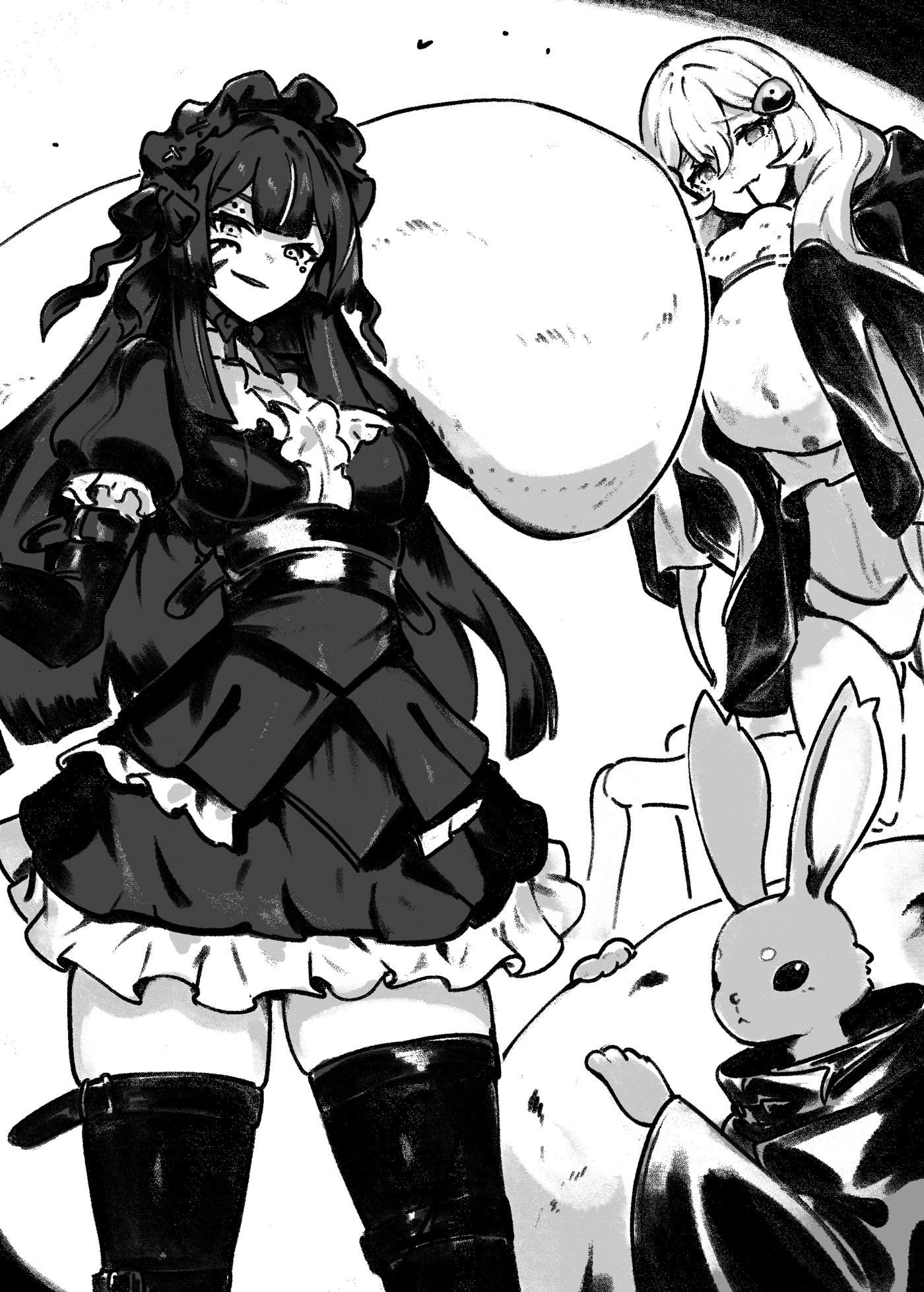
“But being splashed with water is awfully cruel,” Beatrix said. “The nights are still cold! I knew there were men who derive pleasure from seeing a woman in wet clothes that stick to her body, but I must warn you that you will fall to the wayside if you devote yourself to such depraved interests.”
“Lucky me; I’m not into that in the slightest. What sort of company do you have to keep to learn about things like that...?”
I kept an eye on Beatrix, who still continued to tease me, and spun the fey knife in my hand before returning it to my sleeve. She gave a chuckle and told me she was joking.
“But you made the right decision,” she said. “Swordsmen rely too much on their swords and will reach for that weapon even in situations like these. You need to act correctly depending on the situation and strike back without any concern for appearances. It may be a bit unbecoming for a hero who likes to remain under the sunlight, however.”
“I don’t think I’d have any energy to spare for my appearance surrounded by skilled assassins.”
Beatrix might have been joking, but from our terrible bout I knew just how powerful she was. I couldn’t play around. Especially when it was five to one.
“So, what do you need?” I said.
“We dealt with those who had surrounded this canton. Your path home will be secure.”
I was grateful that she saved us the tiresome work. My allies were worn out, and it would have been tough if we were assaulted on our way home.
“And there’s this. Have a look,” she said.
I wondered what the book she threw my way was. It was covered in a few dried, black bloodstains.
“Is this...a cipher?”
“Yes. It’s a disposable code, but the cipher is true.”
The faint scent of magical traces were from an anonymizing spell. Beatrix was a magician, and so had removed the warding spells on it to make sure it didn’t self-immolate upon opening.
“From the grammar, I’d say it’s Seinian?”
“Indeed. The mages weren’t from Ende Erde, but I can say with some confidence that the metal sheets in those living puppets bore traces of the kingdom. It seems there are interests in Seine who stand to gain from Marsheim burning and have operatives to spare.”
Whoever the masterminds were, I had my doubts as to their sanity; no one in their right mind would just grab people from another country off the street and jab magic items into their frontal lobes. I knew that you couldn’t engage in war of any kind without throwing aside your morals, but this was pretty damn extreme.
“Well, you’re a smart one, so I imagine that you were aware that this affair stank of foreign influence too.”
“Yes. I feel chills seeing what they are capable of.”
“It is far easier to do terrible things to people who aren’t your own countrymen. I’ve seen my fair share of shady business like this before.”
How frightening.
I knew there was someone instigating things, but I was surprised they would be so directly involved. I thought I was already well aware that there were people who would whoop and cheer to see the Empire land on its face for once, but this was so brazen. Couldn’t they act, I dunno, more gentlemanly?
“Well, anyhow. If you intend to be a hero who stays under the sunlight, I would advise staying away from Marsheim for a while. Our strict superior is laying some roots down there.”
Miss Nakeisha was beginning an information war in Marsheim? That wasn’t good. Still, with Mister Fidelio around, I had my doubts anyone would try anything too stupid. Too much fuckery in his line of sight had decent odds of inviting the birth of a second sun upon the very earth, especially given that he was raising a kid these days and probably feeling a mite protective. I imagined the cold war among the nobles would just run hotter for the foreseeable future.
In that case, Beatrix was right that it made sense for someone with my taste for plain and simple adventuring to keep their distance from Marsheim for a while.
“Thank you for the warning.”
“Think nothing of it. It’s a mere parting gift from your superiors in the business and their sullied hands. I’m praying that you’ll join our side and work with us instead.”
With that, they disappeared into the darkness for good. It seemed like my premonition from the black smoke of the pyre hadn’t missed its mark.
[Tips] In usual cases, mana stones aren’t formed when humanfolk die. However, if the person in question bears some physical mark of deep magic in their anatomy, such as a potent witch eye, then they may leave a vestige of it behind.
We had needed to reorganize our belongings after the horses scattered during Ferlin’s rampage, but early the next morning we managed to set off without much issue.
“All right people, roll call. Don’t leave anyone behind!”
“Chuck some well water over any idiot you find still sleeping. Anyone late will be forced to run!”
“Get the injured safely into the carriages. No one wants to be left in the middle of people fussin’ about.”
“Um, right, that house was already empty, so we can leave it as is, but this one had some stuff in it, so we should leave what we didn’t use...”
Our unit leaders and the knights and their soldiers busied themselves as we readied to leave the canton, while I, as the adventurers’ leader, made sure everything was going smoothly from atop the saddle. Fortunately all I needed to do was sit and watch in silence—these men were trained well.
Maybe due to his time spent holed inside with his soldiers and their battles together, Sir Lazne seemed to have a more relaxed rapport with them. Surviving a battle helped draw people together, it seemed, and had erased most social standing.
Just as I was nodding in appreciation, I heard a scream. It wasn’t one that indicated danger. I imagined that the booming, resonant, hysterical voice belonged to Yorgos. I heard some chattering among the women too...
“Ah. I see,” I said.
“P-P-P... Pro... Professor?!”
Standing in front of the young ogre, who had fallen onto his behind in confusion, was my old chum—now with slightly less unruly hair and a slightly shorter frame. It wasn’t just the exhaustion of the past few days that had left Mika looking so languid—it was because his transition had been close at hand.
“Y-You’re s-smaller, and your body is...r-rounder...and your voice is h-higher,” Yorgos spluttered.
Mika chuckled. “Surprised, I take it?”
People had started to crowd around, wondering what Yorgos had been yelling at, and soon their confused voices started to ripple through the air. It wasn’t too much of a surprise. The men had treated Mika like just another guy, and some had even gone to the baths with him. It would be weirder if they weren’t shocked to see the change before their eyes.
“I-Is this some kinda spell?!” Yorgos went on.
Thanks to the long stretch he’d spent traveling with Mika, Yorgos was more shocked than anyone. Mika, for their part, shook their head, spread their arms out wide, and did an elegant twirl.
“Apologies for keeping this from you. The truth is, I’m not a mensch. I’m a tivisco,” Mika said. In a light and trilling voice, my old chum went on to explain what a tivisco was. They were open and proud now; it was a far cry from that night when they had hid their body from me.
As a child they had dreaded being singled out, stared at, or set apart, but their friends (and I was lucky to be among them) had loved and accepted them unconditionally, and it seemed to have awakened a sense of pride in what Mika was. They seem convinced now that being embarrassed of being a tivisco was the only thing to be ashamed of. I had asked Mika what they did when the transition came these days, and they had told me, but seeing them in the flesh made me proud to see just how far they had come.
And, as they had mentioned, it seemed they had learned to enjoy the teasing part of their transitions. They’d been curious to see how everyone would react.
“Wait...” Yorgos said after the explanation. “So, Professor, you can become a woman too...?”
“Yes. Next month in fact. I’ll be even shorter than I am now,” Mika replied.
The other Fellows started to mutter.
“Okay, right... But... But...”
“Hold on... We were in the baths together! That wasn’t rude...was it...?”
“I saw them... I saw everything...”
“C-Crap... I totally invited them to come to the pleasure district with me!”
The Fellows each had their own thoughts on the matter—I didn’t blame them, since I might have reacted similarly if this had been my first time too—and they seemed suddenly embarrassed to realize that they had been frank and open with him, as if he were just a regular guy like them. I realized then that some of this lot had been verging on sexual harassment, begging Mika to go to the pleasure district with them, or saying that with his looks they’d be all over him if he were a girl. Finding out that, yes, Mika could in fact become a girl, would prompt this kind of reaction.
“All right, calm down now, people,” I said. “My old chum’s to blame for teasing you all, but we don’t have time to waste being surprised.”
“W-Wait, Boss, you don’t mean...?”
“Of course I know! How could I not? We’ve been friends since I lived in the capital.”
I suddenly received a rain of criticism that I hadn’t filled them in, but I returned a cool expression—I’d never said that Mika was a mensch, had I?
The world’s a big place, people. If you want to go out and see it, then you’ll have to accept that it’s got a wilder and more wonderful continuum of ways to be than you could dream of.
“Pleased, are you, old chum?” I said.
“As punch, Erich! I can’t get enough of seeing their looks of surprise,” Mika said, laughing as they dashed toward me. They removed one of the saddles to make it easier to ride and clambered up onto Castor. Whereas Mika was a bit lighter than they’d been a short time ago, we were still two adults. My beloved horse gave a huff of disappointment, but he’d have to suck it up.
Come on, boy. You carried both of us back in Berylin, eh?
“I weigh more as a man, so I decided to be patient,” Mika said.
“Appreciated. Though, seeing you up close, I can see the changes,” I replied.
“Yeah, the difference is more stark the older I get. I’m looking forward to seeing the look on your face for my next transition. I’ll grin like an idiot the whole time.”
“I’ll train my jaw so that it doesn’t drop to the floor at the sight of you. You bombshell, you.”
At seeing us laugh and banter, the Fellows and knights could only stare openmouthed. I wondered what was going through their heads right now. Maybe they had finally understood why Mika and I were so touchy despite being—at the time—the same gender, and the fact that I only got that close to guys when it came to a brawl.
“Huh? Wait... Huh?! You got the same face, but you also look totally different...” Siegfried said.
“I heard the stories, but my, what a transformation,” Margit added.
“Wow, I wonder how that all works... Like a pupa, perhaps, with everything being rearranged inside...?” Kaya wondered.
While most were simply surprised—for Kaya’s part, she was more interested in the scientific side, it seemed—was it my imagination, or did Margit’s expression look a little ominous? Whatever the case, no one seemed disgusted or anything, so I was happy that Mika had been accepted.
“Enough of those slack jaws, we’re on a schedule to go! Move out!”
As I shouted at them all, I could tell from their expressions that they were angry that I’d dropped this bomb on them just before we left, but this totally wasn’t my fault, so I decided to play ignorant this time.
[Tips] Tiviscos originate in the polar region and only have a short history in the Empire. As such, many in the Empire’s southern and western reaches have never heard of one, let alone seen one.
For fear of his weight overburdening any of the carriages, Yorgos joined the party who would be marching the rest of the way home on foot. Thanks to his huge gait, he was easily able to keep up with the carriages, even having enough time to fall into thought. That day, when he had been overtaken by the Conqueror’s Eye and had struck at his master, he had been asked a question: Do you want to be an ogre warrior? Yorgos had answered: I want to be a warrior that no one will ever forget.
The ogre still hadn’t forgotten the admiration he had felt for the warriors of his tribe that had spurred him to originally take up the sword. They had shown him a battle that had burned itself into his heart, and even far from his home, he still couldn’t forget it. Yorgos knew perfectly well that he couldn’t become like them. No matter how hard he crawled in pursuit of that ideal, he would only amount to an inferior copy.
An ogre’s power didn’t come just from their lifelong dedication to the art of war, but also from the mighty statures they were blessed with. Knowing as much had led the ogre warriors to create weapons that would match their size and refine a style of swordplay that would match these weapons. In comparison to them, Yorgos was practically puny—it was painfully obvious that it was impossible for him to perform their sword arts exactly as they did.
Despite knowing this deep within his brain, he hadn’t wanted to accept it; he had turned his eyes away from the truth. Yet that same truth rattled around in his head with each steady footstep. Soon, the rational part of him and his master’s words spoke to him: What do you need to become truly strong?
The rule of the world was that in order to gain anything, you had to give something up.
Before he was even aware of it, the parade had entered a break, and he found his footsteps stopping along with everyone else. Yorgos loosened the laces of his boots and rested his body. Looking at the sword on his back, he thought that the beaten-up thing didn’t fit him. Even if he did an ungodly amount of training and finally grew used to its heft, its length was still too much for him. And so...if he wanted to be a strong swordsman, then...
“Um, Etan? Can I ask ya something?” Yorgos said to Etan who was sitting down near a carriage, wetting his parched throat with some water.
“Yo, what’s up, Yorgos?”
“Do you have another sword that’s the same size as the one you use?”
“A zweihander? Yeah, I think we might’ve picked one or two up from a knight or foot soldier during the mop-up. Hold on a sec.”
Etan rifled through the carriage loaded with weapons and among the stock that had been taken from those who had perished in their escape—weapons were valuable, and so they had been collected at every opportunity—and found a long sword of a make that saw generous use among mercenaries and folk from larger races.
“Here ya go. It’s a little worse for wear, and the blade’s a bit worn out, but it’s still pretty usable. Did someone ask ya to fetch them a weapon?”
“Oh, no... I...wanted to try it for myself.”
“Really? What about that thing you always lug around?”
Whereas a zweihander was an incredibly huge weapon in your average mensch’s hands, it looked like an ordinary longsword in Yorgos’s. He held it high; Etan’s warrior’s senses could tell something was different.
“Hmph!”
With a shout, Yorgos performed a diagonal slash, cutting through the air in an arc. The ogre had accidentally put a bit too much oomph into the swing, leaving the arc a little untidy. The body of the blade let out a hefty boom as it struck through the air.
All the same, it was an incredibly fast slash that Etan could barely follow. What power, Etan thought. The audhumbla himself had needed some time to get used to the zweihander and had taken a while to get his swings clean. Yorgos’s sword was huge, it was true, but his Fellow had adapted to this new weapon with an unbelievable speed.
“Yorgos, man...”
“The boss asked me a question. Do I want to be a strong swordsman, or do I want to be an ogre warrior?”
“And what’d ya say?”
“That I wanted to be a strong swordsman. That I wanna be me—to be strong as Yorgos. That I wanna be a warrior no one will ever forget. That I don’t wanna just copy the warriors I admire.”
Etan nodded in understanding. While Yorgos’s sword was heftier than any normal blade, it was too much for his body. It was at once the source of his aspirations and the chains tying him down. But Yorgos had chosen to break free from those chains, to say goodbye to the curse of his admiration. It was impossible to say at this stage whether that decision was for the best. What Etan did know was that he had been so shaken by Yorgos’s swing that he inwardly vowed to beef up his personal training.
“Hmm... It feels good...annoyingly so,” Yorgos said.
“I’ll speak to the boss. You use that for now,” Etan replied.
“Are you sure?”
“Heh, ain’t nothing wrong with havin’ a reliable guy on your side in a scrap!”
Etan felt that he couldn’t call himself Yorgos’s superior if he didn’t help him out now that he was trying to keep a vow that would do him some good. Yorgos was certain that their kindhearted boss would say yes, but he thanked Etan for the offer.
The audhumbla decided that he would help show Yorgos the ropes with this new blade. Who knew what could yet come of such a warrior choosing to no longer be swung about by their weapon and take up a higher, truer path? As he made mental plans for his own future training, Etan headed off to make the demand of their master, who was smoking on his pipe a short distance away.
[Tips] No matter how powerful your weapon is, you will be unable to unleash its full potential if you do not fulfill the conditions to actually wield it.
“Ahh...”
As I sank deep into the bathtub, I couldn’t help but let out a stupid-sounding sigh. The baths were the best way to cap off any long journey. As soon as we’d returned to Marsheim, we off-loaded our things as quickly as we could and headed straight to the Imperial baths. We were at our usual spot—the same baths which had that statue of some margrave of Marsheim holding up the head of Justus de A Dyne. It felt like the whole debacle had come full circle.
“This is heavenly...” I said.
“It sure is...” Mika replied.
Maybe because of the early hour, the baths were relatively empty. I’d chosen one of the hottest baths and sunk right up to my neck. I could feel the exhaustion melting away and seeping out through my pores. I was sitting up by the side of the bath, using my hands to keep my balance. Mika was beside me with their knees held up to their chest. Their head was partially submerged as they blew bubbles.
“I thought this last time, but these baths really are quite something,” Mika said. “Although I don’t really like that you have to pay even though they’re Imperial baths...”
What was different about this time was that the Fellows had all decided to go to other baths or the steam room because they had been so blinded by Mika’s androgynous beauty. I didn’t really blame them—it had taken me a while to get used to their beauty too. Although in this state they didn’t have any genitals and were perfectly smooth down there, they were still enchanting to look at, and it would be hugely embarrassing if the Fellows “reacted” to them.
Some of the Fellows had suggested Mika use the women’s baths, but Mika’s habit was to use the men’s baths when they were in their neuter state—I imagined that they felt that it was more polite for other visitors if they used the men’s baths—and so we were enjoying some well-deserved R&R.
“Oof, my calves are tight,” I said.
“Yeah... My lower back’s pretty sore too,” Mika replied.
It wasn’t quite a joyful homecoming, but we really were lucky that the job had ended without anyone dying. Unlike us, I imagined that Sir Lazne—who had dashed off to the castle as soon as we got back—probably didn’t feel very much alive right now. Not only had the head commander—Sir Tarutung—died in battle, the “luggage” he was meant to safely deliver had died too. Given that this was a secret mission, I imagined that the consequences for him would be similarly confidential, but man did I want to be a fly in the wall for that royal dressing-down.
For my part, I felt positively free. We had been on the receiving end of a “No hard feelings, but...” quest, and the ones who had screwed up were the Adventurer’s Association and the mediator. This had been a government-issued job that we couldn’t turn down, and they hadn’t told us of all the dangers on the road, nor that we would be putting our lives on the line for our charge. I had been well within my rights to write a strongly worded letter of complaint; no matter how strong the Lady of Ash was, she wouldn’t be able to retaliate. If I played up the lingering misery of the whole affair and threatened to find a new base of operations, her side would be up to their necks in it and we’d be off scot-free.
I had passed my letter to a clan member who had stayed behind in Marsheim and asked them to deliver it to Lady Maxine. She was probably reading it right now—I wondered just how furious she was. We’d only gotten involved in the first place because her little brother had thrown this utter nightmare of a job our way—at the College’s behest, it was rapidly becoming obvious. She probably was all in a fluster wondering who would take the fall.
I couldn’t wait to see the bonus coming our way to make sure we kept our mouths shut.
“Massages? Anyone in need of a massage?”
“Ooh, perfect timing,” Mika said.
“Two paying customers over here!” I called out.
The Empire’s baths sure were great. They were nice and wide like the “super sento” type of public bath back in Japan, there were cold drinks on sale, and to top it off there were wandering professionals who would offer scrubs and massages. It was a perfect place to recuperate when you didn’t want to lift a damn finger.
Luckily for us, we’d landed some decent masseurs—a couple of beefy orcs. I know, I know, a guy shouldn’t go around making assumptions based on old stereotypes, but I knew at first glance those guys were gonna do a bang-up job. Pretty much anywhere you went in the Empire, it was considered common knowledge that orcish massage and orcish street food had all the competition beat.
At any rate, having a real pro on hand to squeeze out the exhaustion from all the marching and fighting of the past days was ideal. I wasn’t going to say no to the best option here when my body was nicely warmed up too.
“I was hoping you could focus on my legs. My calves are pretty tight,” I said.
“And my lower back for me,” Mika added.
“You got it.”
“Would you like the oil option?”
There were lounge chairs situated around the baths which were also used for this purpose. The prices were reasonable; a thirty-minute massage only ran you fifteen assarii, jumping up to thirty if you wanted the turmeric oil treatment. Before long, a pair of large, warm hands began to squeeze the fatigue right out from me.
Now this was paradise. Part of me was a little concerned, though—the fact that this felt as good as it did seemed like a definite sign I was no longer some spry young fella anymore. From here on out I’d need to put a lot more thought into actually taking care of this body of mine.
“This is wonderful... Amazing... Incredible...”
“It sure is... But, Erich?” Mika said. “Are you sure you don’t need to pay the Association a visit?”
We were both lying face down on our beds. Mika was to my left; they lifted up their head to look over at me as they spoke.
“I plan on not showing my face there for a while, just to show them that I’m good and ticked off this time,” I said. “I figure I’ll be ignoring any requests that mediators pass along for the time being too.”
“I see, I see, freezing them out. Nobles use that method too.”
We’d really been put through a complete shitshow of a job this time around. It didn’t matter how much money I was plied with—I wouldn’t be cooling off about this one for a while. I didn’t have any qualms against running myself ragged on the people of Marsheim’s behalf or anything—that much was just my obligation as an adventurer—but at this point I had zero interest in being anybody’s political pawn.
I wouldn’t dare go to the Association for a month or two. I’d ignore Lady Maxine if she tried to arrange a meeting to apologize. I didn’t want to pick up a reputation for letting this sort of abuse of my trust slide just because of some rote apology. I needed to stay firm here.
“What are you going to do for work in the meantime?”
“A few direct requests came in for me to the inn while we were away. I’ll choose from them and— Agagagack?!”
“You were riding a horse for a long time, weren’t you? If this hurts, then you have definitely pushed yourself too much,” my masseur said.
“Ow, ow, ow! That hurts! But it feels good?! This is weird!”
As soon as the masseur pressed his fingers into my lower back, I couldn’t help but let out a scream. I squirmed, but I couldn’t deny that it felt good.
“Let’s work on your glutes next. They’re bound to be tight after riding.”
“Right, thank you for— Oogogogogh?!”
“Ha ha, Erich, what a funny— Gyah?!”
“You’re awfully tight too! You must have been walking a lot!”
As Mika and I squirmed and groaned, the dreadful job we’d just come back from seemed to grow less important. Afterward, we spent a good two hours going from the bath to the steam room and back before diving into the cold bath. It was incredibly fun. Nothing else worked quite as well to balm a weary soul and wash away one’s bad vibes.
[Tips] The Empire’s baths exist not just to clean the body, but to soothe the heart.
0.1 Hendersons
0.1 Hendersons
Henderson Scale 0.1
A derailing event that has no impact on the overarching story.
The huntress’s prey was asleep. Bathed in the pleasant smell of soap, he made the satisfied sounds of rest. As she watched her napping partner, she couldn’t help but break an awkward smile—it was fair enough that he would rest so deeply on an afternoon as pleasant as this.
They were in their private room in a corner of the Snoozing Kitten—although in recent months, they had only been using one of the two beds—which received a good dose of sunlight during the afternoons. The sun came in at a nice angle, keeping the room pleasantly warm throughout all the seasons.
The pair had made quite the names for themselves to be able to enjoy a nap when the sun was still so high in the sky. Erich had announced that if anyone from the Association came by, begging with tears in their eyes, they were to be brushed off with the excuse that they had injured themselves on their last job. This lazy time was a lovely way to waste the day away.
This morning, they woke up early and helped with some chores around the inn. They felt like popping down to the Snowy Silverwolf, where Erich did enough exercise to not get rusty. He ran through an ample amount of sword swings, had a nice afternoon drink, then headed to the baths to wash off the dirt of the day. After that, they returned back to the Snoozing Kitten and indulged in the exhaustion that came after a bath and fell asleep in their freshly washed sheets.
Was there anything happier than this? Margit could scarcely imagine a more joyful sight.
Erich was dressed in his usual baggy clothing. While some people thought that he chose these clothes simply because he didn’t like his outfits tight, or perhaps because he wanted people to underestimate him, Margit knew that he had the small hope that he would one day grow to fit them. His hair was long now, so splendid that young maidens might hide their own hair out of shame, and the golden threads were splayed all about, as if he were lying atop a mountain of gold coins. Looking like a dragon atop his hoard, he was the spitting image of a fearsome quarry.
A poet once said that love and war were the same thing—the heads that you claimed were all the better the more they gleamed. In this regard, the proud head of Erich of Konigstuhl, also known as Goldilocks, was a prime specimen. If you took his head in battle, then all of his feats would become yours. If you took his head in love, then people would value you as a suitably beautiful woman. It was no great surprise that so many—in both battlefields—wanted to claim him.
The huntress didn’t fear losing him to war, at least. Apart from those youthful days when he was trained by the gallant head of the Watch at home, Erich had never been outdone by an opponent in an honorable fight. All who’d approached that fearless wolf and his unwavering smile would cast their sword and their scream into the pitiless air. Sometimes the battle would end gruesomely, punctuated with arterial spray and severed limbs, but his displays would never fail to break the enemy’s morale. In the songs, it was said that by simply unsheathing Schutzwolfe—a sword that had received her own fair share of renown—some fools threw down their weapons and begged for mercy before another move was made.
Even in the shadow of a stronger foe, Goldilocks would not blanch. The huntress knew of Erich’s secret techniques—which he had yet to use—which could shred even the direst threat to dust in a literal whirlwind of blades.
She didn’t even need to worry if the fight took an underhanded turn. The huntress had managed to nip any and all attempts in the bud with her own hands from the darkness. She was well aware that her training hadn’t been half-baked enough to risk losing to the sort of blundering blackguards who would resort to such unconscionable means just to claim a win. After all, despite her own mother’s cherubic face, she had given the huntress her fair share of difficult training.
When Margit was young and complained of the pain of the blisters on her hands bursting, she couldn’t forget the terrifying sight of her mother’s smile when she merely replied, “So what? Will you cry and give the same excuses to a starving beast in the wild?” After receiving such rebukes with a beaming smile, what else could she do but choke back the tears and pick up her dagger and bow?
Margit was suitably proud of her ability to defend her man’s back. While she could not use magic, she took pride in knowing that she could clear a path ahead of him and pare away the threats around him at a distance as no one else could. It wasn’t arrogance speaking, but her own grueling work when she read someone’s intent from a single breath, where their gaze fell, their gait, and then take advantage of any opening.
As a result, no one dared look down on the huntress. When they had started out as adventurers and Goldilocks’s name had gained traction around the city, there had been no shortage of cruel gossip that Margit was merely by his side because she was his kept woman—a relation from his previous life—but now? No one would dare say anything of the sort.
The huntress was more than satisfied with Goldilocks as her prey when it came to battle. There was no one who could dare threaten her position there.
But what about when it came to the battlefield of love?
Margit wasn’t dissatisfied with how things were. If she was dissatisfied with something, she couldn’t dare say so for fear of the stones and blades that other purehearted maidens would throw her way.
Goldilocks had kept his promise from their youth despite all odds. His sister had been sent off to the College, shouldering fees that a regular person would never be able to pay without the support of a noble or a magistrate. And yet, Erich had managed to pay them off and come home, having put his life on the line and achieving such an ordeal in a mere few years. And then he had gotten onto his knees and invited her to follow him. With absolute sincerity, he asked for her to be by his side as they set off toward adventure. Everything that came after now existed as sweet memories, safely stored away in her mind. That night where they had taken one another’s chastity still replayed as if it were happening now if she closed her eyes.
There were many girls who dreamed of a relationship like theirs. Margit knew as much from sneaking into the crowds of women who would come to hear the love ballads played by women poets in the plaza every now and then. Erasing her presence and watching the faces of those in the crowd, she saw their sensuous sighs.
All the same, Margit couldn’t help her thoughts. Although Goldilocks was gifted at dealing with his fans at large, he still struggled with the women who came up to him. Leaving aside the barmaids who were drawn to his fame and wealth, he was simply so cold to the women (whether regular folk or those also in the business) who harbored romantic feelings for him.
Of course Erich wasn’t rude, but he simply lacked warmth. He would give a faint smile and offer harmless small talk. If they tried to lean into his chest, he would use his well-honed skills to smoothly weave out of the way; if it came to a handshake, he would merely refuse by stating that “I could not touch your hand with one covered in calluses and stained by blood.” It just seemed so wrong to the huntress. She wondered if he couldn’t just act in a way that suited his station more.
In the past, when she had drinks with other girls in the canton and they got to talking, it seemed—subjectively, at least—like she wasn’t lying. The thing was that the huntress didn’t particularly see much value in chastity, especially when it came to men. From where she stood, she wasn’t interested in anyone other than Goldilocks; she didn’t have cause to care too much. This was the case back when their relationship was still pure and especially so now when she looked at him with narrowed eyes.
If someone had asked her if she were mad, she couldn’t have denied it.
Of course, Goldilocks was no less impressive in the bedroom than he was in a scrap. His touch was soft, his whispered words seeped deep into her, and the ecstasy from the seemingly ceaseless pleasure made her mind go blank. She was doted upon like a princess and one-sidedly melted by his skillful handling to the point that she wanted to ask where he had learned how to do it all. Everywhere his fingers touched became her weak points; his “weapon” hit all the right spots without pause (even if it was, in her book, perhaps slightly too large).
What could she compare their lovemaking to? An arachne woman was usually the dominant partner, yet when it came to Erich, although she managed to maintain her dignity, she could only scrunch her face if asked if she had “won” any of these nighttime encounters.
This man was nothing if not meticulous. If he began something, he would complete it properly; when it came to something he enjoyed, he knew no bounds. He drew his pleasure from her quivering body and sweet sounds, and even the memories overwhelmed her.
There was once when she had even felt fear—that instance when, in less than a minute, without even being touched deeply, she was brought to climax. This situation had made her question the stories her mother had told her. Although it was shameful for her to have muttered that she felt her body wouldn’t be able to last, it was difficult to deny.
Of course, she was very much happy to be so loved and so understood. With someone like him, it made sense that any other man she looked at came off like a clay doll, half made and underbaked. Indeed, Erich’s nigh perfection made her question whether he was a mensch at all—perhaps he was an incubus, or some other fey creature. The problem in her eyes was that Goldilocks was too devoted to her. She wasn’t troubled by any shortage of love—if anything, she was overjoyed with the situation—but she felt lacking somehow and a bit scared too.
Some might call this arrogance on her part, but if Margit were to meet an unassailable misfortune, would Erich be able to return back to his two feet? It was a worry that came from being the one person that Erich loved and cherished so deeply.
Margit knew Erich—if she were to die, she was aware that he wouldn’t do something so foolish as to kill himself to follow her. Despite that, Goldilocks cared about appearances. Someone so consistent as him would probably announce that he would forever remain faithful to his spouse. No, not probably—she was sure of it.
In that scenario, where would this golden-haired beast rest? Would he be unable to find peace on his own and have to survive on fitful sleep with his sword in his arms? Margit couldn’t bear to envision such a terrible future for Erich.
The huntress wished her beast would not content himself with feasting on one partner and range about from time to time. The feeling came in part from her hunter’s heart—a truly glorious kill came when there was fierce competition for your quarry—but also from the fear that her precious prey would break beyond repair.
And so she wished, even if it was only a small wish, that he might find somewhere else his heart might find a home as well. The huntress looked at Goldilocks and wondered if he couldn’t just have a little fun. His unwavering fidelity had, if anything, prompted more unwelcome gossip than if he’d played around a little; some questioned whether his seemingly exclusive interest in Margit betrayed a far less wholesome fixation, while others merely wondered if she might be his beard.
It worried Margit that others might condescend to her for not being able to keep down a single man. It troubled her, despite her beliefs, that Goldilocks might turn his back to her. But how many women in this world were there who could keep a man this good to themselves?
Margit’s mother had done it, of course, but in the huntress’s eyes, she felt she was a little too exclusive. Of course, her father was still in fine health, but he looked two or three times older, and Margit couldn’t ignore that. Of course, her father had gleefully entangled himself in her mother’s fiery affections. But when she pondered the notion of doing the same, Margit just couldn’t see herself following through.
In her eyes, protecting a fearsome wolf who had glutted himself on countless prey was all too correct for her.
She didn’t want to pet and love a friendly dog from within the confines of a cage. She couldn’t be the sort of person who would simply care for this golden-haired beast as he purred stupidly in his sleep. While he may have been naught but a sleeping puppy at the moment, he didn’t deserve to have a collar placed around his neck. As soon as she affixed the lead and took any pleasure in it, she would be swung about and have her face dragged along the ground.
Margit knew that Erich had let his guard down so completely because he knew his partner was here to look after him, and she was happy that he could sleep so peacefully and innocently. All the same, although she wasn’t asking him to leap at every woman of pleasure he saw, she wished he would act a little bit more like the beast that he was...
The huntress pulled another awkward smile and poked Goldilocks’s nose.
“Mmf...”
This was a face that he didn’t ever show anyone else. She knew Erich—he wasn’t the sort of man to allow someone else to see him asleep, even if he were in bed with another woman. When on jobs and sleeping alone, he would hold his sword and take his rests sitting down. It was impossible to believe that he would show any openings if he were in someone else’s bed.
That was why she didn’t mind—he could play around; he could see other people. In the end, this was the place he would return, where he would allow himself to sleep in peace. When it came to it, this famous wolf would be drawn into his place by a spider’s hand.
When death finally came, would the spider be in the wolf’s arms, or vice versa? Margit didn’t know the answer, but she did know that as long as she was victorious in the end, that was all that mattered. As for what came before? Well, her wolf could rampage at his leisure. Remaining by the side of such a monster would only serve to heighten her own value.
Maybe two would be the perfect number to take on this beast, Margit thought. With such trivial thoughts in mind, the huntress placed the blanket—kicked off during sleep—back over Erich. She then did a little stretch and snuggled in beside him. All this racking of her brains wore her out.
The pleasant smell of soap wafted over from him. Along with it came the fragrance of an expensive and high-quality incense that he had spent a good half hour contemplating when he had first realized that it would be best to disguise the smell of sweat when meeting a client. While it irked her that there would be other women who would be able to take in this fragrance, she also felt a sense of superiority that Erich didn’t put on such airs when he slept with her.
The huntress was well aware that although her mother was a difficult sort, she was a difficult person too. Using Erich’s arm as a pillow, she closed her eyes. She only wanted a light nap, but she felt so safe here.
Grow bigger, grow stronger...
With these thoughts in mind, the huntress was lulled to sleep.
[Tips] There are some poets who sing love songs which are complete fiction, with the most talented among them drawing a lot of popularity from a subsection of women fans.
Early Summer of the Eighteenth Year (I)
Early Summer of the Eighteenth Year (I)
Sharing Information
It is important to share information in order to maintain the smooth running of a party. While one shouldn’t feel obliged to share absolutely everything, it is worth considering how the fallout will affect the relationship if things come to the surface.
A few days after our return to Marsheim, Mister Fidelio—whom I hadn’t been able to speak with much, as he had been dealing with some top secret business—held a little party for us to ease our exhaustion. It was only a small gathering, and so I thought it was about time to spill the beans on this connection of mine. After checking with Mister Fidelio, I got the okay to invite my friends, and so I asked Siegfried and Kaya if they’d like to join.
“Suh-Suh-Suh...SAINT FIDELIO?!”
“Whoa!”
When Siegfried arrived at the Snoozing Kitten and met the man who had shown me the ropes as an adventurer, his jaw fell to the floor. A few seconds later, I found his fist coming my way.
Damn, this guy can throw a good punch! He’d managed to carry over all the form and discipline of his spear thrusts into his fists. The movement began in his ankles, utilizing his waist, chest, and shoulders, and the punch came with a blinding speed. If I had been taken unawares, I wouldn’t have been able to react to the attack, let alone dodge it.
A resounding smack came as his fist slammed into my open palm. I redistributed the force of the blow as it traveled up my arm into my shoulder, but I needed to take a step back to fully absorb the hit. Man, this guy’s Strength outclassed mine. It made sense considering he swung around that heavy weapon all the time, but it pained me to think he’d outpaced me during our growing periods.
“What’s with this all of a sudden, Siegfried?! If that had hit my jaw, I’d have lost a molar,” I said.
“You sneaky little...! You know how much I look up to the saint, and you still held out on me?!”
“I mentioned him from time to time...” I muttered with a pout.
“Like I could see through such an impossible hint!” my comrade roared back as his right fist came barreling my way once more. This time I managed to shift my right side back and avoid it.
“Ha ha ha. Now, don’t be so angry, young man. I told him not to make a big fuss about our connection, after all,” Mister Fidelio said.
Thanks to his intervention, a third blow never came. It was a sign of not only the saint’s strength, but also his sheer class that a single hand on the shoulder made Siegfried freeze up and drop his clenched fist. His instincts must have kicked in to perform an emergency stop. The alarm bells in his head told him: “Defy this man at your own peril.”
“I-I’m really sorry! I’m Siegfried! I mean, that’s my name. Uh, um, I’ve listened to the song of the limbless drake a hundred times by now...”
“You don’t need to be quite so formal with me, Siegfried. I am just another adventurer like you. I may have spent a few more years in the business, but pay it no heed.”
With a reassuring pat on the back from Fidelio, my comrade hugged his own body as if he were utterly moved.
I had been aware of Siegfried’s obsession with heroes ever since we first met Heavy Tusk Gattie. It made complete sense if he found out that I had been sitting on the fact that I was close with the leading man of one of his favorite songs that he would throw a punch or two my way. I could totally relate, so I decided I’d be the bigger man and forgive him for his attack. Let’s ignore the fact that my palm is still stinging...
“Dee looks so happy,” Kaya said. “But I must say, it was a bit mean to have hidden this from him.”
“I’m sorry, Kaya,” I replied. “Mister Fidelio said he doesn’t want this place to become a meeting spot for adventurers.”
Siegfried looked like he was on cloud nine to be personally brought to the party space with the saint’s hand on his back, but for her part Kaya seemed a little annoyed, seemingly thinking that I’d done this out of ill will toward my comrade. I wanted them to understand that I couldn’t just blab about this stuff! I needed them to know that.
“Aha, so this is the one known as the Lucky and Hapless!” Mister Rotaru said.
“Huh, ain’t he a bit scrawnier than the songs said?” Mister Hansel added.
“Boy... Sit, quick. Waiting is a boredom,” Miss Zenab chimed in, plainly impatient.
In the party room was a stunning platter of food and three adventurers—the saint’s party. All of them were dressed casually, but their martial might and aura were seeping out. They were the splitting image of high-level adventurers.
“N-No freakin’ way! The Bell Crusher! The Windreader! The Gourmand! The whole party is here?!” Sieg said.
“Ooh, you know your stuff, kid!” Mister Hansel said. “C’mon, take a seat. I love meetin’ the young new sprouts.”
“Yep, Hansel here was a bit miffed that Erich didn’t recognize him as the Bell Crusher, you know?” Mister Rotaru added.
“Oy, don’t embarrass me like that!” Mister Hansel replied in his booming voice as his fist came sailing toward the stuart. Mister Rotaru deftly avoided it while Mister Fidelio took his place in the host’s seat at the back.
For Siegfried’s part, he seemed positively happy enough to burst at being personally invited to sit beside them.
“Holy crap... It’s so big... It’s all so freakin’ big! I can’t believe that hoodlum was so scared of these arms that he ran into a bell before you smashed it to bits with an axe...”
“And you know where my epithet comes from! You’ve done your homework!”
Huh, so that’s where that came from. It reminded me of a certain snake myth.
“That’s enough excitement for now. I think it’s time to begin the feast. Otherwise Zenab here will explode,” Mister Fidelio said. Once everyone was seated and drinks had found their respective hands, he raised his cup. “Now then, let us enjoy a feast to celebrate the return of these adventurers. Cheers!”
“Cheers!” we all said in unison.
The cups clashed together and everyone downed their first drink.
“Whew... Now this makes life worth living!” Mister Hansel said.
“Seriously, Hansel? You ain’t been working for a while now,” Mister Rotaru chipped in.
“Ahh, quit that. It’s just exhaustion from the daily grind.”
“Meat, meat, meat! Crunchy skin!” Miss Zenab cheered.
“Calm it, Zenab, the lamb’s not going anywhere, so take a moment. I hope you can adapt to at least a few Rhinian rules—for my sake, at least,” Mister Fidelio said.
It was the job of the host to portion up the meat, and their class was made yet more obvious by how perfectly they could divvy it up. Miss Zenab’s impatience had driven her to take up a fork in hand and an outstretched plate in the other as she begged to be served.
As we ate and made our introductions, I admired Miss Shymar’s cooking. Their treasure, Miss Safiya, was having a nap right now, and so she had the wherewithal to show off her cooking skills. The grilled lamb was deliciously crunchy with delectably juicy meat underneath. We’d eaten quite the fancy spread during the Fellowship’s own little parties, but they paled in comparison to this. I could see why many people chose this as their permanent lodging simply for the food.
“I heard you had quite the time of it,” Mister Hansel suddenly said as he deftly picked apart the quail—cooked together in the same pot as the lamb—and sucked at the bones. His movements were so smooth that it didn’t seem boorish in the slightest.
“Yes, it was a, as they say, ‘No hard feelings, but...’ sort of deal,” I said.
“Yeah... It was hell,” Sieg added. “I was wonderin’ why an adventurer would need to dig trenches...”
“Trenches? Were you at war or something? You didn’t run afoul of a bunch of polemurges, did you?”
“Something like that,” I said.
As Fidelio’s party gave surprised expressions, Siegfried gave a detailed—if slightly overblown—rundown of the job. As he spoke, the listeners who had been indulging in their meals took on the looks of adventurers once more.
“Talk about an ordeal,” Mister Rotaru said. “The idea that even a nonmage can run around blowing up houses in one shot just because they’ve got the right supplier spooks me a bit. Sounds like a real pain.”
“Do not be worrying. Gunpowder, expensive. Hard to be making many for me,” Miss Zenab said.
“The fact that you can’t make ’em in bulk, Zenab, means that you were dealin’ with some foreign nation or noble house’s secret death squad. How unlucky do you have to be to fight against that?” Mister Hansel said.
“Hey, maybe you and Siegfried can both be Lucky and Hapless, Hansel!” Mister Rotaru said.
“Please don’t tease me like that!” Siegfried cried, evidently unhappy with his own moniker. Unfortunately with something like that, he would probably be teased his whole life. Blame your bad luck and the faux poet who gave you that title.
“At any rate, I think you’ll find that your return in one piece will reap rewards elsewhere,” Mister Fidelio said. “We had our own fair share of woes when we were against folk hired by a nation or with really deep pockets.”
“Oh yeah, I remember. That fake job back in Windels Ravine, right?” Mister Hansel said, finally throwing down the quail bones.
Mister Rotaru’s whiskers drooped as he leaned on the table. “And no one listened to me when I said we should’ve dropped the damn gig! I knew there was no way a drake would show up in terrain like that.”
“It wasn’t as if we had a choice. The plea from the locals was genuine,” Mister Fidelio said.
Oh, to think even the saint had been tricked before.
Someone must have had an axe to grind for the party—maybe a noble who had been shown up or something—and so when the party showed up to help out some folk who were complaining about a drake gone wild, what awaited them was a fully armed unit of mercenaries. The battle that unfolded pitted four against hundreds.
“That was hell, man. I thought I was gonna die a whole bunch of times,” Mister Rotaru said.
“For my part, I invoked a few too many miracles. I wasn’t sure I’d ever be able to make up for it,” Mister Fidelio said.
“Remember when my guts spilled out?” Mister Hansel added.
“I am not fond of the remembering. Although, memories make me hungering for more offal stew, Hansel,” Miss Zenab said.
“Hey! Don’t dish me up!”
Mister Hansel really was a mature guy for letting Miss Zenab off with just a sharp remark; he didn’t even break his stride serving up the next round of lamb stew. Most people would have chucked the stew all over her.
“Well, things like this can happen, so think twice about requests that come from afar, even when they come with desperate pleas attached,” Mister Fidelio said.
“Hah, says the guy who went dashing into danger without even asking the info broker to double-check!” Mister Rotaru said.
“Don’t jab at an old wound like that, Rotaru. I didn’t have much of a choice! There were so many letters saying they wouldn’t last the winter. And in any case, I was a younger man then,” he added, downing his drink as if to chase away his embarrassment.
“I want to hear more of the adventure!” Siegfried piped in. “I mean, four versus hundreds?! That must’ve been an all-out war!”
“You bet it was! They were all in square formation, with light cavalry spread out so far that not even ol’ Rotaru here could sniff ’em out. The whole ravine was blocked off. Enemy formations in front, cavalry to the rear. There was no way out!” Mister Hansel said.
“How’d you manage to break through?”
“First I unleashed a top-level prayer to destroy their left wing,” Mister Fidelio said.
“Then we charged into the center as they wrangled with the fallout,” Mister Hansel went on.
“I was dealing with the legs of the horses,” Miss Zenab added.
“Then while Hansel here was on a full-on rampage, we charged through their center and forced our way through,” Mister Fidelio finished up.
“Whoa!”
Talk about scary! It reminded me a little of a grim affair this crew from southern Kyushu had been forced into in days gone by. But they had lost so many lives—even their general—so how had Mister Fidelio’s party all emerged in one piece? As I thought about how they threw off the power balance of the world, despite sharing a table with them, they appeared even more terrifying than before.
Yup, this is what an adventurer is. Despite Mister Fidelio’s earthshaking power in battle, he worked as the owner of an inn alongside his wife. There were a few of his breed at the table back on Earth—wandering holy women, wandering heroes. These powerhouses that would usually be tied to a nation’s forces instead wandered as they pleased.
And so, I decided to listen to the advice given by the seniors in the biz and work to protect the peace of those close to me. After all, I’d just received a job that would allow us to leave Marsheim for a good while at the perfect time.
[Tips] There are folk, level 15 adventurers whose builds seem totally normal to them, who wander about without a master doing as they please when they are more than capable of taking on lower-level gods. They are endless mysteries that only players could come to know or truly understand.
“Now, people, I am sure there are some among you who have spent the last five days since our return from that last perilous job with loose purse strings, and now you’re aching to fill those pockets once more.”
I had gathered the Fellowship in the Snowy Silverwolf and was giving them a little preamble before I told them about our latest gig.
Thinking about it with a level head, adventurers truly were a strange breed. Most people spent their hard-earned cash on good times and the means to make life easier, but us? We put our hard-earned cash into buying super expensive weapons and gear, traded gold pieces for mana stones, changed our coins for catalyst cards for our little home alchemy projects, and then spent what was left over to rent out the cheapest room in the horse stables.
My Fellows were a sensible lot, and so they’d set aside these last five days to properly blow off some steam. Among them were a few who had maybe enjoyed themselves a bit too much, and whose purses had already ended up much lighter than their peers’. They were former second and third sons of poor families in the countryside who had come to the big city and become swordsmen—it wasn’t too surprising that they would splash out in the pleasure district.
I wasn’t criticizing them or anything. Everyone had their own fuel to keep them living, and some would work harder and stay alive if it meant seeing someone they cared about again. The problem was keeping the indulgence in moderation.
“So listen up—we’ve got a job. And a pretty well-paid one at that.”
As I finished up my speech, I held up the request. However, the response I expected was...absent. What was wrong? I’d expect at least one cheer with the announcement of a good job.
“Boss... May I?”
“Yes, Etan?”
One of the rules of the Fellowship was to raise your hand if you had a question, and Etan’s arm was politely held in the air. I ushered him to speak, and he took a good long look at Siegfried before talking.
“Is this job...related to Big Bro Dee at all?” he said.
“What the hell is that meant to mean?!”
I tried to placate my comrade, who had stood up with such force that his chair fell over, as I empathized with what Etan was trying to say. The Fellows ribbed Siegfried about his epithet, claiming that “Lucky and Hapless” was a perfect match for their Big Bro, but with how terrible our last job had been they were worried that his bad luck was starting to trump the good.
“Don’t worry,” I said. “This is a trusted client of ours, and the job is an honorable one. We’ve been asked to keep the peace of a rural canton. You’ll all be able to make a name for yourselves.”
“What do you mean?”
“We’re hunting a gryphon!”
At this, my Fellows let out a hearty cheer.
While defeating bandits was an adventurer’s bread and butter, defeating monsters menacing the good folk was a grand way of elevating one’s name. Gryphons were a plentiful type of phantasmal being. The Empire hadn’t banned hunting them, so they were a valuable source of materials, and many said they were worth their weight in silver. As each specimen boasted great physical power, felling one was a point of considerable pride. Having the head of one on your mantle would speak of your strength in indisputable terms.
“We can trust the location of the request too. It’s Mottenheim.”
“Oh! Mottenheim, huh?”
As Mathieu said this, he looked evidently relieved at hearing the name of a canton we all knew well. Mottenheim was a new, developing canton, and unlike my lovely home of Konigstuhl it didn’t have anyone as reliable as Sir Lambert running the local militia. They were worried about their capability to defend themselves, and so they’d made it a recent priority to train up a decent Watch of their own. Training on their own hadn’t yielded great results, and so they’d come to wonder—what better solution could there be than to hire a professional? They’d first called out to us just as the Fellowship was making a name for itself.
We had been invited over to Mottenheim a number of times since; we were all more than acquainted. With their warm welcomes and generous payouts, we all had a good impression of Mottenheim. Their requests only ever asked for a few Fellows at a time—and they were well aware that asking for the boss each and every time would cost far too much—so we split the work among everyone.
“The job isn’t just the gryphon hunt. They want a real, proper training regimen. As such, this will be a long-term job. Speak now if you won’t be able to commit,” I said.
I was personally quite happy to be away from Marsheim until the stench of subterfuge wafted out. I was thrilled, to tell you the truth. We would work to protect the peace of a canton we liked, and nobody was going to steer us into a suicide mission. What more could we ask for?
“Aw, I’ve got work,” Mika said.
“Is that right?”
“There are a number of facilities I’ve been asked to fix up, you see.”
Mika, who naturally had joined our clan meeting, looked terribly disappointed as they looked at the schedule in their notebook. While they had been given permission to moonlight as an adventurer, it was natural that they couldn’t ignore their main work. It was sad to lose such a talented debuffer, but I couldn’t jeopardize Mika’s future as a magus because they were fobbing off their duties.
We saw Mika off with tears before moving to decide who would be coming along. This would be a big hunt, so for once our client hadn’t given an upper limit on personnel. All the same, despite the fact that the majority of the Fellows had put their hands up to join, a number of them needed to stay back—due to family members being unwell or whatnot—and so we wouldn’t be heading out with everyone in tow.
“But a gryphon, huh... How are we supposed to hunt it?”
“Yeah, they fly, right? Are our archers supposed to just dump arrows into it?”
“Nah, they’re pretty smart. When I was a kid, a gryphon attacked our canton and ate some of the nobles’ horses! The feudal lord ended up raising an army to hunt it down.”
As the Fellows chatted among each other, Dietrich suddenly spoke up.
“Oh, what’s all this? The men of the Empire don’t know how to hunt a gryphon? How pathetic! They’re a cakewalk!”
“So I take it you know something I don’t, Big Sis Dietrich?” Karsten said, plainly a bit annoyed to have his prowess called into question.
In turn, the zentaur puffed out her chest and said, “Gryphons lack stamina!”
“Huh? But they can fly for miles!” I said, confused.
However, Dietrich merely tutted as she wagged her finger in my face, as if to mock my lack of understanding. Gods, she could be annoying.
“My sweet summer child, they can only fly a few miles at best! All you gotta do is chase after them until they wear out! Then, when they stop to land, you lay down a rain of bolts and fire!”
Yup, the barbaric methods of someone from the isles weren’t helpful in the slightest. We had a small cavalry unit, but we didn’t have the technical know-how to chase after a gryphon until it tuckered itself out. And surely the reason that gryphons chose to flee was because they knew just how dangerous zentaurs could be! If we tried that, the gryphon would just pick us off.
“Huh? We can’t?!” Dietrich said as I merely stood in silence.
“You guys have way more limbs than we do and way more options to fight back if a gryphon picks you up! That’s why they don’t do it! And in our case, they won’t just pick us up, but knock us right off our horses. To top it off, none of us can use a heavy bow like you.”
Their strategy involved using composite bows—which they could easily draw past their ear, even though it would take five of us normal folk to draw at all—to attack as a single unit. There was no way we regular humanfolk could begin to emulate that.
Putting Dietrich’s unhelpful suggestion aside, I actually had my own idea about how to take down our little gryphon. Because gryphons didn’t live alongside people—apart from those really rare cases where a hero had chosen one as their steed—they were treated like wild beasts. So your average person had no idea they were canny bastards; many were just as cunning as any person forced to live by their wits.
They wouldn’t fall for poisoned bait or decoys, and they would maintain a safe distance after clocking provocation, preferring to bait their antagonists into a suitable killing ground. That, or they would use their inherent magic to conjure up powerful blasts of wind, keeping the enemy crawling along the ground at a safe distance. The gryphon would hardly ever come down to our chosen battlefield. Most terrifyingly, they were powerful enough to snatch a horse off the ground with their talons and fly it back to its lair. It went without saying, but for us groundlings, being dropped from dozens of meters up in the air meant certain death.
Even top-level adventurers couldn’t reduce fall damage. Rare was the TRPG rulebook that didn’t clearly state: “It may be an obvious statement, but you will die if you fall from a height of ten meters or more.” No amount of natural toughness or thickness of armor would help; if you went into freefall and hit the ground, you would die. Naturally, some people like Uzu—Nanna’s pet ornithurge—had a chance to save themselves, but in the majority of cases, there was no bailing out from falling from a great height. Not even people as unfathomably powerful as Mister Fidelio could pick fights with the laws of physics (at least, not without his god’s intervention). Granted, someone like him could just grab the gryphon and wring its neck before it even got a chance to fly—there wasn’t much point worrying about that sort of scenario.
“Calm down, everyone. I have a plan,” I said.
“Yeah! That’s our boss!” one of the Fellows said.
“Tch... I finally thought it was my time to shine,” Dietrich muttered.
“I’m not sure if this will be a viable method until I see the location, but it’s got good odds. Plus, we might get some special rewards too!”
Again the room erupted in applause, so I tried to calm everyone down—Mister John would blow his lid if we were too rowdy—before telling them that I would send a scouting group ahead and get more intel before firming up the plan. With that, everyone nodded in agreement and began their preparations for our next job.
Our speedy response time was one of our biggest selling points. We would probably be ready to hit the road in two days.
“Rest up and recuperate, all right? We’ll have a party tonight to celebrate our departure. You won’t be getting a bath anytime soon, so get your heads in gear for some marching!” I said.
“Hey, Erich?” Siegfried said. “Before that, mind if I give Etan a good ol’ smack?”
“Leave it, Sieg. You’ll break your knuckles if you do that.”
Siegfried was still fuming at Etan’s earlier comment; I did my best to calm his mood before tossing a gold coin to Mister John to get the tavern ready for the party.
[Tips] Gryphons are phantasmal creatures that are plentiful in the western reach of the Central Continent. Reports of the damage they cause abound. Their feathers, bones, blood, and other body parts are hugely valuable as magical catalysts, so some say they’re worth their weight in silver.
Few people have eaten a gryphon, but apparently they taste similar to fowl and are rather tasty.
To make a name for ourselves, we needed to do work that paid slightly less than the effort required for it. Of course, these decisions required some finesse; you couldn’t undersell yourself either.
There was a caravan that was leaving Marsheim out of season, and so we said that we would tag along for free. They were hugely grateful. Not only had they promised to give us free meals in exchange, but tonight they had offered to share some booze with us. It was quite the luxury. They were a small, intimate caravan that made their way around the local region doing small deliveries; I was surprised by their warm hearts.
Judging by their size, I imagined that they’d said yes so readily because they were happy for the clout that would come from having us with them. If some of the merchants in the caravan managed to sell some of their wares to us, then they could use it as a stamp of approval—they could say that famous so-and-so adventurer had purchased whatever—in the future, even if the product wasn’t all too fancy. They had a blade seller with them, so I was pretty certain that was their angle. It didn’t hurt me to hear these merchants’ sales pitches, so I let them do their thing. If it meant that we could join them at their camp for a nice pot of hot food, then it was a small price to pay.
The carriage that Polydeukes and Castor were pulling contained enough food and drink for both ways, but it was expensive to feed two dozen or so bellies, so I was really thankful to have three days of food expenses paid off. We had quite the big eaters in our clan. Of course, the bigger folk ate as much as their size suggested, but even the shorter among us had big appetites. While goblins were smaller than mensch, they didn’t necessarily run as efficiently as we did.
While I was on guard, watching dinner come together—everyone was treated equally when it came to lookout work—a few Fellows came wandering over, drawn in by the good smell. Some had some of our preserved food in their hands and were offering to put some in the pot to improve the grub.
Very good, very good. A good adventurer treated their caravan with respect. It wouldn’t do if the ones protecting the caravan on a safe journey started putting on unnecessary pressure. Plus, it hadn’t even been a day since we left Marsheim. Ende Erde might have been a dangerous land, but bandits wouldn’t strike this close to the regional capital. It was the perfect time to take it a little easy, so I allowed them a little bit of relaxation. You see, a band of women of pleasure were traveling alongside the caravan.
It went without saying that there weren’t any pleasure districts out in the countryside, and so there was a demand for women who could soothe the weariness of the road. Sometimes they came to Konigstuhl, and some lonely folk who didn’t have someone to call their own paid them a visit.
It wasn’t ideal for them and their customers to be keeping everyone else awake during the night, but it beat traveling with a bunch of pent-up, temperamental folks by a country mile. Some of the women of the Fellowship, few though they were, looked a little put off about it, but they were great adventurers too. I was sure they would understand. After all, it didn’t matter if you were a man or a woman—emotions ran high in the buildup to and the aftermath of a job where you put your life on the line.
“Are ye the leader of this troupe?”
As I watched the Fellowship enjoy themselves with a warm feeling in my chest, someone called out to me. I wasn’t too surprised, as I had sensed her presence for a while now. When I turned around, I saw a young, modestly dressed mensch woman holding a cup of water.
“Are ye thirsty, perchance?” she said.
“Thank you kindly,” I said.
She was a lovely young woman. She had an oval-shaped face with shiny black hair and large drooping eyes with brown—almost black—irises, giving her an almost sleepy look. Her shapely nose was in contrast to her full lips, which elevated her feminine charm. These features were nicely counterbalanced by the fleeting beauty of the charming mole near her left eye.
She was rather short—her shoulders only reaching my solar plexus—but even through her clothes I could see that she was pleasantly well-rounded. In this age, larger women were seen as more typically beautiful than skinnier women, but a fine balance in between was probably the most popular.
The phrase “devilish allure” popped into my mind at that moment. She wasn’t beautiful in a merely artistic or aesthetic sense. She didn’t have that kind of perfection that denied any sort of crack in the armor; not like Lady Agrippina, whose facial features were almost optimally sculpted along the geometries of beauty, or Lady Leizniz, who was almost comically proportioned, her hourglass figure seemingly threatening to snap her in half if she so much as turned around too quickly.
All the same, she was dangerously beautiful. It went without saying that not everyone was drawn to the perfection of the golden ratio. More than anything, that “girl-next-door” energy—beautiful, but familiarly so—reigned supreme out here. In that regard, she had the traits that would interest most men. Even I—who had seen reams of gorgeous men and ladies in Berylin—felt that devilish allure from her.
She had the glamour of an older lady, the genuine air of a young woman, and the demeanor and looks to leave her real age perpetually in question. The yellow ribbon that decorated her peasant’s clothes told me that she too was in the business, so to speak. Back home in the pleasure district, most practitioners of the world’s oldest profession ran their business out of a brothel (not exactly licensed, but certainly tolerated by the city’s officials), but the gals who practiced outside that system flagged themselves with a yellow ribbon. It helped prospective customers recognize what was on offer and who was on the clock. In other words, this young woman was part of the troupe that had joined us and was helping out by passing around water.
The cup she had given me wasn’t particularly cold, but I didn’t mind thanks to the refreshing peppermint that was mixed in. I finished the cup in two or three gulps and handed it back to her. She asked if I wanted a refill, but I declined. It didn’t seem like there was anything fishy about the drink, but I wasn’t particularly thirsty. I didn’t want to be needing the bathroom a lot out on the road. We were well used to drinking the minimum amount we needed for our work.
I handed back the cup and shifted my gaze to return to my lookout duties...and noticed that she hadn’t moved. I wondered if there was something she was worried about, but she hadn’t said anything, so I just kept on at my job. My partner would be working through the night, so I needed to keep at it while Margit slept.
I wondered if this was an implicit invitation for her services? I had Margit, so I never really thought about it. I had avoided the invitations of both my Fellows to the pleasure district—Siegfried and I always did—and the wandering hands of the barmaids until now. And last night after our going-away party, well... Ah, best not to get into detail about that here. Long story short, we satisfied one another, so there was no need for me to head to the pleasure district. Sometimes Margit would joke that I needed to go a bit easier on her.
I had thought that if I stayed quiet she would leave me alone, but the sun would soon be dropping below the horizon, so, unable to bear it any longer, I turned around. There she was, smiling at me so widely that the corners of her eyes creased. Was that slight redness on her cheeks from her drink? Even when I caught her eye, her smile never wavered.
I couldn’t bear it any longer and asked her why she was here.
“Ye are the famous Goldilocks, here in the flesh,” she said. “I always wanted to meet ye, just the once.”
A young woman with a hand on her cheek and an enchanted look in her eye... A fan, I supposed. I was a bit surprised with the sensual way she spoke to me, but I did get people ogling me like this now and again. There were surprisingly many people who wanted to see what the adventurers from the songs were like in the flesh. Even if they weren’t particularly interested, they might come and have a look. It was similar to how, back on Earth, people were intrigued if a celebrity came to their hometown for some TV shoot or whatever.
It wasn’t a bad feeling to be liked, so I shook her hand. It was the right thing to do; she seemed awfully pleased, anyway.
“Ye are as stout as the songs said. What a delight for the eyes.”
As she spoke in her strange accent—which I would later come to know as just how the palatial tongue sounded in the hands of a non-native speaker—she refused to let go of my hand and leaned in close, so I carefully pulled back to show that I wasn’t interested. She looked surprised, but when I smiled warmly back, she realized what I was implying, and so she stepped back too.
I needed to indicate that I wasn’t that sort of person, you see.
I told her she should hand out some water to the others on guard duty. She walked away dejectedly, often turning back to look at me.
Whew, that was close... If I’d been single, I probably would’ve been putty in her hands. That was how cute she was. She had that rare kind of beauty where you just didn’t get bored no matter how much you looked. With other women who had absolutely outstanding features, you felt this pressure just by standing next to them. I had gotten to know Lady Leizniz and Lady Agrippina, so I could stand strong in their presence, and I was firm friends with Mika now, so I wasn’t crushed by their overwhelming beauty—whatever sex they were at the time. But dealing with someone you didn’t know with that class of overpowering looks was quite taxing.
The Empire was rife with beautiful and talented nobles who made a hobby of poisoning people. Even if the First Emperor was a bit lacking in the looks department, generations of beautiful men and women being wed into the family had polished the bloodline’s look to an eye-searing shine. It was exhausting just breathing the same air as them. I forced myself to do it, because that was the job, but you wouldn’t believe just how taxing it got talking to people who belonged on magazine covers or the silver screen on the regular.
And so it was truly rare to be with someone beautiful who didn’t wear me out like that. If the young lady learned a few songs or an instrument, I was sure she could find a consistent spot at a great place in the pleasure district. I wondered what had led her to choose the life of a traveling troupe—one of the “lower-level” choices in the business. This wasn’t something I could ask her, so I could only assume she had her own difficult circumstances. What a world, eh?
“Boss, do you want to end your shift? You’ve been standing for four hours,” Etan said.
“Oh? Have I? I guess that would be good, then. How was dinner?”
“It was pretty lavish. There was meat, and I was damn thankful that they provided some hot stew.”
At Etan’s suggestion, I decided to take my break. The sun had set, so I needed to wake Margit up and send her out on her night watch.
“Oh, yeah. I got a request, Boss.”
As I was about to head off, Etan told me that he wanted a bit of space; Yorgos had been bugging him a lot recently. Yorgos had joined Etan’s unit just today, and had been pretty keen on receiving some zweihander lessons, but Etan didn’t feel all too confident he could be much use.
“Ah, well...” I said. I could, in theory, use a zweihander without too many issues, but I wasn’t too confident myself.
“Yeah, I’m not good enough to teach people either,” Etan said. “So please, Boss, could you just give him a few pointers?”
I couldn’t just nod my assent here. I scratched the back of my head and shrugged my shoulders. I was the one that had set Yorgos thinking, but I couldn’t fix his worries for him. It was a tricky case—one that we’d never had before.
I wasn’t confident I could teach someone thirty centimeters taller than me how to use a weapon that I wasn’t even that confident in myself. My add-ons were pretty much exclusively for One-Handed Swordsmanship, so I could only teach what I’d copied off Sir Lambert. It irked me that I couldn’t fully aid Yorgos as his master in the way of the sword. What to do... I guess I could buy a few cheap add-ons? I thought. But that would be a waste... But it wouldn’t be a waste if my allies got stronger...
“I’ll work something out. This isn’t one of those things you can get over just by spending a night with a woman,” I said.
There was a lot to think about, but I’d get through it. In the worst-case scenario, I was able to swing around the Craving Blade in its zweihander state using my One-Handed Swordsmanship add-ons, so I could try and let my body work things out by practicing with that.
“Aha, yeah, I guess so. Speaking of which, Boss, there was a real sexy sunshine girl here.”
“Sunshine women” was a way of referring to women in the sex trade—a euphemistic reference to their yellow ribbons. More literal-minded folks called them “ribbon girls” on occasion.
“Oh? Interested, huh?” I asked.
“Yeah, I was really taken... But, well, I’m an audhumbla, right? That doesn’t really do it for mensch girls.”
I wondered what he meant—in my eyes, Etan was muscular, handsome, and popular with the barmaids. However, when I asked for details, he told me that audhumbla tended to get a bit violent in the bedroom. A roll in the hay for your typical audhumbla couple involved fistfights as foreplay and sleeper holds when things got really heated. That’d be a bit much for most mensch, I had to admit.
Oh, oops... When I’d told my Fellows that they should hold their blades as if they were holding women, I guess that might have landed very differently for some of them. Upbringing changes everything, I guess. I’d done myself a disservice by not giving sex much thought for so long; it looked like I needed to be a better student of the world moving forward. There were so many things you’d never realize unless you read it in a book or talked to people about it.
I vowed to find a better metaphor for the next training session and returned to the carriage. There I found Margit wrapped up in a blanket, sleeping like a cat. Her deep breaths told me that she was calm and restful. I felt a bit bad for waking her up.
I shook her shoulder, and although she didn’t get up, I could see that she had roused, at least. I realized that stroking her head wouldn’t cut the mustard either, causing her to simply rustle about, so I gave her half-open lips a kiss. I felt that she had let me spoil her like this a lot more in recent days.
“Mm...? The night watch, right...?” she said.
“Yeah. Let’s eat before you head out. Then find some folks with good night vision to join you.”
“All right,” Margit said as she pulled herself up and stretched. From the right angles you could really tell she didn’t have a mensch’s bone structure; with her hands on the floor and her hips raised high, she looked a bit like a cat. She clambered up onto me to rest in her usual spot. I felt my heart skip a beat at this smooth, sensual movement. And then she leaned into my neck and whispered.
“That’s an unfamiliar fragrance on you...”
I sputtered and tried to explain that it was the girl who’d come to give me water, that I’d shaken her hand because she was a fan. However, my partner just hummed knowingly and smiled as she leaned her beautiful face in close enough for our eyelashes to touch. Her smile stretched wide enough that it looked like her cheeks would split. I felt a shudder of fear that I might be swallowed whole.
“I don’t mind if you play around, Erich. I may repeat myself, but I am not so narrow-minded that I’d get upset... It’s more exciting for me if my prey is stronger,” she said.
Margit’s last words sent a chill down my spine.
I pulled my own stiff smile in return and skirted around the topic by telling her that it was time to eat.
[Tips] Traveling troupes of sex workers often join up with caravans or mercenary groups for protection. While they also provide their services at their destination, they have a mutually beneficial relationship with their traveling companions.
These groups are often headed by women that have failed to make a living in urban centers or by Harvest Goddess lay clergy. They often receive support from the church; as an institution, they are about as trustworthy as they come.
Sleeping at night was one of the most natural things in the world. However, the everyday bliss of snuggling up in your sheets and falling into a restful slumber was hard as hell to come by out on the road.
Although summer was on its way, the nights were still cold. Without much wind protection, the gales that whipped through the camp sucked the heat right out of you. That went without mentioning how the earth redistributed your body warmth away. Without a way to reliably keep warm, it was hard to just fall asleep and some nights you had to spend whiling away the hours staring up at the moon.
It was deadly to think of this as the sort of camp where you’d share stories around the crackling bonfire while you made s’mores. Out here, the fire lured in unwelcome visitors.
“No problems here, Boss,” one of my Fellows said.
“Good work. Feel free to clock off. The daytime shift awaits,” I said.
Tonight was our second night since leaving Marsheim. We’d split our night guard into three shifts, and we’d stayed on high alert. Earlier today some of our keen-eyed scouts had spotted a horseman off in the distance. They were just far enough to be almost out of sight and so I announced that we would be putting more effort into our vigilance. Early summer thinned out the caravans on the road, and that meant that there were fewer imperial patrols too. The patrols often hunted bandits or delivered reports of sightings; it was rare to see them on their own. We couldn’t drop our guard.
All the same, if you asked me if a single horseman was suspicious or not, I’d have to shake my head with an awkward smile. Maybe they were a courier running a package on behalf of the magistrate of a nearby canton, or maybe they were just a scout from another caravan. Or, hell, who knew—maybe someone was going out for a nice ride to take in the good weather. The problem was that we had spotted them three or four times already today, which raised the unpleasant possibility that they were a bandit shadowing us, trying to gauge if we were suitable prey.
It really spoke of the state of the world that we already had cause to fear for our lives just two days’ travel from Marsheim. What happened to the influence of the margrave keeping things like this at bay? I had done my fair share cleaning up the bandits of Ende Erde. The notion that there were still so many boggled my mind.
While it might have been possible that this was all some uncanny coincidence, we couldn’t afford to skimp on our safety when the danger wasn’t completely deniable. I had spoken to the head of the caravan and managed to get things a bit more locked down tonight. We had avoided the easy campsites by the side of the main thoroughfare, and instead had settled down next to a forest where we were more hidden. Our campfire was a measured distance from where we’d be sleeping, and I issued a blackout for the night. It wasn’t pleasant to tough out a cold night without a decent source of warmth, but it was a small price to pay for safety. Fortunately for me, the merchants were savvy folk and understood that one unpleasant night was a better choice than fleeing without their tents or their goods. They immediately gave the okay to my heightened guard, and so the caravan decided to either take shifts sleeping in the carriages, choosing not to put up any tents, or had laid out their bedding out on the cold earth.
I was really grateful that some modicum of fame meant that I could get my point across in discussions like these without much effort. If I was a lowly ruby-red, then it would have taken far more effort to get them to see my point of view. It was more than likely that the adventurers that were already traveling with them would’ve slandered me as a coward and a full-blown fistfight would’ve erupted between them and my Fellows.
I might have been overly cautious, but who could blame me? Even I thought that it was crazy to do the sort of prep that was usually done heading into a conflict area or the borderlands where bandits were rife. But knowing that the whole region was descending into questionable circumstances made me want to crush the faintest ember of danger. You only had one life. I didn’t want to send my Fellows to their deaths because I skimped out on careful preparations and, even though we’d only really crossed paths by chance, I didn’t want to lose anyone from this caravan either. There was a fine line between cowardice and care.
In RPGs, you really only had the one path before you, but fortunately for us we were blessed with the freedom to go wherever we chose. In doing so, we would eliminate any possible danger and create a situation where the GM never got the chance to even pick up the dice. If, after all that, the enemy decided to come for us, well, we’d face them with our full might and thank them for the XP with a smile as we cut them down.
I was sitting in the middle of the camp so that I could reposition wherever an attack might strike from when Margit came to deliver her report. The night was stained a deep blue, and Margit’s black clothing let her practically melt into the dark. As she came toward me on her many silent legs, she seemed to me like she’d been spun out of shadow.
“Goodness, it’s cold,” she said. “Allow me a little room in your cloak, will you?”
My partner knew quite well what to do by now; she came up onto my knees and drew my cloak around herself. She knew that this was the cloak I’d brought from Berylin—the one with the hydrophobic and insulative charms—and as such the warmest place she could possibly retreat to.
“I saw a shadow from time to time that wasn’t an animal. It seemed like they were watching for openings,” Margit went on.
“Gotcha. Looks like we were right to be careful.”
“Indeed. There hasn’t been any movement in the last two hours or so, so I expect they have given up. Or, perhaps, they have decided to strike just before dawn when our vigilance is at its lowest. Shall we hunt them down?”
That last bit from Margit put a chill down my spine. I shook my head. If they were talented enough bandits to put their raid on hold because we were well guarded, then they would be well coordinated. Killing one would mean killing them all, and I wasn’t ready for such a tiresome outcome. If they had given up and were going home, great. Guarding a caravan didn’t mean solving things with violence. An ounce of prevention was worth a pound of cure in the security business as much as in medicine.
“We will be arriving tomorrow, won’t we?”
Margit was curled in my lap like a purring kitten. She must have sufficiently rid herself of the chill, because she leaned up against my side and spoke right into my ear. I had told her not to be heard, but I was surprised that she would have the guts to just talk into my ear like this when I was on guard duty.
“Erich? You remember the village chief of Mottenheim, don’t you?”
“Of course. Why do you ask?”
The village chief was quite the memorable gentleman, in no small part because he was a psyche.
Psyches were a race of demihumans that were similar to butterflies or moths in appearance and had immigrated to the Empire chiefly from the area around the Southern Sea. They had familiarly proportioned human bodies and faces, but an extra set of arms and two insect wings on their backs. They ranged in complexion a bit more widely than humans, from snowy to chestnut-colored to ebon to a midnight blue. As evidenced from the carapace in their joints and the lines that ran across their bodies, they had both an internal and external skeleton. They bore compound eyes on their brows and the tops of their heads. The combination of their antennae and splendid colorful wings meant that, even without any clothes on, they looked like elegant dancers. Their wings were used in mating rituals; with magic that could reduce their weight—not enough to allow them to fly at high speeds, mind—they performed baroque dances widely regarded as some of the most beautiful in the world.
A long time ago, the furry body and pure-white wings of one young psyche woman—bringing to mind a Chionarctia nivea or a domestic silk moth—had caught the eye of a noble suitor. He fell for her after seeing her ephemeral beauty and immaculate grace on the dance floor, eventually whisking her away from her life in her troupe and taking her as his beloved concubine. Every night he enjoyed watching her dance, and soon they were blessed with a child. However, as she was a concubine and an immigrant too, he couldn’t simply raise his child under him. Wishing the best for them, he hired a tutor for his son—a spitting image of his mother—and educated him. And so, when he became an adult, he put him in charge of a developing canton.
You may have guessed by now, but this son was the village chief and our client: Mister Voluptas Giesebrecht.
Now a gentleman verging on old age with splendid hair that matched his white wings and antennae, Mister Giesebrecht was the real deal. He was a talented village chief with management skills to put many magistrates to shame. Of course, the generous funding of his doting father made things easier, but over the past twenty-five years or so he had managed to run a stable canton. It was still rough around the edges, but his administrative skills were not merely thanks to his parentage. To top it off, he didn’t abuse his power and we got along easy with him. He was polite, a good talker, and stuck around in my memory.
“I am quite certain that he hasn’t given up, you know,” Margit said.
“By which you mean?”
“On your seed.”
I wanted to yell and ask what the hell she was on about! I snapped my head toward Margit with such speed that I almost got whiplash, only to see that she had the expression of a child who had just pulled off a successful prank. And yet, her eyes, twinkling in the pale light of the moon, had no spark of humor in them at all.
“The canton had many younger girls, but his second daughter is of a suitable age for marriage, is she not? She was throwing glances at you all through the party.”
“Well, I, uh...”
“Yes, yes, I know,” Margit said with a quiet chuckle. “It is rather extreme for someone to suggest her man sleep with someone else.”
She put her arms around my neck, and when I lifted up her body to bring her close to me as I always did, she nuzzled into my neck. I felt her breath, cooler than a mensch’s, upon my skin. Despite her lower body temperature, I loved how she felt next to me. Now, however, I felt like someone had dropped ice cubes down the back of my shirt.
“But I do not want you bringing any shame onto her,” Margit said.
“Shame...?”
“She truly does want you, and not just for the sake of her canton. It would be terrible if you didn’t answer that desire properly. I am sure that saving face is important for men, but do not forget that this applies to women too. I don’t think I need to tell you what would happen if you turned someone down while they were giving themselves to you with all their heart, do I?”
As she spoke in a voice that sent goose bumps rippling down my back, I wondered what she was saying. Was Margit, my partner, really telling me to sleep with someone else? No way, nuh-uh, I was surely just struggling to understand what she was saying! Or, wait, no, was she really interested in that sort of stuff? Surely not...?
“I hope you will pay a little thought to what would happen to such a spurned woman in her community.”
My brain was struggling to keep up. I couldn’t properly take in what she was saying, but eventually my thoughts caught up. I had seen similar things in Konigstuhl, and the gossipy fallout that came of confessing one’s desire for another and finding it unrequited. Was Margit concerned not just about Mister Giesebrecht’s daughter, but also the possibility of my name being dragged through the mud if I turned her down...?
“I think it is time for me to return to the lookout. I’ll be pulling an all-nighter, so I trust you will keep up the morning watch.”
While I stewed in my thoughts, Margit stood up and made moves to leave. I felt that small piece of warmth leave me, and from my open cloak came a gust of cold air. Why did she have to leave me with such a puzzling conundrum on a night like this? As I forced myself not to clasp at my scalp, my partner came back as if she had forgotten something. I asked what it was, and in return she leaned in and gave me a kiss.
I supposed it was her way of saying sorry. Men truly had to be simple creatures to feel slightly better with something like that. But it seemed like that wasn’t the only reason she had come back. At a close enough distance for me to put my lips on hers once more, she smiled as she whispered.
“If it truly troubles you so much, I can join in too, if you like?”
“Excuse me?!”
Once more my brain shut down—this time completely.
Again, completely confused as to what she had just said, I was left alone. Now my outstretched arms didn’t have her back to hold. The cold wind of late spring licked at them in her stead.
Hold on, how was I meant to process these emotions? I wasn’t the protagonist in some dumb R-18 game where I could whoop and shout, “Aw yeah, clear permission! This is every man’s dream!” I honestly wasn’t sure what she had been trying to say. I wasn’t able to find her and ask her back to find out what she truly meant; she had already vanished into the night. I could trace her when she was readying to launch a surprise attack on me, when I could sense her presence and that slight trickle of bloodlust, but if she was trying to remain hidden, it would be like grasping at the mist.
“No, no... Come on, man...”
Saddled with a problem that was probably far more difficult than watching out for bandits, it looked like I had to agonize over this emotion with only the moon for company. A bandit attack would have been far simpler—cut them down and it would be over.
Wait a sec. Was I in the wrong? But, no, whenever someone was making moves on me, Margit always seemed pleased somehow—this was something else that made practically no sense—and pretty much never stopped what was going on, so it wasn’t as if she were telling me to buck up my game and be more forthright in saying no.
Was she dissatisfied with our nights together? I’d like to think not. After all, she was always so lou— No, enough of that. I was sure she was satisfied. She’d even half joked that she wouldn’t be able to manage on her own.
I didn’t need to worry about staying focused; now my thoughts were racing around so quickly that it would be impossible to sleep. I wanted to say, “That was a cruel joke!” with a smile when the morning came, but even after the sun rose, Margit didn’t return. I turned around and saw that she’d left a slip of paper behind without me even noticing. By the time I found it and read it—it said “goodnight” and gave details of her scouting mission—I found her already tucked up in a blanket in our carriage.
I couldn’t dare wake her up after an all-nighter, so I decided to puff on my pipe and keep up the vigil until everyone else woke up. I didn’t feel like I could even catch a wink of sleep in a moving carriage.
My job only required me to swing a sword—it was far, far easier than this...
[Tips] Psyche are a diverse race of insect demihumans that are common in the Southern Sea and Southern Continent. The species is chiefly divided based on the patterns of their beautiful wings, but in some areas, they are separated into butterfly or moth subsets. In the Empire, moths and butterflies are treated as the same creature, and this mindset applies to these demihumans too.
Our journey to Mottenheim was scheduled to take only three days, but delays were all too common in our line of work.
“Looks like it’s gonna rain.”
“Agreed,” I replied.
The leader of the caravan and I were talking as we looked up at the sky; it had been looking threatening all morning. The clouds had covered up the dawn light and peals of thunder rolled in from the distance.
“Boss, the rain is comin’ this way,” Mathieu said, his nose twitching.
“Is that right?”
It seemed entirely likely. A werewolf’s nose could pick up the scent of rain from leagues out. It was almost guaranteed that the weather would start to turn before the day was done.
“And summer brings thunder with it too,” he went on.
“Should we remain under the trees until the rain clouds pass?” I asked the caravan leader.
It wasn’t that uncommon for us to throw on our rain cloaks and push through in this sort of situation, but from here on out we’d be crossing nothing but open fields for quite the distance—we’d be playing Russian roulette with the lightning, left exposed as the tallest objects around in any direction. Caravans delayed for markedly less deadly reasons; for all our sakes, it was best to pause.
“There’s nothing else for it,” he replied. “Let’s get the tents up quickly. It won’t be a laughing matter if any of us get sick from this.”
“Let’s circle the wagons and set up camp within,” I said.
We would be setting up the camp in the same place we’d stayed on alert last night. I’d have preferred to get moving, but the rain wouldn’t just slow us down—it’d make us easier targets. Without chains or shields, we couldn’t set up a true-blue wagenberg, but circling up was still about the safest formation we could hold while we waited out the weather.
“It will require a bit of mana, but I can make the firewood light even in the rain and reduce the smoke,” Kaya said.
“I didn’t realize you had such a handy concoction under your belt. That would be great,” I said.
With Kaya’s help, we would be able to set up camp without drawing too much attention to ourselves.
By the time Siegfried and the others finished setting up the camp and some others had laid a few protective traps, as expected, the rain had started to fall. At first it was a light mist, but in less than an hour the drops started to get thicker and heavier. An hour later, a thunderstorm had broken out; none of us could see much further than about five meters.
“It really isn’t letting up...” I muttered.
Even when evening came, although the rain had lightened up a little, it still hadn’t stopped. The furred folk among us had returned into carriages or tents, feeling leery about getting wet, and those of us who could stand the rain remained on guard.
“B-Boss, you were up all last night. You need to get a bit of rest!”
“Oh, hey, Martyn. I’m all right—I can manage two or three days without sleep.”
I had worked completely untenable schedules back in Berylin. I could manage five nights in a row without losing most function.
“No, please, Boss! If you don’t rest, then it makes it difficult for anyone else to rest...”
Oof. Martyn had a talent for saying what his compatriots would be hesitant to air out in front of their boss. With his ever-improving sword skills and talents on horseback, I was lucky to have such an honest, decent guy under me.
“Okay, I guess I’ll hit the hay, then. Are there any tents available?” I said.
“Yeah, over there. It’s all for you, Boss.”
Martyn was capable enough to know that nobody’d sleep soundly if I was right there, and so he’d prepared an extravagant sleeping space all for me. I would be a failure as his boss and his master if I turned him down now, so I gratefully took him up on his offer. Margit would be up soon, and I could rely on her to keep us safe through the night.
I hated standing out in the rain, but I did enjoy falling asleep with it pattering outside. Whether in a vehicle or under a tent, I found that I went out like a light as soon as the rain evened out. I went to the tent Martyn had kindly told me about, and as soon as I’d changed out of my wet clothes and slipped into my sleeping bag, I was gone.
I wasn’t sure how much time passed. I sensed something was amiss and I sprung up. I grabbed my unknown assailant and pressed my fey knife up close against them.
“Eek!”
“Whuh?!”
My eyes focused, and I saw that the person I’d had in front of me was the sunshine girl who had given me that cup of water the other day. I forced my hand to a halt before the knife in it touched her neck. It had taken all my strength to make sure I didn’t draw blood. The thing was that every member of the Fellowship—excluding Margit—would call out to me or knock when approaching me while I was asleep. Anyone who didn’t would set off my defensive instincts and catch both barrels, so to speak.
That was way too close. This could’ve been a disaster.
“I, uh, I only was...” she sputtered.
“You don’t need to explain. I apologize. I couldn’t help it,” I said.
The girl, who was blinking in a daze, had been trying to sneak into my bed. Without a blade or any sort of weapon in her hands, there was only one reason she would be here right now.
“I really am sorry. When I’m at work, I find it difficult to find mental space for such things,” I said.
After I’d grabbed her lapel, I’d dislodged her clothes. Her chest was very nearly bare, so I fixed up her shirt for her and sat her down. With the kindest words I could find, I told her that I wasn’t interested in her services.
“Is that right...? That’s quite a shame.”
“Please, take this as a token of apology for scaring you and go back to your own bedroll.”
I pushed a silver quarter-piece—twenty-five librae—into her hand and saw her out of my tent.
“Man, that was a surprise...”
My heart was pounding for all sorts of reasons. I was disappointed with myself for being inches away from killing an innocent young lady, and I was completely taken by that devilish allure she had in the fantastical light of the night. This was really bad for my heart. If I hadn’t mentally fortified myself, who knew what might’ve happened?
I wiped away the weird sweat and lay down. I inwardly told myself that I needed to find some way to dial back all the paranoid sleep habits I’d picked up in Berylin.
[Tips] It isn’t uncommon for women of pleasure to sneak into the beds of their potential clients.
The sunshine girl returned to her tent, which she shared with the other five members of her traveling band. Once she had made sure that they were all under the incantation that drew them deep into the land of dreams, she slipped into her own still-warm bedroll.
This particular young woman was blessed with an innate magic that allowed her to remain undetected by others. In all of her years, she had managed to sneak into countless beds without ever losing her head for it. Of course, that included when she was the one aiming for the kill.
“Wow... To think there was a lad who my trick didn’t work on...”
The young woman who muttered this, her hands placed behind her head as a pillow, was not a mensch. Her kin had, for the most part, dwindled nearly to extinction and passed into legend, their name and legacy appropriated as a convenient allegorical device for discussing infidelity. They had been classified (wrongfully) as demonfolk since ages past, owing to their anthropophagic feeding habits and dependence on the vitality of others. The naturalists of the time—it was no exaggeration to say they were almost exclusively methuselah—didn’t want to group a race with its natural prey. She was a succubus.
The truth was that while succubi did live off the mana of other beings, they did not (as was widely believed) have to kill their prey. This is not to say that some succubi didn’t; it wasn’t uncommon, at one point, for a succubus to draw enough mana to kill, and so they became unwelcome among humanfolk. No one knew just how many of their race remained to this day.
Now, this particular succubus had a bad habit that paired very badly with her natural instincts: She was greedy. Whereas a regular succubus would be happy for an entire year after one lethal feast—such a meal would only last a month until her stomach started to growl once more. And so, using the devilish allure that her race gave her, she had joined this traveling band of sunshine girls. When her self-control faltered, as it was bound to now and then, she had laid many caravans who had gotten too lax to waste. Before long her exploits had earned her the name of the Femme Fatale.
Her epithet had been given for her tendency to strike entire caravans in a single night, leaving their husks to be found with the dawn. In the ensuing investigations and requisite head counts, it became all too obvious that in each case, there was one fewer ribbon girl than expected, and so a profile had begun to form. Despite the speculation that went on behind her back, no one as of yet had realized that she was the Femme Fatale.
Tonight would have been an ideal night for her buffet. The rain would have muffled all the screams—of both pleasure and pain—and made perfect cover for slinking about. Hence her decision to drain the man whose strength was most ample and concentrated first. There was no bloodlust behind her lethal whim. It was an instinctual thirst that was, in a certain light, innocent. That was why Erich hadn’t been able to sense her; she was no more murderous than a flea would be toward a dog and bore no more malice than a steer might feel for its cud.
“I s’pose I ought to keep my head down for a while...”
There was a reason the Femme Fatale had lived as long as she had despite the persecution she faced. She had learned from experience that in times like these, there was getting greedy and getting greedy, and of the two the latter was a deadly mistake. Now that she’d failed to slip into Erich’s sheets, he’d be on his toes around her for good. She couldn’t risk making another mistake around him, or else he’d twig to her and hunt her down. With all those trained scouts under him, running would be just about out of the question. Ergo, the best course of action was to play innocent.
The Femme Fatale decided that she would wait until she joined the next caravan to properly satisfy her appetite. It pained her to give up on a truly delectable dish, but she dared not accidentally let this poisoned plate do her in. One delicious bite meant nothing if there’d be no more after.
She closed her eyes, and as sleep came, she pushed her instincts deep inside and fell into the act of a harmless sunshine girl. No one would notice her true identity—she wouldn’t let them. She didn’t desire the sort of bombastic thrill that came from toppling a country from the inside; she was merely happy to live a peaceful life while she sated her cravings.
The succubus—pure evil in the eyes of others, perhaps—survived one more night as but another bloom in a field of sunflowers.
[Tips] The succubi were once classified as humanfolk, but they were struck from this grouping by the natural historians of the time on the grounds that it was wrong for them to view their fellow humanfolk as a food source. After long ages of persecution, only a few remain.
No one knows just how many succubi are left in existence, and this is compounded by the fact that they can live undetected among mensch. At this point they persist mostly as an idea—a specter looming over every unfaithful spouse.
After a sleepless night, we finally arrived in Mottenheim with a rapturous reception.
“It’s the Fellowship! The Fellowship of the Blade has arrived!”
“Finally—we’ll be able to sleep safe!”
“Cooee! Look over here!”
We had visited Mottenheim many times in the past and had never received a welcome like this. You really did see a whole other class of response when you came to help folks out with concrete trouble. I led the march into the canton like a general returning home in triumph. As I rode Polydeukes—my steed of choice today—I warned the children not to get too close. Soon I arrived at the village chief’s manor to say hi, only to see that he was standing outside the door.
“We are greatly pleased to see your safe arrival, Mister Goldilocks Erich!”
“I apologize for making you come out to greet us, Mister Giesebrecht.”
“Enough of that nonsense. Now then, come inside.”
Mister Giesebrecht was a handsome gentleman—the stories of his beautiful mother were evident in his face—and he shot me a handsome smile. He had dazzlingly brilliant skin, pale as fresh snow; between that and his resonant voice, he seemed like he would outshine anyone on any stage.
In my opinion, he didn’t look like someone whose community was being threatened by a beast. Even the leader of the caravan—they had decided they would stop by Mottenheim too to try and sell their wares, thinking that a canton in danger would want to load up on weapons—seemed puzzled with how positively nonplussed Mister Giesebrecht was. But I supposed that was just his way. I’d have preferred it if the caravan leader had kept his surprise to himself, though.
“Dietrich, I’ll leave the horses to you,” I said. “Be on guard in case the gryphon passes by. I’m putting my faith in your skills with the bow.”
“Got it,” she replied. “Hey! Back off, kids! What, have you never seen a zentaur before?! And stop that! My bow is not a toy!”
I left Dietrich with the outdoors work and headed into the manor with the rest of the core members—Margit, Siegfried, and Kaya.
A village chief’s manor was typically a lot bigger and swankier than the other houses in the canton, and Mister Giesebrecht’s house was no exception. Personally, it seemed almost a tad too lavish, an obvious indicator of his noble roots. While it was common for such manors to reach two stories to accommodate for reception rooms and the like, this house was three, most likely to give each child their own room like a true noble. What a doting father he has, I thought. I understood not wanting your son to live in squalor, but this was overkill, surely.
“Please, take a seat! Be at ease.”
“Thank you.”
We sat down on the sofa in the reception room—decorated with many plush furnishings—as Mister Giesebrecht rang a little bell.
“Firene! Firene!” he called. “Bring in the tea.”
“Of course, Father.”
The door creaked open to reveal a luminescent young woman. She held herself with a willow’s retiring poise. The splendid patterns on her wings that flowed like hair captivated me. Despite the ephemeral air of youth that hung around her, her slender eyes had a certain gloom to them. She stared at me, squinting slightly, as if looking at something dazzling.
This was Miss Firene—the second daughter of Mister Giesebrecht. Although it was common for mensch to sire mensch regardless of the species of their partner, Firene was a psyche woman, just like her older sister before her, despite their own mensch mother. These children were Mister Giesebrecht’s pride and joy.
The future that lay in wait for someone like Miss Firene was to either marry an influential member of the community, to be wed into the village head’s family of another canton, or perhaps to be loved and cherished by a magistrate. I was certain that there were many men who would be taken by her lovely white hair and body. Her skin made her seem like a porcelain doll, giving her an almost otherworldly air.
We met eyes. I gave her a smile and a small gesture of greeting to make sure she didn’t think I was giving her the usual ogling that beautiful women like her often received.
The tray that Miss Firene brought in bore a tea set. The bone porcelain with its butterfly patterns seemed to pale in comparison to her. Despite that, I could tell that each piece—belonging to someone who must have truly loved their tea—was worth a lot. The set must have been another little gift from Mister Giesebrecht’s old daddy dearest. A commoner could spend their whole life working and barely be able to afford a single saucer.
Of course, while the tea set was incredible, I felt my eyes boggle when I saw the liquid that flowed out.
“What’s this? This ain’t red tea,” Siegfried said.
“It isn’t an herbal tea either,” Kaya added. “This is the first time I’ve seen a color like this.”
The couple from Illfurth gazed at the tea as Miss Firene poured it out. Siegfried warily picked up his tea and— C’mon, Sieg, careful with that! You could buy a whole plot of farmland with that! I bet this set was a wedding gift for Mister Giesebrecht’s bride!
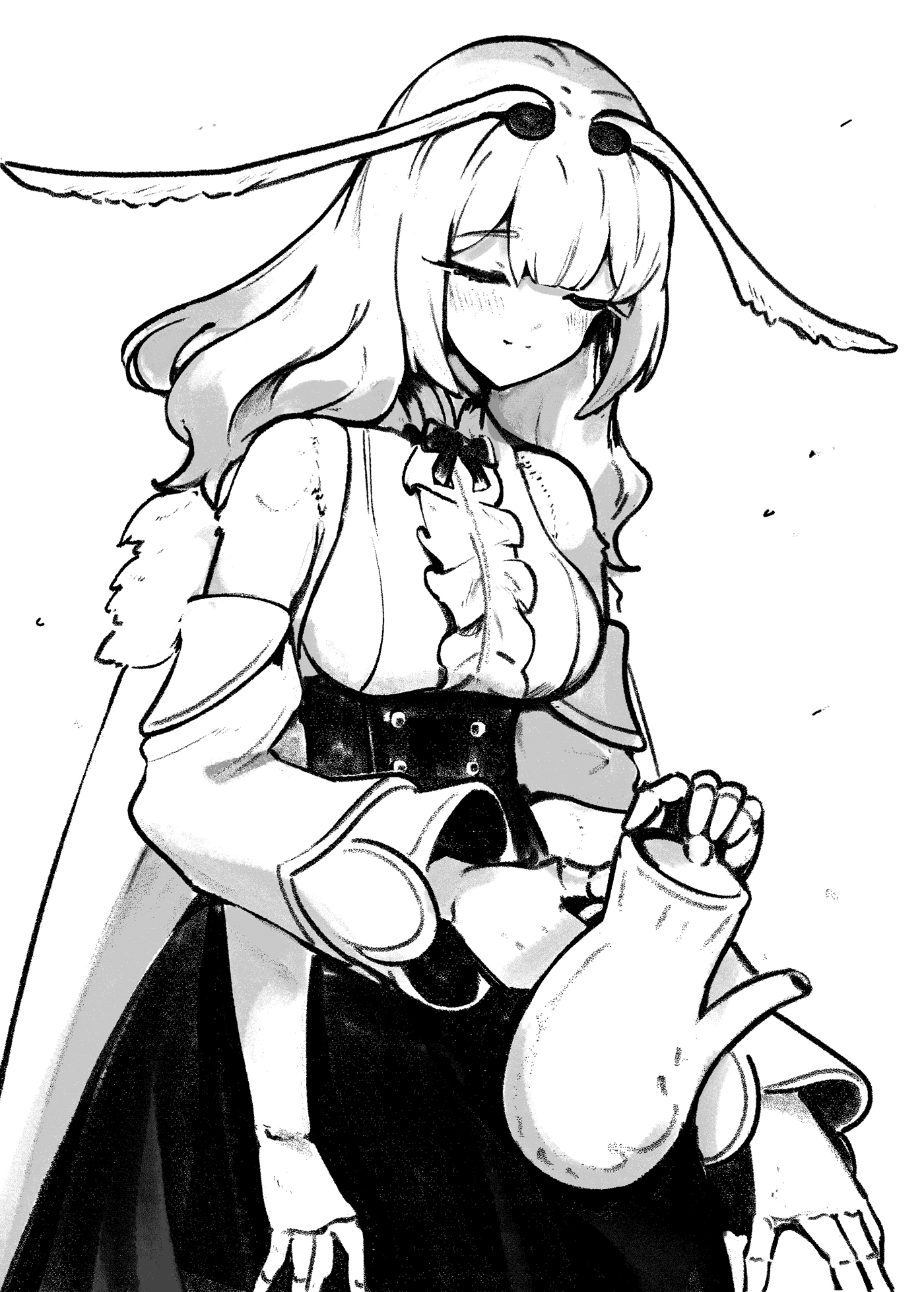
“A foreign tea, perhaps?” Margit said. “It does have a unique aroma.”
It was a clear, crimson liquid. I picked up my cup with quaking hands and lifted it to my nose. A familiar fragrance that I had never smelled in this life wafted into my nostrils for the first time in eighteen years. There was no doubt about it. This was black tea—made from the oxidized leaves of the tea plant.
I knew we were guests, but we were adventurers! To think we would be presented with such a luscious treat. I had heard, while working under Lady Agrippina, that black tea was a rarity that sometimes came through the Eastern Passage, but I didn’t imagine having a taste here of all places.
“Huh, it’s kinda bitter,” Sieg said.
“It smells lovely, but, yes, it is on the tart side,” Kaya said.
“Hmm... I think this might pair well with a jam-topped treat,” Margit said.
Those three were making small talk, completely unaware of the small fortune they were drinking! The cheapest cup would set you back a single silver piece. The Eastern Passage was called a river of gold thanks to the quality of all the goods that came through it, but that didn’t mean those goods were available anywhere and everywhere yet.
But, man... This taste brings me back. I wonder if someone will spring a cup of coffee on me like this some day? Hold on, Erich. Don’t get all slack-jawed in front of the client!
“What a treat this is,” I said.
“Thank you kindly, Master Erich,” Miss Firene said.
Hm?! It felt weird to have a village chief’s second daughter call me “Master Erich.” Was this really okay? I guessed it was, with her father grinning like that...
“I apologize for cutting right to the chase, but what’s the damage so far?” I said.
“Ah, yes,” Mister Giesebrecht replied. “We have lost two of the sheep we raise for their wool. They were high-quality specimens supplied by a noble family, so the loss has cost us rather dearly.”
I remembered now—although this was a new canton, they were flush with cash because they were doing a few cushy jobs for some nobles. They raised specially bred sheep—not to eat, but for the high-quality wool they provided. If I remembered correctly, they also did some silk farming. The end product from both could fetch a pretty penny, so cantons needed permission to cultivate their own.
“Do you know whereabouts the nest is?”
“I do not. I have made sure the hunters of our canton have not set out beyond our borders to do anything rash. However, I do know that the nest is somewhere in the southeast. A farmhand saw the gryphon flying off that way.”
There was an untouched forest to the southwest. It was a bountiful spot, ripe for hunting—and a gryphon needed heaps of fresh protein—so the canton was probably struggling. They hadn’t even been allowed to get firewood. Our warm reception made more sense now.
“Very well. We will begin the search from the forest, then.”
I glanced over to Margit, a wordless question of if she could do the job, and she silently put her cup on her saucer and smiled at me.
“May I have an hour or so?” she asked.
“Of course.”
Margit must have been pretty confident she could sniff it out. I wasn’t surprised. She had hunted far more elusive prey in the forest before; the gryphon was this region’s apex predator, so I was sure she wouldn’t have much trouble finding it.
“All right, Mister Giesebrecht, we shall get to work,” I said. “Sit tight and soon your canton will be free from the terror of this gryphon.”
“Thank you! I pray for your success.”
Mister Giesebrecht saw us off with a firm handshake and we made like adventurers and moved swiftly into action.
Once Margit flushed the beast out, it’d be time to begin the hunt...
[Tips] Mottenheim is a developing canton to the west of Marsheim under the charge of the noble Voluptas Giesebrecht. Thanks to some early-stage investment, it is blessed with high-quality produce not seen in the local area. However, their quick growth has outpaced the scope of their defenses.
Mid-Campaign Clash (I)
Mid-Campaign Clash (I)
Mid-Campaign Clash
If you use all the fuel in the tank, you won’t have the resources you need to weather the climax. On the other hand, choosing to hold back too much might also result in an unexpected accident. A GM’s mettle is shown through providing a well-balanced experience.
Just as she had said, Margit turned up the gryphon’s hideout in an hour. According to her, such a large creature would have few places to make its nest. In her words, “It was a breeze compared to finding a bear’s den.”
“It sure is huge,” I said. “I’m surprised no one in the canton noticed it.”
“This forest isn’t for logging, so I suppose they thought that this tree was just larger than the rest,” Margit replied.
I was looking out at the gryphon’s nest with a pair of binoculars. The nest was a huge tree in the deep woods. It was sixty meters high, with a mighty trunk about ten meters across. It was a type of caudex tree, formed by many trees conjoined by magical means. I’d read about them back during my College days, perusing the herbology archives. Apparently they formed when a monoculture of trees grew in close proximity and a parasitic plant settled within the gaps. It sapped at the nutrients available and began to spread like a spiderweb. Soon enough, its thick roots engulfed the other trees to form a huge new amalgam.
There were few better alternatives for a gryphon’s nest.
“That tree’s a treasure trove of potential catalysts; if you could break it down, every piece would fetch a pretty penny at the College,” I said. “Shame we don’t have any way of transporting it.”
Great gleaming dollar signs revolved in my mind as I contemplated the staggering value of such old growth, but these reveries were cut short by the practical realization that no one in the Fellowship or Mottenheim had the tools required to fell a trunk that huge. Times like these, you’d just be thrilled to see how big a plant could get, or it would become a local landmark. Usually you only saw specimens like these in books, and even then only books for specialists.
“I’ve never seen one so big before,” Kaya said. “Every other specimen I’ve encountered has been midway through its growth.”
“What would be your estimation as a herbalist?” I asked.
“Let’s see... It goes without saying that it would be impossible to take all of the materials home, but some parts would be perfect to reinforce staves.”
Cool, let’s take a healthy pick when the work is done.
Speaking of work...
“Okay, is everyone strapped in?”
“We look kinda stupid, but we’re done,” Sieg replied.
I cast a look behind me and saw my Fellows standing in a line, all connected by a rope that was long but not too difficult to carry. This was a safety precaution against anyone getting picked off. Gryphons were powerful creatures who could hoist horses—animals that weighed almost five hundred kilograms—into the open air, but it was impossible for one to lift up a whole group of armor-clad Fellows (and that was ignoring Yorgos and Dietrich, who were heavier than the rest). If one of us was grabbed, then the others could dig in their heels and keep them from being hauled away to a lethal height. If that wasn’t enough, we had a carriage tied to the end to absolutely foolproof this measure until we reached the forest.
Siegfried did have a point, though—it did look a little silly.
“Then forward march!” I shouted. “Odd-numbered Fellows, keep your eyes ahead! Even-numbered Fellows, keep your eyes skyward! Understood?!”
“Yes, Boss!” came the resounding cry.
While our march across the plain might have looked silly, I didn’t want to trade in safety just for the sake of looking cool. All tied together and with our eyes on the skies, the gods must have been in a pleasant mood; we reached the forest without the gryphon attacking us or any other random encounters springing on us out of nowhere.
“And the point of this was...?” Siegfried muttered.
“Better to have it and not need it than to need it and not have it,” I said. “We could’ve been in deep trouble without these precautions.”
The safety measures for adventurers were similar to the kind you’d see in a factory. It was too late to worry about safety after the fact. I needed to drill this mindset into my Fellows a bit more going forward. What would we have done if the gryphon had passed by and we hadn’t been prepared? We were playing with our lives, so a bit of overcaution didn’t hurt anyone.
“Margit, the gryphon isn’t back, is it?”
“No. I’m not sure if it’s hunting or on a leisurely flight, but the nest was empty when I checked.”
Perfect. Let’s get ready.
I felt sorry for gryphons. They were once low-level divine creatures that had been created as steeds for the gods. However, now that their makers had withdrawn to higher planes, they were treated like vicious beasts. It really seemed to me like the gods had held Themselves to more lax standards than any right-thinking parent or pet owner; if you created something—be it humans, gryphons, or whatever else—you had an obligation to see your responsibility for it through to the end. Still, there was no getting around the sad truth that in these days gryphons were hunted, or treated as a symbol of nobility, or what have you, wholly independent of their own divine origins. Of course, I couldn’t spend my time feeling sorry for them—we needed to do something before this one got a taste for human meat.
“Here will be good,” I said.
There was a small clearing in the forest where you could see the sky. I spread an arm out, and using a bit of trigonometry, I calculated the distance from our tree. It was about three hundred meters in a straight line. A bit far, but it would work.
“Can I count on you?” I asked.
“Who do you take me for?” Dietrich answered.
She raised her bow, indicating that I shouldn’t dare underestimate her, and took an arrow that was thick enough to be used as a short spear. I tied a cloth soaked in pine resin to the arrowhead and set it alight. In no time at all it started burning. Dietrich quickly nocked the arrow and, on my signal, sent the flaming missile into the gryphon’s nest.
“Perfect.”
“Of course.”
The nest started to smoke. A living tree wouldn’t catch fire as easily as this, so there was no cause to worry about us starting a forest fire today, but the materials within the gryphon’s nest would burn. This gryphon had stolen sheep, so I was pretty certain it was working on building its nest. That wool, yet to be washed, contained enough natural oils to throw up a smoke plume—practically a signal fire—in short order.
“It’ll be here soon! Keep your eyes on the sky! Hide in the shadows of the trees and nock those arrows!”
I’d placed our Fellows who were handy with a bow in strategic locations while I stood out in the clearing all alone. Before too long, a high-pitched angry screech pierced the air. The gryphon was speeding back, incensed at the sight of its nest aflame.
“Down here! Your arsonist is down here!” I shouted.
The gryphon circled its nest and tried to use its wind magic to put out the flames, but it had no effect. Smart though it may have been, it didn’t know that a fire of a certain size couldn’t be dampened by the wind. As the smoke merely billowed higher, it cried out once more, a note of grief and desperation in its voice. I shouted at it to rile it up, and despite the distance, I felt us lock eyes.
No, I didn’t feel it—I knew it. It had found me. In a flash it reasoned that no one else was nearby who could have started the fire, and it began to plunge toward me. Nice, I thought. Being assaulted with this gale from afar would’ve made for a tiresome battle of attrition, but the gryphon was coming straight for me, thinking that it could easily defeat one puny human. This would save time and make what came next a hell of a lot easier.
Come on, come at me! I’m pretty good at chicken, you know...
The gryphon rocketed toward me at an incredible speed. It crossed several kilometers in no time at all; I was in awe of the thing, I’ll confess.
Three seconds until impact... Two... One...
“NOW!”
Just as the gryphon’s terrifying talons were about to pluck me away, I moved. Not behind or to the side, no—I dove underneath its grab. A gryphon’s talons hid a wide reach and could grab me easily no matter where I went. So I would use the gryphon’s momentum against it and bear forward.
Just as I dodged past, my Fellows in the trees all launched the net. This wasn’t your regular old net; oh no, this was a custom job made using a huge amount of Margit’s precious silk—the same stuff I dreamed of using when the day finally came that I could hunt a dragon. Despite the thinness of her web, she had told me that it could support a full ton. When that same web was reinforced with itself, there was no hope of even the most violent creature breaking free.
By the time the gryphon noticed this supple yet powerful net around it, it must have realized it had fallen into a trap. It had flapped its wings a few times to begin to reposition, but it couldn’t get clear in time.
“All right, pin it down!”
“Watch out, people! Approach it from behind and watch out for those talons!”
Despite the nets that had been thrown atop it, my Fellows came out from the trees with their spears in hand to make sure that the gryphon didn’t resist; just because it’d stopped moving didn’t mean it wasn’t still dangerous. As they circled it, they used sticks or the butt ends of their spears to give it a good few whacks. No matter how much humankind evolved, nothing would beat this old-fashioned method. Soon enough, thanks to the beatdown and the gryphon’s own struggling, it had exhausted itself in a matter of minutes.
“And that’s a win,” I said.
“Man, that was tiring... How come we’re just smacking it, not stabbin’ it, Erich?” Siegfried said.
My comrade wiped away the sweat as he spoke, recovering from delivering a vital blow with his massive spear. I gestured at the exhausted, beautiful creature before I replied.
“Gryphons are a rare and endangered species. It won’t do to just kill them willy-nilly. That goes especially for a female near her breeding season.”
“Breeding season?”
“Of course. Why else would she be hunting for sheep, not horses? Horses are a better source of meat, after all. This gryphon wanted nesting material.”
Due to the valuable nature of the parts you could extract from a gryphon, they had gone through a period of extensive hunting, which meant that their numbers were lower than they had ever been. Their feathers had made for perfect quills, their blood made for catalysts for long-lasting inks, and their eggs were treated as a delicacy. The result was that they had been overhunted. Some said that there were only a thousand or so gryphons left in the entirety of the Empire. This was something I’d read in one of the latest College papers in preparation for my life as an adventurer, of course; I was pretty well convinced of the figures’ accuracy. Gryphons weren’t yet classified as a protected species—after all, their dwindling number was chiefly a domestic issue—but the paper advised against hunting them. With that in mind, I couldn’t in good conscience let myself contribute to the slaughter of an endangered species like that.
“All us living things have more in common than not,” I said. “Regardless of what you are, a good house and good eats are vital assets in finding a partner.”
“Yeah, I get that, but is this it? Beat it up and leave it be? Won’t it attack the canton again?”
“Gryphons are smart. We’ve taught this one just how scary people are. I doubt she’ll approach a human settlement again.”
This was something else I’d learned from that paper. I felt bad, but a little knocking around was vastly preferable to eventually killing the damn thing.
“Get ready to pluck, everyone!” I called out. “But! Make sure you don’t take her flight feathers. We want her to be able to fly.”
The gryphon screeched—most likely begging us to stop—which pained me, but we set out to do our work nonetheless, making sure that we wouldn’t harm her ability to fly. I chuckled inwardly. Each of these feathers could be used to make stationery, and the Association would give us a silver quarter-piece for each one. We were going to make bank when we got home. While we were at it, I snipped off a talon, knowing they would grow back eventually, and took a little bit of blood.
When we were done we let the gryphon free. She got up on tottering legs. She flapped her wings, and after a few false starts, took flight and disappeared off toward the south. We had taught her the valuable lesson that people were too dangerous to bother with. I doubted that she would ever approach a settlement again; most likely she’d take to the sky the moment she spotted a person.
“What a haul! This is going to net us quite the payday!” I said.
“I getcha. This was that special reward you were on about. But, Erich, aren’t the organs of gryphons worth a lot too? It was just one gryphon—couldn’t we’ve just hunted it down?”
“Where is your heart, comrade? Think about how many creatures have gone extinct in service to the steady accumulation of people’s half-hearted greed.”
On a practical level, a gryphon’s innards contained powerful magic. A regular old preservative spell would just bounce off. Kaya was a pro, yes, but most of our haul would decay beyond repair before we even managed to get it to the College. We weren’t exactly in a position to run all of that all the way to Berylin. We had our next job lined up for us already—we still needed to train up Mottenheim’s Watch. Anything we took would be no good by the time we were ready to head back to Marsheim. In the end all we’d have to show for it is a moldering gryphon corpse.
I couldn’t say that I had built up good karma in my previous life, but seeing as the circumstances were so perfect, this was an ideal time to do a good deed.
“Well, we did the job, so whatever,” Sieg said. “It’s a rare creature, so I did kinda wanna try out gryphon meat though...”
“Hah, enough of that. You’re starting to sound like Miss Zenab!”
I was genuinely surprised to hear those words come from my comrade’s mouth, and even more surprised to hear my Fellows agreeing with him, saying that such a large beast would feed many mouths!
Wait, what? Am I the weird one here?
At any rate, despite some lingering concerns, this was a job well done. It was time to head back to Mottenheim.
[Tips] Even in Erich’s world, humanity has pushed many species to extinction.
Early Summer of the Eighteenth Year (II)
Early Summer of the Eighteenth Year (II)
Changing Circumstances
Sudden, unexpected incidents can radically alter the direction of the story. Still, hashing out whether to blame the GM or the players for such upsets is rarely if ever productive.
I attached the gryphon talon to the end of a spear and marched back to Mottenheim with my Fellows. I had been expecting cheers and smiling faces at our return, but the reaction surprised me. The canton was all in a fluster. I grabbed one of the locals to ask what was wrong, but he just threw me off and told me to get to the village chief’s manor as soon as possible.
“Something bad has happened,” I said. “Everyone, stay on alert! Siegfried, I can leave this to you, right?”
“You bet,” Sieg replied. “All right, you lot, get ready to fight at any moment!”
I left Siegfried to deal with the situation outside and hurried to Mister Giesebrecht’s house with Margit and Kaya. When I approached, a faint but familiar smell struck me—the stench of blood.
“What’s going on here?!”
There was a crowd in front of the manor from which I could hear screams and a crying child.
“Ohh, Mister Erich!” Mister Giesebrecht said as he pushed through the crowd toward me. I looked over at the center of the mass of people to see a boy. He was on the ground, crying. It was obvious from first glance that he hadn’t merely tripped and grazed his knee. There was an arrow sticking out from him. This small goblin boy—a farmer’s son, going by his clothes—was on his hands and knees, blood pouring from the wound, his whole body twisted up in agony. It looked recent.
“Kaya!” I said.
“Leave it to me,” she replied.
I let our herbalist deal with the injured while I asked Mister Giesebrecht what had happened.
“The children were playing in the forest when someone started firing arrows at them! This lad here was unfortunate enough to get hit.”
“Are there any other injured? Any killed?”
“Fortunately, no. Out of that whole volley, only one found a target.”
Someone shot at kids playing in the forest? Bandits wouldn’t do something so reckless; it’d just raise the alarms. It didn’t seem like the work of some bloodthirsty maniac either—they wouldn’t have had such poor aim.
“Margit, can you ask our cavalry to run a sweep of the area?” I said. “And can you and the scouts head into the forest to do some recon?”
“Certainly,” she replied.
“I hate to put you into danger, but I’m counting on you.”
As I said this, she pulled up her face covering and smiled. “It’s my job to forge ahead and ensure your path never falls into shadow. Do not apologize for that.”
“You’re right. Thanks.”
I watched my partner speed off and set to thinking. These assailants let off a barrage, but only one shot connected. They were trying to show off their killing intent. But why? The most probable reason I could think of was simple intimidation. They made sure the child was injured, but still able to return home. The canton would panic at seeing the injury so that the perpetrator could exploit the bedlam to create an opening for their assault. It made some sense, but why be so indirect about it? Why not wait until night, when the canton’s defenses were lower?
In that case, were we dealing with a band of mercenaries who wanted to threaten the canton into vacating? No, that wasn’t right either. We were coming up on summer—war season. Right about now powerful folk all over would be rallying forces for their private armies, especially out here in Ende Erde and the neighboring satellite states, given the tense situation out here. If mercenaries—who were scarcely any different from bandits in my book—were to attack a canton, they would strike in the winter, not the summer, when imperial patrols were out in force and primed to catch them out.
Wait, wait, wait... Mottenheim was in the pro-Margrave Marsheim faction. That earned you a lot of enemies out here—plenty of whom would have cause and means to quash a politically inconvenient neighbor. This stank of the local lords. It made sense that they would wait until summer to begin their attack so that they could cut off any of Margrave Marsheim’s autumnal earnings before they had the chance to sprout.
“Mister Giesebrecht, show me a map of the canton,” I said.
“Of course. Right this way!”
I followed Mister Giesebrecht, who hurried along with fluttering wings, into the reception room. He must have already been planning to discuss how to fortify the canton’s defenses; the map was already laid out over the table. It wasn’t exactly a bleeding-edge piece of work or anything—my guess was that it’d been drafted about a generation ago, going by the technique that had gone into drawing it up—but the map was finely detailed and accurate. Yet another sign of just how much Mister Giesebrecht’s father loved him.
“Things don’t look much different from last I was here,” I said.
“Indeed. I thought it more prudent to leave our money and supplies to the side until we received your guidance on how best to use them, Mister Erich.”
In the center of the canton was the manor and the assembly hall. Nearby were the magistrate’s visiting office, storehouses for the canton, and the Watch’s station. Then surrounding all this were the longhouses of the serfs and rented houses for the crop farmers. As the land stretched outward, there were a number of independent farmers’ houses in between the plots of land.
Mottenheim had a population of 422. This was quite the number for a canton that was less than thirty years old. As a result, the territory it encompassed was quite large too.
Despite Mottenheim having its own milling station, powered by a watermill atop an irrigation river, the small number of pieces placed down onto the map told me that they didn’t have all too many defensive structures. Judging from what I saw during our arrival, the archer pieces on the map indicated the watchtowers where foot soldiers were stationed.
The defenses were most plentiful around the well-populated center of the canton and the storehouses near the farmland; the watchtowers thinned out the farther out you went. All the same, there was also a waist-high stone wall that protected the center of Mottenheim. It had been us, in fact, who had advised the building of this wall last time we were here, as a last-ditch measure against the small possibility of a wandering band of mercenaries with empty stomachs. I was glad to see that they had built it since then. As long as the manor inside that wall remained safe, then we could protect those who were unable to fight while creating a stronghold from which we could safely glare at the enemy.
In truth, there were fewer fighters than the size of the canton warranted, but there was no point worrying about that now. It wasn’t as if this were a twenty-first century Earth urban area where everyone was crammed together into self-contained, defensible residential blocks, and they simply didn’t have enough people on the Watch to keep every area perfectly protected.
One theory of national security argued that a nation needs an active duty fighting force consisting of five percent of the nation’s population, going up to at least ten percent when you include the whole standing army. But that was for a nation. We were in a canton with a smaller population, and those people who had a whole host of their own jobs to do. The community just couldn’t support that many full-time soldiers. When you were a member of the Watch as your sole profession, you needed to go on patrol, train, and sometimes leave the canton to do government-mandated labor. In other words, they didn’t produce anything “material” for the community. Feeding the mouths of military folk who didn’t have the time to do other work put strain on the producers and other workers, with the downstream effect of slowing down the canton’s economic growth. Under conditions like these, it was no surprise that Konigstuhl’s own Watch maintained a brutally strict selection process. They hid this fact by increasing the number of “reserve” member slots.
The short of it was that Mottenheim only had twenty official members of the Watch, with that number only just about reaching thirty figuring in the reserve members. It pained me to say that they weren’t all too strong either. When we had come to train them last, they’d only just barely been good enough not to lop their own legs off at the knees. While I had made sure to teach them how to form a decent enough spear wall so that they could win a close-quarters battle (permitting the enemy wasn’t made up of skilled soldiers), the strategy wouldn’t do all too much good against a pack of mercenaries with an appetite for chaos.
Luckily for Mottenheim, we were here. We would show the enemy what inevitably came of such unsavory pranks.
“First, let’s get the hunters and the people we’ve taught how to use a bow up on the watchtowers. I want someone constantly on guard in three-shift watches,” I said.
“Immediately,” Mister Giesebrecht replied.
“Next, we will lay our own light alarm system while making sure that those on horseback are on patrol too. If we do that, then I expect there won’t be any mercenary foolish enough to make a move.”
When I told Mister Giesebrecht that we’d drown any fools who dared to act despite all of this in a river of blood, he placed a hand on his chest and breathed a sigh of relief. A key part in this kind of protective work was to be a little bit excessive in your speech to make your client feel at ease.
“And we should file a report to the imperial patrol,” I added. “Can you get a horse out?”
“Oh, yes, of course! Right away!”
“Perfect. We are with you every step of the way, so please don’t rush anything.”
I followed Mister Giesebrecht outside and joined up with Kaya. The goblin boy was now free of that arrow, and his wound had been patched up. He was still sniffling, but the fact that I hadn’t heard any screams or shouts meant that Kaya must have given him some manner of anesthetic potion.
“How’s he looking?” I asked.
“Good. It was an easy fix; the arrow didn’t hit anywhere too vital. I cleaned up the wound and stitched it up. He’ll be right as rain in no time.”
That was a relief. With that done, we had a different sort of medicine to dole out.
“Listen well, everyone! Today is an unlucky day for our enemies! Why? Because they dared to attack Mottenheim without realizing that we were here!”
The worried people of Mottenheim looked over at me and started to mutter in agreement.
“We originally came here on request of Mister Giesebrecht to whip the protectors of Mottenheim into shape, but protecting all of you is also within our remit! If any of the foul villains who dared lay a hand on Mottenheim are listening,” I said, unsheathing Schutzwolfe and pointing her to the sky, the blade catching the rays of the early summer sun, “if you dare to even come close, then you will die by my fang and be fed to the wild dogs of the wood! People of Mottenheim, hear me—you have nothing to fear!”
I still found it embarrassing to raise my sword like this in front of a big crowd, but seeing how it brought life back to the worried faces of the people here, I was glad I did it.
“Carrying on unbothered is the greatest form of rebellion,” I said. “Leave the enemy to us. The Fellowship of the Blade shall be a sheltering wall to you. By my word, be at ease!”
Despite my big proclamations, I was still puzzled by the situation. It wasn’t unheard of to attack a child to put pressure on a community, but if they really wanted to bring fear to a whole canton, then kidnapping someone would have yielded far bigger results. So why do what they did?
As I tried to keep myself from blushing as the canton all cheered my and the Fellowship’s names, Kaya whispered that she needed to talk to me about something.
“We are your protectors as of this moment. Let any of us know if you see anyone suspicious!”
As I brought my speech to a close, I turned toward my Fellows and tried to smoothly bring up the topic Kaya had mentioned.
“You said there was something strange about the wound,” I said.
“Yes,” she replied. “There was a lot of dirt in it.”
“Not because he simply fell over, I presume.”
“No. It was deep in there. The arrow itself must have been caked with it.”
That was weird. The arrow was dirty? And so much so that none was shaken off during the firing? As I pondered on it, Kaya showed me the arrow in question.
It was no masterpiece. It was the sort of hastily produced thing that you could churn out tons of with a short turnaround so that you could hand out something to your archers that they could shoot off without much thought. Not only that, it looked old. The arrowhead was chipped and the shaft was warped. It’d be a small miracle if it ever found its mark. You were classed as a decent enough archer if you could hit a target from fifty paces away, but even a good archer would struggle at twenty-five or even ten paces with an arrow as shoddy as this.
While I wouldn’t be too surprised to see bandits reusing arrows again and again, the thing that tugged at my concerns was the dirt. Was I missing something? I needed to accept that something weird was going on. I needed to make sure we had enough people not just on guard, but also to fortify the defenses of Mottenheim in general.
I returned to my Fellows and noticed that Dietrich and the horses weren’t present. They had probably set off already. I saw Siegfried, his spear held under his arm, talking to Etan.
“Hey, Siegfried,” I said. “Have you assigned the patrol units? The locations are—”
“I know. Same as usual, right?” Sieg replied. “Three per unit, with one competent archer. I’ve placed them there and there, as well as two units near the forest to the north and west, where those kids got attacked. It’d be nice if we had a few more feet on the ground, though.”
My comrade pointed to the locations he had sent out our defensive units. He was clearly firing on all cylinders today, putting all his adventuring know-how to work.
“Agreed. Unfortunately more units out means fewer on standby for the shifts. The southern area is mostly fields with few people and some walls. If we can set up the alarm system we can cover a few more areas and create more capacity for people.”
“Gotcha. They’re with the gear, right? Hey, Etan, bring some handy folk to help set up the clappers.”
“You got it, Bro.”
Times like these were made so much easier with capable allies. I held out my fist to bring some energy to the situation. Siegfried’s eyes wavered for a moment, before he returned the fist bump.
Yep, you’re a guy’s guy. You grumble, but I know you like this sort of pageantry. I do too.
I hoped that this whole affair would blow over with nothing more than a bit of bustle on our end. I had made sure to ask the smithing union to fix us up some gear in the event that we’d defend a canton with only a few people, but I had hoped that they’d merely remain an emergency measure.
A famous writer back on Earth once said “If you want peace, prepare for war,” but it was a strange feeling to have something you just bought come in handy.
I was really hoping that there was no point in all this worry, and that the worst was already behind us.
[Tips] It is usually difficult to cover an entire canton when protecting them, so it is common to have preparations in place that will allow the canton to survive until the imperial patrol come to provide aid. In the case of an emergency, people often seek refuge in buildings such as the village chief’s manor. However, such scenarios are not normal.
It was considered common sense that an attacking force requires five times more manpower than the defending force. However, that was in times of war, not a raid.
“Hmm, this is frustrating.”
Mottenheim had been designed by real talented people. It was located in the flat lands near Marsheim, where it was easy to dig irrigation channels. To the west and north was a woodland with much to offer any competent forester, which also served as a natural barrier against northerly winds. The buildings were well-placed too. If we set up obstacles effectively around central buildings like the assembly hall and the plaza, we could create a decent stronghold. If bandits or no-good mercenaries strolled in, we could hold our position pretty handily; they’d have a hard time mounting a proper assault. That went extra if we had a tough stronghold to work from. The windows of the buildings made for perfect arrowslits, entryways could be turned into hastily made blockades, and ground floor windows were small enough that people couldn’t clamber through them.
I was pretty certain that good old daddy dearest had gathered the best of the best to plan the whole canton to a tee, so that his son would be able to shine in the event of an attack.
Unfortunately, things weren’t yet ready to make full use of what we had. It was no surprise. We were only three days from the state capital and one day’s walk from a relatively large town—it made sense that no one in Mottenheim would expect that a situation like this would arise.
A rider had been sent off to drum up some help, unexpected emergency permitting, so hopefully there wouldn’t be an attack in the meantime.
The people of Mottenheim had been so laissez-faire for reasons not unlike how people in warmer climates never even thought about buying snow tires. Even if you had the supplies needed for an emergency, there was little point if you couldn’t use them when you needed them. It was like deciding to pull out an old instruction manual only to find that the text had faded away. Even though this canton had been founded with all sorts of “what ifs” in mind, those measures couldn’t be used to their full capacity unless the people themselves were ready for battle. A peace-loving country boy with a pistol at his waist would never defeat a terrorist. What we needed were warriors who would commit to treating this canton as their potential grave.
I made a mental note of adding surprise evacuation drills once or twice per year to Mottenheim’s policy. This was something we’d practiced a lot back home in Konigstuhl. When the warning bell would sound, everyone would gather in the center of the canton. From there, the reserve members of the Watch and any willing men would gear up and assume their positions. Everyone else would bring out the mobile barriers and fortify the defenses. Sometimes these drills would be done in the middle of the night without warning. The memory of Sir Lambert shouting at everyone for being too slow was still fresh in my memory. He had a point—while we dilly-dallied, people could die. Preparations like that were essential if you wanted to preserve your peace. Regrets couldn’t turn back time. You only had now to do what you needed to do, and there was a lot that could be done in preparation.
First up, I opened up the supplies storehouse to make use of what was inside to fortify the defenses. We created abatises to block the roads—preventing horses from getting by—and placed them in strategic locations. Watching the woodworkers—they were second generation, but really skilled—start on my designs, I would think that with the combined talents of everyone who could help, we’d be done with them in three or four days.
Next, we needed to set up the automatic alarm system. This required a little something we’d brought with us: the clappers. Clappers were a primitive type of warning device and musical instrument—little more than bits of wood with a few moving parts. They were chiefly used in this day and age to scare birds away from crops, but we would make use of their easy function—just a simple shock would set them rattling—for our defenses. With the right adjustments, they wouldn’t sound even when the wind was blowing. By placing them low down, at around shin level, and creating a network of ropes, they made for the perfect analog, unpowered alarm system. They were easy to build and wouldn’t break the bank to mass-produce. When I was told that part of the job was to look over Mottenheim’s defensive capabilities, I decided I’d sell these to them.
I wasn’t the sort of guy who was flush with innovative ideas—this was a system that some people used and some didn’t, that was all. And without the internet, it was impossible for me to will things into thin air without the light bulb moment required for it, even if they existed back on Earth. Depending on the buyer, it didn’t matter if the trap was a bit janky—as long as it worked, that was fine.
They were pretty much free to make—I’d used my Unseen Hands on full power to fashion them from wood scraps—and so I sold each of them for one libra a pop, with instructions on how to make your own for fifty librae. Mister Giesebrecht said yes without a second’s hesitation. Despite the price limit, I’d gone in expecting to haggle, and I’d end up selling them for more than I’d planned to. I inwardly thought that maybe he should work on his bartering skills, but in truth with the situation as it was I didn’t have the mental space to think about changing the price I’d already thought up.
I wasn’t ripping him off, right? He wasn’t going to get annoyed about paying so much, right? It uses Margit’s web, so it’s actually a bargain, right...?
I used all my facial muscles to force my tension into a smile and delegated the tasks to the people Mister Giesebrecht had sent my way. In our most recent job, I’d decided that Battlefield Fortification would be absolutely essential, so I’d cashed in a heap of experience from Limelit, but still, to think that it would come in handy in literally the very next job! Jobs like this where protecting other people was paramount really made skills like my most recent acquisition shine; I was newly equipped to reinforce and bunker down in a position in ways my regular old camping skills never could, and it made me a way more capable leader in siege conditions.
Looking at the lay of the land and recognizing its weak spots was hard as hell without the relevant technical know-how. It was tricky to decide which areas would be difficult to guard when attacked and which would be easy to defend even if things were a little sloppy. Of course, when you had enough supplies, you could do the simple grunt work of building walls and digging trenches, but when you were short on people and time, having a specialist on hand was damn near priceless.
Our situation was extra difficult thanks to how the whole canton was on flat land. It wasn’t as if we were in the sort of army base that necessitated difficult terrain, so that was pretty understandable, but it would be a real struggle to shore up our defenses.
All the same, if I could get inside the enemy’s head and anticipate their tactics, fighting on the flats would be fine and we could assume a markedly more efficient defensive posture. With a four-part shift, we could make sure everyone was well rested and production within the canton would carry on as usual.
First up, I made sure the Fellows and our helpers planted pegs in the north and west of the canton—the area that bordered the forest—so we could set up our clapper system. I and some other canny-fingered folk made sure the clappers were well hidden among the shrubs. It was a simple task on paper, but this was something that really required Battlefield Fortification.
You see, it was important that the areas bordering the forest were simultaneously lightly and heavily guarded. What that contradictory statement meant was we first needed to reduce the number of visible people on guard and make them think there were few people there. At the same time, it was absolutely crucial that our clapper system was spread thick and wide—and that eventually there’d be actual traps to back them up. Of course, these traps would be within the residents’ circle of activity, so we couldn’t use anything lethal, but something that would slow and annoy the enemy would be great.
In the south and east, where there were no trees, our folks who had good night vision would be able to keep up the guard during the night. The enemy would notice this and assume that the forest would be the least protected angle of approach. It wasn’t all too dense, since the locals picked it over for firewood and such on a regular basis, but it was ample enough for them to think they could approach us and remain hidden. That was exactly why I made sure it seemed like we were poorly defended there in order to goad them into attacking from that angle.
Similarly to how leaving a bag partially open will make you want to see what’s inside, if you make an area seem easy to attack, then the enemy will want to make use of the opening. In truth, the strategy relied on us having heavy protection. All we had to do was punish anyone foolish enough to come close.
I called it the “You Can’t Attack Us From Any Angle” plan.
If they came from the east or south, then we could defeat them thanks to our guards there. Even if they approached the less robust area in the south, the clapper system would alert us and prevent their surprise attack. And then with our clapper system and hidden guards facing the forest, we were fully on guard.
The only way they could get through would be to launch an assault from two sides. That or raise an army huge enough that we couldn’t do a thing. But if they did have that, then we were pretty much screwed from the jump, so it wasn’t worth thinking about. If we were forced into an impossible game like that, then no amount of defenses would help. It pained me to admit, but I wasn’t one of those OP generals of the kind you saw in the annals of Chinese history. I couldn’t head into battle with a few horseback riders and rip through an army of tens of thousands. I could maybe probably just about manage a tenth of that without any restrictions on my abilities, but that was something I definitely didn’t want to try out.
This wasn’t the sort of battle where I had to hold back and be slow and careful as I planned a retreat while trying to optimize every survivor’s chance of escape. That meant I could simply think about what it was that I could do. Basically, all we had to do was be so damn tough that they’d give up when they realized there was no busting through our iron defenses.
If our enemies were people, then they were attacking us because they wanted something. If they realized that whatever it is they wanted was worth less than their losses, then they would inevitably give up.
This only worked if our foes were regular old true-blue bandits.
We would lay a rope that seemed ripe for the taking, but behind that would be another rope to ensnare them. If that wasn’t enough, this rope connected to nothing. The true trap would be a rope of spiderweb that lay hidden from even the most keen-eyed folk. Our three-stage trap would soon be set.
All we needed was one or two idiots to fall into it and realize what a waste of time this was. But before that, I needed to hope that the Silent would do a good job for us.
[Tips] Clappers are used primarily to scare away birds from crops. With a system of pressure plates and ropes, they can be repurposed to form a primitive warning system against interlopers.
For an arachne, the forest was home, the kind rooted deep in one’s instincts, and that meant comfort. It was the sort of space you could settle into as easily as your childhood bedroom.
Many subspecies of arachne had adapted to life in human centers of activity, but even though jumping spider arachne blended into society with more ease than their orb-weaving or giant tarantula cousins—not solely due to their smaller size—they were at their heart a nomadic species without fixed nests that originated in the trees and grasslands.
A change of environment from the forest to urban centers wasn’t enough to remove their innate instincts. Hunters especially, who continued to hone their skills, were far more agile than their docile urbanite counterparts.
There was a reason Margit was looked up to in the Fellowship as an elder sister figure and had received the epithets she had—the Silent, the Warding Dagger. Of course, it wasn’t merely because she was Goldilocks’s woman. Just like Siegfried, she was a headstrong character and had become an adventurer with her own sense of warrior pride—there was no way that she would gain such adoration for nothing. To begin with, Margit wasn’t the sort of person who wanted to ride on Goldilocks’s lapels just because they were lovers. She worked for what she did. If by some cruel twist of fate an average woman were to switch places with Margit, her odds of survival in such hellish conditions were slim to none.
In the Fellowship, there was a handful of scouts who could work alongside her. The first of these was the werewolf Mathieu. Whereas his sword skills were only middling, when it came to scouting, he was hugely impressive. He had a keen sense of smell thanks to his racial boons, and also could maneuver quickly and silently despite his huge frame.
Alongside Mathieu was an orc called Linus. Just like Mathieu, he had similarly passing skill with the sword—although both of them were more than capable of beating your average adventurer in a scrap—and was also an equally talented scout. Orcs shared a common ancestor with pigs and had huge physiques that would be exceedingly rare on a mensch. Despite what their appearances would suggest, they were incredibly muscular and powerful people, and quick on their feet. In a knock-down drag-out wrestling bout, there were few other demihumans quite so intimidating.
A little known fact about orcs was that they had an even keener sense of smell than cynocephali. Similar to truffle-hunting pigs, an orc could trace a scent with astounding accuracy. While it would be fair to cynocephali to say that they were talented at picking up the scents they wanted to track, orcs were capable of taking in many smells and sifting through them. Now, what made orcs suited to Linus’s chosen line of work was that they were especially good at picking up the scent of death. The pungent smell of decay, the fragrance of spilled blood, the metallic tang—when it came sniffing out food or life-threatening odors, you couldn’t win against an orc.
Linus and Mathieu worked well as a team—Linus would detect any suspicious scents, and Mathieu would trace them to their source. Not many people knew about their skills in the field, but their work together was so incredible that they would never struggle to find work as someone’s private guard.
And yet, Margit’s own reconnaissance abilities were enough to keep them from getting too big for their britches. For two proud, ambitious adventurers, it made sense to look up to a talented scout like Margit like an elder sister.
Today in particular, Margit was firing on all cylinders. She was in a good mood, and her body moved exactly as she wanted to, coated in a pleasant warmth. Each leap between the branches grew ever faster, and she found herself clearing a route that she would usually use her thread on for safety in a flash.
This state wasn’t thanks to an invigorating potion. Those concoctions could improve her physical capabilities, but she made sure only to drink them when the situation demanded it. After all, the Merciful Sapling had told her that the momentary boost was taken in exchange for her life itself. So what had propelled her to feel quite this good? Ample rest and the feeling of being useful certainly helped her stay in top shape, but that wasn’t all.
“Am I...drunk? No...”
When Margit arrived at her destination, far sooner than anticipated, she sensed the possible root of this strange feeling. This feeling of excitement that pared away at her exhaustion was familiar—it was the same sensation she got when she drank wine cut with a little water. It went without saying that she hadn’t imbibed any alcohol today. She only ever drank from her waterskin on the job, and she hadn’t had any snacks made with anything fermented.
So why do I feel this way?
For a second she wondered if someone had slipped something into her food, but she put aside that theory. She was careful in choosing what she put into her mouth, and their medical expert had been at the meal together with her. There was no way that she had eaten something odd. With that concern tucked away, Margit decided to put these strange thoughts aside and focus on her work.
The huntress had arrived at the spot where the children had supposedly been attacked. If it was true that someone had attacked them, then there should have been proof of it somewhere. She had pinpointed this location based on the village chief’s testimony—which had been hearsay upon hearsay—and the tearful stories of the confused children. Focusing her eyes, she took in the terrain.
“There...”
Her gaze locked onto something that an average person wouldn’t notice normally. The trees and the dirt held signals of things that had occurred days beforehand; she was lucky that the recency of the attack—less than two hours prior—had made the traces stand out from the noise.
Among the footprints of the playing children, there was a patch of earth which had a small indentation from a collision, as well as the slight dark color of dried blood. Margit’s nose was closer to a mensch’s, so she couldn’t say for sure, but her two scouts bringing up the rear would be able to identify it.
In addition, plants were far more eloquent than people—such busy creatures, always rushing about—could ever be. Margit’s hunting instincts allowed her to easily locate the arrows that had missed, fallen into the thicket. If Goldilocks were here, he would probably have muttered that it wouldn’t have even taken a dice roll to pick up on this particular lead. By looking at the branches that had broken during the collision with the arrows, she could work out from what direction and distance they had been fired.
She pinpointed their point of origin, and without leaving traces of her own—thanks to her many legs, light weight, and body control—she managed to locate the traces of the archers. There were many rather obvious footprints. It seemed like the perpetrators had tried to cover some up, but the job was far from perfect—it was clear that skilled hunters or brigands weren’t the culprits here. It seemed to Margit that they were amateurs attempting to repurpose some archery tips they had fobbed off of someone else.
From the firing location, Margit looked over at the place where the children had been, about thirty paces away, and made some more calculations. The archers had been bipedal, short, and light—maybe a floresiensis or goblin? There had been three of them, and they had been poor enough shots for all of them to have missed (aside for that one lucky hit) when firing at the same time.
“Or no... Had they purposefully missed, I wonder?” Margit mumbled to herself.
It wasn’t too strange to miss small, moving targets from this distance, but she didn’t know why they didn’t finish the job after one of the children tumbled over. It would have been the perfect opportunity to finish the job, or at least take a hostage.
Something else that didn’t make much sense was the fact that they had wasted all those arrows on children who had come out to the forest to play and forage. Those arrows were old and battered, but they still had value. Why had they simply left them in the brush? If they wanted to silently kill their prey, then why let them go free? They could have fired more shots, or even chased after them to kill them with their bare hands if they wanted.
Was there something dangerous in the forest they didn’t want them to approach? Did they just want to pull a prank on some children?
The truth eluded Margit. However, this made for a perfect little cautionary tale for the children.
The area was quiet, but she could sense two lumbering presences. Margit turned around to see the two scouts from the Fellowship panting as they finally caught up with her. She gave a bewitching smile as she pointed to the ground. The wordless request to hurry up and do their job was too much for the two men. Despite being many orders of magnitude larger than the arachne, they pushed their noses to the ground and did as she demanded.
[Tips] Orcs and werewolves both have high olfactory aptitudes, but have distinct specialties. There are many small differences between the two races, one being that while orcs don’t blanch when picking up citrus, herbal, or spicy scents, despite their sensitive noses, werewolves hate even the slightest hint of these.
I believed that a defensive position was more advantageous than an offensive one. However, this only really applied to a simple fight to the death. When it came to the mental wear and tear, there was no doubt that the defenders would struggle before their attackers. After all, the attacker held the initiative; they chose the moment they would strike, and the defender could only react.
Thanks to the knowledge that they were in our care, the people of Mottenheim had finished a good day’s work, and now they were all back home to prepare tonight’s dinner. Stoves were being lit, dinners with family eaten, little chores and tasks tended to, and soon everyone would head to sleep in preparation for work the next day.
For us, this was the toughest moment.
When you were mounting a defense, there were many things that made the job easier, like being able to fortify your protective measures (of course the scale of your base had to be factored in), save on energy while you waited, and optimize your staging ground for the conflict to come.
If things went well, we could fight off tens of thousands of soldiers with only a force of five hundred, just like Kusunoki Masashige at Shimo-Akasaka Castle and— Ah, maybe that wasn’t the best example. They ended up losing the siege in the end. At any rate, fighting off thirty thousand—or even ten thousand, as was probably closer to the actual number—with only five hundred and managing to take the lives of double your own head count was an incredible feat. Their victory at Chihaya Castle was also thanks to being amply prepared. It felt a little haughty of me to try and copy them when we found ourselves in (essentially) peacetime. Our location wasn’t quite so precipitous or heartily defended as theirs had been.
Putting aside the benefits of being on the defending side, while the attackers would inevitably have larger losses, they still had the huge advantage of choosing their moment to strike.
When you were under siege, victory was predicated on the enemy retreating; disregarding any particularly good circumstances, you wouldn’t be initiating the attack. What that meant was that you constantly had to be on tenterhooks, wondering when the enemy would strike, staying ready to move into action at the drop of a hat. This was tough on your body and your mind. If you spent too long staying focused like that, then you would just break—such was being mortal. There were cases where soldiers in trenches could no longer bear the cannon fire and threw themselves into the firing line just because sitting around had taxed them to their limits.
“This is going to be a long night.”
I ate my dinner of soup and bread as I stared at the setting sun from the window.
In all honesty, I didn’t think they would attack us quite this soon. All the same, we were here on a job, and so we needed to keep up the night patrol until the situation had been resolved. We needed to preserve the peace for the people of Mottenheim.
It was a tricky job, but one of the more important ones, in my book.
Our first deadline was when our scouts would find out the scale of the enemy force and either rout them out or make them give up. If that didn’t work, the second deadline would be the arrival of the imperial patrol.
The waiting was already getting wearisome.
“Siegfried, who’s gonna take first rest?”
“Huh? Oh, right, yeah...”
We were at a desk in the assembly hall, which we’d repurposed as our temporary headquarters. We were fortunate enough to have been supplied candles. Siegfried slurped up the rest of his soup before pulling out a bronze piece. You needed a leader awake at all times—either Siegfried or I needed to be awake to make split decisions if needed. Unlike the rest of the guard, which was functioning on a four-shift system, we had to tough out dividing the hours between just the two of us.
“Happy doing it the usual way?” he said.
“Yeah.”
Barring extenuating circumstances, we decided this by a simple coin toss. Siegfried’s dirty, stained quarter-piece showed the face of a stern looking bald man. Seeing Archbishop Lampel’s face, I couldn’t help but think of a certain priestess who I hadn’t seen in many years and missed very much.
How much easier would this job have been if Miss Cecilia, devout follower of the goddess presiding over restful sleep, had been with us? A long time ago now I had jokingly asked her if she would join me on my adventures, and she had given me quite the troubled expression as she fell into thought.
The Night Goddess protected the sleep of those faithful to Her, and Her blessing guarded them with even more sensitivity than our clapper system, rousing them gently but firmly and without fatigue at the slightest sign of real danger. Of course, this blessing could only reach so many people at once, but it was still a hell of a miracle.
Miss Celia had replied, “Maybe for a little while,” with a bewitching smile as she put a finger to her lips before telling me about that miracle. Where was she now? Was she still practicing her faith under the moonlight? If she were here, then the gentle clacking of playing pieces would make the long nights far more bearable.
As I lost myself in my memories, I heard the clink of a coin being tossed. I closed my eyes and did my best to tamp down my Lightning Reflexes. I waited until Siegfried caught the coin and placed it on the table.
“I’ll go heads,” I said.
“Then I’ll be tails,” my comrade replied.
I opened my eyes and watched Siegfried reveal the coin to see the image of a full moon, the Night Goddess’s body. Tails—my loss.
“You go rest first,” I said.
“Got it. Don’t you go worryin’ about me. Wake me up when I need to be woken,” he replied.
“I know, I know.”
Despite his own exhaustion, Sieg pushed the point before removing all his gear except for his scale armor prior to getting ready to sleep. It made it harder to sleep, but he wanted to make sure his core was suited up in case of a surprise call to action. And, well, he just enjoyed wearing his new gear. The day he bought that scale armor, he wore it all day even though he wasn’t working. The sight brought warm smiles to the Fellows’ faces.
I get you, Siegfried, I thought. When I first got my armor made, I kept it on for a while too.
“Hey, Sieg? Didn’t Kaya say not to overuse that?” I said.
“Shut up, man, I know.”
I found myself speaking out as I saw Sieg pull out a bisque bottle before he lay down. In his hand was one of Kaya’s sleeping draughts. One gulp would send you into a dreamless sleep until someone roused you. It was great for when you needed some quick sack time. However, there were side effects, and it was easy to start feeling like you needed it to sleep. Sustained use would make you develop a tolerance, requiring greater and greater doses for the same effect; it was an emergency measure only.
“I’ve been on my feet since the morning, so I wanna make sure I get some decent shut-eye. Tomorrow’s gonna be brutal otherwise,” Sieg said. “I’ll stop when we get a proper four-part shift in. When things calm down here we can get Etan, Martyn—hell, we could even put Dietrich on guard and carve out some more sleep for us.”
“I don’t think you should be relying on something so easily just because it’s the simplest option.”
“Then how ’bout you quit that pipe of yours.”
Fair point, I thought, unable to muster a comeback. My herbs were perfect to replenish mana, help my concentration, and help me feel more awake—on top of my trait to help me survive on little sleep—so I kind of found it hard to not rely on it. It was a choice of two evils, I guessed. After I watched Siegfried take a careful gulp of the potion and lie down, I took my pipe and stepped outside. With no one watching me, I conjured up a magical fire to—
“Don’t they say that carelessness is the greatest enemy?”
“Yeah... Sorry, you’re right.”
I felt a coolness around my neck. I raised both my arms and turned around to see my wonderful partner hanging from the eaves of the assembly hall.
Today was quite the curveball. She hadn’t leaped at me; instead she’d drawn her chilly fingers around my neck. A simple squeeze could crush my brain stem and leave me dead without even a scream.
I held out my arms in a welcoming gesture, and she kept her skirt down with her hand in a ladylike manner before leaping toward me. I caught her, and she nestled her face into my chest. I felt her breaths—a chill as she breathed in, and a slight warmth with each exhalation.
After a short while, Margit looked up at me and gave a wonderful smile. With fangs bared, she looked like a beast, proud of a job well done.
[Tips] Kaya’s sleeping draughts come in two forms. The first is taken orally and provides the Fellows with a quick, energizing sleep. The second is meant to be thrown at one’s enemy. When the suppressor formula wears off, the liquid suddenly vaporizes and causes its targets to fall asleep. Based on Kaya’s unorthodox battle style, they are often thrown or catapulted at the enemy. This variant doesn’t have the high-level formula to distinguish between friend and foe, so they are often used as an opening to a surprise attack or as a parting shot at the end of combat.
Margit’s report piqued my interest, for more than one reason. My childhood friend had a funny quirk where she smiled more in the face of danger—not that I could really talk.
We sat down by the campfire—which had been set up as a rest spot for those on the night watch—and I made us some tea as a thank-you for her hard work before I listened to what she had to say. If it hadn’t been Margit, I would’ve doubted what I was hearing.
Margit had followed the poorly disguised tracks with Mathieu and Linus. There, they had picked up a suspicious scent—the faint reek of death. Tracing this smell to its source, the three scouts combed the forest, but strangely enough, they couldn’t find any corpses. While this would have stumped your average scout, to the enemy’s misfortune, we had an orc on our side whose nose could pick up scents from even below the earth. What they had dug up made me feel sick.
In the light of the campfire, I unwrapped the cloth bundle Margit had passed along to me. It was the head of a goblin man, his eyes closed, his expression vacant of all worldly thoughts.
The wrinkles that creased the skin told me that he was probably of middle age. Despite the dirt that remained on his skin, he was surprisingly clean, despite having been interred. My own magically awoken eyes picked out the formula at work behind his preservation. When my soul had been ferried to this world to be born, I’d had time to peruse all the convolutions of its ruleset, and in the long, long list of magic in all its forms, I’d chanced upon it then. Despite its power, it was so foul that I wouldn’t dare learn it. This head contained traces of necromancy.
I was no stranger to zombies. When I thought about how I’d literally just come off of a job where I had to deal with magically controlled meat puppets (scarcely that different from zombies, really), I started to wonder if I was under some kind of hex. I didn’t remember doing anything to warrant such constant punishment... Of course, my first big run-in was with my old chum back in our first ichor maze. I remembered that life-or-death struggle like it was only yesterday— Pipe down, you, I didn’t call you here! I took a puff of my pipe as I pushed down the bloodthirsty impulses of a certain hungry sword. I won’t solve this situation by storming off into the forest with you and cutting down everything that moves, dammit.
This situation was shaping up to be one hell of an ordeal.
“So, Erich,” Margit said. “This isn’t your regular corpse, is it?”
“You’ve noticed too, haven’t you?” I said. “This head...”
“...Has barely decayed. Right?”
Bingo. The spell laid on the head had kept it almost pristine, unmussed by the worms of the earth, hungry hyphae, or the faintest scrap of a germ. We were dealing with something plainly unnatural.
This was distinct from the zombies I’d encountered in the Craving Blade’s ichor maze, which had been inextricably tied to its energies, buffeted about on the waves of its wordless hunger to be brought to bear again. The magic of the maze had preserved their skills and a measure of their rational minds as their bodies decayed, which made them a nightmare to deal with. But they had been a special case; they’d been animated by the potent lingering regret that had spawned the ichor maze and the vast and terrible mana borne by the Craving Blade, and that made them more akin to the kind of walking dead that occasionally turned up at sacred sites.
This head was filled with mana of human origin. A set of incision scars gave away that the cadaver had been physically tampered with.
I’d made what I’d considered a safe bet when I was a child and decided against taking Necromancy as a skill for fear of being ostracized from polite society. My time in the world since had confirmed my suspicions: The art was pretty uniformly verboten. It went without saying that magicians had been imbuing the dead with spells and enchantments before the College had been founded, but in this day and age, no one in the Empire dared to openly pursue this course. This had less to do with any kind of sentimental or moral awakening regarding the sanctity of the dead and more to do with simple practical concerns. Corpses were a hassle to work with, and your average twisted freak with more magic than sense in the modern day had no shortage of living bodies at their disposal to experiment on, thanks to our criminal code and the bevy of volunteers out there just looking to make ends meet.
In a polite and tightly regulated society like ours, it was nigh-on impossible to pursue a line of interest that flipped all conventional morality the bird. In any case, the public consensus that truly reviving the dead was just flat-out impossible anyway.
The filth of death was a heavy load to bear. Even if you managed to slog through milling out zombies to fill out a cheap labor force, there was no way that society at large would let it slide. The populace would be terrified, and you would inevitably alienate your lord or master. There was just no getting around how the average person found corpses just plain icky.
To start with, what fool would sign off on that sort of thing? No one in their right mind would just nod along if someone asked to use their late husband or son as a particularly gross substitute for a draft horse.
If somehow you managed to revive—well, it wasn’t really reviving in the strict sense of the word—your corpse, you’d still be stuck with a zombie, and that didn’t amount to much in the grand scheme of things. You’d be stuck forcing simple bespoke actions or running it through robotic routines with embedded formulae, or else you could do direct control using weaker geists and the like.
All the same, with the right kind of preservative spells you could make sure that their flesh didn’t slough off like a regular corpse and maintain their motor function. Higher-level incantations could turn them into deathless soldiers with far more resilience than their living brethren.
Battle applications were an inevitable nightmare. Zombies didn’t need to eat or rest. Although they couldn’t carry out difficult actions, they could doggedly follow simple commands. An army that didn’t need supplies was hell for a defending force inside their encampment. Zombies didn’t need to procure water; they could stay hidden without smoke from cooking fires giving away their location. It would prove to be a tactical nightmare to rout them from even a forest as small as the one near Mottenheim. There was no hope of waiting until the enemy ran out of resources and we couldn’t bet on an easy win either. Unlike us living and breathing folk, a single well-placed arrow wound wouldn’t put them out of commission. As long as they had at least one limb to speak of, they would fight with the same dogged determination.
Fortunately these weren’t like the zombies you saw in horror flicks back on Earth. They couldn’t increase their number by biting us. Unfortunately this wasn’t the biggest reprieve I could hope for.
Their only weakness was the fact that they functioned based on the formulae they were enchanted with, so they had zero deductive ability. They couldn’t do any more than what they were told. In other words, even if you had a master swordfighter who could split boulders with a single stroke, if they were turned into a zombie, then they would only have higher physical prowess than their zombie peers.
“Margit, can you tell me more about how he was buried?” I said.
“There were two other bodies along with him,” she said. “They were armed, and just as well-preserved.”
I asked Margit to go over the details once more to rearrange my thoughts. She answered without any complaint while sipping her tea.
“Ugh... What a headache.”
I didn’t have the entire picture, but I had a general outline. I didn’t know who we were dealing with, but I could tell what they wanted. It might sound a bit rude, but aside from its slight bit of favoritism, Mottenheim was a regular canton. It wasn’t the sort of place where trade or military production would stop just because it was sacked. While I wasn’t sure what drew them to this canton in particular, I did have one theory: This was only one front in a wide-spanning simultaneous assault.
The local lords were close to exploding into an all-out revolt—they were practically champing at the bit to piss off Margrave Marsheim.
I expected that there were probably numerous cantons in similar situations. With this assault, they could ruin this region’s capacity to provide military support, cause a temporary economic death, and sow chaos. They could presumably muster a force at once too big to ignore and beyond a regular canton’s ability to fight off. I had a modest knowledge of tactics, and my brain was telling me that the enemy had cause to create a disturbance here.
They had this plan thought through. Their soldiers didn’t need to be fed or watered, and they could bury themselves, rendering themselves invisible to the imperial patrol. They’d stacked the deck in their favor pretty damn well. Even one necromancer could cause quite a pain in the imperial patrol’s ass over quite the wide area. But I was pretty certain that it wasn’t just one necromancer pulling the strings here. I suspected that some fronts of the struggle were seeing contributions from their friendly neighborhood bandits and mercenary crews, and knowing the culprits, odds were good that they were outsourcing some labor from abroad.
Even the most talented mage would have trouble spreading their army across an entire region, and I doubted they could whip up an organized force of specialized mages like necromancers. Though they, like anyone, would have had a generous backlog of cadavers to work with—killing witnesses would only add to their reserves, after all—training up a practitioner of this art wasn’t something you could do in a day.
“What shall we do?” Margit said. “The sun had set and they hadn’t finished their defenses, so I was able to procure this head, but...”
A groan escaped me at her question. “Probably best not to poke the sleeping giant too much.”
“You think?”
“Yeah. Did the body respond when you removed the head?”
“When I dug it up, I saw the eyelids flutter. The limbs reacted the same way.”
My instincts had been right. I put my head in my hands. I felt a headache coming on. What a pain...
Odds were good that these zombies had been programmed to attack on detection. Of course, one or two zombies were no issue for Margit and our Fellows, but if the whole plot suddenly got restless, that would be trouble.
Margit had told me she had found a number of fishy spots, but if there were even more hidden zombies and we had to deal with a surprise attack from reinforcements, we wouldn’t be able to fight them off as we were. Defeating a dozen or two zombies was doable for us, but it looked like it’d be a massive pain.
Whatever. Our job was to protect Mottenheim. If the end point of that was dealing with zombies, then nothing came of losing our heads and rushing through things. If we made a big hullaballoo out of this, then the necromancer or the person pulling the strings might fear their plans coming to light and put their back into a counterattack. That would be bad. We might have set some things in motion by destroying a few of their soldiers already, but I was inclined to think we had enough time to prepare.
Ugh... If only we could set that whole forest ablaze. Most of my old tablemates wouldn’t have hesitated to resort to immolating a forest if we knew there were zombies inside. What a breeze it would be to eliminate our enemies in one fell swoop without even rolling for initiative once! Practically speaking, with the damp early summer air and healthy trees, it wouldn’t be easy to set a forest fire. That wasn’t even taking into account how we’d be destroying a valuable asset to Mottenheim. The wood from that forest warmed saucepans and homes, and went into houses and goods—reducing all that to ash would make us little different from the bad guys. Arguably we’d still satisfy the terms of the job, but we’d be stuck with a very large bill for the damages.
“Keep this between us for now,” I said.
“I am well aware. Do not worry—I’ve told my boys to keep it under their hats.”
“Thanks. When the time comes... Well, you can leave the explanations to me.”
The knowledge that terrifying creatures were buried in the forest next door would cause widespread panic. People feared things they couldn’t understand more than the things they could.
I would leave the report until we were organized well enough to fight back. What foul luck, to be dealt crap hands like this one after the other.
[Tips] Necromancy is a type of magic that involves the control of corpses. In the Empire of Rhine it is banned as a taboo art. At the same time, many view it as an outdated practice and do not even bother with it.
The chief methods of necromancy involve embedding enchanted iron or wooden catalysts into the target’s brain or chest in order to control the body, or inviting a geist into the body and using it as a medium for the magician’s commands. Other practices like preservative formulae are also used to extend the product’s shelf life.
I had intended to dig some dry moats once things had settled down.
This was one of the oldest and simplest methods of preventing an enemy from reaching you. All you had to do was dig, so the most rudimentary kind could be thrown together with just a bit of sweat. They had to be reinforced when it rained, or you could lay down some wooden panels to help fortify things.
I’d intended to get some of the men with time on their hands to help dig once our preliminary preparations were complete, but it seemed like I needed to rethink things a little. This canton was being watched. I didn’t know just how many zombies lay in wait, but I didn’t want us to be making overt preparations that would provoke the enemy. We needed to enact our defensive measures slowly but surely, building our way up to a decisive single conflict. I’d hate to be left with a pissed off enemy paying enough attention to strike before we’d finished anything.
Dammit... If Mika were here, while we might not have been quite able to replicate the one-night construction of Marsheim Castle, we could have at least made our trenches foolproof in a snap. Another instance of my luck and opportunity turning their noses up at me.
With this change in plans, I enlisted what free and able bodies I could scrape together in some simple work. Using spare wood from the abatises and the protective walls, I got them to build many, many boxes. They were small enough to just about fit in your hand, and near enough to perfect cubes for my purposes, which is to say “not very.” Basically, I wanted them to fit lids reasonably well and to mill out as many as possible.
Then I borrowed some of the storehouses that people were barely using. My public reason was that I needed a makeshift workshop for Kaya in preparation for battle, but the truth was something else. I know it’s a little late to tell you this now, dear reader, but I hadn’t told anyone in the Fellowship that I could use magic. We offered plenty of bang for folks’ buck already when it came to our two capable mages, and if we had yet another magic user on top of that, I feared we’d receive yet more jobs I really didn’t want.
It’s not like I didn’t trust my Fellows, but people could let information slip in the most surprising ways. Booze and charming women could loosen lips that would ordinarily be bolted shut. Better not to introduce potential points of failure at all. Magic was my ace in the hole, and I didn’t want anyone knowing about it until the situation called for it.
If I were to be totally honest, I wanted to save my tricks for a situation where I could say, “I’ve been waiting for the perfect moment to use this!” If people knew what I could do, then the shock factor would be diminished and I would lose the cool factor when the situation truly demanded it.
I said I hadn’t told anyone about my magic, but that wasn’t quite the truth. Aside from Margit, there was one person who knew: Kaya.
I’d slipped up, but Kaya’s keen eye bore the better part of the blame. Although she was limited by the fact that her magic only really manifested in her concoctions, she harbored incredible talents that were wasted on an adventurer in the sticks. She had sussed out my mana despite my attempts to keep it hidden. When I’d gotten ahead of myself and started talking about all the potential applications for her potions, she drew the conclusion that I was no mere dilettante. And the straw that broke the camel’s back? I couldn’t hold firm when she started questioning me with that cold, dispassionate smile.
I realized that I couldn’t hide my magic from Kaya forever, no matter how secretly I used it, so I came clean. In return, I’d cast a little spell to make sure she didn’t spill the beans. I hadn’t actually stripped her of her free will or anything. All that would happen was that if she was about to let slip the truth about my magic, a little alarm bell would start ringing in her head—a simple little thing. It didn’t force her to do anything and it wasn’t painful. It was just a safety measure.
In her new makeshift workshop, I had a little meeting with her under the guise of her next job. In truth, I was briefing her about my new plan.
“I see... So this is one of your hidden ‘tricks,’” Kaya said.
“The logic and the catalyst are quite simple, aren’t they?” I said.
The Merciful Sapling took my sample and sniffed it. As she looked at the formulae, she narrowed her eyes.
“Oil and...animal fat, right?”
She had measured out a tiny drop of the catalyst on the back of her hand; a single sniff allowed her to discern its constituent ingredients. Kaya was a real genius—she worked out the requisite mana amount for the formulae and calculated the catalyst’s latent firepower in moments.
The catalyst in question was one of my hidden tricks that worked especially well against the undead: mystic napalm.
With refined oil and the gelatin from pig fat, I had created a simple napalm, but I was well aware—through real-world testing—that it worked well against the undead. The fact that the vampire I’d fought all those years ago had needed to explode the surface of his body to prevent the burn from spreading was proof that I’d cooked up something mean.
A zombie’s mortal enemy was fire.
These undead would carry on with business as usual even if they caught aflame—the smoke did nothing to a creature that didn’t need to breathe, after all. A blazing inferno of over a thousand degrees Celsius would burn their bodies to a crisp in a second. They would burn and lose function, their muscles would stop moving, their skin would fall away, and in moments there would be nothing left for their enchantment to animate. It was a pitch-perfect practical solution that required absolutely zero divinity-channeling or undead-turning.
“Can you mass-produce this?” I asked.
“Yes. Each bottle will only use up a little mana, so I think it will be very possible. The only problem will be rounding up enough containers.”
“I don’t mind you using our usual bisque bottles. We brought a lot with us.”
“We did. I’d intended to make some more medicine here, but I only have thirty or so bottles. If we want to have enough medicine too, we’ll need more containers.”
“All right, I’ll speak to Mister Giesebrecht. Now, about the boxes...”
Kaya looked at one of the boxes I’d made with some visible confusion. She picked it up with her slender hands, and as she carefully analyzed it, her expression remained unchanged. It seemed like it was out of our medical expert’s field.
“I don’t think it’s impossible, but...I just can’t visualize how these are meant to function. What are these again?”
“Touch-based fuse spells.”
“I see... Can’t say I’m familiar. The structure is a little too complicated for me to fully grasp.”
These hastily crafted boxes were imbued with a spell that I’d come up with yesterday while on guard duty. I was pretty much an amateur mage, so although I’d worked hard to cobble it together, it wasn’t all too impressive really. I’d simply created two magic circles on two bits of wood. When someone stepped on them, the two magic circles would touch, and the catalyst hidden inside would activate. It was a simple piece of magic, really.
In simple terms, I’d created magically powered mines—of a sort. Instead of shrapnel, these would erupt with plumes of viscous flame. Once we set up the network of mines, if someone stepped on one, it would immolate anything within a radius of three to four meters.
“Hmm... Is the distant activation feature causing trouble? I’d rather not get rid of it,” I said.
“Then I would suggest not using individual markers. Having so many would be a lot more work and would make managing them a lot more difficult.”
“I don’t want to pointlessly set fire to a huge area, you see. And we can’t remove the feature that identifies whether the one stepping on it is friend or foe.”
“All right, I’ll create a marker that will prevent it from exploding should an ally step on it. I hope I have enough mana for all this,” Kaya said with a sigh.
I felt bad, but I needed her help to make sure that we were safe. I would help when I could.
Once the napalm mines were done, we needed to build some watchtowers. If the enemy still hadn’t attacked after that, then we’d reinforce the perimeter wall. And if, after all that, we were still golden, we’d get to the trenches.
I wondered why this job had gotten so long-winded. This would have been so much easier if our enemy general were camped out in a tower or some ruins and we could just charge in and take his head. I wondered how long we’d have to play the waiting game.
[Tips] Although it is possible to reduce the area of effect of a spell with formulae that magically discern friend from foe, if you are using a physical medium like fire or water, there’s no way to guarantee it won’t hit your allies. However, there are some overpowered magia who, with sufficient resources, can whip up spells that will leave their allies perfectly unharmed.
Fundamentally, human beings crave homeostasis and struggle when you remove them from their familiar milieu. In order to keep our charges safe, we needed to preserve their daily schedules as much as possible.
On the fourth day of our stay in Mottenheim, life went on as normal for everyone—aside from those Mister Giesebrecht had asked to help us in our fortifications. Although they had been worried at first, the sight of us standing guard and the protective measures slowly taking shape must have put their hearts at ease; normal life was beginning to return.
Unfortunately for the hunters of the canton—also approved by the local magistrate, like Margit’s family—we had to make them give up on their livelihood for a while. We also very firmly told the children that under no circumstances were they to approach the forest. It would be too late once you were dead, after all. It hurt me that the hunters couldn’t work and the children had lost a spot to play, but it needed to be done. I didn’t know just how many zombies were out there.
We were still far from normal life, but I’d do my best to bring it back. That was our job, and the Fellowship always put their all into a job.
“First line—in formation!”
I wasn’t sure if this was strictly part of our job, but I was happy to do it as a little freebie.
On my command, the young canton’s second sons all held up their shields. These were simple round shields that had been collecting dust in the Watch’s storehouse. There wasn’t a lot of armor, but you could tell that nobles showed this place a bit of favoritism, because there were more than enough shields and arrow shafts to spare. Seeing as we were here, I decided that I would give Mottenheim’s Watch a full-blown training session. Catching wind of this, all the community’s young blood with nothing to inherit came to join out of a desire to protect their families. I had never formed an army so swiftly before, but...
“Whoa!”
“Wack!”
“Agh!”
...Our prospects weren’t looking great.
They’d formed up into a shield wall and were ready to take the Fellowship’s charge. However, it only took one hit for shields to fly into the air and their formation to fall apart. With their heavy armor, they tumbled onto their behinds. Breaking an enemy line was a basic tactic, and I had made it a part of my Fellows’ training, but it was troubling to see just how easily the people of Mottenheim crumbled. Not only that, there were only three of us for every ten of them, and I hadn’t even brought in a physically gifted audhumbla, orc, or ogre into the fray.
“The hell is this?! Do any of you have any balls?!”
“Put your backs into it! You’d all be dead if we were bandits!”
“You gotta strike back! Do you get it?! Think about your wives and girlfriends and give me more!”
My Fellows let out a barrage of insults at the poor show from people of Mottenheim. Usually I’d tell them to go easier on the regular folk, but we needed them to get strong fast, so we couldn’t bother with things like that. Honestly, what had the Watch been doing all this time? Even the leader of the Watch had landed on his ass; clearly the whole operation was a bit of a sham.
My guess was that the canton’s peaceful history up to this point had primed folks to complain as soon as training got a bit too hard for them, and the whole institution had started slacking as a result—holding training sessions too infrequently and with too little rigor. This was something that I’d noticed in the canton’s own internal politics. Training was for their own safety when they would need to defend themselves for real, so the people in charge should have made them get their act together despite the grumbling. In this regard, Sir Lambert did his job perfectly—I honestly couldn’t find any fault in his methods.
I could empathize with how they felt. Unlike Konigstuhl, Mottenheim was near a large city, as well as the state capital, and their village chief had enough clout for backup to come running. They probably didn’t even see the point of having a Watch. It was human nature, really. All the same, I needed them to suck it up and remember that they were their home’s last line of defense.
This was the perfect opportunity to whip them into shape. We were being paid pretty well, so I’d make sure they did their job properly.
“Front line, once more! All you in the second line, watch what they’re doing! It doesn’t matter if they fail or succeed—what I need you to do is make note of what they did well and what they can improve on,” I said.
I waved a flag we’d made for this session and got the residents in line while my Fellows readied up for another charge. Once they could stop three of us without any risk of injury, then we’d up it to five. Once five was doable, we’d do equal numbers. Then, finally, we’d throw our tanks—headed by Etan and Yorgos—at them and show them just how unfair things could be. When you thought that something was impossible, you’d find your formation breaking and your body moving to avoid the attack. The result would be a spear in your back. Once they’d learned the basics, I needed to drill in some practical use cases.
In a real battle, soldiers would use heavy spears—about seven meters long by Imperial standard—instead of shields to make a spear wall. During such cases, battles often got quite chaotic, with smaller races slipping between the gaps to sow their own mayhem. However, when you had fewer numbers, like we did here, it was more efficient to form a shield wall. Shields could be raised to block arrows or arranged to form a protective wall, and could fend off a mercenary-led spear wall that would never reach the hundreds. Back on Earth, this was a traditional technique that had been used until the Middle Ages—it was nothing to sneeze at.
We practiced shield walls a lot back in Konigstuhl. A common sight on the battlefield was soldiers quickly forming a row of shields for themselves and their allies to hunker down behind before the actual fighting began, just to be certain you were doing your due diligence against enemy archers. If you found yourself getting lax, you’d receive a brutal tackle from Sir Lambert himself. You could easily be knocked down like a house of cards, so you couldn’t drop your focus for even a second.
“Raaah!”
“Whoa?!”
“Yeowch!”
Yet again the shield wall fell apart. They needed to lower their hips a bit more and pay attention to the angle of their shields. The trick wasn’t to take the hit, but to let it slide off your shield—otherwise you wouldn’t be able to stop a wave of armor-clad warriors. They either needed to push upward or strike down to the ground.
“You got this, bro!”
“You look pathetic, dear!”
Just as I was wondering what bit of advice to give first, I heard cheers from the sidelines. I looked around to see a group of women and children watching the training session. A number of them had baskets of food and water in their arms; I imagined they’d be back again a bit later with lunch.
I had heard that in the distant past in my home country back on Earth, war had been a spectacle for the common folk. They would bring lunches to watch the battle unfurl and see the losers get hunted down. But you couldn’t just chalk it up to the idea that back in Japan, the Yamato people had been an agricultural people and as such a pack of unflinching barbarians; this was something you probably would have seen in any nation. I supposed it was a deep-set part of human nature.
The fact that everyone had come by meant that they were at ease with how the defensive preparations were going. Despite their cheers and jeers, I wouldn’t be so rude as to force them to leave us in peace.
“Oww... Man, that HURT, you know?!”
“Ugh... My back...”
“Wait! Don’t go home, honey! I’ll impress you during the next charge!”
The men crawled to their feet as they grumbled. The fact that they had the energy to complain meant that they could keep on going. Let’s do this again.
As I watched them get into formation again, I noticed a white shape in the corner of my eye. I turned toward it and noticed a startlingly luminescent silhouette—it was Miss Firene. Wearing a neat white blouse, a navy skirt, and a wide-brimmed straw hat, she was the spitting image of a well-to-do young lady trying to keep out of the sun. In her arm was a basket. From its size, I imagined that there was food inside. Who had she come to support?
Our eyes met. Even at this distance, I knew. This wasn’t my imagination or any inflated sense of ego. Why was I so sure, you dare ask? She waved at me, dammit.
One of her secondary arms took the basket, her primary left arm kept her skirt down, and she waved at me with her right hand. Her elegant poise bespoke an upbringing that perhaps had been designed from the beginning to prime her to wait on a noble one day. Her gesture set off a chain of whispers among the men. Even our Fellows were entranced by the sight. Miss Firene was charming in all of her actions, it seemed.
I paused, wondering how best to respond. In the usual case, I would be done with a smart bow in return, but Margit’s words came back and tickled the corners of my brain. She’d told me to be more friendly. Margit said she knew the workings of the heart of a girl in love and had explicitly said for me not to be so cold—although in my eyes, I’d always tried to be warm—so I was obliged to do something in reply.
But fans, huh...
I couldn’t really toss her a coin. It’d be gross if I made a heart gesture with my hands and, wait, would that sign even be understood in this world? Shouting “Thank you!” would make me seem like a child and might put her off. I wasn’t a pop idol, so I couldn’t go for the full-on response of, “I love you!” I only said those words to Margit in whispers in the bedroom; I didn’t have remotely enough courage to say that out loud under the open sky.
I set my Independent Processing at full pelt as I pondered how to respond. These days, thinking back on it, my answer back then sets my ears aflame with embarrassment.
I put my fingers to my lips and gestured my hand out to her. In other words, I’d blown her a kiss.
Immediately came squeals from the ladies and tuts from the men.
I suddenly came back to myself, and felt my cheeks flush.
“First line, in formation!” I yelled.
I swear there wasn’t an atom of shame or frustration behind my slightly more gung-ho attitude during the freestyle grappling once we wrapped with shield wall practice. Nope, not one bit. As we roared in the fracas, I tried to convince myself I’d done nothing wrong in trying to respond to a young lady’s sparkling gaze.
[Tips] Blowing kisses originated as a form of greeting between close friends in ancient Greece and ancient Rome. As for Erich’s world, this gesture was said to have been brought from the Southern Sea to the Empire in the period of warring lesser states. However, nowadays it is seen as rather pretentious.
In order to prepare the people of Mottenheim for a no-holds-barred skirmish, I formed the local Watch and the Fellowship into two separate groups and let them battle one another. I jumped into the fray too every now and then, and let me tell you, it was pretty fun. Everyone got really into it and threw themselves at us in an attempt to land at least one hit. The feel of battle was really important, so we made sure to answer their attacks with gusto.
I was pretty sure their motivation came from a desire to boast of having landed one hit on an adventurer that was sung about in poems, but I didn’t mind as it was really important to know how it felt to dive into battle with a desire to cut down the enemy. Such mettle would help them seize the initiative when it came to an actual bout, rather than freezing up.
While we met them in battle with all seriousness, we didn’t strike back with all we had either. We made sweeps at their legs or threw them to the ground or did strikes that would only graze their jaws—there would be no bone-breaking hits that would leave lasting injuries. If we rendered them incapacitated now, then what was the point of this training?
I went by the collapsed piles of villagers, their wooden swords thrust in the ground like burial markers, as I spoke to each and every person. I told them what they did well and what they ought to fix for next time, and received half dead responses in return. Our final exercise had been to ask them to come at us until they ran out of steam, so it seemed like everyone here had empty tanks.
As I walked through the collapsed folk, I called out to one person in particular. It was a lad who was still working through some of his own worries: Yorgos.
“You showed good mettle out there. That weapon must be far easier to use,” I said.
“Yeah, Boss...”
Yorgos was lying down with his gaze toward the sky. Next to him was a huge wooden sword. Whereas the zweihander was difficult for mensch-sized folk to use, it fit his huge frame. It was impossible to understand the terror of someone swinging a zweihander as if it were a one-handed sword until you saw it firsthand. It was far larger than your own weapon, but could be swung with the same speed. Not only that, it was difficult to defend against, and you would be crushed under one of its heavy swings. Whether you stepped back or leaped to the side, your opponent would only need to stretch their arm out to get you back into range—in short, it was a pain to deal with.
However, although it seemed like Yorgos was having an easier time, he was glaring at the sky with an expression that spoke volumes of his disappointment. He squinted in absolute disdain, his mouth a perfectly straight line with his fangs sticking out. It was easy to see that he was struggling with the question of whether this was the right thing. It seemed like he still hadn’t come to a conclusion that satisfied him.
It was no real surprise. Mentally speaking, he was in the middle of his teens. It was only natural that, with the question of what weapon he’d favor thrust upon him, he’d struggle to mount a satisfactory answer. Yorgos’s issue was that he hadn’t squared his thoughts with the source of his ideals. Did he simply want to become strong, or did he want to be acknowledged as a strong man in his ogre tribe, or did he want to stand next to gallant warriors? It was a difficult task to compartmentalize these thoughts. All were correct, yet all were wrong. Our sentiments defied reality and couldn’t be summed up with a single word.
“I’m sorry, Boss... I decided. I was sure I did.”
“There’s nothing to apologize for.”
I placed myself down next to him and pulled out my pipe. I put in some herbs and a string from my firelighter, held a breath for a moment, and took a long puff.
“It’s a thorny thing, pinning down what you want to be,” I said. “I’m still figuring it out myself.”
“You too, Boss?”
“Of course.”
I’d honed my abilities to become a great adventurer and had gone to the capital to be a cool big brother. I’d fulfilled a promise with my childhood friend and had come all the way out here. All the same, you couldn’t say that I was yet the adventurer I dreamed of being. Being sung about was merely a passing point when you dreamed, however outrageous it may be, of saving the world one day.
Things were especially hard when I thought about just how many PCs I admired. Back in that musty room, we had come together and created countless wondrous heroes. Some did good deeds, while others flubbed spectacularly and passed their dreams onto others, while some reached the end of their journey before it came to its intended conclusion. All the time, the heroes I played had all done what I wanted to do.
I’d been an honorable knight, a penny-pinching alchemist, a mage driven mad by the pursuit of knowledge, a child born of two worlds who merely wanted to live. Each character had been so fun to play and each was now a precious memory. When I thought about those distant but unfading memories, I felt the weight of possibility upon me.
It was similar to how you felt you could become anything when you were a child. You could be a firefighter, a police officer, a movie star—all these dreams existed at the same time.
That was why I didn’t want Yorgos to force himself to go all in on the first suggestion he’d got.
“There’s no rush, Yorgos,” I said. “If you try to speed through things, your growth will suffer and it’ll affect your well-being. Being lost is good. So don’t be hasty. It’ll affect your swordplay.”
“Got it, Boss,” he said. “Thanks.”
“You’re looking a bit better!”
I looked down at Yorgos to see his stern expression had loosened up somewhat. Thank goodness. When he looked all focused like that, he could have made a little kid cry.
“Onto your feet now. The ladies of the canton are handing out snacks. I’m sure they’re great.”
“Gotcha.”
My huge subordinate slowly stood up. Honesty was the best policy. I was sure that Yorgos would continue to grow. As long as he did so, as a swordsman, he might earn some more ridiculous talents than me. In this line of work, it was standard to want to knock out your opponent with one blow, so when it came to ogres—with their huge bodies and their metallic bones and alloyed skin—they had a bit more of a natural advantage.
All the same, Yorgos still looked a bit troubled. I wondered what I could do to get him to loosen up for real.
Suddenly I remembered that the caravan we’d been traveling with was still here in Mottenheim, having realized from Mister Giesebrecht’s attitude that things were a bit unsafe out on the road. Of course, the sunshine girls with them were still here too. I couldn’t help but wonder if a night with some pleasant company might loosen the swirling thoughts in my young friend’s mind.
[Tips] Although no physical change occurs after a man loses his virginity, a process has without a doubt occurred within him.
I was never part of any sports clubs in school back on Earth, but I think if I had been, it might have been a bit like this.
“Here you go. Please refresh yourself.”
“Thank you kindly.”
A line of people waiting to get some refreshments from the ladies had formed—I had drilled in the manners of waiting your turn, so none of the Fellows would dare let me cut in. As I approached, someone held out a damp cloth for me—Miss Firene, on closer inspection. From her charming smile, I sensed her earnest desire to be helpful. I wondered if she had been satisfied by my bit of fan service. I found the notion that she might have pleasing.
Fortunately for me, the cloth was nice and cold, most likely dunked in some fresh well water. It was the perfect temperature for a warm postexercise body. I wiped my face and neck. I thought I might as well wipe down my upper body too.
“Eek!”
Just as I was pulling my shirt over my head, I heard a squeak. I wondered what was going on and saw that Miss Firene had placed her hands over her eyes. Well, she was peeping through a gap in her fingers, so there wasn’t much point to it. I wondered for a moment why she was so embarrassed and came to the conclusion that she probably felt awkward around naked men.
“Ah, my deepest apologies,” I said. “I was raised in the countryside, so I didn’t realize how impertinent I was being.”
“No, it’s fine! You don’t need to mind me! I was just a bit surprised, that’s all.”
I doubted she was just a “bit” surprised by how red her face was getting.
It made sense now that I thought about it. She was a valuable young lady for Mottenheim. For better or worse, she had probably had little interaction with the “rough” men of the canton. As a result, she was unused to seeing men’s bodies, unlike her female peers.
I made a move to pull my shirt back on—although it was gross to put a sweaty piece of clothing on after you’d taken it off—but she grabbed my sleeve.
“Um... I really am being honest. You don’t need to mind. And please...allow me to wash your shirt for you,” she said in a voice that trailed into a whisper. With her primary hands still over her face, she grabbed onto me with a secondary hand. I could easily wrest my sleeve free, but seeing her slender, quivering arms, I felt guilty even though I hadn’t actually done anything wrong.
“I can’t make you do something like that. It stinks of sweat,” I said.
“Of course not! It’s a nice smell! A very nice one!”
I gave Miss Firene a puzzled expression. She slowly realized what exactly she’d said and hunkered down into a ball, her face progressing from a healthy pink blush to a more tomato-like shade. It seemed she’d scored a brutal critical hit on her own composure.
“How shameful I am...” she muttered.
Wait a second—wait a damn second! This whole thing was starting to paint me as the bad guy! I could feel the pressure of everyone else’s wicked glares boring into me, the heat of their suspicion that I’d done something to make her cry lapping at my body like tongues of flame! Had I done something wrong? Really? I calmed myself, fighting to organize my thoughts and put my head on straight. If I were to take the fan service metaphor further, this was like saying something incredibly embarrassing to your favorite idol at a fan meet and greet.
“Please relax,” I said. “I am not bothered in the slightest. And you haven’t done anything shameful either. I don’t think there’s a man in the world who wouldn’t be happy to be thought of with such care as you’ve spared for me.”
First things first, she needed to be calm. I took her hand that was clutching at my shirt—yep, her grip hadn’t loosened one bit, even as she sank to the ground—and spoke to her in the calmest voice I could.
“No one would dare say you were shameful at all. Just as there is no man who wouldn’t be pleased by your kindness, there would be no person in the world who would laugh at your thoughtfulness!”
“Really...?”
“Really. So please, my lovely fraulein, do not cry.”
She finally looked up at me. Her eyes—an impossible shade of red for mensch—locked with mine. Combined with her charming looks, I felt a protective urge welling up in me.
“Can you stand? I wouldn’t want you to dirty your knees any longer.”
Being this pretty was really unfair. You could always manage to swing negotiations so that you were on top. Only the coldest man, the straightest woman, or someone repelled by all things lepidopteran could brush this aside.
“When we met in the reception room the other day, things had been so busy that I hadn’t managed to talk to you properly. So please don’t let our first proper meeting this visit end in tears.”
“Yes, you’re right... Now then, it has been a little while, Master Erich. It pleases me to see you in good health. I have been praying to all the martial gods every day for your successes in battle.”
Now on her feet, the charming Miss Firene held my hand with all four of hers. I didn’t know if this was learned or instinctual, intended or not, but she had a way of playing with a man’s sense of pride. If I had still been inexperienced, I would have been swept along in no time. I could have found myself settling down in Mottenheim forever.
“Our reunion might be thanks to those very same gods,” I said. “I suppose They are to thank for your safety.”
“Oh, my!”
Miss Firene had switched gears quickly; now she was shooting me a smile that would have put the most beautiful of flowers to shame. Suddenly realizing she was holding my hand, she took a step back in embarrassment. Her emotions really were busy.
“Um... Would you like some water?”
“Gladly.”
I wondered just how long I would have to keep up this fan service...
[Tips] Demihumans with insectoid roots show different shades of color than mensch due to differences in biology, such as some not having red blood. However, psyches, like mensch, have red blood and flush from embarrassment in much the same way.
After that whole debacle (it really felt like I was talking to an innocent middle schooler who’d never touched a guy, and I guess age-wise, it wasn’t far wrong), we decided that it wasn’t worth tuckering everyone out with all-day training and called it quits for the day. Miss Firene evidently wanted to stay, even somewhat desperately inviting me over for some tea, but I sent her home under the guise of work.
She looked at me with the sort of intensity that people gave their favorite actors as she left, but I wasn’t sending her away because I suddenly found her unlikeable. I didn’t dislike all the geeking out over me, but somehow it felt wrong to capitalize on her feelings like that. After all, I wasn’t the sort of chivalric hero that girls like her dreamed about.
At any rate, I’d done enough fan service in my eyes. Margit would finally stop telling me that I was acting way too cold. Next time she criticized me, I’d merely chuckle and throw her argument back in her face.
I headed back to the assembly hall—where I slept now—changed into some fresh clothes, and headed to the plaza, where the carpentry work was underway. There I found a whole line of defensive structures.
“Oh, hello, Goldilocks.”
“Nice work.”
The young floresiensis carpenter in front of me was the oldest son of the carpenter who’d built the bulk of the houses in Mottenheim; he was due to inherit the family business. Despite my slapdash instructions, he had drawn up detailed blueprints and kicked his subordinates, who were terrified of the possibility of war, into gear. He was a hugely important person; I could feel his passion oozing from his small frame. He gave one of the obstacles he’d finished knocking together a prideful pat, telling me he had just finished the last one.
I knew work on these would be done in three or four days, but I was still impressed at his output in that span.
“They look incredible, master carpenter,” I said.
“Oh, come off it, I ain’t no master. I’m still nowhere near my old man. The other folk aren’t used to makin’ these and I’m only just slightly better than them.”
Despite his modesty, I could sense his pride as he leaned on his handiwork. I wasn’t lying—they really were impressively done.
Our movable protective walls looked similar to folded up table tennis tables. They were made up of two thick pieces of wood which sandwiched three supporting posts, at the bottom of each were wheels. All you had to do was roll them into the gap between buildings to plug up the hole, transforming the plaza into a well-protected safe zone. Of course, we’d been worried they’d roll away, so there were metal pins that could fix the wheels in place and transform these creations into an immovable barricade.
That wasn’t all. On top of the wall was barbed wire—Mika had used it during their College days, but it had become more widespread since—to make sure that our enemies couldn’t easily climb over it. A number of holes dotted the wall to allow us to fire arrows or thrust spears and push the enemy back from the safety of the other side. With metal reinforcements in key areas and the walls properly affixed to the ground, even a mighty swing from a battle-ready ogre would struggle to smash it down.
If I were being greedy, I’d have loved to have some magical reinforcements to shore up our defenses even more, but I wasn’t all too good at imbuing objects with spells, so I gave up on that. Lady Agrippina’s warning limited me to the catalysts and formulae I could work with, and I didn’t even have any sort of improvisational skills at hand. If I had the skills, I’d have tried to imbue some of the fortifying enchantments that the castle walls in Berylin had, like arrow wards and repulsion charms. But there was no point quibbling about something we didn’t have. Even if I used all of my remaining experience and poured it into the relevant areas, I still would be far from the realm of what was employed in the capital. The gap between a lowly magician and a magus was vast. As someone who functioned merely on instinct, there was a hell of a lot I couldn’t do.
In an attempt to relieve myself of my frustration, I gave the wall a push. It was heavy, but it moved without much issue. While it would be difficult for one person to move it on their own, a small group could easily get it where it needed to be.
“Nice. It moves well and should hold fast; it’s a sturdy piece of work,” I said.
“Heh, ain’t it? Mind if we have a little show and tell tomorrow? Once the people know they have something that can shelter them from a rain of arrows, they’ll be able to sleep soundly.”
“That would be great. We’ll add in some training sessions so that we can get these up as soon as possible!”
“Thanks, Goldilocks. Oh, check out the abatises too. They’re pretty pieces, if I say so myself.”
Just like the walls, these abatises were also foldable structures that were designed to be reused once the battle came to an end. They had three feet with a spiked pole that pointed to the sky. This was a movable part, and so you could point it in any direction you wanted. Just like the walls, they could be fixed in place. They could be readied, placed in storage, and then quickly pulled out to stop a horse charge. They were real useful tools.
“If you were just bringin’ this into one battle, then you wouldn’t need to go all out like this, but I’m thinkin’ of the future. It’d be a waste of resources to build somethin’ we can’t use again and again,” the carpenter said.
“It’s just as you say. They’re probably a mite too heavy to drag out to the front lines, but they’re perfect for protecting Mottenheim,” I replied.
Very good—our people still had hope. Thinking about what came after our victory was crucial. The desire to live was a key tool in surviving a world of blades and blood. When despair took hold, a group’s life was short. Giving up meant losing morale; thoughts would go from winning to dying by the swiftest, least painful means available. The best end case of this would be a surrender, but at any rate victory would no longer be part of anyone’s thought process.
When it came down to it, no siege had ever been won with this outlook. So long as the people of Mottenheim remained unyielding to the disease of despair, we still had a chance.
They had provided us with incredible equipment, so we needed to do our part too. If things went well, I would give our woodworkers some booze or something to thank them. I could take them to the outskirts of the canton, where the campsite of the caravan we’d been with—who had decided to stay in Mottenheim after sussing out the possible dangers ahead—was set up. Considering the situation, surely they’d sell us something good.
I bumped into some Fellows and a few members of the Watch while I was lost in thought. I noticed they were heading to the camp in question.
“Oh, Boss! F-Fancy seeing you here...”
“Y-Yup, how weird...”
The group gave odd, slightly forced smiles when they saw me. They were all heading in the same direction and were so obvious about hiding it that it didn’t take long for me to put together who they were intending to see. I couldn’t help my eyes from narrowing.
“Don’t go overboard, okay? Rest is important, but our jobs are far from over,” I said.
I wasn’t sure if I should be impressed or critical at the fact that they still had the energy for a roll in the hay after a training session that had left them wheezing on the ground. It wasn’t good for them to work so hard they wore themselves out, but it wasn’t any better for them to be swinging around something that wasn’t their sword so much that they couldn’t work the next day. It’d be so pitiful I just wouldn’t have any choice but to lose my cool.
That said, in moderation, getting some quality evening company was good for the soul and helped fortify your resolve, so I couldn’t completely heap my lid. A nice night could be all it took to give you the push you needed to overcome death. On the flip side, a terrible night could also be the driving force to keep you going, so that you wouldn’t let that be the last thing you ever did.
Just as I was thinking of walking off, two of the men in the Watch caught me off guard.
“Um... Are you coming too, Mister Goldilocks?”
“I mean...we did happen to bump into you...!”
I looked back at them and saw strained smiles on their faces. It looked like they were trying to hide their awkwardness, but I could also sense something darker under the surface. They’d seen me have a nice moment with one of their canton’s treasures, so I imagined they wanted to bring me down to their level. Who knew—maybe they wanted Miss Firene, who seemed so pure and innocent, to look down on me for bumping uglies with a sunshine girl.
I wasn’t going to be immature and snap at them. It must have felt terrible to have some random knave pop up into their canton and steal away a treasure like her—even if they knew that she was a flower that bloomed atop a summit that was out of their reach, no matter how much they struggled. I almost felt compelled to tell them to put their backs into scaling that mountain, but not everyone was such a sore loser. It made sense for them to come at me with something a little underhanded like this.
In all honesty, I was used to this sort of hostile treatment from my male peers. It happened a lot in Marsheim. I’d get off easy if people said I was being haughty, and someone had even gone as far as to say I was a master not of the sword but of ass. Compared to that, this was positively cute.
Still, their comments stopped me in my tracks. I realized that they might have dropped the solution to a little worry of mine from earlier today right into my lap. What better solution was there for a friend stuck chasing his own tail than to give him the opportunity to chase someone else’s for a while? Odds were good it’d get him unstuck from his own head in a way he sorely needed. There were many people who were a bit scared of the pleasure district; folks who could never brave that domain on their own, but might with a group behind them. In my eyes, he was a stalwart soul on the battlefield, but a wee bit too easily cowed when it came to the more profane affairs of day-to-day life.
I turned down their invitation with a smile, but asked in return where they’d last seen Yorgos. I got my answer, but not without a couple of confused looks from my Fellows.
[Tips] When a caravan is established by a single person, it is common for this person—the leader—to change schedules and prolong stays at their sole discretion.
Of course, some caravans have a set delivery schedule or destination, and as such cannot be quite so flexible. Although this can invite danger, they offset that with proper preparations—with enough bodyguards, a caravan can usually crush any danger head-on.
Yorgos wasn’t terribly confident that he was in control of his life. This feeling had been with him ever since that day when the boss of his old tribe had admonished him in battle: What is the source of your burning aspiration for strength? Is your wish truly to become an ogre warrior?
Yorgos had thought she was right at the time. His thoughts had drifted to the valiant warriors of his tribe, daubed in their war paint, bringing a festive joy to the front lines. All ogres, whether male or female, grew up watching the backs of their tribe’s proud warriors.
They had sturdy flesh, glittering dull-blue skin, and powerful muscles. And of course, above all, they cultivated a spirit and martial valor that let them overcome the limits of the flesh—all the better to serve their ever-climbing aspirations in battle. To Yorgos, they were beautiful.
They wielded weapons that even Yorgos, far larger than any mensch, had struggled to bring to bear, and they sortied with the weight of titanic honors and expectations laid upon their shoulders. How could he not look up to them? But if Yorgos were asked if he would like to stand shoulder to shoulder with these warriors and receive the same glory as them, the feeling that surfaced at the prospect defied anything so comfortable as language.
Yorgos knew all too well that no man could be an ogre warrior. And yet, despite everything, he had no desire to be a woman—at least, that was what he would say if you had asked him. It might have been an easier life if he’d been born a woman. He would have armor that fit his body, a sword that fit his palm. It would have been far easier than trying to master a blade abandoned by its former owner, left to gather dust in a storehouse. And the body of a woman, with all its virtues—the mighty stature, the strength of arm to hoist boulders over one’s head, a grip that could bend metal, the poise to take on a charging bull—was a wonder, without question. He was in awe of the whole package. But he only admired it. He didn’t envy it, didn’t covet it, didn’t ache to be that way himself.
Yorgos so admired ogre warriors because they didn’t care about any of this. They shrugged off all of it and still headed into their training to better themselves, without cease. And so, much as he revered them, there was no world where he could be comfortable with simply being given all that power and prestige without working for it.
So if he were asked if he merely wanted pure, sheer strength, then he would have to say no.
The one who trained Yorgos—she had clapped him so hard on the side of the head that his eardrum burst when he tried calling her “master”—had told Yorgos something during a sword session as he tried to swing around a warrior’s blade.
Use something that fits your stature.
An ogre’s blade did not care for vanity or outward appearances; it was simply built for an ogre’s stature. When it came to weapons, bigger was better, and so their swords looked like a bad joke from a mensch perspective. All the same, for the ogre warriors’ mighty frames, they were the perfect size.
Yorgos wasn’t nearly as scrawny as a mensch, but his sword was too long and too big for him. If he wanted to merely become strong, there were many other weapons than this that would fit him better. But he’d ignored the warrior’s teachings and continued to use his ogre blade. While he could just about swing it now, in the beginning he’d been a pathetic sight, constantly pulled around by its weight. It had fractured one of his wrists once, in spite of their mighty bulk.
The sword was with him even on this expedition; despite still struggling with it, he couldn’t let go. As nights of troubled sleep went by, Yorgos was still unsure what exactly it was he had set his sights on, despite the many bold proclamations he had made until now.
Until Yorgos had left his tribe on his journey toward greatness, he had never given real thought to the ogre warrior’s question of what it was he wanted to become. If he wanted to merely become a strong warrior, then he was obliged to forget his commitment to that first weapon entirely. In his experiments with a zweihander, Goldilocks was correct in that it suited him nicely. And yet! Yorgos still couldn’t help but share his sleeping quarters with that mammoth blade.
What was this persistent admiration that clung to his desires to become strong?
For all this racking of his brains, Yorgos was no closer to a satisfactory answer. He had received many lessons from the man he looked up to as his boss, a veritable hero from the stories, and although he had improved his skills, he hadn’t been given an answer. Goldilocks had told him that this answer wasn’t for him to give Yorgos. As the ogre looked up into Erich’s blazing blue eyes, he saw a core that he didn’t have.
If I can attain an unyielding core for myself, maybe I can change too, Yorgos had been thinking to himself as he helped light the fires to prepare the camp.
Even these rote actions were doing little to keep his life under his own control. Otherwise he wouldn’t still be chasing the same question around in circles. Indeed, he had proof that his life wasn’t completely under his own control, for he found himself somewhere he would never have chosen to come: inside the tent of one of the sunshine girls.
When his boss had called out to him a little earlier, he had thought that he would listen to Yorgos’s dilemma once more. His confusion had reached a peak as he found himself being taken to the edges of Mottenheim, some Fellows and some men from the Watch joining him along the way. Why were they looking at him with such kindness? Why did they smack him on the back and tell him they were jealous? That he should put on a “good show”?
As soon as he reached the caravan’s campsite, he found himself stumbling into one of the tents. Finally he understood why Goldilocks handed a silver piece to an older woman who looked like a priestess—a holy seal of the Harvest Goddess dangled from her bosom—and asked her if there was anyone “suitable” for him!
“Ooh, hello, handsome. You’re exactly my type.”
As Yorgos’s heart pounded in his chest, someone appeared at the door speaking in a rough form of Rhinian. It was a werewolf woman in a mesmerizingly sheer shift. Werewolf women were often tall, and she was no exception. With her muscular frame, the crown of her head reached up to Yorgos’s nose. Her ashen fur glistened. Just like other demihuman women, her two upper breasts were plentiful and the row of supernumerary nipples below cast shadows under her clothes.
What drew Yorgos’s gaze was her face. As a demonfolk it was hard for him to differentiate the gender of demihumans, but her face was markedly handsome and seemed dependable. It might have been too fierce to be considered traditionally beautiful, but it was more than enough to tickle at Yorgos’s own sense of aesthetics. It was the face of a confident woman with an unwavering core that reminded him of the women of his old tribe. With her smile—enough to make Yorgos want to treat her with admirable deference—she squatted down onto the floor to join Yorgos. She grabbed the ogre’s chin and glared into his eyes.
“But what a shame...” she said. “You’ve got a lot on your mind, don’t ya? It might ruin my mood when you’re exactly what I look for in a man...”
“Huh? Oh, uh... Excuse me...?”
“Are you stupid? Don’t apologize! It’ll just paint ya as pathetic.”
Yorgos wondered if her tone was strictly appropriate to take with a customer. She drew her hand away from his cheek and suddenly smacked his forehead. She did have paw pads, but they were plenty tough and grippy. Combined with her own musculature, it made for quite the strong smack. If Yorgos’s neck wasn’t as sturdy as a tree trunk, he might have been knocked to the floor.
“No matter... Silly fools who sweat the small stuff are cute in their way.”
“Huh?! I-I...!”
“I know, I know...”
With her clawed paws, she carefully undid the buttons of Yorgos’s shirt, not even causing the tiniest tear, to reveal his muscular chest. The firmness of his blue skin was proof of his training in dogged pursuit of whatever it was he aspired toward. She gently stroked her fingertips across his chest, and Yorgos found a low grunt escaping his throat.
“You’re overthinkin’ things, sweetie... You gotta be more honest with yourself.”
“More honest?”
“Exactly. I’ll play with you so much that it’s your only option. While you’re in this tent, you hide nothing from me, okay?”
The sunshine girl gave a bright and vicious laugh that showed off her canines before planting a kiss on him.
What happened next passed in an instant in Yorgos’s mind. His first taste of someone else’s lips—surely refreshed before she came here—tasted of some miraculous herbal concoction. Her body heat was gentle, but spoke to some deeper, brighter, more fearsome flame hidden within. It felt like he was being swallowed whole by her embrace. A woman’s yielding body in his hands and the ecstasy of the sweet provocations in his ears were both so novel that his brain struggled to keep up with it all. In particular, the heat in his loins felt like it could melt steel. It was all was too much, too sweet, for his inexperienced brain. So much so that it was only after his ecstacy had peaked and fallen away that he’d noticed all the seed he’d spent.
Yorgos didn’t know how many times they had reached the heights of passion, but eventually the sunshine girl collapsed onto his chest with heavy breaths. She panted greedily, her tongue lolling out. Having lost most sense in his stomach too, Yorgos felt a pang of worry that she had overexerted herself—despite the fact that she had sharply told him to do exactly as she ordered right until the end.
She let out a sigh. “What a good boy you are... Who’d have thought you’d manage five times?”
“I, um...”
“Like I said, no apologizin’. I’m complimentin’ you. You’re a guy, aren’tcha? Be proud.”
The werewolf smacked Yorgos’s head again as they laid down. He didn’t know how to respond. But strangely enough, he felt refreshed. Nothing had been solved or answered. He still didn’t know in what manner he wished to get stronger, and he didn’t have a clue where to begin.
“If you get lost in your head, you’ll find yourself trippin’ up somewhere stupid and losin’ your life. You’re an adventurer. It’s a cruel job. If you don’t relax a little, you’ll end up bein’ crushed.”
However, there was one thing that he knew now.
“You’re protectin’ us with what you do, right? So let go of all that pointless tension and do your best when it counts. When it’s all over, come find me again. I’ll play with you as much as you like.”
This was probably something that he, as a man, was aspiring toward, or at least the first glimpse of it.
[Tips] One could argue that the classifications of humankind—humanfolk, demihumans, and demonfolk—are based at least in part on the proximity of sexual compatibility and tastes.
The lay priestess of the Harvest Goddess, who had protected men and women of pleasure for a long time, could make shrewd decisions for her clientele despite differences in race. She was well aware that ogre society wasn’t quite a matriarchy insofar as it did not precisely value women over men. Female ogres derived pleasure from tackling the men they fancied and handling them ruthlessly. She’d gleaned as much when one of her male clients had been singled out by an ogre warrior. In addition, she had been told that ogre men had the opposite sexual inclinations to the women. Copulation was necessary for the propagation of any species, and so their inclinations could be said to have been hardwired. In other words, the priestess’s ability to select the reliable werewolf for Yorgos was incredible work in and of itself.
With all the tents occupied, I decided that there was no point standing like a dunce while everyone was having fun. It was time to head back.
“Ye’re a kind soul.”
I was just about to move along—I felt awkward loitering outside these tents when I had zero intent to do business—when I heard a voice call out to me from inside one of them. I had sensed her presence so I turned to her without much surprise. It was that sunshine girl who had given me a cup of water back on the first day of the job—the young woman who’d seemed like a fan of mine.
“Your care for your juniors makes me tremble like a leaf,” she said.
Just like that day, she spoke in a way that told me she had lived a long time in the pleasure district. As someone with little experience there and who had lived in Berylin, not Marsheim, I found her a little difficult to understand. If I remembered correctly “tremble” here was in the sense of being impressed by something.
It didn’t feel bad to be complimented, but I felt embarrassed to be stopped like this. I didn’t want to be drawn into some nighttime services and push four or five customers down the line simply because she thought I was flush with cash. For her part, she didn’t seem like she was hard selling, but I couldn’t help feeling this way because of where we were.
“A boss is supposed to make sure his subordinates can work in peace,” I said.
“What a wonderful saying. They sure are lucky to have someone as wonderful as ye,” she replied.
“It pleases me to hear you say that.”
I scratched my cheek awkwardly. I didn’t often get compliments like this, so I was happy to hear it. She didn’t seem to be trying to sneak in some kind of jab or lavish me with empty flattery, so I took the compliment at face value.
It had been a while since I’d become an adventurer, so I thought I’d become a bit jaded, but it seemed like there were still parts of me that hadn’t picked up much weathering. Of course, being a bit too pure and naive could be a weakness, so I needed to make sure I didn’t get ahead of myself with what little I had left.
I told her I had somewhere to be, and she saw me off with a simple, “I wish ye luck in the fray.”
With such a good priestess taking charge, the women under her would be good people too. When everything was over, it might be a good idea to splash out and buy everyone a well-earned party. Instead of returning to Marsheim with exhausted minds from the battle, we could return full of energy and take on our future job with gusto as well.
[Tips] Tents that have received the protection of the Harvest Goddess have a blessing which prevents any sounds of pleasure from seeping out. This is because She knows that while there is joy in sex, there is beauty in keeping things secret.
It was the seventh day since we began our job here. Things had progressed more smoothly than I’d imagined.
“Aaall right, get in position! Carefully, now!”
“Lower your hips! Don’t tie the ropes around your hands or you’ll get yanked away!”
“Master carpenter, everything’s safe! We’re ready to go!”
The young folk and the craftspeople counted with raucous voices as they pulled on various ropes. Little by little the watchtower was brought up into a standing position. It had four feet, and the two rear posts were slotted into the supports in the ground as the other two were slowly pulled earthward. It cut a striking figure as it gradually rose into the air. Our design here had been to build it on its side before hoisting it up and slotting its four feet into the foundations. These watchtowers—designed so the lookout had defensive panels on all four sides—had all been built at the same time. We were scheduled to raise the remaining four as soon as this was done.
Just like the defensive walls and the abatises, we had secretly crafted the watchtowers in the plaza before raising them all across the canton at the same time to make sure that our enemy didn’t notice we were working on our defenses and rush in to raze us to the ground while we were barely protected. There was no point stressing out about whether you’d finish one watchtower in time to put up the next; better to set things up so that if folks started panicking, it was because they had a damn good reason to.
“Slowly now!”
“People at the back, give some slack! But just a bit!”
“Great! Just a bit lighter! The legs aren’t misaligned, are they?”
The watchtower rose into the air as planned and the pillars slotted into the holes in the foundation stones, placed in lightly dug pits in the earth. Once the watchtower was in place, our master craftsman—the father of the floresiensis who made our mobile walls—checked everything was good before lifting a fist into the air. A huge roar came from the craftspeople. It seemed like it had all gone to plan.
“How about it, Goldilocks? All good?” the younger floresiensis said.
“It’s a real beaut. Safe from the wind, the rain, and the arrows alike.”
“And during peacetime, it’d make a perfect little hideout for two people wantin’ some time alone!” he replied with a guffaw. Due to inherit his father’s craft, he had been watching the construction at my side. His small and light stature made him a perfect candidate for construction or bricklaying, but less so for jobs which called for much in the way of heavy lifting. “One down and four left, huh,” he went on.
“Yes. These’ll make keeping Mottenheim safe far easier. We’ll have longer, cleaner lines of sight—meaning we’ll see any intruders coming a lot sooner and have all the time we need to pick them off at a distance,” I replied.
It was a little hard to believe, but until now Mottenheim’d had only two watchtowers. One was positioned near the highway as a lookout spot, and the other was in the plaza, with a bell inside on the off chance the alarm needed raising. No matter how peaceful things might be, I was utterly flabbergasted to see how lacking their defenses were.
Back in Konigstuhl, we had a total of seven watchtowers, most of them placed at strategic locations, like the entrance to the canton. Of course, we didn’t have people stationed in them all the time, but during spring and fall, when bandits were on the prowl, we’d prop up scarecrows or light braziers to give the impression we were well defended.
It bore repeating to the people here, but a well thought out bluff was a great defensive measure. It was important to make the enemy give up by puffing up your feathers and indicating that you were ready to rumble if it came down to it. No one went into battle knowing that they would suffer losses. There was a reason some of the more famous bodyguards were chosen for their looks rather than their abilities. Wouldn’t you feel more intimidated by a two-meter-tall beefcake than a talented, weedy looking guy?
“There are a lot of these towers, so it might be a bit tricky to keep them maintained, but I’ll do my part to make sure they’re left as warding measures,” the carpenter said.
“Please do. The cheapest form of defense are structures that will put off your average bandit on sight. People’s lives are valuable and expensive.”
People took time to grow. It took five years for a baby to stop needing constant attention, another five years for the child to become able to work and pay back into the system with some form of labor, and another five years until they were a proper member of the workforce or suitable draft candidate. Without fifteen years and ample food, you couldn’t raise a healthy person. People were a huge resource dump.
“Oof, makes my brains hurt,” the young carpenter said as he scratched the back of his head.
As he did so, a little wooden tag jangled from his left wrist. It was a simple thing attached with a piece of string: an identification tag for the napalm mines I’d finished setting just last night. My blood was imbued into these tags, and thus prevented anyone carrying one from setting off any of the mines.
The minefield had been a royal pain. It hadn’t been doing all the enchanting in the first place; no, the true ordeal had been convincing Mister Giesebrecht that this would be a good idea. They were too dangerous to run a demo, but these puppies packed some serious firepower and could immolate just about any flavor of walking dead we could expect to come our way. Very few leaders would readily agree to having tons of explosives planted all around their home. The possibility of an accident and the cleanup work afterward had weighed heavy on his mind. If even one of his constituents died to one of our mines, then literally everything would fall apart. Our defenses and their trust in us would be blown to bits.
Even if a pro had prepared a bevy of safety measures, a layperson could never be fully certain that it was actually as safe as they were told. This had a way of inflaming the very anxieties such methods were supposed to soothe. I was sure that if a mage or magus looked at the measures I’d put into place, they would be satisfied that I’d made sure that the explosions were controlled, but an average person had no way of knowing that the whole minefield couldn’t go off at any moment.
In the end, I also made a little prototype that would simply make a noise when activated and gave a live demonstration. Then I agreed that we would put little pegs with a red ribbon around them to indicate where the mines were buried, at which point he begrudgingly agreed. It was a real hurdle.
Despite all this, there was still grumbling among the locals. They found it annoying to have to carry around the little wooden tags, and they were terrified of the possibility of being blown to bits because they forgot to attach it that morning. Without the excitement and relief of raising up the watchtower the following day, I might have had a little revolt on my hands.
I understood how they felt, so I couldn’t really get mad. If someone had placed mines all around my house and told me to just download an app and I’d be fine, I’d be constantly on edge, wondering if my phone battery would run out on the way home and I’d end up a black stain on the ground. Thankfully the stress and awareness of the real threat looming outside kept everyone’s complaints in check. To top it off, I told everyone that actually setting the mines was a dangerous step, so I’d do it myself. At night in secret, I used my Unseen Hands to get twenty-five mines in the ground at high speed. I’d concentrated their placement where the canton walls ended and the enemy would probably strike from. This was still a small number, but Kaya was scheduled to fix up a bunch more for us.
Kaya pulled a displeased expression as she set to work, but she was doing a bang-up job. At this rate, I’d be able to lay down ten more tonight, seven the day after, and then five more the day after that. With that much to spread around, we’d have a hell of a lot of sheer destructive muscle backing us up. The watchtowers and other fortifications were just about reaching completion, so if the enemy still hadn’t made a move, I figured it might be time to be greedy and get some trenches dug.
“Hmm... The magistrate’s pretty late, eh...” the elder carpenter muttered as he watched the defenses reach completion.
“That he is. It’s been seven days. Our people should have already reached him and explained the situation,” I replied.
It was weird. The magistrate’s manor wasn’t all too far from Mottenheim, and our messengers had ridden out on two of the fastest horses in the canton—their pride and joy. They should have easily reached the magistrate by now. It was painful to imagine, but the fact that no one had come to our aid could well have meant that our people had been caught by the enemy’s network and taken out...
“Maybe there’s too much even for the magistrate...” I murmured, too quiet for anyone to hear. An ugly hunch of mine told me that maybe I was right in thinking that there were troubles on multiple fronts. Maybe too much was going on for the administration to be able to cover everything—so much so that they couldn’t help the canton run by a noble’s favorite illegitimate son.
This was turning out worse than I’d envisioned.
The chime of the alarm bell in the north of Mottenheim disrupted me from my thoughts. There were three peals of the bell, a moment of silence, then three more peals: the sign to be on guard.
“Everyone, assume defensive positions! Watch, Fellows—get the villagers to safety! Ready the fortifications as you go! Now move!” I dashed ahead as I roared the command without delay.
When I had committed to taking on the leadership of the Fellowship of the Blade, I’d decided that I would use the experience accrued through Limelit to repay their loyalty and keep them safe. I was in charge of a small squadron of fighters, so I’d raised Foot Soldier Leadership to V: Adept. In order to make my voice reach and help raise morale, I’d dipped deep into my reserves to buy Leader’s Timbre. The resounding voice of a leader on the battlefield could sometimes be all it took to encourage one’s allies. Sir Lambert was the picture-perfect definition of this. Whenever I heard his low, booming voice, I felt the strange sensation that as long as he was around, we wouldn’t lose. I was pretty certain he must have acquired a similar trait through his own experience. Knowing firsthand just how handy such a trait was, I picked it up without a moment’s hesitation, even though it cost me as much as a regular Scale VII skill.
My voice might not have had as much solemnity, but it resonated across the battlefield and subconsciously encouraged people to follow my orders despite the chaos. It was worth every experience point. Of course, my voice had already been buffed up by Lingering Timbre and other traits I’d already acquired, but I doubted things would ever have gone quite as smoothly without this big purchase.
My Fellows snapped into action as soon as they heard the bell. A small number stayed behind in key guard spots, while the others dashed to the north of the canton. Those who had been resting in preparation for the night shift emerged from the assembly hall with their weapons at the ready.
We were ready to fight at a second’s notice. What I was confused about was the fact that our enemy had chosen to attack while the sun was still high. We had just set up the watchtowers and were even better prepared to strike back... Had they found the perfect time to strike for some secret reason beyond our knowledge, or were they just desperate? For our part, I was glad that we wouldn’t have to grapple with zombies in the dead of night.
As we reached our destination, the bell suddenly stopped. What was going on? Had the Fellow up by the bell been hit with a projectile? As I hurried to it full tilt, I caught sight of something that drew a deeply weary sigh from my lungs.
Up near the northern wall of the canton, with swaying heads of rye in the background, Margit and Siegfried—in charge of watch duty—were standing in front of a group of five children. The kids were sitting on the ground; Siegfried had one by the collar. I understood what had happened in an instant.
“Hey, Erich. Sorry for makin’ you run,” Sieg said.
“No worries. What did this bunch of miscreants get up to?” I replied.
“I told ’em not to play on this side of the canton,” he replied, scratching his head with his free hand.
One half of the kids on the ground looked ready to cry, while the expressions on the others’ faces broadcast their shared foul mood. The only one who looked completely unfazed was the one my comrade had half hoisted in the air. By the look of him, he was the oldest of the group and the one with all the chutzpah. Judging by the scene, the twerp had ignored all of our warnings and run off to play on the northern edge of the canton. Wait... I thought, catching myself. There was a basket nearby, and other trace signs that he’d been trying to head into the forest.
I was proud to say that in both of my lives I had been a well-behaved boy, so I didn’t really understand what had been going through his head, but it seemed like many children seemed to enjoy acting absolutely contrary to anything an adult ever told them. Heinz had been similarly inclined until our incensed parents scolded him, and every year some youngster or two would injure themselves in some foolish scheme. Despite Margit’s mother’s warnings—said with a devilish and utterly terrifying grin—to not go into the forest lest the wolves eat you, there were still a few kids who wandered off never to return. A simple warning would never suffice to stop an idiot from walking into danger.
Maybe the kids here had been playing a game of chicken in the face of the adults’ warnings. I imagined the ones on the ground were either victims of peer pressure or had tagged along out of concern for their leader.
At any rate, I was relieved that the alarm bell had been sounded and we had come here before they could leave. We could hear their excuses later. First things first; we’d have to send someone with quick legs to report the false alarm.
[Tips] Children are by nature loose cannons. Not even their parents have an easy time restraining such creatures, motivated as they seem to be by an unparalleled death drive.
The incident with the children went pretty much as I expected. They had been playing a game of chicken. They also wanted to pick as many raspberries as they desired, because no one had been able to get at them for a little while. Whoever did the best would be crowned hero of the forest.
On behalf of the canton, Mister Giesebrecht apologized—he looked terribly sorry and had even prepared a few bottles of alcohol to help smooth things over—and looked ashamed throughout the whole explanation. Who could blame him? It was a pretty damning thing to have happen under his watch.
These kids’ situation wasn’t completely alien to us. The Fellowship was full of adults who hadn’t lost sight of their childish dreams. A number of the guys gave wry smiles as they remembered similar episodes from their own childhoods. Luckily no one was hurt and so we in the Fellowship gave the typical response of those who decide to let things slide: “Kids will be kids.”
If the children in question had said this, they would be branded cheeky upstarts, but as the ones who were in the position to forgive, it was a really handy one-liner to pull out. As long as the adults gave the naughty kids a proper telling off, then all would be fine. The kids had been punished now, so I expected they wouldn’t do it again. Getting pantsed and tied to the watchtower in plain public view was a hell of an attitude adjustment. From where I stood, the punishment seemed like the right combination of physically harmless and psychologically grave. The shame wouldn’t fade even when they grew up, that was for sure.
Whatever the case, the whole rigmarole had confirmed quite handily that the people of Mottenheim could leap into action during an emergency, so this had wrapped up about as well as could have been expected.
I accepted the liquor from Mister Giesebrecht. While everyone prepared dinner—the Fellows visibly hankering for the moment we were in the clear to start popping bottles—the bell sounded again.
For the first few seconds it was the triple peal, but it immediately switched to a frantic ringing. Ahh crap... Three rings was the pattern we’d agreed upon for an abnormality, such as when someone activated the clappers, but frantic ringing was a warning sound for disasters like fires.
I threw down the bowl I’d just been given and picked up Schutzwolfe, which I’d left resting by the table. Without a moment to spare, I kicked open the door and headed outside. I was only wearing a breastplate, but I didn’t have the time to don the rest of my armor.
The people of Mottenheim looked a little sluggish thanks to the afternoon’s hassle. I couldn’t have that, so I roared into the crowd.
“We are under attack! Assume defensive positions! MOVE!”
Ugh, dammit... Talk about the boy who cried wolf, huh...
That little fable had ended with a boy being gobbled up, but we couldn’t allow a single loss.
Someone gimme a break... Our enemy were some lucky bastards.
[Tips] There are different patterns for ringing warning bells, but in the western Empire, single peals of the bell indicate warning or an assembly. Three peals of the bell signal a call to assume defensive positions. Rapid ringing indicates an enemy attack or a fire.
There was a reason I had deemed Necromancy a powerful skill despite it being in its own stand-alone category. As I’d mentioned before, animating corpses was pretty damn weak on its own. Zombies had decaying flesh, stiff joints, and a natural odor that rendered stealth a nonoption. Their one virtue was that the sort of wounds that could kill a person wouldn’t drop them. When chopped to bits, they writhed uselessly on the ground. If I were being honest, Necromancy wasn’t worth the effort of stockpiling corpses, let alone the damage it’d do to your popularity.
Despite all this, I thought that Necromancy was powerful because the living dead were upward compatible. You see, my previous examples were only based on the dirt simple application right there on the tin. Once you got more ambitious than just rustling up corpses to do your grunt work, things got ugly fast.
“Crap, they aren’t your usual pushovers...”
Climbing up the ladder was a waste of time, so I leaped up the footholds and sped up the watchtower. In the reddish light of the setting sun and the purplish haze of twilight, I could see the enemy force squirming toward us. Typical—of course they had to come at the moment in the day when our vision would be most impaired. Although they seemed like they had been hastily dispatched, this precision in their strategy spoke of quite the nasty character leading them.
Their number looked to be just over a hundred—easily double our own forces—and made for quite the sight. They were a literal army of the dead, moving with the coordination of the living paired with a relentless forward momentum that was only possible in the absence of any complication posed by distractions like “morale” or “fatigue.” The army didn’t move quite as smoothly as a human formation would—a difficult task even for an adept necromancer—but I was surprised at how fluidly they marched in formation with spears and shields at the ready. To top it off, I could see that their back lines were occupied by soldiers holding slings, able to provide support from far away.
This was a literal nightmare.
People were tough in the broad strokes, but we had lots of small, individual, horribly deadly ways to break for good. A single arrow could injure you, force you to drop out from the front lines, and maybe bust your fighting career for good. But for zombies with a steady drip of mana keeping them up and killing? Well, I’d learned more than enough about that terror in the Craving Blade’s ichor maze.
Zombies kept their intellect even without a head. Zombies kept on walking even with an arrow in the brains; they wouldn’t be fazed for a moment if you clawed out every scrap of their vital organs. Bare minimum, you had to sever the arms and head to neutralize a zombie, and if you didn’t want it still running around, you had to dispense with the rest of the limbs. Even then you couldn’t rest easy, because it was possible for a necromancer to reattach a zombie’s constituent parts. Worse still, you could also stitch together two incomplete zombies into one Frankensteinian creature. All it took was enough bits and bobs to assemble something basically functional.
I’m not sure I’d ever been confronted with a scenario scarier than dealing with this many of the bastards at once.
Up against the might of the Empire, there were all too many ways to deal with zombies. You could call in people of the cloth to nullify them—though not without a fight, mind. You could use cannons or Great Work polemurgy. Then there were all sorts of developed battle tactics to fight back, such as combined arms or maneuver warfare. But we were just a small group. There was no more suitable word than nightmare for this.
Ugh, hell... I know some systems said that using the graveyard was crucial, but this wasn’t that kind of world! I wanted to sock the puppetmaster behind all this and tell them they were breaking the rules. I wondered if there were some handy tricks that could, I don’t know, keep someone from reusing corpses. Well, I guess it wouldn’t come in handy now, seeing as the undead soldiers were already on the march.
We didn’t have a bishop who could call on divine forces to rebuke the undead, and I certainly couldn’t put the Harvest Goddess priestess with the sunshine girls out on the front line. If we had a saint here, we could unleash such radiant vengeance that the GM would only be able to cradle their head in their hands.
Whatever—I needed to stop thinking about what I didn’t have.
This wasn’t the worst-case scenario that I’d envisioned. Some true-blue necromancers could relieve their undead soldiers of the shackles of the living so much that it was scary. It wasn’t unlike how things went in jiangshi folklore, for example. Similarly to how such fabled creatures could obtain intelligence if created by a talented enough daoshi, a powerful necromancer could pour enchantments into a zombie for a terrifying result. With the right constituent parts and high-power spells, you could create an undead monster that could treat even the most well-trained living fighter like a laughable excuse for a threat.
Fortunately for us, the enemy force seemed like it didn’t have any abominations or specialized soldiers designed to sow chaos in the roster. Not that they would be pushovers as is anyway.
“Oops...”
I’d stood out a bit too much. Even though they were still far away, arrows came my way. I picked a new pillar to hide behind and made a note of where the archers were. There looked to be around a dozen. Along with the sling-wielding soldiers, it would be tricky taking them on without a plan. We were pain-feeling mortals. Even in armor and chain mail, arrows were still scary.
“Boss, please come down! You’re too exposed!”
“Enough of that nonsense! A leader needs to be abreast of the situation! I’m not so weak that I’d cringe away from the first volley!”
Our own archers were climbing up the watchtower ladder with bows and quivers out of concern for me, but I wasn’t sure just how useful they would be. Arrows didn’t do much to stop a zombie; I thought it’d be better for them to be on the ground with a sword in hand. Although, hmm, a well-placed arrow that hit a joint or bone could slow our enemy down. Plus, the archers could be my eyes from up here and let us know if the situation changed even after I came down.
“We have ammunition aplenty. Give them hell,” I said.
“We ain’t Big Sis! We can’t hit them all the way from here!” one of my Fellows replied.
They quibbled, but I wasn’t asking them to hit every shot from over one hundred paces away. The enemy was firing at random, hoping the suppressive fire would spook us more than harm us. We needed to fake the image that we didn’t want them getting close.
“Who cares—just pray for a random hit! There’s meaning even in missed shots,” I said.
“I ain’t much of a god botherer, Boss! My mom had to drag me to the temple as a kid, but since leavin’ home I’ve never been back once!”
A good subordinate was one who, despite their complaints, followed their boss’s orders. Talking shit could even help with morale.
“Then you’d best start making up for lost time! Even if you hop on the bandwagon late, the God of Trials will still respect a valiant attempt!” I said.
“Screw that! I don’t want that bastard’s respect!”
As I struck away the buzzing arrows that haphazardly came my way, I heard a bodiless voice in my ear. It was something I had grown totally used to in Berylin, but something I only used for emergencies nowadays. It was a Voice Transfer spell. The voice was Kaya’s; she must have followed the vanguard at a distance.
I looked over to the source of the mana waves and saw her positioned behind the front line, where some Fellows—equipped with large shields to fend off arrows—were forming up. This wasn’t our usual situation. Kaya was dressed in her usual chartreuse robe, but on top was a belt which contained bottles of all her various concoctions. At her waist was what looked like an ammo pouch that was full to bursting—she was ready for battle.
“Launching the Arrow Ward!” she cried.
Kaya pulled out a bisque bottle from her pouch and set it in the sling affixed to the end of her staff. Her staff had received a number of enhancements from her adventures, and she, too, had improved her skills. Now she could easily set the bottle and launch it in one graceful movement. Despite her slender frame, the bottle flew an incredible distance.
It was damn impressive. She had been practicing her launches, and the results were showing. From the bottle came a concoction that activated as soon as it touched the air, temporarily rewriting the laws of the world. Suddenly a gale started blowing, sweeping over the zombie army and redirecting their arrows.
Buffeted by a wind strong enough to steal the breath from your lungs, the arrows—fired off haphazardly to begin with—began to scatter. This was the textbook example of Arrow Ward, a must-have for mages and magia going into battle, doing its job. It gave our own arrows extra range while nullifying the enemy’s. This spell was often used as an opener in battles and was almost a given wherever archers were in play, though it wasn’t a completely infallible strat if the enemy had mages of their own. Anyway, I was happy that I didn’t need to do anything myself.
The archers that had followed me up the watchtower were pelting out arrows as fast as they could. However, with the combination of the twinkling setting sun and the deepening shadows, it was difficult to see well. My own Cat Eyes worked poorly in conditions like these, so even I was having difficulty getting a full grasp of the situation.
Back in Berylin, I had thought about amplifying available light with magic, but Lady Agrippina had warned me that even the faintest miscalculation could burn away your retina, so I’d shelved the idea. All the same, I wished I’d developed something that would let me see things as if it were daytime even under the starlight. It was a real pain trying to lead from the front without being able to see.
I felt a dinging in my earring—a memento and a useful tool that I always kept on. Having finally successfully managed to enchant it with Voice Transfer without harming this precious keepsake, I could communicate with my partner even across distances.
“They will reach the traps before too long,” Margit said.
“Thanks! I’ll be down in a jiff,” I replied.
“Please. They have raised their pace now that they have realized their projectiles are ineffective.”
“Got it. You fall back too. I don’t want you getting caught up in them.”
Margit had been even farther ahead than the front lines, lying in hiding as she kept tabs on the enemy’s movements. We’d had a discussion beforehand that if the enemy were to finally begin the march on us, I wanted to know more about their formation.
“Keep firing, but watch out for any strays!” I said.
“Yes, Boss! Good luck in your own battle!”
I hopped down from the watchtower and stood in front of the two lines of soldiers. The first line was made up of smaller folk, with the beanpoles taking up the rear line. There was quite the height gap between the two lines, but this formation helped keep it from looking a bit too slapdash. Despite the rush getting everyone prepared, they looked pretty reliable with their round shields and spears in hand. It was almost time to put the fruits of their training into action, but I decided to hold out just a little longer.
Usually by now I would have given an encouraging cheer, but instead I was watching the approaching enemy in silence. My Fellows gave me concerned looks, but I was waiting for a certain something to happen.
The enemy force had realized their arrows and slings weren’t harming us, so they had picked up the pace. As they moved, they quickly changed into a spearhead formation, evidently ready to splinter our front line. Their shields were up and their spears were pointed forward; the backliners had drawn their close-range weapons and were following close behind. The sight of their fifty-plus soldiers growing ever closer was enough to send shivers down anyone’s spine. Although holding their weapons reduced their mobility, when they hit, they would hit hard. Horseback soldiers and sufficient training had made formations like theirs redundant in most battles nowadays, but there was always a time and place for them to show the might that had carried the method through ancient days. So long as they reached us.
“Three... Two... One... And kaboom.”
I did a little countdown based on some quick mental math, and all of a sudden a flare of vivid scarlet shattered through the twilight.
Our enemy had been marching at quite the clip; the plume of heat consumed them without warning. The shock wave was enough to ripple through our hair; the heat on our cheeks spoke enough of the mines’ destructive potential.
Very good. My mystic napalm is as explosive as I thought.
Every enemy caught within its radius had been immolated in a thousand-plus degrees of heat, and now their bodies were dancing. As they burned, their muscles contracted in reaction to the shock. Their weapons melted into puddles at their feet. Not even a dvergr with burning blood could survive this—the undead army could do nothing.
This show illustrated the one great weakness of having an army of zombies.
People were cowardly creatures. If you saw your front line gruesomely fall to pieces, you would stop marching. Our enemy did not. They kept on moving, stepping over their fallen fellows, to first be turned into pin cushions and then activate the mines that lay ahead. I’d placed the mines at strategic locations, having considered their route forward, and each formation was drowned in burning napalm. Even those who didn’t directly step onto the mines got caught in the splash zone. The flames jumped from one zombie to the next. Our bodies were mostly water, and so although the zombies bodies didn’t burn so quickly, their clothes provided ample fuel for the flames, slowly incinerating them and rendering their bodies useless.
Our victory was pretty much guaranteed.
Everything had been for show: our formations, our arrow-ward potion to indicate we didn’t want a ranged battle. It had all been chosen to lead the enemy into the trap we had laid for them.
“Very good. Our traps have worked splendidly,” I muttered.
“B-Boss...?”
I turned around to the owner of the voice. I expected to see my Fellows all pumped up and eager to protect the canton, but instead they were all staring at me with the blood drained from their faces.
“D-Did you really make us walk over that?”
They were all terrified—expressed in different ways depending on their race—and so I gave them a hearty grin.
“You have our Merciful Sapling to thank,” I said. “Right, let’s clean our plate.”
It felt good when a plan came together. There was nothing more refreshing than a defensive battle when the enemy fell right into your trap and could do nothing but perish. The enemy had been sent in primed to hack us to bits, but now they were melting away. I wished I could see the face of the mastermind behind all this.
“None of you have forgotten your tags, I hope. Now, let’s go.”
By the end of the mop-up, not even a single zombie was in one piece or fit to attack us.
[Tips] The proteins that make up the human body coagulate under high heats and bones become brittle. If you force yourself to move after this, you could easily find your body falling apart.
If you were a part of the Fellowship of the Blade, it wasn’t rare to see sights that would make you doubt your own eyes. Their leader, Goldilocks, could easily knock over men multiple times his size; the arachne hunter, the Silent, could pop in and out of sight. However, these were pretty much quotidian by now. The techniques required for someone small to topple a goliath were no longer a thing of legend and tall tales; many Fellows were beginning to achieve similar feats. Even the arachne’s ability to fade in and out had become somewhat normal—some scouts had warily asked for her secrets—and they came to understand that this wasn’t some mystical convenience, but sheer skill. Even the charmingly sweet couple of Siegfried the Lucky and Hapless and Kaya the Merciful Sapling had produced results in battle that were almost unbelievable.
But today? This had topped everything they had ever seen.
Explosions of flame, ripples of blistering heat, burned figures that melted like ice in the summertime, fully armed warriors that collapsed like toy soldiers. They could barely believe their senses.
The terror of fire was primeval, universal, known to all but the most secluded and spoiled of wild things. Many had run afoul of it as children after doing something stupid. Some had seen disastrous fires; others had even seen Great Work polemurgy at work on the battlefield. But had they seen bodies immolated and liquefied with such speed and horror? Some came to realize that if such methods were ever to disseminate into the realm of commonplace tactics, the very meaning of war as they knew it would never be the same.
But what terrified them even more was Goldilocks, who looked upon the scene with a broad grin plastered over his face. The man took pleasure in battle. That wasn’t to say that the peril and thrill of fighting and killing drew some deep, visceral ecstacy out of him. No, he found joy in seeing his capabilities used well, at seeing the fruits of his labor—an artisan’s pride in a fine day’s work. That was all. This outcome was the most efficient and satisfying method this man could think up.
“Right, let’s clean our plate.”
It was no real exaggeration to refer to the slaughter of soldiers in this way. The enemies approached with tottering steps, no longer bound by any sort of cohesion, their bodies unable to function thanks to their sloughing flesh. All the Fellows needed to do was stab these enemies to bits—Goldilocks’s wording wasn’t far wrong. However, this process had surprised the Fellows. They found that they felt pity for these flame-cloaked fools who could not die. Were they begging for salvation as they lurched ever forward?
Their pity quickly turned to confusion. Could people really continue to shuffle onward like this in such a state? Could they swing the molten remains of weapons?
Under Goldilocks’s command, the Fellows dealt with these festering bodies—so ruined that it was impossible to see what race they had once been. If they didn’t stop them from attacking, they would be pulled into a flaming embrace. There was no word that could describe the terror at seeing an enemy that, even put to flame, stabbed, and hacked apart, still came at them. Even the most seasoned adventurers among them—having passed through hell and crossed blades countless times—fell into the pit of fear.
So these were zombies—monsters they had only known from stories designed to scare unruly children. Kaya had warned them that this might be the enemy, but it took this bout for the Fellows to truly feel the heart-chilling terror of the undead. Every limb had to be dealt with—they were the soldiers of your worst nightmares.
The Fellows started to wonder: Without this mysterious magic trap, how many people would have died?
At the end of the battle, Goldilocks stared over the burning pile of bodies and muttered that it didn’t seem like there were any reinforcements. He ordered everyone to stay on guard, but even as they waited, it didn’t seem like the forest would produce any more enemies. After receiving a report from his calm partner, he ordered that the battle was over and those on guard duty were to return to their posts.
It was a horrible, gruesome scene, but they had learned one thing. The one in charge of these weapons that sent chills down their spines was on their side. They had always shown her respect, but every member of the Fellowship that day made sure they were extra polite to the Merciful Sapling from then on.
[Tips] Zombies appear in scary bedtime stories, and it is more likely than not you will go your entire life without seeing one.
The firepower was good for such a quickly made contraption. We could increase the number of catalysts and tweak the formulae to increase the range and burn our enemies even more effectively. Wait...maybe I was better off leaving it as it was. I didn’t want to have an accidental explosion on our hands, and they were powerful enough.
My Fellows had finished dealing with the corpses, their expressions showing how this didn’t feel like a proper victory, and I gave an order. War cries were an important part of battle. After the fight, they helped to remind us that we won and also reassure those we were charged with protecting.
“The battle is ours!” I roared.
“Huzzah! Huzzah! Huzzah!”
In the Empire of Rhine, victories were celebrated with a simple three-shout. With raised spears and stamping feet, it rarely failed to get morale up. I was sure our cheers, echoing through the sunset, would tell the people of Mottenheim that they were safe.
It seemed like there were no incoming reinforcements. I had glared out at the forest, but it remained silent. The enemy might have sent out a small squad to watch us and signal for reinforcements if need be, or maybe they had another patrol on a shortcut here. However, as I expected, the enemy were protecting their remaining playing pieces. They had realized that it would be foolish to send their units in small, successive bursts and so had sent their forces all at once to try and take us down. They had made the optimal decision to crush their small enemy with the power of numbers and hadn’t underestimated us.
It was the right call, really. If you had a group with a massive amount of HP, knowing that your side would easily outlast the other, then a full-on frontal assault wasn’t just a foolish brute force solution. It was an attack that would continue to wear down the enemy by sheer numbers alone.
I wondered just how many losses there would have been if this had been a full-on fight to the death. The enemy needed to be chopped to bits in order to be neutralized. If they had gotten a decent counterattack in, even if it didn’t kill us outright, much of our number would be injured enough to have to retire, whittling us down until we were pushed into a corner.
I was really glad we didn’t meet a similar fate to the German soldiers on the eastern front.
I gave the orders for patrols to my people and cast another glare at the forest. It was evident from the lack of reinforcements that the enemy didn’t have anything else in store for us today, but there was something else I was waiting for. I waited there for about two hours. I was a bit on edge, but my own stress would serve to lower group morale, so I had been patient. Finally, Margit returned.
“I’m sorry. I couldn’t find anything,” she said, getting straight to the point.
I had asked Margit to do something for me while she’d been watching in secret. After we had dealt with the zombie formation, I asked her to sneak into the forest in search of the one pulling the strings. Mass-produced zombies weren’t quite so handy that they didn’t need to receive orders. Of course, enchantments could allow them to react, but they didn’t have the intelligence to function as individual soldiers would. The army had been huge. If they were all enchanted, the air would be thick with the caster’s mana.
In that case, there were two methods to control this army. The first was that the one in control was giving simple orders directly. The second was that they had prepared a leader zombie and had left a number of set orders to it.
I had been hoping this was a case of the first approach. I wanted the necromancer to be in the forest giving direct orders. If they had been, this would have been so much easier. Margit would have pinpointed their location, and then a group of elites would have plunged into the forest to take their head, bringing this affair to a swift end. The delivery of the culprit’s head to the magistrate would bring peace back to Mottenheim.
Unfortunately I wasn’t quite so lucky. If Margit said they weren’t there, then either they weren’t there or they had some sort of special ability that allowed them to remain undetected. I wasn’t enough of a fool to doubt a pro like Margit. If I didn’t trust her capabilities, then there would be nothing I could believe in in this world.
“It pains me to disappoint you,” Margit said.
“Don’t say that. I trust your skills more than anyone else’s.”
“I didn’t find any traces of a necromancer...but I do have a present for you.”
Margit produced a hand drawn map. As I looked over it, I noticed a number of symbols—scribbled squares with a rounded top that looked like grave markers. The locations of the corpses.
“Thank you. This is the best present I could ask for,” I said.
“Nothing could please me more.”
There were fifteen locations marked with grave markers. If there were three or four at each location over this wide area, then it seemed like our enemy had sent almost their entire stock of what was available.
Even if I didn’t have the enemy’s head in my hands, this was still a hugely valuable prize.
[Tips] The limits of magic are usually found at the limits of one’s senses. If you wish to increase this range, then you need to use magic that can boost your sight or other senses, place markers that will allow you to identify your target from afar, or prepare another mage that is attuned with your own body.
Unable to drop their guard, everyone in Mottenheim spent the night chilly with tension. They had set up their defenses in the plaza in the event of an attack, but the thrumming anxiety made it nigh impossible to go to sleep. Of course, people said that a good soldier was one who could sleep well even while on alert, but that wasn’t so easy when one’s mind was beset with troubles.
With the moon climbing high into the sky and many of the residents left lying sleepless in their beds, two adventurers in the assembly hall were dealing with an awkward atmosphere for an altogether different reason.
One of them was a young man with a scar that stretched down his cheek to his lip. Siegfried tried to hide his displeasure with a stony expression, but was unaware that this flat affect revealed his displeasure well enough. The other was a young woman drinking a cup of herbal brew to calm her nerves. Kaya was sitting next to Siegfried and so uncomfortable she could barely taste her drink.
Kaya enjoyed the burn of a bit of charming, low-level jealousy, but this was nothing like that. Today, Siegfried’s terrible mood came from the fact that he learned that Erich and Kaya had been hiding something from him.
Despite his reputation as comic relief in many songs and being genuinely a bit slow on the uptake, the hero-hopeful was no idiot. He was a talented adventurer who had grown into a capable leader in his own right, able to command his Fellows on his own. His experience on the battlefield had digested the scene he had just witnessed and told him the shape of what lay behind it. Siegfried knew that such a terrifying magical weapon would never have been implemented unless everything had been shared right from the get-go.
Of course, Siegfried was very much aware of the dangers of a zombie—although his impressions of them were a bit more vague.
The young adventurer was a capable fighter by now, both in terms of the sword and spear—just ask any of his training partners—and could just about fell his foes in one blow. Granted, he’d yet to attain the absurd heights of skill that permitted some fighters to disable their foe’s thumb and forefinger (without which most forms of offense crumbled) while leaving the rest unscathed, but he could make sense of the whispers in the Fellowship that a blade the size of your pinky was enough to kill. Now, that wasn’t to say you could strike anywhere and be done with it, but if you properly slashed at areas with key blood flow—throats, wrists, thighs—you could kill just about any human target, be it a mensch, a jenkin, or even an ogre. Even undead folk like vampires would succumb to the right severed artery—for a moment, at least.
Zombies, on the other hand, ignored that logic and had the audacity to press on well after they’d been felled, even if they had to crawl or slither to do it. They were a woefully bad fit for the Fellowship, as a clan founded on pure martial strength. If they had taken on these zombies unaware of the colossal disadvantage they’d been at, many, many people would have died. Of course that didn’t happen, but he couldn’t simply say that everything was fine and dandy. If he did speak up, however, then people would wonder why he wasn’t happy.
That was the heart of Siegfried’s displeasure.
He wanted to pound that smirking Goldilocks straight in the kisser.
Again, Siegfried wasn’t stupid. A little bit of mulling the situation over made the logic clear to him. Their boss hadn’t wanted the Fellows to lose morale before the fight had even begun; he wanted to tell his people about his idea after he knew that they were capable of winning. Siegfried understood the logic, but people didn’t function on pure logic. While most of the Fellows were in awe of their capable leader, there were some who kept their fear locked away.
Despite himself, Siegfried felt he had a pretty good estimation of Goldilocks. In his eyes, Erich was too shortsighted. He was a creature too enamored with people. Siegfried let out a long, exasperated sigh. Not everyone could fully understand logic and reason; not everyone could stand in the name of justice. And that included the Fellows that they trained and fought alongside.
Siegfried downed his cup of herbal tea—long since gone cold—and practically threw it onto the table before getting up. He was heading over to a bedroll. It had been left unfurled and was starting to smell from the number of sweaty Fellows who’d taken turns using it to rest. He was still grateful for a place to let his body lie for a time.
“U-Um, Dee...?”
“You get some sleep too.”
Without even making his usual jibe to call him Siegfried, the adventurer laid down and rolled over, facing away from his partner. He had known for a long time that his childhood friend had a deep and complex heart that he couldn’t truly understand. But since when? Back when he first met her, the daughter of a powerful healer in Illfurth? When they became friends? When he made the ridiculous request that he join her in becoming an adventurer?
At any rate, Siegfried didn’t truly feel like he understood Kaya—even now after his fingers and lips had explored every inch of her skin in bed. If someone were to ask him if he loved her, then he would argue that he was most likely too young to fully grasp the nuances of romantic love. But if someone asked him if she were more valuable to him than anyone in the world—even himself—then he would nod his head without hesitation. He reflected on a thought experiment someone had posed to him at the tavern. Imagine your mother and your lover were sick, but there was only one dose of medicine. Who would you save? Siegfried would give the medicine to Kaya without hesitation. That answer would remain true regardless of who was put in his mother’s position. Even if it were himself and Kaya cried, begging him to take it.
It didn’t feel good for someone that precious to keep secrets from him.
Siegfried had concerns about the Fellowship and Goldilocks himself. He wasn’t so small a man to think that Goldilocks, for all his pomp, would have feelings for Kaya. Erich was so singularly devoted to Margit that it exhausted her. Even Kaya’s occasional provocations didn’t bother him. All the same, it bothered him that the pair of them would share a secret that he wasn’t even allowed a glimpse of.
He ignored Kaya, who evidently was near his bedroll thinking of something to say, and closed his eyes. In a few hours, he would be on duty once more.
A quick sleep came thanks to his herbal brew, but his dreams were not pleasant ones.
[Tips] If everything could be solved with reason, then weapons would never have come into existence.
I sat myself down at the top of the watchtower under the pretense of keeping watch. Didn’t they say idiots and smoke both like high places? What a ridiculous expression... Not that I’d deny that I’m an idiot.
After over a decade of knowing her, spending three years by her side as an adventurer, and two years of exploring one another’s bodies, I still didn’t understand Margit. I wondered if there was some fundamental difference between men and women that meant that they couldn’t understand one another. Excepting my old chum, of course.
I just couldn’t understand the desire to see your boyfriend playing around with another woman!
The whole reason I’d come up here to keep watch (in other words, to stew in my thoughts alone) was because of something Margit had said just a little earlier today that had caught me off guard...
“Hey, Erich? I don’t recommend insulting women, you know.”
“Excuse me?”
“And it appears you do not understand the subtleties of popular sentiment.”
Nothing sprung to mind from what she had said, so I racked my brain, trying to think what was relevant about insulting women or popular sentiment. I could say that I had kept the canton safe until now and had kept their hearts at ease. I’d even tried to be less cold to the women here, just like Margit had said I should have. When I asked what I’d done wrong, Margit put a hand to her forehead and gave a tremendous sigh.
“Miss Firene has fallen for you, Erich.”
“E-Excuse me?”
I couldn’t grasp what she’d just said. In my eyes, Miss Firene came to me because I was an adventurer sung about in the songs. Just like how Siegfried flitted to Gattie or Mister Fidelio.
“I think you’re misunderstanding the situation,” I’d said.
“It pleases me to hear just how passionate you are for me, but it is a crime to not recognize a young woman in love.”
Despite this, I still couldn’t see what in Miss Firene’s gaze contained these emotions. But Margit chided me, saying that there had to be a limit to my gormlessness.
“Then how about we make a bet,” she’d said. “I bet that she will come and visit you.”
“On a night as dangerous as tonight?”
“Indeed. I promise you. A young woman always wishes to thank the man she’s fallen for.”
“Right... So what happens if I lose this bet?”
“You’ll have to give that young lady what she wants. Do as she wishes you to.”
“What she wants...?”
“Your seed, of course.”
I couldn’t help shouting out loud at how crudely Margit phrased that last sentence. A strange yelp escaped my mouth and ruptured the pure night air. I almost worried that I’d inadvertently woken someone up.
“What are you saying?!” I’d said.
“It isn’t rare for a young woman to pine for the handsome knight she’s fallen for. My insect blood tells me that she is at a marriageable age.”
Yeah, and?! That didn’t mean she had to act like a middle-school girl with misplaced priorities who’d just had her sexual awakening! Miss Firene had been taught to treat her chastity with some pride and to eventually marry into a well-to-do family. She wouldn’t give in to a passing fancy.
“The fact that you’re this eager to deny the possibility makes it a worthwhile bet on its face.”
“Sure. If Miss Firene did come here and things got heated, I’d never be able to show my face to Mister Giesebrecht.”
“Oh? He’d welcome it. Not only would a hero have left his seed, he would be showing his determination to protect the canton.”
I could only goggle at Margit. She’d told me before that I’d spent so long waltzing onto the arena of death that I’d numbed myself to what scared the common person. Not only that, everyone knew that a hero put his life on the line for women. In the stories, they would stand on the battlefield if a young maiden so requested it. Yes, yes, I got that—it was a hackneyed development that I’d heard hundreds of times.
“Mottenheim is still scared, Erich. So if you and Miss Firene develop a close connection, then the people will be at ease knowing that Goldilocks Erich would give up his life on the battlefield to let the place where he sought his rest remain safe. The people here will fight right until the end.”
“I wouldn’t run away and leave them, whether I did that or not!”
“But only you, me, and the Fellowship know that. You are aware just how the world at large views adventurers by now, aren’t you?”
We were scarcely better than the mountain bandits you could find lurking in any forest. But I’d formed the Fellowship in part because I wanted to rehabilitate that image. That was why I’d trained up virtuous and just professionals. I thought that this had come across...
“You see, there is no guarantee you wouldn’t run if things really turn bad. Words are only words.”
“But I showed them with my actions.”
“And I’m saying that it isn’t enough! Goodness, how dense are you?”
Margit had given me a dejected look before pointing a finger right at the center of my face.
“Listen to me. If you want to be my man, then don’t cast any shame on a woman. And protect the popular sentiment that exists here in the canton. Show them your best.”
“Wait!”
I had grabbed Margit’s shoulder before she leaped off the watchtower. I could just about... No, I forced myself to see her point of view before I replied, “Margit, what do you think? Does it please you for me to do such things with another woman? No matter how many people would fawn for your attention, I have zero intent of sharing you. Even if the God of Trials were to cast His eye on you, I would cut Him down!”
“That’s the thorny part of all this.” In faltering speech, Margit went on to say that she wanted me to drown in her love. But at the same time her base instincts whispered in her ear to make the man she’d chosen shine ever brighter. It was impossible for her to resist that instinct. “It tells me that the man I have fallen for needs to be popular with women. That I need to be proud of that and also be the one he would ultimately choose. My instincts yearn for that.” It was the chaos and fear a monster stirred up that made it so much more of an honor for the hunter when it was finally killed. Or so Margit had whispered as she averted her gaze.
“Oh, Margit...”
My partner had quite the sexual inclination.
“I can’t help it! This is just who I am! Is it so presumptuous of me to want you to love that part of me too?!”
“No, no... I’m just saying it’s an odd feeling. I’d always seen cheating as wrong...”
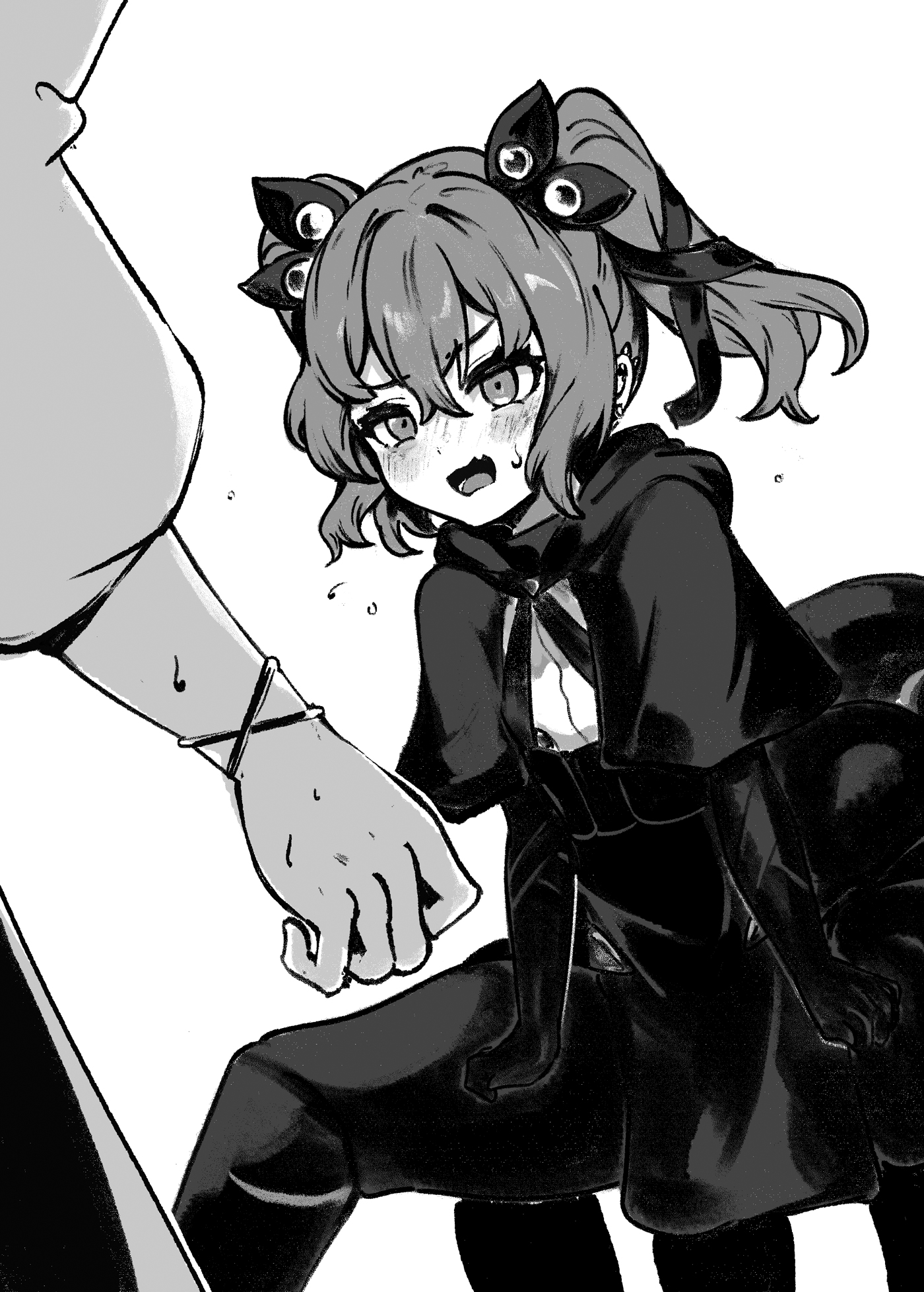
I hated those black scuttling creatures that infested the kitchens of this world, but I hated traitors more. And cheating? That was the most uncouth and vulgar form of backstabbing. Which is why I... How could I put this... Why I felt so damn torn up. Margit had looked sweet with her tomato-red face, but I couldn’t comprehend what I was hearing. I was chewing on so many things, but when I tried to swallow them, they got stuck in my throat.
“Anyway, that’s the bet! As another young maiden who loves you, I truly don’t want you to bring any shame on her.”
“I wonder if Miss Firene would really be so happy to spend just a night together...”
“Women can live on the memories of one night of passion alone. Now, don’t hold out on her. That’s the worst thing a man can do,” she’d said before finally jumping off the watchtower and joining with Etan and Linus, who were below and blessedly out of earshot.
Margit had come up here to tell me she was going to do a bit of recon and leave the canton to me, so I imagined they were off to see if they could sniff out the necromancer. Of course her report had to come with this literal bombshell of a closer.
With the eyes of a dog left behind, I watched Margit lead the two scouts away.
What the hell was I meant to do?
“Like, actually...”
I could just about see a modicum of logic in what Margit had said. Yes, we had saved the canton. But fear still hung overhead. Something that happened once could happen again. Unless a solution was provided, that fear would linger like an unwelcome guest. It would keep a toehold in the small corners of every mind available.
I couldn’t see any movement in Mottenheim now that the sun had set, which just proved my point. In their shared housing—designated as evacuation zones—I could sense the anxiety among so many people rising to meet the night as it settled over everything. Those who chatted with friends dreading tomorrow and parents who tried to placate terrified children held vigil in the faint moonlight. They weren’t awake—they just couldn’t sleep.
I had become a fighter at heart so quickly; so had my friends. We no longer understood their anxieties. My memories of Earth, where peace was in so many places the default condition, were distant now. I had learned that here, your own life and the safety around you was to be won by your own might. In my previous life, I wouldn’t have given the notion that my security was wholly in my own hands a second thought. Unlike the heroes of the stories and TRPG sessions I so loved, my life had been blessed. I had lived in a civilization where the labors of generations in pursuit of a more enlightened, more merciful way to live had denied me the option to even consider that choice.
But if I had no means to protect myself or my family and had to live through a night like this? I would be immeasurably scared and helpless.
We won. It was our victory without a doubt. No one died—Fellow or resident—and no one was injured. Well, apart from those brats we pantsed. I’d heard their parents hurt them unintentionally trying to get them down. At any rate, we had an overwhelming success. But the situation told me our job was far from done.
I could hear creaks and groans from all around, along with the worried voices of others. It was only natural that people would seek the warmth of another to seek some shelter from their fear. They were shacking up with almost self-destructive vigor in empty rooms or in small pockets of privacy. It was all too human to want to leave things to the next generation in the face of existential peril.
I wouldn’t dare laugh at them. Margit and I craved each other’s bodies when we emerged from the maws of death. I was not yet mature enough to maintain my composure after a truly deadly fray. You might call me pathetic with my mere fifty years of experience, but I’d also want you to find some levity in the fact that I still had my humanity.
I crushed my fear because it was necessary going into battle, and felt the ecstasy as I got things done and let things fall into place. At the end of it, fear was left behind. All that was left was the joy of showing off your full capabilities. That data munchkin part of me, tied to my very soul, sung with happiness in those moments: Well done. Your fixed values have frightened everyone around you.
It wasn’t good to get ahead of myself. I was not the sort of divine swordsman whose approach to life had been winnowed down to the perfect clarity and icy logic of a living weapon. That future was just as far removed as the Night Goddess who looked down at this poor canton from up above.
“Enough of that. You’ll hurt yourself.”
Despite my idle moon gazing, I hadn’t dropped my guard at all. With no one around, I’d spread out my Unseen Hands thinly as far as they would go. I didn’t have enough mana to keep them around permanently, and even if I could, there were too many gaps to make them a perfect defense—all the same, I was surprised that Margit had managed to avoid something invisible—but they functioned as a sensor that allowed me to see if something was coming.
I could see someone jump back from the ladder they’d just put their hand on.
Seriously? Like seriously, seriously?!
I was sure she’d come to surprise me. To an outsider, it probably seemed like I’d taken on guard duty as an excuse to sit on a watchtower at the edge of the canton to smoke my pipe.
I’d lost the bet. I scratched my head, wondering what to do.
First up, I thought, I should say hello. Then I could see if this was actually what it was or not. I put away my pipe and leaped down off the watchtower. From her little squeal, it must’ve looked like I’d thrown myself off, but I’d used the handholds to grab and kick as needed to slow my descent, so she needn’t have worried about that. I kicked up a little plume of dust as I stuck the landing. If Margit were here she’d probably sigh and complain that I used to be far better at this. Not that I could help it. I was taller and heavier now, and I was wearing armor. I hadn’t improved Silent Steps at all since then, and now it wasn’t enough to cover for me. I wasn’t a little kid anymore.
“I’m not sure if I approve of you walking alone at night, Fraulein. Especially the night after an attack,” I said.
Putting my own grumbling aside for later, I had an obligation to scold this young lady for sneaking out of bed.
Miss Firene was wearing a big coat over her warm-looking nightwear. She looked pretty surprised I’d clocked her before she could even call out to me; her hands were waving about in thin air. With her in front of me, it was pretty clear why she was here. She was using her two main arms to try and hide her fluster, but her second set were clutching at a wicker basket in a desperate urge to not let it fall.
“I noticed that you hadn’t eaten much dinner,” Miss Firene murmured.
“I am truly grateful for your kindness. But it’s dangerous to walk unattended on a night like this. The Night Goddess’s hands are still so cold.”
By the Night Goddess’s hands, I meant the wind—a well-trodden euphemism hereabouts. Even though it was late spring, it was still cold for a well-to-do young woman. That went double given that she sneaked out without alerting anyone, wearing only a coat over her night clothes.
“I-I’m fine. This coat has been stuffed with fine cotton, so it’s very warm!”
However, I realized that I had misjudged her. Someone in her family had given her this coat and had prepared this little dinner for me. What are you thinking, Mister Giesebrecht?! Wait, calm down, Erich... Maybe all she wants to do is give you this food.
If she had come to deliver me dinner on a night as cold as this, I couldn’t turn her down. In usual times, I would take the basket, send her home, and share the food with a nearby Fellow on patrol...but my partner’s words echoed around my head. No way. No chance. But I should check...
“Thank you for the food,” I said.
“Um... Do you...want to eat together?”
I’d held out my hand, thinking I’d take it and would just need to send her back, but what I received was a wishful gaze.
No way... No damn way...
After a few brief seconds of confusion, I asked her to wait in a house that had been left empty after the family that owned it had left to seek refuge. It was almost time for a shift change, so I would be able to join her. I swapped with some sleepy but well-equipped members of the Watch, suppressed my presence, then went to Miss Firene. When I arrived, she had just finished setting up the food on the table.
“I’m sorry, I could only prepare something simple,” she said.
“It looks like quite the feast,” I said.
I wasn’t even being polite. The amount of food made her modesty seem almost offensive. Much of the spread had been chosen for its ability to remain delicious eaten cold: trout meunière, white asparagus, and sauerkraut. She had prepared white bread—out of reach for any commoner—and the fruits for dessert were evidently given out of a rich person’s kindness. Of course, there was wurst and cheese—essentials at mealtime—which looked like good stuff and smelled like they’d pair well with some alcohol.
I felt a bit guilty to have this delicious spread all to myself, but I’d throw a big blowout party as compensation to the public. They’d find it in their hearts to forgive me.
“Thank you,” I said.
It had been so long since the last time someone had watched me while I ate that it felt a little bit uncomfortable. In the light of a small candle—although this, too, was a high-end piece—the young noblewoman stared at me from the other side of the table while I ate. She’d said she wanted to eat together, but she hadn’t taken a single bite.
This was different from watching my mother smile as I gobbled down all of my favorites back home in lovely Konigstuhl. The expression on Miss Firene’s face had an undercurrent of worry that I might suddenly up and vanish at any instant.
I vacuumed up the meal like a good soldier, not really sparing a thought for how impolite I must have seemed. I probably came off like I was in a hurry compared to the leisurely way that well-to-do young women were taught to eat. All the same, I made sure to observe some decent table manners. I didn’t let the food dirty the corners of my mouth and my cutlery made no sound, so I hoped that she didn’t find me too much of a sorry sight.
“Thank you for the wonderful spread.”
Once I’d eaten the apricot—designed as an after-meal palate cleanser—I noticed Miss Firene was shaking. I almost felt the blood leave my face as I realized I’d totally missed this. Crap, I’d been so on edge that I hadn’t even noticed her!
I slowly stood up, took off my coat, and, as Miss Firene looked up at me in confusion, placed it over her shoulders. It was my specially made coat with insulating enchantments—she’d be plenty comfy in it. But when I tried to help her put on the coat properly, I noticed that her porcelain-white hand was as cold as it looked. I knew from my partner that insect demihumans ran colder than mensch, but I couldn’t chalk this up just to the chill of the night. She was scared—haunted by a fear she couldn’t shake off.
I knew what one ought to do for a woman in a situation like this.
I held her hand in both of mine and massaged it slowly to share my heat with her. It would be weird if I was just standing up, so I joined her on the long seat. Miss Firene drew my hand to her chest and leaned her head upon my shoulder. There was a faint smell of perfume, like fresh fruit but without the overbearing scent of citrus. As she pulled in closer, I realized that this refined fragrance was frankincense.
There were a few reasons a woman would add this fragrance, unobtainable to a common person, to her clothes. However, I only knew of one reason she would use some while in her nightwear. It was designed to mask body odor, create a suitable atmosphere, and show her partner that she was willing to head to bed together.
Oh man... Margit was damn right...
I felt a cold sweat over my palm and felt my fingers tighten around her gradually warming hand.
Just what had been running through her mind when she came to see me? I knew her family must have seen her off, so had her father helped with the frankincense? Modesty permitting, my name had become somewhat well-known, and I still intended to become more famous. I’d said many times before that I was a sucker for positive publicity, even if the opposite scared the hell out of me.
I could see that there were boons in forging a strong connection with an adventurer like me. The discounted rates were an obvious point of appeal, but perhaps more relevant was that fundamental urge in any good parent to protect their children. Anyone that took on the burden of raising a hero’s child while they were out working the adventuring grind had a hell of a lot of strings to pull for the foreseeable future. What’s more, everyone in a small community welcomed fresh blood; the gene pool risked getting a wee bit stale after a while without new faces.
I bet that Mister Giesebrecht’s inner monologue had gone something like I want children blessed with strength to carry on this canton. He’d followed that motive to a hell of a conclusion through some impressive leaps of logic, but I couldn’t laugh at him. Since ancient times, people have pursued marriages as a means of “recruiting talent” into the family line. It was a practice as old as domestication, from the breeding of the first dogs to the cultivation of livestock.
The effects were evident if you looked at the nobles of Rhine. Generations of exacting standards for talent and aesthetics among the aristocracy’s choice of lovers had produced an abundance of frightfully competent and gorgeous extended family. This meritocratic, far-ranging, relatively freewheeling approach to romance, marriage, and procreation had rescued the noble bloodlines of Rhine from the ignominy that had plagued Earth’s House of Habsburg and many other blue-blooded lineages besides.
Folks in this world seemed a lot more leery of the self-defeating cultural hangups around “purity of the bloodline” that plagued their historical parallels back on Earth, preferring instead to treat the talents of relative strangers and outsiders like promising new grafts to the old family tree. It was awkward contemplating the extent to which this whole situation probably owed as much to Mister Giesebrecht seeing me as an alluring and valuable asset as it did to any genuine romantic feeling on his daughter’s part, but I was also very much aware that wasn’t the topic at hand right now.
A quivering hand, tear-filled eyes, racing breath—those mattered more in the moment.
“Master Erich,” Miss Firene said. “I’m...so scared... Too scared...to sleep on my own...”
She was telling the truth. She wasn’t just scared because of the attack—she was in the grip of a deeper dread, the realization that a peace she’d assumed would last all her days had been broken. Peace was the most precious thing to anyone, but it could also be lost in the blink of an eye, and restoring it was a long, brutal uphill battle. It seemed easy on paper—build a house, collect food, shore up defenses, earn money—but it took a mountain of effort. It was something you attained after scaling an endless staircase right up to the cloud-covered peak. But once there, it was easy to take it for granted. That went extra for those born into peace, raised with a promised future.
Human misunderstanding was inevitable. They believed that the stage they stood upon was built on top of steel pillars and a concrete foundation, when all that ever held it up was an unstable marsh. When that stage shook—which it indeed was wont to do—it felt an omen that the world itself was about to end. As someone who’d leaped down into the mud to try and keep that wobbling structure stable, I wouldn’t laugh at her. I knew well enough how it felt for her from my own past life.
I could see why she had a fear that couldn’t be staved off unless she was safe in the arms of the man she thought she could rely on. Margit had known as much before I did. That was why she’d decided to suggest the bet in the first place and shared her sexual quirks with me in spite of her own embarrassment. I always knew she was tough, but I also knew that she was a gentle person who could sense when another woman was struggling. I could never hold out long against her (or anyone like her). I was sure no one could.
I pulled in her shivering body, coat and all. Internally I continued to question myself, wondering if what I was doing was the right thing. At the same time, I couldn’t leave someone struggling when they were right in front of me.
I felt the tension in her slender, almost fragile body release. Her breath was warm; her body finally stopped shaking. The strength in her fingers grew and she looked me in the eye. Her lips, faintly open, called my name—like how a child calls for their parent; like how a worshipper asks for their god. Then those lips gradually opened.
I still didn’t know if this was the right move. It was a question I’d probably never find an answer to for as long as I lived.
[Tips] Rural society doesn’t place the same stock in chastity that noble circles often do.
It was a nigh-impossible task to grow up without learning something about the birds and the bees.
In a daze, the girl thought back on the time she had just spent. It had been like a dream. As she ruminated on the passion and redrew the images in her brain, she felt her chest and the pit of her stomach grow hot.
She was barely able to stand and too lethargic to even move her fingers, so what could explain the strange sensation that she wouldn’t mind going at it again? She was certain she would jump on the dozing boy next to her if only the energy for it still lingered in her body.
It had been so wonderful that she began to wonder if the women who gathered on canton festivals and slandered their men were in fact lying. The older women of the canton gave constant warnings to the young girls, telling them that their first time would be so painful that you would spend it praying for it to end, and that they would have to steel themselves for handling the bloodied sheets in the aftermath. And if you got really unlucky, the man might force his thing into you again to sate his lustful urges. The sex education available in the canton scarcely counted as education; it might have been more accurate to say that it constituted a list of sex threats. Sex warnings, perhaps. Bleak sex prophecies, certainly. Firene remembered that she could barely sleep that night from the horror of it all.
The women advised that if you wanted to get through it, then you needed to be the proactive party—a dyed-in-the-wool seductress—and apply all available leverage to prevent anything unpleasant from happening in the first place.
Firene knew that these women weren’t lying about this issue. This wasn’t the sort of trick that parents played with their children, like telling them sweets were poisonous to you. Firene had seen them—boys and girls getting close on the spring prayer festival or the autumn thanksgiving festival, only for the girls to emerge the next morning with their hands on their stomachs as they walked. But Firene felt no pain, just a pleasant numbness left over from past ecstasies.
Young women cried and bled so often during their first time in the bedroom not just due to their hymen breaking, but because their partners had charged ahead without sufficient preparation and engaged in too much violent friction during the act. If a man were to force himself inside a woman while she was stiff with nerves and still dry, then although he could get off on the act alone, the woman would feel nothing but terrible pain. In other words, if she was relaxed and eased into the act, then the pain would be trivial and she would take less time to find the pleasure in it.
Firene had accepted the pain that awaited her and flung herself into Erich’s arms, but they were unexpectedly gentle. She couldn’t even remember exactly what he’d done. Her mind had been swept up in a current; she could only begin to impose sense on it in retrospect, and all she could remember were the sweet nothings he whispered in her ear and the sensation of his fingers and lips on her body. She had been embarrassed when he had put his head between her legs—where even she had felt reservations about touching herself before—but he had replied that he was doing this to make sure he didn’t hurt her. What came next practically made her nerves melt and her cerebellum fuse.
If she regretted anything, it was the fact that she had reached ecstasy and yet he seemed completely devoid of exhaustion. Even after he’d climaxed three times, he still seemed full of pep, in spite of how she’d always overheard the women of the canton complaining that their men would lose interest the moment they were satisfied and roll over to sleep, leaving them in the cold.
Her night had been so wonderful that it almost made every threatening piece of advice seem like a lie thanks to his care. The bed had creaked, splintered, and been soiled—she felt terrible about whoever’s house this was and inwardly reminded herself to send a new bed over—but while she rested in it, he had smartened it up, and had even wiped her body clean. He must have stepped outside for a moment and cleaned himself off at the well; she noticed that when he came back in through the door, only the pleasant smell of sweat wafted from him. It was a sweet, gentle scent, just like when he had taken her in his arms. He laughed, saying it was probably the smell from his pipe, but she knew the sweet fragrance that came every time he moved his head was his own.
Ahh, what a fantasy in the flesh. What a wonderful night.
Firene wondered how many women had ever had such a blissful first time. There had been no splendid banquet, she hadn’t worn a silk gown, and she had received no mammoth bouquet, but she was happy nonetheless. After all, every last scrap of fear that had haunted her was wiped away. She was sure he would fight for her and protect her with this love.
Perhaps this was why she could lie in the afterglow with no pain. It was an instinctual ease. As long as she was in his arms, she would not be hurt—she knew that. It wasn’t just kindness, but also the reliable feeling of a strong body made to protect. It was difficult for her to put her feelings into words. But Firene knew that people called this feeling love.
When she first met Erich, all she thought was that his epithet fit his name well. The second time he visited, her father had lit a fire under her, and she realized that if she were to not know love, then at least she would like to be with someone distinguished. The third time, now that he’d dispelled her fear, she had no doubts.
There was something that she regretted. Now that she had awoken to this love, she wanted to feel this pleasant embarrassment, this warm exhaustion, and see his face—she knew he wasn’t sleeping—but the fatigue had gripped her soul and wouldn’t let go. She wished to keep her eyes open longer, but the Night Goddess blessed her with sleep in spite of her prayers.
When she awoke after this regretful sleep, she found herself lying in her own bed. Her nightwear had no creases, despite how she’d worn them outside, and they even seemed to have a pleasant fragrance, as if they’d been washed. Her body bore no traces of her indulgent night, and seemed as if she’d just stepped out of the bath. She almost thought that it was all a dream.
But there was one piece of evidence that her night of passion wasn’t a dream. By her pillow was a flower. Not a real flower, but one crafted of paper. She wasn’t sure exactly how it had been made, but the paper had been folded to create a lily that would never wilt. Even its stem had been lovingly re-created.
Firene took it in her hands and smelled him. She made the mental note to ask her maid to prepare a vase for this flower. Later, she would take up the broom and sweep up as much dust as would settle to thank the maid who had helped her sneak out the night before. It was a small price to pay to keep this wonderful gift safe.
It truly was a wonderful present. After all, heroes in the stories conquered great and terrible summits in search of a flower that never wilted to win the affection of their princess. What better thing could there be to pledge one’s undying feelings with.
The young woman gently cradled the flower, so as not to harm it, and put her secondary arms over her stomach, praying that he’d left her another, more valuable gift.
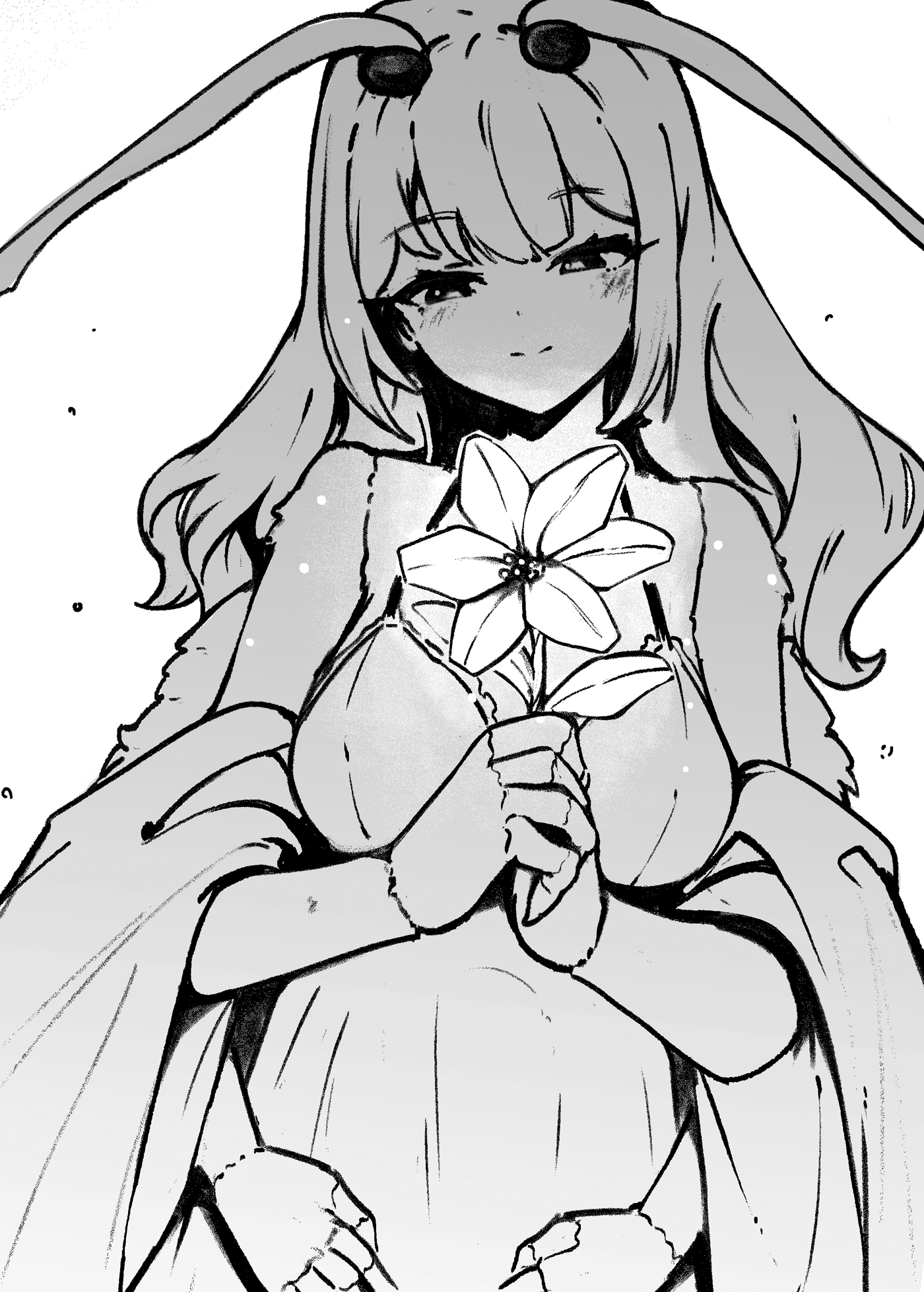
[Tips] Many insect demihumans are ovoviviparous.
I’d really done it... Did it in two senses, I guessed.
God damn, that was a terrible joke. Only made me feel worse. Don’t know why I thought it would lighten the mood. It looked like I couldn’t say I didn’t have the potential to lose my marbles anymore. I shouldn’t have been making ill-conceived digs at my own miserable state, even if they did help me put some distance between myself and the disgust and shame I felt knotting up in me on Margit and Miss Firene’s behalf—which, I should be clear, they did not.
Dawn had come and I’d delivered Miss Firene safely and secretly home, but an answer still hadn’t come to mind. My trepidation over being disloyal to Margit (even if she was the one who put me up to it) led me to rather return Miss Firene home by rather uncouth means, and I started to wonder if her worries had resurfaced in my absence. Even if I’d managed to shake off the fear that had been hounding her at the moment, what would I do if some kernel of it still festered in her heart? When it turned into true despair, then it would be even more unsalvageable. If Miss Firene, beloved by all the canton, ended up falling into a terrible malaise, then everyone’s morale would drop and Mister Giesebrecht would be left too disheartened to act...
No—I needed to stop using logic to try and pretend I wasn’t at fault here. It didn’t matter what Margit had said; at the end of the day it had been my undertaking. I had taken the risk; the child, if one was to come of this, was mine. It was my fault for finding joy in the prospect of a roll in the hay with no stakes and no strings attached, just coasting on the good vibes—being able to have your cake and eat it. I needed to up my game. I hadn’t been the one to make the moves on Miss Firene, but I couldn’t let this become a gateway to a philandering lifestyle. No good came of letting your other head do all the thinking.
Now that I realized how pathetic I was being, it was time to shape up—at least so that people wouldn’t look at me and wonder why Miss Firene had chosen to sleep with me.
“Oy, what’s with you? You were lookin’ like a right idiot and now you’re all serious.”
As I was steeling my resolve, Siegfried called out to me.
“Oh, sorry. Some stuff on my mind.”
“Don’t lose concentration now. If you’re not with it, then the others will get sloppy too.”
Siegfried pulled out the shovel I’d left half buried in the dirt and set to his own work.
While I was fighting my own internal battle, the Fellowship had started doing some cleanup from the previous day. In the outskirts of the canton near the communal graveyard, some of the men with time on their hands had pitched in to help us. We hadn’t yet set to digging the trenches; we were cleaning up the zombies we defeated last night.
I got Kaya to explain to everyone how zombies worked. She explained that they themselves weren’t to blame; they were poor victims who had been forced into their bitter work. At this, the people of Mottenheim gladly agreed to help. Simply abandoning corpses would invite disease and wild animals, so I wanted to deal with them quickly. I also wanted them to be even more aware of what their victory last night meant, so I was happy for the aid.
By the morning, the burnt and charred corpses had cooled off, and everyone sent them off with prayers to the Night Goddess so that they would find rest in the afterlife. Then we buried them all in a deep pit in the corner of the graveyard where there were few tombstones already. It was highly unlikely that someone would break into this grave, but I didn’t want these poor folk to be used yet again, so last night, while no one was watching, I severed all the tendons in their arms and legs to make sure that they were well and truly neutralized. I didn’t want a little oversight to come back and bite us in the ass later.
“Wow... Even their bones are burned...”
“What do you even need to use to do something like this? Gives me shivers...”
“This one’s a woman... Poor soul. She wasn’t even that old from what I can tell.”
“And this kid’s not much older than my own boy. Breaks my heart...”
“To use someone’s body after they’ve died? That’s disgusting! Foul mage, I hope the Sun God curses you Himself!”
We carried on with our work, accompanied by these outcries of pity and righteous fury. The bodies may have been smaller after burning, but it would still take a day to bury fifty bodies. I needed the locals to stick around and stay involved so that they could know that we had bested this enemy force and they didn’t need to worry. It made me happy that they could still offer words of sympathy. If their hearts were truly broken, then it wouldn’t go quite as amicably as this. They would abuse the bodies, play with them, and derive some schadenfreude from the process.
We could still fight. We could still do this.
Adventurers weren’t suited to battles of attrition. Many people chose this line of work in the first place because they were bad at sticking to one task for very long. Defensive battles were the wheelhouse of mercenaries. It was like forcing a gaggle of light cavalry—best suited for quick skirmishes—to protect your fort. Still, if there weren’t any voices of dissatisfaction and the logical parts of their brains still worked, we could still fight.
Remaining on the defensive when you couldn’t see when the end would come was a tough endeavor. I really wished a report from the magistrate would come already. The people here have been paying their taxes, so do your damn job!
We were being hired directly by Mister Giesebrecht and also, by extension, the canton itself. That meant the money was coming out of his pocket and any other expenses would need to be covered by us. I wanted an imperial patrol to come, preferably with some soldiers in tow, so that we didn’t have to be saddled with extra costs. The magistrate wouldn’t quibble about penny-pinching, but drawing out this affair would result in a bigger debt for the canton. Building more emergency residences or protective measures on the outskirts of the canton would only sink money into the matter right in front of us. These types of war preparations put a strain on the public, but undercooking them would result in those same people being taken over—it was a tricky situation.
The problem was that we didn’t even have a reply from the magistrate, let alone reinforcements. Therefore, we needed to make quite the risky gamble. Under the assumption that the first horses sent out had been attacked on the way, I decided to send out some Fellows with a letter from Mister Giesebrecht. I already had decided who would be going.
But man. If we were facing zombies, I really wished we had some heavy machine guns. Four of those could solve most of our problems. Couldn’t someone at the College or some such have cooked some up for me already? Wait, wait, if they did, it’d totally shift things away from my beloved fantasy setting. I had loved a certain world that combined guns and maces before, but I didn’t want to deal with real-world advancements that changed what it meant to be a foot soldier. No thank you to a world of endless trench-digging.
The burial ended as I contemplated just how much things weren’t going my way. Around the same time, our mounted messengers finished their preparations. As a safety measure, I’d sent Margit and two skilled Fellows atop my Dioscuri, just in case anything bad happened out there. The party left Mottenheim without issue.
My horses would only take a day or so to reach the magistrate at their standard clip. I could expect it to take around three days for them to petition the magistrate and for him to give his response. Add to that another day for the return journey, and we had a five-day wait on our hands. Factor in another one or two days’ buffer in case they needed to avoid anything dangerous. On top of all that, I asked them to gather some intel on the way, so I could expect them to take yet another day for that.
It was disheartening to be without Margit for that long—she was practically my other half, after all—but it was scarier to think about important information not reaching the magistrate. Right until their departure I’d fought with myself about sending a different scout party, but I wanted to be prepared, so in the end I decided on Margit. Having only one scout and one bodyguard would be terrible, balance-wise, and I wanted our best woman on the job, so I decided to let her go.
I hoped I’d made the right decision. The woods seemed calm; it was unlikely they would send another army of undead soldiers right away. To make sure, Siegfried or I would lead a scouting party to do a sweep once a day. Our defenses here were improving, so it made sense to make sure that the messenger party, a bigger source of worry at this point, was safe. Even if I knew the answer in my head, I couldn’t shake off my anxiety. This was why war was scary. The tally at the end only showed if you won or died.
In this case, I needed to hold my head high and make sure the work here proceeded smoothly. I couldn’t let my spirit be worn down. In the words of the poet Bernkastel, whose incisive insight had made him one of my favorite wordsmiths this world had yet produced, a strategist’s job amounted to convincing a block of ice to hold fast atop a hot stove.
One false move would crush this tiny canton in a second. If we had arrived a mere fortnight later; if we had begun our training ten days later; if the completion of the walls and abatises had been three days later; if the mines had been laid one day later, we’d be living in a nightmare. I’d be rounding up anyone still with their wits about them to pick over the people of Mottenheim, giving them the same treatment I’d administered to our zombie aggressors so that they couldn’t be reanimated and leveraged against the survivors. Hell, arguably that wasn’t a sufficiently catastrophic worst-case scenario; I could just as easily have been stuck leading my underlings and the scant survivors out of a burning canton. We got lucky.
We couldn’t rest on our laurels, though—there was no telling when the God of Trials would smile down upon us. That was especially true when luck often gave me the cold shoulder.
While Margit was away, I would use everything in my power to defend this canton. Information moved slowly in this era. It made me anxious, but I couldn’t let that spur me into anything rash. I’d take on this battle properly and push on through it. The enemy’s objective was still a mystery to me, but if I was correct in assuming they were pulling similar ploys on multiple fronts, then it was unlikely they would pull any more nasty tricks.
This was just like ehrengarde. If a watchman wasn’t budging from a really annoying spot and you couldn’t avoid or take it, then the only answer was to attack from another angle. Miss Cecilia had often backed me into similar frustrating corners; I knew this feeling all too well. Despite liking proper strategy, she was really damn good at those nasty plays. I still really dreaded the idea of making an enemy of her, especially if she ended up landing some kind of state administrative role like so many of her folks had been steering her toward.
“Looks like we’ve finished the burial. The sun’s low in the sky, so let’s save our prayers for tomorrow. We can get a priest to perform proper rites.”
With this job done, it was time to discuss our next moves with Siegfried over dinner. It felt like he’d been cold to me all day, so I wanted to smooth over any misunderstandings that’d cropped up between him and me. He was a sharp guy, in his way. If I didn’t choose my words properly, I could expect a fist to the face.
Sieg really hated it when you tried to fuss over him. I got that. He was still young—a time when it made sense to be more critical of others than yourself—and he didn’t discriminate (which isn’t to say he was totally devoid of tact—just that he knew nobody was above criticism). If he was mad, he had a proper reason for it. Plus, the fact that he hadn’t already heaped his lid at me was a sign that something was on his mind. I couldn’t just waltz up to him and ignore the signs. I hoped from our normal conversation that he realized I wasn’t giving him the cold shoulder or anything.
That reminded me. It seemed like Miss Firene had suitably recovered, because she was standing a short distance away, a basket in hand and her eyes fixed on me. I needed to talk to her too. I could understand what Margit had meant when she whispered that I “overdid it” before leaving on her mission...
[Tips] Burials are mainstream in the Empire of Rhine. This is chiefly a matter of economics—it costs too much to supply enough firewood to reduce a body to ashes—and sanitation. Although funeral pyres are rare, they are treated as an honorable way to be delivered to the afterlife by some religious sects.
I suddenly found myself missing the sagas. The bad guys in them were just so simple.
The magus who planned the end of the world wouldn’t budge from their tower. The evil dragon that had hoarded the kingdom’s wealth wouldn’t leave their cavernous lair. The terrifying bandit chief always returned to their hideout in the mountains or some ruins. The foreign general would station themselves in the middle of a camp and even tell the hero where they were based. I envied that simplicity. If you knew where the enemy was, all you needed to do was charge in and take their head.
A key part of our jobs as adventurers was making the trek into enemy territory and taking down our target. It didn’t matter if there was a village plagued by bandits or a new dungeon somewhere, because most times it was obvious who needed killing and where we needed to go to do it. We were the ones who were meant to be surrounding the enemy and setting them ablaze!
“Ugh... I don’t care who it is anymore...someone...bring the fight...” I muttered.
“What’s wrong with you? Did ya finally lose it from too much digging?” Sieg replied.
The lack of an answer or any development had gotten to me. It had been two days since Margit had left, and we were still hard at work digging. This time we had finally gotten around to the trenches. It was a boring job, and I’d started to question what it meant to be an adventurer.
Siegfried, who was digging next to me, had shot me a look as if I had gone truly mad. He wasn’t completely wrong, but were you really meant to look at your comrade the same way you do some guy in the street having an episode?
I tried to explain my position by talking about the difficulties of this battle of attrition. He wiped away the sweat and pulled a difficult expression.
“I get where you’re comin’ from,” he said.
“Right? This kind of work isn’t even suited to adventurers.”
“Hey, this is beyond ‘suitable.’ Who even knows all this stuff about fortress defense? What’s weird is how clued in you are about all this.”
“Huh? Can’t you think of any songs where it comes up?”
“No.”
Siegfried was talking to me, but he was still giving me quite the cold shoulder. I’d seen him talking in small groups with the Fellows, but I didn’t know what exactly had happened. I didn’t want to play the role of the stupid protagonist who had selective hearing; it was clear he had a problem with me. Whatever it was, he was keeping it to himself and putting his energies into his work instead.
To be honest, I could think of a few reasons.
I knew that although Kaya was good at hiding things from our Fellows, there was no way she could hide them from her childhood friend. While she was a mage with knowledge way beyond Sieg’s ken, even he could tell that the terrifying explosion—at least that was how it must have seemed to them—and her intel on zombies were things that a herbalist couldn’t simply pick up along the way.
I had my own personal reasons for hiding the fact that I could use magic. It was my own excitement after chatting with Kaya that had led her to finding out, but I still hadn’t told my comrade. We’d been friends for a long time now, and really mulling over why I had kept this for so long, I couldn’t produce a decent logical reason. It wasn’t that I didn’t trust him. He wasn’t the sort of guy to tell everyone in earshot about it and I didn’t see him trying to do anything bad with the knowledge. It was just, I dunno, the longer I knew him the more awkward it was to bring up!
I didn’t yet have a decent response prepared for when he’d inevitably corner me and say, “Why did you hide this for years?!” The truth of it was that I’d wanted to gallantly whip out my magic at the exact time the situation called for it, but I could tell he’d rip into me. But wouldn’t it be cool though, comrade? It’d be like witnessing your friend suddenly “awakening” on the battlefield, just as the situation got dire! The problem was that each adventure had put us in situations where I couldn’t call on my magic or that didn’t actually warrant it, meaning I’d missed every chance up until now.
I had hidden this facet of my whole deal for a ridiculous reason, and now I wasn’t sure how I was meant to even approach him about it after all this time. Unless I came up with a decent explanation, there was no doubt I’d end up kissing the pavement.
The thing was that I could totally empathize in the opposite case. If Siegfried suddenly revealed that he was a priest packing high-level miracles, then I’d grab him by the shirt and complain about all the jobs we’d done where that would’ve saved our bacon. I knew just how deep a hole I’d dug for myself.
It was true that I’d been following my former master’s request not to make my magic known, but she’d said not to abuse it, not hide it from every single person I met. After all, Margit and Kaya knew.
Fortunately, we hadn’t suffered any losses thanks to my restraint—I wasn’t so coldhearted that I’d keep the secret even at the cost of life and limb—and hadn’t lost anyone’s trust because we hadn’t failed any gigs yet. Or at least that was how I would have liked to view the situation, but it was true that I couldn’t avoid some huge fallout.
Back on Earth, my seniors had told me, “If you screw up, make sure to let people know. The longer you leave it, the worse it’ll become.” This creed had been something I’d made sure to drill into my juniors as it had been into me. I valued Siegfried’s friendship. What could I do?
“Hey, did you see that?” As I was taking my anger out on my shovel, Siegfried spoke up.
“Again, huh?” I looked over to where he’d indicated and saw a faint shadow. “Just the one, I think?”
“They’re not too tall. Mensch, maybe?”
“We’re too far to know.”
Since yesterday, we’d been receiving reports from our scouts and people up on the watchtower that they saw a shadow moving around the corners of the forest. I did a head check to make sure this wasn’t another childish prank, and it seemed like their punishment and subsequent assault had done the trick; everyone was present and accounted for. I factored in the Fellowship and the caravan, just to be extra sure, and there was no exception there either. It wouldn’t have been us anyway—we always traveled in pairs at least, so a single shadow would be weird.
I’d gone into the forest with some backup in case it was the enemy’s own reinforcements, but we couldn’t find hide nor hair of them. We couldn’t waste hours wandering the woods, so we decided to head out every time we caught sight of the mysterious figure. Only after half a day did I realize that they were toying with us. I didn’t know if this figure was a remnant of their forces or someone who’d come from afar, but they really knew how to push a guy’s buttons.
This had forced us into a bit of a corner. We didn’t know the enemy’s objective and now we couldn’t do anything without the possibility that they still had sights on us hanging over our heads. We were in this for the long term, so we couldn’t lose our patience and burn down the forest like I would’ve done with my old tablemates. I couldn’t leave the canton understaffed either, so I couldn’t take a big force with me to flush out our shadowy antagonist.
It was a textbook catch-22 situation.
If only we had all of the Fellowship with us. If those Fellows who’d stayed behind in Marsheim were here, we could get ten or so together and head into those woods. Another example of why playing defensive was tough. The job should’ve gone to some mercenaries or a formal army.
I hoped Margit would be back soon. Hopefully with an imperial patrol in tow, if not a whole war party. It would be so easy if we could just bring the fist of the state to bear.
“What’s the plan? I’m happy to head out if you need me to. I can take five Fellows or so,” Sieg said.
“No, leave it. They’re just trying to rile us up. If we waste energy chasing them our work will stall and fewer of us will be able to rest. It’ll make the night tough.”
Siegfried was just as tired as I was and itching to sort things out, but I decided to reel him in. Our trenches would make it more difficult for the enemy to attack. They were willing to show themselves if it meant we stopped working. That meant we needed to continue to annoy them by sticking at our work. When they finally had enough and came for us, then we’d welcome them with all of our available strength.
“Dammit. If only the forest was a bit closer,” Sieg muttered.
“It’s a windbreak, and the locals use it for lumber and such. It can’t be any closer. It’d be dangerous,” I replied.
“You really know everything, huh? Almost pisses me off.”
“You think?”
With his grimace, I wondered if I’d let too much slip.
It made sense that he’d wonder what kind of life you’d have to lead to learn what I knew. Sure, any fool could tell you a well led to water, but knowing how to effectively dig trenches and why man-made forests were placed on the windy side of settlements were things that only an expert in the field ought to have known. We lived in an era where it was tough to accumulate random trivia.
Earth was damn near swimming in information. Films and manga were chock-full of little tidbits of knowledge, and if you wanted to learn more about something you could count on the shiny auxiliary brain in your pocket to rustle up a dozen different answers to your question in a matter of seconds if you knew how to ask correctly. I’d never given much thought to the omnipresence of information back on Earth, but here even a scrap of knowledge could be overwhelming. People could get real distrustful of anyone who seemed to know too much, and the threshold for “too much” was low.
Heroic songs and war epics detailed battles, but they weren’t exactly fine-grained tactical or historical treatises. Back on Earth, fiction could open doors to all sorts of knowledge. And it seemed like I had been reborn in a world where that information was useful. That was all. But to an outsider, it was hard not to look like a charlatan—or something more sinister.
“Siegfried, listen, I—”
“I know, I know. You were a noble’s servant or whatever, yeah? I know, so shut up and dig. You’re the one who ordered this whole thing.”
With him being so up front about his desire not to listen, all I could do was obey. I sighed inwardly and picked up my shovel once more.
[Tips] It isn’t all too difficult to study and learn specialist knowledge. However, many of those same specialists keep their secrets to themselves in order to maintain their hegemony. Silence is golden, as they say.
Cantons in early summer usually buzzed with activity, but the canton that the messenger group arrived at was nothing like normal.
“This is...”
Riding alongside another rider on one of the horses, the arachne couldn’t hide her displeasure at the sight. She pinched her nose.
“Big Sis...”
“You don’t need to protect me. Whatever happened is already over,” Margit said, trailing off a bit.
She hopped off the horse that her chosen bodyguard, Yorgos, was on. Castor seemed a little tired from carrying him, but that was no real surprise—a two-meter-tall ogre with metal bones to boot weighed as much as a knight in heavy armor. Yorgos’s intimidating presence correlated well to his size, so Erich’s beloved horse had done a good job bringing him all this way. Despite getting on in years, Castor was still quick enough to keep up with the fastest warhorse. He was truly a fine steed. Of course, keeping such a powerful horse healthy was an ordeal in itself, requiring a lot of water and feed.
The anomaly that Margit had sensed was the fact that the air wasn’t filled with the cheerful laborers’ songs, but with crying and groaning. She had wrinkled her nose because instead of the fragrant smell of earth and growing crops, she could smell burning wood and the whiff of decay. Instead of children playing in the paths, there were bodies left to rot by the roadside.
This was a sight that most adventurers acclimated to early on, but one that the Fellowship hadn’t often seen.
“What... What’s going on?!”
One of the younger Mottenheim folk, astride his own unbroken horse, split from the party and exclaimed his own confusion. Given one of the canton’s fastest horses and charged with delivering the missive to the magistrate, he was none other than Giesebrecht’s son-in-law. It wasn’t difficult to see why this young man, wed to Firene’s older sister and charged with leading the next generation, would be chosen for this job. There was danger in Mottenheim, and it was more convincing if someone in a position of power was the one to entreat the higher-ups for aid—especially if the first messenger had died in the process.
An amount of decorum was required to make negotiations and receive orders, so it made sense for someone with decision-making power to be present. If the canton had sent along someone with no standing, then they would have proven no more useful than a slow messenger pigeon. To show the desperation of their petition, this man had been chosen for his ability to make quick decisions when the time came. Having formerly worked as a tax collector for a magistrate, even Margit could tell that he was capable and shrewd.
Over the course of their journey, he had decided that they should stop at local cantons in order to gather information and take the opportunity to rest their horses before their fatigue posed further complications. As they traveled, he had chosen routes along flat land so that they could easily spot approaching enemies. Margit praised him for his expertise, and he modestly replied that a tax collector needed to know the lay of the land. In his previous job, he had learned the local geography and learned what tax would be appropriate for them.
But now, his face was pale with shock. He had been at the forefront when giving instructions when his own canton had been beset by danger, but even he couldn’t bear the sight of a canton being ravaged by a one-sided assault.
“Oh! You’re from Mottenheim!”
From a burning house came a small, withered old man, smoke still lingering around him. That wasn’t quite right. He only looked so small and fatigued because of the soot, exhaustion, and resignation etched upon him. His expensive clothes were singed and torn. His body, once so sturdy, looked exhausted. When he finally stood alongside the mensch messenger, the group realized just how tall he actually was.
“What happened here, good gentleman? What is this?!” Giesebrecht’s son-in-law demanded.
“We don’t know either... Bandits just appeared out of nowhere...”
Despite the battery of questions, all he could say about the tragedy was that it was a surprise assault. The brigands had come in the night and set his home ablaze. When the Watch came with weapons in hand, half of them were killed. The old man was trapped inside with his son—the village head—as well as his daughter-in-law, who both perished in the flames.
This much seemed to be nothing more than a bandit gang’s usual modus operandi—something that, sad to say, was all too common—but what happened next didn’t follow the usual script. Not only had they not taken any of the women, they hadn’t even raided the stores for food or valuables. It seemed like their only goal was to kill. They set fire to the doors of homes and slaughtered any who tried to escape. It was only when the sun rose that they finally left.
This wasn’t normal. It was like cooking up a big dinner only to leave the house with it untouched—it made no sense. Piecing together their objective was daunting beyond belief. Murder, assault—these were things that one did to achieve some sort of goal.
Margit was smart, but she was neither a strategist nor a tactician. She couldn’t suss out the workings of a group of dozens at the best of times, and this was a particularly odd scenario. Who would brutally assault a canton and then slip away come sunrise? She was a normal woman who had never had cause to wargame out an explanation before. She could make a few deductive leaps; she could pose theories, but she had no idea what the right answer would be.
The arachne gritted her teeth in frustration that the magic tool her partner had made didn’t allow her to transmit her voice from quite this far. Wishing to get moving quickly, she asked for some water before suggesting they make their way onward swiftly.
[Tips] Scribes, secretaries, and tax collectors work in close proximity to the local magistrate. Often these jobs go to those who will succeed the rule of their canton or are in the running to be married into the family. Due to the nature of the job, reading, writing, and arithmetic are essentials, as well as an understanding of politics insofar as it ramifies on the magistrate and the local community.
Oftentimes, reality and your expectations don’t match up. I supposed I wasn’t the only one—many people probably were upset with their current lot in life. But I couldn’t help but think, I really wanna go on an adventure... This whole situation reminded me of how it felt after the third week in a row of nobody’s schedules lining up for our next tabletop session.
As I tried to tamp down my itch for excitement, I heard the warning bell and my body jolted up. I was having a light sleep, on a constant, low alert, and thanks to that my brain was able to get into gear quickly. I grabbed Schutzwolfe from its place by my side and headed out, not willing to waste any time even putting on armor.
“What’s the situation?” I said.
A Fellow who had been on watch on the north edge of the canton came rushing up to me. His breath was ragged from sprinting all the way here, but he managed to announce in a loud voice that a large assault had begun on the north end of Mottenheim.
“I need more than ‘large’! Give me some rough numbers and details!” I said.
“Frontline soldiers followed by a few tight formations! Those are the only details I have!”
“Understood. Good work and hurry with the evacuation!”
I almost found myself tutting despite being in front of my subordinate. Calm down, I told myself. People will panic if they see their leader panicking. Remain calm and composed. I sent my Fellow off to the Watchhouse and Mister Giesebrecht’s manor to begin the evacuation. We couldn’t keep them all packed together in their temporary residences in the plaza, so I’d sent everyone home today, the third day since Margit had left with the messengers. Our enemy, canny bastards that they were, had been keeping close tabs! It was painful to see them move into action so quickly.
I didn’t have the time to rush back for my armor; I hurried north and clambered up the watchtower as I had done a few days prior. The Watch stationed there with their quivers looked utterly shocked, but I couldn’t deal with that right now. I peered into my spyglass and finally let that tut slip.
Under the light of the waning half-moon, a group of shadows approached, as if laughing at the Night Goddess’s faltering protection. There were five tight rows made up of five to ten soldiers. Leading the charge was a group of assault troops. This group seemed small, but I supposed they were there to act as meat shields. Skirmishers like these were usually armed with bows and marched ahead to launch a projectile assault before the main forces engaged in battle. Their job was to collapse the enemy’s own formation. Indeed, a few in the front line coming toward us had a mishmash of bows; the remaining majority of them bore slings at the ready.
However, the distance was too great. The front line would get crushed as soon as they met the enemy forces and the main forces that followed couldn’t hide behind them when they were that far behind. Wait, I thought, they don’t need to hide them. This was all designed so that the front line could set off the napalm mines and negate any danger for the main forces that followed behind!
They had around eighty soldiers, with half of them being cast aside to protect the main forces. What a bleakly logical strategy. Granted, it only worked with fearless, perfectly obedient undead soldiers. If you asked a normal army to do this, you’d have a revolt on your hands.
In order to reduce the costs and produce as many mines as possible, I’d simplified their design so that they would activate either manually from a distance or automatically upon impact. I regretted not integrating a method so that I could choose one or the other. All I could do from here was turn them on or off—no freedom in between. And if I did turn them off, I would need to dig them up and imbue them with mana once again. I wouldn’t ask for such luxuries as being able to switch between functions. If only I could have been able to switch between on and deactivated, I’d have laughed at them as I temporarily disabled the mines then reactivated them once the main forces were in range. This had been a painful decision, considering how many we planted and to reduce labor, but it had come to screw me over now.
“Erich, our people are here, but we’re low on numbers for the evacu— Whoa, where’s your armor?!” my comrade said.
“Thanks Siegfried! And there wasn’t time to put it on!”
“Are you stupid?! Dammit, anyone got a moment to spare? Someone get his armor! Surely you don’t plan to send your boss into battle without his armor?!”
Someone responded immediately and dashed out from the line. I had made the decision because I needed to move into action in a hurry, but it wasn’t encouraging to see someone walking around a battlefield without any protection, so I was grateful. I’d dashed here wondering if I’d even have enough time to head back and get it.
“Sorry!” I said.
“Shut it and give your orders! We got eleven Fellows here in total. The others are helping with the evacuation and gettin’ our defenses up!”
Siegfried was moaning at me, but he didn’t have a full set of armor on either! He only had the top half of his new scale armor. I looked around and saw that we were all bearing signs of our having been caught on the back foot.
This wasn’t good. Our sentries were wearing helmets and breastplates to save their stamina during long shifts, but without full armor, they were dismayingly vulnerable in these conditions. I had been optimistic enough to think that the enemy wouldn’t come so quickly that we wouldn’t be able to prepare even a little. Forsaken by luck yet again.
“How long will the evacuation take?” I asked.
“An hour! We’re prioritizing the north, but because we moved their valuables beforehand, it should be coming to an end soon.”
Time, time, time... I didn’t have enough of it! No, I thought, I should be grateful. I’d put people with good night vision up on the watchtower, so the situation wasn’t as bad as it could have been. If we’d only noticed them once they were right on top of us we’d practically be dead already.
In all honesty, I would have preferred to abandon the outer edges of the canton and get everyone to hole up in the center, but that was impossible without all the residents of Mottenheim already being gathered there. Considering the leadership of this affair and whatever was to come afterward, losing so much as a single civilian would result in our loss. Fortunately, the people of Mottenheim were understanding, and I was sure they wouldn’t rebuke us should a member of the Watch or one of the willing men lose their lives in the fray. All the same, I couldn’t dare let someone who couldn’t fight die, especially the children and the elderly. If we abandoned people to barricade ourselves into a fort, their plummeting morale would mean we wouldn’t last long.
Why did my luck have to hose me at every turn?
“All right, then let’s fi—”
No, wait a second.
“What?!” Sieg said.
“Please! Give me just a second! Just a second to think!”
Why were they coming from the north?
Our enemy knew that we had terrifying mines in place on the northern side of Mottenheim. And while we hadn’t dug them all around, we had dug trenches around the openings of the canton. So why did they still choose to come from the north?
At the beginning, we chose this defensive formation because the enemy was lurking in the forest to the north and were poking at us. In truth, the enemies stationed there had begun a quick assault, evidently not wanting us to develop any more defenses than we already had.
But was there a reason for them to come from the north now? Normally you would learn from a painful mistake and avoid that place a second time. Our trenches weren’t even perfect elsewhere; they had gaps all over. If it were me, I would’ve avoided the north and attacked from the west, where there were few buildings and lots of space created by ample farmland. No, that wasn’t quite right. Even if I had few soldiers, I would attack from all four sides to eventually crush the target within. If the zombies were capable of working as a group, then they could do the job of a force five times their size. We only had just over fifty people here in fighting shape, so there was no reason for the enemy to only attack on one front!
I needed time! More time to think! Stop distracting me, idle thoughts! I couldn’t help but imagine that devilish GM who’d prepared hourglasses to make sure we didn’t go over our allotted thinking time!
My decision was half based on instinct and half on conjecture. But the strategy I’d thought up was something I would do and something I wouldn’t want done to myself.
At this point, I didn’t think our enemy was an idiot. They had managed to reform their army in a short period of time and picked the moment to strike that would cause us the most agony. If it turned out that the enemy actually didn’t have any other zombies to divvy up on multiple fronts, then I’d end up looking like an idiot who’d just reduced our manpower for no reason. All the same...
“Siegfried!”
“Yeah?! What?”
“Can you win this?”
My comrade didn’t question me at all.
“Listen up, you bastards! Goldilocks here is worryin’ that you’re all too lily-livered to make it on the battlefield without his help! Whaddya have to say to that?!” Sieg roared.
“Screw that! We’ll cut ’em all down!”
“Don’t underestimate us, Goldilocks! You trained us up, so trust us, dammit!”
“Your Fellows ain’t some snot-nosed kids at private school!”
In response, my Fellows responded with coarse shouts fully worthy of true adventurers. Some even made terribly rude gestures at me, while others raised their spears into the air with a rallying cry. Siegfried looked at the encouraging sight and huffed. It wasn’t his usual huff of disapproval, but one of satisfaction and pride.
Siegfried too raised his spear into the air and yelled.
“You heard ’em, Goldilocks, ya snob. Hurry up and do whatever you need to do; just don’t get cocky. We ain’t just here to make you look pretty by comparison. We’ll hold this spot for an hour if we gotta!”
It was a real encouraging speech. It was enough for me to know that Siegfried, these eleven Fellows, the archers in the watchtower, and Kaya, who I was sure would turn up soon enough, would be able to fend off the enemy for an hour at least.
Our cavalry were on standby in the center of Mottenheim to save energy. They had high mobility, so I wanted them ready in case significant reinforcements came from an angle that I wasn’t expecting. Dietrich had wanted to be on the front line, but I had talked her down; I imagined she was helping everyone get their horses ready right now.
“I want you to hold on for as long as you can, but if things go to shit, call for the cavalry! The signal is—”
“The red tube, I know, I know!”
Unlike last time, the enemy was sending out sacrifices to clear the way for them. I hadn’t been able to tweak the mines so that they only exploded once enough people entered their range, but nothing could be done about that now. We could pare down their number, but only by a few skirmishers at best. The dozens of zombies behind would make their way to us before long. We could funnel them thanks to the trenches, but a difficult battle lay ahead. But I gathered my crew was up to the challenge.
They weren’t cheap murderhobos hired for a measly fifty assarii day wage. They weren’t goldfish poop, clinging to the might of Goldilocks. They were honorable adventurers of the Fellowship of the Blade.
“I’ll leave this to you. Once the evacuation is complete, fall back, even if I don’t return!” I said.
“Just shut up already! Don’t worry about us. If you find any Fellows on the way, use ’em,” Sieg said.
“Boss, I’ve brought your armor and shield!”
It was Mathieu—ever speedy on his feet—with a chest of armor in his arms. After placing it at his feet, the Fellows cracked it open and suited me up. The Konigstuhl smithy had made my armor not just tough, but quick to don—I was grateful for that in times like these. I could get it all on in ten minutes on my own, but we were done in five with the help.
“I leave this to you.”
“Got it! Now go—take any more time and it’s all gonna be over!”
I wasn’t worried any longer. My stalwart allies sent me off with self-assured shouts.
Right, westward.
The forest flanked the whole northwestern span of Mottenheim, but it was markedly thinner on the western side—probably due to the canton’s demand for lumber—so it was lower on the priority list for our lookout. We hadn’t managed to get the trenches dug there yet, and our stock of mines meant there weren’t all too many there either. The clapper system was in place, but at this stage it wasn’t doing all too much.
As I made my way there, I passed a few families. I listened to scraps of intel from them and learned that the Watch and Fellows on patrol were already helping with the evacuation. They had left two people up on the watchtower, and the rest were already in the canton. I cross-referenced my mental map of Mottenheim and realized only two families or so were left to be evacuated from the western side. They were relatively close, so I imagined my people were following the plan pretty much without a hitch.
As I hurried along, the worry that my premonition had been unfounded crept in. What if they weren’t coming to the west? Maybe I should have put all our power into the north...
However, the sudden rapid ringing of the bell cut through my panicked thoughts. It was from ahead. I used my Listening to hone in on the frantic sound of the clappers. Then, in the distance, a vivid pillar of fire blossomed into the night air. Someone had stepped on a mine!
I had been conserving my energy, but now I let loose and sprinted to my destination. Before long I saw a group with torches in hand. It was impossible to mistake the man at the front. It was Etan; he’d been posted out here tonight from the jump.
He made for quite the spectacle as he helped people evacuate. Etan had strapped an old man with weak legs to his back with some rope, taken up two children—who were holding a torch for him—in his right arm close to his chest, gingerly slung a pregnant woman in his left arm, and hoisted one last child atop his shoulders! Behind him were villagers with their bare minimum belongings.
Bringing up the rear was Karsten, who was in charge of the western side. As a goblin, he couldn’t leverage the same insane stature, but he put his body to work and made sure none of the exhausted villagers fell behind.
I had memorized the faces of the people of Mottenheim beforehand, as well as their addresses. These were the final families who lived on the farthest edges of the western side and so, most likely, the last to be evacuated.
Well done! With these families safe, then the west was empty!
They must have noticed me; Etan called out to me. I needed to let them push on so I could focus on saving the sentries in the watchtower who were in the most vulnerable positio— Wait a second. What was that noise?
Heavy panting, low rumbling, pounding steps—it was something I knew all too well. It was something my ears had become accustomed to in the saddle: the sound of a warhorse’s hooves trampling the dirt.
As I and Etan’s group exchanged looks, suddenly a group of cavalry emerged from the horizon. With longspears at the ready and heavy armor that would render them slow on foot, they were the stars of the battlefield. Five heavy cavalrymen cut across the land with a group of ten relatively lighter-outfitted fighters following close behind.
You bastards! They spread out and lay undercover, only to reform at the center! And they ignored the watchtower to get here faster!
My internal state was quite complicated right now. First of all, I felt relief that my paranoid reaction was grounded in reality. Second of all, I was furious that they’d sent out this many to bring an end to the stalemate. These weren’t the sort of forces you brought out to attack some plush little canton! What was the enemy thinking?
Fuck, I won’t make it in time! At this rate, they’d be pounded into a pulp so fine you wouldn’t be able to sift them from the dirt.
There were only a few seconds until the first group reached us. No time for hesitation. If this wasn’t the perfect opportunity for me to go all out, when was it? All that stuff about vanity and showing off could go out the window. If I futzed about a moment longer, I wouldn’t be able to so much as breathe without feeling guilt. Siegfried and the others were giving everything they had. It was my turn now. I didn’t care at this point if Lady Agrippina would be mad at me—saving lives was more important. I’d sit on the floor and put up with the inevitable lecture for as many hours as I needed to.
All right, I hope you lot are ready to get a taste of just how cruel optimized fixed values can get. Don’t worry, I’ll collect my dues...
[Tips] Heavy cavalry do not have the same overwhelming influence as they once did thanks to the normalization of tactics involving tight formations. However, the mobility, might, and sheer power of their steeds renders them as powerful as ever.
When used in assaulting a canton, they have more than enough power and speed to utterly crush the forces of a small-scale base.
Mid-Campaign Clash (II)
Mid-Campaign Clash (II)
Multiple Mid-Campaign Clashes
Should the PCs get stronger and become capable of more consecutive battles, the GM may include multiple mid-campaign clashes for balance purposes so that the eventual boss battle doesn’t drag out. One drawback of this approach is that the time spent at the table increases. After all, TRPG battles can last a long time.
On the verge of death, your body moves into action even if your brain knows that things are pointless.
The group in the west end of Mottenheim knew too well that the arrival of one adventurer meant nothing when a stampeding cavalry unit was hot on their heels. Even if the adventurer in question was lauded in songs and distinguished enough to have their own epithet, the math just did not add up in their favor. There was no escape from the spears that nipped at their heels. All the same, their bodies carried them forward even though they knew it was a fruitless endeavor. No matter how much energy they expended, how much sweat they shed, their two legs could never compare to the mighty four of a trained warhorse.
Even if the goblin adventurer at their rear turned around to fight back, how many seconds would this gain them? If the audhumbla adventurer at their head dropped the civilians he carried, he would only be able to stop one or two of the incoming horde. The men and the elderly in the group held fast to the faint hope that they would join the adventurer and act as a shield to let the women and children run free when the time called for it.
However, their panicked thoughts were interrupted by a shout that cut through the air.
“Keep running! Don’t turn around! Head straight to the plaza!”
The voice was strangely clear. It was if Goldilocks’s very words were spoken straight into their ears, silencing even their panting breaths. He was still so far away and sprinting at such speed that he shouldn’t even be able to shout so clearly. In another strange turn, none of them felt like ignoring him. Their self-sacrificial resolves came loose and their legs kept pounding the dirt. They didn’t know why, but suddenly the hope that perhaps they may be saved started to well up within them.
This hope came to them after seeing Goldilocks’s face as he slowly came closer into view. His face was obscured by his helmet, the nose guard, and the chain mail that framed his head, but despite that, even from this distance they could tell that he was smiling. His grin stretched to its outermost limits; the ecstasy of battle was written all over his face.
Most of his witnesses in that moment were adults. They knew that heroes in reality were a far cry from what you got in the stories. A solo adventurer could never win against a platoon of cavalry. If such a thing were possible, then how had the concept of cavalry even developed since bygone times? And yet, they ran. An unreasonable expectation propelled them forward; they began to cling to the belief that they might actually survive.
The three cavalrymen in the vanguard grew closer; the pounding hooves and sneering laughter grew louder. Just as their spears were about to come into range, chaos erupted from behind the villagers. They heard whinnying and a heavy thud. Goldilocks had said not to look behind, but no one could help it.
What they saw was a group of horses bucking, out of control. Their riders had all been thrown from their horses.
“I’ve got this handled! Keep running!”
The villagers didn’t know what had happened, but they knew that Goldilocks, who dashed past them as he drew his sword, had done something. Why else would he have looked so certain he could save them?
This was the truth of the affair. Although they didn’t know it, Goldilocks had whipped out a spell that he had loved since his years in Berylin—a game changer that came in a tiny package. Its name was Flashbang. He had wrapped a catalyst in oiled paper, put it into an Unseen Hand, then sent that hand hurtling through the air at blinding speed. Once the Hand had cleared the fleeing villagers, he had unleashed it, setting off an explosion that lit up the night with the blinding brilliance of the sun.
Horses were cowardly creatures by nature. Even warhorses that had been inured to the din of the battlefield could not bear the roar that had just scraped their eardrums. The three horses at the fore of the column, as well as many of the horses following behind, flinched at the bright light and brutal report, stopping in their tracks or rocking backward.
The riders were helpless. Erich’s spell could permanently damage one’s vision and hearing if they were too close. It was a vicious assault on their retinas and semicircular canals; many would have been unhorsed even if their steeds hadn’t succumbed to the same assault.
Goldilocks smile set more firmly on his face, reinforced by the pleasure of a plan seen through to its ideal end. He’d made a gamble. If the enemies had been zombies, then simply assaulting their senses would have done nothing. Whether you burned out a zombie’s eyes or destroyed their ear canals, they wouldn’t flinch in the slightest. A zombie, after all, hunted by no earthly sense, but by the scent of their prey’s soul. If these soldiers had been a necromancer’s creations, there would have been no one left to save by now.
Goldilocks had read between the lines and assumed that there was a high chance that these were living, breathing people. If the enemy had chosen to use zombies, they could only have made the horses zombies. No home-cooked undead minion had the mental faculties to succumb to any sort of sadistic impulse, as the soldiers clearly had. A unit of zombies would have trampled the villagers without a care. They wouldn’t have teased their prey with their spears. They wouldn’t have sent out just three ahead.
His gambit having paid off, Goldilocks gripped his beloved sword as he passed by the villagers and went alone to take down the soldiers still dazed by the flash. Unfortunately, fortune would shortly turn in his foes’ favor. Some had been too far from the burst to suffer its full effects; some had been shielded from it by their allies.
Others still went entirely unscathed—great juggernauts in heavy plate, and though they were artifacts of an increasingly obsolete war doctrine, they were no less a menace in the moment. Despite standing well within the blast, they’d shrugged it off like a passing breeze. They marched at a swift and steady clip, human and horse alike, and barked commands to restore their formation. Their armor had, at eye-watering cost, been enchanted head to toe against the perennial bugbears of their martial role: hostile spells and the dreaded crossbow bolt.
The leader of these ironclad and war-fattened jackals raised his voice, calling his dazed underlings back into formation. Each member of the unit bore a transmission device on their warhorse that allowed them to receive commands via Voice Transfer despite the clamor of battle. They knew from experience that a cavalry unit without cohesion and mobility was a brittle thing indeed.
All the same, the leader of the group chuckled. What did it matter when their opponent was one measly foot soldier?
One or two of the vanguard had been knocked out of commission, but it would only take a few troops who still had their sight and their wits about them to rub him out. Their lances meant their reach far exceeded that of this knave and his pittance of a blade. Adventurers were mobile, agile, fundamentally irregular fighters, and rarely keen on long weapons—easy prey for a proper mercenary company or squad of infantry. This, surely, would prove a prime example.
“Raaah!”
One of the cavalrymen guffawed at the scene due to unfold. The fool was in a corner.
Goldilocks lifted his sword as if readying for a swing, but then suddenly hurled it toward one of the cavalry that still hadn’t regained his eyesight! Such a heavy implement would strike hard—but not so hard that the blow might penetrate his foes’ armor. The maneuver seemed like little more than a desperation strike, born of the despair that his sword would never be long enough to strike the enemy before he was felled.
Reality defied their every expectation.
Schutzwolfe’s fang pierced the breastplate and sunk deep into the hapless mercenary’s shoulder. He screamed in pain and toppled off his horse. It took the other soldiers a good few seconds to realize what had happened. The scene defied all doctrine of battle, all technique, all common sense. That breastplate had been warded against blades of all sorts and all seasons, and to begin with, no fighter with their head on straight would strike at an enemy in heavy armor with a bare blade! Everyone knew that in such a matchup, the smart thing to do was strike at the joints with heavy, percussive blows! It dazed them more than the flash had.
“Come on, then! Soup’s on!”
A scream tore the very world apart. The air itself was creaking; the world was screaming from the heavy load. The sound of glass scraping against glass, of rusty cogs being forced to turn, of a tree being ripped in two—the sound of the very world crying out. It was a sound that no one could understand; an uproar with no meaning. Despite that, everyone understood it. It was love. The ecstasy of being desired, gratitude for being put to use, the mad joy to be had in catching the scent of blood to spill and souls to unhitch for one’s master—the sum of all a sword’s affections.
Space itself started to rend in twain as a sword slithered into existence in Goldilocks’s hand. It was a zweihander, and the blade bore a dull glint in the cloud-blotted gloom. Upon the hilt, golden letters in a script illegible to mortal eyes glowed eerily.
This sword that sang of its twisted love was held in the hand of a swordsman with a farmboy’s easy smile. As he approached, everyone held their breath. No gleaming tale of a hero’s deeds ever touched upon sights as dreadful as these.
[Tips] Just like swords, armor can also be enchanted, to the envy of all soldiers. Regular enchantments improve its sturdiness, remove its weight, or make it as comfortable as cotton while remaining just as rugged as ever. Of course, there are high-quality pieces too, which are imbued with powerful effects that can protect the wearer from being blinded, create physical walls, or even summon gusts of wind to blow away arrows.
Everyone knew that a sword could not cut through armor. That was why you learned how to cut in between the gaps. Naturally, anyone who somehow could stick that landing would be sitting on an outstanding opportunity to seize the initiative while everyone else was picking their jaw up off the floor.
I’d achieved this through a combo of my Scale IX Hybrid Sword Arts, Scale IX Dexterity, and Enchanting Artistry—a stack of bonuses that meant regardless of how the dice fell, just about anything on the receiving end was hosed. If I wanted to make it even tougher I’d have to incorporate other traits or skills, but at this point, my physical capabilities were already well buffed by Insight and Lightning Reflexes, so adding more to the mix would be inefficient. I had thought about covering for my other senses and improving my thinking speed even further with Mind’s Eye and the like, but the experience cost would be too much to make it worth it. If I hadn’t already reached Scale IX in both of these (Divine and Divine Favor, respectively), then it might have been worth it, but little extra tricks wouldn’t help at this stage when my raw power was so high. And, in all honesty, it would be a bit boring.
I was a swordsman and solved things with my sword, but I still hadn’t forgotten my dreams of becoming an arcane swordfighter, despite keeping it hidden. More accurately, I aspired to be the kind who could cut down his foe before they had a chance to know what hit them.
Lady Agrippina had said that the essence of a magus lay in either killing on sight or killing someone with methods they couldn’t comprehend. With that in mind, what was the difference to an arcane swordsman? There were many theories, but I supposed there was one coherent throughline on which the question had to hang: how one enchanted one’s weapon. Huge swords coated in flame that burned as they sliced. One-handed blades that would freeze over the cut. Rapiers that sent waves of electricity with each thrust. All of them were pretty damn flashy. For all that special-effects bluster, they tended not to measure up mechanically or practically, and so I hadn’t given the whole idea much thought.
Instead, I’d cooked up a spell of my own (with the help of some heaps of experience I had to spare at the time). It was far quicker and cheaper than Schism, and would still remain in effect after my sword left my hand. Your average magus would call it stupid and sniff their nose at it, but it tied back to one of my old standbys: Insulating Barrier—my go-to solution to all my woes when roughing it outdoors. By very, very lightly coating my sword with a similar barrier, this new spell could “insulate” it from the world. Sacrificing all of the barrier’s protective value, the enchantment instead left it momentarily fine and rigid enough to sever bonds at the molecular level.
I called it Monoplane Barrier.
Its precision was still low, and I could only activate it for a few seconds at a time, but it made a path that let a blade pass through what would usually be impenetrable.
In other words, it was an extreme type of Armor Piercing attack. It seemed like it was easy to neutralize, but a hit could prove fatal. Not only that, unless your eyes were really good, it was hard to tell if it was activated or not, meaning it served my kill-on-sight purposes too. I could whip it out at an ideal moment during a proper sword fight to destroy an enemy’s sword without leaving them the option to respond. Basically, I had managed to replicate the illogical benefits from my fey karambit with any sword I used.
There was purpose to throwing my sword too. The sight of Schutzwolfe stuck in a breastplate, having cut through the chain mail and armor underneath, was quite the spectacle.
I had neutralized three cavalrymen with my Flashbang, and so there were a dozen left. I needed to cross this difficult distance between us—which meant it was time to bust out my secret weapon. I had wanted to hide it for as long as possible, but it was wake-up time now. It had been awfully loud, knowing that I’d let it sit through so much of the fight already. It (or he, or she) was almost too much to handle in its default zweihander form, but if I was going to go all out, I’d settle for no lesser sword—not least because I could count on it to take on a more agreeable shape for handling a mounted charge from heavy cavalry.
The world and my mind both bent under the pressure of its ecstatic howl. It was bigger than normal today. This wasn’t the usual nighttime practice session, held in secret and out of sight; this was the first time in a long while that it would get to cut down a real enemy. Its joy seemed vaster than usual. That wordless scream that assaulted my brain had a meaning behind it: I love you; I adore you. I supposed such thirst for blood had left it without much other vocabulary.
Following my wishes, the Craving Blade transformed into a more nimble longsword. I closed in on the soldiers as they were still shaking off their daze and struck the first arm I reached. It felt good watching the Craving Blade cut through steel and flesh alike with equal ease and send the severed limb wheeling skyward.
It might not need saying, but I hadn’t doctored up my strike with my magic in any way. The realm of human logic and this particular weapon weren’t really on speaking terms. In the hands of a suitable wielder, no mere metal of the prosaic world would bear up against it.
Sorry, folks, I thought. I can’t handle this sword quite as deftly, so I’m afraid I can’t leave you any fingers to work with when we’re done here. Not that I was planning to.
I was pretty pissed, after all; we’d been thrust into a life-or-death fight without cause or warning by forces beyond our understanding. I’d try not to kill anyone, but, well, I wasn’t about to keep track. They were here to kill us, so they had no right to complain if they died in the process. I couldn’t afford any grown person the childish logic that they were allowed some exclusive right to lethal force. They had tried to trample us underfoot, so they had no excuse if I returned the favor by equally absurd means.
I had their full attention now. They wouldn’t follow the “logical” path and ignore me to hunt the people of Mottenheim. It seemed like that they had sensed the threat of my blade, especially now that it’d tasted blood. They wouldn’t dare turn their backs on me—just as I’d hoped.
Still, I needed to make doubly sure.
They had heavy armor. That meant whoever was funding them had deep pockets—someone important. If they screwed up, then who knew what punishment this lot would face.
“I’m coming for your leader’s head! Stay where you are!”
I made the announcement with a loud enough voice that it hurt my throat. Now I was sure I would keep their full attention.
All right, come on then, guys. You wanna get rid of this annoying little foot soldier, don’tcha?
I was pretty sure their boss wouldn’t hesitate to harm their families should they fail the mission, so naturally they would want to sort me out as soon as possible. But if they were here to kill, then I’d give them the exact same treatment.
The Craving Blade made another sound, as if it had cottoned on to my bloodlust, and a beat later the flag bearers kicked their horses into action, ready to put their lives on the line.
[Tips] When you work for a noble and you lose your life as you fail to protect them, your family might bear the brunt of the responsibility. This isn’t particularly approved of in public circles, but it is an unavoidable outcome in a world where the law doesn’t reach every corner.
Cavalrymen were terrifying until they really, really weren’t.
I wondered where I read or heard that? But it was true. Seeing this one cavalryman, who must have shaken off by my blinding flash from earlier, charge at me with his lance was truly impressive. He had his lance under his armpit, kept in place by the hook on his breastplate—if someone sketched him right now, it would make for a wonderful image.
It was the sort of sight that could freeze you where you stood. However, herein lay the weakness of a single cavalryman trying to take on a single foot soldier. If I read the trajectory of his lance, I could duck my head just in time. His lance would pass by as he dashed on, leaving nothing but a gust of wind. Blinding speed was a weapon, but it was also a weakness. My own speed made it difficult for him to course-correct.
As we passed one another, I struck up and across, severing his arm. He wailed as a stream of blood followed him and I heard a thud—most likely him falling off his horse.
Not even the toughest races could survive a mounted charge with a well-aimed lance, and if you did survive the initial blow, you were all set to be crushed beneath a storm of hooves. Against a whole unit in formation, any attempt at escape would reduce you to a smear on the ground. But one-on-one? Even if I stood there stock-still, waiting for the collision, I had nothing to fear. As long as you could get your hit in as they passed by, they were easy to deal with. Sure, the approach was rough on the nerves and primed you to panic—you were, after all, basically playing an extremely high stakes game of chicken—but as long as you kept a cool head, you could exploit their stupidly easy trajectory.
Ideally, it was best to sever the horse’s legs and leave them out of commission—you’d get the rider caught up in the crash too for an unpleasant death—but I wasn’t thrilled about killing an animal that’d never asked to be thrust onto the battlefield. In any case, it made sense to leave as many alive as I could, so we’d have more people to grill for information later.
I gave the Craving Blade another test swing to flick the blood off the business end, and it let out another cry of elation. The scream scraped at the deepest parts of my brain, but I wasn’t going to complain, so long as the job got done. I wasn’t so small at heart that I’d piss and moan at my navigator for getting their groove on in the passenger seat now that their jam was playing.
The other cavalrymen split their formation to close in on me from three sides. Their positions and speeds were calculated so that they wouldn’t crash into their allies, even if I managed to dodge. This was the sort of precise and quick coordination I expected from well-trained mercs. It was a waste making them put innocent peasants to the sword out here in the sticks for reasons unclear. I was pretty sure they must have gotten started as a knight and his attendants.
The world was really an unfair place.
If I were still functioning under my restrictions from mere moments ago, I would have had to dodge the first charge, use the Eastern crossbow under my arm to loose a bolt at the second soldier, then work out the best position to dodge the attack from the third cavalryman... A bit much, huh?
“To me, my swordsmen...”
I activated my next spell. Thanks to the power of fixed values, my Mana Capacity had only been cranked up to Scale VII and my Mana Output had halted at Scale V. These were pitifully low compared to anyone who’d picked a better set of racial traits for it or otherwise fine-tuned that facet of their build. I was but a mere mage. It didn’t matter if it was embarrassing or if people more talented than me laughed—I wouldn’t hesitate to use an incantation when activating my spells.
At almost the same time, the row of soldiers were unhorsed—by their own beloved blades.
The trick wasn’t so different from my usual strat: I’d simply chained several Unseen Hands spells thanks to Independent Processing. I had increased their range and strength, and now, with Third Hand, I could pull off some quite dexterous feats. With my swarm of Hands, I’d drawn my foes’ swords from their own scabbards, slamming the pommels into their chins.
One simply fell backward; his horse, now free, galloped off wherever it wanted. One fell to the side, but unfortunately for him, his foot got caught in his stirrup, and now his horse dragged his limp body behind it. The last one fell with more finesse than the others, and although he groaned, he was still conscious.
What a shame. If we’d gone at this as a proper fight, they would’ve been pretty tough, but here they were being wiped out without even knowing why. It was hardly fair to them. If they hadn’t chosen to raid this canton and pick a fight with me, then we could’ve had a decent scrap on more upright terms. It could have happened somewhere you didn’t need to hide your death once it came for you.
“Into formation...” I muttered.
However, the unfairness wasn’t over yet.
“Huh? Whoooa!”
The man I had hit with Schutzwolfe found his sword being ripped away. Between the three I’d just stolen, the two I’d salvaged from the soldiers the Flashbang had dropped, and this last one, I had a half dozen dancing blades to field in my Unseen Hands. I assigned each a number in my head and assigned my marching orders as I slashed at the open air with the practiced grace of a conductor.
The swords which had been assigned odd numbers pointed upward; those with even numbers pointed down. I’d arranged them in a perfectly symmetrical formation. At my whim, they spun into the air, each blade paired to a mate in the opposite rank. I ended the dance by gathering the swords in front of me in an arc and consolidating them into a cone, leveled dead-on at the enemy.
“Gather together, my blades, my kinsmen...”
All this pageantry served a purpose beyond looking sick as hell, mind you. Spells, as a general rule, twisted and warped the fabric of creation, and in this world, that wasn’t all that separate from “consensus reality.” The more you could get an audience to buy into what you were doing—the more “normal” it was, you might say—the firmer a spell’s claim to reality became. Archaic incantations, magic circles, showing off your catalysts with an ostentatious bit of stage business: All this business helped you economize your energy costs.
Of course, if you were to ask a magus, they’d tell you that only vain, spineless, petty magicians without the will to polish their own skills would resort to such methods, but I was a barbaric adventurer. I didn’t need to play their games of elegance and decorum. Plus, y’know, it put the fear of God in folks, y’know? If my target was scared shitless, I could wear away at their reflexes and tank their morale.
Only six swords, you say? Well, I hadn’t been sitting on my butt doing nothing. As I formed my sword circle, I picked up the lances that had been thrown aside.
Back when I was a child, I had stopped at only six Unseen Hands because it was the cheapest way to achieve the desired effect. Thanks to how much Limelit had expanded my experience budget, I’d doubled that number to twelve. It was like how you only bought single card packs or snacks with freebie toys as a child, but when you were an adult you bought them by the box. This was the power of experience funded by personal virtue.
My multiplied arms crawled forth and secured the lances from the seven felled cavalrymen. This was one more than I could manage, but I had my reasons. My Hands were only constructs of force, but they functioned like human hands in the abstract, with five fingers apiece. Of course, their shape was malleable, but following a human body plan made them way more intuitive to steer. What’s more, most tools were designed to be used for hands which had opposable thumbs and four fingers anyway. And there were fun little perks to these practical concessions too. With Giant’s Palm, I could fit four spears in my finger gaps—similar to how children play with chopsticks.
It was impossible to perform difficult maneuvers with four spears in one hand, but it was enough to create a threatening spear wall. By just charging forth with them, I could drive my enemy to a halt and knock their weapons from their hands. What’s more, my Hands could extend as far as I could see and had no physical form to harm. They were invisible soldiers, unburdened by anything so cumbersome as a body. I could send a sword out to disarm my opponent without worrying about them striking back to harm me. If this wasn’t unfair, what was?
What’s more, I took up my crossbow and the enemies’ bows in my spare hands. My formation was thus: six swordsmen, one spear wall, and two archers.
“March on, and strike down my enemies.”
With that, the spell was complete.
The result was multiple actions, range as far as I could see, armor piercing, and the ability to shut down my opponents’ reactions. The data munchkin in me wanted a bit more firepower, but concessions had to be made if I wanted to keep my energy costs manageable.
Now that I thought about it, this was a spell that I had practiced many a night in Konigstuhl after I’d whipped it out for the first time on that miserable damn mission. I hadn’t given this whole combo a name! If I muttered the name of every skill I was using each time, then the mid-campaign clash would end up taking two hours. I’d lost my sense of wonder! What was happening to me?
I’d thought about a name for this combo during its second showing, but I couldn’t think of anything cool. To be fair, I wasn’t at the table and nothing in this world required that I yell out the name; as long as I knew what I was doing, that was fine. I’d ended up calling it the Order, but now I thought that it was a fitting name. It echoed the Fellowship of the Blade.
All right, I hope you lot are ready for this...
[Tips] Incantations have fallen out of fashion in the College, but there are circles among common folk which continue to use them.
As the situation evolved at a dizzying pace, the leader of the cavalry racked his overheating brain for the best course of action.
They had suffered enough losses to make retreat a viable option, but he was keenly aware of what it meant for him to run away. He was under strict orders to not leave a single trace of evidence, and that included leaving anyone behind. The group had lost their advantage to a wholly unexpected, outright preposterous twist of fate. No one had even mentioned that it was possible for weapons that had been tossed aside to rise from the earth and approach them. No one had mentioned that Goldilocks was a magician! He had confirmed as much with his superior, his informant, and just for good measure, all those mindless, simpering ballads.
Screaming to the heavens that this wasn’t part of the deal would not divert the storm of abandoned arms coming his way. He ordered his men to gather and dismount. At this stage, a lance charge was off the table. Goldilocks’s swords and lances had formed a wall. Before they even reached him, they would be tossed from their saddles. The only option was to dismount and cut their way ahead.
Their armor was heavy, but they were career soldiers who had learned how to run about and ride in it as a matter of course. Their breastplates had been constructed with the expectation that they would have to fend off arrows, swords, and spears in the chaos of battle.
Their number had been pared down to eight men. All the same, their leader’s morale was not yet broken. Even though they had not chosen this battlefield of their own accord, they had taken on this dishonorable mission, vowing to use all their strength and accept death if necessary. It was a dirty job, to assault a canton full of innocents—even if their village head did have tainted blood.
The soldiers unsheathed the swords strapped to their saddles before they let the horses free. If they died in the fray, they would have no way home.
“Line up!” the leader announced.
The soldiers drew their huge zweihanders, which they had never envisioned needing, as they steeled themselves.
This is a real shit show, the leader thought. Here he was in this nowhere canton working a garbage job, down half his men, staring down a man who’d turned out to be more a force of nature than the stray irregular infantryman he’d seemed at first glance, searching for some faint scrap of courage to hold him steady as he charged headlong into the heart of a spell he couldn’t begin to understand.
“CHARGE!”
It was a shit job, yes, but one he could not back down from—he gripped his sword and gave the order. Despite the agony of their injuries, his men let out a bestial roar and surged into the fray. The distance between them and their enemy was great, and those lances, just floating there comically, stood in the way.
“Raaah! Cut them down! Push on!”
“Grh!”
“Guh! Dammit!”
The soldiers lopped spearheads left and right and forced their way through, but one of the lightly armored cavalrymen collapsed as he was run through, and one of the ironclads tumbled after taking a crossbow bolt to a gap in his armor.
The blunt spear wall still struck at them. Once they had shredded the handles down into splinters, the unit was exhausted. This was no mere pike formation—each lance had been built around an iron core meant to bear the brunt of many a mounted charge. Many of the company found that they’d reduced their blades to little more than crude bludgeons. Nevertheless, they’d made it through, and now they only had to contend with a sword apiece.
“Ngh... Halt! Their footwork’s childish! Knock them down and snap them!”
The soldiers began to strike down the swords. Goldilocks was close at hand!
The leader raised his head subconsciously, recognizing in a flash of instinctual panic first the tenor of a feint in the blades’ motions, and then a fleeting pang of bloodlust at his back. His hand moved without thinking. He raised his sword and twisted clear of the strike. If the sword had hit, it most certainly would have pierced him under his arm—one of the rare vulnerable spots that was nigh impossible to provide coverage with any form of armor—and found his heart.
This first attack seemed like a joke! No, it was a joke. The sword’s imprecise form evoked the movements of a beginner swordsman, not yet advanced enough to be trusted with more than a stick. The leader was a knight, and thanks to his many years of training, for a moment he could see the image of a swordsman behind the blade. The easy posture of that phantasmal figure resembled Goldilocks, who stood a distance away with his sword over his shoulder, glaring at them.
It was impossible—the leader was shocked with the sudden realization that behind each sword was a tactical mind as fearsome as Goldilocks himself. It was unfair, unacceptable. Could such techniques really be allowed out in the field?!
A chorus of screams and a splatter of blood on his armor told him that his subordinates had lost. In a blink, two fell to the ground. One had been cut through the gap in his gauntlet, his hand thudding to the ground. The other had been hamstrung, sending him tumbling to the ground for good.
“Grh... Go on!”
Despite that, the subordinate lunged at the sword coming for his leader and stopped it in its tracks. The sword struggled and blood flowed from his hands. His flesh split open; his bones were scraped away.
“If this is magic...crush him and it will end!”
“Please, go on!”
“We’ll be your shield! We’ll stop the blades, so cut him down!”
The soldier who had lost his hand took up his dagger in the hand he had to spare, and the leader’s remaining subordinates threw themselves into occupying Goldilocks’s remaining proxies.
The leader made his way through the momentary gap that had opened for him. Sparks scattered as a sword scraped at his back, but he pressed on across dirt stained with his subordinates’ blood.
“Prepare yourself!” the leader said. He felt the sting of shame that he could not give his name, but he charged with his sword at the ready regardless.
“Splendid! I’ll take you on. Now come!”
Goldilocks stood there with a relaxed posture and a fearless grin. Perhaps his magical sword, imbued with an unbreakable incantation, had felt the fighting spirit of the two warriors, for it began to wail with bliss in the faint light of the Night Goddess.
[Tips] Cavalrymen equip themselves such that they may continue combat when horseback charges are no longer ideal. Soldiers clad in heavy armor are not to be underestimated, even on foot.
Our blades clashed and sparks scattered in the night air.
The impact I felt through my arm was heavy—too much to parry.
“Oh? You’re not too bad,” I muttered.
“Shove off...you sprat! What does...a rootless wannabe bandit...know of the blade?!” he grunted in return.
My foe’s swordsmanship was unique—both heavy and light, both smooth and hard. His zweihander was as mighty as his stature, yet his swings were far more easy than I would’ve imagined. The blade’s sharp edge and its heft were enough to crush an unprepared opponent’s sword. He had his own well-honed “kill-on-sight” maneuvers too, it seemed.
I was so impressed by his skills that I let a compliment slip from my lips, but what I got back was nothing more than angry vituperation.
It irked me to admit, but he really was good. If I were to rate him in my own terms, I would say he had zweihander mastery of some kind of style at about Scale VII or VIII. Then with a whole ream of add-ons and traits, his magically hardened armor boosting his defense, and the battery of enchantments on his unique weapon, he was just as good at defending as he was on the offense.
What reasons had led someone so wonderfully complete like this into doing such a dirty job out here? On the other hand, perhaps jobs like these had always been his bread and butter...
I let up on the power I was putting into the push and let him pass me on my left, giving him a good knee to the abdomen in the process.
“Ngh...”
My foe stumbled slightly, but immediately regained his composure. He spun around into a rising slash. I knew that a simple kick wouldn’t harm someone in metal plate, so I’d been planning to get him down onto his knees, but he was well-versed in dirty fighting like this and quick to strike back.
Clearly he was no squeaky-clean knight who had earned his stripes through jousting sessions and mock battles. He was a real warrior, accustomed to scuffles and wrestling, who saw nothing out of the ordinary about a battle where he was vastly outnumbered as projectiles rained all around. He didn’t blanch at all in the face of my rough-and-ready Hybrid Sword Arts. Rather, it seemed like he had been a border patrol sentry, a bandit hunter, or involved in the feudal lords’ territorial skirmishes—someone who had been hardened by many a battle.
Good, I thought, he’s worth taking down!
I stepped forward and slightly to the side, clear of his slash. I needed to return the favor, so I committed to a rising sweep from the shins up. However, with the momentum from his own attack, he rolled over to the right, buying himself a fair bit of clearance from my attack. He had good eyes and was crafty enough to keep out of my range. With both of us using longswords, a single misstep in positioning could all but lock you out of mounting a meaningful attack or defense.
The Craving Blade must have sensed my excitement; it let out a high-pitched howl. I clasped it tighter, trying to get a better read on what it was trying to get across, when its emotions became waves that assaulted my brain, begging me to go ever faster.
All right, I get it, so calm down! You’re having fun too, huh...
Very good. I was in the same boat. The first clash had told the Craving Blade and me the exact same thing, and that was just about the best news that it had ever heard.
The sword’s edge was incredible, even without the influence of my own magic. A regular, blunt sword would’ve snapped right down the middle upon the first strike. The edge on this thing, the brutal bite of it, dire enough to rive an ancestral weapon down to the fuller, was a sense memory that wouldn’t fade for a long, long time.
The enemy in front of me had a fine magic sword of his own—or a time-tested blade which had been packed to the gills with spells. I was pretty damn sure that the magically forged sword before me had premium enchantments engraved into the hilt and had received a powerful blessing through quite the intricate ritual. I didn’t have the insight to pin down which spells had been used, but judging by its power, it must have had some sort of conceptual binding put on it. The Craving Blade would have crushed the sword, enchantments and all, if only a half-hearted magical ward was placed on it.
In short, my opponent was a swordsman with a weapon I could only call an heirloom, incredibly tough armor, and skills honed through the fires of real battle. His own capabilities were in the realm of “absurd,” allowing him to slaughter all his allies single-handedly if he so chose.
It really pained me to see this. If this were a place where we could give our names and openly show one another our skills—what a bout this could have been! I would’ve been able to strike him with my sword to show him what my capabilities were, and I would’ve been able to gush over his build. He would never understand just how frustrating it was to not be able to take him on with everything I had, with each second being worth its weight in gold.
I was fighting a worthy opponent who had sacrificed his subordinates to block my path for a battle where we’d resolved to win or die. What self-respecting hot-blooded lover of the fray wouldn’t pop off about it? I wouldn’t be able to call myself a man unless I hit back with my head held high.
“Ngh! Why do you laugh?!” he said.
“Oh... Excuse me. I wasn’t laughing at you. Pray forgive me.”
“Enough jokes! You’ve been laughing for a long damn while now!”
The past three years of maniacal focus on refining my swordsmanship had meant that I’d let a strange smile slip past my usual facade. I had decided I’d match his absurd strength with my own, but it appeared that I’d shown my dissatisfaction with the impossibility of a proper fight with him.
At any rate, I was running out of time. A bleeding man couldn’t waste a drop. The situation was serious enough that I couldn’t just stand around gabbing. I’d have to apologize to this swordsman: I wouldn’t be able to give him a fair fight. I was happy to take any of his anger later. I’d allow him to heap on whatever abuse he wanted, but I would be taking the win home with me today.
As I showed my intent to go on the offensive, he too gripped his sword tight and charged at me. He moved with such quick and easy steps that you’d be forgiven for forgetting he was wearing heavy armor. He brought his blade to bear for a horizontal sweep, but...he ended up striking thin air.
“What?!” he exclaimed.
I’d given a wordless request to the Craving Blade to change its form. Now it was the same size as Schutzwolfe—a size that I had gotten used to ever since I first received her. The Craving Blade showed its mad love through violence. As long as it remained a sword, then it would gladly answer my command and change shape at will.
Seeing a zweihander shrink to the size of a regular sword in the blink of an eye was more than enough to throw off the pace of a well-sighted swordsman. His sword, which should have connected with the Craving Blade, instead swung at nothing; his body was packed with momentum from a full-power strike and couldn’t be halted. Before the end of his swing, just before his hand passed me by, I forced my Enchanting Artistry to get my fingers to dance and do a half spin of my sword in my palm. Just as my pommel came to face my enemy, I grabbed at the bladed end which came my way. In my half-sword stance, I lowered my center of gravity and forced my body forward in a single breath. The unexpected inertia from hitting nothing had left my foe unable to strike back. Ready to tumble, I put all my energy into my body and rammed my pommel into his left armpit.
“Gurgh!”
The movable parts of your armor couldn’t perfectly protect you. Chain mail and under armor could offset damage, but there was no way to stay mobile and fully protected. There were spells which maintained the toughness of your armor while rendering them flexible, but areas like these needed to be less protected if you wanted to move.
I felt my hilt bite deep into his flesh, sticking into his joints, crushing his soft cartilage and critically damaging his ribs. The feedback was heavy, telling me I’d done some serious harm.
The knight fell to the ground in pain, and his sword clattered out from his hand. He wasn’t capable of fighting with just the one hand, but I kicked the sword out of the way to prevent him from struggling. However, he was a knight to his core. Despite one arm being out of commission, his fighting spirit hadn’t been dampened. With his working right hand, he scrambled to unsheathe the dagger at his waist as he tried to pull himself to his feet. I inwardly praised his martial spirit, but I showed no mercy as I stabbed my sword through the base of his hand.
“ARRRGHHH!”
The metal struck halfway through his wrist, cutting through bone and tendon alike. Now he couldn’t get his dagger or slug at me. I wouldn’t allow him to struggle either. I kicked at the struggling knight and got him down onto the ground. With most of his subordinates defeated now, I reassembled my Hands and pulled some rope from my waist pouch.
“Grh! You bastard... How dare you shame me like this. Kill me now!”
Oh yeah, I thought, I still hadn’t cut out his tongue and he had enough energy to wail at me. Very good, very good. I wouldn’t steal away his right to moan about his loss. However, I couldn’t let him get the wrong idea. The only people who got to choose how they died were the truly mighty warriors who deserved it and the beneficiaries of the tremendous mercy of their opponent; a cool death was a privilege, not a right. It was important not to forget that.
“You, who are without mercy, now beg for it? How utterly arrogant of you. You must have known there was no honor in this battle.”
Although I wished for a heart-racing battle with him, I didn’t particularly want him to have the sort of death that could be romanticized in song. I needed to ask him things first, after all.
“However, I suppose some honor is owed to your subordinates for fighting off my swords until my battle with you was over.”
“Grh! Don’t!”
I used my Unseen Hands to unclip his helmet and remove it, baring a rough face befouled by dirt and sweat. His goatee was well maintained, fashioned in the militaristic style favored by western Rhinians. His face was tanned but his unweathered features suggested he was no mere mercenary outfitted beyond his station for the sake of securing his patron’s objective. His hair was well-kept too, and tied into a battle-ready topknot. He wasn’t a rough-and-ready soldier—he was a knight.
He hadn’t observed the etiquette of the battlefield, to my consternation. If you worked for a long time under a noble, you learned their ways. Among these I had learned of a thing called knight’s makeup. When a person’s head was cut off, the blood quickly drained from it, causing it first to blanch, and then in time to turn a sickly shade of brown. Heads were a difficult thing to keep clean on the battlefield, and without salt or beeswax close at hand, they were nigh impossible to preserve.
To perhaps combat this, knights applied a thin layer of makeup to show their respect for their opponent who succeeded in vanquishing them. Not only that, preparing for death had a strange way of firming your resolve not to die. It was an honorable practice, and one that had made my heart flutter when I first learned of it. But...what a shame.
This knight’s virtuous mien, despite being sullied by dirt and sweat, showed no trace of rouge or anything. Whether he had never thought he would die or he didn’t think it was necessary to show respect in the event that he did, it didn’t make me feel good. Even I had managed to put a bit of lipstick on my lips despite the rush. I looked like an awful fool having readied my mind for the possibility of imminent death as I was applying the shade of pink that Margit had picked out for me.
Very well. I’d answer his desire not to die, then.
“What are...”
I used my Unseen Hands to remove the fallen soldiers’ armor while also tying a gag around this knight’s mouth. While making sure it was secure enough to prevent him from biting his own tongue, I tied up his hands and feet. I also tied two ropes together and wrapped it around his abdomen nice and tight, so that he wouldn’t be able to wriggle free if he dislocated his joints. Of course, a simple dagger would render all my effort worthless, so I needed to ensure he had nothing on him. It brought me no pleasure to body check a naked, angry man, but such was the job.
Oh! I needed to remove any rings and necklaces in case they were potential magic tools. There were specific tools that were designed to give you a peaceful death should you realize that an unbearable torture awaited.
This brought me back. In an old campaign of mine, I’d simply tied someone up, but they had ended up committing suicide. All of us PCs fell into chaos wondering what to do with the loss of such a major lead. I could still remember that GM and his evil smile as he said: “Right, you tied him up with rope. That’s all?”
Now then, there were still a few survivors. Most would probably die if they were left as is, but I thought I did a good job leaving them with injuries they could survive if they received treatment.
I wanted to raise a glass to their fealty and fighting spirit, but I didn’t have the time.
A piercing screech that didn’t leave me in total psychic agony indicated that the battle had satisfied the Craving Blade. It seemed pleased with my own satisfaction at subduing the enemy. It didn’t scream at me for not killing our foes; I suspected that this was the fruit of my explanation that a better sword would be able to bring my ability to not kill everything in sight to comparable heights as my talent for slaughter. But it wouldn’t want the average person to see this sword...
I turned around and saw my Fellows and the men of Mottenheim standing with their jaws on the floor.
Etan and Karsten had come back with the men from the group they were evacuating with weapons in hand, unwilling to leave me to die. They were an honest lot, having come despite me saying that I didn’t need their help. The expressions on their faces as they stood in a line told me that although they might not have seen the whole battle, they had seen enough.
I had chosen to reveal my magic, but, ugh, this didn’t feel great. That went doubly for when I had this cursed thing in my hand raising a fuss.
“Uh... Did you guys not hear what I said?” I said.
I laughed awkwardly to try and hide my guilt. Seeing them all stood there pin straight was just so odd that I couldn’t stop myself from laughing...
[Tips] War makeup is a part of knightly culture, and originated from the realization that a claimed head doesn’t look valiant if it is pale or ashen. It also arose from a desire to have one’s head look somewhat presentable when returned to the family of the deceased. Nowadays it is also used to show one’s respect to one’s opponent and treated as a ritual to settle one’s nerves before battle.
When Siegfried was a boy, he viewed the older ten-year-old boys as adults and realized that he too would one day become an adult.
When Siegfried turned ten and took charge of the younger kids in their games (he felt now that he was nothing more than the leader of a pack of unruly kids and wouldn’t flatter himself by saying that he looked after them), he viewed those older kids, even older now, as adults.
When he reached adulthood, he viewed those who had married and had children of their own as adults; he viewed those who had left Illfurth in order to become adventurers as adults as well.
With each stage of life, as he looked at his seniors, Siegfried believed that he would simply wake up one day and be an adult. However, even as the years passed, he felt that nothing had changed. Even after he turned eighteen, or after his first kill, he didn’t feel much different from that snot-nosed five-year-old he’d once been.
Siegfried’s thinking patterns, his hobbies, even his favorite foods hadn’t changed much over the course of his life. He’d been told that he’d develop a taste for ale when he grew up, but it still was far too bitter. He’d once tried a pipe, but felt it was far too harsh to take pleasure in it.
In the end, in Siegfried’s eyes, despite having gotten bigger, he didn’t feel like he’d become an adult yet.
“All right, you lot!” the hero-hopeful shouted. “None of you crap your pants now. Those arrows and projectiles won’t hit us. Believe in our herbalist!”
“Yeah!” came the resounding reply.
A wind blew from behind them. It was strong and gusted toward the enemy, robbing their arrows and stones of their strength. While these projectiles wouldn’t strike through their armor, they would still hurt, so it was still terrifying to stand with your back to them and give a speech.
Siegfried stood in front of a formation of fifteen—filled out slightly by some extra folk who were available. They were like a candle in the wind in the face of the enemy, who were more than double in number.
“Remember this! There may be a wall behind us, but there is none in front! If we don’t stop these bastards, then it’ll be the young’uns and the women who get pelted by the enemy!”
“Yeah!”
Everyone in the formation bore a shield of the same shape, but their weapons were all different. The situation had unfolded so quickly that some didn’t even have proper armor on. Indeed, the canton’s Watch was far too inexperienced. Even taking this out of the equation, adventurers were simply not suited to a head-on assault. Although the enemy’s number was chipped away with each blazing pillar of fire as their sacrifices cleared the way, their number remained undaunted.
“Remember the faces of your parents, wives, kids! If ya don’t have family, then I don’t care who ya think of! Maybe it’s a barmaid in your favorite tavern, a cute girl you saw on a street corner once, or someone who broke up with you and you’re still pissed about it! I want you to remember their face!”
“Yeah!”
The men were putting on a brave front, but through the gaps in their helmets it was evident that they had troubled expressions. This applied even to the Fellows, who had already braved a number of battles and stained their swords with blood. It was laudable that none present had soiled their trousers already.
It was all Siegfried could do to draw his voice from deep within his belly, to make sure it didn’t come out weedy and high-pitched. When he was a boy, he had envisioned an adult as someone who was smart, brave, who would do whatever needed doing without hesitation, who would confidently live their life as they poured everything they had into whatever they wanted to do. He was nowhere near that.
At his core, he was the same as back then. He had enjoyed the tales of heroes that his parents told him to get him to go to sleep and the adventurers’ tales that the bard sang when they came through the canton. What had changed was that he had learned how to pretend to be an adult.
“Imagine those bastards’ cold, dead hands on those you love if we fall here! Picture it! The people you’ve devoted your lives to protecting, ripped apart! If you lose your cool and run home, that’s what’ll be waiting for you! Is that what you want?!”
A chorus of nos filled the air. No way! Screw that! I’ll never let that happen! Their words were filled with their devotion to their job, transforming fear into morale. Goldilocks had said once that the pain of defeat was nothing compared to letting someone die. With these thoughts in mind, they could valiantly take to battle and defeat the enemy.
“Then do what needs doing!” Siegfried continued. “Get your heads screwed on! Steel your resolve! When we’re done tonight, you may be dead! But if you run away now, you’ll regret every second of the life you save. Spit in the face of the possibility!”
The image of Goldilocks blowing out a puff of smoke as he said, “Being the leader is a terrible job,” appeared vividly in Siegfried’s mind. The young adventurer had decided that it didn’t matter whether he liked or hated the job; with the situation in front of him, he needed to do it. In all honesty, Siegfried didn’t like what he was saying. Although it roused people’s morale, it was akin to cutting off any escape route for them.
In Siegfried’s mind, an adult didn’t need to say this kind of stuff. They were kind. They stood with the vanguard and confronted every threat without fail. But Siegfried still needed these emotional crutches. In his mind, despite having turned eighteen, despite earning money, despite learning about the fairer sex, the thing at the controls inside was barely out of short pants.
“We ain’t completely helpless!”
A crack cut through the air, and a moment later, a bright flash bloomed.
It was one of the potions Kaya had cooked up through the long nights leading up to this moment. She had worked hard to affix little parachutes to them by stitching scraps of fabric together, letting them float through the air gently. All the while, they could shine blinding light onto the ground below, as if it were high noon on a cloudless day.
After two or three more lifted into the air, the men let out a cheer. Darkness on the battlefield incensed fear and made it difficult for those without decent night vision to move about. Kaya’s latest invention had left them unburdened by such troubles.
The next potion launched into the fray crashed into a trench before suddenly coming alight. It wasn’t quite as powerful as the mines, which continued to incinerate any approaching skirmishers, but it was still deadly and wouldn’t simply fizzle out on the ground.
These were oil-based potions that Kaya herself had come up with; they would burn for a long time. She had been inspired by Goldilocks’s instantaneous immolating catalyst and had realized that she might have had the means to create a wall of flame that would halt the enemy’s approach. It had been evident to her that although the trenches would slow down the enemy, they wouldn’t completely stop them—but if they could gush flame, that would be a different story. Zombies were tough, but crossing a trench would take time. With a literal wall of flame in the way, crossing the trench would take more than enough time to melt away their armor and weapons and wear away at their bodies in the process.
The herbalist often complained to herself that she was growing talented at making awful, terrible potions, but it was clear why she had arrived at the idea of her own accord. Thanks to the mobile abatises and the flaming trenches, the enemy’s path was limited. With this defensive strategy, she had been able to limit the number of enemies who could approach at a single time, rendering the strength of their numbers nearly irrelevant.
“Look!” Siegfried shouted. “There are only a few who can approach us at once! If you still wanna bail, then chop your balls off right now! Women hate wimps, so it’s not like you’ll need ’em anymore!”
The crowd of men found themselves genuinely laughing at Siegfried’s vulgar jibe. They knew laughter did wonders for quelling fear.
“They’re on their way, so get those shields in formation! Get those spears up! On this Bloodsoaked Lane of our own, we’ll become the Sir Knapfstein of Mottenheim!”
Siegfried’s final comments, likening themselves to a bona fide hero, were to rile up the men’s faint desire for honor. He raised up his spear, and the fellow men raised their own in answer, letting the spearheads clang together. He hoped the heartening echo of iron would keep their fear at bay.
“Let’s do this valiantly! If we keep this up, you won’t be getting just a song out of this, you’ll be getting a whole damn festival! Kids in Mottenheim hundreds of years from now are gonna hear about us in nursery tales and sing our praises! Now, who’s with me?!”
“YEAH!”
Everyone thudded their shields and stamped their feet. Here stood a formation of soldiers who had forgotten the possibility of death.
Siegfried thought that he was still far from being the kind of adult he had looked up to. There was only one reason that he continued to stand here. One that had been in his heart even back during his first-ever battle, when every little thing he saw atop Goldilocks’s horse had made him soil his trousers. His cheap, stupid pride that asked him: If he bowed out here, how uncool would that be?
But to the men before him, Siegfried cut the figure of a trustworthy and valiant leader. An incredible adventurer who went into battle to protect their canton and who had the power to crush their fear. Most people would call him a stalwart adult.
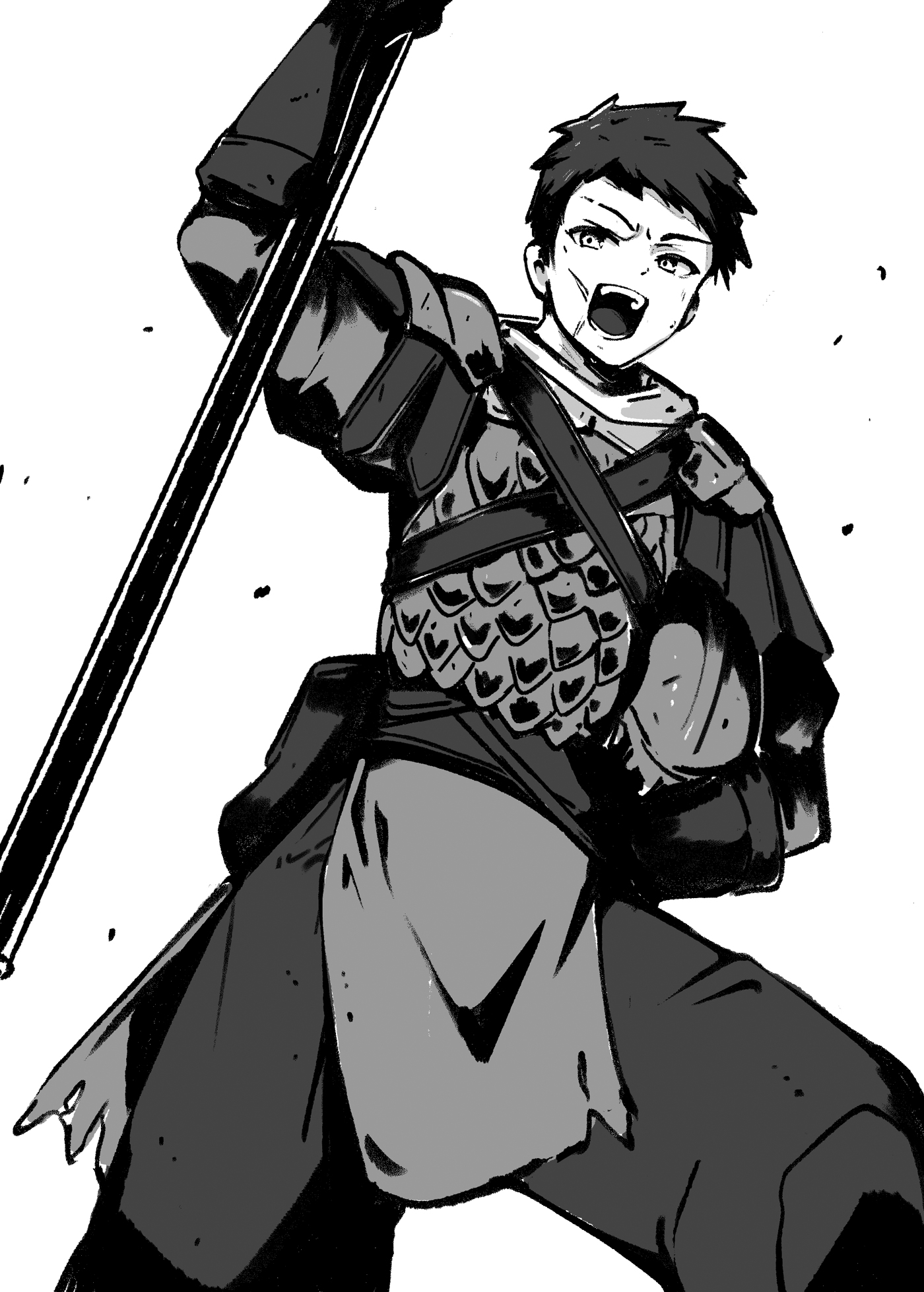
[Tips] Kaya’s illuminating flares use a light-based formula cribbed from her Flashbang spell. Although they can only be used outdoors, they can shed persistent light. Erich tasked Kaya with their creation in preparation for a nighttime assault. She had struggled more with the parachutes than the actual magical components.
“Valor is the cure for all one’s qualms.” This phrase, originating in the east, was one that the Fellows knew well, and they had vowed they would never leave Goldilocks to fight on his own.
Etan had joined the Fellowship of the Blade when he’d gone to see Goldilocks in the flesh and ended up being awed by his strength. Karsten had left his old party, unable to bear the pain of not being taken seriously, and joined the Fellowship of the Blade in search of strength. Although their reasons for joining could be described as trifling, they remained in the Fellowship because they adored Goldilocks’s personage from the bottom of their hearts.
Their boss was a peculiar sort. His feminine visage left them struggling to adore him purely as a man. Some people turned their noses up at his well-to-do pretentious behavior. Someone who didn’t really respect him might remark in passing that they wondered whether he ever stopped playing for the cheap seats.
However, his skills with the sword were top class, and he was an excellent teacher. Like the ideal father teaching his child, he understood each and every mistake they made. For those who thought highly of themselves, receiving such care most likely got under their skin. The most frustrating part of it all was probably the fact that Goldilocks was right—too keen, too thoughtful, too helpful to snap back at. If you followed his guidance diligently, you could feel your weaker past selves peel away from you week by week. Through this very process, Etan and Karsten had realized the extent of Goldilocks care for his students.
Their boss could achieve incredible feats as if they were nothing. Although this made the Fellows unsure of how to react, they respected him—both as an adventurer and as a swordsman.
Within the Fellowship, there were a number of members who didn’t actually like Goldilocks. Some of the more loyal Fellows berated them as boorish, but Goldilocks himself merely laughed and let it be. According to him, the Fellowship wasn’t a gaggle of adventurers who had come together to treat Goldilocks Erich as some kind of idol. Not only that, he saw the fire to try and confront him as a necessary quality.
It was this character that made the Fellowship function. Even though there were those who disliked Goldilocks, none of them disrespected him.
Now, Etan and Karsten were well aware of their boss’s skills, but they weren’t so obedient that they’d leave him behind while he took up the rear guard against a whole cavalry unit. These two lifelong swordsmen also didn’t realize how much of a backbone the men of Mottenheim had. Having been saved by Goldilocks, they too had their own righteous anger. It was true that Goldilocks had been hired for this job, but he had flung himself into a situation which would render those very same gold coins useless. They couldn’t sit by and do nothing.
After reaching a safe distance, they made sure the women and elderly were safe before they headed back the way they came. Goldilocks was their boss, the man they owed their lives to, and they wouldn’t let him fight on his own. They ran without thinking, but when they got back to the battlefield, the sight seemed to defy reality itself.
They saw horses without riders and bandits strewn across the ground. Most shocking of all, they saw a formation of swords without wielders attacking a row of enemy soldiers. It was an unbelievable scene, fit for a nightmare. It had no sense, no logic, but they couldn’t tear their eyes away.
The blades danced beautifully in the air as they cut down their foes. Fingers and hands careened into the air; weapons were rent apart, pinned to the ground by the unmanned swords. They moved without any sort of visible trick, but for the two Fellows, it seemed as if each had its own phantom wielder. In the empty space, they could see their boss’s face.
A huge knight in heavy armor fought through this hellish tableau to challenge Goldilocks. The men watching the sight gulped collectively as they sensed his daunting presence and wall-like aura. The lot of them shook with fear, knowing he was a foe to be reckoned with.
A knight clad in full-body metal armor was a swordfighter’s weak point. It was difficult to topple such mighty warriors, and they were extra prudent to make sure their weak points were covered. Due to his mighty size, throwing him or even using joint locks to take him down were both daunting prospects. If you made the wrong move, you could find yourself crushed under that terrible weight.
The audhumbla and the goblin wondered how they would take on someone so obviously outfitted at tremendous expense. The only thing they could think up was to try to trip him up before slashing at his joints while the opening lasted. That, or they could make use of their lighter weight and wear him out while trying to find the right time to attack. Goldilocks hadn’t done either—he was attacking the knight head-on.
And at the heart of the whole dreadful scene was that sword and the groan, darker than the Night Goddess in Her cloud-blotted, waning state at this bleak hour. Those screams that scraped at the very air originated from no human language, and yet it sounded in their heads with perfect clarity, its meaning more plain than any confession uttered with a tongue of flesh. That strange sword sang of deep, carnal ecstacy. It sapped at one’s very sanity to hear.
Under the weak moonlight, Goldilocks—seeming like the envoy of the hidden Night Goddess—and this eerie sword seemed to fit each other uncannily well.
The knight seemed to be talking to Goldilocks as he performed two-handed maneuvers—techniques that Etan and Karsten knew immediately were far beyond the realm of their skill. The techniques they had imagined they might use against him were thrown out the window. This foe could easily crush them where it hurt the most before splitting them in two. If it had been them standing in front of him, they would have found their own weapons—held up as a last-ditch defense—and armor utterly crushed.
However, none of these deadly strikes harmed Goldilocks. His swarm of swords continued to fight the other cavalrymen, forming an unbreakable bulwark while he performed a blindingly quick string of attacks that dropped the knight to the ground.
Only the two Fellows came close to glimpsing what had happened. That blade, almost too terrifying to look at, had suddenly shrunk to the size of Goldilocks’s preferred sword. His weapon could change size at will to its master’s wishes! As soon as it dawned on them, they stood frozen by a fear that went beyond the terror of the blade alone. The saliva in their mouths felt as heavy as lead as they realized there was no weapon quite so devious that had ever been left in a swordsman’s hands before.
What would they do if that blade grew or shrunk on the supposed felling blow? This was a terrifying thing to learn for someone who learned how to swing a sword as efficiently as possible in a life-or-death battle. It was like changing your play after the fact during a game of rock, paper, scissors. A sword that could increase by a hair’s width to turn a safe dodge into a mortal blow was every swordfighter’s worst nightmare.
No, it wasn’t a simple trick of changing size. The truly scary thing about this was the wicked imagination and frightful technique it took to pull off such a move right at the perfect opportunity. They wondered now whether he was even human.
There were all manner of things that walked the earth in human guise but were nothing of the sort. Alfar—those creatures who played on the border between this world and another, spirits who were under the control of the gods’ envoys. Those who watched the scene wondered if he was one of theirs. As a wind that reeked of blood blew past, he stood there with an aura that felt altogether alien.
And yet, in spite of these bone-chilling, impossible feats, the feeling that took hold of them was not fear, precisely. Nor was it relief that such a terror in the flesh was on their side. They were in the grip of a thunderous, resplendent awe—both toward the mystery of the dancing swords and that indescribable sword in his hand.
Goldilocks suddenly turned around, as if worrying about him was a rude thing to have done, and gave the onlookers a smile.
“Uh... Did you guys not hear what I said?” he said.
The group couldn’t reply. They stood up properly, and Goldilocks’s smile broadened as he swung his sword and let it rest upon his shoulder.
“S-Sorry... I just thought you were in danger!” Etan said.
“If I tell you I’ve got it handled, I do mean it, you know? Come on, believe in your leader!” Erich replied.
As he gave an awkward smile, suddenly a whistling sound cut through the air as a red pillar of light shot into the sky.
“That’s...!”
“Reinforcements for the cavalry?!”
Goldilocks clucked his tongue, realizing that backup had been placed on standby. It was a common ploy to draw out the main forces with disposable pieces and then to begin a fight with mobile forces while the enemy’s belly was exposed.
“I’m worried about Siegfried and the others in the west. Can you lot do another one or two jobs for me?”
The men nodded instantly.
“Great. And you can ride, right?”
Before long, some horses started to gather. Their reins were drawn by a seemingly invisible force. Despite their lingering fright from the battle, these horses seemed obedient enough.
“Let’s give them a heaping helping of revenge. Yeah?”
Goldilocks gave another big smile as he stroked the rugged armor-clad horses. It was only then that the men present realized they might have agreed to something they might later regret.
[Tips] Divinities made flesh appear in all manner of places. There are many legends about the children of such beings.
The situation was altogether too strange to call an ordinary battle.
While the sight of the encroaching army with their shields in a row and spears held out was no different from how it would have been on any other battlefield, something was missing. Anyone, anywhere else, would be raising furious war cries—whether to propel you to kill your enemy or simply to urge your body to live another minute more—but the undead horde advanced in silence upon the defenders of Mottenheim, who gave raucous cries to warn their allies and cover for one another. Although the skirmishers, clad in shoddy armor and chain mail, made steady progress in their march, no sound came from their lips, not even a breath. The only noise was the eerie cacophony of their scraping weapons and armor, which melded with their pounding footsteps.
The enemy’s vanguard was sparsely populated, and so the early stages of the battle appeared to be in the defending force’s favor. Their archers on the watchtowers rained arrows down on the skirmishers. It was almost a dull sight. The archers almost felt as if they were in the yard of the Snowy Silverwolf, striking at the practice dummies. However, although the job was just as easy, it had about the same efficacy as shooting at lifeless scarecrows too.
“Crap, they won’t stop coming!”
“There ain’t any point shooting their bodies! Aim for the heads!”
“There’s no way I can hit their limbs! I ain’t Big Sis!”
The zombie skirmishers kept up a steady march. Although the arrows they had taken would have felled a mortal enemy, these unfeeling horrors paid them no heed. Now that they had breached the sphere of protection granted by Kaya’s arrow ward, they had begun to fire back with their own slings and arrows while continuing the advance. Whether the arrows pierced their eyes and came out the back of their heads or took root in the hollows of their hearts, they would not stop.
The row of defenders blanched in the face of this unassailable march.
These zombies, brought back from the dead by means beyond reason, were nothing short of terrifying. This was something that the Fellows and people of Mottenheim had known beforehand, but seeing them for themselves, their mortal instincts screamed that such monsters should not exist.
Geists were, in a sense, a mere transmutation of the soul. Despite the fear that they might have evoked, it was a fact that they still existed as complete people, and so they were welcomed in by the Empire. Rhine was a welcoming and eclectic place—to a fault, some might argue—but even far afield, no one could deny that as strange as they were, geists were still ensouled people.
Zombies, on the other hand, were completely different. They were empty husks that should have been laid to rest out of respect for the dead and for the peace of mind for the bereaved, reappropriated into mere tools. For those people with souls who believed that death would be the end, they couldn’t help but feel disgust.
If there had been a geist or geists operating all this relinquished flesh with some measure of regard for the original owners, perhaps the reception would have been different, but these were shambling husks that had been set in motion by a living person’s incantations. It was too much.
“Raaah!”
While the hesitance of some of the defenders could be seen in their spears, a sudden roar cut through the air from the middle of the formation as one of the skirmishers collapsed backward. The sword that it had drawn to strike at the defenders’ shields fell away as the zombie lost its arm and tumbled to the ground.
“What’s with these pathetic spear strikes?! I told you to get your asses into gear!”
Siegfried raised his heavy spear high to rile up his allies. Zombies were sturdy monsters, so he whipped his allies into shape so that they wouldn’t lose morale as he repeated the knowledge that his partner had passed down to him about zombies: They were mass-produced soldiers that relied on their numbers, so it was best to cut away at the joints to neutralize and whittle them down.
“Get their numbers down while you can! Cut their shoulders and the tops of their legs! Aim and strike!”
“Y-Yeah!” came the reply.
“In formation and...STRIKE!”
“YEAH!”
Siegfried barked commands, and the unit struck with their spears, just as they had practiced.
They knew how hardy zombies were and had prepared accordingly. Unfortunately, they didn’t have the sort of ace in the hole which could neutralize their enemy in one fell swoop, but it was better than nothing—similar to pulling your hoodless coat over your head during a sudden downpour.
Their strategy was to team up in groups of two or three and strike at the same spot. The number of skirmishers had been whittled down thanks to the mines, and even though they came together, the narrow approach and their reduced number meant that the defenders outnumbered them at the crucial chokepoint. The terrain had given them the advantage, and so they were able to thrust two or three spears into a single zombie, pulverizing their joints and weak areas.
“Ngh... So tough...”
“When you’ve stabbed, twist and break! Destroy these bastards!”
A zombie without a weapon wasn’t all too scary anymore. Although a weakened zombie could still crawl and bite—more than enough to tear through human flesh—they didn’t have the sort of jaw strength to bite through armor or a decent set of boots. A zombie’s terror could be found in their tenacity and the strength of their terrible grip, which was more than sufficient to pull a living body apart like an expertly brined Thanksgiving turkey.
The defenders aimed to immobilize the zombies and reduce them into squirming heaps of flesh. Some of the zombies tried to mount a charge against the shield wall, but with their collective center of gravity kept low the defenders were easily able to absorb the blow and strike back.
“Stab and crush! Crush and stab! Don’t let them grab your shield—they’ll rip it off ya in a second!”
One by one the horde was diminished and the pile grew in front of the line of defenders. The defeated zombies tried to crawl out of the way to clear the path, but the defenders were relentless and crushed them until they fell still. Even the zombies recognized what was happening—the stack of corpses would serve as a wall, blocking the rest of the horde’s advance.
The sight of the skirmishers being speared and collapsing under the hail of arrows made it seem like the defenders of Mottenheim had the advantage, but Siegfried still thrummed with quiet dread. It was taking too much energy to defeat each zombie. Even if they weren’t performing particularly complicated moves, the endless cycle of stabbing and bracing for an enemy tackle was slowly but surely chipping away at their stamina.
What was more, the blood that oozed from these corpses was foul. It was far stickier and more viscous than the fresh blood of the living, and as it mingled with their putrescent bodily oils, the morass blunted his comrades’ attacks. The hefty armor that a few of these soldiers were blessed with was beginning to wear down some of the squad’s spearheads.
Spears were a disposable product in the battlefield. Some would inevitably warp or snap during the ordeal, but human blood and oils were the greatest enemies of a spear’s cutting edge.
They were only a small line of warriors, so no one had the wherewithal to drop back and gather fresh spears—not that they could, as Mottenheim’s supplies fell short in this regard.
“Holy hell, all this just for them?!” Siegfried muttered.
The first wave of zombies were disposable soldiers. Their self-destructive assault had given their allies ample time to approach in a formation of multiple rows. While the adventurers and the Watch had been fighting for their lives to dispose of the skirmishers, the back lines had gradually formed up together and begun their march.
There were three lines of eleven apiece. The sight was like something out of a nightmare; a bleak omen of imminent death. The first line of zombies had comparably decent armor, shields, and spears; those behind them bore poor armor, some only outfitted with a shield and spear. Still, they had arranged a menacing shield wall bristling with polearms—the front line had them held out to the fore, while the row behind held them higher in the gaps. It was a textbook phalanx.
“Dammit! They’re gonna be on us soon! Get those hips low and take ’em on. We ain’t got a chance in a battle of attrition!”
Despite the exhaustion that the Fellows and people of Mottenheim felt, they all fell into action at Siegfried’s command, getting their shields into place. There was no chance of escape at this stage, so it was better for them to take Siegfried’s advice to at least go out in style.
There was little chance that help would arrive. Facing an enemy that feared nothing and would fight on even deprived of their heads was nothing short of a sick joke. They would slowly be worn down to naught but stepping stones for the zombie menace.
Everyone knew as much, yet no one dared to retreat. Not a single person threw his spear aside hoping to save his own skin.
Each had their own reason. Mottenheim’s watchmen wanted to protect their home. Some had met a lovely woman during their short time here and couldn’t get her face out of their mind. Some Fellows thought that if they were to die, then at least they could earn an impressive engraving upon their gravestone. And of course, there were those who were here not out of pride as an adventurer but simply because this was what they said they would do.
Not the faintest shred of timidity remained in their hearts as the enemy’s main unit slowly approached. Their vanguard had been reduced to helpless pill bugs, curling and uncurling in the muck, unable to so much as headbutt the defenders—but the strength of their assault had never been all that important. Their push had quickly, conveniently forced the confrontation into the desired shape—their lives were ultimately meaningless. Not that an army of the undead had any reason to care.
“Bring it on!”
“Grgh!”
“RAAAH!”
A chorus of cries rang out as the clash began. Spearheads crackled as they collided with shields and armor; weapons clanged together. Where blades found their mark, blood erupted. For the zombies, this was perfect. Of course it would be ideal if they could crush their enemies in one swift blow, but in a drawn-out bout, forcing blood loss was ideal. Strong hits might break the enemy formation and cause their foes to scatter, but it didn’t matter at the end of the day. As long as they got up and close, then their reinforcements would have an easy time.
“Ngh... Don’t underestimate us!”
“Agh! I can’t see!”
“Stay standing! Even if you can’t see, keep striking—you’ll hit something!”
The zombies didn’t care about defending themselves. Even if the defending side managed to get ten whole hits in, it didn’t matter if the enemy managed to land a single direct hit or not—against mortals susceptible to pain, this pressure was more than enough to seize the advantage. A powerful blow to the stomach could bring someone to their knees. A slash at the forehead could blind a person and leave them screaming.
Living, breathing people would inevitably weaken under a tireless, merciless, ceaseless assault.
“Dammit! Push! PUSH! We have a chance if we can disrupt their rhythm and break their formation!” Siegfried roared.
“Wagh! They’re too heavy! Sorry, Bro... I can’t push ’em back!” someone replied.
“I don’t wanna hear your stupid sob stories! If you don’t wanna waste all that time you spent training with the sword, then clench those ass cheeks and push back!” Siegfried yelled.
Adventurers weren’t sturdy and handled battles of attrition poorly, so their one chance of turning the tables on the enemy was to shatter their enemy’s discipline and reduce the battle to a chaotic fray. With their honed sword skills, they were far more capable when it came to a free-for-all; if they could get some breathing space and throw the enemy into confusion, they would be able to win. If they could disarm the enemy, drive them to the ground, and protect their allies, then they could hold their own more easily.
“The potion is ready!” came a shout from behind the group. “Everyone, make sure you breathe it in!”
As the row of defenders were pushed back, a fresh fragrance tickled their nostrils. It was a concoction launched by the Merciful Sapling.
Kaya’s potions were designed to react once they made contact with oxygen, and many were designed to confer their effects on those who breathed it in. In usual cases, her recovery potions would inevitably heal the enemy too, so they were chiefly used in camp, but in this particular fight, that was a nonissue.
The herbalist’s potions worked by aiding the natural abilities of the body. To the uninitiated it might have seemed like her targets had suddenly got better, but the truth was that the majority of her potions were gentle things that merely boosted the imbiber’s healing factor. The men breathed in the potion and felt the energy flood through their bodies as their wounds began to heal and their exhaustion was swept aside. Stab wounds closed up; hematopoietic cells churned out more blood; metabolisms burned through the chemical traces of fatigue. These were all strictly privileges of the living, and so only the living rallied.
“Big Sis, you’re the best!”
“Big Sis Kaya, you rock!”
“You’re so cool! Let me sleep with you! No—please sleep with me!”
“Oy! The hell are you sayin’ while I’m here?! If you survive this thing, watch out, ’cause I’m gonna kill you myself!” Siegfried yelled.
Kaya couldn’t help but stifle a chuckle at the raucous voices of the men, even forgetting she was on the battlefield for a moment. She had been told to run once she had created the arrow-ward barrier, but she’d decided to remain with them, despite not having any armor of her own. How dare Siegfried accept the possibility of death and then force her away? She grabbed her partner’s cheeks and stole a kiss from him before berating him.
“Please don’t underestimate me.”
Kaya hadn’t chosen this life halfheartedly. It infuriated her when people looked down on her own decision to leave Illfurth, abandon her position as the only child of a respected healer’s family, and follow the path of an adventurer—of danger, peril, and death. Kaya had known these things were all very possible since before she had come to Mottenheim. She’d accepted it when she had watched her mother treat injured patients—it had long since been evident to her that an adventure was never as beautiful as the songs depicted.
There was something else that stung Kaya just thinking about it. Her role meant that her survival would prove essential in helping the canton once the fighting was over. And still she chose to be here. Just like everyone else, she didn’t want to close her eyes to the things that were to come. If the worst-case scenario were to arrive, then she was ready to incinerate everything in a sea of flame.
“PUSH!”
“STAB!”
The defending force had regained their energy and caused the enemy’s front line to waver with the force of their renewed retaliation. Thanks to their continuous bloodletting strikes, more and more enemy zombies started to collapse, having finally met their limit. They dropped their weapons as their shoulders were pulverized; their formation started to crumble as their legs were shredded away.
“Good work! Keep at it!” Siegfried called.
The adventurer had noticed the enemy formation wavering and sensed that their window of opportunity had arrived. Their steady strategy had forced the enemy to falter. In that moment, they had cut down a generous fraction of the enemy, and the rest fought to keep up their positions as they were pushed back. If they didn’t take this chance, it wouldn’t come again—unless they acted now, they would be slowly but surely whittled down to their deaths.
Siegfried gave one final push with his shortspear, leaving it stuck in the enemy, unclipped his shield, and drew his sword. Its keen gray fang manifested his urge to fight as it glinted in the light of the flares. Taking the two Fellows at his sides in tow, he crashed into the enemy line. Siegfried dodged the spear coming his way and grabbed it under his left armpit before severing the offending arm. He was like a wild beast as he sliced at the zombies surrounding him, denying the enemy a chance to attack as he pushed onward.
We can do this, Siegfried thought. It was quite the desperate situation, but no one had retreated; everyone had borne up under their fear and stayed fighting. The remaining enemy forces were starting to fall apart! If things kept going apace, then some parts of their own formation might start to outnumber the enemy. Then, they could just drive them back...
All of a sudden, the familiar sound of a bugle cut through the air and derailed his train of thought.
“What?!”
Everyone forgot about their weapons for a moment and looked up. From the edges of the forest, just out of sight of Kaya’s illuminating flares, he saw a row of ten or so mounted soldiers and five rows of ten infantry apiece following close behind!
“You gotta be kiddin’ me! They still have more?!”
The enemy had been hiding their trump card. In order to bring down Mottenheim without fail, they had sent off the smallest possible unit of disposable soldiers to exhaust their enemy so that their main force could come and strike them while they were weakened.
The defending side was a motley crew of nineteen: fifteen members of the Watch and Fellows on the vanguard and four archers split between the two watchtowers. If the enemy marched into Mottenheim with their heads on pikes, it would be a silent proclamation of their utter dominance.
“Then it’s our turn too!” Siegfried shouted. “Hey, Kaya!”
“Okay!” she replied.
Kaya drew a single tube from her pouch and pulled out the string from its end. Suddenly, a red flare shot up into the night sky—not a light to fight by this time, but a signal. It was meant to flag to Dietrich, who was positively itching for battle, that she was needed, along with the Fellowship’s own cavalry unit of ten. It would be a matter of minutes until they arrived from central Mottenheim. They weren’t too far at all.
Siegfried used his beloved heavy spear to crush the remaining zombies as he steeled his resolve to stand ready in the face of the fifty soldiers coming his way. You ain’t the only ones with surprise reinforcements on your side, he thought. He spat out the foul blood that had painted his face and held up his spear as he turned to his unit. Everyone was exhausted, bearing wounds and burning muscles. But they had to fight on. Any amount of agony was preferable to defeat.
“Get back into formation, people! Believe in our cavalry!” Siegfried commanded.
“But...there’s too many!”
“Quit it! You can complain when you’re dead!”
With the enemy at this distance, the unit had more than enough time to reorganize themselves as they waited for backup to come, but they weren’t nearly as sturdy as they were before. Could they really survive an assault of fifty?
“Gagh!”
A cry came from Siegfried’s right just as the replenished zombie army made their first strike. It was a young mensch whose eye had been pierced by a spear.
“Lembeck!” Siegfried shouted.
Lembeck was a Fellow from Marsheim. He had a sickly mother whose medication couldn’t be covered by his older brother’s loans alone, so he had decided to become an adventurer to help with the costs. Lembeck had decided he would fill the hole that his deceased father had left to help his brother and welcome his brother’s wife into the family.
“Ngh... Graaaagh...!”
Fortunately for Lembeck, the spearhead hadn’t pierced through bone. His own spear had broken during the earlier clash, so he had switched to the sword. He gave a roar to steel his resolve as he sliced through the handle.
“I ain’t DONE!”
With the spearhead still lodged in his eye, Lembeck desperately swung his sword and beat back death.
Similar cries came from elsewhere in the formation. An old-timer in the Watch had his shoulder pierced by a spear that had crashed through his shield. He forced out his daughter’s name through gritted teeth and a throat full of blood.
“I’m...going home! To my...family!”
The old-timer forced his last dregs of energy out as he stopped his foe in its path and lopped its arm clean off. Despite knowing that it would worsen the blood flow, he yanked the spear from his shoulder and roared: “Get the HELL out of my home!”
There was another who had sustained an injury. It was unlikely that the enemy had planned this, but the broken head of a spear had stabbed right into his foot.
“Urgh!”
“Gerrit!” Siegfried cried.
Gerrit was a young man who had first joined the Fellowship as a spy but now had truly committed to the group.
“This isn’t enough to stop me!” Gerrit said.
Despite the terrible pain, the young adventurer wielded his spear as if it had all been to his advantage—in a certain light, having his foot pinned down meant that he would never be forced back. He forced out a laugh. The enemy hadn’t “attacked” him insomuch as demarcated the spot from which he would never fall back.
As Siegfried analyzed the situation, he could tell that they were all doing a great job at resisting. But they were like the old and brittle teeth of a comb, ready to snap as more and more sustained injuries. If they didn’t push the enemy back soon, they would start to topple all at once. Just as this thought ran through his head, the enemy’s pressure let up—and not thanks to another recovery potion from Kaya.
“Ngh... Dammit... Dammit!”
The enemy had abandoned their front line, and the remaining soldiers had retreated, ready to return with a full-on charge. The uninjured soldiers in the back lines fell back to prepare while the remnants of the first and second lines did their best to obstruct the defenders. This was an utterly heartless battle tactic that could only be employed with lifeless soldiers. It caused the first cracks to appear in the defenders’ morale.
“Get back here, ya bastards! Crap, crap, get off of me! Urgh!”
Siegfried tried his best to try and find a way out of the chaos, but he sustained an injury from the heartless zombies that blocked his way. A zombie had dropped its spear and sliced at the gap in his helmet to cut his left eyelid. Blood blurred his vision. Even his right eye, safe but in pain, seemed hazy.
Thank heaven, then, that there was another world-shifting change in store, and that such things had a way of announcing themselves with unparalleled spectacle.
“Aaaall right! Kept ya waiting, huh?!”
Pounding hooves and an unyielding war cry! Siegfried tried to get a fix on the source of the sound, and through the blur he made out a cavalry unit, their angle suggesting that they had come the long way around from the northern bound of the canton.
“Dietrich!” he called out.
In order to increase the force of their charge, the cavalry unit was packed into two tight lines of six horses each. Dietrich led the charge and immediately went after the foot soldiers positioned a safe distance from the defending side.
“Huh? Why are they going back?” Dietrich said.
“They’re probably regrouping!” Martyn called back.
Dietrich didn’t really understand the complexities of the situation, but her instincts told her this was the perfect time to get at them. There wasn’t a more delicious sight for a mounted fighter than being able to strike at the enemy’s belly without harming your allies.
“I dunno what’s goin’ on, but let’s do this! CHAAARGE!”
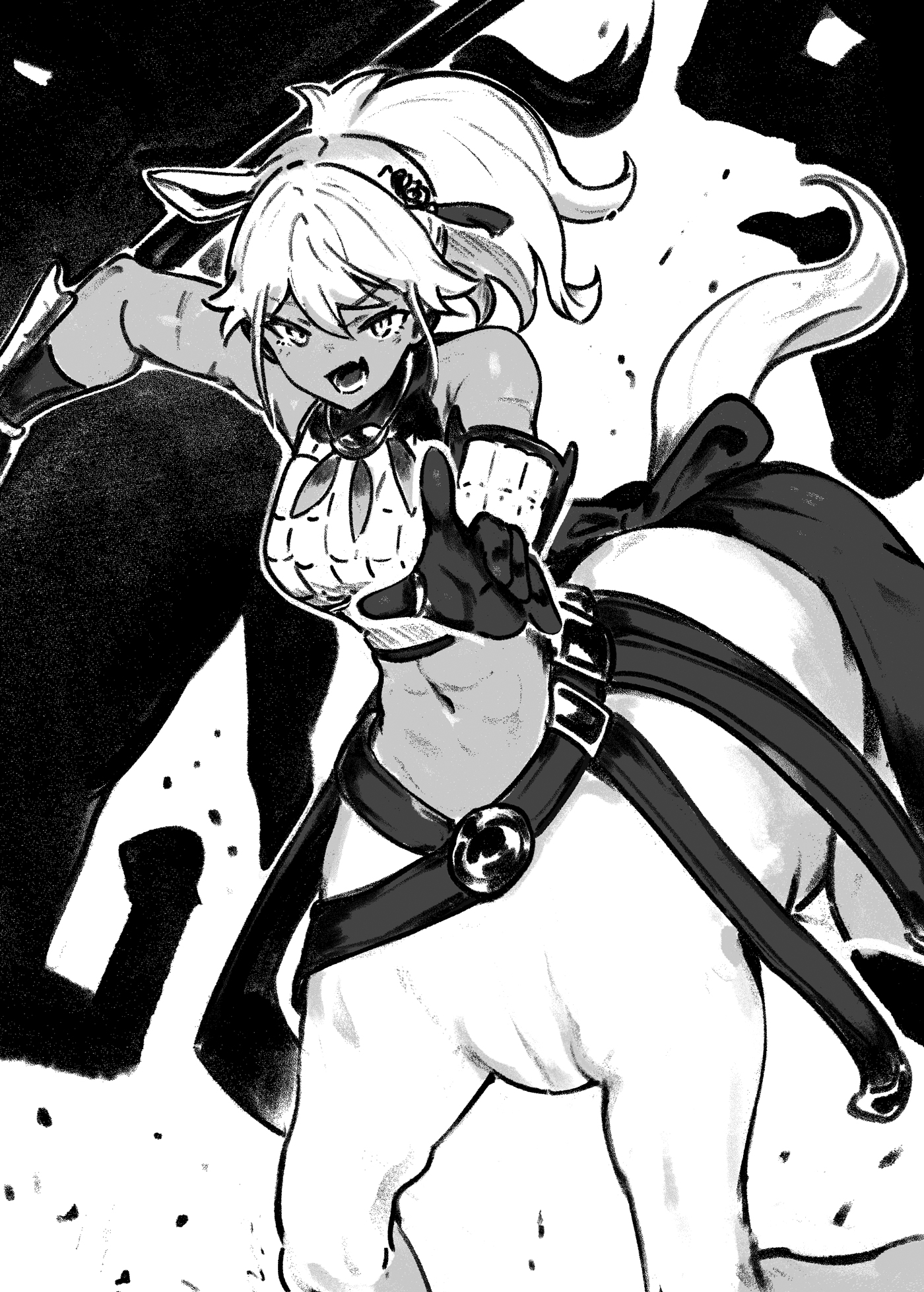
Dietrich galloped into the fray and charged right into the side of the enemy’s formation, sending six enemies flying with a swing of her halberd. Her momentum unbroken, she tore a hole through their formation and trampled her way through the other side. Through the gap, six cavalrymen followed the path she had left. Lances speared and toppled; hooves crushed armor, flesh, and bone alike.
The arrival of Dietrich and her unit was nothing short of a miracle. If they had been one minute earlier or later, they would not have managed to secure such a splendid victory.
All the same, the tides of battle had not been turned in their favor. The enemy was already on the move, clambering up the trenches as they doggedly resumed their charge. They silently reformed their formations, not even reacting as their allies were ripped apart.
“Lucky, am I, huh...? Maybe it’s finally run its course...” Siegfried muttered.
As the despondent adventurer wondered whether to resort to prayer, another bugle broke through the clamor.
[Tips] A bugle is used to relay orders or signals across distances. It has been used since ancient times as a practical, nonmagical solution to the challenges of coordinating a fighting force. In the Empire of Rhine, it is mostly used for war, the signal to charge being chief among them.
There were many times in life when you wished you’d been just five minutes earlier; however, this regret was one that would stay with me for the rest of my life. In the course of my new life, I’d accumulated many an occasion where I’d had cause to think that I’d made it in time, only for reality to prove me wrong.
After I’d sorted out the knights, I used the help of the folk who’d come to check up on me to tie them up and shove them off for safekeeping. I also successfully rounded up seven of the enemy’s horses. I’d only been able to bring fewer than half of them, as the others were too restless to be able to carry anyone a distance away, but this was more than enough, considering they were well-trained warhorses.
I convinced the available locals to loot the enemy’s armor, helmets, and lances, and pass them along to those who could ride before the citizens dashed off back to the evacuation point. I wasn’t the sort of person who’d send simple civilians into a damn war zone. Although these men were familiar with draft horses, I doubted they would be able to endure the intense gallop of a cavalry unit.
Left with my Fellows and the few members of the Watch who were more than capable riders, I formed a makeshift secondary cavalry unit. In my eyes there was no negative to being able to ride a horse, so when I’d formed the Fellowship’s own cavalry unit, I’d made sure as many Fellows were trained up to be able to survive on horseback, so this part went smoothly. My practice sessions in the event that a caravan we were protecting might need one of us to take the reins instead of the driver were paying unexpected dividends.
I’d tried to make sure we were as close to fully kitted out as we could manage before coming in to provide support, but it appeared that we were still late. There were folk on the ground, injured people. One had left so much blood at his feet, that I thought he might be dead. I didn’t bother asking why people who had chosen to fight had ended up injured. I was the one who had trained them up for this exact situation, after all. But still, but still, I couldn’t help but wish I’d arrived but five minutes earlier!
I alerted my allies to the charge—I did not want Dietrich to mistake us for the enemy—by blowing the bugle I’d stolen from the knight. The melodious howl of it echoed through the night.
I could tell that everyone, foes and allies alike, stopped for a moment as they looked over.
The situation was rough. The defenders of Mottenheim had zero intent of falling back and had resisted the enemy’s persistent assault, but they were losing energy right at the gates to the canton. Dietrich had torn apart the enemy’s formation, but they were working to reassemble. Near the trenches, the backup cavalrymen were beginning preparations to pulverize their weakened enemy once and for all.
I told myself that I had made it in time. If I’d been three minutes later than I was now, their charge would’ve already finished, and they would have scattered our defending line and taken them down. Like a well-cooked lobster, their shell would’ve been cracked right open, exposing the soft flesh underneath.
As the bugle’s note lingered, I felt my body grow hot. I supposed the horn must have had some enchantment on it, but it was trifling at this stage. Our final move had signaled a checkmate. All that was left was to clean up shop.
I drew my sword. The Craving Blade once more answered my wishes and transformed into a curved saber, an ideal shape for horseback combat. That howl that carved its mad love into my brain proclaimed its joy at the rare opportunity to draw blood on so many occasions in the space of one day.
“CHARGE!”
At my command, my six cavalrymen followed me. Mud scattered into the air with our pounding hooves as the horses careened over ground that had been twisted by my mines. When our lance charge finally connected, it was a sight to behold. The enchantments on the zombies evidently didn’t allow them to respond swiftly to a clash this immediate. They were lethargic, unsure whether to focus on the new enemy or keep up the assault as they had been. As for the enemy’s own cavalry unit, they suddenly paused, unsure whether they should continue their charge or not. They had calculated our trajectory and had realized that they had no escape route to speak of.
“Keep stabbing!” I heard Siegfried roar. “Don’t let them think! Don’t give them the luxury!”
Siegfried continued the attack with his bloodsoaked, beloved spear. The enemy couldn’t focus their attention on us; their separated formation in the back was starting to crumble too.
Uh-huh, I thought, they’re pros at controlling zombies, but when it comes to leadership, they’re amateurs, and either hastily prepared or too used to easy wins.
It was a poor move to dither over the next move at this stage in the game. They were backed up into a corner. Horseback charges had been developed as a response to tight spear-led formations, so we had the advantage now. Their ten or so soldiers with projectile weapons weren’t providing decent support, and the main forces were struggling to get back into formation—we couldn’t be stopped.
Warhorses had shorter legs than their speedier, regular counterparts, and could easily weigh over half a ton. With their armor and a heavily equipped individual in the saddle, they were even mightier. The speed and weight gave them the destructive power of a car in a head-on collision, but with pounding hooves instead of tires—it was enough to kill pretty much any regular person.
What the enemy should have done was to try and deal as much possible damage as they could by throwing everything to the wind and sticking into our foot soldiers. A chaotic scenario like that would force us to give up on the charge and dismount. Or they could also have decided that a few kills were better than none and formed a spear wall to stop us in a desperate, last-ditch attempt.
But now? They had no chance of winning. If they were unable to surrender—I doubted they thought there was any worth in it—then all that was left was to let the blood flow. They had gotten greedy and tried to change their formation, but now they were hesitating.
Unlike them, we showed no hesitation. All we had to deal with were cavalrymen who had lost their momentum and the remaining zombies who hounded our allies. A cavalry unit was a support unit; a battle without boots on the ground was one you were bound to lose. Their only options were to run away or play a losing gamble. They had wasted their little remaining time by dithering over whether they should make a huge loss into a regular loss, and now they were nothing but mincemeat beneath our hooves.
Our own side let out a raucous cheer as the enemy’s fear turned into our own morale.
The enemy’s shields were shattered; their bodies were tossed aside; their limbs succumbed to sword and lance. Our allies’ line cast aside their shields and joined the chaos, cutting down those who still had hold of their sword.
The remaining forces must have felt fear—a terror that with the zombies now dealt with, their number was up. The cavalrymen kicked their horses’ bellies and tried to make a run for it into the forest.
The foot soldiers, the bedrock of a battle, had been crushed under the mighty hammer of our cavalry charge. This sight, so foul you would turn your nose up at it, spread in no time at all. The zombies’ bodies were pulverized, no different from the mud they were crushed into, and the reek of blood filled the air. We had seized the moment and turned the battle on its head. Despite the recent invention of cannons and smoothbores, we evidenced how terrifying a well-trained cavalry unit could be.
Victory was ours. The enemy’s soul had been crushed.
All the same, I felt regret. If only I’d been but five minutes earlier—the thought stuck in my brain.
Although the results of our charge had been great, we hadn’t come out unscathed. Right in the eleventh hour, the enemy’s back line had steeled their resolve and started to repel our attacks, felling two horses in the process. One bucked out of surprise and tossed back its rider, but the other was on the ground, its remaining time short. Although no one died, two men had fallen from their saddles from the counterattacks during our repeated charges. One was groaning, simply unconscious, and the other was— Wait, Martyn?!
“Martyn! What happened?!” I said.
He coughed. “H-Hey, Boss... I’m sorry to...embarrass you. I...screwed up...”
Martyn must have fallen badly; his left forearm was twisted at a strange angle. The bleeding suggested an internal fracture.
“I know how talented you are! How did this happen?!” I asked.
“I’m sorry... I saw an ally...about to be speared through...” he replied.
Crap, crap... He’d pushed himself to save one of his own and had been tossed aside! Martyn’s senses on the battlefield were sharper than most; I’d wondered how someone like him would have gotten injured like this...
“Enough talking. It seems like your ribs have punctured your lungs,” I said. “Someone take him to Kaya!”
The Fellowship’s most talented swordsman was out of commission, and everyone who had held the line was terribly injured. Considering the scale of the enemy assault, this was a magnificent victory worthy of toasting to, but we weren’t soldiers—just a small unit of adventurers. The sight was painful to look at.
It was nigh-on a miracle that no one had died, but our forces were pretty much decimated. This damage had been due to my own lack of foresight. I had been able to make up for it in the thick of things, but it wasn’t nearly enough to hold my head up high. Enough of that, I thought; this wasn’t the time to moan about my own shortcomings.
“This isn’t over! There’s more to come!”
As my allies held up their weapons and cheered for their victory, I called out over them and raised the Craving Blade to gather their attention.
“We need to take them on!” I went on. “We have one horse spare for anyone who can ride! I need whoever is capable to follow me!”
“A-Another assault? What do you mean, Boss...?” Etan said.
He had followed me in the cavalry charge—I’d given him the mightiest horse belonging to the knight I’d dueled, so he’d just about managed—but I pointed my sword to the forest cloaked in night as I carried on.
“The necromancer is nearby! Our charge confused them and caused the enemy formation to falter. In other words, these zombies were being controlled by a person, not some fire-and-forget spell! We need to flush them out now! Anyone who can ride, follow me! If you don’t feel confident about riding through the forest at night, then cede your place to someone who can.”
I understood how it felt to have someone rain on your parade after you were celebrating a victory snatched from the jaws of death. I thought that this final charge would have marked the end of it all. Dammit, GM, how could you stick us with another climax after all this? Give us a break! If this’d only been a tabletop battle, I’d have slipped a d4 into the GM’s shoe before they left.
“Gimme the reins!” came a shout and a clang.
It was Siegfried who had roughly pulled off his helmet and tossed it aside. His face was still caked in blood, but he didn’t bother to do anything about it and instead grabbed at the reins of an unmanned horse. My comrade must have really pushed himself in that assault, for his limbs—left bare, since he’d gone without armor—were covered in wounds. He looked like he was one hit away from defeat.
“Siegfried, you’re far too inj—”
“Shut up! I don’t wanna hear it! I ain’t gonna step down after all this! The bastards gave me another damn facial scar!”
With reins in hand, Siegfried pulled out a potion from his pouch and doused his head in it, before pulling out another and downing it. Both were Kaya’s own creations, but her potions only activated the body’s own natural restorative capabilities. If he chugged so many in such a short amount of time, he’d be hit with some painful side effects later—lethargy, hunger, insomnia, physical pain akin to growing pains. Kaya had warned us not to take more than two per day, but here he was using two at once.
With this, I couldn’t really talk him down. How would a man react after having his resolve spat on? I was a man too—I knew exactly how. The only paths left would be an irreparable parting or a duel to the death.
“You’re so stubborn... Fine! Come!” I said.
“You don’t need to tell me! Save the explanation for later, so lead the way and let me kill the bastard myself!”
Siegfried was blatantly furious, and I worried whether it was the right decision to bring him along. The others around him were positively calm in comparison. In a way, I felt a bit more uneasy about leaving him here to mop up.
“Kaya, I’m sorry, but can I leave this to you?” I said.
“Of course, Leader. I’ll take care of everyone as best I can,” Kaya replied.
She was a far more approachable person than me, so I was sure she’d do a good job. But, man, she was really serious about this. In her waist pouch of potions, I noticed a bottle marked with red paint. This potion, marked with a hazard symbol, was some of the leftover napalm catalyst from after we ran out of boxes for the mines. It looked like she had packed it with her stock in the event that escape was impossible, so that she could cremate everyone around her. If this was powered up by her own magic, the explosion would encompass a blast zone dozens of meters wide.
I breathed another sigh of relief for having made it in time. With it, I felt the churn of my anger at myself rising. Siegfried, I thought, you might be ticked off, but I’m well past my limit too.
“Toss aside your spears; they’ll do nothing for you in the forest!” I said. “Drink some water, because we’ll be going full pelt until we find the bastard! Anyone with free hands, get some water for these horses—I don’t care if you use your helmet!”
As we prepared for our pursuit, I decided to pull out another trump card.
“Ursula, Lottie,” I whispered.
I felt my pouch shake. I opened it up and saw the rose I always kept with me open up to reveal Ursula, whose silver hair was shinier than usual. She leaned on the opened petals and gave a smile that indicated she’d been waiting to be called. The gentle breeze that licked my neck wasn’t the night air. Lottie couldn’t bury herself in my hair while I had my helmet on, so instead she allowed her breeze to stroke my body.
The moon was waning—a dark form, close to a new moon. It was as if the False Moon had its mouth open, waiting eagerly until it became full.
In other words, the perfect time for alfar magic.
“You called for us, Beloved One?” Ursula said.
“Hmm... It smells of stinky iron... It’s not fluffy soft at all!” Lottie said.
Whereas Ursula seemed perfectly happy, Lottie was disappointed that she couldn’t touch my hair. They were complete opposites, but they both readily accepted my call for their help.
I got Lottie to test the perimeter for signs of life. Only my comrades and I were nearby, but deep in the forest she had picked up a squirming group of a few people.
“It’s gross and ew! They’re people-shaped, but they stink of medicine!”
Thanks, Lottie. That settles it.
I had been worried about a few possible scenarios. With the perfect timing of the enemy’s assault, I’d been concerned that there was a mole in the canton or that the necromancer had been lurking among us. There were a few suspicious people I’d marked, but I’d leave that for now. To be honest, paranoia of this kind had been fostered in me thanks to countless traumatic events from TRPG campaigns long since past.
Even I would be able to detect someone with enough magical ability to control this many zombies at once, or even their minion. I had undergone so much antimagic combat training with Lady Agrippina that it had made me sick. If there were any suspicious mana waves, I would’ve picked up on them. I’d been making plans to be doubly, triply sure in the case that we were dealing with a real pro who could hide from me, so I was glad that my anxiety had been for naught.
I pushed aside my desire to breathe a sigh of relief. I asked Ursula for her blessing and received a kiss on my eyelids. Just like in that ogre-haunted manor, the darkness lifted. My eyes were so keen that I could see the sweat from the hardworking horses and even the features on my exhausted allies’ faces. It had gifted me sight far superior to any night vision sorcery could have conferred on me.
This would allow me to dash into the forest without fear, even without Kaya’s flares to guide me. My allies could follow my back, so we would be fine. This little meeting under the moon had swept away my lingering worries.
All that was left was to hunt and kill. Our bloodlust was more than enough. We had barrels’ worth of hatred—enough to buy out the whole Empire.
“Boss...”
While the horses cooled off and fueled up, I went to see to the injured.
“You did a great job,” I said.
I went around the group, shaking people’s hands and talking to them, but some didn’t even have the strength to grip back.
In particular, Martyn’s breathing was shallow, and his face was as white as a sheet. Martyn had said that he wanted to return home with riches so that he could buy land for the girl he promised to marry and take her as his wife. His dream was to have land for his whole family. Some of the Fellows laughed at him, saying his goal was short on grandeur, but he furiously argued back that there was no manlier dream.
“Don’t you dare die over something as ridiculous as this, Martyn,” I said. “I’m gonna make sure we get paid our dues, okay?”
“Okay, Boss,” Martyn said before he was too consumed with coughing to speak.
I looked over to Kaya; she clenched her fists tight—her face told me she would do everything she could to save him. There was nothing else to worry about.
We had our job to finish. It was time to say thank you to the assholes who did this to my subordinates and my comrade.
[Tips] A cavalry charge can create an advantage for a few minutes. Victory can be decided by whether this opening is well utilized or not.
Middle Act
Middle Act
Middle Act
In the event that a scenario becomes overly long or the GM goes overboard and sends out so many enemies that the PCs have run out of resources, it is common to put a pause on the scenario and readjust things.
Our rough-and-ready line of horses dashed through the trees.
We had been pretty lucky. The forest saw frequent use from the people of Mottenheim, so not only was there ample space between the trees (to encourage healthy growth), but the ground was also relatively flat. We weren’t cavalrymen by trade, but we cut a pretty decent figure.
The line of five cavalrymen followed me a short distance behind, each of them using the torch in their hand or lantern at their waist to light the way ahead. I imagined that my companions were raising their collective eyebrow as I dashed on without any obvious light source. Before we left, I’d told everyone that I’d explain everything once this had been sorted, so I imagined they were holding their tongues. I’d really been blessed by my connections. If this was a poorly written Western movie, I’d have had some idiot force me to explain everything and waste precious time in the process.
“Lottie, where are they?” I asked.
“Umm... Over there! They’re a bit squirmy,” she replied.
I’d removed my helmet to increase my peripheral vision, and now Lottie was happily embedding herself in my hair. I checked the direction she indicated as I made my way toward it. I wondered if our enemy was beginning preparations for the end. Unfortunately, we had business with them, so they couldn’t close up shop quite yet.
Luckily, the forest was free of any zombies, so our way was clear and unbothered. The enemy had chosen the traditional route of throwing everything they had at bringing a swift end to the battle without leaving any backup on reserve, and that was doing us a great favor right now. It was a potent, efficient approach—so long as you won. Recovering from failure was a hell of a lot harder if you went all in on your offense. It was possible to resort to some smoke and mirrors tricks with your remaining numbers if you had a big army, but that wouldn’t work for a smaller force of just over a hundred. They may have had a little retinue with the leader, but not enough to beat us.
“We’re being watched,” Ursula whispered into my ear.
I was honestly a bit surprised. Did they really have some units placed to slow us down at this late stage?
“It seems like they’re using beasts,” she went on.
“Aha, so that’s their game. Dammit,” I replied.
A necromancer’s familiar, huh. In order to make a living familiar, you needed an animal that had been carefully bred and attuned to your magic, but it was far easier to simply shove these functions into a corpse. If you weren’t interested in endowing it with any resistance to other people’s spells, you could quickly and easily mill out a whole bunch of capable units. If you ignored just how dishonorable necromancy was, it was infuriatingly useful.
“Well, I’ve blinded them already,” Ursula said, chuckling.
“Thank you.”
Naturally, I found my alfish companion a bit terrifying. Without me even asking, she’d leveraged powers mighty enough to tamper with the necromancers’ puppets. Some birds that I’d noticed had been moving rather strangely dropped from the air. They must have lost their senses and fallen. I really appreciated her cooperation and hard work, in spite of how the thought of what she could do with it all made it hard to sleep at night sometimes.
“I can see them! Get ready to engage!” I called out.
As I followed Lottie’s directions, I glimpsed the backs of people between the trees. Their cloaks masked their shapes, but two-footed silhouettes always stood out in the forest.
“Don’t bother running them down—they may yet put something in your path! Disembark just before we make contact and get them on foot!”
I used Voice Transfer to deliver the message to the others, but I could sense a few people expressing some discomfort, evidently unused to how it felt. I’d used it so that my commands wouldn’t get lost under the pounding of our steeds’ hooves, but I supposed it was a bit of a shock—I was glad no one had fallen out of their saddle. I remembered I found Lady Agrippina’s Thought Transfer spells pretty damn uncomfortable to receive.
The enemy amounted to a mass in the darkness, black on black, but it looked like there were around ten of them. They looked like they were just about human, but you never knew.
I lifted up my hips and activated my Unseen Hands. I’d used up a fair bit of mana when fighting off that cavalry unit, but I still had fuel in the tank. Siegfried and the others slowed their pace—I could imagine Dietrich, positioned further behind, speeding ahead before too long—while I sped up, closing with the enemy.
They had two choices: to flee or to fight. But the group did both, with the latter half of the group turning around and mechanically swinging their swords. Just as I’d expected since I first noticed they had bodies to spare—they were abandoning their soldiers, letting them act as a roadblock.
If they knew that we were more mobile than them, their options were to give up on fleeing and launch a full-on retaliation or to buy time for the most strategically valuable assets to get away. They could have been a bigger pain for us by choosing somewhere defensible to hole up. That or they should have simply fled after noticing that victory was no longer possible. Unlike an army of real people, no one would have noticed if the zombie army had lost their leader.
However, the enemy had committed to a half-baked strategy. I lifted myself up out of my saddle and sprung at the enemy. From an outsider’s perspective, it looked like straight-up wire-fu, but I was actually using my Unseen Hands to hoist my body. Having grown up in Japan, I’d had the philosophy of “waste not, want not” drilled into me—and taking all that time to dismount seemed like a waste of both precious seconds and my horse’s own momentum.
With my magically assisted leap, I struck with the Craving Blade in a huge arc, one that would only leave me open to attack in normal circumstances. My target was the rear of the enemy’s unit. They reacted too slowly to get anything done. My sword felt a surge of pleasure at my killing strike, its earsplitting scream echoing through the trees.
Yeah, that was right. Unlike earlier, I was in this to kill. My opponent was a necromancer—who knew what nasty tricks they had up their sleeve? This wasn’t the time to neutralize them with a few lost fingers. I’d always tried to make sure my enemies could at least speak, but that wouldn’t fly with a mage. I didn’t want them to use their final breath to cause more damage than they had until that point. Sorry, I thought, but it’s time to die.
I reprimanded myself for trying to be polite about my intentions. I was furious and would no longer let the folk who’d tormented Mottenheim and hurt my friends live. That was why they had to die; why I had to kill them. They’d come to kill us, after all; turnabout was fair play.
“Eins!”
I performed a heavy vertical slash as I landed, slicing the zombie at the back in two.
“Zwei!”
I rode my acceleration into a dash and sliced through the gap between the enemy’s abdomen and waist.
“Drei!”
The third zombie finally had the time to react, and made a poor attempt at a horizontal slash. I ducked underneath it and severed its legs.
Now that I was this close, Ursula’s blessing allowed me to see the whole scene, even in the dark. They had left two more in our way. In the middle of the group was the mage. A single glance told me they were different from the rest. The fact that they had a staff and cloak meant that it was unlikely they were a fake.
“HRAAAH!”
I made use of the minute gap I had to work with as the necromancer left more units to get in our way and threw the Craving Blade right at the mage. I was sick of this game of tag. I didn’t want to find out they had a horse waiting at the end of it. Unfortunately I was too far to plant the sword pointy end first with any certainty, but I could probably break a bone or two, and that would be good enough for...
“Enough!” came a shout.
“Whuh?!”
Suddenly a clang rang out as my sword, thrown with all my frustrations, was repelled.
That one spoke?!
One of the hooded figures among the zombies had moved with an astounding speed, completely unlike the others, to protect the mage! Was this one not a zombie, then? Wait, were there two mages? Or, no, was this a specially made super zombie?
“Coming throoough!”
Just as I was sorting out my thoughts, Dietrich had charged in from the side, leaving our allies who had gotten off their horses to smash through the enemy. She then turned to the two remaining enemies and barreled at them, as if they were mere twigs waiting to be crushed in her path.
“No you don’t!” the figure said.
“Whoa!”
There was a rumble—no, more like an explosion. The zombie that had batted away my sword to protect the mage a second ago had brought its arms up to the fore and somehow managed to stop Dietrich’s halberd!
“Yeow, that’s hard! What the hell?!”
Dietrich had approached at full tilt, bringing to bear a brutal mass of metal no ordinary mensch could lift, let alone swing, yet she wasn’t moving an inch! Do your job, physics! I thought. She had hit that enemy with all the force of a truck, dammit!
As I watched this impossible scene, I saw that the zombie she was locked in combat with had rooted itself in place with spiky appendages that burst from its shins! All the same, this was weird. Even with all the advantages it was bringing to bear, Dietrich’s power should’ve been enough to send the top half of its body flying away.
“Siegfried, we got an anomaly!” I said.
“You talkin’ about yourself?!” he called back.
“Oh, shut up!”
I decided to take on our bewilderingly hardy outlier so that Siegfried could head onward. Just as I slashed at it, the leg braces retracted, and it used its right arm to stop my sword strike. From the hit, I’d gathered I’d struck a hard target. I had put in about half of my forearm strength into this strike, which should’ve resulted in a nice, clean hit, but my sword was stuck in place.
Oh, you’ve gotta be kidding me! My cutting edge was perfectly aligned, I put a ton of muscle into the attack, and this is the Craving Blade we’re talking about! How the hell is it not cutting flesh?! What are this thing’s bones made of?!
I tried to force the cut, but the enemy’s flesh seemed to clutch at my sword, so I pulled back, not willing to lose my grip. Even still, it didn’t feel like I’d actually cut the bastard. It was true I hadn’t put a full combo into the attack, but I liked my fixed rates! There was something wrong here!
“Whoa!”
I tried to buy myself some space when, suddenly, another arm tried to grab me from under the cloak. I hurried backward and narrowly avoided its clutch. This was no vierman—the arm was plainly unnatural, patched together from many sources, with entirely too many joints. It had been folded away under the cloak, ready to grab me. Not only that, the creature before me had a rather thin frame, but this extra arm was huge and powerful—I imagined much of it had been stolen from someone a fair sight bigger than any mensch. That hand could crush my head like an overripe fruit.
Finally, it had made its debut: a modified zombie.
I wasn’t completely unfamiliar with these creatures. For a time in my old life I’d been fascinated by a game world I shan’t name in mixed company whose singular aesthetic sensibilities had beckoned me not just to dally with such horrors, but to build my own from scratch. But here, now, necromancy was ethically taboo and a tremendously tasteless discipline in the eyes of the College. Had no one told this person that patching together body parts to make a monster was both vile to even contemplate and hideous to look at?!
“Dammit, this is gonna be tough...”
This zombie had been forged into something terrifying to behold and could tank my hits frighteningly well—it must have been a specially made bodyguard. I could leave the necromancer to Siegfried, but in order for him to complete the job, I needed to make sure this thing was kept occupied.
I kept my distance as a cold sweat broke out. I reaffirmed my relief that I’d never taken up necromancy. It was strong, yes, but my gods, was it far from heroic.
[Tips] Talented necromancers can stitch body parts together to create powerful zombies and use them as useful emergency tools. It is a lot of effort to create and maintain these zombies, but their power is the real deal.
“Wait, you bastard!” Siegfried roared as he struck with his spear.
The zombie that blocked his path went tumbling out of the way. With triple the thickness of a usual spear and a heavy core, Siegfried’s weapon struck with a destructive power that could crush a helmeted foe. He could shatter the spines of even zombies, known for their sturdiness, leaving them neutralized in an instant.
“One more!” Dietrich shouted.
“Eek!” the necromancer squeaked.
The zentaur had gotten used to dealing with these zombies. She had realized that all she needed to do was use her halberd like a tenderizer. She quickly mopped up the remaining zombie bodyguards, slowly stripping away the necromancer’s defenses.
“Get up! Get up, get up, get up!” the mage roared.
However, they were a fraction too late.
The necromancer had reached a marker near the roots of one of the trees. She lunged to the ground and placed her hands on the ground before expelling some mana. In response to the spell, three coffins burst from the soil.
“Three as one, one as three... Three for one, one for three!”
The necromancer’s incantation echoed through the forest, and the coffins opened to reveal three pale figures. Their fighting clothes were old-fashioned; they had sabers in their hands (valued for their beauty but not their efficacy in the Empire), and strange tubelike things at their waists. They had white hair and smartly manicured beards, and their outfits indicated that this was the necromancer’s ace in the hole at this stage. They hadn’t been sent into battle earlier because the mage had thought them unnecessary.
However, these zombies, despite being powerful, were inefficient. While the necromancer had been able to control the zombie army with a few tricks, these zombies required direct mana input to be activated. That was why she’d had to hide them here.
“They’re just regular ol’ zombies!” Dietrich laughed.
She swung her halberd at one, but it moved with the grace of a ballet dancer to evade the strike.
“Huh?!”
Then it used its glinting saber to strike at Dietrich’s legs—a zentaur’s pride, their greatest source of strength, and also their biggest weakness. Dietrich lurched backward and only barely evaded the blow. If she had been any slower, she would have lost her legs at the knee. The attack wasn’t over. With the same effortless grace, the zombie readied the strange tubelike weapon in its left hand and pulled the trigger.
“Ngh!”
The rumble shook the forest and the sleeping birds scattered from their perches.
Gunpowder had been imported into Rhine from the east, and here and there individuals had managed the feat of scaling down the conventional cannon to something that could be carried in hand. Given that most folk felt magic was a far simpler solution to the problem of wanting someone dead without having to walk all the way up to them, firearms were not a well-known technology. This specimen was more powerful than an off-the-cuff combat spell, and could be deadly if used well in a close-quarters battle. To top it off, this wasn’t your average weapon—it had been boosted with incendiary magic.
“Dietrich!” Siegfried called.
The zentaur’s upper body balked at the shock of the lead bullet. Yet she did not collapse. She coughed up blood and recovered, moving out of sword range.
“Ugh! Took the breath outta me!” she moaned.
“You okay?” Siegfried said.
“Of course I’m not! Just how many ribs do you think I just broke?!”
From the volume she was speaking at, Dietrich didn’t seem like she’d broken any ribs, but she had grown up in nearly barbaric circumstances—she was used to a few broken bones.
“How are you alive?!” the necromancer wailed.
The mage herself was shocked to see Dietrich had got off so lightly. Her surprise was understandable. The power of such a musket could handily dismember nearly any mortal foe—barring the occasional ogre or one of her custom zombies that had been built specifically to endure spectacular punishment. The bullet should have bored a gaping hole in Dietrich’s stomach.
“Don’t you dare look down on the Hildebrand tribe’s runic blessing! I ain’t the sort of cavalry you can fell with a jumped-up sling stone!”
Dietrich’s scale armor, a mesh of small pieces of metal, was flexible. This made it weak against blunt force blows, and so the style had fallen out of favor in Rhine. However, each piece of Dietrich’s armor had been enchanted by the shamans of the Hildebrand tribe. As cavalry units were susceptible to sudden impacts, this armor had been laden with careful arrow-wards; projectile attacks lost much of their stopping power against her. Even a close-range missile like this was merely painful, rather than almost instantly lethal.
“H-Holy crap!”
Siegfried knew as much going in, and so he didn’t dare underestimate this weapon. He felt its lethargic aim on him and rolled quickly to the side. This wasn’t an unplanned evasive maneuver—with a short first step, a large second step, and a short third step, his unreadable movements confused the zombies.
“That almost took off my damn ear!”
The shot had gone off at extremely close range. It had made a terrible sound the likes of which he had never heard as it whistled past his ear, sending a shiver down the hero-hopeful’s spine. One hit and that would be it. This knowledge set alarm bells ringing in his head.
“Dammit!”
Siegfried had worked out that the weapon was similar to a crossbow in that it couldn’t be fired in rapid succession. He swung his heavy spear, certain that it would be enough to crush the enemy’s saber, building momentum to magnify its destructive power. After two warm-up swings, he delivered a mighty blow.
But the enemy hadn’t parried or evaded him—they had easily intercepted it.
“You’re kiddin’ me!”
Siegfried felt such an impact that it felt like his spear had warped, but the zombie stood there firm. Although its knees buckled to absorb the blow, its saber remained immaculate, and its arms held fast. This zombie had undergone physical reinforcements that no living person could endure; its sword had been specially forged using magical means. After receiving the hit, the zombie didn’t toss aside its firearm; it merely holstered at its waist.
“Ohh, crap...”
Although it may have looked like the zombie was merely putting away a weapon that had run out of bullets, Siegfried could sense something bad happening. He quickly tossed aside his spear and put everything he had into forcing his body to the left. It was an instinctive dodge, but it had been enough to get Siegfried out of the way of the zombie’s next shot. The weapon was anything but abandoned; rather, the holster had been gimmicked up to reload an empty fusil in the same motion that stowed it.
The leather pouch was a lot bigger than the firearm itself. By pushing the firearm into the pouch with some force, you could activate the ramrod at the base of the holster, which would push the bullet prepared there into the weapon. Manual reloading could take half a minute to complete, yet this could be done with incredible speed.
Even after the roaring bullet churned through the space where Siegfried had been, he was still on high alert. He didn’t stand up immediately and instead chose to roll and get some more distance. This decision had saved him. Right where his shoulder had been a second ago, an explosion bloomed. As a spray of soil caked him, Siegfried belatedly noticed that another zombie behind the one he’d engaged was also drawing a bead on him. Enough similar strategies in the past had honed his senses to alert him to the danger.
“Bro!”
“Throw ’em!”
Siegfried used the momentum from his roll to get to his feet as Etan and the others belatedly joined him. Erich had sent them along on the grounds that he didn’t want them caught up in his battle with his own monster. Siegfried had realized the weapon could kill in one hit, but decided that he would keep the heat on and not allow the enemy time to reload. The group responded to Siegfried’s command and launched their weapons.
The Fellows weren’t so poorly trained that they would ignore their second-in-command’s orders. They had learned that it was best to act first and think later. Their spears flew only an instant later. They instinctively knew where to hit when given a command like this: the enemy’s brittle back line. It would be a huge boon if they could deal damage to the mage.
“Ack!” the mage squeaked.
But that wasn’t all. By attacking the back line, they could force the front line to move to the necromancer’s defense. This way, they could simultaneously direct and waste the enemy’s movements.
“Bro!”
“Good work!”
Etan kicked the spear Siegfried had tossed aside back to him. The second-in-command followed its position with his peripheral vision and caught it in his hand without even looking. As soon as he had it, he rode its inertia into a spinning maneuver.
“RAAAH!”
Using the advantage that the enemy’s delayed movements had given him, Siegfried spun his spear above him before turning it into a sweep at the nearest zombie’s legs. The zombie’s own internal programming had already flagged the motion as an imminent threat. The calculations told it that it couldn’t jump back or to the side, and closing the gap would result in being crushed. Therefore, the only direction left to escape was up. These mechanical decisions weren’t wrong. Indeed, they would have been more than sufficient against a more amateur wielder of the spear.
However, Siegfried’s spear suddenly changed direction as it reached the zombie’s legs. The original trajectory had been a falling strike, so Siegfried hooked his left arm under the spear to forcibly alter its course. With the spearhead hooking upward now, the zombie had nowhere to run. It was about to be smashed to bits.
“Are they acrobats?!”
But the zombie managed to mitigate the damage. It had realized that it was going to get hit, and so it had used the third zombie—positioned behind it—as a springboard, leaping clear of the strike.
Despite the attempted damage control, Siegfried’s spearhead still made contact and smashed through the zombie’s groin. Maybe due to the poor angle or the loss of speed from the sudden shift in direction, the spear didn’t make it all the way through the leg, stopping in the zombie’s stomach. Although the attack had done a lot of damage, these custom zombies were too sturdy to be put out of commission by damage like this. The zombie had realized that the injury would render it unable to fight properly, and so it grabbed the spear, fixing it in place. By giving itself up to the attack, it aimed to steal Siegfried’s weapon and deny him the advantage he’d seized.
As for Siegfried, he froze in place for a moment as he watched its heartless battlefield logic resolve. His spear groaned and threatened to strike him if he let go, rendering him unable to drop it and fall back.
But Siegfried wasn’t alone. The Fellows could work as a team too.
“Hraaagh!” came a roar.
Siegfried heard flesh splitting and pulping.
As the second zombie leaped at Siegfried, ready to cut him to ribbons with its saber, a halberd whistled through the air. It was Dietrich—she had roared as she sent her weapon flying. She had still been grappling with the first zombie, but instead of attacking its unprotected lower body as it reloaded, she decided that it would be easier to take the blow and dispatch the enemy stuck in the arc of its jump instead.
The heavy halberd smashed into its mark. Even the toughest zombie couldn’t have imagined this strategy, let alone prepared for it, and so with its limbs left splayed at strange angles, it crashed into the brush. It was quite impressive that it was still just about in one piece.
“No! Fere! Picardy!”
The necromancer’s movements froze for a moment at the sight of her precious creations rendered helpless and immobile. She had put her faith in them. In her heart, her self-preservation instincts fought with her compulsion to watch.
“Surround ’em!” Etan roared.
There were few tales of a single swordsman felling a group by their strength alone.
The third zombie was currently in a deadlock with Siegfried as it tried to steal his weapon. The second zombie had been turned into mincemeat in the air by Dietrich, who had resolved to take another hit. That left the Fellows with only one logical choice: to draw their weapons and charge.
Etan led the attack, using his mighty strength to grapple with the zombie’s saber. While he blocked the attack, the other Fellows scattered and wildly attacked where they could. They left the zombies no time to draw their firearms, and slowly but surely the necromancer’s defenses were whittled down.
“Not you too, d’Herblay! This can’t be happening! How?!” the necromancer wailed.
At this stage, she finally decided that it was time to run. This decision was slow, but that wasn’t necessarily her fault. She was these zombies’ leader and their maker, not a fighter herself. She didn’t have the battle experience to make quick decisions on the fly.
“No you don’t!” Siegfried said. He kept a hold of his spear and drew a dagger with his right hand.
The dagger in his hand was a special throwing tool designed by Kaya to be used against the undead. It had a red string tied to the handle—a special marker reserved for her most dangerous creations. It was a specially made piece; Kaya had told him to twist the pommel a half turn before using it, and now his hands obeyed. He judged the distance with his fingers. She hadn’t gotten too far, but it would take some skill to get it to hit her. It wasn’t a distance he’d had much luck with during training, but he launched the dagger, hoping it would hit.
As it spun through the air, it was clear that his lack of training with throwing had led him to put too much force into the throw. There was one half rotation too many—the blade end wouldn’t connect. However, it was important not to forget Siegfried’s epithet. He was Lucky and Hapless.
“Ah!”
The necromancer was unused to this forest. Her foot snagged on a root and she froze on the spot. If she had managed to get one more pace farther, then the blade would have bounced off her as the handle hit her. However, her slipup had positioned her perfectly for the blade to find its mark.
“Ow...!”
The dagger embedded itself just below her left shoulder blade. Unused to pain, the burning sensation of the hit rushed through her, forcing her to her knees. What happened next, even Siegfried—who had gotten rid of his spear in an opening and drawn his sword—hadn’t foreseen.
“Huh? What’s this sound? What’s going on?!”
The dagger was hissing strangely. Sparks shot from the pommel. The necromancer wasted precious moments in her befuddlement—if she had grabbed the dagger and tossed it away, maybe she could have escaped her fate.
“Waaah... Aaaah!”
Maybe she could have avoided the mad dance she leaped into as a ball of flame began to swallow her.
“What’s goin’ on?”
“Eep...!”
“S-Someone’s burnin’ up!”
The Fellows were busy hacking away at the first zombie, but they couldn’t stop themselves from stopping and looking over at the ghastly sight. A flame that rivaled the sun erupted from the necromancer. No matter how much she tried, the flames wouldn’t subside. No amount of panicked flapping could arrest the steady burn of a thermite payload.
“D-Dammit, Kaya... You gave me something scary...” Siegfried muttered.
The hero-hopeful watched the scene, his stomach dropping at the sight that he had caused, as he understood the meaning behind what his childhood friend had earnestly told him: “Don’t be near it when you use it! Once you twist the pommel, throw it as far as you can! Promise me that! Please, promise me!”
Siegfried understood that this was an improved, throwable version of the weapon that had brought an end to their winter-long battle in the cursed cedar ichor maze.
It was an effective weapon, for sure, but it didn’t seem like the sort of thing that people should use. The hero-hopeful felt a shiver run down his spine at the fact that Kaya had given him this weapon with the intent that he would use it.
The necromancer’s cries were engulfed by the roaring nano-thermite until she eventually collapsed, never to move again. The flames that lit up the night offered no mercy, merely content to gnaw away until they were finally satisfied. Soon the mage’s body stiffened into a charred mass. The light had been blinding for the Fellows, whose eyes had grown used to the night, and all that remained was a blackened, almost unidentifiable heap.
“Huh...? Talk about terrifying...” Dietrich muttered.
Despite the blood that trickled from her lips—she had suffered more internal damage from the second bullet—she couldn’t help but offer her frank thoughts on the scene.
All eyes moved to Siegfried. They had heard Kaya’s warning. They knew that she had foisted this dangerous thing on him. Their memories of the zombie horde being swallowed by the sea of flame still fresh in their minds, they swallowed the collective lump in their throat as they thought, Maybe the scariest person in the Fellowship isn’t Erich... If Kaya could have heard their thoughts, she would probably start pointing the finger at Erich with tears in her eyes, but right now there was no one to fight in her corner.
As the Fellows stood in shocked silence, they heard the clangor of swords and remembered they were still in a pitched battle. Everyone, including Siegfried and Dietrich, had assumed that Erich would be fine, seeing as he’d said he would fight on his own. But his bout wasn’t over yet. A wave of concern swept across the group as they wondered why their leader would struggle with one zombie. In the next moment, that very same zombie came rushing past them.
“Wha—?!”
Everyone present was confused. How could this zombie be moving? Kaya had said that if the necromancer was killed, then their zombies would eventually die without a mana supply! But this zombie was moving with such speed that they could barely keep an eye on it, despite the end that the necromancer had met.
The second-in-command didn’t even bother to question why. It didn’t matter. If there was an enemy still to defeat, then it was better to ignore the small details and take them on.
“Charge!” Siegfried shouted.
Despite the confusion he felt at Goldilocks having let this zombie out of his sight, he calmly readied himself as the other Fellows followed suit. However, their act was for naught. The zombie that had come thundering toward them had gone right to the charred husk without hesitation.
“Oh... Ohhh...” It wailed like a wild animal.
The Fellows looked closer. It had lost one of its right arms, but had gathered up the ashes of its creator in what it had left.
“This is a tragic sight... How...?” it muttered.
“I-It spoke?!” Siegfried said.
The zombie shoveled the ashes into its mouth—a strange act of grief, perhaps? Its killing intent plain for all to see, it turned and stood, ready to fight. Its bare face and soot-streaked lips froze everyone in place. Metal plates affixed with nails imposed a haphazard but durable structure upon its bald head. Six extra eyes had been implanted all over its scalp. Its jaws had been given vicious fangs. What could the onlookers do but tremble in the face of such an aura of menace?
“You’ll pay for this... You’ll pay! RAAAAAH!”
“Oh crap...”
The zombie flailed its arms. Etan had been closest. Despite his huge frame, he went flying. His reflexes had saved him in the nick of time, but despite intercepting a direct hit with his sword, he was still flung three meters into the air and three times the distance away. Seeing a mighty audhumbla thrown around like a rag doll by a backhanded blow filled everyone at hand with an icy panic. That strength could crush limbs, pulverize bone, and liquefy organs, reducing an unlucky victim to a bag of mincemeat.
The zombie’s other arm extended, but just as it was about to grab Martyn’s throat, a high-pitched sound cut through the air. That arm had moved like a whip; it would have crushed Martyn’s windpipe a mere moment later.
“Boss!”
“Sorry! It left an arm behind and made a run for it!”
Erich looked worse for wear. His armor was charred in places, and his sleeve looked like it had been melted away. There was a wound on his cheek where it looked like the flesh had been abraded down to the bone.
“Watch out, that thing’s got acid in its veins! Get caught in the splash and you’ll end up like me, so don’t slash at it,” Goldilocks said.
“Acid?! How does that work?” Siegfried replied.
“Hell if I know! But I have a plan, Siegfried!”
Erich pulled a bag from his pouch and threw it to his comrade.
“I’ll engage it, so while I’ve got its attention, I want you to place those tags so that they surround it!”
Inside the bag were five pegs. They were smaller than the ones they used for tents and bore strange engravings. Siegfried knew they were untrustworthy things—setting aside the thing Erich had in his other hand that was an order of magnitude less trustworthy—but he didn’t care at this point.
“Got it. At any distance?”
“Yeah!”
It would be a waste of time to argue at this stage. Siegfried handed out the pegs and dashed off to get them into position. Erich carefully closed the gap with the zombie, ready to engage with its attacks. In order to achieve his plan, he needed to make sure it didn’t move an inch.
The Fellows didn’t say a word to their leader as he flung himself into the jaws of death—they knew that this was where he made his home.
[Tips] Most zombies stop moving without their necromancer’s mana. However, it is possible to embed a mana stone into certain units so that they can operate independently. There are also some necromancers who have developed means to transmit their mana to their zombies from a distance.
Now, I confidently said I’d sort this out, but I was unsure how well this would actually go. I knew it wasn’t very cool to be thinking this stuff after talking such a big game, but this zombie really did look like something special, and this battle wasn’t going ideally.
The zombie’s bones were probably made of some kind of magical alloy. All the same, it was weird that the Craving Blade couldn’t cut through it. I’d traded enough blows with it now to have noticed that what I was striking stretched slightly with every blow. I wondered if it was actually some kind of malleable metal. Metal bones that were also relatively flexible could throw my cutting edge off by reacting with each slash, making it damn difficult to get a proper decent cut in. Flesh hardened when you struck it, so these bones were probably what was screwing things over.
Once I’d puzzled that out, I managed to find an opening. I threw any supplementary actions to the side and unleashed a Schism, but even though I managed to lop off the zombie’s right arm, I was met with an unpleasant surprise: a gush of acidic blood. Even the little splash I hadn’t been able to avoid had made my armor smoke and left a searing pain in my cheek. It was some powerful stuff. I’d scraped off the acid with an Unseen Hand and avoided lingering burns, but this was going to be tricky.
The Order would be useless against an enemy like this. Apart from the Craving Blade, all of the swords I used were just regular blades, well-made though they might have been—if they got soaked in that acid, then they’d melt away in no time. Even a little had damaged my breastplate, so cutting through flesh and blood would ruin the blade in no time.
I’d thought about using a spell to burn the sucker, but I realized that the acidic explosion afterward would asphyxiate anyone caught in the cloud.
My only option was to use the Craving Blade, seeing as it was basically indestructible, but being stuck with one attack vector at a time meant that against a foe this skilled, I didn’t have a lot of openings to work with. It used all four (three now, I guessed) of its arms well, sometimes to dodge, sometimes to attack, always with a killing intent. I had to sacrifice all my minor actions and reactions to use Schism, so it was pretty much impossible to exploit the few windows of opportunity he was giving me.
If I panicked, I’d lose. I was angry at myself for not pouring my experience into the near bottomless pit required to crank Schism up to Scale II: Novice, but to be honest, I wasn’t sure it would have made that big of a difference against an enemy who knew the limits of my reach and had my action economy this locked down.
To top it off, I was a fragile mensch, while it was still fine and dandy despite losing an arm. I was just a little fencer—if I forced in another clean hit, then it’d turn me to hamburger with its bare hands.
It was frustrating. Schism was a real OP move, and it paid for its preposterously unfair effects with one huge weakness: its dependence on a single moment of complete concentration. Moves as devastating as these had to be either a pain to initiate or a pain to execute. In much the same way that space-bending magic was more difficult to use in this age, distant from the Age of Gods, it took a lot of energy to overturn the rules of the world and cut something that a mere sword should not cut.
All the same, you could get through many problems with a simple Armor Piercing skill, so I kind of wished they hadn’t been doled out so sparingly in this system.
“Huuurgh... Raaaargh...”
Most of its eyes were shedding tears. As it wept, it kept me back with a wild assault with its remaining three arms. It seemed like it was trying to fling me aside, but at the same time it seemed like it was also calming itself down.
“You can cry...” I muttered.
I was pissed. What grown being in its position had any right to cry? I didn’t care one way or the other that the necromancer had outfitted it with working tear ducts, but their earnest use in this situation nauseated me.
“You have the gall to shed tears after the horrors you and yours have committed tonight, you monster?!”
If it had enough of a heart to shed tears at the death of its associate, then how the hell could it so callously attack a canton with a seemingly unending zombie army? I caught fire with rage as I swung my sword. It was unthinkable. Mottenheim was a canton of over four hundred people. I didn’t get what they hoped to achieve by wiping it off the map, but anything that could commit to such an unthinkable course didn’t deserve anything so human as tears!
“Eins!”
I had sensed that it was getting irritated with this furious hack and slash and was aiming to disengage, but I wouldn’t let it. I pulled out some swords from storage with some space-time magic. The zombie reacted furiously and resorted to a full-power blow of its own to smash through my midair slash. It was a smart move. It had sensed my overflowing mana and concluded that I had whipped out another Schism, powerful enough to wound it. Clever enemies were, in some ways, much more helpful opponents than stupid ones, because they understood my movements and reacted correctly—and a correct move could be predicted. However, the enemy must have known that using my Unseen Hands was a minor action in itself, so there was no way I could do a combo with them out.
“Hmph!”
“Grrrgh!”
My first move was a feint—I wasn’t particularly hoping that I could cut it down from behind, but the enemy didn’t want to receive the hit. I wasn’t in a rush, as I didn’t need to win this thing with my first shot; I just needed to slow it down. Its reaction to the sword behind it left me a minute opening. I took advantage of it and slashed at its left leg with Schism. I felt the feedback of cutting through something hard. Wait, not just one thing! Two, three...four bones?! Was it multiplying its bones to prevent my attack?! What the hell was going on with this zombie’s body?
“Zwei! Drei!”
I managed to cut right through its thigh. Without a leg to stand on, it slumped to the side. As it lost balance, it used its arms to try and get at me—whether to strike or grab, I wasn’t sure. I interposed another summoned sword between me and the enemy. In TRPG terms, Schism earlier took a whole round to fully complete, and so I’d committed to this whole elaborate string of maneuvers on my prior turn to keep my target busy while I teed up the shot. It cost me three swords from my magic box, but it had made the enemy wary and stopped them from going totally ham, which was a win in my book.
This zombie was powerful, but whoever was running things wasn’t that used to combat. It moved efficiently and had a tough body, but I could sense some inefficient overthinking on the part of the person in the driver’s seat. That was why it had overreacted to my sudden fakeout backstab. My enemy was ingeniously engineered, but undisciplined, unproven.
This combination seemed weirdly familiar to me. It reminded me of a magus who wasn’t yet a polemurge. They had incredible tools at their disposal, but the person in question couldn’t use them to their full potential, given their dearth of practical experience. They had enough destructive power to crush most regular foes, but a more seasoned combatant could read them like a book. Everything about my enemy’s tactics just screamed “amateur combat magus” to me.
Well, they were a technocrat, after all. I didn’t want to think that an Imperial magus would do something so despicable. I supposed there were similar folk in any land. Specialists had a tendency to all think along similar lines, so I would just assume for now they weren’t a domestic threat.
Down a leg and shaken by the idea that they might actually lose, the zombie had lost much of the zeal that had driven its attacks before, and its movements had become exponentially more sloppy. It wasn’t just because I’d diminished its abilities. It was distracted. I glanced over to its severed leg and noticed that tendrils were squirming from the wound.
Uh-huh, I see... It was a regenerator, and it wasn’t used to its wounds healing this slowly! Schism, after all, was no mere armor-piercing strike, but a technique that annihilated what it cut down to the conceptual level. The leg that I had chopped off had forgotten it had once been a leg. That concept was gone. It was beyond the zombie’s regenerative formulae’s ability to recover.
Now, you might argue that handing out status ailments that forbid healing seems awfully like the sort of homebrew skill you’d see on a really nasty NPC antagonist, but y’know, up against something that forced me to waste actions dodging acid whenever I landed a clean hit, I could live with looking a little like the bad guy, and it had no right to be sore about it. In short, now that I’d deprived it of the frankly cracked ability to recover from harm as it punished me for harming it, it was stuck abiding by the conventional rules of combat.
It pushed harder to disengage as it sustained the pressure on me, seeming less like it wanted to actually hurt me and more like it was buying time to figure out why it couldn’t heal. I was happy to oblige.
Just then, I heard the signal I’d been waiting for.
“It’s ready!”
“Awesome, Siegfried!”
My opportunity had arrived. Siegfried and the others had finished planting the pegs, and now the preparations were complete. If I were being honest, though, I didn’t want to resort to this. The zombie was bitching and moaning—and even grieving—like a human, but there was no way a person could survive in a body as overtuned as that. Their brain couldn’t survive the mental strain.
Back in Berylin, I’d read something to that effect in a book Lady Agrippina had borrowed from the College’s vaults. According to a Setting Sun school authority in the past, if you were to forcibly change someone’s physical form—aside from natural transitions seen in other races such as vampires or geists—then their soul wouldn’t be able to cope with the intellectual gap that came from the structural difference of the body, even if it looked similar to the person’s previous form. In other words, this thing was either a zombie controlled by an independent geist or was being remotely controlled from afar. My instincts told me it was the latter.
The sorrow that this zombie had displayed didn’t seem like the despair one felt at losing one’s creator; rather, it came across like it’d been mourning the loss of a peer and colleague taken from the world too soon. Unless this was a brief window onto one of those weird and super obtuse backstories that a crafty GM would occasionally cook up in secret—so hidden that you only found out in the diner after the session—where it turned out that the zombie had raised an adoptive human child or something, I was pretty sure there was someone elsewhere pulling the strings.
That was why I didn’t really want to reveal yet another one of my secret tricks to an enemy that could still take that knowledge home, even after I killed them. On the other hand, I didn’t think that my stamina would last long enough to pop off enough Schisms to do the zombie in properly. I was locked in a deadly dance where one hit against me would spell my doom, and I was bound to run out of juice first. That was why I had to reveal my super top secret, max-power attack—one that, in all honesty, I viewed as perhaps the single most tremendous XP boondoggle of my entire career: a lesson in hubris I’d stumbled into while I was drunk on all my experience from Limelit.
“Hm? A spell?!”
The metal pegs were ritual tools engraved with fine incantations that aided in the creation of a magic circle. The circle they made was a bit messy, but it was only when I poured my mana in that the enemy realized I had finished my preparations. Fortunately the enemy had been so busy dancing with me that it hadn’t been able to use its many eyes to notice the preparations that had been underway around it. I was so, so grateful for my allies. Doing a big magic trick like this would be nigh impossible alone.
The pegs glimmered with light as they received my mana, and the magic circle was complete. It began to groan, and I felt it gobbling up my mana like God had stuck a straw in me and got to sucking. Usually you’d need a staff to channel powerful magic like this, but I’d pursued the path of simplicity and pumped it all through my lunar ring. The toll that it took made sense, considering that the thing I was trying to achieve was patently ridiculous.
The lights that appeared in the circle formed a pentagram. Depending where you were from, this symbol, capable of being drawn with one single brushstroke, would appear to some as a symbol used in Hermetic ritual, as the onmyoji Seimei’s seal, or even as the Elder Sign to ward off the Great Old Ones. In truth, this magic circle stole the best parts of all of these. The pentagram itself warded off demons, which extended to the expulsion of one’s enemies. The fact that it could be drawn with one line indicated an enclosed space. And of course, whosoever stood in the middle of the Elder Sign would be consumed by a pillar of flame.
The sheer semiotic sledgehammer to the face of it all really made my inner middle schooler explode with excitement, but I made the excuse (silently) that it served a purpose and wasn’t just edgy for edginess’s sake.
“Dammit! This isn’t good! But...”
“Don’t think you can get out of this,” I said.
The zombie tried to hop away on its one remaining leg, but a couple of sword-laden Unseen Hands kept it in place.
It had cried about losing someone precious to it, so that meant it was an important playing piece. I wasn’t sure if they were a wyvern knight or part of the imperial guard, but they had forced me to reveal my hand. It wasn’t quite a fair trade, but I’d take one of their pieces as recompense.
I knew I was pretty much bone dry on mana now that I had forced out the Order and used my Independent Processing to finish this magic circle. I felt my brain bubble with the complex magical formulae; even though the brain had no nerve endings to register pain with, it felt like it was scraping at the inside of my head.
Magia saw magic circles as an extravagance and a waste, but it still took this much energy! And yet, I’d still gotten carried away with giving it a go; I wished I could punch my past self.
“Enclose, my circle. Burn bright, my symbol, and light the shadowed path ahead...”
I felt a sticky feeling on my tongue as I recited the incantation. My nose was bleeding—the second symptom of mana depletion. I accepted it; at least I wasn’t bleeding from the ears. I’d be stuck with a headache akin to a forty-eight hour hangover, but it beat dying.
Space itself seemed to scrape together as a hugely powerful Insulating Barrier separated the world from the inside of the magic circle, twisting the laws of physics temporarily. Magic that upended physical law was pretty efficient so long as you configured the spell to solve a very specific problem, but unless I isolated this particular effect to a localized area, then I’d end up burning everything in the vicinity, myself included. Most of the mana cost behind this technique was just keeping containment. Now enclosed inside, the zombie, nothing more than an imminent corpse, punched at the insides of the barrier.
“Enfold the creaking paths. Abandon the scream of time and the laws of stars. Enclose the body within...”
Space-bending magic required a lot of uncool elements just to complete. If Lady Agrippina were here to see this, she would probably clutch her stomach as she reeled back with laughter before giving me a multihour lecture about what a dunce I was for trying this. Then she’d start laughing again at the fact that even all this wasn’t enough to let me so much as move people.
It was, well, uh... I guessed I had about a sixty percent chance of succeeding as I was. It would be akin to pumping my fist and celebrating that I’d managed to safely deliver living organisms with magic...while ignoring that nearly half of the ten lab rats were dead. I hoped that painted the appropriate picture. In my eyes, sixty percent was as good as zero percent: a transparent failure.
However, I didn’t want to waste all the experience I’d poured into improving my space-bending magic, so I’d combined it with a barrier to protect people during the process—Lady Agrippina could do the same with a paper-thin barrier—in order to transform it into an offensive spell.
“Heat that awaits at the end of the path, glow with no further destination ahead. Lay together and look to the firmament...”
Inside the barrier, the atomic composition of the particles in the air were altered, and for just a moment hydrogen transformed into deuterium and tritium. These particles mixed together and formed helium and neutrons as the space began to heat up.
“The beginning of the path is also the end... Entangle seams, openings...”
This process was called thermonuclear fusion. The heat produced by such a reaction, as you might have guessed, was said to be on par with the sun itself.
The space inside the barrier momentarily became subject to the same physical laws that governed the heart of a star. If I hadn’t enclosed that space and made sure the center was conceptually structured around a columnar formation, it wouldn’t have remained concentrated in that space—the neutron beams would have unraveled our chromosomes.
“The cycle ends here! Come together and depart forevermore!”
A pillar of blazing hell exploded in a half breath with the power to eliminate just about any living thing with a form on this planet. Just before the barrier collapsed, a tear opened in space to dump all that heat and radiation into a remote abyss.
Extreme heat that I could barely control; a barrier that could only survive just a little more; space-bending magic that was too incomplete to send living organisms through—I’d mashed it all together into a ghastly kludge. When the last of the mana burnt out and the spell was over, all that was left was a melted husk.
Learning my lesson from the time I’d sent the Craving Blade off with my space-bending magic only for it to return, I made sure that my spell properly incinerated the enemy before it erased both the enemy and the lingering heat.
“I am become Death...destroyer of worlds...” I said between heavy, panting breaths.
With these final closing words, the creaking barrier vanished and the lingering contamination disappeared.
It was a bit embarrassing to have cribbed from Oppenheimer, but it fit the scene.
It felt uncool to call it a technique for removing what monsters my sword couldn’t slay, but I couldn’t ignore that yet again, I’d made a top secret weapon and yet again, I’d been forced to show it off. It wouldn’t work again against the mage who had been remote controlling the zombie. It was a true kill-on-sight maneuver with firepower to reduce you to nothing as soon as the barrier broke, and unless you were a certain zodiac knight, there was no coming back from it. It had been a necessary decision, but it had cost me dearly.
Now I really was flat broke. If the GM dared tell me there was another climax after this, I’d string them up by their heels before going home. If they still hadn’t learned their lesson, I’d shake them about and leave them up to dry for a few more days.
“Ngh...”
Now that the pressure was off me, suddenly my world was spinning. I clutched my head as it twinged and felt an unpleasant sensation near my ears. Dammit, I was bleeding. I’d used way too much mana. I quickly rummaged in my pouch and chugged a mana-replenishing draught Kaya had made for me.
I’d let it all rip, refusing to die here, but I’d used up way more mana than I’d realized. My pipe was designed to replenish my mana supply in times of an emergency, but if I didn’t have the time to fill it with herbs, I had some cigarettes made so that I could quickly recover. I put one between my lips and lit up.
Even with their help, I still felt a pounding in my skull, as if I were trapped inside a bell. Alongside the pain was the scraping sound of the Craving Blade, wondering why I hadn’t let it land the felling blow...
“We won...right?” Sieg said.
“Yeah. A group victory,” I replied.
Siegfried had come wandering over to me while I sat on my butt recovering, however, my reply only garnered an angry glare.
“I have a whole ton of things I wanna ask you,” he said.
Ugh, can’t he let me off the hook? I thought. No, I suppose not...
I blew out a cloud of purple smoke and looked to the heavens, wondering how I was going to explain this. The Night Goddess, barely present, gave no reply; the stars around Her twinkled in silence.
Things really never went my way, huh...
[Tips] In order to safely pass a living organism to another space, you need enough precision to not only open the gateway but also the skill to get the organism through alive.
One Full Henderson ver 0.11
One Full Henderson ver 0.11
1.0 Hendersons
A derailment significant enough to prevent the party from reaching the intended ending.
It was the spring of the year 242 of the New Imperial Calendar.
A young lad was bringing his younger brother to the Emperor Edgar III Imperial Museum, located next to the Martin I Imperial Aeroport in the old capital of Berylin. It was a warm day. The Sun God in the sky cast a gentle glow which made the brothers’ blond hair and blue eyes glitter.
“It’s so big...” the little one said.
“It sure is,” the older brother replied.
The younger brother had been all aflutter at seeing the Theresea-class Lead Ship Kaiserin Theresea, put proudly on display for all to see, but now he was somewhat subdued by the grandeur of the museum, built at the start of the Empire of Rhine’s latter era, when it became a constitutional monarchy following the western revolution.
“So our ancestor’s sword is meant to be in here, right?” he went on.
“It sure is. They’re bringing it out for display just this week!” the older brother replied.
The building, built in the old imperial style that favored pragmatism, had banners that fluttered in the breeze on it that read: Mystic Blades, Modern And Archaic: Famous Swords Exhibition. The organizers of the exhibit must have been keen to lure in customers; signboards stood all about guiding prospective visitors.
“I wanna see our ancestor’s sword right away!”
“Cool your jets. This museum’s got stuff on the past thousand years of imperial history. There’s so much other stuff to see.”
It had been two hundred years since the Trialist Empire of Rhine had become the Constitutionalist Empire of Rhine. Thanks to the development of magical technology, railways and automobiles had become a common sight, but even now, these museums—built all across the land—had not lost their luster from the age when this country had been the strongest in all the west.
These two brothers had begged their parents for some pocket money to come and see their ancestor’s sword, a veritable relic of the past that had been donated to the empire many years ago. However, the lad wasn’t quite sure whether to believe it. Their ancestor had many children, and countless towheaded, blue-eyed braggarts claimed his lineage. His house had a family tree, originally penned by the man himself, and the dagger that had been at his side in all his battles was still kept as a family heirloom, but could they really believe what the museum said?
The age was no longer one of the sword, but enchanted gun and cannon. Strategic Great Work polemurgy and the accompanying logic of mutually assured destruction reigned supreme in the grand hierarchy of violence. Swords stood now merely as symbols—fossil icons of power. For the older lad, a student at a gymnasium like other good boys and girls their age, sword practice was nothing more than a social rite or a matter of private discipline, so he had never truly held one seriously. In all honesty, what did it matter now that they were from a family of swordfighters, that their ancestor had received a nobleman’s “von” to append to his surname for his distinguished service in the Great War? It made for an interesting little anecdote in future job interviews, one had to suppose...
“Let’s get our tickets and head in,” he said.
“Okay!”
The smartly dressed goblin attendant gave them their tickets, one child and one adult, and the pair went into the museum. The younger brother was about to burst with energy, so the older brother told him to not talk too loudly and gave him a reminder not to touch any of the items on exhibit.
“Wow, what a big painting!”
“It’s a reproduction of the painting of the Emperor of Creation in the Imperial Castle.”
“Oh, so that’s Emperor Richard. We learned about him in history class!”
“Yeah. So magnificent that no other emperors were named Richard, so yeah...”
“But he looks so normal!”
“Hush, now.”
It was an imperial museum, so it made sense to have a portrait of the man who laid the foundations for the current empire, the Trialist Empire’s founder, right by the entrance. Having such a large reproduction of his portrait here probably also reminded foreign tourists that the spirit of the empire persisted to this day. Still, it was true—his face didn’t project much majesty. Partly it was an inevitable consequence of the adaptation to paint on canvas, but working from the man’s diaries, it was a matter of public record that Richard himself abhorred the notion of idealizing his reign, and always insisted that his portraitists and sculptors capture minute details and flaws as they worked. The episode where he kicked over an overly beautified sculpture of himself and yelled, “Are you mocking me?!” was particularly famous.
“All right, the mystic blades and famous swords exhibit is in the special exhibition room off in the west wing of the complex, it seems.”
The grand Edgar III Imperial Museum had undergone many renovations and extensions throughout the years, and now, in addition to the main building, there were east and west annexes, a second west annex, a north annex near to the east annex, and even another smaller building dedicated to modern art. It seemed like the Institute for Thaumaturgical Research and Innovation, an organization once known as the College of Magic, were preparing some sort of display, so the second west annex, which housed historical artifacts, was where the exhibition was taking place.
“This is where they show off the empire’s spoils of war, official documents, personal items belonging to famous emperors, and administrative artifacts...”
Similarly to how the east annex was designated to house works of art, the west annex exhibited items that embodied the empire’s administrative history. About seventy percent of the permanent exhibition was for the loot from the empire’s long history of war, with the last thirty percent detailing how government policy was carried out.
“Brother, let’s go see the sword already!”
“Listen, the west annex is filled with relics of the empire’s history! Look at that golden statue. Apparently, it was earned as reparations from a satellite state.”
“Huh? It says it’s a copy.”
“Really? You’re right...”
The plaque detailed that most golden statues, imperial crowns, and other valuable items had been returned to their original owners after peace negotiations, and so the item on display was a finely crafted replica. The only originals that remained were from countries that no longer existed or war flags and imperial crowns that would not be returned at any cost. The Constitutional Empire still held one of the most powerful armies on the western continent, and made sure to show its might to the world, but during this era it was the nations of the new continent that were at the heart of economic growth, and so there were certain matters that they wouldn’t budge on.
All things were impermanent, bound by the laws of prosperity and decline—so went the words of wisdom from the east that the older brother had learned in school. In this moment, he reaffirmed his understanding that the strong empire of the past and the empire of today were two different beasts. All the same, the empire still boasted the third-largest national economy on the planet, and although they had lost their hegemony over the western continent, they were in a far better situation than many other malingering nations that had peaked in ages past.
With these thoughts in mind, the lad took his younger brother’s hand and led him to the second west annex.
A banner with a logo and smart text on it indicated the exhibition hall. Just like the name of the exhibition stated, there were swords as far as the eye could see. Swords nowadays were merely ornaments, no longer worn by nobles or soldiers, so the sight of the glittering metal in the room set the boys’ hearts aflutter.
“Wow, they’ve got specimens borrowed from the Institute’s own vaults,” the older brother said.
“They’re so cool!”
The main attraction was a mystic blade from the Age of Gods known as Windslaught. This sword was hugely popular in creative works, from songs, plays, films, manga, and even works of fiction called “reincarnation stories”; it was the very same sword from the Song of Sigurd. During the middle ages, it was rediscovered by a hero with the same name, in what was now known as the Renaissance of Siegfried, and was a centerpiece in many heroic stories about this adventurer. The historical records proved that the second Siegfried existed, but these depictions of him were vastly different from the accounts typical of the festivals and songs originating from his homeland. These varying depictions befuddled historians so much that some thought that perhaps “Siegfried” was a myth, a single figure derived from the deeds of many.
“Ooh, so this is the hero Sigurd’s sword. Forged using a fragment of the Sun God and used to slay the foul drake Fafnir...”
“It’s so cool, Brother! They say this sword chooses its wielder, and that no one can wield it now!”
“Then how’d they hang it up here...?”
The pair went around the room, admiring the various swords on display until they finally found what they were looking for. This sword was not a mystic blade, and was displayed in a corner of the section, but so many people had crowded around to see it that it was impossible to get a good look. The frustrated younger brother jumped up and down to try and see over the crowd, but thinking that this was a little uncouth for a museum, the older brother lifted him up onto his shoulders.
“Can you see now?”
“Umm... Yeah!”
The blade that caught everyone’s attention was called Schutzwolfe, the favored sword of Goldilocks Erich. This famous blade made appearances with its wielder in biographical works and video games in the modern day. However, its appearance wasn’t all too breathtaking. With its traditional design, it must have been an impressive piece at the time, but unlike the other pieces in the exhibition, it hadn’t received any sort of blessing or magical incantation. Anyone could unsheathe it; anyone could swing it. That strange truth could be seen in its appearance—a perfectly ordinary sword.
“How is it? Cool?” the older brother asked.
“Kinda normal.”
“Normal? C’mon, dude...”
The older brother felt his shoulders slump at these words—he’d used a lot of his pocket money to take his brother to the museum, and this was the response? As he did so, a strand of his golden hair came loose.
“But it is! It looks nothing like the SSR version in the game...”
“Well, yeah? Dad told you, didn’t he? Goldilocks Erich was a real hero, a master swordsman who would use any weapon. He could use a normal sword to drive off divine avatars, destroy the undead, and even slay a true firstborn dragon.”
This was common knowledge to anyone who’d read the Goldilocks Saga, one of those rare classics that remained fresh despite its antiquarian origins—not only did Goldilocks love the sword, but he was incredibly powerful with one in hand. He had used a mere sword to best a god’s illegitimate child, slay a beast that was already dead, and drawn blood from things without form. That was why he was a hero, and why his name persisted to the present day. In his hometown of Konigstuhl, there was a small museum which housed his armor and a lock of his hair. Many fencers stopped there as a rite of passage.
Schutzwolfe had received special attention and care due to the simple fact that it had been wielded by Goldilocks, but as it wasn’t a mystic blade, it wasn’t much to look at. It had a well-balanced business end and was evidently made with practicality in mind over vanity. It looked practically shoddy in comparison to the other weapons on display. However, despite its plain appearance, no one questioned the existence of Goldilocks Erich or the legitimacy of the piece, thanks to the abundant historical records that had been left in his wake. From the Adventurer’s Association register, to the personal notes left by the Association manager at the time, to the diaries of nobles that were involved in his jobs, there was more than enough to corroborate the stories.
“But it really is a normal sword. It is kinda pretty though, I guess.”
“Well, as long as you’re happy having seen it, then I’m happy too.”
The lad set his younger brother down, heavier now than he had once been, and wondered what his ancestor would think looking at this moment now. His beloved sword was no longer in possession of his direct lineage; now it belonged to the house of Count Ubiorum. To top it off, his very personage had been melded into various shapes for popular entertainment for the masses.
That reminded the lad—things had gotten better than they had in the past, but a number of years ago, a female version of Goldilocks Erich had been introduced into an R-18 game. There had been so many stories about his luxurious hair that many people had argued that it wouldn’t have been strange for him to have actually been a woman. That had started a boom where many historical games had featured him as a woman. The lad wondered what his ancestor, with his many descendants, would think from his vantage point in the lap of the gods, observing the mortal realm. Most likely he’d smile awkwardly at seeing this boy call his beloved sword “normal.”
“Anyway, wanna see the rest of the exhibit?” the lad asked.
“Yeah.”
After seeing this simple sword, his younger brother’s excitement from earlier had all but vanished, and the pair headed off to another glittering mystic blade on display.
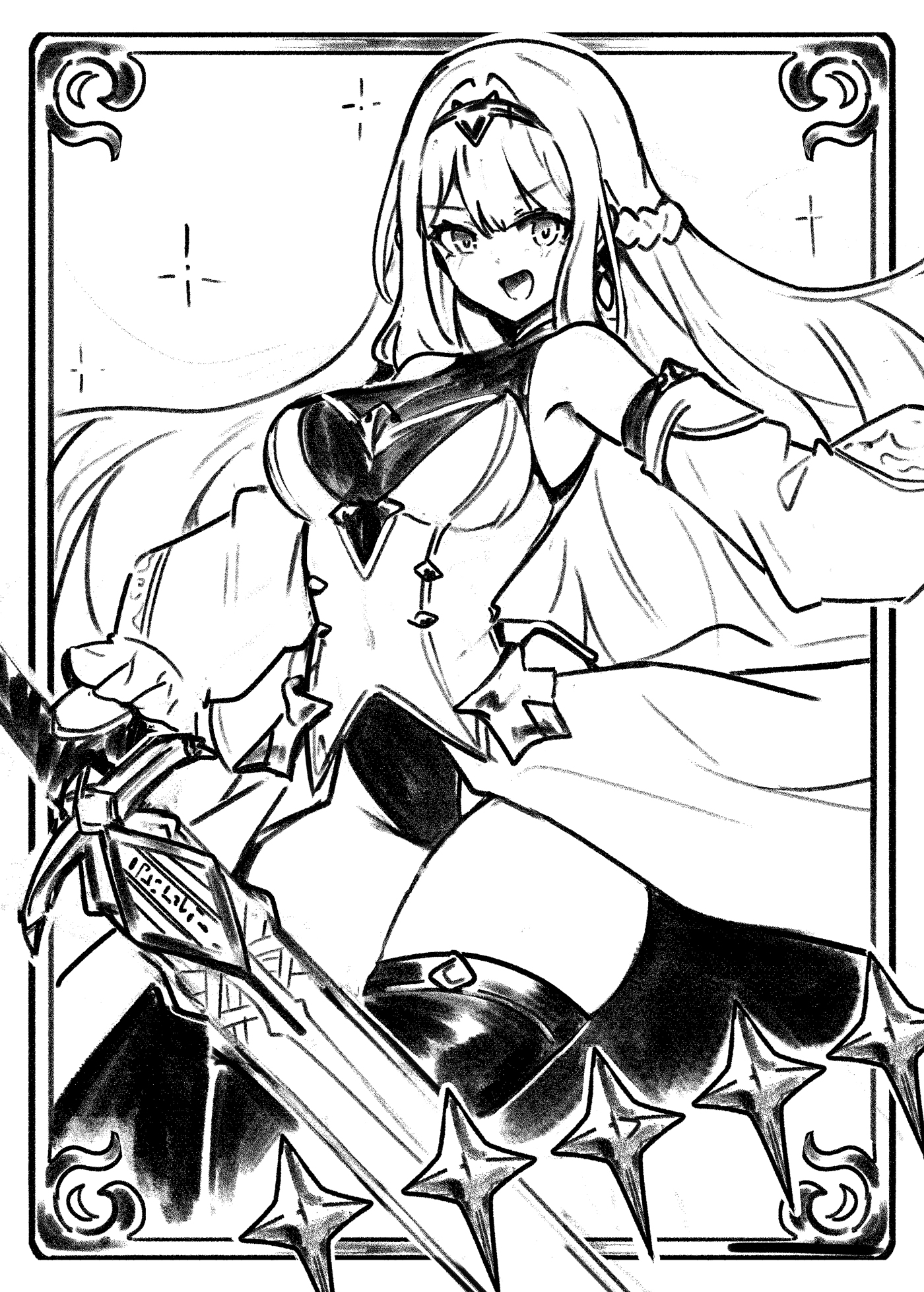
[Tips] Schutzwolfe was Goldilocks Erich’s sword. Despite the many feats he achieved, it was an ordinary sword without enchantments, lending it a higher value. Goldilocks’s descendants had fought for the glory of owning it, and so, following Erich’s own will, it was taken into Count Ubiorum’s care. It is donated to exhibitions when she remembers to bother.
In the realm of fiction, Schutzwolfe receives many embellishments. One particularly popular feature among these is a special move where she can shoot out a huge beam of light.
“Oh, wow, what a sneeze...” I muttered to myself.
I had been unable to suppress a huge sneeze and wiped my nose from atop my perch on the barrel I was sitting on. That was bad; I didn’t ever let stuff like this happen. Talk about embarrassing. If Lady Agrippina found out, I wouldn’t get off lightly.
“Leader? Are you okay?” a young man said to me, having dashed over in evident concern.
“Yeah... Yeah, I’m fine,” I said, waving my hand to let him know I was okay. “Return to your position.”
He was a beautiful young lad, if I said so myself. As a psyche, he was covered in fine fur, but unlike his mother’s, his was slightly golden in color. The wings on his back glittered as if the sunlight shone through them. He had slender, well-proportioned limbs and was taller than me.
“Sorry for keeping you. Shall we begin?” I said.
The lad—Soult of Mottenheim—picked up his usual wooden sword, shaped like a rapier, and held it elegantly.
“Heh, you’ve gotten older, Goldilocks. If you just sit around staring into space like an old fool, your body’s gonna rust over real quick,” said a huge swordsman, punctuating his remark with a rough guffaw. He was around 190 centimeters tall, a height that mensch rarely reached, and had a sword so huge it looked as if it’d been meant for someone of totally inhuman stature hoisted onto his shoulder. I felt bad for Soult saying so, but he cut a far more imposing figure, as martial types go. If I’d taken bets, I was sure most rookies would have put their money on him.
“Mocking our leader before the match begins? Someone’s got an awfully loud mouth and a bad attitude to match. I’m looking forward to seeing what you’ll be spouting on the walk home,” Soult said.
“Hah! When I head home it’ll be with the Fellowship’s glory in hand! And I’ll be talking shit about you for all to hear the whole way back!”
The only way I could describe what was happening was a phenomenon known in my old world as “dojo arashi.” Basically, it was where some brute would barge into a dojo and demand a fight. If they were refused they’d be rude and steal money, and if they won, they’d claim something as theirs. But seriously? The Fellowship was a clan of adventurers, not a dojo. However, some people had been going over the top and lauding me as the best swordsman in the western reaches, supposedly a master without peer, so this was all pretty routine by now. How many did today make this month alone? Last week there were two nobles, the week before that I had the head of some clan... Ugh, I didn’t really care. It was such a drag that I couldn’t even pin a number to it.
The guy did have a point in one respect, I’ll concede. I was pushing forty, and for a mensch, forty was the prime of your life.
“All right, begin when I give the signal,” I said. “Both of you, take your positions.”
Age wasn’t just a number. I was mature enough not to get angry at some young upstart with no respect for his elders. I gave my signal with a calm voice, and from in between my Fellows, who watched the intruder with restrained bloodlust, I opened up my arms. I wasn’t all too angry, but Soult over there was—I didn’t know who he took after in this respect. While he had fine enough features that noble girls went gaga over him, I couldn’t take my eyes off him too much with his short fuse. Anyway, whatever would be would be. I clapped my hands together and gave the signal to begin.
“Hmph!”
It was as if a beam of golden light shot through the air. A single flick of his wings erased all his weight and led him into a dashing strike. Here were the fruits of the blood he’d shed from all his training; he moved so quickly that he’d left his opponent no time to react.
“Whoa?!”
The huge man stumbled backward by instinct, but that had been his failing. If he had wanted to make some distance, he should have dodged to the side. Against an enemy with thrusting jabs, moving back saved you only for a moment, as your foe just had to step once more before their attack.
Soult’s wooden sword seemed more flexible than was possible. It groaned with the might of the thrust. He was talented enough to keep it from snapping, but it was very close to cracking.
“Ngh! Dammit!”
Rapiers had been mocked as toys for duels, but the large mensch was clearly sweating under the pressure the weapon created. However, Soult’s opponent’s next step wasn’t so foolish. He hopped to the left and brought his heavy sword down to try and intercept Soult’s blow.
Now then, nameless challenger—wait, did you name yourself?—you underestimate the boy. Soult wasn’t actually going for a second strike. With one arm tucked close to his neck, he hadn’t been going all out with these moves that required a combination of a flexible body and quick steps. In order to show that, he fluttered his psyche wings to avoid the sword strike by a hair’s breadth.
“Tch... I told him not to play around...” I muttered.
“Now, now,” my wife said, trying to placate me.
However, I just couldn’t accept how Soult was doing things. He clearly had the upper hand, so why did he wait until the last moment before dodging? If he wanted, he could have dodged it in two or three steps or easily countered it, so why dodge like that right at the last second? What would he do if his opponent was hiding their full potential? A wooden sword could kill you if it hit hard enough. He was so focused on protecting the name of the Fellowship that he wanted to show off the extent of his skill. I wondered if he was playing around in full awareness of the weight of a match to the death.
Soult’s hands were sweaty, enough that a single slip could spell his doom, but you couldn’t tell from the grace of his movements. He raised his sword once more and laughed.
“What’s wrong?” he said. “Out of breath after two clashes?”
“Shut it!”
What followed next was similar to what came before—the mensch attacked the psyche, only for him to dodge clear; the psyche attacked, and the mensch darted away as if he’d stepped in embers.
“Ugh... He’s just playing around,” I said.
“Dear...”
“I know, I know...”
With my wife’s firm remark, I decided to watch in silence. Ordinarily I would be berating Soult right now. I’d told him countless times that a challenger needed to be polite. I’d never taught him to show off or toy with his prey.
“Raaah! Haaah!”
The mensch challenger shouted as he swung and closed the gap, but his sword never slipped past Soult’s nimble evasions. Then, as if making a point, Soult leaped in time with a huge swing. As if he were a dragonfly cutting through the air, he soared above the mensch and landed behind him.
After ten minutes, this cat and mouse performance was getting dull, so I rapped my hands together.
“Ugh... Enough.”
My voice rang out through the hall’s inner courtyard and the mensch made one last mighty swing, but Soult easily dipped out of range. He walked away from the mensch—who was still raring to fight—and bowed at me, his sword hilt held to his forehead.
“Why did you stop the match?! I was—” the mensch roared.
“Roll up those sleeves,” I cut him off.
The mensch, covered in sweat and a little confused at my request, did as I asked, but as soon as he saw his arms his eyes went as wide as dinnerplates.
“Wh-What’s this?!”
His arms were covered in welts. I doubted it was just his arms either. Even from this distance, I could see six welts on his neck too—his chest and stomach likely hadn’t gotten off scot-free either. Each of these had been inflicted when Soult had merely “stroked” him with his rapier as they traded blows. If this was a proper match, then each of these marked a possible death.
“You lost the match,” I said. “All of these hits were in fatal locations. You would’ve been killed on the spot.”
A rapier was a difficult weapon to master and many viewed it as a mere decoration, unfitting for the battlefield. However, it was peerless when it came to piercing strikes. People might be inclined to mock a sword that had been fixed up more to look good on a noble’s waist than to pierce through armor, but it was good at what it did. There were countless holes in armor that could be exploited to kill. It was ridiculous to look down upon a weapon that crystallized this weakness. Although the undead could come back after receiving a critical hit, in a bout with a mortal, you could easily get them to raise the white flag. In this ten or so minutes of battle, this mensch had been killed almost fifty times—he had lost.
“The winner is clear. The match is over,” I said.
“B-But I...” he said.
“It’s a disgrace to not know when you’ve just been disgraced. Enough of this. Leave.”
I sat back down on the chair that’d been provided for me to watch over this performance and clapped my hands, signaling an end to this farce. Come on, guys, I thought as I looked at my Fellows, you shouldn’t be wasting time getting riled up. You have lots to do, so get back to it.
“And you, Soult,” I said.
“Yes?”
“Meet me in my room later,” I said coldly.
The young psyche’s face froze in terror. It seemed he had finally cottoned on to how I felt.
“U-Understood, Leader.”
“And make sure to tidy things up.”
“Of course.”
As Soult bowed to me, I put the courtyard behind me and headed back to my room. I understood wanting to show off how much he had improved, but I wished he could put his energies into giving me some damn grandkids...
[Tips] Although people confident in their strength usually bust into dojos to prove themselves, this does happen with adventurers’ clans too from time to time. Clans and dojos are alike in that those who enter their service prove themselves through their might and pride themselves on it. One’s reputation plays a large role in both organizations.
“Now then,” I said.
I ignored Soult, who was looking terribly put out, long enough to pack some revitalizing herbs into my pipe. I’d pushed my body quite a bit in my younger days, and now with my forties approaching, my knees were beginning to hurt. My sword skills hadn’t dulled, but at this time of year with winter on its way, my joints did start to twinge. I would rather not get older if I could. I’d outlived my previous life, but no amount of training could stop the eventual aches and pains that an aging body developed.
“I’m sorry, Leader,” Soult said.
“As long as you understand why I’m upset, then that’s fine. Anyway, it’s just the two of us here. You can call me Father.”
“Yes, Father.”
As you may have guessed, reader, this golden-haired psyche was in fact my son. His mother was Firene, and I had been truly surprised that, considering the timing of his birth, she had gotten pregnant from one roll in the hay.
Putting that aside, Soult had been sent to the Fellowship as an apprentice to train up. Mister Giesebrecht had been unsure whether to get him to stay in Mottenheim or to let him see the wider world. Having been raised with love by the whole of Mottenheim, he was less my child and more the canton’s beloved son. I was happy about that, but Mister Giesebrecht had sent me a letter a few years ago explaining that, now that Soult was almost of age, he was unsure what he should do with him. He said the boy was quick-witted, gentle, charming—I was amazed at how much praise he heaped on his grandson—and wondered whether it would be a waste to leave him within the canton’s confines.
After much consideration, he decided to send the fifteen-year-old boy to the Fellowship so that he could broaden his potential. Mister Giesebrecht had initially thought that he could send him to work for a noble or to take on the Watch (which had become quite impressive), but Miss Firene had put a stop to this. As she could only remain in Mottenheim and wait for her husband to visit, she had reasoned that as Soult had hardly known his real father, he should spend time with him to help him discover what he wanted for his future. Mister Giesebrecht, loving father that he was, acquiesced. Miss Firene still sent romantic poems once a season to me—it was an unsurprising decision on her part.
I did think that it was good for the boy to dedicate himself to the blade, but he had a pretentious, ostentatious side and was popular with the ladies (again, I didn’t know where he got this from...), which made him difficult to keep a handle on. He had enjoyed himself during the match today too.
“How old are you now?” I asked. “Eighteen, is that right?”
“Yes, as of this coming winter.”
The Watch had drilled the basics into him, but my son had really come a long way during these three short years. No one in the Fellowship would mock him for his weapon, and he had surpassed many of our oldest members. He was almost too much for our best to handle. I supposed you couldn’t fight your blood. It was a bit late to be wondering anything of the sort, but I couldn’t help but speculate that the skills and traits I’d honed had been passed down.
“Right, right... I had been thinking that your parries and dodges had really improved a lot, but eighteen, huh...”
“It passed by quickly in my eyes,” he replied.
That meant that I couldn’t just treat him like a mere houseguest; he needed proper work. He was an adventurer, yes, but not an occupational one like me. He wasn’t as enamored with the life as I was, so this was probably a good time to ask him what he wanted. According to Miss Firene’s letters, when he was a young boy, he’d said he wanted to become like his papa and played adventurer with the other rowdy kids of Mottenheim.
Anyway, he was the steward of his own future, so as his father I was making sure not to be too expectant or too put out.
“What happened to that guy, by the way?” I asked.
“Oh, he acceded that I won and asked to be my disciple. You were so cold to him that I felt sorry for him and tried to be nice.”
“Yet another disciple of my disciple...”
I puffed out some smoke. Soult shrank back. Seeing him like this, he looked more like Miss Firene than me.
“What’s wrong?” I asked.
“My sword isn’t your sword, Father.”
“Well, of course it isn’t.”
Psyche were one of those rare breeds that trended even frailer than most mensch; they couldn’t wear heavy armor. That meant that Hybrid Sword Arts, which used grapples and throws, was not really best suited to him. His weak bones would start to complain, and he would end up hurting himself instead of damaging the enemy—that was why I had decided that a lighter rapier would suit him far better.
Unfortunately, in Soult’s eyes this wasn’t the swordplay that Goldilocks Erich practiced. He probably felt like this aspect of him was a burden. It made me sad as his father that he didn’t realize that by training him personally and teaching him how to use his sword, I had passed on what I knew.
“I can’t follow in your footsteps, Father... Schutzwolfe will eventually be taken by one of my other siblings,” Soult went on.
I was surprised that this was what he was worrying about. I loved Schutzwolfe, but at the end of the day it was just a sword. Inheriting her didn’t mean you would inherit all the knowledge and skills of Goldilocks Erich too. But it was true that I had used her on a great many adventures now, and she had been sung about in many sagas. I supposed the eldest son would want to inherit such an iconic weapon.
“What do you think strength is?” I asked.
“The ability to never lose to anyone in a match, just like you.”
Despite the fact that I’d only met Soult once or twice per season when he was a young boy, he had really turned out into a bit of a daddy’s boy. I felt sorry that he was chasing a phantom of me and wouldn’t turn to look at the amazing strength he had mustered by his own merit. I sighed and decided that there was nothing to do but hand him the package that was on my display shelf. I tossed it over to him.
“What’s this?!” he said, hugely surprised to see what lay within.
Inside the bundle was a splendid rapier. Of course, it was no average sword. The blade was made from mystarille, and I’d used a College connection to inlay it with a few enchantments that would toughen it up while preserving its flexibility; they told me that it was just about indestructible by physical means. The guard and the pommel were also mystarille, engraved with fine lines. A separate suit of enchantments allowed it to be called back to the wielder’s hand.
“It’s a bit early, but it’s your eighteenth birthday present. You came of age so quickly, I had to hire the best blacksmith in Marsheim to make sure it was finished in time,” I said.
“You didn’t have to... And the best blacksmith in Marsheim?”
“This sword is for you, but I have my own reasons for giving it to you.”
This sword was a one-of-a-kind item that had been crafted, from its weight to its length, entirely for Soult. It was a specialized magic weapon that would make anyone go green with envy, so expensive that your average adventurer would never be able to afford it even if they skipped every meal.
“You might be wondering why I’m focusing on eighteen, but that age has meaning to me, so I wanted to get you something,” I said.
“I couldn’t possibly accept something like this...”
“It’s yours. I made it for you—your hand and your skills. It’s far more valuable than this old thing.”
“Oh, Father...”
As Soult took a few practice swings, I took another drag of my pipe. Come to think of it, I had developed a real soft spot for children too. Eighteen was a milestone back on Earth, but it was also how old I’d been when he was born. And here I was making a sword for him just because he’d reached that point. Mister Giesebrecht had a habit of giving tailors fancy fabric and asking them to make Soult a new wardrobe each year, but it looked like I was no longer in the position to throw stones.
“Listen to me, Soult. You need to leave a legacy with your own name. Don’t copy me and try to achieve things while staying obsessed with one old sword,” I said.
“Right!”
“By the way, that sword is as of yet unnamed.”
“Huh?”
“Give it a name that you like. The sword is designed such that when you call its name for the first time, it shall be engraved on the tang.”
Names were, from a magical perspective, a sort of handle you could put on things. The sorcerer blacksmiths had wanted to name it themselves, as they’d poured their souls into this thing, but I’d said that Soult deserved the honor. Otherwise it wouldn’t truly be his blade.
After some thought, Soult lifted the hilt up to his forehead and spoke its name.
“Wolpe. I’ll be naming this sword Wolpe,” he said.
Wolf cub, huh? I thought. “That’s quite the sentimental name.”
“It’s what I want. It’s the right name, Father,” Soult said before carefully putting his named blade onto his waist. I bet the weight felt good on his side. He flapped his wings and did a graceful twirl. “What do you think?”
“It suits you, son.”
“Thank you.”
As Soult gave me a small bow, I decided to turn to the matter at hand. I hadn’t called him here for just a lecture.
“By the by, what happened to Countess Homburg?”
“Whuh?! Wh-Where did you hear that, Father?!”
Hearing the name must have been quite the surprise—he looked like a deer in the headlights. His graceful demeanor, like a noble son, vanished in an instant.
“Hey, now. I was the one who introduced you to be the proxy for her duel. It’s no surprise that I’ve heard the stories going around in certain circles about the role you’ve played as her sword.”
“Ohh, uhh, I...!”
“That countess became a widow quite young. I know I’m in no position to talk about chastity...”
I needed to ask Soult what his motives were unless I wanted to start hearing some untoward rumors in the near future. He had some blue blood in him, being the grandson of a noble’s illegitimate child, and he also was a talented enough swordsman in the Fellowship to get men and women falling for him alike. I knew that he treated them all with decent enough care, but this kid had taken on way more lovers than I ever had.
“I’m not telling you not to play the game of love, but choose your work with care,” I went on. “If you let things go as they are, people will think you’re a full-time proxy, not a Fellow.”
“Y-You’re not wrong that people do think that, but...”
“I want to do what I can so that you can achieve whatever it is you want to do, but if you end up on a one-track road to a future you don’t want because of your own mistakes, I’m not so softhearted that I’ll wipe your ass for you, okay? I want you to understand this.”
As I earnestly scolded him, he merely sulked, the excitement after receiving Wolpe draining from him by the second. I knew that wandering eyes could invite struggle, hence the lecture, but I needed him to know that making a habit of this sort of thing could alter the direction of his life, and not necessarily toward ends he would like.
Before long, there were three knocks at the door. It wasn’t locked, so it opened, and in came some bouncing children.
“Papa!”
“Paaapa!”
“Dear Papa!”
The eldest was eleven and the youngest was five. Soult and I received each of them, and I scolded my eldest daughter.
“Now, Ursula,” I said. “There’s no point knocking if you just come barging in.”
“But Mother Margit said that you were bullying Brother Soult, Papa!”
There was one child who was especially clingy. She had dark skin, white hair, and red eyes; there was no mistaking who this was. Ursula had played one of her tricks and been reborn as one of my children—the full changeling whammy. I had realized the first time I picked her up as a baby. There was no forgetting that color scheme. I hadn’t heard from her in a while and thought maybe she’d gotten bored of me, so this outcome had been unexpected. I imagined that her alfish brain had thought that with so many kids to my name already, one changeling wouldn’t really make a difference.
Ursula didn’t have any memories of her former life so there was no point bringing this stuff up. I just raised her properly. Obviously I told Lottie not to get any ideas. Two changeling kids would be too much to handle. As the years passed Elisa was really getting on my case about sending her over to the College and managed to force the matter, keeping Ursula by my side until she was bigger. With my dear sister having reached professorship, she was ready to take care of Ursula, but I didn’t want to expose her to such harsh training quite yet. Thanks to that, Elisa sent me a letter each season, each one more strongly worded than the last. That wasn’t to speak of how intense it was when she came to visit.
I could understand that it was a necessary step in getting citizenship for a changeling, but after Elisa’s long, lonely parting of ways from her parents at age nine, I felt myself holding on just a bit longer. I had asked Lottie to help take care of her, and thanks to that, Ursula hadn’t fallen sick due to her fey heritage and hadn’t pulled any surprising tricks, but I knew at some point I’d have to send her to the College.
Thinking about it, it was strange that my other children had my recessive traits—wait, was that a no-go phrase now?—and were born with my blue eyes and blond hair. It was reassuring to think that this would compel Lottie to protect them all, but then again, I was a bit worried that they’d be snatched away by alfar. Lottie had said that she was utterly faithful, but I couldn’t keep my paternal worries from rearing their heads. I couldn’t cover every base on my own. It was impossible to earn decent money and also raise children properly.
“You came here to save poor old Soult here, huh?” I said.
“Yeah, your lectures are always so long, Papa.”
“You’re a bit too young to hear the details, but your brother has been quite naughty.”
As I sighed, my menagerie of children made merry around me, and I sat down, realizing it was no longer possible to have a serious conversation with Soult. As I did so, I saw a flickering shadow launch at me.
“Whoa! That was a surprise. Is that you, Iseult?” I said.
“Did you not realize?” Ursula said. “She was behind my back this entire time.”
Upon my lap was a beaming arachne girl. Arachne grew quickly, so she looked like she might be five or six now, but she was still only three. I was really getting rusty if I hadn’t noticed her. She was my and Margit’s first child—the youngest of my children—and it was shameful that someone so young could get the drop on me. I really didn’t like getting older.
As I listened to the excited squeals of children echo in my private chamber of the clan offices, I could only sigh and scratch my head at the incongruity of the scene.
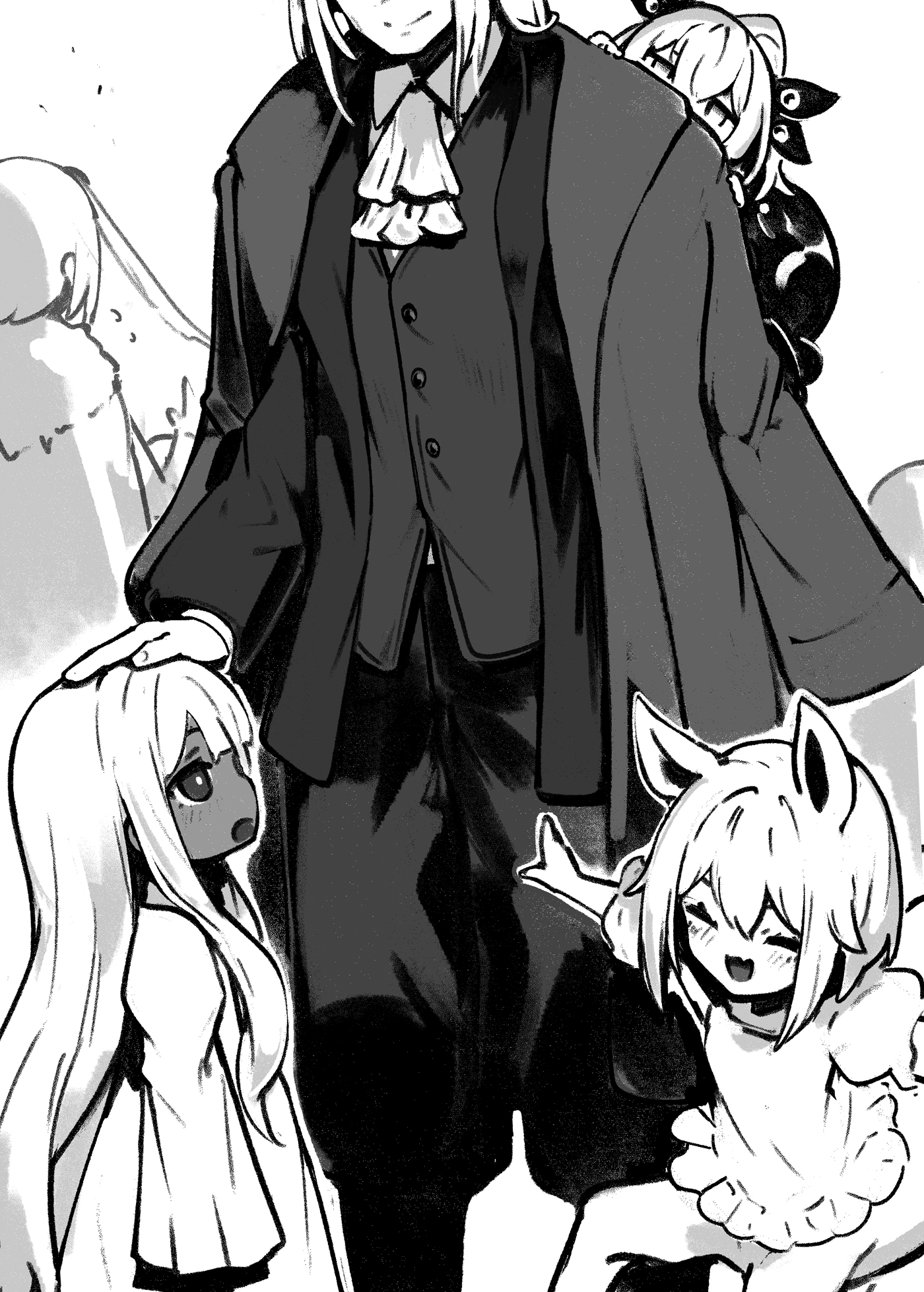
[Tips] Soult the Wolf Cub became famous in later years for his glory as a judicial champion and for his first-class swordsmanship. With his spotless win record, he was valued by nobles for his peerless skills. Thanks to his brilliant results, he received a noble rank and started a family that persists into the present day.
He was unable to inherit Schutzwolfe, but as the first son of Goldilocks Erich (who was famed for being a ladies’ man) he left his own mark on history. When his descendants squabbled over who would take Schutzwolfe, he intervened; in the end, he confiscated it and left it in Count Ubiorum’s hands. Feats like these made his name famous as part of the wolf’s bloodline.
With Iseult resting peacefully atop me after too much excitement, her body warm but cooler than other children her age, I looked out from my bed and realized that the reassuring feeling I felt with my child close to me was a sign that I’d really become a father. They were still so soft, so young; I wondered if the calm I felt having them within arm’s reach was instinct.
Just like how Soult was thinking about what to do with his life, these other kids would one day fly from the nest to start the next stage of their lives. Just thinking about it made me misty-eyed. I really didn’t like getting older.
“Is that you, Margit?” I said as I stroked Iseult’s hair as she slept. From the side of the bed came a charming face that resembled my lovely daughter’s. Margit’s hair was picking up its first gray streaks—a reminder that we were both falling into time’s clutches.
“I suppose I have to put up my scout’s cloak for good if you spotted me so easily,” she said.
Regardless of what she’d said, she’d approached me in utter silence. Margit, who was publicly my only wife, nestled herself opposite Iseult and drew my head down to meet hers.
“It’s because I’m with Iseult. I can’t help but be more on guard,” I said.
“Is that right? A huntress is second-rate if she lets her prey spot her, whether they’re on guard or not,” she said.
“We’ve just gotten older, I suppose.”
I gazed at her face, which hadn’t lost its charm over the years and stroked her hair. Despite the gray, it was as smooth as it was when she was younger. I enjoyed running my fingers through it. However, I could tell that I wasn’t in quite the state that she wanted of me.
“We haven’t left Marsheim in a while,” I said. “Why don’t we all go somewhere a bit further afield?”
“Oh? Marsheim’s top adventurer on a family outing? The rumors will start to fly.”
I felt bad for Soult and embarrassed saying this, but when I received the letter that he had been born, it was so far away that it didn’t really feel real. However, when I went to see him under the guise of work and glimpsed his little form asleep in a cot I felt a powerful urge welling up in me: I need to protect this child.
That was probably the decisive moment that changed the course of my life. I put more importance on being a father than an adventurer, and now that Ende Erde had a semblance of peace, I’d sent out my subordinates to make sure things stayed peaceful further from home, meaning that my own work had gotten a lot less busy. The only jobs I really took nowadays were the sorts of unmotivated peacekeeping jobs that would keep Marsheim safe for my children, such as protecting an important figure who definitely could not be allowed to die. I’d put my life and adventure on the scales and found that the former had won out. I’d become more cowardly since my youth, it seemed.
I couldn’t budge on my ideals. The local lords, who were fading away for good now that they were cornered, were left with only one plan to turn the tables. While it was impossible to take down the Emperor, Margrave Marsheim and his sons (who were in charge of leading battles) were very realistic targets to dispatch. The loss of even one of these people would destroy the western region’s fragile peace and plunge it into chaos.
They couldn’t die yet; I wouldn’t let them. This feeling kept me going and pushed me to grow far more cautious. I wondered what my eighteen-year-old self, who had undertaken so many deadly battles to keep Mottenheim safe, would think of my more pragmatic attitude now. I doubted he would look down on me, but he would probably be disappointed. But when I looked at my children’s faces, I knew that although I could put my life on the line, I could no longer do anything foolish.
“Three times just this month,” I said.
“Ah, yes, the last was an attempted poisoning of Margrave Marsheim, wasn’t it?” Margit replied.
“It was. I wonder where they got a poison that could remain undetected through the usual techniques. I’d bet some foreign influence is involved.”
I felt a cold rush run through me, despite the slight warmth that my daughter offered me. Our Fellows and the margrave’s own taste testers had saved Margrave Marsheim from the three attempted assassinations just this month. This time the assassins had used a really powerful poison. The fact that it had beaten not just the silver test that detected arsenic, the emerald ring test that indicated known poisons, but also the latest magic tool that the College had sent over meant that the pathogen in question had been devised by the kind of potent technologies that were really only available to a state apparatus.
The local lords had realized that a proper victory was out of the question, and so they were aiming to exploit a monarchy’s weakness; the difficulty of electing a substitute and the inflexibility of the whole process. They were desperate. If they couldn’t upturn things with political chaos, all that awaited them was the death of their lineages and a thorough routing. They couldn’t win things themselves, and so their only option was to trip up the Empire and create a chance for another nation to swoop in.
Other nations were in their own share of trouble too. Not only did the Empire have the agricultural and manufacturing power to meet domestic demand, they had glutted on the east—a veritable trove of gold and silver—to pay for their foreign spending too. There were many countries that wouldn’t want to see the Empire exert further hegemony. Even if they couldn’t topple the Empire, they could lay stones or dig holes on the path forward. The Empire employed the same methods, so it was no real surprise.
“We need to find the root of this and get rid of them. It’s clear that some intelligence agencies are at work,” I said.
“The One Cup Clan and Miss Nakeisha are working overtime without sleep, I hear.”
“Yeah. Marquis Donnersmarck is owed more than a few favors all over the region now.”
I needed to help keep the Empire aloft to protect my children, and so I’d stayed here in Marsheim making sure things didn’t go sideways. Lady Agrippina was really a slippery figure—she had drawn up plans which would allow her to benefit even if the Empire royally screwed up. I appreciated the help, but that smirk of hers suggested she was thinking of something untoward. I was sure she was thinking of using the west as a testing ground for some new kind of weapon. This would speed up her own work and allow her to pass along her dull responsibilities to her subordinates; a great result, in her eyes. I supposed I should be happy that she didn’t like to be underestimated. If not, she would have purposely screwed the pooch and accepted a demotion so she could bow out.
“Wouldn’t it be dangerous to have Soult settle quarrels as a stand-in during times like these?” Margit said.
“Countess Homburg is a supporter of Margrave Marsheim and has serious pull in Berylin. I feel confident having someone powerful by her side.”
“Now that he’s an adult, you’re making him work just like you. What a cruel papa you are,” Margit said with a chuckle.
I stroked her head and told her that she was the one who set up the whole thing in the first place, who had set it all in motion. If I’d made different choices, I imagined things would be greatly different right now. In all honesty, I didn’t know if that would have led things toward a positive direction for me or for the Empire.
“That boy needs to learn what a bit of hard work is. When we were his age, we had our own share of hardships, didn’t we?”
“Be that as it may, you’re sending him somewhere quite frightening.”
“He took himself there, the fool. He thinks with his other head. I wonder where he gets it from...”
Margit laughed again and I stroked her lips with a finger. I didn’t think it was that funny.
“If we’re going on an excursion, we’ll need to bring some ground bait.”
“Agreed. There are loads of people baying for my blood, so we need to do some work to reduce the load for our spies.”
It wouldn’t be funny if they were too exhausted to protect the margrave from another poisoning.
“This isn’t my style, but we can stretch it out for a few days. We can leave the kids with someone on the way and do a little hunting excursion, adults only.”
“We can slip out and make use of their weaknesses,” Margit said.
“And seeing as we’re going on a hunt, would you prefer for your new scarf to be made from rabbit or fox fur?” I said.
“Both would be nice,” my greedy wife said as she buried her face in my neck.
It sure was something, being the chief breadwinner.
“We can leave things in Siegfried’s hands while we’re away and make sure Kaya continues her medical treatment of Nanna,” I went on.
There was so much to do. Ende Erde still wasn’t a salubrious place. Not only that, the head of the Baldur Clan, Nanna, had finally started to see the results of her years of self-neglect and the side effects of her new creations; she’d collapsed recently. In doing so she’d thrown the underworld into a bit of a tizzy. She was on death’s doorstep, but we needed to drag her soul back so she could help bring peace to Marsheim. Kaya had vowed to make sure Nanna survived. We still needed to buy a whole bunch of high-quality medical ingredients. It was an ordeal just keeping everything that needed to be done in mind.
“And then, and then...” I muttered.
“You should rest.”
“You think...?”
I enjoyed Margit’s and Iseult’s warmth as I looked past the curtains of my bed. Soon a drowsiness came for me. Before I knew what was going on, the curtains were drawn—enchanted to block out the noise from outside—and my sheets were pulled over me.
“Yeah... Maybe you’re right...”
“I am. So let’s all sleep together. It’s been a while.”
“All right...”
Margit... My beloved partner. Is this how your favorite prey sleeps? Or are you disappointed in what I’ve become? As she gave me a smile that was the same as it had ever been, I couldn’t find an answer. All I could tell was that the warmth of them felt nice. It drew me into the first deep sleep I’d experienced in a long while.
[Tips] Wolf Pack Erich came to be known by this teasing epithet due to his popularity with the ladies and the deeds of his many talented children on his behalf across the known world. The fact that he lived his life without specifying which of his lines was his “true” lineage spoke of the love he held for each of his children.
Afterword
Afterword
With each coming spring, I remember my grandmother. I miss you. To my paternal grandmother, who always coddled me, and my maternal grandfather, without whom the house is a lot quieter—I hope you two are also doing well in the afterlife.
I’d like to thank my editor for always sticking with me despite the rushed work after I collapsed after getting sick and when I got the flu. Thank you to Lansane for making Firene—a character I designed because I wanted to see her in drawn form—look so cute. And a deep thank you to Uchida Temo for bringing the world to life as a manga—not just for the readers, but for me as well. Finally, thank you to my friends who share the table with me.
How many Western-style afterwords does this make now? Lessee, we are on Canto I of volume 11, and there have been two two-part volumes in the past too, so... Actually, never mind. It’s a lot, and I’m truly happy to have reached this stage! Unlike the previous volume, we were able to have a little bit of leeway before publication, so I’m happy to write to you all here.
I didn’t do the kind of ridiculous stuff I did in the past like extending my deadline twice, so we’re all in the clear. A real improvement compared to the terrible time before.
Now then, we’re in the next big stage after passing volume 10 and, yup, we’re in another double volume situation. Sorry. But if I’d forced all of this into one volume it would’ve been ridiculous, so that’s why it ended up this way. Of course, I don’t have the sort of influence to ask for everything to be compiled into a single volume resulting in a book that’s almost a perfect cube, so we settled on this format.
One of my life goals is to publish a book as thick as the ones Mr. Kawakami, whom I admire a lot, writes—but I don’t have enough Super Hero Points or CP, so I’ll have to put that on hold. I’ll make sure to keep my desire to get OVERLAP Inc. to publish a book that will break the Japanese printing press secret for now so that I don’t ruin my Bonds.
Despite that, this volume ended up really long, and it’s looking like Canto II will be too. What do I do? This is the part of the story where back in the web novel version, I’d received comments that it was too long, too boring, and too hard to read, so I’d worked really hard fixing things up for the novel publication. I’m a bit worried about what’s coming next. I suppose it’s an author’s job to find a good balance, so I’ll do my best.
As expected, I’m not all that interesting and haven’t lived an interesting life to have any fun anecdotes, but I’ve got three pages this time, so I’ll fill the space with some tedious sentences!
Of course we have to talk about Firene. Unlike our previous heroines, she’s not an excessively idiosyncratic character, the sort of country girl that has feelings for traditional heroes. During the design process, I asked Lansane to design someone that could ensnare any virgin, and indeed, I got a young lady who could steal the heart of any young man in the canton. It really pumped me up to see.
Personally, silk moths come second to jumping spiders in my list of favorite insects, so I’m beyond happy to have a character based around this insect. That sweet but evanescent way of living really messes with me...
I’m also pleased to announce my TRPG sessions are still in great health. Right now, we’re having fun playing as ninjas and Overeds. My fellow tablemates now include writers—my seniors, cohorts, and juniors—and artists too. I’m enjoying my days so much that my friends from my old haunt are probably staring daggers at me and wishing for my death out of jealousy. The battles are so intense that I wonder if one day I might run afoul of an “accident.” And, guess what, I get to enjoy two sessions a week! Mwa ha ha ha!
I’ll leave the bragging there. It is time for my dear friends who have joined me at the table for this issue, my readers, to get your record sheets signed. Don’t forget to bring them to the next session too!
[Tips] The author uploads side stories and world-building details to @Schuld3157 on Twitter (which he refuses to call by the pretentious name “X”) as “extra replays” and “rulebook fragments.”
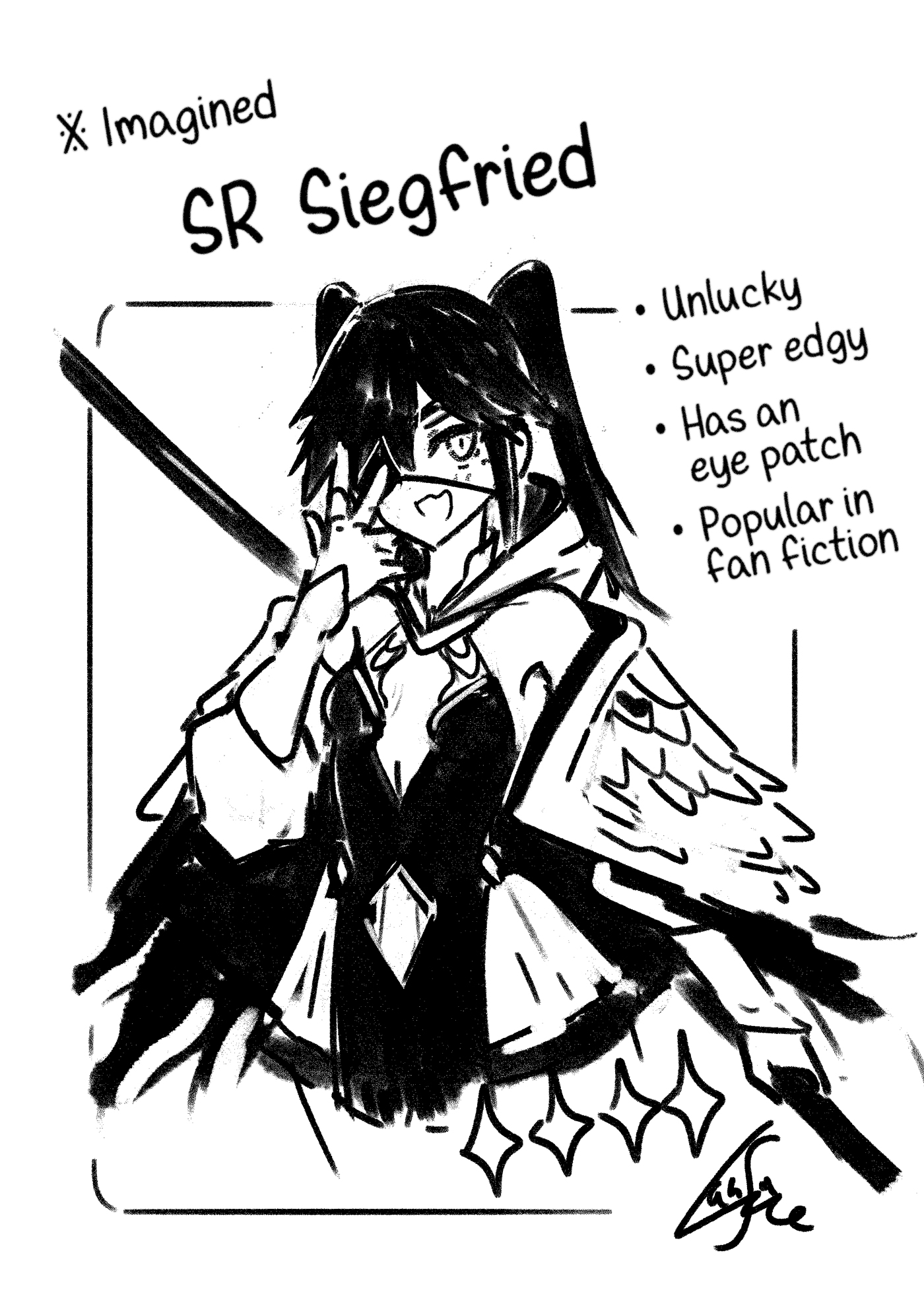
Color Illustrations
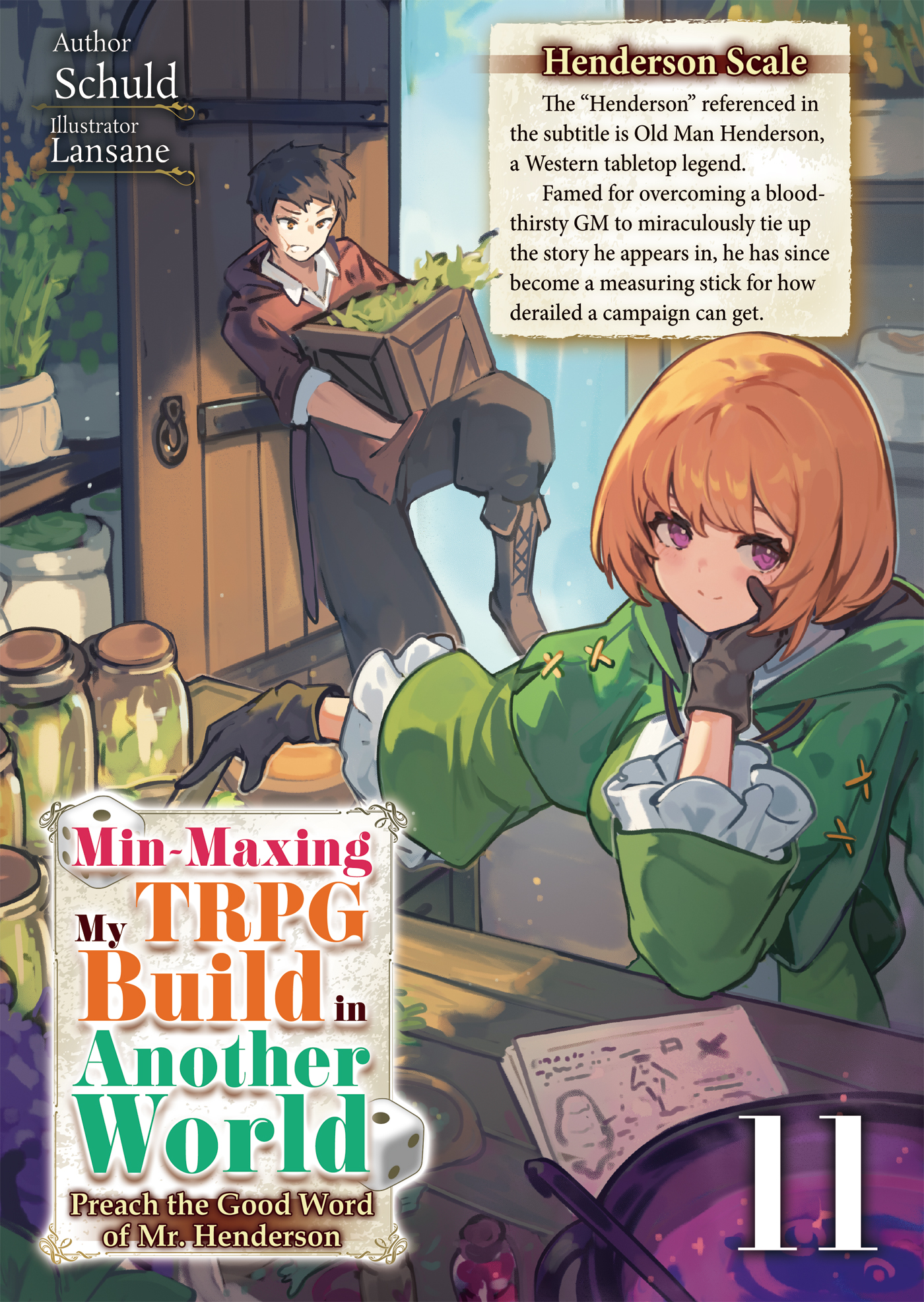
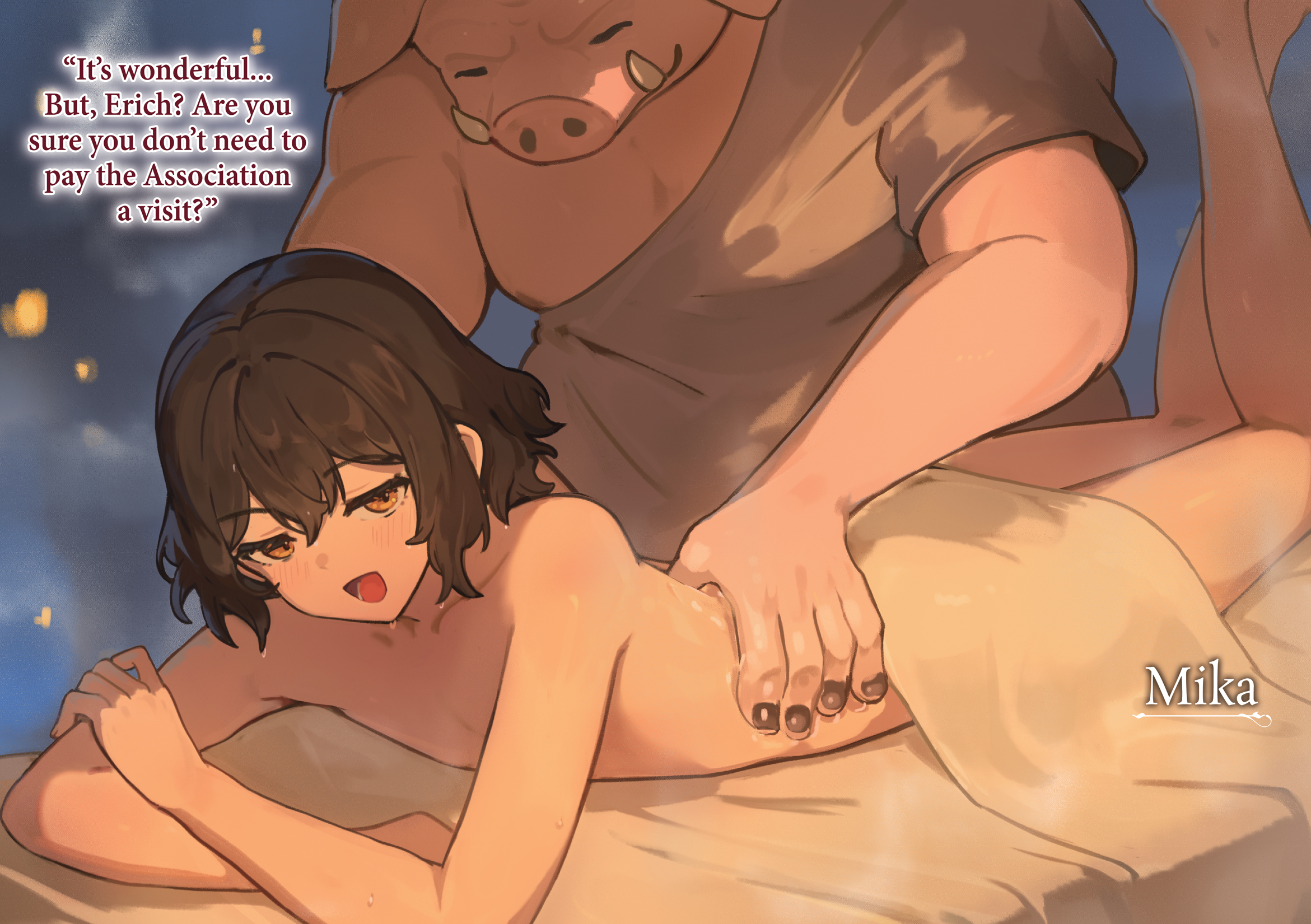
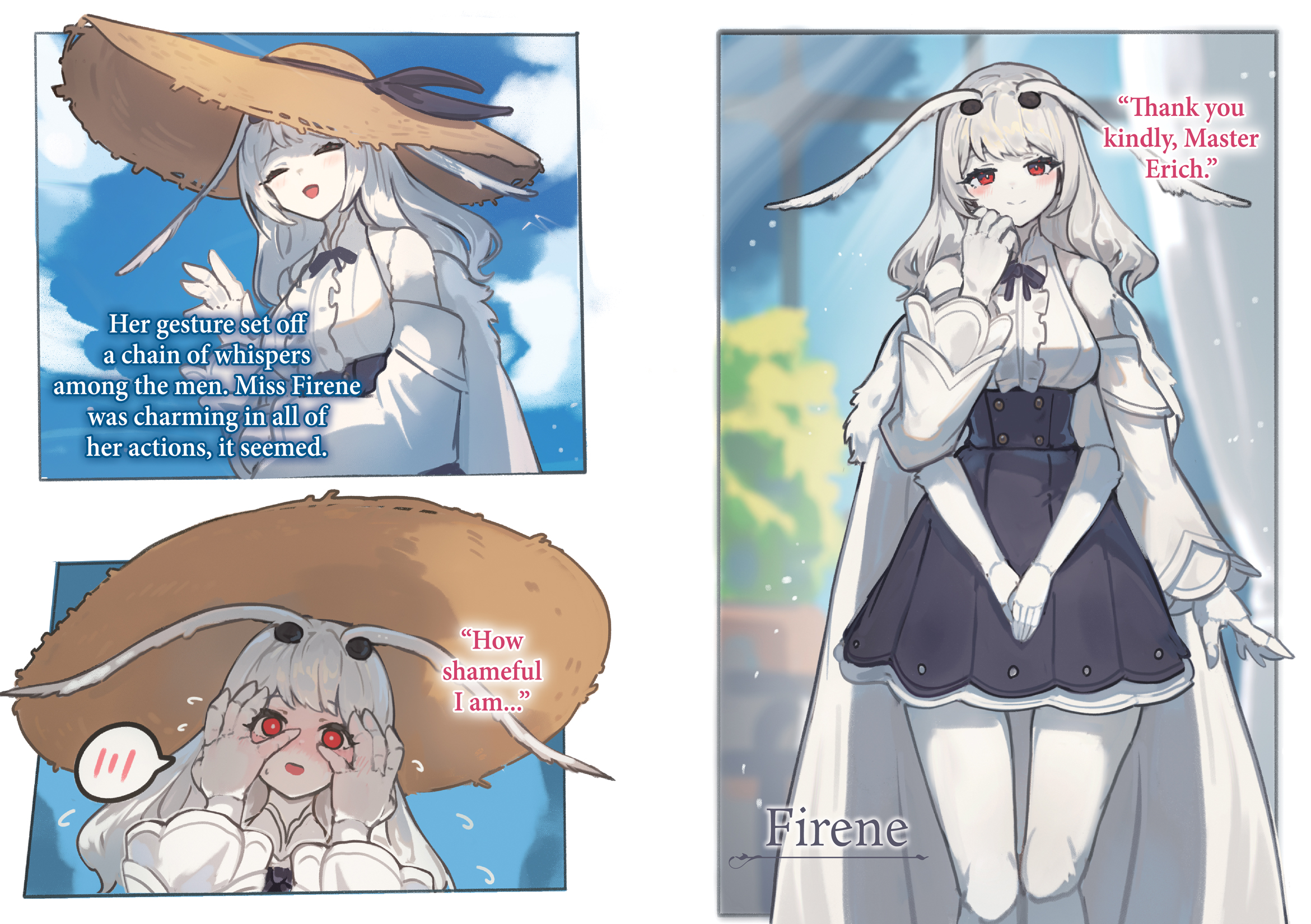
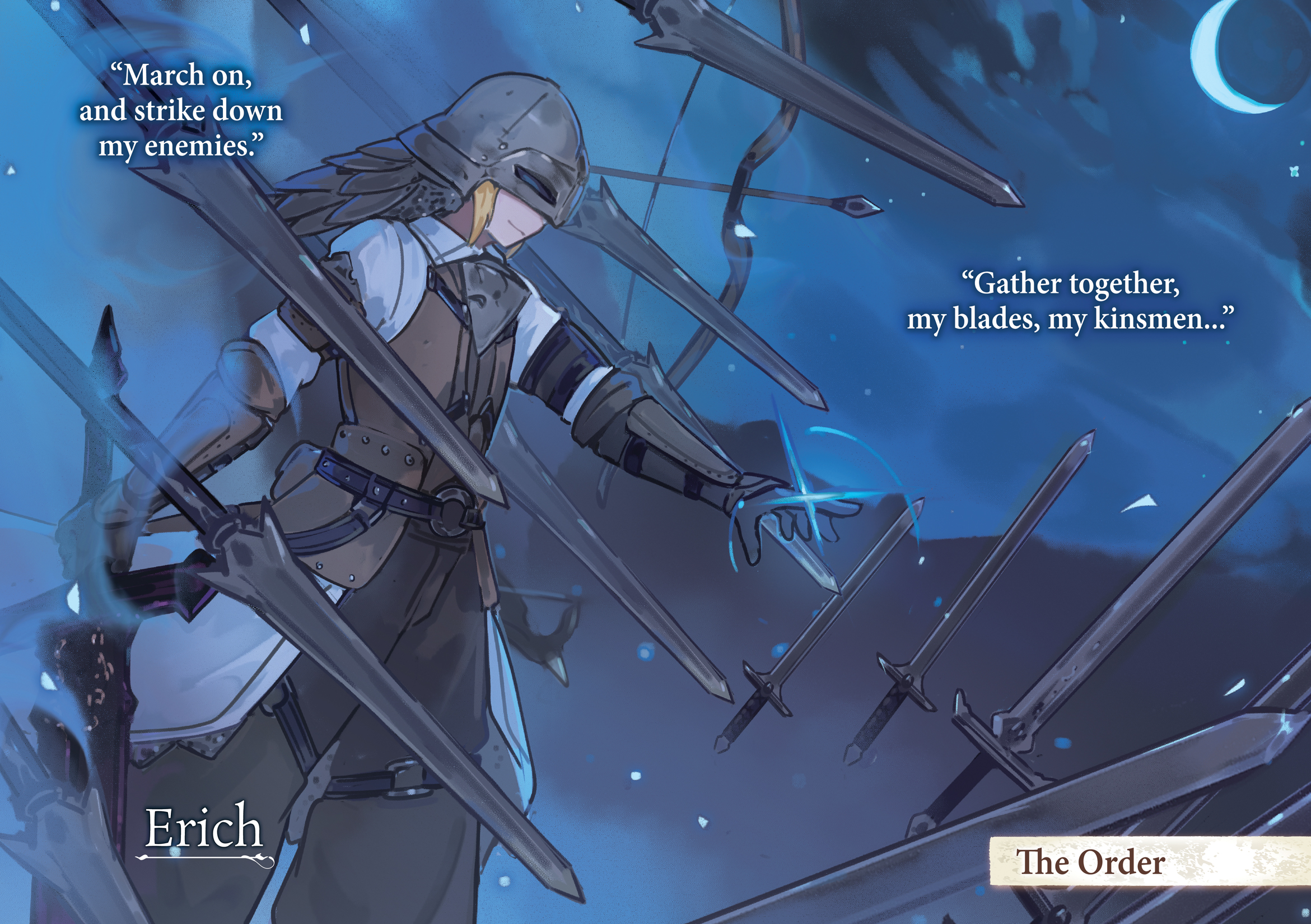
Character Stats
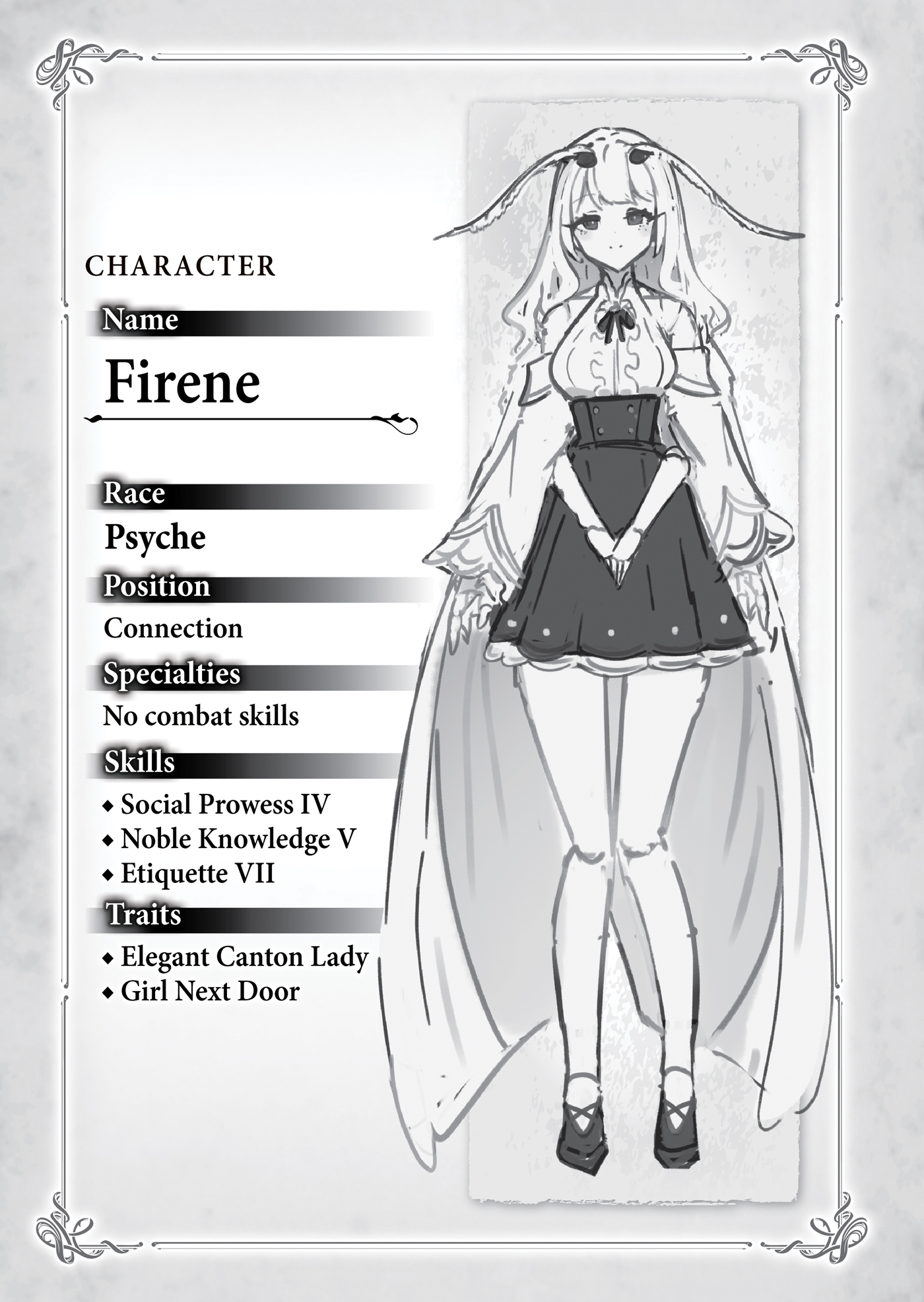
Bonus Textless Illustrations